Offline America: Pew’s latest research shows that 15% of American adults don’t use the Internet at all.

Internet usageFor those of us who spend practically every living minute of our day online, it seems almost unbelievable that there are actually some people in the United States who simply never go online.

The Pew Research Center has been researching this question for the past 15 years. And today, the percentage of “offline American adults” (people age 18 or over who don’t use the Internet) remains stuck at around 15% — a figure that has been stubbornly consistent for the past three years or so:

Pew Research Center Americans Not Online 2000-2015 survey results

But up until then, the percentage had been declining, as can be seen in these milestone Pew survey years:

  • 2000: ~48% of American adults not using the Internet
  • 2005: ~32% not using
  • 2010: ~24% not using
  • 2015: ~15% not using

Part of the long-term shift has been new people interfacing with the Internet.  But another factor is simply the “aging out” of older populations as they pass from the scene.

The demographic dynamics Pew finds on Internet usage show relatively little difference in behavior based on ethnicity — except that only about 5% of Asian-Americans never go online.

Rather, it’s differences in age particularly — but also in income levels and education levels — that are more telling.

offline AmericansThe age breakdown is stark, and shows that at some point, we are bound to have near-total adoption of the Internet:

  • Age 18-29: ~3% don’t use the Internet
  • Age 30-49: ~6% don’t use
  • Age 50-64: ~19% don’t use
  • Age 65+: ~39% don’t use

Income levels are also a determining factor when it comes to Internet usage:

  • Less than $30,000 annual household income: ~25% don’t use the Internet
  • 30,000 – 50,000 annual HH income: ~14% don’t use
  • $50,000 – $75,000 annual HH income: ~5% don’t use
  • Over $75,000 annual HH income: ~3% don’t use

And Pew also finds significant differences based on the amount of formal education:

  • Some high-school level education: ~33% don’t use the Internet
  • High school degree: ~23% don’t use
  • Some college: ~9% don’t use
  • College graduate or post-graduate education: ~4% don’t use

Lastly, while no difference in Internet usage has been found between urban and suburban Americans, the adoption rate in rural areas continues to lag behind:

  • Urban dwellers: ~13% don’t use the Internet
  • Suburban residents: ~13% don’t use
  • Rural areas: ~24% don’t use

One reason for the lower adoption rate in rural areas may be limited Internet access or connectivity problems — although these weren’t one of the key reasons cited by respondents as to why they don’t go online. Pew’s research has found these points raised most often:

  • Have no interest in using the Internet / lack of relevance to daily life: ~34%
  • The Internet is too difficult to use: ~32%
  • The expense of Internet service and/or owning a computer: ~19%

The results of Pew’s latest survey, which queried ~5,000 American adults, can be viewed here. Since the research is conducted annually, it will be interesting to see if Internet usage resumes its drive towards full adoption, or if the ~85% adoption rate continues to be a “ceiling” for the foreseeable future.
State of the States: CNBC’s take on the best ones for business.

In CNBC’s recently published scorecard, don’t look to the Northeast or California to find the states that are best ones for business.

CNBC State Rankings for Business
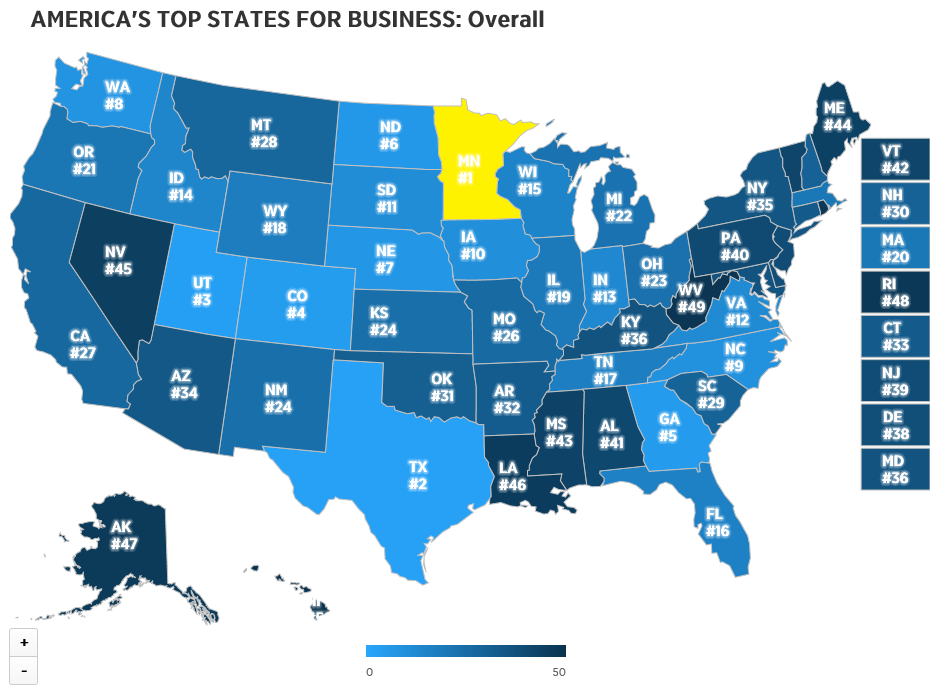
L’Etoile du nord: Just as in its state motto “Star of the North,” Minnesota is the stellar performer in CNBC’s 2015 state ranking of business competitiveness. (Click on the map for a larger view.)

State and city rankings are a source of fascination for many people. Of course, there are many ways to fashion them to place nearly any state or city you like at the top of the heap.  Some of the lists use criteria that are so convoluted, it stretches credulity.

Since when is Baltimore the best city in America for single men?  Since it was ranked #1 in this evaluation, evidently.  Many of us who know the city’s innards really well would disagree heartily, of course.

But I think the CNBC 2015 scorecard on state business climates, published earlier this month, is based on a more solid set of criteria.

CNBC created it by scoring all 50 states on approximately 60 separate measures of competitiveness – a list that was developed with input from an array of business and policy experts, official government sources, and CNBC’s own Global CFO Council, and that uses government-generated data.

CNBC then grouped these measures into ten broader categories, weighting the results based on how often each is used as “selling point” in state economic development marketing and promotional efforts. This was done in order to rank the states based on the criteria they themselves use to showcase their attractiveness to businesses considering expansion or relocation.

Here are the ten broad categories in the CNBC evaluation, and which states ranked first and last within them:

  • Access to capital: #1 North Carolina … #50 Wyoming
  • Business friendliness: #1 North Dakota … #50 California
  • Cost of doing business: #1 Indiana … #50 Hawaii
  • Cost of living: #1 Mississippi … #50 Hawaii
  • Economy: #1 Utah … #50 Mississippi
  • Education: #1 Massachusetts … #50 Nevada
  • Infrastructure: #1 Texas … #50 Rhode Island
  • Quality of life: #1 Hawaii … #50 Tennessee
  • Technology/innovation: #1 Washington … #50 West Virginia
  • Workforce: #1 North Dakota … #50 Maine

Do we see any surprises here?  To my mind, the high and low rankings look pretty well-aligned with the anecdotal information we hear all the time.

Perhaps we might consider several other states besides Nevada to be “bottoms” in education. And personally, I am pretty shocked to see Tennessee ranked last in quality of life. Having lived there during my college years at Vanderbilt University, I never considered the state to be substandard when it came to that attribute.

But It’s when CNBC amalgamates all of the rankings to come up with its overall state ranking that a few surprises emerge.

Such as … Minnesota notches first place overall. I’m sure some people are genuinely surprised to see that.

For the record, here is CNBC’s list of the Top 10 states for business in 2015:

  • #1 – Minnesota
  • #2 – Texas
  • #3 – Utah
  • #4 – Colorado
  • #5 – Georgia
  • #6 – North Dakota
  • #7 – Nebraska
  • #8 – Washington
  • #9 – North Carolina
  • #10 – Iowa

We see that four of the ten top states are in the Midwest … three are in the South … three are in the West … but none are in the Northeast.

CNBC study on business competitiveness
The center holds: According to CNBC, most of the most competitive states for business are in the Mid-Continent region.

By contrast, for the most part the Bottom 10 states are clustered in other areas of the country … including four Northeastern states plus Alaska and Hawaii, two states that clearly have unique locational circumstances:

Hawaii lacks business competitiveness
Not so sunny: Hawaii’s bad business climate.
  • #40 – Pennsylvania
  • #41 – Alabama
  • #42 – Vermont
  • #43 – Mississippi
  • #44 – Maine
  • #45 – Nevada
  • #46 – Louisiana
  • #47 – Alaska
  • #48 – Rhode Island
  • #49 – West Virginia
  • #50 – Hawaii

CNBC has issued a raft of charts and maps providing details behind how their ratings were formulated, and the results for each of the major categories. You can view the data here.

Speaking for yourselves, in what ways would you challenge the rankings? What strikes you here as different from your own personal experience in doing business in various states? Please share your perspectives with other readers.

TV’s Disappearing Act

Television viewing among 18- to 24-year-olds reaches its lowest level yet. 

TV watchingThe latest figures from Nielsen are quite telling:  The decline in TV watching by younger viewers is continuing – and it’s doing so at an accelerating pace.

Looking at year-over-year numbers and taking an average of the four quarters in each year since 2011, we see that the average number of hours younger viewers (age 18-24) spend watching television has been slipping quite dramatically:

  • 2011: ~24.8 hours spent watching TV weekly
  • 2012: ~22.9 hours
  • 2013: ~22.0 hours
  • 2014: ~19.0 hours

It’s nearly a 25% decline over just four years.  More significantly, the most recent yearly decline has been at a much faster clip than Nielsen has recorded before:

  • 2011-12 change: -7.7%
  • 2012-13 change: -3.9%
  • 2013-14 change: -13.6% 

So far this year, the trend doesn’t appear to be changing.  1st quarter figures from Nielsen peg weekly TV viewing by younger viewers at approximately 18 hours.  If this level of decline continues for the balance of the year, watching TV among younger viewers will be off by an even bigger margin than last year.

There’s no question that the “great disappearing television audience” is due mainly because of the younger generation of viewers.  By contrast, people over the age of 50 surveyed by Nielsen watch an average of 47.2 hours of television per week — nearly three times higher.

picLest you think that the time saved by younger viewers is going into outdoor activities or other recreational pursuits and interests, that’s certainly not the case.  They’re spending as much time using digital devices (smartphones, tablets and/or PCs) as they are watching TV.

So, it’s a classic case of shifting within the category (media consumption), rather than moving out of it.

I don’t think very many people are surprised.

Gallup’s Payroll-to-Population Rates Pinpoint the Go-Go Metro Areas

Commuters in New York City.

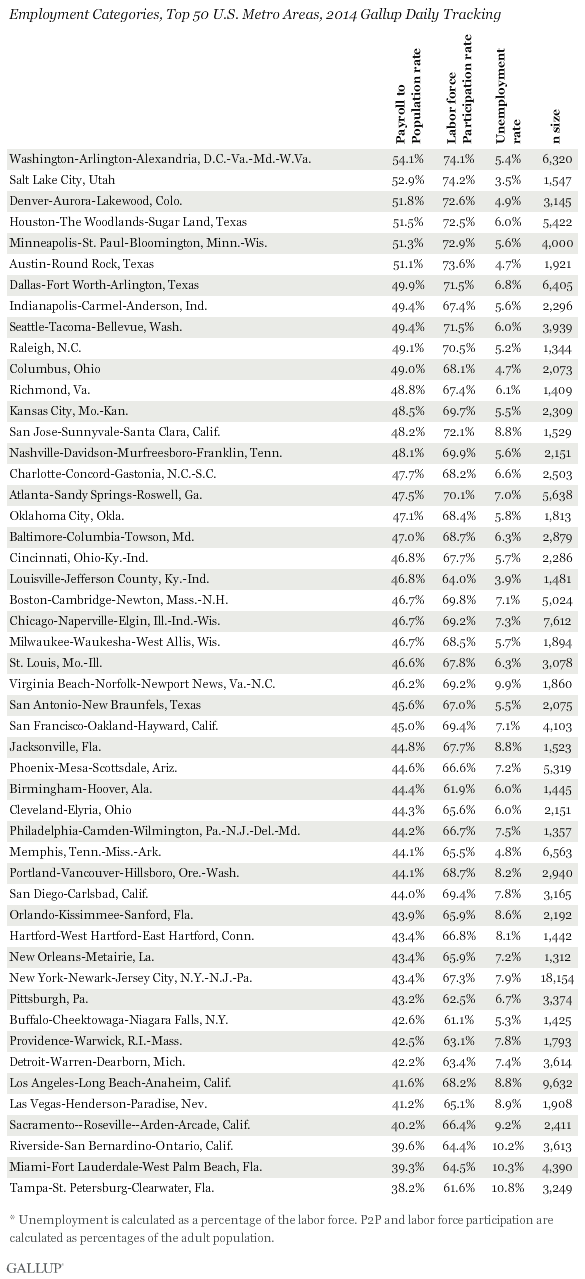
The Gallup polling organization’s P2P measurements (payroll-to-population employment rates) are an interesting metric and add an extra dimension of understanding as to what’s happening with employment across the United States.

Gallup’s evaluation is limited to the top 50 most populous SMSAs (metropolitan statistical areas).  But because of the large number of phone interviews conducted within each metro area (ranging from ~1,300 to 18000+ depending on the population), the findings are statistically significant whether looking nationally or within a particular urban area.

The latest surveys, conducted by Gallup in 2014 among nearly 355,000 households, find that two metro areas with the highest P2P measures are Washington, DC and Salt Lake City, UT — urban centers that couldn’t be more dissimilar in other ways.

For DC, the P2P rate is 54.1.  The calculation is derived from the percentage of the adult population (age 18+) who are employed full-time for an employer for at least 30 hours per week.

For Salt Lake City, the P2P rate is just slightly lower, at 52.9.

Other top scoring metro areas include three markets in Texas (Austin, Dallas-Ft. Worth and Houston).

What about metro areas at the other end of the scale?  Those would be Miami (38.2 score) and Tampa (39.3).

Three other low-scoring MSAs are located in California:  Los Angeles, Riverside and Sacramento.

What do these stats mean in a broader sense?

For one thing, there’s a direct relationship between employment stats and P2P performance:  Metro areas with the highest unemployment rates correlate to those with low P2P scores.

For instance, Miami’s unemployment rate in 2014 was 10.3%.  It was 10.2% in Riverside, CA.

That’s a big contrast with Salt Lake City, which had an unemployment rate of just 3.5%.

I find one interesting deviation from the norm:  Buffalo, NY.  There, while the unemployment rate is one of the ten lowest in the country, its labor force participation rate is also very low — bottoms among all 50 metro areas, in fact.

Shown below are the figures for all of the 50 largest U.S. metro areas based on the interviews conducted by Gallup in 2014:

Gallup full results

More details on the research findings are available here.

The needle finally moves in changing TV viewership habits.

graphDespite the many changes we’ve seen in the way people can consume media today, one thing that has remained pretty consistent has been the dynamics of TV viewership.

Things have taken so long to evolve, to some observers it’s seemed as if TV was effectively immune to all of the changes happening around it.

But now we’re finally seeing some pretty fundamental shifts happening in the way content on TV sets is consumed.  Two new surveys chart what’s changing.

A recently released report from Accenture, which surveyed nearly 25,000 online consumers during the 4th quarter of 2014, notes that viewership of long-form video content (television and movies on a TV screen) is now in decline across all demographic categories – not merely among younger viewers.

The decline amounts to ~11% over the previous year among American viewers.  It’s even bigger (a ~13% decline) when looking at worldwide figures.

Not surprisingly, the drop is less pronounced among viewers aged 55+ (for them it’s closer to a 5% reduction) than with young viewers age 14-17 (a decline in excess of 30%).  But the fact that declines are now occurring across the board is what’s noteworthy.

At the same time, the Accenture survey found that consumers who watch long-form video on connected devices rather than on TVs aren’t all that enamored with the experience:

  • About half find that watching online video isn’t a great experience because of Internet connectivity issues.
  • Approximately 40% complain of too much advertising. 
  • Around one-third encounter problems with video buffering … and an equal portion report problems with audio distortion or dropouts.

More highlights from the Accenture research are available for download here.

time-shifted TV

Another study – this one from Hub Entertainment Research – has found that viewers who have broadband and watch at least five hours of TV per week are actually watching more time-shifted TV than they are watching live broadcasts.

On average, participants in this study reported that ~47% of the TV shows they watch are live and ~53% are time-shifted.

Among younger viewers (age 16-34), time-shifted viewing is even more prevalent (around 60%).

Most time-shifted viewing is still happening through a set top box:  DVRs (~34%) and video-on-demand from a pay TV provider (~19%).

For consumers, being able to watch TV on their own schedule isn’t just more convenient; it has also made back catalogue material more accessible.

Survey respondents noted the following reasons for watching shows at a different time:

  • Can watch when it’s more convenient to do so: ~60% of respondents
  • Can see missed episodes:  ~37%
  • Can skip ads: ~37%
  • Can pause or rewind the program:  ~34%
  • It takes less time to watch the show: ~33%
  • Not available to watch the show during live airing: ~29%
  • Can watch show episodes back-to-back: ~19%

Notice that ad avoidance isn’t at the top of the list.  Nonetheless, for the industry this is a mixed bag.  Time-shifting has clearly put pressure on the business model and how the TV business traditionally makes money – namely, shows watched live, with ads.

Additional details on the Hub Entertainment Research report can be accessed here.

Is Telephone Landline Usage Doing a Disappearing Act?

phoneIt may be a surprise to some people, but we’re getting pretty close to half of all households in America that are now without any sort of telephone landline.

[Actually, it’s not quite there yet – the percentage is ~44%.  But the trend is clear, and it’s accelerating.]

The latest statistics come to us courtesy of GfK Mediamark Research.  And GfK’s consumer survey findings align with other published survey data from U.S. government sources.

Just five years ago, only about one in four American adults lived in cellphone-only households.  But since then, the cellphone-only population has jumped by ~70%.

And when we look at a breakdown by age demographics, it becomes even more obvious that we’re in the midst of a transformation.

Here are the stark figures:

  • Pre-Boomers (born before 1946): ~13% live in cellphone-only households
  • Baby Boomers (born from 1946 to 1965): ~32% live in cellphone-only HHs
  • Generation X (born from 1965 to 1976): ~45% live in cellphone-only HHs
  • Millennials (born from 1977 to 1994): ~64% live in cellphone-only HHs

Mirroring the age statistics are ownership rates for smartphones:  very high among millennials down to very low among pre-Boomers:

  • Millennials: ~88% own a smartphone
  • Generation X: ~79 own a smartphone
  • Baby Boomers: ~56 own a smartphone
  • Pre-Boomers: ~20% own a smartphone

[Additional topline findings from the GfK research can be viewed here.]

Based on the trends we’re seeing, how soon will it be that telephone landlines become a thing of the past?  I’d be interested in hearing your perspectives.

Bird dropping: Instagram overtakes Twitter in the social media derby.

Instagram logo

It seems like the jockeying for position among social networks is never-ending.

The latest case in point:  Instagram, which is presently the fastest growing social media network in the United States.

According to the latest figures released by digital market research company eMarketer, as of February 2015 Instagram now has over 64 million users in America.

That’s a ~60% increase in just one year, and it puts Instagram in third place among all social networks, surpassing Twitter for the first time.

Not only that, eMarketer forecasts that Instagram will add more than 10 million additional users in the United States this year:

  • Facebook: ~157 million U.S. users forecast in 2015
  • LinkedIn: ~115 million
  • Instagram: ~78 million
  • Twitter: ~53 million
  • Pinterest: ~47 million
  • Tumblr: ~20 million

       (Source:  eMarketer and LinkedIn, February 2015.)

eMarketer also forecasts that Twitter will continue to fall further behind Instagram in the upcoming years, since Twitter’s annual growth is expected to be in only the single digits throughout the rest of the decade.

Based on the overall American population, Instagram has now a market penetration of nearly 25%.  Of course, that’s well behind Facebook, which has nearly 50% penetration.

Untitled-1But Instagram’s user base is skewed heavily towards teens and millennials – people between the ages of 12 and 34.  This makes Instagram a bit more of a threat to LinkedIn and even Facebook than you might think at first.

Facebook’s user base has been skewing older in recent years.  If those trends continue, we could see a measurable drop-off in Facebook’s share of users, with a corresponding rise in Instagram’s penetration.

Of course, we mustn’t forget that Facebook was the social media network of choice for younger people at one time, too.  After all, it got its start on college campuses.  But now that Facebook has solid adoption among older Americans (age 40 and over), no longer does it seem like a “cool” network for some millennials and teens.

So it would be foolish to assume that Instagram is a slam-dunk to continue to be the “network of choice” for younger people in the years hence.  One never knows what new network might suddenly appear on the horizon and capture their hearts.

Still, Instagram’s rise has been noteworthy.  And it certainly puts the lie to the notion that there wasn’t room for a new network to enter the increasingly crowded social media space and make a big splash.

Personally as an “aging boomer,” I don’t have an Instagram account, and neither do most of my acquaintances.  What about your own personal experience or professional experiences with this network?

Americans Still Love Their Libraries

local libraryI’m trying to remember the last time I visited our local library in our town.  It was more than a year ago … and it was to attend a community meeting, not to check out a book or use the reference materials.

For me at least, access to the Internet at work, at home and on mobile devices has made the library pretty much irrelevant to my daily life.

It wasn’t always that way.

There was a time — not so many years ago — when I went to the library on a weekly basis.  I even traveled to other cities to do business-oriented research in larger libraries that were the designated repositories of U.S. Census Bureau, Department of Commerce and other government publications.

So based on my personal evolution, I was a bit surprised to read the results of a recent Harris Poll that surveyed ~2,300 Americans aged 18 or older on the topic of libraries and their role in people’s lives.

Harris found that ~64% of the respondents it surveyed have a library card — a statistic that is higher than I thought it would be.

[Granted, that library card figure has declined from the ~68% level that was reported by respondents in a similar survey conducted by Harris in 2008.]

The Harris research also found that women are more likely to use the local library than men.  Related to this, more than 70% of women in the survey possess a library card, compared to only ~57% of men.

Children may be a factor in how strong a relationship adults have with their local library, since adults who have children are significantly more likely to patronize the library — and more often as well.

For those who have library cards, nearly 80% reported that they’ve used the library at least once in the past year.  Indeed, more than one-third use the library on a monthly basis or more frequently.

Most library-related activity appears to be for traditional uses:

  • Borrowing books: ~56% identify as the “top reason” for going to the library
  • Borrowing DVDs/videos: ~24%
  • Consuming digital content: ~15%
  • Attending kids/community programs: ~5%

A Community and Education Resource …

library meeting roomRegardless of their own personal library usage patterns, more than nine in ten respondents in the Harris survey consider libraries to be a valuable education resource for their local community.

Nearly as many consider the library to be an important community center and meeting space.

Based on the Harris results, the role of libraries may be evolving more slowly than I would have thought.  And they still play a central role in the nourishment of their communities.

What about you?  How are you using (or not using) your local library these days?  Please share your experiences with other readers here.

Coming Up: A Labor Shortage?

The coming labor shortageIt may seem fanciful, but a new report published last week by The Conference Board concludes that the United States and other advanced economies will actually face significant labor shortages over the coming decade and a half.

This forecast has been made primarily based on the Baby Boomer workforce departing the labor market over this period.

The Baby Boomer phenomenon is what makes things different in now compared to the decades previously:  For the first time since World War II, working age populations will actually be declining in mature markets.

Conference Board logoAs Dr. Gad Levanon, director of macroeconomics at The Conference Board reported, “The global financial crisis and its aftermath – stubbornly high unemployment in many countries – have postponed the onset of this demographic transformation, but will not prevent it from taking hold.”

According to The Conference Board’s analysis, several countries have already begun to see this happen, as their natural rates of employment have now fallen below their pre-recession levels:  Japan, Germany, South Korea and Canada.

The same thing is expected to happen in the United States and the United Kingdom by 2015 … and in the Scandinavian countries, the Benelux countries plus Australia by 2016 or 2017.

Other mature economies like those of Spain, France, Portugal, Italy and Greece won’t experience this until the years further out – but The Conference Board predicts that it will happen there as well.

U.S. market sectors that are expected to experience the most severe labor shortages include healthcare occupations, STEM occupations (science, technology, engineering and mathematics), as well as skilled trades that don’t require a college degree but that do require specialist training.

Among the challenges The Conference Board envisions in these three major categories are the following:

  1. Skilled labor occupations like construction, transportation and utility plant operations are going to be adversely affected by many more retirements happening than new job seekers coming in to fill the void.
  2. STEM occupations won’t be as stressed as some might imagine, because higher productivity will alleviate the pressure on hiring more workers in IT and high-tech manufacturing segment. That being said, certain sub-segments such as information security, environmental and agricultural engineering, and applied mathematics are expected to face severe labor shortages.
  3. The numbers of new entrants in various healthcare occupations are constrained by high barriers to entry such as extensive education and experience requirements, along with accreditation requirements.

The Conference Board report has constructed a Labor Shortage Index covering 32 countries.  The index combines current labor-market tightness with future demographic trends to predict the likelihood of the different countries experiencing labor shortages.

The bottom line on the index:  with the exception of the Mediterranean countries, all of the labor markets in developed economies are expected to be squeezed pretty tightly starting within the next few years.

It’s been quite a while since we’ve been hearing about pending labor shortages … but that’s exactly what The Conference Board is predicting.  Here’s a link to more details about the report, which is appropriately titled From Not Enough Jobs to Not Enough Workers.

If you have thoughts or personal observations to share on the job markets on the domestic scene or internationally, please share them with other readers here.

The “App Gap”: Mobile Apps Overtake All Others in Digital Media Consumption

Mobile apps overtaking other digital media consumptionIt was bound to happen.

The bulk of time Americans are spending on digital media … is now happening on mobile applications.

According to data released this past week by Internet and digital analytics firm comScore, the combined time that people expend using digital media breaks down as follows:

  • Mobile apps: ~52% of all time spent online
  • Mobile web surfing: ~8%
  • Desktop: ~40%

Apps are clearly in the driver’s seat – particularly in the mobile realm.  In fact, comScore estimates that apps account for 7 out of every 8 minutes spent on mobile devices.

On smartphones, the app usage is ~88% of all time spent, whereas on tablets, it’s ~82%.

This doesn’t mean that app usage is spread evenly throughout the population of people who are online.  Far from it.  Only about one-third of people download one app per month or more.  (The average smartphone user is downloading about three apps per month.)

The inevitable conclusion:  App usage is highly concentrated among a subset of the population.

Indeed, the 7% most active smartphone owners account for almost half of all the download activity during any given month.

But even if most users aren’t downloading all that many apps … they are certainly engaged with the ones they do have on their devices:  comScore reports that nearly 60% are using apps every day.

Here again, the data show that usage levels are much higher among smartphone users than they are with tablet users (where only about one quarter of the people use apps daily).

Where they’re spending their time is also interesting.  Well over 40% of all app time spent on smartphones is with a user’s single most used app.  (Facebook takes top honors — of course.)

And if you combine social networking, games and Internet radio, you’ve pretty much covered the waterfront when it comes to app usage.

When you think about it, none of this should come as much surprise.  We’re a mobile society – hourly, daily, monthly and yearly.  It only makes sense that most online time is going to be happening when people are away from their home or their desk, now that it’s so easy to be connected so easily from even the tiniest mobile devices.

And speaking of “easy” … is it really any wonder why people would flock to apps?  It’s less hassle to open up an app for news or information rather than searching individual sites via mobile.  People simply don’t have the patience for that anymore.