Peeking behind the curtain at Google.

A recently-departed Google engineer gives us the lowdown of what’s actually been happening at his former company.

Steve Yegge, a former engineer at Google who has recently joined Grab, a fast-growing ride-hailing and logistics services firm serving customers in Southeast Asia, has just gone public with an explanation of why he decided to part ways with Google after having been with the company for more than a dozen years.

His reasons are a near-indictment of the company for losing the innovative spark that Yegge thinks was the key to Google’s success — and which now appears to be slipping away.

In a recently published blog post, Yegge lays out what he considers to be Google’s fundamental flaws today:

  • Google has gone deep into protection-and-preservation mode. “Gatekeeping and risk aversion at Google are the norm rather than the exception,” Yegge writes.
  • Google has gotten way more political than it should be as an organization. “Politics is a cumbersome process, and it slows you down and leads to execution problems,” Yegge contends.
  • Google is arrogant. “It has taken me years to understand that a company full of humble individuals can still be an arrogant company. Google has the arrogance of “we”, not the “I”.
  • Google has become competitor-focused rather than customer-focused. “Their new internal slogan — ‘Focus on the user and all else will follow’ – unfortunately, it’s just lip service,” Yegge maintains. “A slogan isn’t good enough. It takes real effort to set aside time regularly for every employee to interact with your customers. Instead, [Google] play[s] the dangerous but easier game of using competitor activity as a proxy for what customers really need.”

Yegge goes on to note that nearly all of Google’s portfolio of product launches over the past 10 years can be traced to “me-too copying” of competitor moves. He cites Google Home (Amazon Echo), Google+ (Facebook) and Google Cloud (AWS) as just three examples — none of them particularly impressive introductions on Google’s part.

Yegge sums it all up with this rather damning conclusion:

“In short, Google just isn’t a very inspiring place to work anymore. I love being fired up by my work, but Google had gradually beaten it out of me.”

Steve Yegge

It isn’t as if the company’s considerable positive attributes aren’t acknowledged – Yegge still views Google as “one of the very best places to work on Earth.”

It’s just that for creative engineers like him, the spark is no longer there.

Where have we seen these dynamics at play before? Microsoft and Yahoo come to mind.

These days, Facebook might be trending in that direction too, a bit.

It seems as though issues of “invincibility” have a tendency to creep in and color how companies view their place in the world, which can eventually lead to complacency and a loss of touch with customers. Ineffective company strategies follow.

That’s a progression every company should try mightily to avoid.

What are your thoughts on Steve Yegge’s characterization of Google? Is he on point?  Or way wide of the mark?  Please share your perspectives with other readers here.

The vacations that aren’t: The myth of “getting away from it all.”

Even with the end-of-year holidays coming up, for many families, the biggest vacation time of the year is now over.

And if you took that vacation and were able to steer completely clear of any work-related requirements … consider yourself lucky.

For years now, we’ve heard about the challenge to “disconnect” completely while on vacation, as more ways for the office to intrude on personal time and space continue to proliferate.

For the latest insights on this issue, we have a recent online survey of 6,600+ travelers from 14 urban areas around the world, conducted by Marriott Reward’s Global Travel Tracker.  Foremost among the research findings is that the majority of us are staying connected with our work via e-mail or other digital means while on vacation.

Breaking down the responses by gender, a larger portion of women than men reported that they are able to completely disconnect from work while on vacation.

On the other hand, by a 36% to 44% margin, fewer men than women reported being “more stressed” upon returning to the office and facing the presumably larger stack of work requirements that have built up during their absence.

Interestingly, the Marriott Rewards survey found that residents of Tokyo report the highest levels of stress upon returning to work, whereas residents of Mexico City are at the other end of the scale. Residents of major U.S. cities – New York, Chicago and Los Angeles — fall in the middle range of the 14 international urban areas that were included in the Marriott Rewards survey.

Speaking personally, I haven’t been able to “completely disconnect” from the office while on vacation in living memory — and I don’t think I know anyone else who has.

What is your vacation track record in this regard? What sorts of strategies do you use to get the most relaxation out of your days away from the office? I’m quite sure other readers will be interested in hearing about them.

Where Robots Are Getting Ready to Run the Show

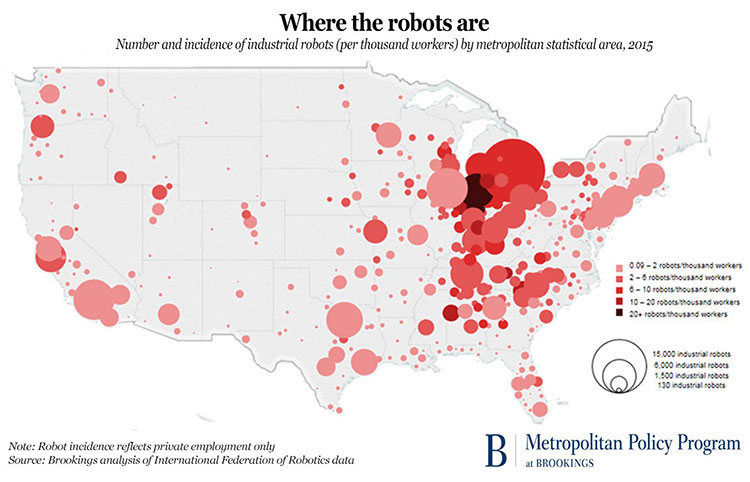
The Brookings Institution has just published a fascinating map that tells us a good deal about what is happening with American manufacturing today.

Headlined “Where the Robots Are,” the map graphically illustrates that as of 2015, nearly one-third of America’s 233,000+ industrial robots are being put to use in just three states:

  • Michigan: ~12% of all industrial robots working in the United States
  • Ohio: ~9%
  • Indiana: ~8%

It isn’t surprising that these three states correlate with the historic heart of the automotive industry in America.

Not coincidentally, those same states also registered a massive lurch towards the political part of the candidate in the 2016 U.S. presidential election who spoke most vociferously about the loss of American manufacturing jobs.

The Brookings map, which plots industrial robot density per 1,000 workers, shows that robots are being used throughout the country, but that the Great Lakes Region is home to the highest density of them.

Toledo, OH has the honor of being the “Top 100” metro area with the highest distribution of industrial robots: nine per 1,000 workers.  To make it to the top of the list, Toledo’s robot volume jumped from around 700 units in 2010 to nearly 2,400 in 2015, representing an average increase of nearly 30% each year.

For the record, here are the Top 10 metropolitan markets among the 100 largest, ranked in terms of their industrial robot exposure.  They’re mid-continent markets all:

  • Toledo, OH: 9.0 industrial robots per 1,000 workers
  • Detroit, MI: 8.5
  • Grand Rapids, MI: 6.3
  • Louisville, KY: 5.1
  • Nashville, TN: 4.8
  • Youngstown-Warren, OH: 4.5
  • Jackson, MS: 4.3
  • Greenville, SC: 4.2
  • Ogden, UT: 4.2
  • Knoxville, TN: 3.7

In terms of where industrial robots are very low to practically non-existent within the largest American metropolitan markets, look to the coasts:

  • Ft. Myers, FL: 0.2 industrial robots per 1,000 workers
  • Honolulu, HI: 0.2
  • Las Vegas, NV: 0.2
  • Washington, DC: 0.3
  • Jacksonville, FL: 0.4
  • Miami, FL: 0.4
  • Richmond, VA: 0.4
  • New Orleans, LA: 0.5
  • New York, NY: 0.5
  • Orlando, FL: 0.5

When one consider that the automotive industry is the biggest user of industrial robots – the International Federation of Robotics estimates that the industry accounts for nearly 40% of all industrial robots in use worldwide – it’s obvious how the Midwest region could end up being the epicenter of robotic manufacturing activity in the United States.

It should come as no surprise, either, that investments in robots are continuing to grow. The Boston Consulting Group has concluded that a robot typically costs only about one-third as much to “employ” as a human worker who is doing the same job tasks.

In another decade or so, the cost disparity will likely be much greater.

On the other hand, two MIT economists maintain that the impact of industrial robots on the volume of available jobs isn’t nearly as dire as many people might think. According to Daron Acemoglu and Pascual Restrepo:

“Indicators of automation (non-robot IT investment) are positively correlated or neutral with regard to employment. So even if robots displace some jobs in a given commuting zone, other automation (which presumably dwarfs robot automation in the scale of investment) creates many more jobs.”

What do you think? Are Messrs. Acemoglu and Restrepo on point here – or are they off by miles?  Please share your thoughts with other readers.

This LinkedIn sayonara message says it all.

Over the past several years, it’s been painfully evident to me as well as many other people that LinkedIn has become a sort of Potemkin Village regarding its professional groups.

While many groups boast enviable membership levels, there’s been precious little going on with them.

It’s almost as if the vast majority of people who signed up for membership in these groups did so only to be “seen” as being active in them – without really caring at all about actually interacting with other members.

And if any more proof were needed, try advertising your product or brand on LinkedIn.

Crickets.

Today I received the following message from Alex Clarke, digital content manager and moderator of the B2B Marketing LinkedIn group. You know them:  publishers of B2B Marketing, one of the most well-respected media properties in the marketing field.

We’ll let the Alex Clarke memo speak for itself:

What ever happened to LinkedIn Groups? What was once a bustling metropolis, teeming with valuable discussion and like-minded peers sharing success and insight has now become a desolate, post-apocalyptic wasteland – home only to spammers and tumbleweed. 

We’re sad, because, like many other groups, our 70,000+ strong LinkedIn community has become a stagnant place, despite constant love and attention and our best efforts to breathe life into its lonely corridors. 

That’s why we’re moving to a new home … Facebook: bit.ly/B2BGroupFB. 

We’re aiming to build a similar – and ultimately, better – community on this platform, with an eye on providing B2B marketers with a place to seek advice, share success, and connect with like-minded professionals in a well-moderated environment. 

We’ll still drop in to keep an eye on the LinkedIn Group, continuing to moderate discussions and approve new members, but much of our effort will be invested in building a brand-new community on Facebook. Many of you will already know each other, but please feel free to say hello!  We’re really excited to see where this goes, thanks for coming along with us.

So, while B2B Marketing will maintain a default presence on LinkedIn, what’s clear is that it’s abandoning that social platform in favor of one where it feels it will find more success.

Who knows if Facebook will ultimately prove the better fit for professional interaction. On the face of it, LinkedIn would seem better-aligned for the professional world as compared to the “friends / family / hobbies / virulent politics / cat videos” orientation of Facebook.

Time will tell, of course.

Either way, this is a huge indictment of LinkedIn and its failure to build a presence in the cyberworld that goes beyond being a shingle for newly minted “business consultants,” or a place for people to park their resumes until the time comes when they’re ready to seek a new job.

It’s quite a disappointment, actually.

Business owners give the lowdown on workplace — and their own — productivity.

The owner of a business is arguably the single most important employee on the payroll. As such, the findings from a recent survey of business owners conducted by The Alternative Board are revealing.

According to the survey, which was conducted in May 2017, the typical business owner reports having only about 1.5 hours of uninterrupted, high-productive time per day.

Four in five of the business owners reported that they feel most productive in the mornings. It stands to reason, then, that nearly nine in ten respondents reported that they prefer to get the most important tasks of the day out of the way first.

The majority of respondents reported that they are most productive working from the office, but nearly one-third of them reported that most of their work is done from their home.

A majority of the respondents also reported that they spend the biggest block of their daily time on e-mail activities.  Tellingly, less than 10% feel that this is the most important use of their time.

Asked to report on what factors are working against their employees achieving a high level of productivity in the owner’s business, these following four factors were named most frequently:

  • Poor time management: ~35% of survey respondents cited
  • Poor communications: ~25%
  • Personal/personnel problems: ~18%
  • Technology distractions: ~16%

Taken as a whole, these findings suggest that while there are certainly issues that affect business productivity, business owners have it within their power to improve time management, foster better communication between employees, and ultimately run a tighter ship.

More findings from the TAB research can be found on this infographic.

Chipping away at the opposition, a Wisconsin company plans to implant its employees with microchips.

I’ve blogged before about how micro-chipping has been morphing from appliances and pets to people.

But not without opposition.  Earlier this year, it was reported that lawmakers the state of Nevada had introduced legislation that would make it a felony to require a person to be implanted with microchips such as an RFID (radio frequency identification) or NFC (near field communication) devices.

Nevada isn’t the only state legislature to take up the issue, as similar legislation has already been passed in North Dakota, Oklahoma, Virginia, Wisconsin and – how come we are not surprised? – California.

But now comes word that at least one company is quite publicly thumbing its nose at the state of Wisconsin by offering implanted chip technology to all of its employees.

Beginning in August, River Falls-based Three Square Market (32M) will be implanting all willing employees with an RFID chip. Reportedly, this will allow these employees to purchase items in the company’s break room, as well as to log on to computers, open locked doors on the company premises, and to use copy machines.

[For those who may not know, River Falls is located near the Twin Cities of Minneapolis-St. Paul, and is also home to one of the University of Wisconsin’s more notable tech campuses.]

As many as 50 employees of 32M are expected to participate in the scheme, in what is claimed to be the first employee micro-chipping program implemented in the United States.

As it turns out, there’s a little more than just altruism behind 32M’s program. The company operates in a market segment that’s naturally aligned with chip technology.

More specifically, 32M is a key player in the so-called “micro market” – also known as the break room market — wherein mini-convenience store kiosks that are installed in employee break rooms feature self-checkout functionality.

32M sells micro market technology, while operating more than 2,000 kiosks in 20 countries around the world.

According to Tony Danna, 32M’s vice president of sales, one of the reasons for embarking on the microchip implantations is his company’s desire to have first-hand experience working with the technology, which it offers in addition to more conventional RFID payment solutions such as rings and wrist bands.

In other words, it isn’t a “forced march.”  And while 32M is at it, the company is getting more than its share of publicity out of the gambit.

Mr. Danna pushes back against the notion that microchips and the data they contain are an invasion of privacy, insisting that the microchips are not trackable and “anyone can pop it out, like a splinter.”

Of course, credit card information can be stored on the chip — and likely a whole lot more.

Despite any reservations that recalcitrant employees – or state legislators in Wisconsin – might have, 32M is moving ahead and planning for a “chip party” at the company’s headquarters in early August.

No word if any other kinds of chips – such as of the corn or potato variety – plan to be served up as well during the event.

Chief Marketing Officers and the revolving door.

If it seems to you that chief marketing officers last only a relatively short time in their positions, you aren’t imagining things.

The reality is, of all of the various jobs that make up senior management positions at many companies, personnel in the chief marketing officer position are the most likely to be changed most often.

To understand why, think of the four key aspects of marketing you learned in business school: Product-Place-Price-Promotion.

Now, think about what’s been happening in recent times to the “4 Ps” of the marketing discipline. In companies where there are a number of “chief” positions – chief innovation officers, chief growth officers, chief technology officers, chief revenue officers and the like – those other positions have encroached on traditional marketing roles to the extent that in many instances, the CMO no longer has clear authority over them.

It’s fair to say that of the 4 Ps, the only one that’s still the clear purview of the CMO is “Promotion.”

… Which means that the chief marketing officer is more accurately operating as a chief advertising officer.

Except … when it comes to assigning responsibility (or blame, depending on how things are going), the chief marketing officer still gets the brunt of that attention.

“All the responsibility with none of the authority” might be overstating it a bit, but one can see how the beleaguered marketing officer could be excused for thinking precisely that when he or she is in the crosshairs of negative attention.

Researcher Debbie Qaqish at The Pedowitz Group, who is also author of the book The Rise of the Revenue Marketer, reports that as many as five C-suite members typically share growth and revenue responsibility inside a company … but the CMO is often the one held responsible for any missed targets.

With organizational characteristics like these, it’s no wonder the average CMO tenure is half that of a CEO (four years versus eight). Research findings as reported by Neil Morgan and Kimberly Whitler in the pages of the July 2017 issue of the Harvard Business Review give us that nice little statistic.

What to do about these issues is a tough nut. There are good reasons why many traditional marketing activities have migrated into different areas of the organization.  But it would be nice if company organizational structures and operational processes would keep pace with that evolution instead of staying stuck in the paradigm of how the business world operated 10 or 20 years ago.

Rapid change is a constant in the business world, and it’s always a challenge for companies to incorporate changing responsibilities into an existing organizational structure.  But if companies want to have CMOs stick around long enough to do some good, a little more honesty and fairness about where true authority and true responsibility exist would seem to be in order.

Employee churn rates underscore the volatile nature of e-mail contact databases.

Most marketers are well-familiar with the challenges of e-mail list maintenance. In the business-to-business world in particular, e-mail databases can become pretty stale pretty quickly, due to the horizontal and vertical movement of employees inside organizations as well as jumping to other companies.

Whether they’re moving up or out, often they’re no longer good prospects.

Based on my experience, my personal rule of thumb has been that approximately one-fifth of any given list of B-to-B names will “churn” within a 12-month period, meaning that any such contact database will rapidly lose its effectiveness unless assiduously maintained.

And now we have a new report from Salesforce Research that confirms this basic rule of thumb.

Salesforce looked to LinkedIn, exploring this social platform’s data from more than 7 million records over a 48-month period to gauge the lifecycle of the typical “persona.”

The research considered not only changes that result in the deactivation of an e-mail address, but also circumstances where individuals may keep the same e-mail address but still should be removed as a target because a horizontal or vertical change within the same organization places them in a different employee function.

What the new research found was that the average annual B-to-B churn rate for such “personas” is ~17%.

That figure turns out to be fairly close to my basic rule of thumb based on years of observing not only e-mail contact databases, but also the postal mail databases we’ve worked with in my company or with our clients.

Beyond the broad average, there are some small but meaningful differences in the B-to-B churn rate depending on the product focus and on the type of employee function.

In high-tech fields, the average annual churn rate is higher than the average. And it’s across the board, too:  23% churn in marketing … 20% in sales and in HR personnel … 19% in IT, and 18% in finance.

People employed in the retail and consumer products industries also clock in at or higher than the overall churn average, but the annual churn rate is a tad lower in the medical and transportation fields.

Another interesting finding from the Salesforce evaluation is that annual churn rates are somewhat lower than the average for personnel at director levels and higher in companies (around 15%). For managers, the churn rate matches the overall average, while “worker bees” have a higher churn rate averaging around 20%.

Considering the critical importance of e-mail marketing efforts in the B-to-B environment, Salesforce’s finding that it takes only 4.2 years for an e-mail database to churn completely means that the value of these marketing assets will decline dramatically unless cultivated and maintained on an ongoing basis.

The volatile nature of e-mail contact databases also helps explain why so many companies have adopted a multi-channel approach to marketing, including interacting on social media platforms. Yes, those platforms do have their place in the B-to-B world …

The full report of the Salesforce findings can be downloaded here.

Are boomerang kids the “new normal” now?

I’ve blogged before about how the Great Recession and resulting high unemployment rates drove a significant number of young adults back into their childhood homes — or relying on Mom and Dad for financial support at least. It affected millions of young adults.

The economy and job prospects have been steadily improving since those dark days – even if the improvement hasn’t been as rapid as people would like to see …

But here’s an interesting finding: Those new jobs and the improving economy haven’t resulted in the kids moving back out of the house.

In fact, two studies conducted by the Pew Research Center in 2016 have determined that “living with parents” is now the single most common living arrangement for America’s 18-34 year olds.

That is correct: Instead of living with a spouse, a partner, a roommate or on his or her own, the largest single segment of millennials lives full-time with parents.  The phenomenon is most prevalent in Connecticut, New Jersey and New York, where it’s no coincidence that the cost of living is much higher than the national average.

For marketers, this means that the once-coveted 18-34 year-old cohort is today made up of many people who are consuming other people’s resources (e.g., the resources of their parents) rather than making all of their own purchase decisions and spending their own money.

Furthermore, Pew Research has determined that living with parents isn’t merely about employment (or the lack thereof). Over the past eight years, adults age 18-34 have continued to move back home in greater numbers — even as more of them have been able to find jobs.

The Pew findings suggest yet another surprising trend that appears to be in the making – that this is the first American generation where a large portion of the people won’t ever purchase a home.

It’s easy to figure that trends of this kind are transitory. But Pew cautions that the trends may well be more fundamental than the implications of an economic recession.  Instead, there are broader cultural dynamics at play – as well as the long-term challenges of economic independence for this generation of people.

The implications for marketers are intriguing, too.  For some, it will mean placing more emphasis on marketing initiatives aimed at parents, who are the now ones making purchase decisions within a larger multi-generational household — often one that stretches over three generations rather than just two.

And consider these dynamics as well: How do young adults and their parents work through multi-generational purchase decisions?  What are the most effective ways to target and reach multiple generations living under one roof who are making coordinated purchase decisions?  Maybe the old ideas of targeting each audience separately no longer make as much sense as before.

One thing’s for sure – it’s risky for marketers to wait for a return to normal … because that “normal” likely isn’t coming back.  Better to come up with new tactics and new messaging to reach and influence buyers in the new multi-generational environment.

Where’s the Best Place to Live without a Car?

For Americans who live in the suburbs, exurbs or rural areas, being able to live without a car seems like a pipedream. But elsewhere, there are situations where it may actually make some sense.

They may be vastly different in nearly every other way, but small towns and large cities share one trait – being the places where it’s more possible to live without a car.

Of course, within the larger group of small towns and larger cities there can be big differences in relative car-free attractiveness depending on differing factors.

For instance, the small county seat where I live can be walked from one side of town to the other in under 15 minutes. This means that, even if there are places where a sidewalk would be nice to have, it’s theoretically possible to take care of grocery shopping and trips to the pharmacy or the cleaners or the hardware store on foot.

Visiting restaurants, schools, the post office and other government offices is also quite easy as well.

But even slightly bigger towns pose challenges because of distances that are much greater – and there’s usually little in the way of public transport to serve inhabitants who don’t possess cars.

At the other end of the scale, large cities are typically places where it’s possible to move around without the benefit of a car – but some urban areas are more “hospitable” than others based on factors ranging from the strength of the public transit system and neighborhood safety to the climate.

Recently, real estate brokerage firm Redfin took a look at large U.S. cities (those with over 300,000 population) to come up with its listing of the 10 cities it judged the most amenable for living without a car. Redfin compiled rankings to determine which cities have the better composite “walk scores,” “transit scores” and “bike scores.”

Here’s how the Redfin Top 10 list shakes out. Topping the list is San Francisco:

  • #1: San Francisco
  • #2: New York
  • #3: Boston
  • #4: Washington, DC
  • #5: Philadelphia
  • #6: Chicago
  • #7: Minneapolis
  • #8: Miami
  • #9: Seattle
  • #10: Oakland, CA

Even within the Top 10 there are differences, of course. This chart shows how these cities do relatively better (or worse) in the three categories scored:

Redfin has also analyzed trends in residential construction in urban areas, finding that including parking spaces within residential properties is something that’s beginning to diminish – thereby making the choice of opting out of automobile ownership a more important consideration than in the past.

What about your own experience? Do you know of a particular city or town that’s particularly good in accommodating residents who don’t own cars?  Or just the opposite?  Please share your observations with other readers.