(Still) Too Much Irritating Online Advertising

online advertisingTime was, the online experience was blissfully free of annoying advertising.  (Of course, that was back in the very early days of the Internet.)

Then things got pretty bad pretty quickly, as publishers became forced to find ways to make up for lost advertising revenues from their print vehicles.

One of the most egregious examples of the explosion in online advertising were pop-up and pop-under ads.

So infamous, in fact, that an entire industry of ad blocking software sprang up, eventually providing the ability to eradicate most of them.

Not all of them, of course, but enough so that for those who use the programs, those ads are no longer quite as pernicious as before.

And yet … the arsenal of publisher’s revenue-generating ad tricks is still quite large — and pretty irritatingly effective, too.  Here are the most pervasive ones:

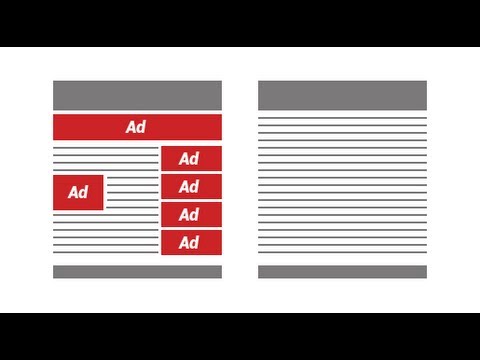
Slideshows – Some publishers use a picture slideshow format at every opportunity as a way of increasing page views and ad impressions.  Each click to view the next slide means more opportunities to collect revenue from serving up more display ads.  Using this scheme, publishers can end up with ten times the ad volume compared to if they had presented the information and images on a single page.

Pagination – Related to the slideshow scheme is the idea of publishing an online news story on two or three pages, whereas it could easily have been presented on just one.  If you ask people, most would be quite happy simply scrolling down the page to read the entire story.  On the other hand, publishers love this tactic because it enables them to double or triple their ad impressions.

Autoplay video – Even though most viewers hate autoplay videos, publishers think this tactic is great because they can gain revenue from video serves without having to wait until a user clicks on it to play.

Autopage refreshing – The obnoxious practice of refreshing and reloading a web page every 30 or 60 seconds has little to do with fresh new content being added to the page – unless that “fresh new content” is new advertising impressions.  And that’s precisely why it happens – so that publishers can get credit and revenues from significantly more ad impressions than they would otherwise.

Add to these techniques the age-old practice of attracting attention via “cheesecake” or other questionable images – no matter that they have nothing to do with the product or service being promoted – and you have a veritable rogues gallery of obnoxious “tips and tricks” – all designed to serve up as many ads as possible and generate Potemkin Village-like “engagement” along with the heightened ad revenues.

And who’s surprised?  After all, it’s only “mere money” we’re talking about …

If you find certain advertising practices particularly detrimental to your online experiences, I’m sure other readers would love to hear about them.  Please share your thoughts in the comment section below — and what you’ve done about it in response.

Criptext: When a recall actually looks pretty good.

Criptext logo

I doubt there are many of us in business who have never inadvertently sent an e-mail to the wrong person … or sent a message before it was fully complete … or forgot to include an attachment.

In such cases, it would be so nice to be able to recall the e-mail — just like we used to do in the days of postal mail simply by retrieving the letter from the outgoing mail bin.

Recent news reports reveal that this capability is actually a reality now.

In the fast lane?  Criptext principals just completed a successful round of investment funding.
In the fast lane? Criptext principals just completed a successful round of investment funding.

A start-up firm called Criptext has just raised a half-million dollars in private investment funds to help it perfect and expand a product that allows any sent e-mail to be recalled — even if the recipient has already opened and read it.

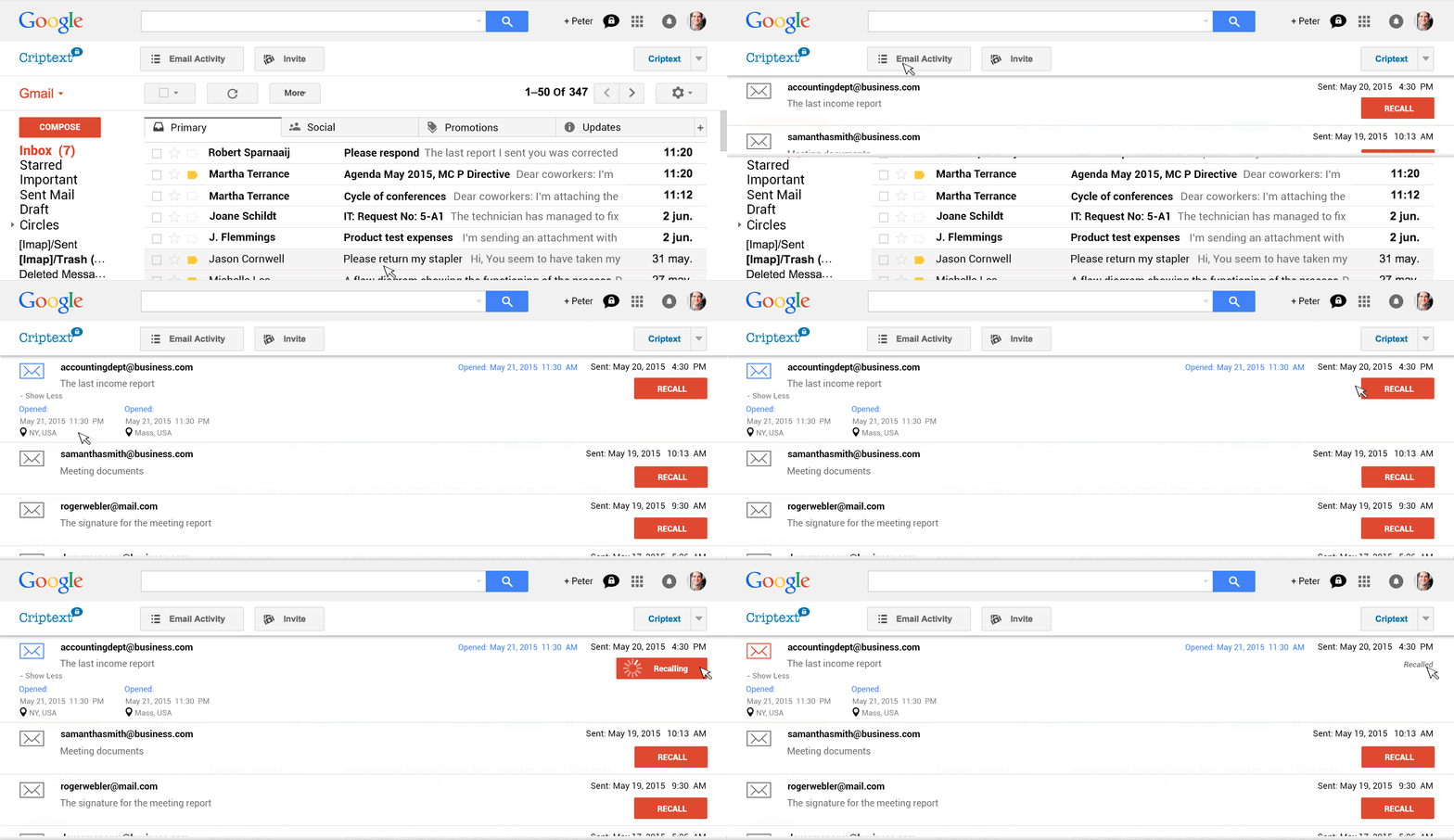
According to a report from Business Insider, Criptext is currently available as a plugin and a browser extension for the popular Outlook and Gmail email services.  It operates inside of the email, enabling the sender to track when, where and who has opened emails and/or downloaded attachments within them.

In addition, Criptext also enables the sender to recall emails, and even to set a self-destruct timer to automatically recall emails after a specified length of time.

Viewing a screenshot of how Criptext works (in this case with the Gmail service), things look pretty simple (and pretty cool, too):

Criptext activity panel example

I thought it would be only a matter of time before some developer would figure out a way to “unwind” an email communiqué once the “send” button was hit.  And now we have it.

Of course, time will tell whether Criptext can live up to its billing … or if it turns out to be more of a nightmare of glitches than a dream come true.

It would be great to hear from anyone who may have first-hand experience with Criptext — or other similar email functionalities.  Please share your experiences and perspectives pro or con with other readers here.

Big, brawny behemoth: Google’s Gmail email service reaches 900 million active users.

Google GMailIt’s been several years since Google gave us an official report on Gmail’s user base.

But now we have a new announcement from one of Google’s senior vice presidents,  reporting that Google’s Gmail service has now reached a new milestone of 900 million active users.

Three years ago — the last time Google commented officially on the Gmail active user base — the company had reported ~425 million users.

… Which means that in the past three years alone, Gmail’s active user base has more than doubled — and doubled from an already strong baseline figure.

In fact, Gmail had already become the most popular email service in America by 2012.

Despite the fact that most other email services have failed to report newer stats since then, it’s a safe bet that Google remains King of the Hill when it comes to the number of active users of its Gmail email service.

[Related to this, the same Google spokesperson is also reporting that three out of four active Gmail service users are accessing their accounts on mobile devices.  I’m sure this doesn’t come as a surprise to anyone.]

The continued robust growth in Gmail users may explain why Google hasn’t been making significant changes to the service or the user interface.  Any service that’s the largest one out there can’t risk irritating or alienating large swaths of its users.

Indeed, even when an email service isn’t the biggest or most important one in the market, making changes can still be a risky move.  Just recall the howls of protest from users (and even some of Yahoo’s own employees) when Yahoo made sweeping changes to its e-mail service about 18 months ago.

No doubt, Yahoo has lost a certain number of subscribers who simply couldn’t abide the changes.

Google InboxIn Google’s case, what it’s doing is using Inbox, which Gmail users see on top of the Gmail platform, as an area to experiment with new email features and such — without upsetting satisfied Gmail users who may have little appetite for those changes.

Inbox is an email app by Google for Android and iOS, along with web browsers Chrome, Firefox, and Safari.  In a hint at things to come, Google has now made Inbox open to all users.

Google claims that its Gmail and Inbox services serve different functions and needs, and that it will continue to work on enhancements and updates for both.

But it’s pretty clear that Inbox is where the bulk of Google’s developmental effort and energy are being directed these days.

The Ideal Privacy Policy?

policyRecently, I came upon a column written by software entrepreneur and business author Cyndie Shaffstall in which she proposes the following policy for any company to adopt that truly cares about its customers’ privacy:

The Ideal Privacy Policy:

1.  We have on file only your first name, last name, and e-mail address.

2.  We ask for nothing else.

3.  We send you only e-mails you request.

4.  We have nothing to share with others – and wouldn’t if they asked.

5.  We won’t change this policy without prior notice – ever. 

Thank you for being our customer, 

~ Your Grateful Vendor 

Cyndie Shaffstall
Cyndie Shaffstall

As Shaffstall herself acknowledges, she’s never actually seen a policy like this.

But if a company actually adopted such a policy, it would certainly make people more comfortable about purchasing its products — particularly things like phones, wearables and other products that capture and process user-specific data as part of their functionality.

Unfortunately, Shaffstall is correct in asserting that few if any companies would actually adopt such a privacy policy.  Because if they did, they’d be voluntarily walking away from so much of what makes the online world such a lucrative business proposition.

But think for a moment:  Wouldn’t it be absolutely wonderful if we didn’t have to consider such privacy policies “too good to be true”?

Do you know any real-live examples of companies whose privacy policies come close to this ideal?  If so, please share them with readers here.

On the march: Ad blocking tools continue their rise in popularity.

What Adblock PromisesI’ve blogged before about the rise of online ad blocking tools and their growing popularity with consumers.

One example:  AdTrap – a device that intercepts online ads before they reach any devices that access a person’s Internet connection.

AdTrap’s motto is simple and powerful:  “The Internet is yours again.”

In the months and years since I first blogged about it, ad blocking has only become more popular – so much so that it’s no longer just a mild irritant to advertisers and publishers, but rather a commercial threat that has a significant impact on publishers’ financial bottom lines.

It’s hardly surprising.  Most people want to run as far away from advertising as they can.  For years, we’ve taken trips to the kitchen or bathroom during TV commercial breaks.  We’ve TiVo’d ads out of existence.

And the participation levels in online ad blocking bear this out now as well.  According to data from PageFair, a company that measures publishers’ ad blocking rates and provides alternative non-intrusive advertising options, the number of ad blocker tool users reached nearly 145 million people in 2014.

That’s more than five times the 21 million users of ad blocker tools we had in 2010.

Growth continues apace:  Adblock Plus, which is the biggest of the ad blocking tools, reports more than 2.3 million downloads each week, on average.

Where are people blocking online ads?  In all sorts of areas.  But the most frequent incidence of ad blocking is on gaming sites, where blocking rates are in excess of 50%.

But blocking is happening on other online sites, too, including entertainment, fashion and lifestyle sites – albeit at about half the degree as on gaming sites.

[Tellingly, ad blocking is happening on technology sites, too, where about a quarter of the ads are being blocked.]

One of the more interesting nuggets of information reported by PageFair is the difference in ad blocking rates by country.  What we see is that Americans lag well-behind a number of other countries:

  • Argentina: ~34 of online ads are blocked
  • Poland: ~34% are blocked
  • Sweden: ~33%
  • Finland: ~32%
  • Germany: ~30%
  • United States: ~15%

Germany, in particular, has been the scene of several fervent legal skirmishes in recent years.  There, the publisher of the news magazine Die Zeit sued the parent company of AdBlock, claiming that the ad blocking tool is “illegal and anti-competitive.”  (The suit went nowhere, incidentally.)

Some observers speculate that the higher incidence of ad blocking in certain countries may be tied to those nations’ sociological profiles.  “I personally suspect that in some of these countries, citizens are more concerned about their personal privacy – perhaps for historical reasons,” Sean Blanchfield, PageFair’s CEO, has remarked.

One might wonder if, in the age of Edward Snowden and the Patriot Act (now superseded by new legislation ironically called the “USA Freedom Act”), Americans’ ad blocking practices might now be poised to align more closely with Europeans’.

I imagine we’ll know more about that degree of convergence within a year or two.

Gallup’s Payroll-to-Population Rates Pinpoint the Go-Go Metro Areas

Commuters in New York City.

The Gallup polling organization’s P2P measurements (payroll-to-population employment rates) are an interesting metric and add an extra dimension of understanding as to what’s happening with employment across the United States.

Gallup’s evaluation is limited to the top 50 most populous SMSAs (metropolitan statistical areas).  But because of the large number of phone interviews conducted within each metro area (ranging from ~1,300 to 18000+ depending on the population), the findings are statistically significant whether looking nationally or within a particular urban area.

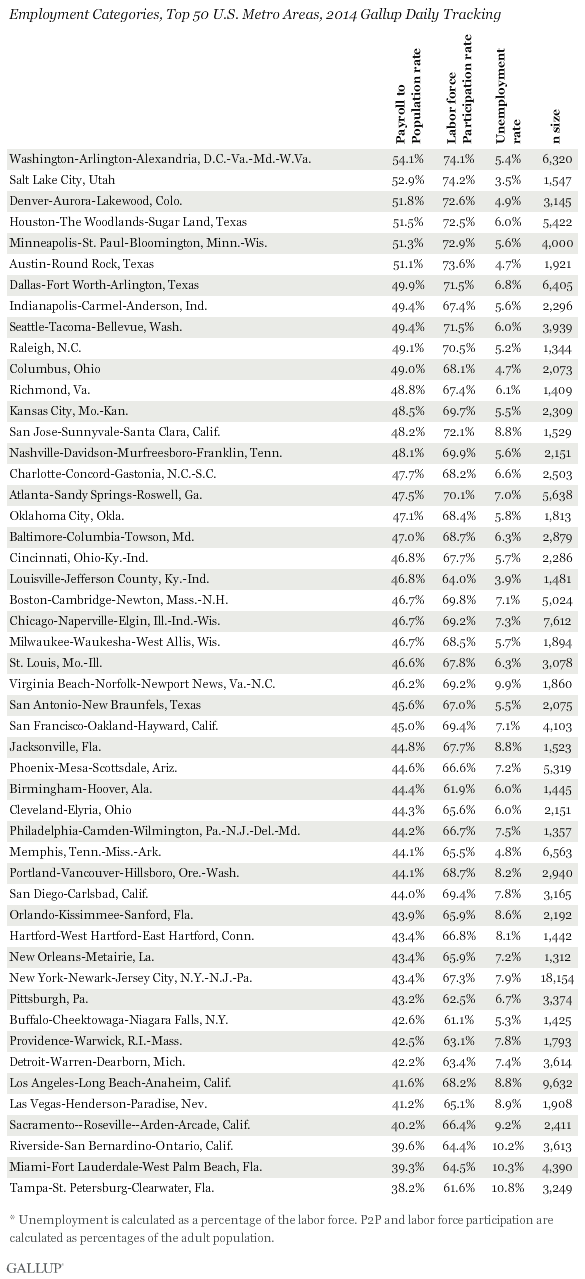
The latest surveys, conducted by Gallup in 2014 among nearly 355,000 households, find that two metro areas with the highest P2P measures are Washington, DC and Salt Lake City, UT — urban centers that couldn’t be more dissimilar in other ways.

For DC, the P2P rate is 54.1.  The calculation is derived from the percentage of the adult population (age 18+) who are employed full-time for an employer for at least 30 hours per week.

For Salt Lake City, the P2P rate is just slightly lower, at 52.9.

Other top scoring metro areas include three markets in Texas (Austin, Dallas-Ft. Worth and Houston).

What about metro areas at the other end of the scale?  Those would be Miami (38.2 score) and Tampa (39.3).

Three other low-scoring MSAs are located in California:  Los Angeles, Riverside and Sacramento.

What do these stats mean in a broader sense?

For one thing, there’s a direct relationship between employment stats and P2P performance:  Metro areas with the highest unemployment rates correlate to those with low P2P scores.

For instance, Miami’s unemployment rate in 2014 was 10.3%.  It was 10.2% in Riverside, CA.

That’s a big contrast with Salt Lake City, which had an unemployment rate of just 3.5%.

I find one interesting deviation from the norm:  Buffalo, NY.  There, while the unemployment rate is one of the ten lowest in the country, its labor force participation rate is also very low — bottoms among all 50 metro areas, in fact.

Shown below are the figures for all of the 50 largest U.S. metro areas based on the interviews conducted by Gallup in 2014:

Gallup full results

More details on the research findings are available here.

Data breaches: Target is just the tip of the iceberg.

Target data breachI’m sure we aren’t the only family who’s had to suffer through the aftershocks of Target’s infamous Great Thanksgiving Weekend Data Breach that occurred in late 2013.

According to news reports, as many as 40 million Target credit cards were exposed to fraud by the data breach.  And as it turns out, the initial reports of nefarious doings were just the beginning.

Even after being given a new credit card number, my family has had to endure seemingly endless rounds of “collateral damage” for more than a year since, as Target’s very skittish credit card unit staff members have placed card-holds at the drop of a hat … initiated phone calls to us at all hours of the day … and asked for confirmations (and reconfirmations) of merchandise charges.

Often, these unwelcome communications have occurred on out-of-town trips or whenever someone in the family has attempted to make an innocuous online purchase from a vendor based overseas.

It’s been altogether rather icky — in addition to being a royal pain in the you-know-where.

But our experience has hardly been unique.  Consider these scary figures when it comes to data breaches that are happening with businesses:

  • On average, it takes nearly 100 days to detect a data breach at financial firms. 
  • It takes nearly 200 days to do so at retail establishments.

Those unwelcome stats come to us courtesy of a multi-country survey of ~1,500 IT professionals in the retail and financial sectors.  The study was conducted by the Ponemon Institute on behalf of network security and software firm Arbor Networks.

The next piece of unsettling news is that, even with the long “dwell” times of these data breaches, the IT professionals surveyed aren’t optimistic at all that the situation will improve over the coming year.  (Nearly 60% of those working in the financial sector aren’t optimistic, as do a whopping ~70% in retail.)

It’s doubly concerning because companies in these sectors are such obvious targets for hack attacks.  The reason is simple:  The amount and degree of customer data stored by companies in these sectors is highly valuable on the black market — thereby commanding high prices.

It makes it all the more lucrative for unscrupulous people to make relentless attempts to hack into the systems and extract whatever data they can.  IT respondents at ~83% of the financial companies reported that they suffer more than 50 such attacks in a given month, as do respondents at ~44% of the retail firms.

The impact on companies isn’t trivial, either.  Another study released jointly just last week by Ponemon and IBM, based on an evaluation of ~350 companies worldwide, finds that the average data breach costs nearly $160 for each lost or stolen record.  And that’s up over 6% from a year ago.  (The Target breach cost substantially more on a per-record basis, incidentally.  And for healthcare organizations, the average cost is well over $350 per record.)

dbWhat can be done to stem the endless flood of data breach attacks?  The respondents to this survey put the most faith in technology that monitors networks and traffic to stop or at least minimize these so-called advanced persistent threats (APTs).  More companies have been implementing formalized incident response procedures, too.

As Dr. Larry Ponemon, chairman of the Ponemon Institute has stated, “The time to detect an advanced threat is far too long; attackers are getting in and staying long enough that the damage caused is often irreparable.”

Clearly, more investment in security tools and operations would be advisable.

Anyone else care to weigh in with opinions?

Conundrum Corner: Europe, Google and “The Right to be Forgotten”

file and forgetThis past week, The Wall Street Journal published an article which reported on the fallout from the European Court of Justice’s 2014 ruling that Google is required to remove links in European search results for individuals whose reputations are harmed by them.

In practice, it’s turned out to be quite a conundrum.  Since the ruling went into effect, Google has had to field requests to remove nearly 950,000 links from European search results.

Each request is deliberated on a case-by-case basis by a panel of specialists.  Reportedly, Google has dozens of attorneys, paralegals and engineers assigned to the task, which is based at its European headquarters facilities in Dublin, Ireland.

So far, approximately one-third of the links in question have been removed while about half were deemed acceptable to continue displaying in search results.  The remaining cases – the gnarliest ones – are still under review.

Unfortunately, the European Court of Justice hasn’t been very specific on the standards to apply when evaluating each request – other than to assert that search results should be removed that include links to information that is:

  • Irrelevant
  • Inadequate
  • Excessive
  • Harmful
  • Outdated

Which, of course, could encompass practically anything.  But the broader standard the Court has sought to uphold is “the right to be forgotten.”

Google hasn’t exactly been a willing participant in these mini-dramas.  Peter Fleischer, Google’s global privacy counsel, contends that Google has been compelled “to play a role we never asked to play – and don’t want to play.”

Lisa Fleisher and Sam Schechner, the authors of the Wall Street Journal article, noted several examples of criteria that Google appears to be using when evaluating individual requests for removal.

More likely to be removed are search entries pertaining to crimes committed long ago and expunged from criminal records … nude or other revealing photos published without the permission of the subjects … and arrest records for petty infractions.

Less likely to be removed:  stories about public figures.

As for the “group dynamics” involved in the decision-making, Fleischer reports that the committee’s votes are normally “a large majority in favor of one decision or the other.”

Looking ahead, as the experiment in parsing web search results to remove certain links while retaining others continues, it’s sure to have implications worldwide.

One reason is that, for now at least, Google has been removing search results only from European domains such as google.it or google.es, but not from the far-more-ubiquitous U.S.-based google.com – even when accessed from Europe.

This means that the “offending” search results can continue to be viewed, retrieved and opened easily.

That fact isn’t sitting well with EU privacy regulators.  In fact, they’ve already issued an opinion contending that Google’s actions are insufficient, and they are seeking wider compliance.  The potential price for not doing so is – you guessed it – legal action.

As time goes on, it will be interesting to see what ends up leeching into the American sphere when it comes to the ability of people to have erroneous or unflattering information about them that is currently so readily visible removed from view.

Clearly there are competing principals at work:  freedom of information versus reputation protection.

paper documents on fileCourt documents and similar documentation have always been public-access information, of course.  But up until a few years ago, anyone interested in trolling for “dirt” on an individual or a company had to do costly, proactive searching through reams of paper-based documents.

Not only was it a labor-intensive process that might or might not result in anything of substance, the source information itself was scattered among thousands of county seats all across America.

That alone was enough to guarantee that most documents were effectively far away from public view.

But in today’s everything-digitized world, court documents – many dating back decades – have been optically scanned and can now be keyword-searched within an ounce of your life.

digitized docsWhat used to take months and cost plenty can now be researched in a matter of minutes.

And beyond court or government documentation is the press, which can get things very wrong (or simply premature) when reporting on controversial or titillating news items.

It affects companies as well as individuals.  I recall one such example in Baltimore from a number of years ago.  The local business press reported on a lawsuit brought by a disgruntled creditor against another company.  (I’m not naming the companies in question in deference to their reputations.)

The press reporting focused on the plaintiff’s petition to force the company into bankruptcy by virtue of the alleged “unpaid debt.”  The fact that the substance of the suit was found wanting and the defendant firm cleared of wrongdoing made little difference when it came to the reputation of the company and its principals;  the original news reports continue to have a life online, years later.

As the CEO the defendant company wrote to the publication involved,

“We now live in an age where digital documents take on a life of their own, and where it is no longer sufficient to consider whether someone might read a newspaper article on a given page on a given day.  Now, with the press of a button articles are stored in massive servers and retrieved by anyone around the world, leaving innocent people branded forever by erroneous words and faulty assumptions. 

It is your ethical responsibility to avoid causing undue harm to innocent parties by prematurely publishing information that others will negative construe and act upon.  Waiting a little longer to clarify the facts and determine the truth is sensible public policy and only makes your paper’s articles more trustworthy and fair, thereby avoiding the journalistic equivalent of shouting ‘fire’ in a crowded theater.”

It seems to me that we’re just starting down a road with this issue, and we don’t really know where it’s going to end up.

Considering everything – the European Court of Justice, Google and the global nature of “search and destroy,” I’d be interested in hearing what readers think about the situation, the competing issues, and the ultimate destination.

The fine art of negotiation: It never goes out of style.

Harvey Mackay
Harvey Mackay

Many people in business know about Harvey Mackay.  The chairman of Twin Cities-based MackayMitchell Envelope Company became famous as the author of the book Swim with the Sharks Without Being Eaten Alive, and six subsequent business best-sellers.

In the years following the release of his first book, Mackay became something of a business guru in the same mold as General Electric retired chairman and CEO Jack Welch.

The advice of these two men, borne out of their experiences in the corporate world, was a refreshing change of pace from the pronouncements of other authors who speak from their perches in academia.

In recent times, the thoughts and ideas of “sages” like Mackay and Welch might seem to some a little old-school – even quaint.  But I don’t think that’s the case.

Take Mackay’s thoughts on the art of negotiation.  The other day, I came across some points on that topic that Mackay first put forward about 20 years ago.  Reading through his points now, the advice seems as valid today as it was back then.

As for particular “do’s” and “don’ts” of the art of negotiating, here are a few points that Mr. Mackay makes:

  • Never accept any proposal immediately – no matter how good it sounds. 
  • Don’t negotiate with yourself – don’t raise a bid or lower an offer without first getting a response from your original position.       Otherwise, you’ll give the other side information and ammunition they might never have found out themselves. 
  • Don’t negotiate a deal with a person who has to get someone else’s approval. Effectively, it means that they can take any deal you’re willing to make and then renegotiate it. Why give them two chances to your one? 
  • Nothing is ever truly non-negotiable, no matter what someone might have you think at the outset. 
  • If you can’t say ‘yes’ … say ‘no’ and step away. (‘No’ can be just as good an end-result as ‘yes’.)

negotiatingAs for the dynamics of effective negotiating, Mackay’s pointers are equally valid:

  • Instinct is no match for preparation: Rehearse your positioning and pre-anticipate the other side’s response. (Even try role-playing.) 
  • Be respectful and courteous when negotiating. If you don’t think you can do that, have someone else negotiate your side of the deal instead.

As a final note, Mackay makes the point that “a deal can always be made when both parties see their own benefit in making it.”

It’s a positive parting thought – and it’s even better because it’s true.

What people dislike most about B-to-B websites …

Too many business-to-business websites remain the “poor stepchildren” of the online world even after all these years.

btob websitesSo much attention is devoted to all the great ways retailers and other companies in consumer markets are delighting their customers online.

And it stands to reason:  Those sites are often intrinsically more interesting to focus on and talk about.

Plus, the companies that run those sites go the extra mile to attract and engage their viewers.  After all, consumers can easily click away to another online resource that offers a more compelling and satisfying experience.

Or, as veteran marketing specialist Denison ‘Denny’ Hatch likes to say, “You’re just one mouse-click away from oblivion.”

By comparison, buyers in the B-to-B sphere often have to slog through some pretty awful website navigation and content to find what they’re seeking.  But because their mission is bigger than merely viewing a website for the fun of it, they’ll put up with the substandard online experience anyway.

But this isn’t to say that people are particularly happy about it.

Through my company’s longstanding involvement with the B-to-B marketing world, I’ve encountered plenty of the “deficiencies” that keep business sites from connecting with their audiences in a more fulfilling way.

Sometimes the problems we see are unique to a particular site … but more often, it’s the “SOS” we see across many of them (if you’ll pardon the scatological acronym).

Broadly speaking, issues of website deficiency fall into five categories:

  • They run too slowly.
  • They look like something from the web world’s Neanderthal era.
  • They make it too difficult for people to locate what they’re seeking on the site.
  • Worse yet, they actually lack the information visitors need.
  • They look horrible when viewed on a mobile device — and navigation is no better.

Fortunately, each of these problems can be addressed – often without having to do a total teardown and rebuild.

But corporate inertia can (and often does) get in the way.

Sometimes big changes like Google’s recent “Mobilegeddon” mobile-friendly directives come along that nudge companies into action.  In times like that, it’s often when other needed adjustments and improvements get dealt with as well.

But then things can easily revert back to near-stasis mode until the next big external pressure point comes down the pike and stares people in the face.

Some of this pattern of behavior is a consequence of the commonly held (if erroneous) view that B-to-B websites aren’t ones that need continual attention and updating.

I’d love for more people to reject that notion — if for SEO relevance issues alone.  But after nearly three decades of working with B-to-B clients, I’m pretty much resigned to the fact that there’ll always be some of that dynamic at work.  It just comes with the territory.