Tax filing: Is there a better way to do it here in the United States?

untitledTax filing day has come and gone, and for millions of Americans, it’s another reminder of how complicated and convoluted our current tax collection system is.

For some of us, it means setting aside a couple evenings or an entire weekend to collect receipts and other relevant documentation, work through the filing documents and prepare tax information — most of which the federal government already possesses.

For many others, trepidation — or just the sheer irritation of preparing their tax returns — means paying another person or a tax preparation service to do it for them.

The amount of hours and dollars spent on tax preparation is rather astounding; according to a White House estimate published as far back as 2010, collectively it amounts to over 7.5 billion hours and ~$140 billion each year.

Thus, the current lay of the land should make considering new alternatives just the thing to do.

Along those lines, in a recent article in The Atlantic, senior economics editor Derek Thompson posited a “third way”:  Why not receive a document from the government with the relevant information already filled in, and all the taxpayer needs to do is confirm the documentation?

It seems like a cross between Pollyanna and a pipe dream … until one begins to realize how neatly this approach aligns with the financial lives many people lead.

According to the Atlantic article, about half of American taxpayers earn all of their earned income from a single employer’s wages along with interest income from just one financial institution.  This is information the government already collects, which would make it possible for the IRS to send nearly completed tax forms to these individuals.

Some Scandinavian and Baltic countries have been doing this for years.

In fact, a full decade ago economist Austan Goolsbee proposed this very thing for the USA.  In a paper published by the Brookings Institution, Goolsbee advocated adoption of a “simple return” that would involve sending out pre-filled documents to those taxpayers who have the most straightforward taxes.

Those who qualify would include approximately 9 million single, lower income taxpayers who work for a living and don’t itemize their deductions.

An additional 17 million taxpayers have returns that are nearly as simple — including married couples who don’t itemize deductions.

Alas, as with any problem, there is a solution that’s “simple, elegant … and wrong.” Barriers preventing the adoption of a new, streamlined tax filing process include three big ones:

  • The current federal income tax system is not just complex, but also riddled with special interest protections. While in theory, a powerful argument for simplification falls on receptive ears, ultimately it fails when people begin to realize how the reform will reduce their own personal tax benefits. Too often, it’s “Tax simplification for three but not for me.”


  • The cost to overhaul the tax collection system isn’t chicken feed — and as we all know the IRS isn’t exactly swimming in excess funds after having raised the ire of Congress through its targeting of not-for-profit entities (not to mention the not-so-trivial cost of implementing Obamacare compliance enforcement).


  • Resistance is also coming from two other quarters. Tax preparation services are fundamentally opposed to simplification of the process because their very raison d’être depends on the continuation of a complex system that most people cannot or will not deal with on their own.

[On this last point, unlikely allies of the tax preparation services are political conservatives who may hate the current tax code, but who are suspicious of any remedies that might make tax collection become any “easier” for the government.]

Still … it would seem that any serious effort at rethinking the current tax filing system should be given all due consideration, as I have yet to meet anyone who is satisfied with the way things are today.

Where do you come down on the issue? Please share your observations with other readers here.

The States Where Your Dollar Goes a Good Deal Further

billsPeople have long suspected that many of America’s “richest” areas, based on salaries and other income, also happen to be where the cost of living is significantly higher.

Silicon Valley plus the New York City, Boston and the DC metro areas are some of the obvious regions, notorious for their out-of-sight housing and real estate prices.

But there are other factors at work as well in these high-cost areas, such as the cost of delivering goods to certain areas well-removed from the nation’s major trunk transportation arteries (think Alaska, Hawaii, Washington State and Minnesota).

And then there are state and local taxes. There appears to be a direct relationship between higher costs of living and higher taxation, too.

It’s one thing to go on hunches. But helpfully, all of these perceptions have been confirmed by the Bureau of Economic Analysis, using Personal Consumption Expenditure and American Community Survey data to do so.  Rolling the data up, the BEA has published comparative figures for all 50 states plus DC pertaining to the relative cost of living.

The approach was simple: consolidate the data to come up with a dollar figure in each state that represents how much $100 can purchase locally compared to the national average.  To get there, average price levels in each state have been calculated for household consumption, including rental housing costs.

Based on 2014 data, the figures have been mapped and are shown below:

100

So, just how far does $100 go?

The answer to that question is this: quite a bit further if you live in the mid-Continent region of the country compared to the Pacific Coast or the Northeast U.S.

In fact, $100 will get you upwards of 15% more goods and services in quite a few states. Here are the Top 10 states how much $100 will actually buy there:

  • Mississippi: $115.74 worth of goods and services
  • Arkansas: $114.16
  • Alabama: $113.51
  • Missouri: $113.51
  • South Dakota: $113.38
  • West Virginia: $112.87
  • Ohio: $112.11
  • Iowa: $111.73
  • Kansas: $111.23
  • Oklahoma: $111.23

At the other end of the scale, $100 is only going to buy about 20% to 30% fewer goods and services in the “Bottom 10” states compared to the “Top 10.” Here’s how it looks state-by-state:

  • DC: $84.60
  • Hawaii: $85.32
  • New York: $86.66
  • New Jersey: $87.64
  • California: $88.57
  • Maryland: $89.85
  • Connecticut: $91.41
  • Massachusetts: $93.28
  • Alaska: $93.37
  • New Hampshire: $94.16

Which states are closest to the $100 reference figure? Those would be Illinois at $99.40, and Oregon at $101.21.

I must say that those last two figures surprised me a bit … as I would have expected $100 to go less far in Illinois and Oregon.

Which of the state results surprise you? If any of them do, please share your observations with other readers.

Saints and Sinners: The Ten Most Sinful Cities in the United States … and the most Saintly

deWhich cities in America are the “most sinful” of the bunch? Perhaps they’re the ones whose monikers or mottos seem to suggest as much:

  • Always turned on.
  • Big beach. Big fun.
  • The city that never sleeps.
  • Glitter Gulch
  • Live large. Think big.
  • More than you ever dreamed.
  • Sin City
  • Sleaze City
  • Tinseltown
  • Town on the make.
  • What happens here, stays here.
  • What we dream, we do.
  • The wickedest little city in America.

While some of the descriptions above hardly represent what city boosters would want to convey about their burgs, a surprising number of them are actually the end-result of formal marketing and branding efforts – focus-group tested and all.

[How many cities do you think you can name for these slogans?]

tr logoBut put all of that aside now … because the online residential real estate website Trulia has been busy doing its own analysis of which cities qualify as being among the nation’s most “sinful.” Earlier this month, it published its listing of the ten most “sinful cities” in the United States.

How did Trulia compile the list? For starters, it limited its research to the 150 largest metropolitan areas.

Next, it used a variety of data such as drinking habits, the number of adult entertainment venues and the number of gambling establishments to determine the cities where it’s easiest to succumb to the eight deadly sins – among them gluttony, greed, lust, sloth and vanity.

For each “offense,” Trulia examined statistical measures that serve as key clues – stats like how many adult entertainment venues there are (for lust), and exercise statistics (for sloth).

Obviously, a mega-city like New York or Los Angeles is going to offer many more outlets catering to the sinful nature of mankind compared to smaller urban centers. So Tulia has “common-sized” the data based on per capita population, making it possible to determine the destination in which it’s easiest to satisfy one’s whims (or vices).

So – drumroll please – here’s the resulting Trulia Top Ten, listed below beginning with #10 and moving up to the ignominious honor of being the most sinful city of the bunch:

  • #10 Columbus, OH
  • #9   San Antonio, TX
  • #8   Las Vegas, NV
  • #7   Shreveport, LA
  • #6   Louisville, KY
  • #5   Toledo, OH
  • #4   Tampa, FL
  • #3   Philadelphia, PA
  • #2   Atlantic City, NJ
  • #1   New Orleans, LA  

I suppose few people would quarrel with New Orleans coming in at #1 on the list; anyone who has spent any time in that city knows must know how much of an “anything goes” atmosphere exists there. (Few tourists seem to avert their eyes to what they see, either.)

Atlantic City? Las Vegas?  Pretty much the same thing.

But what about Louisville, or Toledo, or … Shreveport?? OMG!

Of course, the same statistics Trulia crunched to determine who sits atop the “Sin City” list also reveal which cities are their polar opposites – the places Trulia calls America’s “saintly sanctuaries.”

Which cities are those?  Here’s that list:

  • #10 Cambridge, MA
  • #9   Greeley, CO
  • #8   Asheville, NC
  • #7   Boise, ID
  • #6   Claremont-Lebanon, NH
  • #5   Raleigh, NC
  • #4   Tuscaloosa, AL
  • #3   Ft. Collins, CO
  • #2   Ogden, UT
  • #1   Provo, UT

I think fewer surprises are on this list.

Tr

For details on the Trulia analysis and to read more about the methodology employed, click here.

What’s your take? Based on your own personal observations or even first-hand experience, which cities would you characterize as the most “sinful” … and the most “saintly”?  We’re all interested to know!

OSHA names the Top 10 most frequent workplace violations — some of which may surprise you.

fpWhat hazards represent the biggest threats to employees at worksites across America? We all may have our own suspicions … but the federal government has been keeping records about them for years.

In fact, this week the Occupational Safety & Health Administration (OSHA) has published its annual list of the Top Ten most frequently cited violations it has found following inspections of worksites its officials undertake on a regular (and unannounced) basis.

The OSHA listing shines a light on the types of safety issues that are most pronounced in the workplace. Here’s OSHA’s latest list, based on the 12-month period from October 2014 through September 2015.  It’s headlined by fall protection, which is the most frequent OSHA standards violation:

  1. Fall protection violations (construction standard)
  2. Hazard communication (general industry standard)
  3. Scaffolding (construction)
  4. Respiratory protection (industry)
  5. Control of hazardous energy (lockout/tagout) (industry)
  6. Powered industrial trucks (industry)
  7. Ladders (construction)
  8. Electrical (wiring methods, components and equipment)
  9. Machine guarding
  10. Electrical (general requirements)

olOSHA publishes the list once per year to alert U.S. employers about the most common violations being cited so that they’ll take precautions to fix similar hazards in their own companies before OSHA officials show up to carry out an inspection.

Reviewing the list, some of the categories fall into the “everyone knows” category. Who doesn’t think that fall protection, scaffolding and ladders are major contributors to injuries in the workplace?

But then there are other OSHA violations like electrical systems and industrial trucks; it’s a little surprising to me to find them among the most frequently cited violations.

Which workplace threats do you think represent the biggest safety hazards to workers? Share your thoughts with other readers here.

Sea change: Today, Americans are receiving their political news in vastly different ways.

pnWhere are Americans getting their political news in this very intensive Presidential election year?

There’s no question that the season is turning out to be a news bonanza, beginning with the string of debates featuring interesting and entertaining candidates and continuing on with near-nonstop political coverage on the cable networks.

And then there’s the endless chatter over on talk radio …

Recently, the Pew Research Center asked Americans where they’re receiving their political news. According to its just-issued report, Pew found that nine in ten American adults age 18+ typically consume some sort of news about the presidential election in any given week’s time.

When asked to cite which sources of information of political news are “most helpful,” here’s how the respondents answered:

  • Cable TV news: ~24% cited as the “most helpful” source of information
  • Local TV news: ~14%
  • Social media: ~14%
  • Website or apps: ~13%
  • Radio: ~11%
  • Network nightly news broadcasts: ~10%
  • Late-night comedy TV: ~3%
  • Local newspapers: ~3%
  • National newspapers: ~2%

Looking at this pecking order, several things stand out:

  • Even a few years ago, I doubt social media would have outstripped network TV or radio as a more helpful source of political news.
  • And look at where cable TV news is positioned — not only at the top of the list, but substantially above any other source of political information.
  • As for newspapers … even accounting for the fact that some websites or apps cited as helpful political news sources may actually be digital outlets for newspapers, newspapers’ position at the bottom of the list underscores their rapid loss of importance (and influence) in the political sphere. Aside from inflating a candidate’s own ego, who really cares about newspaper endorsements anymore?

Not surprisingly, the Pew research finds noticeable differences in the preference of political news sources depending on the age of the respondents. For instance, among respondents age 65+, here are the top four “most helpful” sources:

  • Cable TV news: ~43%
  • Network nightly news broadcasts: ~17%
  • Local TV news: ~10%
  • Local newspapers: ~6%

Contrast this with the very youngest respondents (age 18 to 29), where the two most helpful sources of information are social media (~35%) and websites or apps (~18%).

I’m sure readers have their own personal views as to which of the sources of political news are preferable in terms of their veracity. For some, social media and late-night TV comedy programs illustrate a general decline in the “quality” of the news, whereas others might look at radio programs or cable TV news in precisely the same negative terms.

More details on the Pew Research study can be found here.

The Sanders/Trump phenomenon: A view from outside the United States.

photo1This past Tuesday evening as I watched Bernie Sanders and Donald Trump vanquish their rivals handily in the New Hampshire presidential primary election, I received an e-mail from my brother, Nelson Nones, with his observations on “what it all means.”

As someone who has lived and worked outside the United States for years, Nelson’s views are often quite perceptive — perhaps because he is able to look at things from afar and can see the “landscape” better than those of us who are much closer to the action.

Call it a “forest versus trees” perspective.

And when it comes to the 2016 presidential election, it is Nelson’s view that the Sanders/Trump phenomenon is absolutely real and not something based on personality or celebrity — for good or for ill.

Shown below is what Nelson wrote to me.

… On the Underlying Dynamics

For context into what’s happening in the United States, the Pew Research Center’s recent report on the wealth gap in the United States is instructive.

In a nutshell, over the past 30 years Pew’s data points reveal: 

  • Upper-income families currently represent ~20% of the total, and their wealth (measured by median net worth) has doubled. 
  • Middle-income families represent 46% of the total. Their wealth barely changed (up 2%). 
  • Lower-income families therefore represent ~34% of the total, but their wealth fell 18%.

Now, after the end of the Cold War in 1992 until the onset of the Great Recession in 2007, the wealth of all three groups did rise, albeit by varying degrees: 

  • Upper-income by 112%
  • Middle-income by 68%
  • Lower-income by 30%

Here’s how they fared during the Great Recession (2007-10): 

  • Upper-income wealth declined by 17%
  • Middle-income wealth fell by 39%
  • Lower-income wealth fell by 42%

And after the Great Recession:

  • Upper-income families recovered 36% of their wealth lost during the Great Recession
  • Middle-income families recovered none
  • Lower-income families lost an additional 7% relative to their wealth in 2007

So, if we assume wealth to be a proxy for the feeling of well-being, then one could surmise that ~80% of American families feel like victims today — of which nearly half feel they are still being victimized.  

… On “Anger”

Are people feeling angry about this? You bet.   

Who are they going to blame? The other ~20% and foreigners, of course. 

Never mind the exculpatory hard data proffered by defenders of the nation’s elites revealing that big banks paid back all the bailout money they received during the Great Recession, or that bankers cannot be jailed for their alleged misdeeds unless and until proven guilty by jurors in courts of law (like anyone else), or that pharmaceutical companies’ margins on $45 billion of profit, at 12%, aren’t “quite” as obscene as they appear at first glance.   

None of those facts can ever restore wealth that’s been lost and never recovered, or is still falling. When you feel like a victim, such hard data are utterly and completely irrelevant.  

Both Bernie Sanders and Donald Trump are tapping into this anger with great success. As I watched both Sanders’s and Trump’s victory speeches, to vastly oversimplify, here is what I heard.  Sanders essentially said:

“It’s not fair that most Americans can’t get ahead or are falling behind. I’ll expropriate money from the rich by taxing Wall Street bankers and give it to you in the form of free tuition, student debt restructuring, lower healthcare costs and single-payer healthcare!” 

Trump essentially said:

“Political hacks are negotiating bad deals, letting China, Japan and Mexico take our money away from us every day. As the world’s greatest businessman, I’ll negotiate great deals fast to give you universal healthcare, and beat these countries so you get your money back – without having to share it with all those illegal immigrants!”

Photo2In my view, what both Sanders and Trump recognize is that ~80% of American families may have lost 40% of their wealth since 2007 with little or no hope of recovering it … but they haven’t lost any of their voting power.  

It makes no difference that the prescriptions offered by Sanders and Trump – squeezing money from Wall Street, China, Japan and Mexico, for example – are nonsense. As a lawyer I once knew always said, “Winning isn’t everything; it’s the only thing.”  To have any chance of accomplishing something useful (or not) as President, you have to win first.   

… On Populism being the Winning Ticket

In this election, under present circumstances, populism is a sure winner. 

The wealthiest ~20% of families (Democrats as well as Republicans) who represent the “establishment” in the eyes of the angry Sanders and Trump crowds, don’t quite smell the coffee yet.  

The angry crowds are out for money this election cycle, and I believe they hold enough votes to elect one of the two populist candidates (Sanders or Trump) who is promising “money.”   

… Not “experience,” “pragmatism,” “conservativism,” “liberalism,” “socialism,” “limited government,” “feminism,” “pro-life,” “pro-choice,” “pro-LGBT,” “hope,” “change,” or whatever.  But money.

To protect as much of their wealth and status as they can, the elites have little choice but to scuttle their aspirational platitudes and learn to deal with it.

So there you have it — a view of the presidential election from the outside looking in. I think there’s food for thought here — and very possibly a look at where we’ll be in another nine months.

What do other readers think? Agree or disagree?  Please share your observations here.

As the U.S. Postal Service girds for processing 15 billion pieces of mail this holiday season …

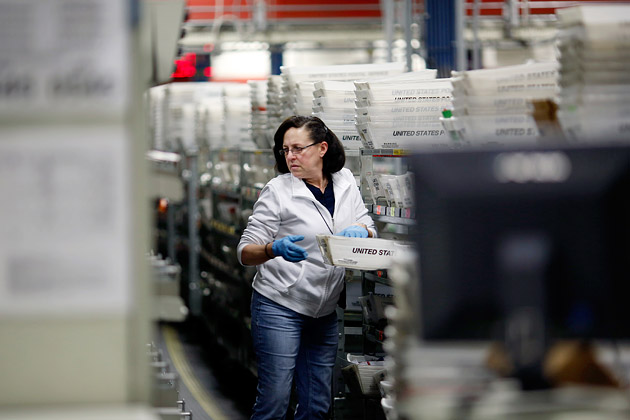
workerConsidering the many dire predictions about the perils of the out-of-date business model of the United States Postal Service, one might surmise that its very future is in doubt.

But then we read the following news about the upcoming holiday mail season:

  • 15 billion+ pieces of mail are expected to be processed by the USPS this holiday season.
  • That represents an increase of ~10.5% compared to last year.
  • Of the 15 billion items processed, more than 500 million will be packages.

There’s a new benefit being offered to USPS customers, too. Ahead of the holiday season, the USPS is now offering real-time delivery notification.  People who register will receive real-time e-mail alerts when delivery scans are made by postal workers.

That new function may well be why the new USPS slogan has been unveiled as “One more reason this is our season.”

Normally, all of the additional volume would be cause for celebration – tapping unused capacity while growing revenues during this busy time of year.

But here’s the rub: In order to handle the added volume, the USPS needs to hire ~30,000 temporary workers.

This could mean that substantially all of the added revenues are immediately sucked out of the USPS’s coffers in order to pay for the added labor resources.

“It’s always something …”

In the “right to be forgotten” battles, Google’s on the defensive again.

untitledSuddenly, the conflict between Google and the European Union countries regarding the censoring of search results has taken on even wider worldwide proportions.

This past week, the courts have upheld the French government’s data protection office (CNIL) order for Google to broaden the “right to be forgotten” by censoring search results worldwide — not just in Europe.

Google had appealed the initial CNIL ruling.

The CNIL rejected Google’s argument that a worldwide implementation of the European standard of censoring search results would mean that the Internet would be only as free as the “least free place.” (Think Belarus or Syria.)  But in its ruling, the CNIL noted that a country-by-country implementation of the “right to be forgotten” would mean that the right could be circumvented too easily.

While it’s true that more than 95% of Google searches in Europe are performed via European versions of the company’s search engine tool, such as google.fr and google.co.uk, identical searches can be performed easily using google.com, meaning that anyone trying to find “forgotten” information on an individual can do so easily, irrespective of the European standard.

file-and-forgetAs I blogged back in May, The European Court of Justice’s 2014 ruling meant that Google is required to allow residents of EU countries to delete links to certain harmful or embarrassing information that may appear about themselves in Google search results.

The directive has turned into a real thicket of challenges for Google.

What the definition of “harmed and embarrassing” is is somewhat amorphous, as the court’s ruling encompassed links to information ranging from excessive and harmful on one end of the scale all the way down to links that are merely outdated, inadequate or irrelevant.

Since the ruling went into effect, Google has had to field requests to remove more than one million links from European search results.

Link removal isn’t accomplished via some sort of “bot” procedure.  Instead, each request is considered on a case-by-case basis by a panel of arbiters made up of attorneys, paralegals and search engineers.

Approximately one-third of the links in question have been removed following panel review, while about half have remained in search results.

The rest – the real toughies – are still under review, and their status as yet unresolved.

Obviously, for this activity to spread from covering just European search engines to include potentially the entire world isn’t what Google has in mind at all.  (If Google could have its way, doubtless the whole notion of “the right to be forgotten” would be off the table.)

But the situation is getting pretty hot now. French authorities imposed a 15-day compliance deadline, after which Google could be fined nearly US$350,000.

Of course, the amount of that penalty pales in comparison to the cost Google would incur to comply with the directive.

But that fine is just the opening salvo; there’s no telling what the full degree of financial penalties might turn out to be for continued non-compliance.

I wrote before that it’s difficult to know where the world will eventually end up on the issue of censoring search engine results.  Today, I don’t think we’re anywhere closer to knowing.

China’s controversial product supplier pledge: An “on the ground” view from the Far East.

The business world is abuzz about the latest moves by China to regulate the behavior of U.S. and other foreign companies that choose to do business in that country.  What’s the real skinny?

contract

While much of the reporting and commentary has been decidedly scant on details, we can actually take a look at the official document that contains the various provisos the Chinese government is intending to impose on foreign companies.

Ostensibly, the declaration is aimed at “protecting user security.” Here are the six provisions that make up the declaration:

Information Technology Product Supplier Declaration of Commitment to Protect User Security

Our company agrees to strictly adhere to the two key principles of “not harming national security and not harming consumer rights” and hereby promises to:

#1.  Respect the user’s right to know. To clearly advise users of the scope, purpose, quantity, storage location, etc. of information collected about the user; and to use clear and easy-to-understand language in the user agreement regarding policies and details of protecting user security and privacy.

#2.  Respect the user’s right to control. To permit the user to determine the scope of information that is collected and products and systems that are controlled; to collect user information only after openly obtaining user permission, and to use collected user information to [sic] the authorized purposes only.

#3.  Respect the user’s right to choice. To allow the user to agree, reject or withdraw agreement for collection of user information; to permit the user to choose to install or uninstall non-essential components; to not restrict user selection of other products and services.

#4.  Guarantee product safety and trustworthiness. To use effective measures to ensure the security and trustworthiness of products during the design, development, production, delivery and maintenance processes; to provide timely notice and fixes upon discovery of security vulnerabilities; to not install any hidden functionalities or operations the user is unaware of [sic] within the product.

#5.  Guarantee the security of user information. To employ effective measures to guarantee that any user information that is collected or processed isn’t illegally altered, leaked, or used; to not transfer, store or process any sensitive user information collected within the China market outside China’s borders without express permission of the user or approval from relevant authorities.

#6.  Accept the supervision of all parts of society. To promise to accept supervision from all parts of society, to cooperate with third-party institutions for assessment and verification that products are secure and controllable and that user information is protected etc. to prove actual compliance with these commitments.

Often with China, there are “official” pronouncements … and then there’s what’s “really” going on behind the curtain.

So to find out the real skinny, I decided to ask my brother, Nelson Nones, who has lived and worked in East Asia for years.  Since Nelson’s business activities take him to China and all of the other key Asian economies on a regular basis, I figured that his perspectives would be well-grounded and worth hearing.  Here’s Nelson’s take:

Points 1 through 3 are fundamentally no different from the provisions of personal data protection laws already on the books in the 27 member states of the European Union, plus Australia, Hong Kong, Iceland, India, Japan, South Korea, Liechtenstein, Macau, Malaysia, New Zealand, Norway, Singapore, the Philippines, Taiwan and some U.S. states.  Nor do they materially differ from privacy policy best practices — so I would not see these as particularly onerous or unreasonable.

The key difference is that these points are not enshrined in law in Mainland China, so compliance is voluntary at the moment (as it was in Singapore until 2013) – presumably binding on only those companies that sign this declaration. 

News reports also indicate that China has asked only American technology companies to sign its Declaration of Commitment, implying that domestic Chinese companies aren’t necessarily held to the same standards — although if this is truly the case, it might actually put Chinese companies at a competitive disadvantage by enhancing the appeal of American technology products to discerning Chinese users.

Point 4 doesn’t generally fall within the scope of existing personal data protection laws, but in my view its provisions fall well within the QA and warranty commitments that any legitimate technology company should be prepared to make in today’s competitive environment.

Comparing Point 5 with legislation currently in force within the European Union, Australia, Hong Kong, Iceland, India, Japan, South Korea, Liechtenstein, Macau, Malaysia, New Zealand, Norway, Singapore, the Philippines, Taiwan and some U.S. states, this point lacks some really key definitions, including:  

  • Who exactly is a “data subject” who is entitled to personal (i.e. user) data protection?
  • Who exactly is the “data controller” who owns the user information that is being collected or processed?
  • Who might be the “data processor” who stores and/or processes user information on behalf of the “data controller”?

EU Data Protection DirectiveThe legislation and regulations I’ve reviewed in this realm provide very explicit (and varied) definitions of these entities. Unlike China’s Declaration of Commitment, for instance, the E.U. Data Protection Directive allows “data controllers” or “data processors” to transfer user data outside the E.U., as long as the country where the data is transferred protects the rights of “data subjects” as much as the E.U. 

It also defines which “data controllers” and “data processors” must comply with E.U. law, based on whether or not they store or process personal information with the E.U., or operate within the E.U. (regardless of where the data is actually stored or processed).

The requirement to keep sensitive user information within China’s borders, in the absence of permission from users or “relevant authorities” to transfer, store or process it elsewhere, could also be seen as an attempt by the Chinese government to enlist the help of American technology companies in circumventing the U.S. government’s ongoing Internet data-gathering programs.

If this attempt succeeds, it might further enhance the appeal of American technology products to discerning Chinese users. 

Point 6 is garnering the most headlines in the West because of the implied threat that cooperating with “third-party institutions for assessment and verification … to prove actual compliance with these commitments” could mean being forced to reveal source code or encryption algorithms.  

However, in classic Chinese style, none of that is actually spelled out. 

Green Dam Youth Escort ServiceA little history about this: Over the past decade, the Chinese government has put forward various proposals for controlling IT – and then abruptly withdrawing them in the face of domestic as well as global criticism. Here are two: 

As for implications, China’s Declaration of Commitment shouldn’t have significant impact on companies that aren’t in the consumer IT market.  At best, its first five points could potentially improve the competitiveness of American IT products in the  Chinese market.    

However, I would advise any tech companies that may be wondering what to do, to sit on their hands for a while. Law in China is always a “work in progress,” so the safest bet is to wait for that “progress” for as long as possible.

So there you have it – the view from someone who is smack in the middle of the business economy in East Asia. If you have your own perspectives to share on the topic, I’m sure other readers would be interested to hear them as well.