The Sanders/Trump phenomenon: A view from outside the United States.

photo1This past Tuesday evening as I watched Bernie Sanders and Donald Trump vanquish their rivals handily in the New Hampshire presidential primary election, I received an e-mail from my brother, Nelson Nones, with his observations on “what it all means.”

As someone who has lived and worked outside the United States for years, Nelson’s views are often quite perceptive — perhaps because he is able to look at things from afar and can see the “landscape” better than those of us who are much closer to the action.

Call it a “forest versus trees” perspective.

And when it comes to the 2016 presidential election, it is Nelson’s view that the Sanders/Trump phenomenon is absolutely real and not something based on personality or celebrity — for good or for ill.

Shown below is what Nelson wrote to me.

… On the Underlying Dynamics

For context into what’s happening in the United States, the Pew Research Center’s recent report on the wealth gap in the United States is instructive.

In a nutshell, over the past 30 years Pew’s data points reveal: 

  • Upper-income families currently represent ~20% of the total, and their wealth (measured by median net worth) has doubled. 
  • Middle-income families represent 46% of the total. Their wealth barely changed (up 2%). 
  • Lower-income families therefore represent ~34% of the total, but their wealth fell 18%.

Now, after the end of the Cold War in 1992 until the onset of the Great Recession in 2007, the wealth of all three groups did rise, albeit by varying degrees: 

  • Upper-income by 112%
  • Middle-income by 68%
  • Lower-income by 30%

Here’s how they fared during the Great Recession (2007-10): 

  • Upper-income wealth declined by 17%
  • Middle-income wealth fell by 39%
  • Lower-income wealth fell by 42%

And after the Great Recession:

  • Upper-income families recovered 36% of their wealth lost during the Great Recession
  • Middle-income families recovered none
  • Lower-income families lost an additional 7% relative to their wealth in 2007

So, if we assume wealth to be a proxy for the feeling of well-being, then one could surmise that ~80% of American families feel like victims today — of which nearly half feel they are still being victimized.  

… On “Anger”

Are people feeling angry about this? You bet.   

Who are they going to blame? The other ~20% and foreigners, of course. 

Never mind the exculpatory hard data proffered by defenders of the nation’s elites revealing that big banks paid back all the bailout money they received during the Great Recession, or that bankers cannot be jailed for their alleged misdeeds unless and until proven guilty by jurors in courts of law (like anyone else), or that pharmaceutical companies’ margins on $45 billion of profit, at 12%, aren’t “quite” as obscene as they appear at first glance.   

None of those facts can ever restore wealth that’s been lost and never recovered, or is still falling. When you feel like a victim, such hard data are utterly and completely irrelevant.  

Both Bernie Sanders and Donald Trump are tapping into this anger with great success. As I watched both Sanders’s and Trump’s victory speeches, to vastly oversimplify, here is what I heard.  Sanders essentially said:

“It’s not fair that most Americans can’t get ahead or are falling behind. I’ll expropriate money from the rich by taxing Wall Street bankers and give it to you in the form of free tuition, student debt restructuring, lower healthcare costs and single-payer healthcare!” 

Trump essentially said:

“Political hacks are negotiating bad deals, letting China, Japan and Mexico take our money away from us every day. As the world’s greatest businessman, I’ll negotiate great deals fast to give you universal healthcare, and beat these countries so you get your money back – without having to share it with all those illegal immigrants!”

Photo2In my view, what both Sanders and Trump recognize is that ~80% of American families may have lost 40% of their wealth since 2007 with little or no hope of recovering it … but they haven’t lost any of their voting power.  

It makes no difference that the prescriptions offered by Sanders and Trump – squeezing money from Wall Street, China, Japan and Mexico, for example – are nonsense. As a lawyer I once knew always said, “Winning isn’t everything; it’s the only thing.”  To have any chance of accomplishing something useful (or not) as President, you have to win first.   

… On Populism being the Winning Ticket

In this election, under present circumstances, populism is a sure winner. 

The wealthiest ~20% of families (Democrats as well as Republicans) who represent the “establishment” in the eyes of the angry Sanders and Trump crowds, don’t quite smell the coffee yet.  

The angry crowds are out for money this election cycle, and I believe they hold enough votes to elect one of the two populist candidates (Sanders or Trump) who is promising “money.”   

… Not “experience,” “pragmatism,” “conservativism,” “liberalism,” “socialism,” “limited government,” “feminism,” “pro-life,” “pro-choice,” “pro-LGBT,” “hope,” “change,” or whatever.  But money.

To protect as much of their wealth and status as they can, the elites have little choice but to scuttle their aspirational platitudes and learn to deal with it.

So there you have it — a view of the presidential election from the outside looking in. I think there’s food for thought here — and very possibly a look at where we’ll be in another nine months.

What do other readers think? Agree or disagree?  Please share your observations here.

A nation of “haves” vs. “have-nots”? Gallup tests the perceptions.

pictureIn any presidential political season, there’s always plenty of rhetoric about the American economy, how well it’s performing for the average voter, and people’s perceptions of how they’re doing socioeconomically.

As it turns out, the Gallup Survey has been testing this issue annually for years now — going all the way back to 1988.

The question posed to Americans in Gallup’s surveys is a simple one: Do you consider yourself personally to be part of the “haves” or “have-nots” in America?

Gallup’s latest survey was fielded in July 2015.  Nearly 2,300 U.S. adults aged 18 and older were part of the research.

In response to the “haves vs. have-nots” question, ~58% of respondents considered themselves to be “haves” in U.S. society, while ~38% placed themselves in the “have-nots” segment. (The remaining ~14% see themselves borderline between the two, or they don’t have an opinion.)

Over time, Gallup has found that the percentage of Americans who perceive themselves to be part of the “have-nots” in society rose pretty steadily from 1988 to 1998, but since that time the percentages have leveled off — even during the worst years of the Great Recession from 2009-2011.

And so, the “haves” percentage has fluctuated in a tight band between 57% and 60% in each year since the late 1990s.

It seems that heightened discussions about social inequality in America haven’t resulted in a higher percentage of people thinking that they are on the less fortunate side of the country’s socioeconomic divide.

However, considering that the latest Gallup survey was conducted in July 2015 — and that since that time there have been more news events drawing attention to the issues of social justice — one wonders if we may be on the cusp of some changing thinking on the subject.

Another persistent finding in Gallup’s surveys is this:  Even among families of quite modest means (annual household incomes of $35,000 or lower), only a little more than half in that segment consider themselves to be part of the “have-nots” group.

Education-wise, the survey findings are similar, with fewer than half of the respondents who don’t possess college degrees considering themselves part of the “have-nots” segment.

In reporting on the Gallup survey results, an article published in the November 2015 issue of Quirk’s Marketing Research Review magazine stated:

“The stratification of U.S. society into unequal socioeconomic groups has long been a fixture of philosophic, political and cultural debate. It appears to have remained or even expanded as a fairly dominant leitmotif in the ongoing 2016 election, particularly among the Democratic presidential candidates. 

[Nevertheless,] the results … in this analysis show that a majority of U.S. adults do not think of American society as being divided along economic lines, and a slightly higher percentage say that if society is divided, they personally are on the ‘haves’ side of the equation rather than the ‘have-nots.'”

More information about the Gallup survey results can be viewed here.

What are your thoughts? Do the perceptions Americans have of socioeconomic inequality — or the lack of it — match the reality?  Or are we poised to see some new significant shifts in the way Americans view socioeconomic divisions in this country?

How to Lie with Statistics: Commercial Airlines Edition

airlineIt’s become rather predictable. Government pronouncements claim that because the national unemployment rate is down to around 5%, it means that the U.S. economy is humming along.

But in fact, that conclusion doesn’t square neatly with the reality that the unemployment percentage is calculated based on the lowest level of workplace participation in decades.

So, which is it?  A strong economic upturn … or a middling recovery?  When the average citizen is the judge rather than breathless PR flacks, it’s the latter.

The same could be said about the airlines.

The amount of “happy-talk” about passenger airline travel is quite high these days.  Some of the news is undoubtedly welcome:  The lowest jet fuel prices in recent memory are making it cheaper to fly cross-country today than in years.

But upon further scrutiny, another spate of good news seems to be little more than blue smoke and mirrors. For a number of years now, the passenger airlines have been crowing about their on-time flight arrival performance.

The statistics purport to show that on-time performance rates for commercial airlines have been steadily improving.

But look a little closer … and the skies aren’t quite as clear-blue as all that.

A study by OAG Aviation Worldwide, a UK-based analytical firm that analyzes travel data, finds that airlines have been padding their flight-time schedules going on 20 years now.

Here’s a representative example of what’s been happening:  OAG evaluated 1,400+ commercial flights scheduled between Los Angeles International Airport and San Francisco International Airport.  Back in 1996, not even one of the flights between these two airports was scheduled to take longer than 90 minutes.

And yet … by 2015 the airlines had allotted flight times of between 91 and 110 minutes for nearly half of the flights scheduled between those two airports.

Of course, it’s axiomatic that if the scheduled flight times are lengthened upwards of 10%, that will take a so-so on-time flight arrival statistic and transform it overnight into a pretty impressive one.

… And the transformation’s been accomplished without changing a thing where it actually counts: on the ground (or in the air, I could say).

logoFor the record, no one at the airlines is acknowledging this statistical sleight-of-hand. Asked to comment on the OAG study’s findings, a spokesperson for the trade group Airlines for America (A4A) responded with this rather mealy-mouthed statement:

“We have the same goals as our customers, which is to get them, their luggage and packages to their destination safety and on time.”

Well, at least they’re not fudging on the safety part …

Suddenly, GoPro isn’t so “Go-Go” …

untitled2Most likely, I’ll never be a GoPro customer.

The only direct interaction I’ve had with the maker of action cameras was several years ago during the Great Target Credit Card Breach of 2013, when suddenly a half-dozen GoPro purchases mysteriously appeared on my card statement.

But other than that, my connection with GoPro and its line of cameras has been nonexistent — which isn’t at all surprising considering that at my age, I’m hardly an “action adventurer.”

Unfortunately for GoPro, many other people aren’t, either – and it’s one reason why the company’s financial results have been pretty ugly coming off of the most recent holiday season.

This past week, GoPro announced that it is cutting nearly 10% of its workforce (more than 100 people) because of weak sales during the 4th Quarter.

In a holiday quarter when product purchases should have grown revenues considerably, the weaker-than-expected sales volume of ~$435 million meant that GoPro’s revenues were far short of the $510 million originally projected.

From the financial market’s perspective, this news was sufficiently negative that trading of GoPro shares had to be halted briefly this past Wednesday.

untitled
GoPro shares over the past six months.

The company promises to divulge more information about its financial results in early February, but some observers are already beginning to paint the picture of what’s out of kilter:

  • GoPro misjudged the price consumers were willing to pay for its Hero4 Session cube cam, introduced in July 2015, resulting in two dramatic drops of the sticker price in September and December down to $199. 
  • Competitors are entering the field, putting further downward pressure on pricing. 
  • There’s a ceiling on the demand for action cameras because “action adventurer” consumers are such a small slice of the general population.

But does any of this come as a particular surprise?

Like in any other consumer electronics product category, the trajectory of high growth among early adopters leads to new market entrants, followed by the hardware becoming essentially a commodity.

… And the whole process is as swift as it is inevitable.

GoPro is branching into newer segments like camera drones — and not a moment too soon. But the reality is that in a product segment like action cameras, any supplier will always be just one step ahead of commoditization.  And for this reason, product mix reinvention has to be happening continuously.

The disappearing American middle class? The Pew Research Center weighs in.

mcIn this political season in the United States — when is it ever not, one wonders? — we hear many of the presidential candidates refer to the so-called “crisis” of the middle class.

It matters not the political party nor ideological stripe of the candidate, we hear copious references to “the disappearing middle class” … the “middle class squeeze” … and that the middle class is “just getting by.”

Considering that the middle class income group represent the single largest block of voters in the country, it isn’t at all surprising that the presidential contenders would talk about middle class issues — and to middle class voters — so frequently.

The question is … is the hand-wringing warranted?

PewWell, if one believes a new Pew Research study on the subject, it may well be the case.

Based on its most recent analysis of government data going back nearly 50 years, Pew reports that there are now fewer Americans in the “middle” of the economic spectrum than at the lower and upper ends.

This is a major development, and it is new.

Pew defines a middle class household as one with annual income ranging from ~$42,000 to ~$126,000 during 2014. Using that definition, Pew calculates that there are now 120.8 million adults living in middle class households, but 121.3 million who are living in either upper- or lower-income households.

Pew characterizes this new set of figures as a kind of tipping point. And it helps to underscore the narrative wherein certain presidential candidates — you-all know which ones — are tapping into a collective “angst” about the decline in middle-income families, and the notion that they are falling behind compared to upper-income adults while unable to access many of the support services available to lower-income households.

Looking at things in a bit more depth, however, one can find explanations — as well as other data points that go against the “narrative” to some degree. Consider the following:

  • Senior citizens have done quite well shifting into the upper category since the 1970s — their share increasing by well over 25% in the upper-income bracket.
  • African-Americans have experienced the largest increase in income status over the same period, meaning that their lower-income category share is lower today.
  • The rapid rise in the number of immigrants in the late 20th century has pushed down median incomes because those new arrivals, on average, make less in income.

I suspect the Pew study findings will be fodder for more discussion — and perhaps some additional sloganeering — in the upcoming weeks and months. But you can judge for yourself whether that’s warranted by reviewing more findings from Pew’s report here.

If you have your own perspectives about what’s happening with (or to) the middle class, I’m sure other readers would be quite interested in hearing them.  Please share your comments here.

“Immigration Nation”: Pew Research Projects U.S. Population Demographics into the Future

immigrantsI’ve blogged before about the immigration issue and its potential impact on the U.S. economy and society.

Now the Pew Research Center has released a report that predicts the U.S. becoming a “no ethnic majority” nation within the next 35 years.

When one considers that the United States population was nearly 85% white Anglo in 1965 … and that percentage has dropped to about 62% now, it isn’t that hard to imagine Pew’s prediction coming true.

Here’s the trajectory Pew predicts over the coming ten-year periods:

  • 2015: ~62% estimated U.S. white Anglo population percentage
  • 2025: ~58% projected white Anglo population percentage
  • 2035: ~56% projected
  • 2045: ~51% projected
  • 2055: ~48% projected
  • 2065: ~46% projected

Perhaps what’s more intriguing is that Pew projects the largest future percentage gains will be among Asian-Americans rather than Latino or Black Americans. The Asian share of the American population is expected to double over the period:

  • 2015: ~6% estimated U.S. Asian population percentage
  • 2025: ~7% projected Asian population percentage
  • 2035: ~9% projected
  • 2045: ~10% projected
  • 2055: ~12% projected
  • 2065: ~14% projected

If these projections turn out to be accurate, the Asian population percentage is on tap to become the nation’s third highest group.

By contrast, the Hispanic population, while continuing to grow, looks as if it will level off at about 22% of the country’s population by 2045. For Black Americans, Pew projects the same dynamics at work, but at the 13% level.

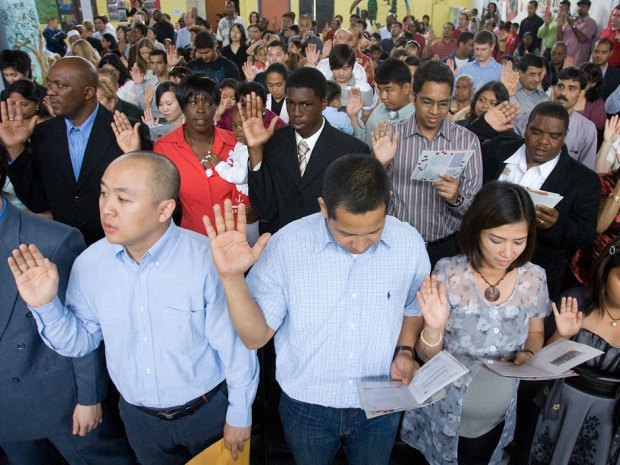
citizenship ceremonyAccording to Pew’s analysis, the biggest driving force for the projected Asian population growth is immigration. By 2055, Pew expects that Asians will supplant Latinos as the largest single source of immigrants — and by 2065 the difference is expected to be substantial (38% Asian vs. 31% Latino immigrants).

Conducted in parallel with Pew’s projection analysis was an online opinion research survey of American adults (18 and over) it conducted in March and April of this year.

Among the attitudinal findings Pew uncovered were these:

  • “Immigrants in the U.S. are making society better”: ~45% of respondents agree … ~37% disagree
  • “I would like to see a reduction in immigration”: ~50% agree
  • “I would like to see the immigration system changed or completely revamped”: ~80% agree

Again, no great surprises in these figures — although if one paid attention only to news accounts in the “popular media,” one might find it surprising to learn that a plurality of Americans actually consider immigration a net positive for American society …

Additional findings from the Pew survey as well as its demographic projections can be found here.

“Boomerang employees”: No longer such a rarity in the corporate world.

Time was, once a person left a company – for whatever reason – the likelihood that they’d ever come back to work there was pretty slim.

Perhaps to be re-engaged as a consultant or a contract worker … but as a return employee? Not likely at all.

That mindset appears to be changing.  Data accumulated from a recent survey by HR research and advisory firm Workplace Trends from ~1,800 human resources executives, managers of staff, and employees provide the following clues:

  • Half of the HR professionals responding to the survey claimed that their organization once had formal policies against rehiring former employees (even if the employee had departed in good standing).
  • Three-fourths of the HR respondents reported that they are more accepting of hiring boomerang employees today. More than half of the respondents who are people managers felt the same way.

The actual incidence of returning to work at a former company isn’t all that common.  Of the employees who took part in the survey, fewer than 15% of them fell into this category.

Still, 15% is way up from where it has been traditionally — and the current percentage is higher than I would have guessed.

What’s more, nearly 40% of employee respondents reported that they would consider going back to an employer where they had once worked.

There are distinct differences in employee attitudes based on age demographics: More than 45% of Millennials would consider returning to work for a former employer … but the percentage is just 29% for Baby Boomer respondents.

As for why boomerang employees are becoming more common, a number of factors are at play:

  • Intense competition for certain technically advanced employees who may be in short supply makes poaching more common … and also intensifies the need for companies to respond in kind. In fields were strong talent is hard to come by, often the pool of workers is too small to summarily omit former employees from consideration.
  • Familiarity with a company’s organization, culture and ways of doing business reduces “ramp-up” requirements and the amount of training needed, when compared to bringing on a brand-new employee.
  • The “devil you know” factor: Even if a former employee possesses a few characteristics that are less-than-ideal, at least these are known quantities, as compared to a brand-new employee who may or may not be all that she or he seems to be on paper.

chairGoing forward, I suspect that boomerang employees will become even more prevalent than they are today.

To do well at that, companies might wish to look into maintaining open lines of communication with select former employees. It seems like a good way to keep choice workers “in the loop” and potentially available — and interactive/social media makes it easier to keep those channels open.

As things stands now, the results of this survey suggest that such channels are, at best, ad hoc rather than being part of a formal “alumni” communications strategy.

Addressing this point, Dan Schawbel, head of WorkplaceTrends, had this to say:

“In previous research we’ve done, we’ve found that Millennials are switching jobs every two years because they are searching for the job – and organization – of best fit. But this new study indicates that this younger generation is more likely to boomerang back when they’ve experienced other company cultures and realized what they’ve missed.”

Schawbel’s prediction? “We’ll see the boomerang employee trend continue in the future as more employees adopt a ‘free agent’ mentality – and more organizations create a stronger alumni ecosystem.”

What about you? Are you a boomerang employee? Or do you know colleagues who have done this? What are the pluses and minuses? Please share your thoughts with other readers here.

China’s controversial product supplier pledge: An “on the ground” view from the Far East.

The business world is abuzz about the latest moves by China to regulate the behavior of U.S. and other foreign companies that choose to do business in that country.  What’s the real skinny?

contract

While much of the reporting and commentary has been decidedly scant on details, we can actually take a look at the official document that contains the various provisos the Chinese government is intending to impose on foreign companies.

Ostensibly, the declaration is aimed at “protecting user security.” Here are the six provisions that make up the declaration:

Information Technology Product Supplier Declaration of Commitment to Protect User Security

Our company agrees to strictly adhere to the two key principles of “not harming national security and not harming consumer rights” and hereby promises to:

#1.  Respect the user’s right to know. To clearly advise users of the scope, purpose, quantity, storage location, etc. of information collected about the user; and to use clear and easy-to-understand language in the user agreement regarding policies and details of protecting user security and privacy.

#2.  Respect the user’s right to control. To permit the user to determine the scope of information that is collected and products and systems that are controlled; to collect user information only after openly obtaining user permission, and to use collected user information to [sic] the authorized purposes only.

#3.  Respect the user’s right to choice. To allow the user to agree, reject or withdraw agreement for collection of user information; to permit the user to choose to install or uninstall non-essential components; to not restrict user selection of other products and services.

#4.  Guarantee product safety and trustworthiness. To use effective measures to ensure the security and trustworthiness of products during the design, development, production, delivery and maintenance processes; to provide timely notice and fixes upon discovery of security vulnerabilities; to not install any hidden functionalities or operations the user is unaware of [sic] within the product.

#5.  Guarantee the security of user information. To employ effective measures to guarantee that any user information that is collected or processed isn’t illegally altered, leaked, or used; to not transfer, store or process any sensitive user information collected within the China market outside China’s borders without express permission of the user or approval from relevant authorities.

#6.  Accept the supervision of all parts of society. To promise to accept supervision from all parts of society, to cooperate with third-party institutions for assessment and verification that products are secure and controllable and that user information is protected etc. to prove actual compliance with these commitments.

Often with China, there are “official” pronouncements … and then there’s what’s “really” going on behind the curtain.

So to find out the real skinny, I decided to ask my brother, Nelson Nones, who has lived and worked in East Asia for years.  Since Nelson’s business activities take him to China and all of the other key Asian economies on a regular basis, I figured that his perspectives would be well-grounded and worth hearing.  Here’s Nelson’s take:

Points 1 through 3 are fundamentally no different from the provisions of personal data protection laws already on the books in the 27 member states of the European Union, plus Australia, Hong Kong, Iceland, India, Japan, South Korea, Liechtenstein, Macau, Malaysia, New Zealand, Norway, Singapore, the Philippines, Taiwan and some U.S. states.  Nor do they materially differ from privacy policy best practices — so I would not see these as particularly onerous or unreasonable.

The key difference is that these points are not enshrined in law in Mainland China, so compliance is voluntary at the moment (as it was in Singapore until 2013) – presumably binding on only those companies that sign this declaration. 

News reports also indicate that China has asked only American technology companies to sign its Declaration of Commitment, implying that domestic Chinese companies aren’t necessarily held to the same standards — although if this is truly the case, it might actually put Chinese companies at a competitive disadvantage by enhancing the appeal of American technology products to discerning Chinese users.

Point 4 doesn’t generally fall within the scope of existing personal data protection laws, but in my view its provisions fall well within the QA and warranty commitments that any legitimate technology company should be prepared to make in today’s competitive environment.

Comparing Point 5 with legislation currently in force within the European Union, Australia, Hong Kong, Iceland, India, Japan, South Korea, Liechtenstein, Macau, Malaysia, New Zealand, Norway, Singapore, the Philippines, Taiwan and some U.S. states, this point lacks some really key definitions, including:  

  • Who exactly is a “data subject” who is entitled to personal (i.e. user) data protection?
  • Who exactly is the “data controller” who owns the user information that is being collected or processed?
  • Who might be the “data processor” who stores and/or processes user information on behalf of the “data controller”?

EU Data Protection DirectiveThe legislation and regulations I’ve reviewed in this realm provide very explicit (and varied) definitions of these entities. Unlike China’s Declaration of Commitment, for instance, the E.U. Data Protection Directive allows “data controllers” or “data processors” to transfer user data outside the E.U., as long as the country where the data is transferred protects the rights of “data subjects” as much as the E.U. 

It also defines which “data controllers” and “data processors” must comply with E.U. law, based on whether or not they store or process personal information with the E.U., or operate within the E.U. (regardless of where the data is actually stored or processed).

The requirement to keep sensitive user information within China’s borders, in the absence of permission from users or “relevant authorities” to transfer, store or process it elsewhere, could also be seen as an attempt by the Chinese government to enlist the help of American technology companies in circumventing the U.S. government’s ongoing Internet data-gathering programs.

If this attempt succeeds, it might further enhance the appeal of American technology products to discerning Chinese users. 

Point 6 is garnering the most headlines in the West because of the implied threat that cooperating with “third-party institutions for assessment and verification … to prove actual compliance with these commitments” could mean being forced to reveal source code or encryption algorithms.  

However, in classic Chinese style, none of that is actually spelled out. 

Green Dam Youth Escort ServiceA little history about this: Over the past decade, the Chinese government has put forward various proposals for controlling IT – and then abruptly withdrawing them in the face of domestic as well as global criticism. Here are two: 

As for implications, China’s Declaration of Commitment shouldn’t have significant impact on companies that aren’t in the consumer IT market.  At best, its first five points could potentially improve the competitiveness of American IT products in the  Chinese market.    

However, I would advise any tech companies that may be wondering what to do, to sit on their hands for a while. Law in China is always a “work in progress,” so the safest bet is to wait for that “progress” for as long as possible.

So there you have it – the view from someone who is smack in the middle of the business economy in East Asia. If you have your own perspectives to share on the topic, I’m sure other readers would be interested to hear them as well.

Six years on … and the U.S. ad economy is still in recession?

recession recoveryTwo reports from advertising research sources released in the past month reveal that the advertising field doesn’t appear to be rebounding in strongly – at least not to same degree as the economy as a whole.

One report, from U.S. Ad Market Tracker, is an index that pools electronic media buys processed by major agency holding companies and their brand marketers.

It’s true that this report shows an increase in the overall ad activity index year-over-year of about 18 points (it’s 184 today … 166 a year ago … and 100 back in the recession year of 2009).

But when we look at the breakdown where most of the advertising growth is coming from, it’s nearly all from a handful of categories: social media advertising, advertising on video, Internet radio, plus ad network marketplaces.

By contrast, search advertising is growing at a much slower rate, and the most “commoditized” segments – particularly online display advertising – are doing little better than treading water.

This isn’t the robust rebound that many business and ad industry observers were expecting to see by 2015.

advertisingOver at Kantar Media, the statistics are even less encouraging.

In fact, Kantar projects that the 2015 ad economy will underperform U.S. economic growth for the fifth straight year.

Considering how lethargic in general the U.S. economy has been over that period, to be growing at less than the average is almost an indictment of the industry.

That’s what Kantar Media Chief Research Officer Jon Swallen suggests:  a “streak that might have once seemed unimaginable, but now would seem par for the course.”

Second-quarter 2015 data released by Kantar estimates annualized measured media ad spending declines in the neighborhood of 4%.

More to the point, Kantar is seeing increases in just 7 of the 22 individual ad media categories it tracks, led by the same categories U.S. Ad Market Tracker identifies as the most healthy ones.

Perhaps a surprise — considering the overall disappointing numbers — is that Kantar has tracked two analogue categories as experiencing growth:  radio and out-of-home advertising.

But print continues to decline at pronounced rates, and Internet display advertising has also officially joined the ranks of media segments that are contracting.

Is the disappointing performance of advertising a function of a weak market overall?  Or is it the result of structural changes and the reallocation of promo dollars into different, in some cases non-advertising MarComm vehicles?

I’m not completely sure.  It’s true that certain advertising categories that are “newer” ones are attracting more attention (and more dollars).  But Kantar’s 2nd Quarter reporting of advertising expenditures by major industry category finds just one – one – segment that has experienced an overall increase year-over-year — pharmaceuticals:

Ad economy chart

When just one industry segment out of ten is showing an increase, it suggests more than just some restructuring or re-jiggering is going on. Instead, it’s just as likely that the U.S. advertising economy remains stuck in a recession, even if the overall economy has finally emerged from it.

What are your thoughts on the tepid advertising results? Please share your views with other readers.

How China’s economic woes will affect the United States: A view from East Asia.

Chinese economyIt’s only natural for Americans to be somewhat spooked about what’s happening in the financial markets, what with thousand-point drops on the stock exchanges and all.

It’s even more disconcerting to realize that the forces in play are ones that have little to do with the American economy and a lot more to do with Europe and China. (China in particular, where bubbles seem to be bursting all over the place with the fallout being felt everywhere else.)

In times like this, I seek out the thoughts and perspectives of my brother, Nelson Nones, an IT specialist and business owner who has lived and worked outside the United States for nearly 20 years — much of that time spend in the Far East.

To me, Nelson’s thoughts on world economic matters are always worth hearing because he has the benefit of weighing issues from a global perspective instead of simply a more parochial one (like mine).

Nelson Nones
Nelson Nones

Yesterday, I had the opportunity to ask Nelson a few questions about what’s happening in the Chinese economy, how it is affecting the U.S. economy, and what he sees coming down the road. Here are his perspectives:

PLN: What is your view of the Chinese economy — and what does the future portend?

NMN: I’m a real pessimist when it comes to the current state of the Chinese economy. I also think the Chinese will turn on themselves politically as their economic house of cards is collapsing — so look for a sharp upturn in political and social turmoil as well.

Just as the bubble burst in the U.S. and Europe in 2007-08, it’s bursting now in China — and the rest of East Asia (South Korea, Japan, Thailand and Singapore) are going to get caught in the fallout because of the extent to which their economies are reliant on trade with China.

 PLN: What do you look at, specifically, for clues as to future economic movements?

NMN: The barometer to watch is the price of oil. It plummeted in 2007, presaging the “great recession” in the West.

untitledOil prices began to drop again in 2014.  The U.S. oil benchmark fell below $40 per barrel on August 24, 2015, a level not seen since 2009. I believe the underlying root cause is a sharp contraction of East Asian demand due to the economic bubbles bursting over here, coupled with persistently high supply as Middle Eastern oil exporters compete against American producers to protect market share.

PLN: How will these developments affect the U.S. economy?

NMN: The oil bust will continue in the U.S., dragging the economy down. But energy prices will be lower, buoying other parts of the American economy.  For instance, the domestic airline sector will benefit and consequential demand for Boeing jets will grow.

U.S. imports — specifically, imports from China and the rest of East Asia — will become cheaper as China and other countries allow their currencies to fall in order to protect their exports.

This is probably a “net-neutral” for the US economy in that American exports will be hurt due to the relatively stronger U.S. Dollar, but American consumers will benefit from lower prices. So, the direct economic impact is likely to be mixed.

PLN: So, why worry?

NMN: The real risk, in my opinion, is a global liquidity crisis. Over the past quarter-century, China and other East Asian countries have accrued enormous wealth. But they didn’t hoard their newfound wealth; they invested it both domestically and overseas.

China has invested ginormous amounts of cash in domestic infrastructure and housing. That money is already spent, and a sizeable part of the investment has already gone to waste in the form of corruption, new housing that nobody wants, underutilized transport infrastructure and non-performing loans made to inefficient state-owned enterprises. 

All of this will eventually need to be written off (that’s why their bubble is bursting).

But China has also invested lots of money in overseas financial instruments. Think of the Chinese as the folks who financed the Federal Reserve’s Quantitative Easing program as well as Federal debt in the U.S. But as the Chinese run out of cash at home, they will increasingly need to liquidate their overseas investments just to pay their bills.

This poses a very real threat to the fiscal stability of U.S. and European governments, and to the supply of capital in U.S. and European financial markets.

The Federal Reserve is likely to be caught in a double-bind. On the one hand, if the Fed raises interest rates in response to the reduced supply of capital (as it is widely assumed they will, later this year), they risk choking off the tepid U.S. recovery currently underway.

This would also cause the U.S. Dollar to strengthen further, thereby exacerbating the negative impact of the Chinese bust by making U.S. exports less competitive in global markets.

On the other hand, if the Fed leaves interest rates where they are (basically zero), then they won’t be able to attract enough capital to roll over the public debt that the Chinese are trying to liquidate. In other words, the Fed risks a “run on the bank.”

The Fed can deal with this by printing more money (more or less what the Chinese did in 2007-8), but this would inevitably introduce inflationary pressures in the U.S. It would also lengthen the time it takes for the Chinese to right their ship, because it will put downward pressure on the U.S. Dollar, thereby constraining whatever the East Asians can do to boost exports.

My guess is that the Federal Reserve will “blink” and keep interest rates at zero (and also print more money to pay off the Chinese) in hopes that (somewhat) cheaper imports will offset (some of) the inflationary impact of printing more money.

This is equivalent to kicking the can down the road.

PLN: Do you see any impact on the 2016 Presidential race in the United States?

NMN: As a result of kicking the can down the road, I foresee little impact on the 2016 U.S. Presidential race — but watch out in 2020 when the hangover is well underway.

Alternatively if the Fed raises interest rates, I suspect the Democratic Party candidate will be more vulnerable because the short-term economic pain will be much higher in the U.S. The incumbent party will get most of the blame. Fair or not, that’s just the way bread-and-butter issues play out in American politics.

PLN: What about unrest in China — might that have political repercussions in America? 

NMN: The way I see it, political or social turmoil in China will have zero impact on the U.S. Presidential race. Americans of nearly every political stripe or ideology dislike or distrust Chinese governance, yet unlike the “China lobby” of the Cold War era, they have no appetite to intervene in what they rightly perceive to be internal Chinese affairs.  

Or they’re clueless about events in East Asia. Or they just don’t care.

So there you have it — a view from the Far East. If you have other perspectives, please share them with our readers here.

______________

Update (8/28/15):  A few days after this post was uploaded, I received this follow-up from Nelson:

Just as I had predicted, check out this link.  Federal debt is getting more expensive to finance, because the drop in demand for U.S. Treasury bonds (caused by the Chinese liquidation apparently underway) is driving yields up.  According to the article, “The liquidation of such a large position, if it continues, could wreak havoc on the Treasuries market.”
Now look here:  http://www.bloombergview.com/quicktake/federal-reserve-quantitative-easing-tape. It’s an easily understandable explanation of how the Federal Reserve’s quantitative easing (QE) program worked.  Essentially the Fed, like China, stepped in to buy Treasuries also. The Fed also bought mortgage-backed securities.
The Fed’s purchases of Treasuries and mortgage-backed securities now make up ~85% of the Fed’s assets.  The Fed hasn’t indicated what it will do when these assets mature, but if it doesn’t roll over this debt (or a portion thereof) then we can expect Treasury yields to rise yet again. Even if the Fed decides to keep interest rates where they are, at near-zero, rising Treasury yields could bring on a liquidity crunch within the private sector as capital is increasingly drawn away from private investments (loans, corporate bonds and equities) to government-issued bonds paying higher yields with little risk.
Facing the Chinese liquidation, this is why I suspect the Fed will opt to roll over its holdings of Treasuries and mortgage-backed securities, and keep interest rates at near-zero, at least through the 2016 Presidential election cycle.  The Bloomberg article cited above describes QE as an alternative to printing more money, but in the end it’s really the same thing.