Twitter is looking more and more like the old, hidebound player in social platforms.

tWe’ve been hearing for a while now that Twitter’s go-go-days might be in the rear-view mirror.

But even so, the latest growth forecast for the company still seems pretty shocking for a “new media” participant.

In its most recent forecast of Twitter usage in the United States, eMarketer has lowered its projections of Twitter growth in usage to essentially “treading water” status.

More specifically, digital data research company eMarketer forecasts that by the end of the year, ~52 million U.S. consumers will be accessing their Twitter accounts at least once per month.

That will represent just a 2% increase for the year.

Long-term growth prospects for Twitter don’t look any better. At one point, eMarketer was forecasting growth estimates of nearly 14 million new Twitter users by 2020.  But today, that forecast has been downgraded significantly to only about 3.5 million new users.

In the world of social media platforms, such paltry growth expectations mean that Twitter’s share of domestic social network users will continue to decline. (It’s at around 28% now, which is already a bit of a drop from last year.)

What’s making Twitter seem like such a “passé player” in the go-go world of social media? Oscar Orozco, an analyst at eMarketer, sums up its challenges succinctly:

“Twitter continues to struggle with growing its user base because new users often find the product unwieldy and difficult to navigate, which makes it challenging to find long-term value in being an active user. Also, [Twitter’s] new product initiatives have had little impact in attracting new users.”

Who’s eating into Twitter’s market presence? How about Snapchat and Instagram, for starters.  A host of other messaging apps are also hurting Twitter’s growth prospects.

It hasn’t helped that Twitter has been struggling mightily to monetize its service offering. While it has made valiant efforts to do so, Facebook and LinkedIn have done a more effective job of leveraging their massive user data into attracting advertising dollars.

Facebook is a cash machine … LinkedIn does a respectable job … while Twitter seems almost hopeless by comparison.

After flying high for so long – even to the degree that many companies still speak about social media as one mashup term “Facebook-Twitter-LinkedIn,” Twitter’s decline is all the more surprising.  Poignant, even.

Journalism’s Slow Fade

jjLate last month, the 2016 Lecture Series at the Panetta Institute for Public Policy in Carmel, CA hosted a panel discussion focusing on the topic “Changing Society, Technology and Media.”

The panelists included Ted Koppel, former anchor of ABC News’ Nightline, Howard Kurtz, host of FAX News’ Media Buzz, and Judy Woodruff, co-anchor and managing editor of the PBS NewsHour show.

During the discussion, Ted Koppel expressed his dismay over the decline of journalism as a professional discipline, noting that the rise of social media and blogging have created an environment where news and information are no longer “vetted” by professional news-gatherers.

One can agree or disagree with Koppel about whether the “democratization” of media represents regression rather than progress, but one thing that cannot be denied is that the rise of “mobile media” has sparked a decline in the overall number of professional media jobs.

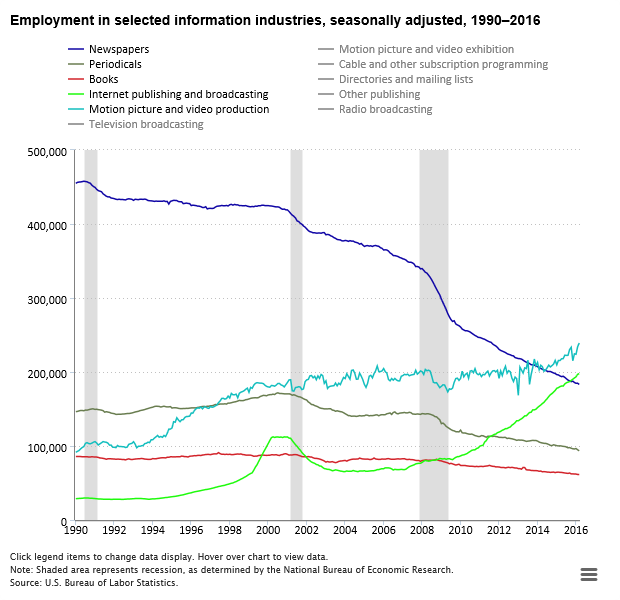
Data from the Bureau of Labor Statistics can quantify the trend pretty convincingly. As summarized in a report published in the American Consumers Newsletter, until the introduction of smartphones in 2007, the effect of the Internet on jobs in traditional media, newspapers, magazines and book had been, on balance, rather slight.

To wit, between 1993 and 2007, U.S. employment changes in the following segments looked like this:

  • Book Industry: Net increase of ~700 jobs
  • Magazines: Net decline of ~300 jobs
  • Newspapers: Net decline of ~79,000 jobs

True, the newspaper industry had been hard hit, but other segments not nearly so much, and indeed there had been net increases charted also in radio, film and TV.

But with the advent of the smartphone, Internet and media access underwent a transformation into something personal and portable. Look how that has impacted on jobs in the same media categories when comparing 2007 to 2016 employment:

  • Book Industry: Net loss of ~20,700 jobs
  • Magazines: Net loss of ~48,400 jobs
  • Newspapers: Net loss of ~168,200 jobs

Of course, new types of media jobs have sprung up during this period, particularly in Internet publishing and broadcasting. But those haven’t begun to make up for the losses noted in the segments above.

According to BLS statistics, Internet media employment grew by ~125,300 between 2007 and 2016 — but that’s less than half the losses charted elsewhere.

All told, factoring in the impact of TV, radio and film, there has been a net loss of nearly 160,000 U.S. media jobs since 2007.

employment-trends-in-newspaper-publishing-and-other-media-1990-2016

You’d be hard-pressed to find any other industry in the United States that has sustained such steep net losses over the past decade or so.

Much to the chagrin of old-school journalists, newspaper readership has plummeted in recent years — and with it newspaper advertising revenues (both classified and display).

The change in behavior is across the board, but it’s particularly age-based. These usage figures tell it all:

  • In 2007, ~33% of Americans age 18 to 34 read a daily newspaper … today it’s just 16%.
  • Even among Americans age 45 to 64, more than 50% read a daily newspaper in 2007 … today’s it’s around one third.
  • And among seniors age 65 and up, whereas two-thirds read a daily paper in 2007, today it’s just 50%.

With trends like that, the bigger question is how traditional media have been able to hang in there as long as they have. Because if it were simply dollars and cents being considered, the job losses would have been even steeper.

Perhaps we should take people like Jeff Bezos — who purchased the Washington Post newspaper not so long ago — at their word:  Maybe they do wish to see traditional journalism maintain its relevance even as the world around it is changing rapidly.

In the Facebook-faceprint tussle, score one for the little guys.

Is that Maria Callas? Check with Facebook -- they'll know.
Is that Maria Callas? Check with Facebook — they’ll know.

I blogged last year about privacy concerns surrounding Facebook’s “face geometry” database activities, which have led to lawsuits in Illinois under the premise that those activities run afoul of that state’s laws regarding the use of biometric data.

The Illinois legislation, enacted in 2008, requires companies to obtain written authorization from subjects prior to collecting any sort of face geometry or related biometric data.

The lawsuit, which was filed in early 2015, centers on Facebook’s automatic photo-tagging feature which has been active since around 2010. The “faceprints” feature – Facebook’s term for face geometry – recognizes faces based on the social network’s vast archive of users and their content, and suggests their names when they appear in photos uploaded by their friends.

The lawsuit was filed by three plaintiffs in a potential class-action effort, and it’s been mired in legal wrangling ever since.

From the outset, many had predicted that Facebook would emerge victorious.  Eric Goldman, a law professor at Santa Clara University, noted in 2015 that the Illinois law is “a niche statute, enacted to solve a particular problem.  Seven years later, it’s being applied to a very different set of circumstances.”

But this past week, a federal judge sided not with Facebook, but with the plaintiffs by refusing to grant a request for dismissal.

In his ruling issued on May 5th, U.S. District Court Judge James Donato rejected Facebook’s contention that the Illinois Biometric Privacy Information Act does not apply to faceprints that are derived from photos, but only when it’s based on a source other than photos, such as in-person scans.

The Judge roundly rejected this contention as inconsistent with the purpose of the Illinois law. Donato wrote:

“The statute is an informed consent privacy law addressing the collection, retention and use of personal biometric identifiers and information at a time when biometric technology is just beginning to be broadly deployed. Trying to cabin this purpose within a specific in-person data collection technique has no support in the words and structure of the statute, and is antithetical to its broad purpose of protecting privacy in the face of emerging biometric technology.”

This isn’t the first time that the Illinois law has withstood a legal challenge. Another federal court judge, Charles Norgle, sided against Shutterfly recently on the same issues.

And Google is now in the crosshairs; it’s facing a class-action lawsuit filed early this year for its face geometry activities involving Google Photos.

Clearly, this fight has a long way to go before the issues are resolved.

If you have strong opinions pro or con about social networks’ use of face geometry, please share your views with other readers in the comment section below.

The Ugly Other Side of Entrepreneurship

mA few years ago, I recall seeing a film made in India called Three Idiots. It’s a comedy about the college experience in India.  But there’s a serious undertone in that one of the issues dealt with in the movie is the pressure that many students feel about competing for precious few slots in top universities — as well as the pressure to excel once enrolled there.

In one scene, one of the students attempts suicide by jumping from a fourth floor dorm window.

The extreme pressures to succeed aren’t limited to India, of course. For years we’ve been reading articles about equally competitive environments in other countries like China.  Even the United States isn’t immune if one thinks about the elite private colleges and top public universities.

Unfortunately, the drive to succeed often follows students into the professional world in unhealthy ways. Several weeks ago, it was reported that a 33-year-old entrepreneur from Hyderabad, India named Lucky Gupta Agarwal took his own life after an app he had been developing failed to achieve the user acceptance and popularity he had anticipated.

The venture had started promisingly enough. After working for a number of years as a software engineer in a large Mumbai-based company, Mr. Agarwal developed a social networking app he named KQingdom that enables users to chat and photo-blog on the same app while earning rewards points for content created.

Mr. Agarwal believed that the features of his app were ones that were missing from Facebook and other social networking options.  He did many things right: He tested the app with fellow techies and social network users.  The app went through two years of development and alpha/beta testing to ensure that it worked smoothly.

When the app was listed on the Google Play store, it earned a 4.8 out of a possible 5.0 rating.

But Agarwal fell victim to over-rosy projections. He claimed to his family, friends and industry colleagues that the app would become more popular than WhatsApp.  He hired a staff of five to assist in the launch of the product.

As it turned out, after being launched in mid-2014 the app failed to garner the publicity or the engagement levels that Agarwal had anticipated. His financial situation deteriorated.  After having to lay off staff and downsize his operations, the entrepreneur sank into a depression that lasted for months before he ended his life several weeks ago.

In the wake of the news story, in the social commentary I’ve been reading on LinkedIn and elsewhere it seems that Mr. Agarwal’s situation isn’t an isolated one — even if the measures he ultimately took were unusually drastic. Clearly there are many, many other entrepreneurs who encounter a mismatch between their start-up expectations and the harsh reality.

Simply put, too many entrepreneurs don’t plan for failure even as they work for success. Even if a new product sufficiently fills a market need (whereas many of them fail for this fundamental reason), there’s still the challenge of implementing effective marketing and sales strategies, forging an efficient team of employees working together towards a common goal, and fending off nimble competitors who quickly react to new market moves with countermoves of their own.

And one other thing: Looking out from the safety of a job inside an established business, it’s very easy for a would-be entrepreneur to sense the shortcomings of staying in such an environment.  The siren call of becoming the head of one’s very own business is strong.

Unfortunately, many people are ill-prepared temperamentally to be entrepreneurs; it’s a big reason why so few ventures succeed. For every successful entrepreneur, there must be hundreds who fail — or whose efforts never even remotely achieve the level of success anticipated and hoped for.

Tragic incidents like the Agarwal news story remind us of the potentially tragic consequences.

The Federal Trade Commission vs. Native Advertising: Score One for the FTC

ptpbIt’s pretty much a given these days that “native advertising” has it all over traditional advertising when it comes to prompting prospects to try a new product or service. Study after study shows that positive recommendations and ratings from family members, friends, key influencers and even simply fellow users are what prompt people to try it for themselves.

These dynamics mean that suppliers are looking for as many opportunities to publicize their offerings through these native channels as they can.

There’s a bit of a problem, however. Bloggers and other influencers have become wise to this reality — and many are taking it all the way to the bank.  The market is replete with conventions and other events such as the annual Haven Conference, at which these key influencers congregate and “hold court” with suppliers.

While there is no prescribed agenda regarding what’s discussed between suppliers and influencers, generally speaking there’s a whole lot of quid pro quo going on:  Things like receiving copious free samples in exchange for publishing product reviews, receiving monetary payments for mentioning products and brands in blog articles and on social media posts, and more.

One can’t really blame the influencers for peddling their influence to the highest bidder. After all, many successful bloggers and other influential people derive most or all of their livelihood from their online activities.  It’s only natural for someone whose influences ranges widely and deep to expect to be compensated for publicizing a product, a service or a brand — whether or not they themselves think it’s the best thing since sliced bread.

But there’s a growing problem regarding the “pay to play” aspects of native advertising. This past December, the Federal Trade Commission reiterated its opinion that such sweetheart deals are tantamount to advertising, and therefore must be prominently identified as such in online and other informational content.

Of course, including a prominent announcement that payment has been exchanged for an influencer’s commentary significantly lowers the positive impact of native advertising, in that the commentary being valued by consumers precisely because of its inherent objectivity and credibility is no longer much of a hook.

Until recently, it wasn’t clear how strict the FTC was going to be about enforcing its stated policy about disclosing financial remuneration for brand coverage by influencers.

L+TLWell, now we know.  It’s in the form of a settlement reach this month by the FTC with retailer Lord & Taylor over a particular online ad campaign that contained native advertising and social media components.  It’s the first time the FTC has brought an enforcement action since its native ad guidelines were published.

The settlement pertains to a promotional campaign for Lord & Taylor’s Design Lab private-label line of spring dresses. The initiative reached more than 11 million Instagram users, and the particular sundress at the center of the publicity campaign sold out quickly as a result.

The native advertising portion of the promo effort stemmed from an article about DesignLab that appeared in the online magazine Nylon.  That article was paid for by Lord & Taylor, which also reviewed and approved the article’s content prior to publication.

As could be expected, no notification that the piece was a paid ad placement was included when the article was published.

Skating close to the edge even more, the social portion of the promo campaign involved the retailer giving the sundress to approximately 50 top fashion bloggers, along with paying each blogger between $1,000 and $4,000 to model the dress in photos that were then posted to Instagram.

The bloggers were allowed to style the dress in their own way, but they were asked to reference the dress in their posts by using the campaign hashtag #DesignLab as well as @lordandtaylor.

Furthermore, the retailer reviewed and approved these social media posts before they went live, which enabled them to make stylistic edits before-the-fact as well.

Here’s an excerpt from the FTC’s statement about the Lord & Taylor action:

“None of the Instagram posts presented to respondents for pre-approval included a disclosure that the influencer had received the dress for free, that she had been compensated for the post, or that the post was a part of a Lord & Taylor advertising campaign.”

Clearly, the FTC is now putting muscle behind its 2009 opinion (and reiterated last year) that failing to disclose that an endorsement has been paid for is a deceptive practice.

In this particular “test case,” Lord & Taylor is getting off somewhat easy in that there have been no monetary penalties levied against the retailer. However, the company has signed a consent decree that is in place for the next two decades, which would mean “swift and stiff” penalties if the retailer were to transgress in the future.

Other terms of the settlement mandate that Lord & Taylor require its endorsers to sign and submit written statements outlining their obligation to “clearly and conspicuously” disclose any monetary or other material connections they have to the retailer.

Clearly, the Lord & Taylor settlement is a shot across the bow by the FTC, signifying that it means business when it comes to alerting consumers of the financial or other material connections that exist between influencers who are making value judgments on products and services.  In effect, the FTC is saying to the marketing world, “Be very careful …”

It’ll be interesting to see how marketers finesse the challenge of figuring out how to corral the obvious benefits of native advertising while mitigating the dampening effects of “full disclosure.”

Perhaps bloggers and other influencers will need to re-think their own business models as well, seeing as how the “golden goose” of supplier perks seems to have lost some of its luster now.

Stay tuned — this new “lay of the land” is still unfolding.

Antisocial behavior: Major retailers do much better broadcasting on social media than they do responding.

untitledWhen it comes to social media, it turns out that the major U.S. retail brands are a lot better at dishing it out than consuming it.

On the “dishing out” side of the ledger, these retailers have been posting an ever-increasing number of social messages aimed at their target audiences.

A recent report from Sprout Social Index titled Snubbed on Social shows just how much:  In the 3rd Quarter of 2014, the average number of messages deployed by the typical major retailer was around 150, but in the 3rd Quarter of 2015, the number had grown to in excess of 350.

But what happens when these retailers are on the receiving end of social messages? Sprout Social has determined that the typical retailer receives around 1,500 inbound social messages over a busy quarter (such as during the holiday season).

Of these, approximately 40% of the messages are ones that warrant a response.

But only about 1 in 6 – fewer than 20% of them — actually get one.

And those consumers who are fortunate enough to receive a response are waiting approximately 12 hours to get it. That’s up from ~11 hours a year earlier.

One interesting factoid from the Sprout Social reporting is that customer messages on Twitter tend to get a better response from brands.

But it’s the difference between merely poor (~14% on Twitter) and downright embarrassing (~9% on Facebook).

untitledScott Brandt, chief marketing officer at Sprout Social, states it succinctly: “More often than not, brands are silent when their customers reach out.”

What are the implications of this (non-)behavior?

For one thing, interacting with customers helps drive more interesting and more purchases.  Sprout reports that consumers are seven times more likely to respond to social promotions and other social news if they have had meaningful interaction with the brand.

Obviously, ignoring the social messages that come through isn’t the way to build that engagement.

One dynamic that appears to be at work is that brands continue to use social media as a vehicle for broadcast messaging, whereas many consumers view social platforms as the place for a more conversational, two-way level of engagement.

You know – just like social media is supposed to work.

But there are some seemingly intractable reasons why it’s difficult to put the “theory” of social interaction into “practice.”

For starters, there are so many ways for people to communicate with companies and brands today (versus only by letter, phone or in person not that many years ago), that too many businesses are either stretched to thin or simply don’t feel the need to respond urgently if at all.

Another issue is similarly personnel-related. For brands to respond better would mean hiring and training people who possess the authorization to actually do something about a question or concern.  Low-level staff with low wages and benefits and with no authority to resolve issues is a clear ticket to nowhere.

At the very least, putting a process in place that provides a quick response to all inquiries – even if the initial response is auto-generated – is just plain common sense. The value to the consumer of a response that comes within just a few minutes – even if the message was posted in the dead of night – is what makes consumers bond with a brand.  (Just having their existence validated is huge for some people.)

Contrast that to the other, more common experience of brands ignoring their consumers to death … and where people never forget which companies aren’t good at responding to their questions or concerns. Does anyone think that reputation doesn’t have a dampening effect on sales?

More information about the Spout Social Index can be found here.

Our Visual World

vcThe old adage that a picture is worth a thousand words has ever-greater resonance as time goes on. And when visuals come up against text – it’s really no contest at all.

Marcel Just, PhD, who directs the Center for Cognitive Brain Imaging at Carnegie Mellon University in Pittsburgh, PA, states the case plainly:

“Processing print isn’t something the human brain was built for. The printed word is a human artifact.  It’s very convenient and it’s worked very well for us for 5,000 years, but it’s an invention of human beings.   

By contrast, Mother Nature has built into our brain our ability to see the visual world and interpret it. Even the spoken language is much more a ‘given’ biologically than reading written language.”

So it’s fundamental that photos, other pictorial graphics and videos are effective with audiences across the board – not just with certain demographics. This universality makes the visual world so much more universal than the world as seen through an “education level” or a “language” prism.

3M Company has done research to attempt to measure this impact quantitatively. It has found that ~90% of all information transmitted to the brain is visual.  And now, the growth of digital communications has provided all sorts of ways to gauge the effectiveness of those visual communications.

Consider these points:

  • Visual content is processed 60,000 times faster than text.
  • Humans retain only about 20% of what they read … just ~10% of what they hear … but ~80% of what they see.
  • ~80% of the text on most pages of content doesn’t get read.
  • Twitter tweets containing images generate ~20 more clickthroughs … ~90% more “favorites” … and ~150% more re-tweets.
  • Social media posts including video clips do dramatically better – outstripping text-only posts by a factor of ten times.

The implications for advertisers couldn’t be clearer. The explosion in digital content only makes it that much more important to catch the audience’s attention, because typically advertisers have only seconds to do so.

And that attention-getting content is going to be visual.

Twitter’s Continuing Monetization Challenge

Press reports have been pretty consistent over the past year or so about the underwhelming financial performance of Twitter.  Here’s the trend line for Twitter shares of stock since the beginning of 2014:


Twitter share price trend


… And beyond the financial performance, I’ve been writing about Twitter’s fundamental business challenges off and on for well over five years now.

While Twitter undoubtedly has its place in the social realm — its place in “breaking news” is a biggie — it remains a frustrating platform for advertisers, which is one reason Twitter’s business model has turned out to be less effective than Facebook’s.

Recent stats from eMarketer reveal that over 50 million Internet users in the United States are accessing their Twitter accounts via any device at least monthly.

That equates to about fifth of U.S. Internet users — and nearly three in ten people active on social networks.

So … this means that many people are seeing ads on Twitter. And that’s confirmed through an evaluation conducted by Cowen & Company which finds that well over half of U.S. adult Twitter users are e encountering ads on their Twitter feed at least every 10 or 20 tweets.

Predictably, most of the advertising pertains to retail, app installations and travel. Those are pretty relevant as broad advertising categories.

It’s just … many Twitter users aren’t finding the ads effective.  Here’s what Cowen’s findings show in terms of user feelings about Twitter advertising:

  • Ads on Twitter are relevant and/or insightful: ~3%
  • Ads are OK: ~26%
  • Ads are not really relevant: ~45%
  • Ads are usually a poor fit: ~14%

These results suggest that advertisers need to improve their targeting capabilities significantly if they wish to reach the right audience segments with relevant messages.

More fundamentally, current attitudes about Twitter advertising pose continuing challenges for Twitter as it attempts to further-monetize its platform. The tepid performance of Twitter shares since the beginning of 2014 underscores how the company continues to cast about for answers to that fundamental challenge.  I wonder when (or if) the company will ever figure it all out.

Sea change: Today, Americans are receiving their political news in vastly different ways.

pnWhere are Americans getting their political news in this very intensive Presidential election year?

There’s no question that the season is turning out to be a news bonanza, beginning with the string of debates featuring interesting and entertaining candidates and continuing on with near-nonstop political coverage on the cable networks.

And then there’s the endless chatter over on talk radio …

Recently, the Pew Research Center asked Americans where they’re receiving their political news. According to its just-issued report, Pew found that nine in ten American adults age 18+ typically consume some sort of news about the presidential election in any given week’s time.

When asked to cite which sources of information of political news are “most helpful,” here’s how the respondents answered:

  • Cable TV news: ~24% cited as the “most helpful” source of information
  • Local TV news: ~14%
  • Social media: ~14%
  • Website or apps: ~13%
  • Radio: ~11%
  • Network nightly news broadcasts: ~10%
  • Late-night comedy TV: ~3%
  • Local newspapers: ~3%
  • National newspapers: ~2%

Looking at this pecking order, several things stand out:

  • Even a few years ago, I doubt social media would have outstripped network TV or radio as a more helpful source of political news.
  • And look at where cable TV news is positioned — not only at the top of the list, but substantially above any other source of political information.
  • As for newspapers … even accounting for the fact that some websites or apps cited as helpful political news sources may actually be digital outlets for newspapers, newspapers’ position at the bottom of the list underscores their rapid loss of importance (and influence) in the political sphere. Aside from inflating a candidate’s own ego, who really cares about newspaper endorsements anymore?

Not surprisingly, the Pew research finds noticeable differences in the preference of political news sources depending on the age of the respondents. For instance, among respondents age 65+, here are the top four “most helpful” sources:

  • Cable TV news: ~43%
  • Network nightly news broadcasts: ~17%
  • Local TV news: ~10%
  • Local newspapers: ~6%

Contrast this with the very youngest respondents (age 18 to 29), where the two most helpful sources of information are social media (~35%) and websites or apps (~18%).

I’m sure readers have their own personal views as to which of the sources of political news are preferable in terms of their veracity. For some, social media and late-night TV comedy programs illustrate a general decline in the “quality” of the news, whereas others might look at radio programs or cable TV news in precisely the same negative terms.

More details on the Pew Research study can be found here.

Facebook reigns supreme among smartphone apps — at least in the United States.

faWhich was the most popular smartphone app in the United States during 2015? If you guessed Facebook, you’d be correct.

According to Nielsen estimates, the Facebook app notched more than 125 million average unique users per month during 2015. It was an ~8% increase in the app’s user volume over the previous year.

The second most popular smartphone app was YouTube, but at fewer than 100 million, its average unique user volume was substantially lower than Facebook’s.

The Nielsen estimates are calculated based on a monthly survey of 30,000+ mobile subscribers age 13 and older in the United States, as well as a panel of ~9,000 English-speaking adults (age 18+).

Here is Nielsen’s “Top Ten” chart for the most popular smartphone apps in 2015:

  • Facebook app: ~127 million average unique monthly users
  • YouTube: ~98 million
  • Facebook Messenger: ~96 million
  • Google Search: ~95 million
  • Google Play: ~90 million
  • Google Maps: ~88 million
  • Gmail: ~75 million
  • Instagram: ~56 million
  • Apple Music: ~55 million
  • Apple Maps: ~47 million

Within the top ten list, the two apps with the highest user growth in 2015 were Facebook Messenger, which charted an increase in average monthly users of ~31%, and Apple Music, with ~26% growth.

Also noted by Nielsen, the level of smartphone penetration ticked up yet again in 2015, so that today four out of five mobile subscribers are using a smartphone rather than a feature phone.

fa anAs for the ongoing competition between Apple and Android for smartphone hegemony, it remains a real donnybrook but with Android ahead.

As of Q3 2015, Android devices represented ~52.5% of the subscriber base whereas ~42.5% of Americans used Apple iOS devices to access their apps.  (The remainder is made up of Blackberry users and phones operating on Windows.)

Additional information about the Nielsen evaluation and analysis can be viewed here.  It will be interesting to see how these trends might change in 2016.  Would anyone care to make any predictions?