E-Mail Marketing: On the Subject of Subject Lines …

emWith groaning inboxes, is it any wonder why so many e-mail messages get ignored by their recipients?

Indeed, with it costing so little to send an e-mail – especially when compared to the “bad old days” of postal mail – it’s too irresistible for marketers and others to deploy hundreds or thousands of e-mail missives at a pop, even if the resulting engagement levels are so paltry.

And therein lies the problem: The “value” of such e-mails diminish to the point where recipients have a very good idea of their (lack of) worthiness without needing to open them.

In such an environment, what’s the the likelihood of something important inadvertently slipping through the cracks? Not so great.  And so users go on their merry way, hitting the delete key with abandon.

Faced with these realities, anything senders can do to improve the odds of their e-mails being opened is worth considering.

As it turns out, some of those odds can be improved by focusing on the e-mail’s subject line.

We know this from research conducted recently by e-mail platform provider Yesware. As reported this week in Fast Company, Yesware’s data scientists took a look at ~115 million e-mails of all kinds, gathered over the course of a 12-month period, to see how open rate dynamics might be affected positively or negatively by differences in the subject line.

ywThe Yesware analysis was carried by analyzing most- and least-used words and formats to determine which ones appeared to be more effective at “juicing” open rates.

As the benchmark, the overall e-mail open rate observed across all 115 million e-mails was 51.9% and the overall reply rate was about 29.8%. But underneath those averages are some differences that can be useful for marketers as they consider how to construct different subject lines for better impact and recipient engagement.

The findings from Yesware’s subject line analysis point to several practices that should be avoided:

Subject line personalization actually works against e-mail engagement.

It may seem counterintuitive, but adding personalization to an e-mail subject turns out to suppress the open rate from 51.9% to 48.1% — and the reply rate goes down even more dramatically from 29.8% to 21.2%.

Yesware surmises that this seemingly clever but now overused technique bears telltale signs of a sales solicitation. No one likes to be fooled for long … and every time one of these “personalized” missives hits the inbox, the recipient likely recalls the very first time he or she expected to open a personal e-mail based on such a subject line – only to be duped.

“First time, shame on you; second time, shame on me.”

Turning your subject line into a question … is a questionable practice.

Using a question mark in a subject line may seem like a good way to add extra curiosity or interest to an e-mail, but it turns out to be a significant turnoff for many recipients. In fact, Yesware found that when a question mark is used in the subject line, the open rate drops a full 10 percentage points (from 51.9% to 41.6%) – and the reply rate also craters (dropping to 18.4%).

It may be that turning a subject line into a question has the effect of reducing the power of the message. Yesware data engineer Anna Holschuh notes that posing a question is “asking a lot of an already-busy, stressed-out professional.  You’re asking them to do work without providing value up front.”

On the other hand, two subject line practices have been shown to improve e-mail open rates – at least to a degree:

Include numbers in the subject line.

Subject lines that contain “hard” numbers appear to improve the e-mail open rate slightly. Yesware found that open rates in such cases were 53.2% compared to 51.9% and the reply rate improved as well (to 32%).  Using precise numbers – the more specific the better – can add an extra measure of credibility to the e-mail, which is a plus in today’s data-rich environment.

Use title case rather than sentence case.

Similarly, Yesware has found that the “authority” conveyed by using title case (initial caps on the key words) in e-mail subject lines helps them perform better than when using the more informal sentence case structure.

The difference? Open rates that have title case subject lines came in at 54.3%, whereas when using sentence case in the subject line resulted in open rates at just 47.6%.

Similarly, reply rates were 32.3% for e-mails with subject lines using title case compared to 25.7% for e-mails where the subject line was sentence case — an even more substantial difference.

Generally speaking, e-mail marketing succeeds or fails at the margins, which is why it’s so important to “calibrate” things like subject lines for maximum advantage. The Yesware analysis demonstrates how those tweaks can add up to measurable performance improvements.

Whole Foods may now have to settle for half-a-loaf.

wfThe Whole Foods chain of upscale “healthy grocery” outlets just released its 2016 3rd Quarter results … and things continue to look a little less fresh and a little more droopy for company.

Sales for stores open one year or longer have now declined for the fourth consecutive quarter, and the latest ~2.6% drop is steeper than analysts had been predicting.

Company profits have slid more than 20% since the same time last year.

One bit of good news is that Whole Foods’ total sales have increased by around 2%. It isn’t exactly the double-digit growth experienced up until a couple years ago — but at least it remains a gain.

In a nutshell, the problems faced by Whole Foods, which describes itself as the “World’s Healthiest Grocery Store,” is a maturation of the market for high-end groceries and other foods. In the words of Stephen Tanal, a vice president at Goldman Sachs, as reported by Forbes last week:

“Wellness has gone mass, and it’s not coming back – never again to be relegated to niche specialty retailers serving price-insensitive early adopters.”

Underscoring Tanal’s contention is the fact that ~75% of Whole Foods store locations now have one or more Trader Joe’s located within five miles.  More than half of them have a Kroger store within five miles, and nearly 85% have a Costco outlet located within ten miles.

In response to the heightened competition, Whole Foods is speeding up implementation of its plans to open a line of smaller outlets called 365 by Whole Foods Market. According to the company, these are “value-driven” locations that feature a streamlined operating model while benefiting from centralized buying and auto-replenishment of inventory.

Reportedly, pilot locations in California and Oregon have been positively received, and a third location will be opening soon in the Seattle suburbs.

Other initiatives being undertaken by the company fall under an umbrella described by co-founder and co-CEO John Mackey as a “back to basics” program including refocusing on the customer experience as well as improved store layouts and wayfinding, signage and the like.

… And lower prices, too, one would presume – if the company is serious about reclaiming the mantle of “good for you” food market leader from Kroger, Wegmans, Redners and other “mainstream” chains that have been encroaching on Whole Foods’ turf.

Will Whole Foods regain the momentum … or continue to be on the defensive?  We’ll see how it plays out in the coming quarters.

Online shopping insights: Why is the in-store pick-up option so popular?

With online shopping so popular these days, why are consumers electing to pick up the merchandise they’ve ordered at the store?

spu

While it isn’t a pervasive practice, a study published recently by consumer analytics firm Connexity/Bizrate Insights finds that more than 30% of online shoppers have used in-store pick-up at least once during the past 12 months.

Even more surprising, perhaps, is that ~13% of respondents reported that they had considered abandoning a purchase because in-store pick-up wasn’t offered as an option.

As it turns out, people choose the in-store pick-up option for four major reasons:

  • To avoid paying shipping charges: ~55% cited
  • For the convenience: ~43%
  • Need to receive the order quickly: ~36%
  • Shopping online to ensure the item is available: ~29%

At first blush, I wouldn’t think that “convenience” means having to drive to a store versus having the product delivered right to the house. But perhaps “convenience” in this sense is related to product availability – avoiding a fruitless trip to the store only to find out after-the-fact that the desired product isn’t in stock.

But the other reasons cited make good sense, too. Everyone understands the desire to save money – if not on the product itself, then by avoiding shipping charges.  And if a quick drive to the store gets you the items compared to waiting a few days for the shipment to arrive, that’s understandable as well.

The Connexity findings underscore how important it is for retailers to align their e-commerce setups to allow for in-store pick-up – especially if the economics don’t allow them to offer a free shipping option. There’s simply too much competition from online-only retailers to afford losing sale to them based on any of the four factors listed above.

Trends in Economic Well-Being in the Era of Globalization

Some findings are surprising …

egThe political environment in the United States and Europe has been an endless source of fascination this year — and of course it’s been influenced by a myriad of factors.

To try to make sense of it all, how much of what is happening is due to new challenges to the social order … and how much is due to changes in economic well-being in an era of globalization?

My brother, Nelson Nones, has lived and worked outside the United States for the past two decades. His business is based in East Asia, and much of his work is done in Europe as well as in Asia and North America.  I find his perspectives quite interesting and often different from the “conventional wisdom” heard here at home, because Nelson’s is truly a worldview borne of first-hand experience and observations across many regions.

I asked Nelson to share his thoughts on how globalization has affected the average person — hopefully looking beyond “perceptions” and other qualitative factors and instead focusing on hard metrics.  Nelson’s analysis is insightful — and surprising in some respects. Here is what he reported:

The “Era of Globalization” covers the last quarter-century, beginning with the fall of Communism and continuing to the present day. It began with the opening of national economies which were previously barred from global trade and migration – the former Soviet Union, Mainland China, India, Brazil and others.

Major economic blocs also emerged to liberalize free trade and migration, most notably the Euro Area but also NAFTA in North America, and ASEAN in Southeast Asia.  

In five of the world’s eight major regions, economic well-being has trended quite consistently during this time.

In North America (the United States, Mexico and Canada) and the Euro Area, economic well-being initially grew but peaked between 1999 (North America) and 2001 (Euro Area), and has declined ever since.  North America’s well-being has fallen 22% since its peak; the Euro Area’s has fallen 20%.

By contrast, economic well-being in the East Asia and Pacific as well as South Asia regions has grown steadily.  It has risen by 74% over the past quarter century in the East Asia and Pacific region, and by 68% in the South Asia region.

Economic well-being in Central Europe and the Baltics has also risen steadily after 1992, up 45% within the past 23 years.

In the remaining three regions, trends in economic well-being have been less consistent. The Middle East and North Africa declined steadily after its 2009 peak; down 7% during the last six years, and down 10% over the entire 25-year period.

The Latin America and Caribbean region peaked in 1994, and is down 15% over the past 21 years.

Bringing up the rear is the Sub-Saharan Africa region, which is down 20% over 25 years, although economic well-being grew marginally during nine of those 25 years.

Interestingly, the trend in economic well-being has been least consistent in the Russian Federation.  It fell 49% between 1990 and 1998, rose 118% between 1999 and 2008, and then fell 5% during the last seven years.  Overall, economic well-being in the Russian Federation rose 7% over the last 25 years.

Here’s a graphical representation of the trends noted above:

Chart Nelson Nones

In very broad terms, what do these trends tell me? 

The hands-down winners during the Era of Globalization have been the East Asia and Pacific (including China, Japan, Korea, Southeast Asia, Australia and New Zealand), Central Europe and the Baltics, and South Asia (primarily India) regions.

Not surprisingly, these regions (despite a few exceptions, like Pakistan) are generally peaceful and orderly today, abetted by the rule of authoritarian governments in many countries.

Although they profited during the first decade or so, the biggest losers during the Era of Globalization have been the North America and Euro Area regions.  

One could reasonably argue that the UK’s recent Brexit vote, rising far-right sentiments in Western Europe and the popularity of Donald Trump and Bernie Sanders in the current U.S. Presidential election cycle are all recent symptoms of this underlying trend.

One could just as reasonably argue that the oil curse, authoritarianism, widespread unemployment (or underemployment), the rise of radical Islam, war and terrorism are symptoms of the persistent declines in economic well-being throughout the Middle East and North Africa during the Era of Globalization.

Nevertheless, the Sub-Saharan Africa as well as Latin America and Caribbean regions have underperformed even the Middle East and North Africa region during the Era of Globalization. Might these regions become hotbeds of significant unrest in the not-too-distant future?

Looking at things from this perspective, it becomes easier to understand the “pressure points” we’re witnessing in the political environment in the United States and Europe.  I didn’t realize the degree to which North America and the Euro Area were “the biggest losers” over the past quarter century.  Seeing it spelled out like this, perhaps we can have a little more empathy for the people who feel dissatisfied and who are looking for change.

How easily that change can occur — and whether it will turn out to be a net benefit — well, those are entirely different questions!

__________________

In brief, the methodology behind the analysis is as follows:

1.       Data source is the World Bank World Development Indicators database, last updated 19th July 2016.

2.       Raw data is gross domestic product (GDP) per capita per year, in constant International Dollars, adjusted for purchase price parity (PPP). Use of constant International Dollars strips out the effects of inflation or deflation. The PPP adjustment accounts for differences in the cost of living within each region; GDP is adjusted down for regions having higher-than-average living costs, while GDP is adjusted up for regions having lower-than-average living costs.  

3.       The index for each region and year is calculated as the regional GDP at PPP, divided by worldwide GDP at PPP.

4.       The graph pictured above depicts the natural logarithms of the calculated indexes for each region and year. Hence worldwide GDP at PPP is zero (0); GDP at PPP values lower than the worldwide average are negative, while GDP at PPP values higher than worldwide average are positive.  


Tech meets traditional: Digital marketing drives more phone calls by far.

CCIn a classic case of marrying tech with traditional marketing, digital channels are driving more calls to businesses than ever before.

What’s more, digital channels are now responsible for nine out of ten phone calls made to companies as a result of promotional efforts using the ten most popular marketing channels.

These findings come from the 2016 Call Intelligence Index published by Invoca, a phone call tracking and analytics firm that evaluates phone call activity across 40 industry segments.

Invoca’s 2016 evaluation covers more than 58 million phone calls generated from ten marketing channels — six of them digital and four of them “traditional offline” channels.

According to Invoca’s analysis, the biggest single source of phone queries is mobile search — representing nearly half of all phone call volume. But the next five channels that follow in line are all digital as well, as can be seen in this list:

  • INMobile search: Drives 48% of phone calls to businesses from marketing channels
  • Desktop search: 17%
  • Desktop display advertising: 11%
  • Content / review websites: 9%
  • Mobile display advertising: 3%
  • E-mail marketing: 3%
  • Total digital channels: 91%


  • Radio advertising: 3%
  • TV advertising/infomercials: 2%
  • Newspaper advertising: 2%
  • Directory advertising: 2%
  • Total non-digital channels: 9%

Comparing the 2016 results against a similar analysis conducted by Invoca in 2014, digital marketing channels have continued to rise in prominence — from representing 84% of the total phone call activity to 91% today.

The Invoca research also finds that phone calls are supplementing digital interactions, which is the result of consumers shifting between various different digital channels as they go about their research — often employing several different ones during the same mission task.

One of the biggest jumps in digital channel usage is in the automotive segment, where it’s clear that a big shift is underway from offline to digital channels — particularly mobile. The automotive industry experienced nearly a 120% increase in digital sources driving phone calls in the current Invoca research compared to the previous one.

So there’s no question that digital now “rules” when it comes to marketing channels. But far from causing the demise of a traditional channel like a phone call — as some people predicted not so long ago — digital channels have simply changed where the consumer might be just prior to heading for the (smart)phone.

Is an online survey always the “slam-dunk” methodology for field research projects?

srIt’s been quite a long time since I’ve received an invitation to participate in a telephone research survey. And postal mail surveys?  I haven’t been asked to participate in one of those in eons.

It isn’t hard to understand why. Online surveys have become the “default” option for quantitative research.  Not only has digital shaped the way people interact, communicate and shop, online research has plenty of advantages over the more traditional survey methods.  It’s cheaper … it’s faster … it can be quite engaging … and it’s in line with modern behavior.

But being involved in market research in my business, I’m also finding that online surveys have their drawbacks — and it’s becoming more evident with each passing year.

The biggest problem? We’ve seen online survey participation rates crater in recent years as more “stuff” crams people’s inboxes.

When you’re forced to deploy survey invitations to thousands of e-contacts in order to obtain a few hundred usable responses, that’s a symptom of a pretty big problem.

And it leads to another potential concern: Will the respondent pool be representative of the required population?

We’ve known for a long time that certain groups tend to be underrepresented in terms of Internet or digital engagement. And now … to that we can add those people who suffer from “inbox overload.”

In the B-to-B world especially, it isn’t uncommon for a manager to receive 150+ e-mails in a single business day.  Not surprisingly, the great majority of them are trashed without any sort of recipient engagement whatsoever.

… And there goes your research invitation and online survey link.

Online spamming is also contributing to lower online survey participation rates as more people become concerned about the potential dangers of spam mail, thus hesitating to engage with unsolicited e-mails.

On the other side of the coin are the people who have become “professional respondents.” As the financial incentives to participate in surveys have become more lucrative, some people are in the business of survey-taking as revenue-generating proposition.

One wonders how “engaged” these people really are as survey takers — or if they care at all about the topics being studied.  “A mile wide and an inch deep” is more their style.

pst

Ironically, the sum total of these concerns seems to be making phone surveys (the CATI kind — computer-assisted telephone interviewing) the “new-old” alternative to online surveys.

CATI surveys are more expensive and more time-consuming. But in some cases, they may represent the difference between the success or failure of a research endeavor.

What’s more, employing a phone methodology can provide better control over the survey process, along with greater depth and “nuances” regarding the insights gleaned.

Am I going to be recommending CATI telephone survey methodologies to our clients going forward? In most cases, the overall economics — the price-to-value equation — still heavily favors online survey methodologies.

But the gap between them is narrowing … and I can easily envision at least some instances where a return to the classic methodologies of the past may be just what’s needed in the present.

Journalism’s Slow Fade

jjLate last month, the 2016 Lecture Series at the Panetta Institute for Public Policy in Carmel, CA hosted a panel discussion focusing on the topic “Changing Society, Technology and Media.”

The panelists included Ted Koppel, former anchor of ABC News’ Nightline, Howard Kurtz, host of FAX News’ Media Buzz, and Judy Woodruff, co-anchor and managing editor of the PBS NewsHour show.

During the discussion, Ted Koppel expressed his dismay over the decline of journalism as a professional discipline, noting that the rise of social media and blogging have created an environment where news and information are no longer “vetted” by professional news-gatherers.

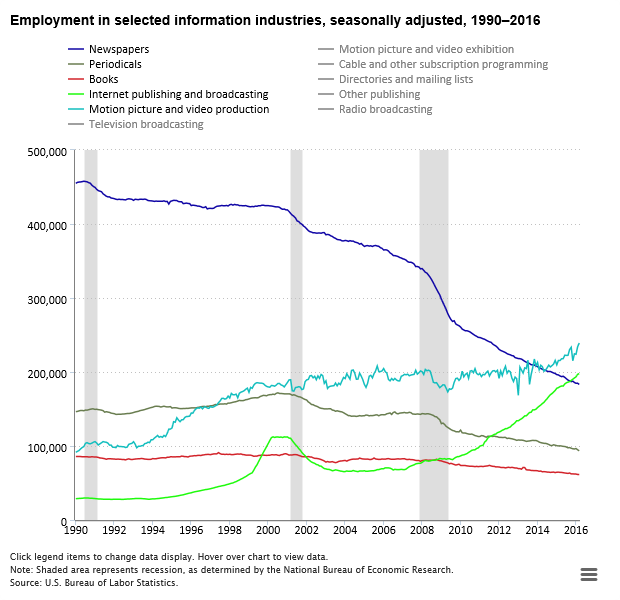
One can agree or disagree with Koppel about whether the “democratization” of media represents regression rather than progress, but one thing that cannot be denied is that the rise of “mobile media” has sparked a decline in the overall number of professional media jobs.

Data from the Bureau of Labor Statistics can quantify the trend pretty convincingly. As summarized in a report published in the American Consumers Newsletter, until the introduction of smartphones in 2007, the effect of the Internet on jobs in traditional media, newspapers, magazines and book had been, on balance, rather slight.

To wit, between 1993 and 2007, U.S. employment changes in the following segments looked like this:

  • Book Industry: Net increase of ~700 jobs
  • Magazines: Net decline of ~300 jobs
  • Newspapers: Net decline of ~79,000 jobs

True, the newspaper industry had been hard hit, but other segments not nearly so much, and indeed there had been net increases charted also in radio, film and TV.

But with the advent of the smartphone, Internet and media access underwent a transformation into something personal and portable. Look how that has impacted on jobs in the same media categories when comparing 2007 to 2016 employment:

  • Book Industry: Net loss of ~20,700 jobs
  • Magazines: Net loss of ~48,400 jobs
  • Newspapers: Net loss of ~168,200 jobs

Of course, new types of media jobs have sprung up during this period, particularly in Internet publishing and broadcasting. But those haven’t begun to make up for the losses noted in the segments above.

According to BLS statistics, Internet media employment grew by ~125,300 between 2007 and 2016 — but that’s less than half the losses charted elsewhere.

All told, factoring in the impact of TV, radio and film, there has been a net loss of nearly 160,000 U.S. media jobs since 2007.

employment-trends-in-newspaper-publishing-and-other-media-1990-2016

You’d be hard-pressed to find any other industry in the United States that has sustained such steep net losses over the past decade or so.

Much to the chagrin of old-school journalists, newspaper readership has plummeted in recent years — and with it newspaper advertising revenues (both classified and display).

The change in behavior is across the board, but it’s particularly age-based. These usage figures tell it all:

  • In 2007, ~33% of Americans age 18 to 34 read a daily newspaper … today it’s just 16%.
  • Even among Americans age 45 to 64, more than 50% read a daily newspaper in 2007 … today’s it’s around one third.
  • And among seniors age 65 and up, whereas two-thirds read a daily paper in 2007, today it’s just 50%.

With trends like that, the bigger question is how traditional media have been able to hang in there as long as they have. Because if it were simply dollars and cents being considered, the job losses would have been even steeper.

Perhaps we should take people like Jeff Bezos — who purchased the Washington Post newspaper not so long ago — at their word:  Maybe they do wish to see traditional journalism maintain its relevance even as the world around it is changing rapidly.

Online ad blocking grows ever-more popular.

abThe ad blocking phenomenon on the Internet shows no signs of abating.

Underscoring this, marketing research and forecasting firm eMarketer has just published its most recent ad blocking stats and forecasts for the United States. It projects that ad blocking adoption will continue to rise by a double digit rate in 2016 to reach nearly 70 million users.

If those projections turn out to be accurate, it will mean that ad blocking will now be used by more than 26% of all Internet users in the United States, up from ~20% just a year earlier.

And for 2017? Those forecasts are looking a whole lot like this year, too; eMarketer forecasts that ad blocker adoption will grow to more than 86 million users by the end of 2017.

[For the record, eMarketer defines a user as an Internet user of any age who accesses the ‘net at least once per month via a desktop or laptop computer, tablet, smartphone or other mobile device that has an ad blocker enabled.]

eab

According to the eMarketer analysis, the incidence of ad blocking is substantially more common on desktops and laptops; ~63 million people will use an ad blocker on these types of devices this year compared to ~21 million who will do so on a smartphone.

One reason for this is that ad blockers typically don’t work on apps, which is where mobile users spend much of their time. Moreover, some of the most irritating aspects of desktop/laptops advertising, such as ads with video and sound, are the kinds of advertising less likely to be served on mobile devices.

eMarketer expects many more people to begin installing ad blockers on their smartphones, however — to the tune of an increase of over 60% this year.

These projections must be alarming to publishers and advertisers. Paul Verna, a senior analyst at eMarketer, notes this:

“They’re seeing immediate revenue losses and [they] would be remiss to downplay what amounts to a large-scale rejection of their main monetization model.”

Separately, an analysis by Juniper Research sees more than $27 billion in advertising revenues lost over the next five years as a result of ad blockers.

Of course, that’s a far cry from the estimated ~$160 billion that digital advertising represents today.  But significant nonetheless.

As if on cue, The New York Times has just announced that it will introduce an ad-free subscription option. Reportedly, the publication will begin to offer subscriptions that cost more than a regular digital subscription, along with giving subscribers the option of opting out of seeing advertising if they wish to do so.

At present, NYT subscribers who use ad blockers are technically violating the publisher’s Terms of Use agreement — although I seriously doubt many people have had their knuckles rapped for doing so.

For now, all the Times does is kindly request that users “white-list” the NYT site so that the ads will appear even though an ad blocker has been installed.  According to news reports, about 40% of the people notified have actually done so.

Presumably, the new subscription option is targeted at people who really do wish to avoid seeing online advertising — and are willing to pay a premium for the benefit.

One wonders how much of a dollar premium subscribers will be asked to shell out for the privilege of keeping their screens from being inundated with advertising. (At present, annual NYT digital subscriptions range from ~$140 to ~$200.)  Will users balk at the higher rates?

Clearly, we’re in the middle of this movie … and it’ll be some time before we see how things shake out in the online media advertising game.  What are your thoughts about spending more for an ad-free subscription … and do you even have any online pay subscriptions at all?  (Many of my friends and business colleagues don’t.)

Are there mixed feelings about the value of product innovation centers?

icIn my line of work in industrial and B-to-B marketing, it’s common to encounter manufacturing companies – particularly larger entities – that are seeking ways to spur greater creativity and innovation in their approach to product design and development.

One manifestation of such a commitment is the building of an “innovation center.”

It may be a single room, a suite of rooms, or even a standalone facility situated within the larger corporate campus.  However they’re configured, these centers are designed to become the focal point of product research, product design and related activities.

Often, product training is also part of the mission of these centers, too.

Product innovation centers seem to be growing in popularity. Speaking personally, in the past 18 months, three of my firm’s marketing clients have opened new centers, often accompanied by a good deal of PR hoopla and so forth.

The question is, how well do these centers actually measure up to the lofty expectations senior company managers have for them?

It’s a fair question. And along those lines, I saw a news piece recently that summarized the results of an online mini-survey of medical device manufacturers, wherein the survey respondents were asked to share their views about the effectiveness of the innovation centers within their companies.

The survey was administered to readers of Qmed (aka Medical Product Manufacturing News] magazine, and the results were a little surprising, I felt.

To begin with, only about one-third of the respondents reported that their firms actually have formal, dedicated product design centers or innovation centers.

Moreover, the commentary from those who do have access to them was, on balance, not positive; for every complimentary comment about innovation centers, where were two negative ones recorded.

We can let the respondents speak for themselves:

  • “Great idea – won’t last. Most large corporations are run by pathological control freaks [who] stifle creativity. This is what made these design centers necessary in the first place.” 
  • “I’m creative at my own desk.” 
  • “Not used. I’m over it.” 
  • “Passing fad. No true innovation has come [out] of it in several years. But it is an interesting place to relax – [a] horrible room for meetings.” 
  • “Passing fad, especially at large companies. We consistently see companies standing up ‘innovation centers’ but not changing the fundamental way they handle product development. You can’t just drop R&D teams into a snazzy new office space and have them innovate.” 
  • “Quirky fad that’s useless without an accompanying company culture of creativity and commitment to innovation – the latter in terms of freedom, resources, incentive, etc.” 
  • “Romper Room.” 
  • “This is yet another wacky, management-mandated passing fad in the tradition of others such as Quality Management, Six Sigma and open office [floor-plans].”

I guess one takeaway from the Qmed research is that unless a company already has an effective or otherwise well-established culture of nurturing and rewarding innovation, simply introducing a dedicated design facility won’t do very much to improve matters.

Online Shopping Trends: Going from “Go-Go” to “No-No”?

The easy growth for online shopping appears to be over, according to new research findings published by Boston Consulting Group.

bcgBCG just completed surveying ~3,300 Americans aged 15 to 85 about their online shopping habits across 41 merchandise categories. In every category, a clear majority of respondents report that they don’t plan to increase their online spending in the next three years.

Depending on the category, the percentage of people who do not plan to increase their online spending ranges from 78% to 92%.

And in some disparate categories ranging from food and beverages to packaged goods, fine jewelry, news media and automobiles, more than a quarter of the people already shopping online said that they actually plan to decrease their online spend over the upcoming three years.

opsoPerhaps even more surprising, the BCG survey results show similar findings regardless of generational groups — Baby Boomers, Gen-Xers and Millennials alike.

BCG has conducted other studies on this topic in the past, but reportedly this is the first time such low “future intention” figures have been collected, and it suggests that future e-commerce growth will be a good deal more challenging for many companies who offer their products and services for online purchase.

Here’s a quote from Michael Silverstein, a BCG senior partner and specialist in consumer shopping behaviors, speaking about the new research findings:

“Consumers are notoriously unable to predict their spending patterns. However, the findings from this research certainly pour cold water on everyone’s expectations for a continuously rising e-commerce world.  E-commerce winners will have to earn new dollars and new spending by providing new value.  That means me-too players will suffer — and leaders will need to provide more user-friendly websites, lower prices, and offers tailored to individual customers.”

There remain a few categories where people are planning to spend more online in the coming years.  However, they don’t represent physical products. Instead, those categories are airline tickets, hotel reservations, and entertainment ticket reservations.

Still, it’s interesting to see online commerce now entering its “mature” phase.  Those rapid, double-digit growth rates couldn’t go on forever — and indeed, they now look to be a thing of the past.