The Sanders/Trump phenomenon: A view from outside the United States.

photo1This past Tuesday evening as I watched Bernie Sanders and Donald Trump vanquish their rivals handily in the New Hampshire presidential primary election, I received an e-mail from my brother, Nelson Nones, with his observations on “what it all means.”

As someone who has lived and worked outside the United States for years, Nelson’s views are often quite perceptive — perhaps because he is able to look at things from afar and can see the “landscape” better than those of us who are much closer to the action.

Call it a “forest versus trees” perspective.

And when it comes to the 2016 presidential election, it is Nelson’s view that the Sanders/Trump phenomenon is absolutely real and not something based on personality or celebrity — for good or for ill.

Shown below is what Nelson wrote to me.

… On the Underlying Dynamics

For context into what’s happening in the United States, the Pew Research Center’s recent report on the wealth gap in the United States is instructive.

In a nutshell, over the past 30 years Pew’s data points reveal: 

  • Upper-income families currently represent ~20% of the total, and their wealth (measured by median net worth) has doubled. 
  • Middle-income families represent 46% of the total. Their wealth barely changed (up 2%). 
  • Lower-income families therefore represent ~34% of the total, but their wealth fell 18%.

Now, after the end of the Cold War in 1992 until the onset of the Great Recession in 2007, the wealth of all three groups did rise, albeit by varying degrees: 

  • Upper-income by 112%
  • Middle-income by 68%
  • Lower-income by 30%

Here’s how they fared during the Great Recession (2007-10): 

  • Upper-income wealth declined by 17%
  • Middle-income wealth fell by 39%
  • Lower-income wealth fell by 42%

And after the Great Recession:

  • Upper-income families recovered 36% of their wealth lost during the Great Recession
  • Middle-income families recovered none
  • Lower-income families lost an additional 7% relative to their wealth in 2007

So, if we assume wealth to be a proxy for the feeling of well-being, then one could surmise that ~80% of American families feel like victims today — of which nearly half feel they are still being victimized.  

… On “Anger”

Are people feeling angry about this? You bet.   

Who are they going to blame? The other ~20% and foreigners, of course. 

Never mind the exculpatory hard data proffered by defenders of the nation’s elites revealing that big banks paid back all the bailout money they received during the Great Recession, or that bankers cannot be jailed for their alleged misdeeds unless and until proven guilty by jurors in courts of law (like anyone else), or that pharmaceutical companies’ margins on $45 billion of profit, at 12%, aren’t “quite” as obscene as they appear at first glance.   

None of those facts can ever restore wealth that’s been lost and never recovered, or is still falling. When you feel like a victim, such hard data are utterly and completely irrelevant.  

Both Bernie Sanders and Donald Trump are tapping into this anger with great success. As I watched both Sanders’s and Trump’s victory speeches, to vastly oversimplify, here is what I heard.  Sanders essentially said:

“It’s not fair that most Americans can’t get ahead or are falling behind. I’ll expropriate money from the rich by taxing Wall Street bankers and give it to you in the form of free tuition, student debt restructuring, lower healthcare costs and single-payer healthcare!” 

Trump essentially said:

“Political hacks are negotiating bad deals, letting China, Japan and Mexico take our money away from us every day. As the world’s greatest businessman, I’ll negotiate great deals fast to give you universal healthcare, and beat these countries so you get your money back – without having to share it with all those illegal immigrants!”

Photo2In my view, what both Sanders and Trump recognize is that ~80% of American families may have lost 40% of their wealth since 2007 with little or no hope of recovering it … but they haven’t lost any of their voting power.  

It makes no difference that the prescriptions offered by Sanders and Trump – squeezing money from Wall Street, China, Japan and Mexico, for example – are nonsense. As a lawyer I once knew always said, “Winning isn’t everything; it’s the only thing.”  To have any chance of accomplishing something useful (or not) as President, you have to win first.   

… On Populism being the Winning Ticket

In this election, under present circumstances, populism is a sure winner. 

The wealthiest ~20% of families (Democrats as well as Republicans) who represent the “establishment” in the eyes of the angry Sanders and Trump crowds, don’t quite smell the coffee yet.  

The angry crowds are out for money this election cycle, and I believe they hold enough votes to elect one of the two populist candidates (Sanders or Trump) who is promising “money.”   

… Not “experience,” “pragmatism,” “conservativism,” “liberalism,” “socialism,” “limited government,” “feminism,” “pro-life,” “pro-choice,” “pro-LGBT,” “hope,” “change,” or whatever.  But money.

To protect as much of their wealth and status as they can, the elites have little choice but to scuttle their aspirational platitudes and learn to deal with it.

So there you have it — a view of the presidential election from the outside looking in. I think there’s food for thought here — and very possibly a look at where we’ll be in another nine months.

What do other readers think? Agree or disagree?  Please share your observations here.

A nation of “haves” vs. “have-nots”? Gallup tests the perceptions.

pictureIn any presidential political season, there’s always plenty of rhetoric about the American economy, how well it’s performing for the average voter, and people’s perceptions of how they’re doing socioeconomically.

As it turns out, the Gallup Survey has been testing this issue annually for years now — going all the way back to 1988.

The question posed to Americans in Gallup’s surveys is a simple one: Do you consider yourself personally to be part of the “haves” or “have-nots” in America?

Gallup’s latest survey was fielded in July 2015.  Nearly 2,300 U.S. adults aged 18 and older were part of the research.

In response to the “haves vs. have-nots” question, ~58% of respondents considered themselves to be “haves” in U.S. society, while ~38% placed themselves in the “have-nots” segment. (The remaining ~14% see themselves borderline between the two, or they don’t have an opinion.)

Over time, Gallup has found that the percentage of Americans who perceive themselves to be part of the “have-nots” in society rose pretty steadily from 1988 to 1998, but since that time the percentages have leveled off — even during the worst years of the Great Recession from 2009-2011.

And so, the “haves” percentage has fluctuated in a tight band between 57% and 60% in each year since the late 1990s.

It seems that heightened discussions about social inequality in America haven’t resulted in a higher percentage of people thinking that they are on the less fortunate side of the country’s socioeconomic divide.

However, considering that the latest Gallup survey was conducted in July 2015 — and that since that time there have been more news events drawing attention to the issues of social justice — one wonders if we may be on the cusp of some changing thinking on the subject.

Another persistent finding in Gallup’s surveys is this:  Even among families of quite modest means (annual household incomes of $35,000 or lower), only a little more than half in that segment consider themselves to be part of the “have-nots” group.

Education-wise, the survey findings are similar, with fewer than half of the respondents who don’t possess college degrees considering themselves part of the “have-nots” segment.

In reporting on the Gallup survey results, an article published in the November 2015 issue of Quirk’s Marketing Research Review magazine stated:

“The stratification of U.S. society into unequal socioeconomic groups has long been a fixture of philosophic, political and cultural debate. It appears to have remained or even expanded as a fairly dominant leitmotif in the ongoing 2016 election, particularly among the Democratic presidential candidates. 

[Nevertheless,] the results … in this analysis show that a majority of U.S. adults do not think of American society as being divided along economic lines, and a slightly higher percentage say that if society is divided, they personally are on the ‘haves’ side of the equation rather than the ‘have-nots.'”

More information about the Gallup survey results can be viewed here.

What are your thoughts? Do the perceptions Americans have of socioeconomic inequality — or the lack of it — match the reality?  Or are we poised to see some new significant shifts in the way Americans view socioeconomic divisions in this country?

Organizational Management: Zappos Meets Reality

ZLIt’s always interesting to read about the concept of flattened or “matrix” organizational structures for companies, and how they offer a much more creative and fulfilling environment for employees when compared to working within a more traditional hierarchical organizational structure.

… And then you read about a company that actually tries to implement such an organizational model — and gets thrown against the rocks in the process.

The latest example is Zappos, the online shoe and clothing retailer which has built its business and reputation on exquisite customer service. For years it’s also been known as a company willing to experiment with nontraditional human resources models.

The most famous of these is known as “the offer,” where new hires are given the opportunity to take a $2,000 stipend in lieu of remaining on the job – the idea being that it’s a practical as well as humane way to ensure that Zappos employees are the best “fit” for the company.

The company’s latest endeavor has been to introduce a new management structure known as a “holocracy.” This structure, adopted by Zappos in 2014, aims to facilitate (or codify, actually) collaboration among workers by essentially eliminating workplace hierarchies – as in no titles and no direct-report bosses.

In Zappos’ holocracy environment, employees now work through their job responsibilities, strategies and tactics via a web-based app known as the “Glass Frog.”

I think you might know where this is headed: Self-governance isn’t a tidy business, and there’s a good dose of mixed signals and even confusion that comes along with it.

When structures are flattened and titles eliminated, it causes disruption in ways big and small:

  • How do strategic initiatives and tactical tasks get done efficiently?
  • Who is responsible for what? 
  • How do co-workers (as well as outsiders) know what each employee “does”?
  • How are employees monitored and evaluated on their work performance and contribution to the success of the enterprise?

And how about this: Try determining salaries for existing and prospective new employees after titles have been eliminated.

Guess what happens when confusion reigns in any organization? Attrition rates rise.

As reported this month by Bourree Lam in The Atlantic, in the case of Zapppos, nearly one in five employees have taken buyouts since last spring, resulting in an annual turnover rate of ~30%.  That’s dramatically higher than the typical attrition rate at companies.

Weeding out less productive workers is a staple in managing for business efficiencies, productivity and profits. But when nearly one-third of your entire staff is leaving the company within a 12-month period, you’re getting into territory where “institutional knowledge” is in serious danger of being lost.

Research by Stanford University’s Graduate School of Business and other institutions shows that the more “egalitarian” an organizational structure is, the more unpredictable and potentially disorienting it is to workers. Simply put, most people prefer a defined “pecking order.”  They might grumble about corporate hierarchies, but those structures are more “predictable” and many workers find them to be more psychologically comfortable.

hoThe reality is that holocracries, flattened and matrix organizational structures are often less efficient than hierarchical ones. They may well spur more innovation and creative thinking, but the price paid in lost efficiency may be too high for many companies.

In my personal experience working with a matrix organization (not as an employee but as a person providing business support services to the company), I’ve seen where a matrix structure can actually work. It certainly helps if the business has strong, industry-leading products that are protected by patents and that benefit from being able to command high prices and correspondingly high product margins.

Zappos isn’t operating in any such marketplace. It has little or no protection against aggressive market competitors entering its space.  Profit margins in retail are famously tight.  It’s just not clear that any company can operate successfully in that space for any length of time without keeping very tight controls over operating expenses and also squeezing as much productivity out of each employee as possible.

Despite the challenges, it appears that Zappos is doubling down on its holocracy structure. Here’s what CEO Tony Hsieh wrote in 2014 to his employees:

“Self-management and self-organization is not for everyone, and not everyone will necessarily want to move forward in the direction of the … strategy statements that were recently rolled out. Therefore, there will be a special version of “the offer” on a companywide scale, in which each employee will be offered at least 3 months’ severance … if he/she feels that self-management, self-organization and our … strategy statement as published in Glass Frog are not the right fit.”

With a pronouncement like that coupled with a big financial carrot, it’s understandable why so many employees have taken up Zappos’ severance package offer.

The next question is this: Will Zappos emerge as a stronger, more creative and more nimble company as a result of its transition to a holocracy structure?  Or will the initiative turn out to have been a massive miscalculation?

If you work in a flattened or matrix organization structure and have observations to share about its positive and negative aspects, please leave comments. I’m sure other readers would be quite interested to read them.

Memo to newspaper publishers: Don’t ‘diss’ your print subscribers.

nindA few weeks ago, the Boston Globe stubbed its toe in major fashion when it changed the company it uses to deliver ~115,000 hard-copy versions of the daily paper in the Boston metro area.

And the problems continue to persist even now.

No doubt, the decision to switch home delivery services was made out of a desire to save money rather than to improve service.  And one can understand why management might have been looking for ways to cut production costs on the print version compared to the “go-go” online/digital realm.

But focusing on solely millennials and other younger customers can come back to “bite you on the bottom line” – which is exactly what happened in the case of the Globe.

Evidently, the new delivery service was untested – at least in terms of taking on a client with volumes as large as Boston’s leading newspaper.

As it turned out, tens of thousands of papers weren’t delivered, sparking a cataclysm of loud, negative feedback.

The pique of customers went well-beyond failing to receive something that had been paid for. In the case of the Globe’s extensive Baby Boomer subscriber base, missing home delivery struck at the heart of the time-honored rituals of how they receive and consume their news.

Consider this: The average subscriber to the Boston Globe pays around $700 per year for their home-delivery subscription.

That’s more than $80 million per year in income for the paper – before factoring in advertising revenue.

Of course, the costs of producing and delivering the print product exceeds that of digital. But this subscription base is more loyal than digital news consumers precisely because they value how the news is presented to them.

Let’s not forget that for people born before 1965, most are emotionally attached to print far more than those in other demographic groups. As Gordon Plutsky, a director of applied intelligence at IDG, writes about the Boston Globe snafu:

“[It’s] not just the physical paper, but the ritual of getting the paper off their driveway or front steps and starting their day spreading out the broadsheet and scanning the news. They missed curling up with coffee or tea and working the crossword puzzle or cutting coupons.  It is easy to forget that until the mid-‘90s, this was the only way to read the news and, for Boomers, it is how they learned to read and interact with the world.  Their brains are wired for print in the same way Gen Z is wired for mobile.”

Perhaps the Globe’s business and administrative staffers lost sight of that fact. Maybe they treated their “unsexy” print subscribers as an afterthought while forgetting that this segment of their customer base is critical to the very survival of their paper – and the industry – in a period of transition.

True, delivering the news to print customers is more expensive than doing so digitally. But these customers are more predictable and loyal, versus fickle and finicky.

… But only if the product is delivered. Fail in that fundamental function, and the gig is up.

nosThe Boston Globe’s print readers are hardly unique. Recently, Pew Research Center surveyed consumers in three urban markets.  Despite the differences in these markets (geographic, economic, social), a highly significant percentage of respondents in all three metro areas reported that they read only the print version of their local newspaper:

  • Denver, CO: ~46% read only the print version of their local newspaper
  • Macon, GA: ~48% read print only
  • Sioux City, IA-NE-SD: ~53% read print only

This isn’t to suggest that Boomer audiences are a bunch of rubes who aren’t connected to the digital world. Far from it:  They tend to be better educated and more wealthy (with more disposable income) than other demographic segments.  Their attachment to print isn’t in lieu of digital, but more in concert with their online habits.

Unlike other generations, they’re not single-channel as much as omni-channel consumers. The keys to newspaper publishers’ continued relevance are bound up in how they serve this older but critically important segment of their customer base.

Speaking personally, I can “take it or leave it” when it comes to print.  I don’t subscribe to a daily print paper, and the bulk of my news comes to me from digital sources.  But there’s something quite comfortable about sitting down with a quality daily paper and reading the news stories therein — including long-form journalism pieces that are difficult to find very many places these days.

There are millions more people across the country that are happy to continue paying for the privilege of consuming the news in just such a fashion.  Indeed, they’re the newspaper industry’s most loyal readers.

The disappearing American middle class? The Pew Research Center weighs in.

mcIn this political season in the United States — when is it ever not, one wonders? — we hear many of the presidential candidates refer to the so-called “crisis” of the middle class.

It matters not the political party nor ideological stripe of the candidate, we hear copious references to “the disappearing middle class” … the “middle class squeeze” … and that the middle class is “just getting by.”

Considering that the middle class income group represent the single largest block of voters in the country, it isn’t at all surprising that the presidential contenders would talk about middle class issues — and to middle class voters — so frequently.

The question is … is the hand-wringing warranted?

PewWell, if one believes a new Pew Research study on the subject, it may well be the case.

Based on its most recent analysis of government data going back nearly 50 years, Pew reports that there are now fewer Americans in the “middle” of the economic spectrum than at the lower and upper ends.

This is a major development, and it is new.

Pew defines a middle class household as one with annual income ranging from ~$42,000 to ~$126,000 during 2014. Using that definition, Pew calculates that there are now 120.8 million adults living in middle class households, but 121.3 million who are living in either upper- or lower-income households.

Pew characterizes this new set of figures as a kind of tipping point. And it helps to underscore the narrative wherein certain presidential candidates — you-all know which ones — are tapping into a collective “angst” about the decline in middle-income families, and the notion that they are falling behind compared to upper-income adults while unable to access many of the support services available to lower-income households.

Looking at things in a bit more depth, however, one can find explanations — as well as other data points that go against the “narrative” to some degree. Consider the following:

  • Senior citizens have done quite well shifting into the upper category since the 1970s — their share increasing by well over 25% in the upper-income bracket.
  • African-Americans have experienced the largest increase in income status over the same period, meaning that their lower-income category share is lower today.
  • The rapid rise in the number of immigrants in the late 20th century has pushed down median incomes because those new arrivals, on average, make less in income.

I suspect the Pew study findings will be fodder for more discussion — and perhaps some additional sloganeering — in the upcoming weeks and months. But you can judge for yourself whether that’s warranted by reviewing more findings from Pew’s report here.

If you have your own perspectives about what’s happening with (or to) the middle class, I’m sure other readers would be quite interested in hearing them.  Please share your comments here.

What’s in a name? When it comes to senior living communities – plenty.

BrooksideFor those of us “of a certain age,” it seems hard to believe that within five years, most of the Baby Boomer generation will be of retirement age.

… This also means that millions of people will be thinking about downsizing, right-sizing, or whatever the applicable term may be.

All sorts of considerations come into play when making such a decision; climate, social, cultural and recreation opportunities, plus proximity to relatives are some of the most common.

But when the dust settles, most people will actually end up “aging in place.”

That’s one key finding from a recent survey of ~4,000 American Baby Boomer households that was conducted by the Demand Institute Housing & Community.

Not only do nearly two-thirds of the respondents plan to stay in their current homes, the majority of them feel that their homes are well-suited for aging – even if they’re multi-story, don’t offer accessibility features, or aren’t particularly low-maintenance structures.

But the survey suggests another interesting dynamic that may also be at work:  the notion that senior living communities are primarily places for people who have serious health issues or who can’t take care of themselves on their own.

Let’s face it.  Baby Boomers don’t consider themselves part of that cohort at all, which they equate with people who are substantially more elderly than themselves.

When you think about it, so many of the terms used to describe senior living facilities convey exactly the wrong thing to Baby Boomers.  The names may well be accurate descriptions of the properties in question, but they fairly scream “geriatrics.”

community

I’ve run across quite a few descriptors.  A good number of them reside in the same wheelhouse – which is to say, distinctly unattractive.  Meanwhile, other alternative names are often too narrowly descriptive as well, because one important aspect of senior living is to access to continuing care if and when that becomes necessary.

Either way, those charged with marketing these properties clearly prefer the word “community” over the word “center” or “home.”  But you can be the judge of how successful these names really are:

  • 55+ communities
  • Active adult communities
  • Age-restricted communities
  • Continuing care retirement communities
  • Elder cohousing communities
  • Independent living communities
  • Leisure communities
  • Mature living communities
  • Senior housing communities
  • Senior living communities

The bottom line on this is pretty fundamental:  Few people – regardless of how old they are – wish to be reminded of the limitations of life on a downward curve.  It’s just not compatible with the positive attributes that are so much a part of human nature.  Anything we can do to avoid being reminded of our mortality, we’ll do.

Obviously, that reluctance to face the reality of aging is of concern to property developers in the housing industry as well.  One of the actions coming out of field research such as the Diamond study is a new initiative to establish an alternative “umbrella descriptor” that works across the entire spectrum of senior living facilities.

It will be interesting to see where that exercise will end up.  As for me, I’m guessing it’ll still telegraph “geriatric.”  But perhaps we’ll end up being surprised.

Who Trusts the Media?

Americans give a big thumbs-down when it comes to having “trust and confidence” in mass media – TV, radio and newspapers.

MediaAre Americans’ attitudes about the press becoming more negative over time? If the latest survey figures on media trust are any guide, the answer is a pretty stark “yes.”

According to a recent Gallup field survey of ~1,025 American citizens aged 18 or over, trust and confidence in the mass media in the United States has reached a new low.

Today, just ~40% of respondents report that they have “a great deal” or “a fair amount” of confidence that newspapers, TV and radio report the news “fully, accurately and fairly.”

What’s more, trust levels have been on a downward trajectory ever since the late 1990s, when Gallup began surveying Americans’ attitudes on an annual basis.

Here’s what the trend looks like in the “off-election” years:

  • 1999: ~55% have “a great deal” or “a fair amount” of trust in mass media (TV/radio/newspapers)
  • 2003: ~54%
  • 2005: ~50%
  • 2007: ~47%
  • 2009: ~46%
  • 2011: ~44%
  • 2013: ~44%
  • 2015: ~40%

Moreover, the notion that young people might be more inclined to trust the media isn’t borne out in the Gallup survey results. The trust of Americans age 18-49 has dropped from 53% in 2005 to only 36% now.

Contrast this with older Americans (age 50 or older): 45% of them reported that they had trust and confidence in mass media in 2005, and today that trust level is … still 45%:

Media trust by age

Giving further credence to the oft-stated claim that American mass media are slanted towards one political party, ~55% of self-identified Democrats express trust in the media, compared to just 32% of Republicans and 33% of independents.

Gallup can’t resist editorializing a bit about its most recent media trust figures:

“Americans’ trust level in the media has drifted downward over the past decade, but some of the loss in trust may have been self-inflicted, as major venerable news organizations have been caught making serious mistakes in the past several years.”

Additional information on the Gallup survey can be accessed here.

“Immigration Nation”: Pew Research Projects U.S. Population Demographics into the Future

immigrantsI’ve blogged before about the immigration issue and its potential impact on the U.S. economy and society.

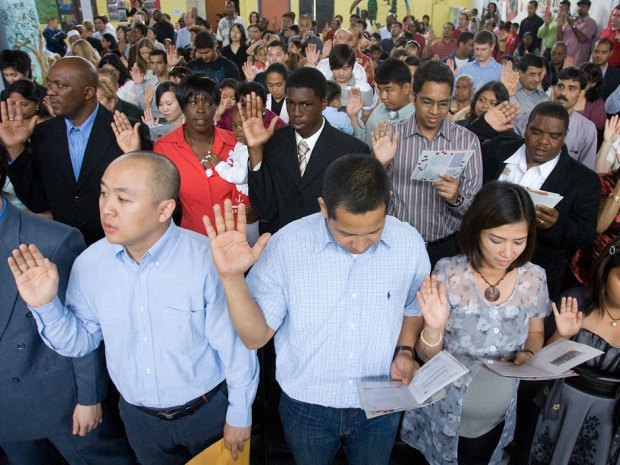
Now the Pew Research Center has released a report that predicts the U.S. becoming a “no ethnic majority” nation within the next 35 years.

When one considers that the United States population was nearly 85% white Anglo in 1965 … and that percentage has dropped to about 62% now, it isn’t that hard to imagine Pew’s prediction coming true.

Here’s the trajectory Pew predicts over the coming ten-year periods:

  • 2015: ~62% estimated U.S. white Anglo population percentage
  • 2025: ~58% projected white Anglo population percentage
  • 2035: ~56% projected
  • 2045: ~51% projected
  • 2055: ~48% projected
  • 2065: ~46% projected

Perhaps what’s more intriguing is that Pew projects the largest future percentage gains will be among Asian-Americans rather than Latino or Black Americans. The Asian share of the American population is expected to double over the period:

  • 2015: ~6% estimated U.S. Asian population percentage
  • 2025: ~7% projected Asian population percentage
  • 2035: ~9% projected
  • 2045: ~10% projected
  • 2055: ~12% projected
  • 2065: ~14% projected

If these projections turn out to be accurate, the Asian population percentage is on tap to become the nation’s third highest group.

By contrast, the Hispanic population, while continuing to grow, looks as if it will level off at about 22% of the country’s population by 2045. For Black Americans, Pew projects the same dynamics at work, but at the 13% level.

citizenship ceremonyAccording to Pew’s analysis, the biggest driving force for the projected Asian population growth is immigration. By 2055, Pew expects that Asians will supplant Latinos as the largest single source of immigrants — and by 2065 the difference is expected to be substantial (38% Asian vs. 31% Latino immigrants).

Conducted in parallel with Pew’s projection analysis was an online opinion research survey of American adults (18 and over) it conducted in March and April of this year.

Among the attitudinal findings Pew uncovered were these:

  • “Immigrants in the U.S. are making society better”: ~45% of respondents agree … ~37% disagree
  • “I would like to see a reduction in immigration”: ~50% agree
  • “I would like to see the immigration system changed or completely revamped”: ~80% agree

Again, no great surprises in these figures — although if one paid attention only to news accounts in the “popular media,” one might find it surprising to learn that a plurality of Americans actually consider immigration a net positive for American society …

Additional findings from the Pew survey as well as its demographic projections can be found here.

Surprising statistic? One-third of American adults still aren’t on social media.

social mediaFor the many people who use social media on a daily basis, it may seem inconceivable that there are a substantial number of other Americans who aren’t on social media at all.

But that’s the case. The Pew Research Center has been tracking social media usage on an annual basis over the past decade or so, and it finds that about one-third of Americans still aren’t using any social networking sites.

To be sure, today’s ~65% participation rate is about ten times higher than the paltry ~7% participation rate Pew found the first time it surveyed Americans about their social media usage back in 2005.

According to Pew’s field research findings, here’s how the percentage of social media involvement has risen in selected years in the decade since. (The figures measure the percentage of Americans age 18 or over who use at least one social networking site.)

  • 2006: ~11% using at least one social networking site
  • 2008: ~25%
  • 2010: ~46%
  • 2012: ~55%
  • 2015: ~65%

In more recent years, the highest growth in social media participation rates has been among older Americans (over the age of 65), ~35% of whom are using social media today compared to just 11% five years ago.

That still pales in comparison to younger Americans (age 18-29), ~90% of whom use social media platforms.

While it’s a common perception that women are more avid users of social media than men, Pew’s research shows that the participation rate is actually not that far apart. Statistically it isn’t significant, in fact: a ~68% social media participation rate for women versus ~62% for men.

pew-research-centerSimilarly, there are more similarities than differences among the various racial and ethnic groups that Pew surveys — and the same dynamics are at work when it comes to differing education levels, too.

Regional differences in social media practice continue to persist, however, with rural residents less likely to use social media than suburban residents by a ten-point margin (58% versus 68%). City dwellers fall in between.

More details on Pew’s most recent field research on the topic of social media participation can be accessed here. See if you notice any surprising findings among them.

“Boomerang employees”: No longer such a rarity in the corporate world.

Time was, once a person left a company – for whatever reason – the likelihood that they’d ever come back to work there was pretty slim.

Perhaps to be re-engaged as a consultant or a contract worker … but as a return employee? Not likely at all.

That mindset appears to be changing.  Data accumulated from a recent survey by HR research and advisory firm Workplace Trends from ~1,800 human resources executives, managers of staff, and employees provide the following clues:

  • Half of the HR professionals responding to the survey claimed that their organization once had formal policies against rehiring former employees (even if the employee had departed in good standing).
  • Three-fourths of the HR respondents reported that they are more accepting of hiring boomerang employees today. More than half of the respondents who are people managers felt the same way.

The actual incidence of returning to work at a former company isn’t all that common.  Of the employees who took part in the survey, fewer than 15% of them fell into this category.

Still, 15% is way up from where it has been traditionally — and the current percentage is higher than I would have guessed.

What’s more, nearly 40% of employee respondents reported that they would consider going back to an employer where they had once worked.

There are distinct differences in employee attitudes based on age demographics: More than 45% of Millennials would consider returning to work for a former employer … but the percentage is just 29% for Baby Boomer respondents.

As for why boomerang employees are becoming more common, a number of factors are at play:

  • Intense competition for certain technically advanced employees who may be in short supply makes poaching more common … and also intensifies the need for companies to respond in kind. In fields were strong talent is hard to come by, often the pool of workers is too small to summarily omit former employees from consideration.
  • Familiarity with a company’s organization, culture and ways of doing business reduces “ramp-up” requirements and the amount of training needed, when compared to bringing on a brand-new employee.
  • The “devil you know” factor: Even if a former employee possesses a few characteristics that are less-than-ideal, at least these are known quantities, as compared to a brand-new employee who may or may not be all that she or he seems to be on paper.

chairGoing forward, I suspect that boomerang employees will become even more prevalent than they are today.

To do well at that, companies might wish to look into maintaining open lines of communication with select former employees. It seems like a good way to keep choice workers “in the loop” and potentially available — and interactive/social media makes it easier to keep those channels open.

As things stands now, the results of this survey suggest that such channels are, at best, ad hoc rather than being part of a formal “alumni” communications strategy.

Addressing this point, Dan Schawbel, head of WorkplaceTrends, had this to say:

“In previous research we’ve done, we’ve found that Millennials are switching jobs every two years because they are searching for the job – and organization – of best fit. But this new study indicates that this younger generation is more likely to boomerang back when they’ve experienced other company cultures and realized what they’ve missed.”

Schawbel’s prediction? “We’ll see the boomerang employee trend continue in the future as more employees adopt a ‘free agent’ mentality – and more organizations create a stronger alumni ecosystem.”

What about you? Are you a boomerang employee? Or do you know colleagues who have done this? What are the pluses and minuses? Please share your thoughts with other readers here.