“Dying on the Vine”: Why the video sharing service is now history.

vineRemember back in 2012 when Twitter introduced its Vine video sharing service?

Back then, observers were positively breathless in their accolades for the service, with some positing that Vine represented some sort of tipping point in the world of instant communications.

A little more than four years later … and as of November 1, Vine has just been shuttered. How is it that such a vaunted social media platform went from de rigeur to rigor mortis in such a short time?

There are several key reasons why.

Time and place: The year 2012 was a perfect time to launch Vine, as it coincided with when many companies and brands were shifting their focus towards video communications.  At the time, short-form video was a novelty, making it a kind of dog whistle in the market.  But Instagram, newly acquired by Facebook, swooped in and made a big splash, too, while Snapchat attracted younger audiences.  What was Vine’s response to these competitor moves?  If there was much of any, no one seems to have noticed.

Competing … with yourself: Strange as it may seem, Twitter itself ended up competing with Vine in 2015, launching its own branded video playback capabilities.  When something like that happens, what’s the purpose of the older brand that’s doing the same thing?  Twitter’s simultaneous foray into live-streaming was a further blow to a brand that simply couldn’t compete with these newer video services introduced by Vine’s very own parent company.

Commercial viability? — What commercial viability? In all its time on the scene, Vine never figured out a way to sell advertising on its network.  It had a good germ of an idea in sponsored content, but never seemed to capitalize on the opportunities that presented, either.

Knowing your audience: From the outset, Vine attracted a fairly unique and crowd of users, such as people involved in the hip-hop music scene.  It was vastly different from the typical user base in social media – and yet Vine never did all that much to support these users.  As a result, there was little brand affinity to keep them close when the next “bright, shiny object” came their way.

In the social media space, the rise and fall of platforms can happen with amazing speed. Unlike some other platforms, Vine was a big hit from the get-go … but perhaps that turned out to be a double-edged sword.  Vine never did figure out a way to “mature” with its audiences – which eventually left it behind.

In the end, Vine went out not with a bang, but with a whimper.
Downsizing hits America’s most prestigious business media properties.

bwsjThis past week, the business media world was buzzing about the inadvertent release of information concerning pending layoffs at Barron’s magazine, thanks to editor-in-chief Ed Finn mistakenly hitting “reply all” on a message intended for just one person.

But the more interesting news is what’s happening right now with two of America’s most important national print publishing properties: Barron’s and The Wall Street Journal.

Up until now, it was thought that a select handful of America’s largest and most pervasive publications with national reach and reputation would be the ones least susceptible to problems befalling the industry regarding declining advertising revenues and changing news consumption habits.

At or near the top of the list of those rarefied properties were these two publications for sure.

But now we know a different reality — or at least a more complicated one. WSJ editor-in-chief Gerard Baker announced last week that the publication is seeking a “substantial number” of employee buyouts to limit the extent of involuntary layoffs that will need to happen otherwise.

The WSJ buyout offer been extended to all news employees worldwide – managerial and non-managerial – and includes a lucrative voluntary severance benefit that’s 1.5 times larger than the company’s standard buyout package.

WSJ employees will need to make up their minds quickly, as the buyout offer is good only until the end of October.

wsjbAs for Barron’s, its situation became public only after the Ed Finn memo was received in the New York City newsroom of The Wall Street Journal in error.  The Finn memo, which had been intended for Dow Jones Media Group publisher Almar Latour, speculates on how The Wall Street Journal’s announcement might affect an upcoming round of layoffs at Barron’s.

That bit was “new news” to pretty much everyone.

Aside from the “drama” of news scoops happening because of unintentional actions, the bigger question is this: What do these layoffs and buyouts portend?  Is it the end of the adjustments – or just the beginning?

Clues to that answer come in Gerard Baker’s memo, where he reveals that The Wall Street Journal has “begun an extensive review of operations as part of a broader transformation program.”

Let’s see what kind of “silver bullet” business strategy they end up devising – and whether it will have its intended effect.

What’s Up with Apps These Days?

Results from comScore’s latest annual U.S. Mobile App Report point to some interesting user behaviors.

No one needs to be reminded of how important mobile apps have become in today’s world of communications. Just looking around any crowd of people, it’s clear that usage has become well-nigh ubiquitous.

And now, we have some new stats that help quantify what’s happening, courtesy of the most recent annual Mobile App Report published by global media measurement and analytics firm comScore.

Among the salient findings from this report:

  • Today, mobile devices represent two of every three minutes spent on digital media.
  • Smartphone apps alone account for nearly half of all digital media time spent – and three of every four minutes spent while on mobile.
  • Over the past three years, total time spent on digital media has grown by over 50%. Most all of that growth has been because of mobile apps.
  • Indeed, time spent on desktop media has actually dropped by more than 10%.

Despite the rapid rise of mobile app usage, there are a few findings in the comScore report that point toward some consolidation of the market, with certain apps being the recipient of strong brand loyalties.

Typically, while smartphone users have uploaded many apps on their devices – and may use several dozens of them on a monthly basis – nine out of every ten mobile app minutes are spent with just five top apps.

[Good luck to any app provider attempting to break into that rarefied group of top performers!]

At the same time, “push notification fatigue” appears to be a growing issue: More smartphone users are rejecting app update notifications than ever before.  According to comScore’s recent report, nearly 40% of users rarely or never agree to such update notifications – up significantly from around 30% last year.

Conversely, only about 25% often or always agree to updates, which is down from about one-third of users in last year’s survey.

This last set of figures doesn’t surprise me in the least. With so many apps housed on so many devices, one could easily spend an hour each day accessing nothing but app updates.

Especially considering how little additional functionality these ongoing updates actually deliver, the whole operation falls into the “life’s too short” category.

Ad fraud: It’s worse than you think.

It isn’t so much the size of the problem, but rather its implications.

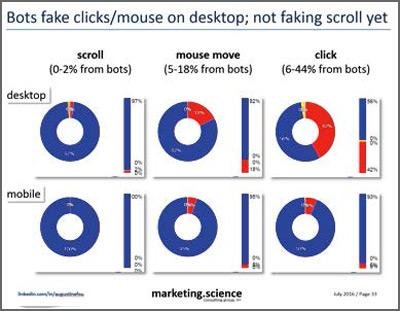
affaA recently published report by White Ops, a digital advertising security and fraud detection company, reveals that the source of most online ad fraud in the United States isn’t large data centers, but rather millions of infected browsers in devices owned by people like you and me.

This is an important finding, because when bots run in browsers, they appear as “real people” to most advertising analytics and many fraud detection systems.

As a result, they are more difficult to detect and much harder to stop.

These fraudulent bots that look like “people” visit publishers, which serve ads to them and collect revenues.

faaf

Of course, once detected, the value of these “bot-bound” ads plummets in the bidding markets.  But is it really a self-correcting problem?   Hardly.

The challenge is that even as those browsers are being detected and rejected as the source of fraudulent traffic, new browsers are being infected and attracting top-dollar ad revenue just as quickly.

It may be that only 3% of all browsers account for well over half of the entire fraud activity by dollar volume … but that 3% is changing all the time.

Even worse, White Ops reports that access to these infected browsers is happening on a “black market” of sorts, where one can buy the right to direct a browser-resident bot to visit a website and generate fraudulent revenues.

… to the tune of billions of dollars every year.  According to ad traffic platform developer eZanga, advertisers are wasting more than $6 billion every year in fraudulent advertising spending.  For some advertisers involved in programmatic buying, fake impressions and clicks represent a majority of their revenue outlay — even as much as 70%.

The solution to this mess in online advertising is hard to see. It isn’t something as “simple and elegant” as blacklisting fake sites, because the fraudsters are dynamically building websites from stolen content, creating (and deleting) hundreds of them every minute.

They’ve taken the very attributes of the worldwide web which make it so easy and useful … and have thrown them back in our faces.

Virus protection software? To these fraudsters, it’s a joke.  Most anti-virus resources cannot even hope to keep pace.  Indeed, some of them have been hacked themselves – their code stolen and made available on the so-called “deep web.”  Is it any wonder that so many Internet-connected devices – from smartphones to home automation systems – contain weaknesses that make them subject to attack?

The problems would go away almost overnight if all infected devices were cut off from the Internet. But we all know that this is an impossibility; no one is going to throw the baby out with the bathwater.

It might help if more people in the ad industry would be willing to admit that there is a big problem, as well as to be more amenable to involve federal law enforcement in attacking it.  But I’m not sure even that would make all that much difference.

There’s no doubt we’ve built a Frankenstein-like monster.  But it’s one we love as well as hate.  Good luck squaring that circle!

Digital display advertising: (Still) looking like the weakest online promo tactic.

untitledI’ve blogged before about the lack of engagement with online banner advertising, and as time goes on … the picture doesn’t change much at all.

When you break it down, online banner advertising is a bust on several levels:


  • As of the most recent stats, clickthrough rates on online banner advertising are running about 0.08%. That translates to fewer than one click for every 1,000 times the ad is served.


  • Based on current pricing for online banner ads, that one click might be costing anywhere from $5 to $10 (and it might have even been an accidental click).


Despite these “inconvenient truths,” nearly two-thirds of digital ad spending continues to go to online banner advertising based on a “cost per impression” pricing model. Why?

One answer is that it’s an easy way to advertise a product or service. Simply supply ad creative to the publisher and let it be served online.

Another may be that advertisers consider banner advertising to be a basic component of any promotional campaign: prepare a mix of direct marketing, some search engine marketing, some print advertising and some digital display advertising, and you’re off to the races.

A third reason — related to the one above and I suspect one big reason why so much digital display advertising persists in the B-to-B realm in particular — is that publishers who offer a suite of promo tactics as part of a specially priced integrated program always throw in digital display advertising as part of the mix. It becomes the default option for advertisers as they approve bundled programs and the discount rates that come along with them.

Here’s a suggestion for advertisers going forward: Push back a bit and ask publishers to come up with alternative program options that don’t include digital display advertising.  The revised program might not look as promising at first blush, but then remember the stats above and you may well see the attributes of the alternative program in a more positive light.

Online ad blocking grows ever-more popular.

abThe ad blocking phenomenon on the Internet shows no signs of abating.

Underscoring this, marketing research and forecasting firm eMarketer has just published its most recent ad blocking stats and forecasts for the United States. It projects that ad blocking adoption will continue to rise by a double digit rate in 2016 to reach nearly 70 million users.

If those projections turn out to be accurate, it will mean that ad blocking will now be used by more than 26% of all Internet users in the United States, up from ~20% just a year earlier.

And for 2017? Those forecasts are looking a whole lot like this year, too; eMarketer forecasts that ad blocker adoption will grow to more than 86 million users by the end of 2017.

[For the record, eMarketer defines a user as an Internet user of any age who accesses the ‘net at least once per month via a desktop or laptop computer, tablet, smartphone or other mobile device that has an ad blocker enabled.]

eab

According to the eMarketer analysis, the incidence of ad blocking is substantially more common on desktops and laptops; ~63 million people will use an ad blocker on these types of devices this year compared to ~21 million who will do so on a smartphone.

One reason for this is that ad blockers typically don’t work on apps, which is where mobile users spend much of their time. Moreover, some of the most irritating aspects of desktop/laptops advertising, such as ads with video and sound, are the kinds of advertising less likely to be served on mobile devices.

eMarketer expects many more people to begin installing ad blockers on their smartphones, however — to the tune of an increase of over 60% this year.

These projections must be alarming to publishers and advertisers. Paul Verna, a senior analyst at eMarketer, notes this:

“They’re seeing immediate revenue losses and [they] would be remiss to downplay what amounts to a large-scale rejection of their main monetization model.”

Separately, an analysis by Juniper Research sees more than $27 billion in advertising revenues lost over the next five years as a result of ad blockers.

Of course, that’s a far cry from the estimated ~$160 billion that digital advertising represents today.  But significant nonetheless.

As if on cue, The New York Times has just announced that it will introduce an ad-free subscription option. Reportedly, the publication will begin to offer subscriptions that cost more than a regular digital subscription, along with giving subscribers the option of opting out of seeing advertising if they wish to do so.

At present, NYT subscribers who use ad blockers are technically violating the publisher’s Terms of Use agreement — although I seriously doubt many people have had their knuckles rapped for doing so.

For now, all the Times does is kindly request that users “white-list” the NYT site so that the ads will appear even though an ad blocker has been installed.  According to news reports, about 40% of the people notified have actually done so.

Presumably, the new subscription option is targeted at people who really do wish to avoid seeing online advertising — and are willing to pay a premium for the benefit.

One wonders how much of a dollar premium subscribers will be asked to shell out for the privilege of keeping their screens from being inundated with advertising. (At present, annual NYT digital subscriptions range from ~$140 to ~$200.)  Will users balk at the higher rates?

Clearly, we’re in the middle of this movie … and it’ll be some time before we see how things shake out in the online media advertising game.  What are your thoughts about spending more for an ad-free subscription … and do you even have any online pay subscriptions at all?  (Many of my friends and business colleagues don’t.)

What’s behind Microsoft’s $26 billion purchase of LinkedIn?

LI MCAt first blush, it appears almost ludicrous that Microsoft Corporation is offering an eye-popping $26 billion+ to acquire LinkedIn Corporation.

The dollar figure far eclipses any previous Microsoft acquisition — including the $9 billion+ it paid for Nokia Corporation in 2014, not to mention what the company paid for Yammer and Skype.

What’s also acknowledged is that none of those earlier acquisitions did all that much to further Microsoft’s digital and social credentials — and in the case of Nokia, the financial write-downs Microsoft has recorded have actually exceeded Nokia’s purchase price.

So what’s different about LinkedIn — and why does Microsoft feel that the synergies will work to its advantage better this time?

In a recent Wall Street Journal column, technology journalist Christopher Mims noted that such synergies do exist — and in a much bigger way.

That includes Microsoft Office, the productivity suite that’s now delivered almost exclusively online. And then there’s LinkedIn’s database of over 400 million subscriber professionals.

Put those two elements together with a strong strategic vision, and you have the potential for some pretty amazing synergies.

When you think about it, LinkedIn’s users are essentially Microsoft’s core demographic. And it isn’t something that’s replicated anywhere else in Cyberspace.  Here’s Microsoft’s CEO Satya Nadella talking:  “It’s really the coming together of the professional cloud and the professional network.”

Acting on its own, LinkedIn hasn’t been all that successful in leveraging what is arguably the most comprehensive and powerful database of business professionals ever compiled in the history of mankind.

While it consists of self-contributed information that hasn’t been “vetted” by outside parties, it’s still the single most comprehensive and valuable repository of information about business professionals — anywhere in the world.

I view the dynamics of LinkedIn as something like the Wikipedia. Wikipedia has become so pervasive, it has driven traditional encyclopedias from the scene.  And while we all know that there can be misstatements of fact — or omissions of facts — from Wikipedia entries, it’s also become the quickest and easiest place to go for information that’s “accurate enough and complete enough” for most any type of informational query.

In similar fashion, LinkedIn is making personnel databases like Dun & Bradstreet that are less robust and accessible only by subscription increasingly obsolete.

And yet … with all of this powerful data at its fingertips, up to now LinkedIn hasn’t been all that effective in leveraging its vast trove of data in way that goes much beyond using it as a personnel recruitment tool.

Try as LinkedIn might to create “stickiness” by offering communities of users based on job function, shared industry involvement and the like, to this day only about one-fourth of LinkedIn’s ~400 million users come to the site on a monthly basis.

The reality is that the vast majority of people continue to access LinkedIn only when they’re in the job market — either as a seeker of talent or seeking a new position for themselves.

In the wake of the pending Microsoft acquisition, those dynamics could change quickly — and in a big way.

One way is in how LinkedIn could begin to provide a big boost to Microsoft’s CRM services. Many companies use such products to identify and track sales leads; in fact, having such a tool is almost a prerequisite for any successful business of any size at all.

As of today, Microsoft languishes behind three other CRM software providers (Salesforce.com, SAP and Oracle). LinkedIn’s own product (LinkedIn Sales Navigator) is essentially an also-ran in the category.

But bringing together LinkedIn’s extensive personnel database with Microsoft’s CRM capabilities looks to deliver data and reach that would be the envy of anyone in the market.

So … it is certainly possible to understand why Microsoft might see LinkedIn as its strategic “ticket to ride” in the coming decades. But two questions remain:

  • Does the acquisition business potential match with the $26 billion+ Microsoft is paying for the buying LinkedIn?
  •  Will Microsoft do a better job of integrating LinkedIn with its other products and services when compared to the disappointing results resulting from its other acquisitions?

We’ll need to check back over the coming months to see how things are come together.

In the Facebook-faceprint tussle, score one for the little guys.

Is that Maria Callas? Check with Facebook -- they'll know.
Is that Maria Callas? Check with Facebook — they’ll know.

I blogged last year about privacy concerns surrounding Facebook’s “face geometry” database activities, which have led to lawsuits in Illinois under the premise that those activities run afoul of that state’s laws regarding the use of biometric data.

The Illinois legislation, enacted in 2008, requires companies to obtain written authorization from subjects prior to collecting any sort of face geometry or related biometric data.

The lawsuit, which was filed in early 2015, centers on Facebook’s automatic photo-tagging feature which has been active since around 2010. The “faceprints” feature – Facebook’s term for face geometry – recognizes faces based on the social network’s vast archive of users and their content, and suggests their names when they appear in photos uploaded by their friends.

The lawsuit was filed by three plaintiffs in a potential class-action effort, and it’s been mired in legal wrangling ever since.

From the outset, many had predicted that Facebook would emerge victorious.  Eric Goldman, a law professor at Santa Clara University, noted in 2015 that the Illinois law is “a niche statute, enacted to solve a particular problem.  Seven years later, it’s being applied to a very different set of circumstances.”

But this past week, a federal judge sided not with Facebook, but with the plaintiffs by refusing to grant a request for dismissal.

In his ruling issued on May 5th, U.S. District Court Judge James Donato rejected Facebook’s contention that the Illinois Biometric Privacy Information Act does not apply to faceprints that are derived from photos, but only when it’s based on a source other than photos, such as in-person scans.

The Judge roundly rejected this contention as inconsistent with the purpose of the Illinois law. Donato wrote:

“The statute is an informed consent privacy law addressing the collection, retention and use of personal biometric identifiers and information at a time when biometric technology is just beginning to be broadly deployed. Trying to cabin this purpose within a specific in-person data collection technique has no support in the words and structure of the statute, and is antithetical to its broad purpose of protecting privacy in the face of emerging biometric technology.”

This isn’t the first time that the Illinois law has withstood a legal challenge. Another federal court judge, Charles Norgle, sided against Shutterfly recently on the same issues.

And Google is now in the crosshairs; it’s facing a class-action lawsuit filed early this year for its face geometry activities involving Google Photos.

Clearly, this fight has a long way to go before the issues are resolved.

If you have strong opinions pro or con about social networks’ use of face geometry, please share your views with other readers in the comment section below.

Bing Plays the Bouncer Role in a Big Way

untitledMicrosoft Bing has just released stats chronicling its efforts to do its part to keep the Internet a safe space. Its 2015 statistics are nothing short of breathtaking.

Bing did its part by rejecting a total of 250 million ad impressions … banning ~150,000 advertisements … and blocking around 50,000 websites outright.

It didn’t stop there. Bing also reports that it blocked more than 3 million pages and 30 million ads due to spam and misleading content.

What were some of the reasons behind the blocking? Here are a few clues as to where Bing’s efforts were strongest (although I don’t doubt that there are some others that Bing is keeping closer to its vest so as not to raise any alarms):

  • Healthcare/pharma phishing attacks: ~2,000 advertisers and ~800,000 ads blocked in 2015
  • Selling of counterfeit goods: 7,000 advertisers and 700,000+ ads blocked
  • Tech support scams: ~25,000 websites and ~15 million ads blocked
  • Trademark infringement factors: ~50 million ad placements rejected

Bing doesn’t say exactly how it identifies such a ginormous amount of fraudulent or otherwise nefarious advertising, except to report that the company has improved its handling of many aspects based on clues ranging from toll-free numbers analysis to dead links analysis.

According to Neha Garg, a program manager of ad quality at Bing:

“There have even been times our machine learning algorithms have flagged accounts that look innocent at first glance … but on close examination we find malicious intent. The back-end machinery runs 24/7 and used hundreds of attributes to look for patterns which help spot suspicious ads among billions of genuine ones.”

We’re thankful to Bing and Google for all that they do to control the incidence of advertising that carries malicious malware that could potentially cause many other problems above and beyond the mere “irritation factor.”

Of course, there’s always room for improvement, isn’t there?

Magazine Profitability Strategies: Prevention Magazine Goes for a Radical Solution

pmWhen a business model becomes problematic, sometimes the only solution is to step outside the circle with some seriously radical thinking.

That seems to be what magazine publisher Rodale has done with its flagship media property, Prevention magazine.

As reported by Jeffrey Trachtenberg this past week in The Wall Street Journal, beginning with the July issue, Prevention will no longer accept print advertising.

It’s a major step for a publication as venerable as Prevention, in print since 1950 and an important player in the magazine segment focusing on nutrition, fitness and weight loss.

According to the Trachtenberg piece, Prevention magazine has actually seen an increase in ad pages – up over 8% to 700+ ad pages in 2015 over the year before.  But here’s the rub:  ad revenues were actually down because of circulation losses.

The magazine hasn’t turned a profit in a number of years, either, although other related Rodale titles have (Runner’s World and Men’s Health).

The radical surgery planned for the publication means that the number of pages of a typical magazine issue will decline dramatically. So the cost of printing and shipping will go down.  In order to make up for the loss in ad revenue, the magazine’s subscription price is set to more than double to nearly $50 per year.

Price-conscious as consumers are, that action is expected to drive circulation figures down even further – from around 1.5 million to roughly 500,000 if the company’s projections are correct.

Is this an ingenious idea that will preserve and strengthen a highly regarded publication? Or a desperate action that will end up simply driving this magazine into oblivion in a novel way?

Maria Rodale

Maria Rodale, CEO of the family-owned publication company, thinks the former. As she stated to reporter Trachtenberg:

“We’re walking away from revenue but we’re also walking away from a lot of expense. Let’s serve our readers and charge them for it.”

Rodale anticipates that Prevention magazine’s operating expenses will be reduced by more than 50%.

What are the implications of that?  Maria Rodale again:

“If you have to run the numbers out with an advertising model, it’s hard to see it ever getting to profitability. With a non-advertising model, it quickly becomes profitable.”

… But I’m not so sure. This radical departure from the traditional ad-supported publication model may pay short-term dividends.  But will it turn out to be merely a momentary respite before the next downward slide – this time into irrelevance?

With so much information being so easily accessible online (and free of charge) – particularly in the areas of preventive health – I can easily envision fewer and fewer people wishing to shell out $50+ per year for the benefit of receiving a monthly publication that may or not contain highly relevant and valuable information each and every issue.

What do you think? Is this a silver-bullet solution?  Or a zinc zeppelin?