Will consumer spending bring holiday cheer to businesses in 2016?

hdsThe holiday season isn’t yet upon us, and already there are a plethora of prognostications being made as to how holiday sales will stack up compared to prior years.

These predictions come courtesy of numerous forecasters including the National Retail Foundation, Deloitte, Kantar Media, eMarketer, the International Council of Shopping Centers, Market Track and others.

So what’s in store? On balance, forecasters predict that holiday sales in the United States will post an increase of approximately 3.5%.  That’s higher than the 10-year rolling average of 2.5% but down a tick from last year’s 3.7% increase.

Still, at more than $655 billion in total sales, holiday spending continues to be the biggest single driver of the U.S. consumer market.

Hardly surprising, e-commerce sales are expected to continue their double-digit growth over last year’s holiday season, with various predictions ranging from 14% to 17% growth in this sector. Not only are consumers attracted by the convenience of online shopping, many of them believe they can find products at the cheapest price via online sources rather than taking a trip to the shopping mall.

Another factor that drives at least some people to shop on their online devices is their aversion to the crush of holiday shopping at the stores. A McKinsey study has found that nearly one-third of U.S. consumers basically hate Black Friday (the day after Thanksgiving), and make it a point to stay as far away from it as possible.

But there’s one drawback for businesses about online holiday shopper dynamics, however:  Those consumers tend to be less brand loyal than is typical. RJ Metrics calculates that the typical e-commerce business acquires nearly 25% of its new customers during just the months of November and December.  Tempering that healthy statistic is the lifetime value of those consumers, which RJ Metric has determined is about 13% lower than the lifetime value of customers acquired at other times of the year.

You might be wondering what amount of money the typical U.S. consumer will spend on his or her holiday shopping this year. Wait for it:  The 2015 per capita amount is expected to be $935.

That figure may seem quite rich … but it’s actually a little bit lower than 2015’s average spend-per-person, which at $953 happens to have been the all-time high ever recorded.

Does the new $935 forecast signify a reversal of a trend … or is it just a pause in an otherwise ever-increasing amount of money that consumers are willing to plunk down as part of their celebration of the holiday season?

Check back in about a year and we should have an answer.

Social media: The biggest casualty of the U.S. presidential election?

smrrOnly one presidential candidate was a winner on election night. But there was more than one loser.

Sure, minor-party candidates lost. But I’d posit that social media itself was a loser as well.

It isn’t an exaggeration to contend that the 18-month long presidential campaign has had a corrosive effect on the social media landscape.

You could even say that the social media landscape became downright “anti-social,” thanks to the 2016 campaign.

For those who might have posted politically-oriented social media posts, they’ve risked receiving strident arguments, flamethrower responses and alienated friends.

Along those lines, a recent Pew Research study found that significant percentages of people have blocked individuals or adjusted their privacy settings on social media to minimize their exposure to all the vitriol.

It’s a far cry from social media’s promise in the “good old days” – not so long ago actually — when these platforms enabled people to stay in touch with friends and make acquaintances across the country and the world that they would never have been able to forge in the days before social platforms.

The easy ability to share information and interests only added to the appeal of social media, as people expanded their horizons along with their network of friends.

Companies and brands got in on the action, too. They found social media a welcoming place – particularly in the case of consumer brands where companies could ride the wave of social interaction and promote all sorts of products, services and worthwhile causes.

Advertising and promotion on social media naturally followed, with many companies allocating as much as 20% or more of their annual marketing budgets to those endeavors.

Until quite recently, that happy scenario seemed to be holding, with brands launching interesting, fun, quirky or cause-oriented shareable content in the hopes that they would “go viral” and pay dividends far in excess of the resource outlay.

What a difference 18 months makes. Suddenly, brands are spending only about half as much on social media marketing as they attempt to stay above the fray.  That also means staying far away from venturing into current topical discussions, lest their prickly digital audiences become instantly polarized.

Unfortunately, for brands who wish to avoid controversy arising from even the most seemingly innocuous of postings, social media is no longer a welcoming meadow of lush green grass and bright flowers. It’s closer to a war-torn field peppered with land mines just waiting to explode.  Hence the hasty retreat.

Unfortunately, just like trying to unscramble an egg, it’s very hard to see social media ever going back to what it used to be.

And for that state of affairs, there’s plenty of blame to go around.

Yahoo’s Terrible, Horrible, No-Good Month

ybb

Aren’t you glad you don’t work at Yahoo?

Where to begin … For starters, the Associated Press is reporting that Yahoo disabled its e-mail forwarding service effective the beginning of October.

Yahoo has a rather benign statement in its Help Center “explaining” why the service has been disabled:

“Automatic forwarding sends a copy of incoming messages from one account to another. The feature is under development.  While we work to improve it, we’ve temporarily disabled the ability to turn on Mail Forwarding for new forwarding addresses.  If you’ve already enabled Mail Forwarding for new forwarding addresses in the past, your e-mail will continue to forward to the address you previously configured.”

This hardly passes the snicker test, of course.

Disabling the auto-forwarding feature for new forwarding addresses came at the same time it was revealed that a 2014 hack of Yahoo’s platform resulted in the theft of ~500 million e-mail accounts including information on addresses, phone numbers, passwords, security questions and answers, plus birthdays.

It doesn’t take a genius to conclude that the reason Yahoo disabled its automatic forwarding function for new forwarding addresses was to deter concerned or frightened Yahoo Mail users from making a mass exodus to rival services.

But this is only the latest in a string of stumbles by the company in just the past few weeks.

For one, Yahoo is now defending a class-action lawsuit accusing the company of security negligence in the wake of 2014’s half-billion e-mail accounts theft.

There’s also a report from Reuters that for the past 18 months, Yahoo has been scanning all incoming Yahoo Mail messages for a wide range of keyword phrases — all on behalf of our friends in the federal government.

And if those weren’t enough, the much-ballyhooed announcement this past summer that Verizon was planning to acquire Yahoo for $4.8 billion has devolved to this: Verizon is now asking Yahoo for a $1 billion discount on the purchase.

It’s little wonder some people are calling the company “Whowee” instead of “Yahoo” these days …

What’s Up with Apps These Days?

Results from comScore’s latest annual U.S. Mobile App Report point to some interesting user behaviors.

No one needs to be reminded of how important mobile apps have become in today’s world of communications. Just looking around any crowd of people, it’s clear that usage has become well-nigh ubiquitous.

And now, we have some new stats that help quantify what’s happening, courtesy of the most recent annual Mobile App Report published by global media measurement and analytics firm comScore.

Among the salient findings from this report:

  • Today, mobile devices represent two of every three minutes spent on digital media.
  • Smartphone apps alone account for nearly half of all digital media time spent – and three of every four minutes spent while on mobile.
  • Over the past three years, total time spent on digital media has grown by over 50%. Most all of that growth has been because of mobile apps.
  • Indeed, time spent on desktop media has actually dropped by more than 10%.

Despite the rapid rise of mobile app usage, there are a few findings in the comScore report that point toward some consolidation of the market, with certain apps being the recipient of strong brand loyalties.

Typically, while smartphone users have uploaded many apps on their devices – and may use several dozens of them on a monthly basis – nine out of every ten mobile app minutes are spent with just five top apps.

[Good luck to any app provider attempting to break into that rarefied group of top performers!]

At the same time, “push notification fatigue” appears to be a growing issue: More smartphone users are rejecting app update notifications than ever before.  According to comScore’s recent report, nearly 40% of users rarely or never agree to such update notifications – up significantly from around 30% last year.

Conversely, only about 25% often or always agree to updates, which is down from about one-third of users in last year’s survey.

This last set of figures doesn’t surprise me in the least. With so many apps housed on so many devices, one could easily spend an hour each day accessing nothing but app updates.

Especially considering how little additional functionality these ongoing updates actually deliver, the whole operation falls into the “life’s too short” category.

The ad blocking phenomenon: It’s all about human nature.

noadThe rapid rise in consumer adoption of ad blocking software is threatening the traditional advertising model for publishers. For some, it seems like a topsy-turvy world where none of the old assumptions or the old rules apply.

But author and MarComm über-thought leader Gord Hotchkiss reminds us that the consumer behaviors we are witnesses are as old as the hills.

In a recent MediaPost column titled “Why Our Brains Are Blocking Ads,” Hotchkiss points out that the environment for online ads is vastly different from the environment where traditional advertising flourished for decades – primarily in magazines, newspapers and television.

Gord Hotchkiss
Gord Hotchkiss

He notes that in the past, the majority of people’s interaction with advertising was done while our brains were in “idling” mode – meaning that they had no specific task at hand. Instead, people were looking for something to capture their attention within a TV program, a newspaper or magazine article.

Hotchkiss contends that in such an environment, the brain is in an “accepting” state and thus is more open to advertising messages:

“We were looking for something interesting, we were primed to be in a positive frame of mind, and our brains could easily handle the contextual switches required to consider an ad and its message.”

Contrast this to the delivery of most digital advertising in today’s world, which is happening when people are in more of a “foraging” mode – involved in a task to find information and answers with our attention focused on that task.

In such an environment, advertising isn’t only a distraction; often, it’s a source of frustration. As Hotchkiss notes:

“The reason we’re blocking [digital] ads is that in the context those ads are being delivered, irrelevant ads are – quite literally – painful. Even relevant ads have a very high threshold to get over.”

Hotchkiss concludes that the rapid rise of ad blocking adoption isn’t about the technology per se.  It has to do with the hardwiring of our brains.  New technologies haven’t caused fundamental changes in human behavior – they’ve simply enabled new behaviors that weren’t an option before.

adbAs is becoming increasingly obvious, the implications for the advertising business are huge:  Ad blocking software is projected to lower digital ad revenues by more than $40 billion in 2016 alone, according to estimates by digital data research firm eMarketer.

Looking back on it, actually it seems like it was all so inevitable.

The “Millennial Effect” – and how it’s affecting the Boomer Generation.

bm

In the world of marketing communications, it seems that confluence is in the air. This point was underscored recently by Eric Trow, a MediaPost columnist who is also vice present of strategic services at Pittsburgh, PA-based marketing communications firm Gatesman+Dave.

Trow’s main point is this:  Despite the big differences that marketers have traditionally noted between members of the Boomer Generation and their younger Millennial counterparts, today the two groups are becoming more similar than they are different.

In particular, Boomers are beginning to act more like Millennials.

Trow identifies a set of fundamental trending characteristics that underscore his belief:

  • Boomers increasingly want instant gratification – and related to that, they want convenience as well.
  • Boomers are embracing technology more every day, including being nearly as dependent on mobile devices as their younger counterparts.
  • Boomers connect online – with adults over the age of 65 now driving social media growth more than any other generation at the moment.
  • Boomers want control – and to that end, they do their research as well.
  • Boomers want to live healthier – with levels of interest in natural, healthy and environmentally responsible products rivaling those of younger age groups.
  • Boomers are more questioning of traditional authority – and not just because of the 2016 U.S. presidential election race, either.

Putting it all together, Trow concludes that he and many other Boomers could, in practice, be classified more accurately as “middle-aged Millennials.”

Speaking as someone who falls inside the Boomer generation age range, I concede many of Trow’s points.

But how about you?  Do they ring true to you as well?

Are wearable devices wearing out their welcome?

fb

So-called “wearable” interactive devices – products like Fitbit and Apple Watch – aren’t exactly new. In some cases, they’ve been in the market in a pretty big way for several years now.  Plenty of them are being produced and are readily available from popular retailers.

And plenty of consumers have tried them, too. Forrester Research has found that about one in five U.S. consumers (~21%) used some form of wearable product in 2015.

That sounds pretty decent … until you discover that in similar consumer research conducted this year, the percentage of consumers who use wearables has actually declined to ~14%.

The findings are part of Forrester’s annual State of Consumers & Technology Benchmark research. The research involves online surveys of a large group of ~60,000 U.S. adults age 18 and over, as well as an additional 6,000 Canadian respondents.

Not surprisingly, the demographic group most likely to be users of wearables are Gen Y’ers – people ages 28 to 36 years old. Within this group, about three-fourths report that they have ever used a wearable device … but only ~28% report that they are using one or more this year.

Forrester’s research found the same trend in Gen Z (respondents between 18 and 27 years old), where ~26% have used wearable devices in the past, but only ~15% are doing so currently.

The question is … does this mean that wearables are merely a passing fad? Or is it more a situation where the wearable technology isn’t delivering on consumer expectations?

The Forrester research points to the latter explanation. Gina Fleming, leader of Forrester’s marketing data science work team, put it this way:

“Younger consumers tend to have the highest expectations for technology and for companies. They tried these devices, and oftentimes it didn’t meet their expectations in their current use case.  Young consumers tend to be early adopters, but are also fast to move on if they’re not satisfied.”

One interesting finding of the survey is that among the older cohorts – respondents over the age of 36 – their usage has increased in the past year rather than decreased as was found with younger respondents.

Among the respondents who currently use at least one wearable device, there are no real surprises in which ones are the most popular, with Fitbit and Apple Watch heading the list:

  • Fitbit: Used by ~40% of all current wearable device users
  • Apple Watch: ~32%
  • Samsung Galaxy Gear: ~27%
  • Microsoft Band: ~21%
  • Sony SmartBand: ~19%
  • Pebble Smart Watch: ~17%

Looking to the future, although marketers of wearable devices might be happy to see positive trends among older consumers, the usage levels in broad terms tend to be significantly lower than with younger consumers.

It’s within that younger group where the high degree of “churn” appears to offer the biggest opportunities – as well as risks – for wearable device purveyors.

What about your own personal experiences with wearables? Have you found yourself using wearable devices less today than a year ago?  And if so, why?

Ad fraud: It’s worse than you think.

It isn’t so much the size of the problem, but rather its implications.

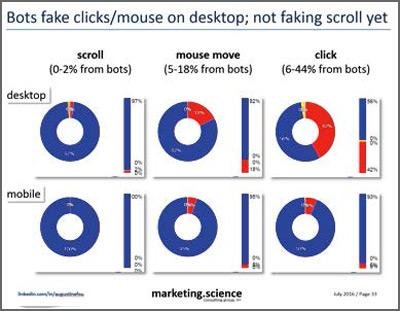
affaA recently published report by White Ops, a digital advertising security and fraud detection company, reveals that the source of most online ad fraud in the United States isn’t large data centers, but rather millions of infected browsers in devices owned by people like you and me.

This is an important finding, because when bots run in browsers, they appear as “real people” to most advertising analytics and many fraud detection systems.

As a result, they are more difficult to detect and much harder to stop.

These fraudulent bots that look like “people” visit publishers, which serve ads to them and collect revenues.

faaf

Of course, once detected, the value of these “bot-bound” ads plummets in the bidding markets.  But is it really a self-correcting problem?   Hardly.

The challenge is that even as those browsers are being detected and rejected as the source of fraudulent traffic, new browsers are being infected and attracting top-dollar ad revenue just as quickly.

It may be that only 3% of all browsers account for well over half of the entire fraud activity by dollar volume … but that 3% is changing all the time.

Even worse, White Ops reports that access to these infected browsers is happening on a “black market” of sorts, where one can buy the right to direct a browser-resident bot to visit a website and generate fraudulent revenues.

… to the tune of billions of dollars every year.  According to ad traffic platform developer eZanga, advertisers are wasting more than $6 billion every year in fraudulent advertising spending.  For some advertisers involved in programmatic buying, fake impressions and clicks represent a majority of their revenue outlay — even as much as 70%.

The solution to this mess in online advertising is hard to see. It isn’t something as “simple and elegant” as blacklisting fake sites, because the fraudsters are dynamically building websites from stolen content, creating (and deleting) hundreds of them every minute.

They’ve taken the very attributes of the worldwide web which make it so easy and useful … and have thrown them back in our faces.

Virus protection software? To these fraudsters, it’s a joke.  Most anti-virus resources cannot even hope to keep pace.  Indeed, some of them have been hacked themselves – their code stolen and made available on the so-called “deep web.”  Is it any wonder that so many Internet-connected devices – from smartphones to home automation systems – contain weaknesses that make them subject to attack?

The problems would go away almost overnight if all infected devices were cut off from the Internet. But we all know that this is an impossibility; no one is going to throw the baby out with the bathwater.

It might help if more people in the ad industry would be willing to admit that there is a big problem, as well as to be more amenable to involve federal law enforcement in attacking it.  But I’m not sure even that would make all that much difference.

There’s no doubt we’ve built a Frankenstein-like monster.  But it’s one we love as well as hate.  Good luck squaring that circle!

Quick-change artistry: Masculinity goes from “alpha-male” to “alta-male” inside of a generation.

Alpha-male: Venezuelan actor Alejandro Nones
Alpha-male: Venezuelan/Mexican actor Alejandro Nones

Many people contend that changes in society are driven by many influences – not least movies and music. Certainly, the popular arts reflect the current culture, but they also drive its evolution.

This view was underscored recently in the results of field research conducted by a British- and Singapore-based survey firm Join the Dots for Dennis Publishing, which has just launched Coach, a magazine in the U.K.

The magazine’s audience consists of men who are committed to lifestyles that make themselves “healthier, fitter and happier.”

The research aimed to figure out what are today’s characteristics of being “male.” An in-depth qualitative focus group session with men aged 22 to 60 helped establish the set of questions that was then administered in a quantitative survey of ~1,000 respondents (including women as well as men) between the ages of 25 and 54 years old.  The survey sample represented a diverse mix of family status, sexual preferences, incomes, professions and interests.

The survey questions focused on the habits and aspirations of men … and the results showed how far we’ve come from the heydays of the “alpha-male” barely 25 years ago.

The researchers contrasted good and not-go-good alpha-male stereotypes (self-absorbed … unwilling or unable to talk about insecurities or vulnerabilities) with a new persona they dubbed the “alta-male.”

The alta-male is a man who values work/life balance and finds personal fulfillment as much in self-improvement as in material wealth.

Additionally, the alta-male tends to reject male role models from earlier generations, instead opting to establish their own identity based on a myriad of diverse influences.

Of course, it’s one thing to aspire to these goals and quite another to actually attain them. The study found that two-thirds of the respondents are finding it difficult to achieve the satisfactory work/life balance they desire.

On the other hand, alta-males tend to be more adaptable, and they’re willing to embrace uncertainty more than the alpha-males of yore.

Even more strongly, alta-males are seekers of experiences, which they value over “mere money” – despite recognizing that it takes money to partake in many such life experiences.

Perhaps most surprising, the study found little difference in perspectives between older and younger male respondents.

It turns out that older men are just as likely to have an “alta-male” attitude towards life.  So clearly, the culture has been rubbing off on them, too.

From my own personal standpoint (as someone whose been around the track quite a few times over the decades), I sense a similar shift in my own personal perspectives as well.

What about the rest of you?