Is it time to change daylight savings time – and time zones – once and for all?

changing the timeEach time we Americans need to change our clocks, it’s accompanied by an undercurrent of grumbling about how disruptive it can be to our daily routines.

Indeed, in certain states that are in close physical proximity to time zone boundaries, the issue can be controversial enough to affect the popularity of elected officials, as has happened in Indiana and Arizona.

Daylight savings time, an innovation that became popular in the 1970s, continues to be a nettlesome issue because of when it is in effect in the United States – nearly a month earlier and a month later than before … and no longer in sync with other countries (if they even observe DST — and many of them don’t).

Daylight savings time is supposed to be more energy-efficient.  But it turns out the energy savings are minimal if any.  Uncoordinated time changes could very well undermine economic efficiency far more than any positive impact in energy savings.

A case in point:  Lack of synchronization with European time changes is estimated to cost the airline industry nearly $150 million in travel disruptions each year.

Moreover, some investigations have found that daylight savings time may actually cause worker productivity to be lower.

Does the current time zone structure have to be cast in stone?  Of course not.  The history of “time” is actually one of pretty constant change, dating all the way back to when time zones were first implemented in the 1880s.

Before then, each city and town had its own local time which was established by calculating the solar time in the local location using sundials.  Effectively, this meant that there were more than 300 different time zones in the U.S.A.

The American railroads were more streamlined:  They operated with only about 100 time zones.

Clearly, introducing four time zones for the continental U.S. was a way to introduce simplicity while compromising only a little regarding human biorhythms.

Of course, it took awhile for the time zone system to be adopted worldwide, but eventually it happened.

The economic and commercial landscape looks far different today than in the late 19th Century.  We are no longer bound by the physical limitations of geography in terms of how we do business.

As a result, some economists are suggesting that it’s time to overhaul the time zone structure and to move to a system that is even simpler and less disruptive to people’s lives.

One economist, Allison Schrager, has come up with the most radical solution I’ve seen yet.  Drawing from economic models plus her own experiences working across multiple time zones, Dr. Schrager has put forward the following recommendations:

  • Scrap daylight savings time altogether
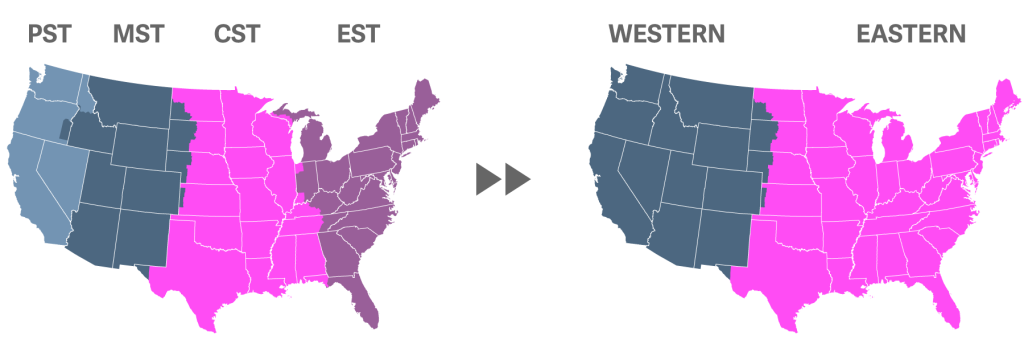
  • Consolidate and reduce the four current continental U.S. time zones (Eastern, Central, Mountain, Pacific) to just two (Eastern, Western)

Under the Schrager scenario, the new time zone map for the continental United States would look like this:
simplified time zone mapDr. Schrager points out that, while a fewer number of larger time zone geographies would seem to remove some people further from their “true” time zone, the realities of global commerce are already doing that anyway.

By contrast, she sees the benefits as more major.  For example, frequent travel between time zones under today’s four zones causes jet lag, robbing employees of productive work time.

With just a one-hour time difference between New York and California, bi-coastal travel would become almost effortless in that regard, Schrager maintains.

As for the disruption such a change might cause to international business coordination, Dr. Schrager contends that just as it took one or two countries to start things off in the 1880s, someone needs to step up to the plate today to start a new trend.

She says:  “… America won’t line up with the time zones of countries directly north and south unless this catches on as a global trend.  But the discontinuity ship already sailed when rich Western countries haphazardly adopted daylight savings time and most other countries didn’t.  Time is already arbitrary; why not make it work in our favor?”

Does Dr. Schrager raise some good points?  Would simplifying the time zone map and ditching daylight savings time be a “net positive” or not?

Some of her arguments seem to make sense to me.  What do you think?  Please share your thoughts with other readers if you’re so inclined.

A surprising development? America is now the world’s largest oil supplier.

number-1For those of us who came of age during the oil embargo of 1973 and the subsequent decades of high-priced, restricted-supply petroleum coupled with a contorted foreign policy continuously buffeted by those economic realities … the recent news that the United States is poised to become the world’s top oil supplier in 2013 comes as a bit of a surprise.

But it’s right there in black-and-white, in data published by PIRA Energy Group, a New York-based energy markets consulting firm:

  • This year, the United States is projected to produce an average of ~12 million barrels per day of liquid oil products (crude oil, natural gas liquids and biofuels together).
  • That’s ~300,000 barrels per day higher than Saudi Arabia … and ~1.6 million more than Russia.
  • The other countries that make up the “Big Ten” oil producers – China, Canada, the United Arab Emirates, Iran, Iraq, Kuwait and Mexico – don’t even come close to the “Big Three.”

Where’s Venezuela on the list?  Nowhere to be found.

Take that, Carlos Chávez and Nicolás Maduro!

The United States is forecast to pump approximately 7.5 million barrels per day of crude and concentrate in 2013.  That’s actually 3 million barrels less than Saudi Arabia and Russia.

But the shortfall is more than made up by the ~2.5 million in natural gas liquids and ~1 million of biofuels America is also producing every day.

The rise in U.S. production is practically unprecedented.  Only once before has a country raised its production faster (Saudi Arabia in 1970-74).

The reason for the rise in American production?  Two words:  “shale oil.”

USA Shale Gas Exploration ZonesU.S. shale oil and condensate production now stands at ~2.5 million barrels per day.  That’s slightly over one-third of total U.S. crude production.

And shale natural gas liquid production, at ~1.2 million barrels per day, is nearly half of total NGL production.

America’s shale oil boom could turn out to be of far greater import than all of the renewable or “alternative energy” schemes put together – despite the political attention and funding these more “sexy” technologies have had lavished on them by federal and state governments and research foundations.

Abetted by the explorationof shale oil formations via horizontal drilling and fracking, the impact of shale oil reserves isn’t a flash in the pan, either.  According to PIRA Energy, America’s position as the largest oil supplier in the world looks to be secure for many years.

Production growth rates may level off eventually, but PIRA forecasts that the United States will continue to increase its lead over Saudi Arabia and Russia until 2020 at least.

… And retain its production lead over all other countries until at least 2030.

What a relief all of this is.  Speaking for myself, I’m loving the fact that America is no longer so beholden to offshore energy resources controlled by people who “might” be our friends one day … and who “might” not be the next.

It’s like financial debt:  Having too much debt is really bad.  Having no debt at all is really nice.

Energy independence — or something close to it — is really nice, too.

Samsung gets its marketing knuckles wrapped – twice.

Samsung logoTech manufacturing giant Samsung’s “questionable” marketing activities have been in the news this past week – again.

This time, it’s reported that the company has been fined a $340,000 penalty for paying people to post trash-talk comments about competitor HTC’s products in customer online forums in Taiwan.

Back in April, the Fair Trade Commission in Taiwan opened an investigation into allegations that Samsung had recruited certain employees along with freelance writers from the outside to flack the shortcomings of its competitors’ products.

In addition to the company being held culpable, two of Samsung’s outside marketing firms were fined for their part in the marketing shenanigans masquerading as natural content.

This is pretty big news in the world of smartphones.  HTC and Samsung are major competitors in this highly competitive marketplace, and both companies offer products that operate on the Android platform.

But Samsung’s fortunes have risen dramatically over the past year as its global smartphone market share jumped from ~19% to ~30%.

By contrast, HTC’s share declined from ~9% to slightly less than ~5% over the same period.

Evidently, Samsung couldn’t resist the temptation to kick a competitor when it was already on the ropes.

Chalk it up to the “take no prisoners” atmosphere in the cutthroat competitive world of mobile technology – the “New York Garment District mentality” writ large.

“Astro-turfing” isn’t new, of course.  But the practice is usually the province of smaller companies with fewer scruples … or marketing people who are simply unaware of proper marketing etiquette (and often backed by legal opinion).

Amateur hour
“Amateur hour” at Samsung’s marketing department makes the company look just … silly.

For a company as large and as sophisticated at Samsung, it does seem a little … odd.  And certainly not in good form.

But as it turns out, this isn’t the first time Samsung’s gotten caught with its marketing pants down.

Just a few months ago, the company was discovered bribing various people to “talk up” its development activities – and “talk down” their competitors – during the Samsung Smart App Challenge competition.

Android developer Delyan Kratunov went public with ongoing correspondence in which a viral marketing company working for Samsung offered him $500 to cite positive mentions on the Stack Overflow online community.

The instructions were specific:  Mr. Kratunov would need to ask a series of “casual and organic” questions about Samsung’s app challenge over a month-long period.

Later, the marketing company attempted to distance itself from the egregious behavior — but not before the incident had been exposed.

My response to Samsung is this:  You’re already winning.  There’s no need to engage in “adolescent business behavior” of this kind.

It’s in very bad form … and sooner or later it’ll come back to bite you.

Stuff like this always does eventually.

Getting Bunky with Retail Marketing

digital circularsAre the days of the lowly printed sales circular numbered?

Judging from the flurry of newfangled activity by key retail marketers, it would seem so.

This past week, CVS Pharmacy announced a complete makeover of its weekly circular.  The new digital version, dubbed myWeekly Ad, incorporates customized promotions focused on the products that are deemed of greatest interest to individual consumers.

The personalized sale items are determined from scanning the trove of customer buying behavior information housed in CVS’s ExtraCare Rewards database, which now numbers more than 70 million active users.

The myWeekly Ad circular determines which items to feature based on the products that each targeted consumer buys most frequently, along with showcasing deals on other products in related categories that may also be of interest based on the purchase history of each customer.

CVS’s digital circular provides other user-friendly options as well:

  • Consumers can scan the savings and rewards currently available to them, and print coupons or digitally send special offers to their card before visiting a CVS store. 
  • Shopping lists can be created, shared and sent to mobile devices. 
  • Shoppers can view their own purchase history showing all products bought at CVS previously going back 18 months.

And CVS is hardly alone in digitizing its MarComm materials.  Thanks to the continuing evolution of rewards cards and the voluminous customer data they can collect, new personalized circular announcements are coming with regularity now.

Here are some of the latest new developments:

  • Shoplocal is a Gannett-owned print and digital circular publisher.  It has gotten together with personalized video firm Eyeview to create a new digital ad promo piece known as V-circular.  This vehicle allows retailers and major brands to target customers on a local level based on geographic, demographic and behavioral data – along with factoring in “real-time” conditions like the weather.
  • National coupon clearinghouse Valpak has introduced a novel “augmented reality” feature for its digital circulars.  Simply pointing a smartphone toward the horizon will enable shoppers to see which nearby businesses are offering coupons.
  • Direct mail media and marketing services firm Valassis has unveiled Geo-Commerce Retail Zone, a new ad-targeting capability that applies transaction and behavior data from consumers to local store trading areas, enabling targeted advertising to be delivered cross-platform.

No one questions the fact that more and more information on individual consumers is being collected, archived and applied on an individualized basis.  Anonymity is fast becoming a quaint notion of the past.

Of course, this couldn’t happen without the cooperation and willing engagement of consumers. 

Considering the benefits – special discounts and even freebies on goods and services – is it any wonder that these programs have been able to grow in size and comprehensiveness over time?

What are your thoughts about the tradeoffs?  Feel free to add your thoughts to the discussion.

Is AdTrap the answer to our prayers when it comes to blocking online advertising?

ad blocking deviceYou may have heard of AdTrap … or maybe you haven’t.

AdTrap is a newly developed device that intercepts online ads before they reach any devices that access a person’s Internet connection.

That basic action means that people are able to surf the web – including viewing videos – without the onslaught of online advertisements that seem to become more and more pervasive with every passing month.

The fundamental promise that the developers of AdTrap are making is a return to the “good ol’ days” of web surfing.

You know, back when most web pages you downloaded contained text and pictures – and virtually no advertising.

AdTrap’s motto is a simple and powerful one:  The Internet is yours again.”

Not surprisingly, there’s a good deal of excitement surrounding this new product.  In fact, interest has been so great that the invention attracted more than $200,000 in funding — raised in a 30-day Kickstarter campaign in early 2013.

Those funds are now being used to manufacture the first AdTrap units for shipment to “early adopter” consumers across the country.

How New an Idea Is This?

advertisingIn actuality, there have been a plethora of (often-free) software and browser plug-ins offered to consumers that can block online advertisements. 

But most of them have significant limitations because they’ve been designed to work only with specific browsers or on specific devices.

Free is good, of course.  But the developers of AdTrap are banking on the willingness of consumers to shell out $139 for their product – a rectangular box that looks a lot like a wireless router and that intercepts advertisements before they reach a laptop, tablet or mobile device.

The beauty of AdTrap is that it will work on every device connected to a person’s network.  Situated between the modem and router, it takes just a few minutes to set up.  

CNN technology correspondent Dan Simon reports that AdTrap does an effective job blocking advertising content.  But not perfectly; ads still appear on Hulu content, for example. 

But the developers of AdTrap report that they’re working on ways to block even more content going forward, including ads on Hulu.

Is this Bigger than Merely Blocking Ads?

Beyond the collective sigh of relief you’re likely hearing from those reading this blog post … what are the larger implications if AdTrap and similar devices are adopted by consumers on a large scale?

One not-so-positive implication may be that websites will no longer offer be able to offer content without charge, since so many publishers’ business models rely on advertising content to help pay most of the bills.

If advertising isn’t appearing thanks to AdTrap, people aren’t getting paid.

So let’s think about this for a minute:  It’s true that the Internet was blissfully free of wall-to-wall advertising 15 years ago compared to today. 

But cyberspace was also far less robust in terms of the quantity and quality of the informational and entertainment content available to us.

So yes … having a device to block 80% or more of the ads served to us is a very attractive proposition.  But if it means that some of our favorite sites move to pay-walls as a result, it might be that making a $139 investment in an AdTrap device isn’t such a “no-brainer” choice in the final analysis.

What do you think of this development — pro or con?  Please share your thoughts with other readers here.

“Public pronouncements” versus “private predilections”: What we say isn’t always what we actually believe.

Public versus private thinkingThere’s an intriguing new research report out from Young & Rubicam that lays bare the contradictions of what people say they like and want … and what they secretly think.

The findings are outlined in a new research study Y&R has dubbed Secrets & Lies … and it’s based on research conducted in September 2013 among adults over age 18 in the United States, Brazil and China.

The bottom line?  The Y&R research finds that many people hold views that are diametrically opposed to what they reveal to others publicly.

That kind of a result would be difficult to measure using traditional survey research.  So Y&R chose to meld the conventional survey approach with a second methodology known as “Implicit Association Testing.”

IAT helps reveal sub-conscious or unconscious motivations that lie outside of our standard awareness.

So, what contradictions and correlations did the research uncover? 

Let’s start with the study’s global findings.  When asked to rank-order a group of 16 “values,” here’s a listing of the top five values as cited by the survey respondents in all three countries:

  • #1.  Finding meaning in life
  • #2.  Choosing my own path
  • #3.  Helpfulness
  • #4.  Environmentalism
  • #5.  Success

Now … compare that to the “Top 5” list that was revealed with these same respondents were evaluated using implicit association:

  • #1.  Sexual fulfillment
  • #2.  Respect for tradition
  • #3.  Maintaining security
  • #4.  Environmentalism
  • #5.  Building wealth

Wow.

We  see just one value appearing on both lists … and there are some pretty big differences in the values that reside on each of them.

Did American respondents differ from their counterparts in China and Brazil?  Like the global results, the values were quite different between conscious responses and implicit association. 

U.S. respondents named helpfulness as their highest-ranked value, followed by choosing my own path and finding meaning in life.

But what did the implicit association testing reveal among these same American respondents?

Far from being at the top of the list, “helpfulness” came in dead last:  16th place out of 16 values rated.  Instead, the top three “subconscious” values are actually these:

  • #1.  Maintaining security
  • #2.  Sexual fulfillment
  • #3.  Honoring tradition

As the Y&R study pointedly opines, America’s top conscious values sound like political correctness reminiscent of the Oprah Show … whereas our unconscious values sound more like a return to the Eisenhower era.

These seeming disconnects between “public pronouncements” and “private predilections” manifest themselves in brand image as well.

As it turns out, consumers say they like the “popular kids” on the branding block a lot more than they actually do subconsciously.

Here’s a list of top brands researched and how they come out in conscious rating versus IAT evaluation:

  • Alignment between public and secret likes:  Amazon, Target, Whole Foods
  • Alignment between public and secret dislikes:  AT&T, K-Mart, Playboy
  • Liked less in secret:  Google, Microsoft, Starbucks
  • Liked more in secret:  Exxon, Facebook, National Inquirer

When I scan this list, it’s pretty evident what’s going on.  Certain brands are popular whipping boys in the “popular media” and on certain cable news channels, where one rarely hears positive word uttered about them. 

Not surprisingly, it’s precisely those brands that get a “public thumbs-down” from the respondents.

But in secret — away from the klieg lights and the admonitions of the culture’s PC denizens — it’s quite a different ballgame.

Of course, no one would want their brand to be in AT&T’s or K-Mart’s unenviable position – because that’s where people dislike those companies publicly as well as in their private thoughts!

Sprawl & Crawl: Are work commutes actually worse than you think?

DC traffic
It turns out politics isn’t the only kind of gridlock in Washington, DC. It also has more traffic gridlock than anywhere else in the country.

This past weekend, The Wall Street Journal published a feature story in its “Personal Journal” section that profiled how businesspeople cope with their daily work commutes

It turns out that the average daily work commute in the United States takes about 25 minutes

Another interesting statistic from the article is the amount of time car commuters in larger cities spend stuck in traffic:  52 hours annually, or about an extra hour per week.

The WSJ story profiled several people who access mass transportation for their work commutes, as well as one businessman who relocated from the Washington, DC Metropolitan area to Metro Cincinnati, substantially reducing his daily commute time and hassle in the process.

As someone who lives not far from the DC Metro area and who contemplates any drive through the region with a mixture of disdain and dread, this got me to wondering:  Just what is the worst geographic market for commuting?

Helpfully, there’s a recently completed study that answers this very question.  The Transportation Institute at Texas A&M University has applied a calculation tool called the Planning Time Index (PTI) to compare drive times in heavy traffic (i.e., rush hour) against travel times when the same highways are clear.

The way the PTI calculation works is this:  A PTI of 2.00 means that a “normal” drive will take twice as long in heavy traffic. 

Using that PTI=2.00 example, a drive that may ordinarily take ~20 minutes will take ~40 minutes instead.

My suspicions about the DC Metro area turned out to be right on the money.  Here are the most “challenging” metro markets for work commutes based on their PTI indices:

  • Washington DC:  5.72 PTI index
  • Los Angeles:  4.95
  • New York-Newark:  4.44
  • Boston:  4.25
  • Dallas-Ft. Worth-Arlington:  4.00
  • Seattle:  3.99
  • Chicago:  3.95
  • San Francisco-Oakland:  3.74
  • Atlanta:  3.71
  • Houston:  3.67

How do these PTI indices translate into actual drive times?  Shockingly, a DC-area commute that ordinarily takes 20 minutes translates into almost two hours in heavy traffic. 

And among all of the other “top ten” worst markets, that normally 20-minute commute  will take 1.2 hours or longer in rush-hour traffic.

Interestingly, when one scans the “Top Ten” list, the only Midwest urban area that shows up on it is Chicagoland.  So if you wish to avoid the hassle of long commutes, consider relocating to urban markets in the Midwest like St. Louis, Minneapolis-St. Paul, Cleveland, Milwaukee or Kansas City.

But what’s the absolutely easiest metro market for commuting?  According to the Texas A&M study, it would be Pensacola in Florida.  It has a PTI of just 1.31. 

… Which means only about six extra minutes in rush traffic compared to the ordinary 20-minute commute.

Come to think of it … Pensacola has great beaches and nice sea breezes as well.  Perhaps dealing with the occasional hurricane is worth it, all hassles considered!

Are small businesses under increasing risk of cyber-attacks?

cyberWhen it comes to cyber-security, high-visibility data breaches get all the press, which is understandable.

But small businesses are also victims of cyber-attacks.  And sometimes those events can be financially devastating.

Now a newly published survey quantifies the extent to which small businesses are at risk.  The National Small Business Association polled nearly 850 U.S. small business owners (most with annual revenues between $500,000 and $25 million) in August 2013).  The NSBA survey found that nearly 45% of the respondents’ businesses had been the victim of cyber attacks such as malware, spyware or banking Trojans.

The average cost of these cyber attacks was reportedly nearly $9,000 – with some dollar amounts going much higher.

Separately, another study shows that a record number of cyber attacks targeted small businesses in 2012.  Verizon’s Data Breach Investigations Report examined 855 data breaches and found that over 70% of them involved victim companies with fewer than 100 employees.

Verizon’s 2013 report is showing a continuing increase in cyber attacks on small business, meaning that 2012 was no fluke.

What’s going on here?

According to the Verizon study’s conclusions as well as comments from security experts like Vikas Bhatia, small and medium-sized businesses could be doing a better job of “offensive defense.”

Among the mistakes commonly observed in small businesses are these:

  • Lack of conducting regular backups of business data
  • Neglecting to store backed up data offsite
  • Failing to test data restore functions on a periodic basis
  • Neglecting to keep antivirus software up to date, including software patches and updates
  • Practicing sloppy password protection behaviors (using plain-language passwords … using identical passwords across multiple accounts, etc.)
  • Not understanding cloud-based data storage and what outsourced providers’ liabilities are (and are not) for protecting data

There’s no question that cyber-security continues to be a big challenge – and probably a growing one – for many companies.

But it’s also pretty evident that many businesses could be doing more to protect themselves from the heartburn (and financial fallout) along the way.

Here’s a Big Book on Big Data

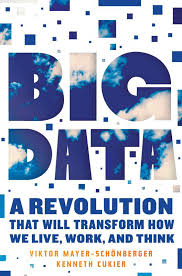
Big Data: A Revolution that will Transform how we Live, Work and Think by Mayer-Schonberger and Cukier“Big data” is definitely one of the more commonly heard business buzz terms these days.

But beyond the general impression that “big data” represents the ability to collect and analyze lots and lots of information in some efficient manner, most people have a difficult time explaining with any specificity what the term really means.

Moreover, for some people “big data” isn’t very far removed from “big brother” – and for that reason, there’s some real ambivalence about the concept.  Consider these recent “man on the street” comments about big data found online:

  • “Big data:  Now they can crawl all the way up your *ss.”
  • “The scary thing about big data is knowing [that] Big Brother can know every single thing you do – and realizing your life is too unimportant for Big Brother to even bother.”
  • “Big data is what you get after you take a big laxative.”

But now we have a recently-published book that attempts to demystify the concept.  It’s titled Big Data:  A Revolution that will Transform How We Live, Work and Think, and it’s authored by two leading business specialists – Viktor Mayer-Schönberger, a professor of internet governance and regulation at Oxford University and Kenneth Cukier, a data editor at The Economist magazine.

The book explores the potential for creating, mining and analyzing massive information sets while also pointing out the potential pitfalls and dangers, which the authors characterize as the “dark side of big data.”

The book also exposes the limitations of “sampling” as we’ve come understand it and work with it over the past decades.

Authors Viktor Mayer-Schonberger (l) and Kenneth Cukier (r).

Cukier and Mayer note that sampling works is fine for basic questions, but is far less reliable or useful for more “granular” evaluation of behavioral intent.  That’s where “big data” comes into play big-time.

The authors are quick to note that advancements in data collection tend to come along, shake things up, and then quickly become routine.

Mayer calls this “datafication,” and describes how it works in practice:

“At first, we think it is impossible to render something in data form.  Then somebody comes up with a nifty and cost-efficient idea to do so, and we are amazed by the applications that this will enable – and then we come to accept it as the ‘new normal.’  A few years ago, this happened with geo-location, and before it was with web browsing data gleaned through ‘cookies.’  It is a sign of the continuing progress of datafication.”

Causality is another aspect that may be changing how we go about treating the data we collect.

According to Cukier and Mayer, making the most of big data means “shedding some of the obsession for causality in exchange for simple correlations: not knowing why but only what.”

So then, we may have less instances when we come up with a hypothesis and then test it … but rather just use the data to determine what is important and act on whatever information is revealed in the process.

Retail DisplayOne example of this practice that’s cited in the book is how Wal-Mart determined that Kellogg’s® Pop-Tarts® should be positioned at the front of the store in selected regions of the country during hurricane season to stimulate product sales.

It wasn’t something anyone had thought about in advance and then decided to verify; it was something the retailer discovered by mining product purchase data and simply “connecting the dots.”

Author Mayer explains further:

“There is a value in having conveniently placed Pop-Tarts, and it isn’t just that Wal-Mart is making more money.  It is also that shoppers find faster what they are likely looking for.  Sometimes ‘big data’ gets badly mischaracterized as just a tool to create more targeted advertising … but UPS uses ‘big data’ to save millions of gallons of fuel – and thus improve both its bottom line and the environment.”

One area of concern covered by the authors is the potential for using “big data predictions” to single out people based on their propensity to commit certain behaviors, rather than after-the-fact.  In other words, to treat all sorts of conditions or possibilities in the same manner we treat sex offender lists today.

Author Kenneth Cukier believes that the implications of a practice like this – focusing on the use of data as much as the collection of the data – is “sadly missing from the debate.”

This book fills a yawning gap in the business literature.  And for that, we should give Dr. Mayer-Schönberger and Mr. Cukier fair dues.  If any readers have become acquainted with the book and would care to weigh in with observations, please share your thoughts here.

Smartphones and Tablets have Doubled Our Time Spent Online

screenjumpersWhat a difference a few years makes.

Back in February 2010, Americans over the age of 18 spent a total of ~451 billion minutes’ time on the Internet, according to comScore’s Media Metrix research.

By comparison, in February 2013, the total time spent online had nearly doubled to ~890 minutes.

The vast majority of the increase is attributable to tablet computers and smartphones rather than PCs:

  • PC minutes rose from ~388 billion to ~467 billion (+24%).
  • Smartphone minutes grew from ~63 billion to a whopping ~208 billion (+230%).
  • Tablet minutes grew from zero to 115 billion (tablets didn’t exist in 2010).

In fact, taken together, smartphones and tablets now account for nearly 60% of the time online spent by people age 18 to 24.  On the other hand, smartphones account for a relatively small 25% of time spent online by Americans age 50 or older.

This age divide is also clearly evident in comScore’s estimated breakdown of platform adoption:

All American Adults

  • PC only:  ~30%
  • “Screen jumpers” (PC + mobile):  ~63%
  • Mobile platforms only:  ~7%

Young Adults (age 18-24)

  • PC only:  ~22%
  • Screen jumpers:  ~65%
  • Mobile only:  ~13%

Older Adults (age 50+)

  • PC only:  ~48%
  • Screen jumpers:  ~51%
  • Mobile only:  ~1%

The comScore analysis also provides some interesting stats pertaining to online share of minutes by the type of content being accessed.

Most online time spent on PCs:

  • Business/Finance (~68%)
  • TV (~68%)
  • News/Information (~62%)
  • Sports (~62%)
  • Retail (~49%)
  • Health (~54%)

Most online time spent on smartphones:

  • Radio (~77%)
  • Social Media (~58%)
  • Weather (~55%)
  • Games (~48%)

Tablets don’t lead in any single category, but score particularly well in these two:

  • Games (~34% of time online is spent on tablets)
  • TV (~20% of time online is spent on tablets)

More details and insights from the comScore report can be found here.