Another for-profit higher educational institution bites the dust …

it

Last week, ITT Technical Institute, a for-profit higher educational institution enrolling ~40,000 students on more than 130 campuses across the country, announced that it is shutting down, while also laying off the lion’s share of its more than 8,000 employees.

This development comes hard on the heels of the closure of Corinthian Colleges last year. Together, it raises the question as to whether such “glorified trade schools” are doing any kind of service to students who seek to better themselves but who don’t have the scholastic record – or the money – to attend traditional two-year or four-year colleges.

tlpThere’s no question of the pent-up demand for higher learning. Guidance counselors push continued schooling as the next logical step for high school students, and society in general promotes a college education as the ticket to the good life.

For-profit colleges have benefited greatly from an environment which prizes higher education as the next logical step for high school graduates, and during the Great Recession beginning eight years ago, these schools continued to promote their curricula heavily while churning out more students into what was a very weak job market.

Students graduating from not-for-profit institutions had a hard enough time landing employment in their chosen fields … and for graduates of ITT, Corinthian and other such schools it was even worse.

corinthian_colleges_logoThe U.S. Department of Education had had its eye on both ITT and Corinthian for a number of years. Becoming alarmed at the inability of graduates to pay off their federally funded student loans, the Department ultimately banned both schools from enrolling any new students who rely on federal financial aid – which was nearly all of them, of course.

An angry ITT Technical Institute pronounced the sanctions unwarranted, inappropriate and unconstitutional – amounting to a death sentence.

A news release from the school stated, “These unwarranted actions, taken without proving a single allegation, are a lawless execution.”

As is often the case in such situations, there’s more than meets the eye. At the same time, ITT Technical Institute is also facing fraud charges from the SEC plus a lawsuit from the Consumer Financial Protection Bureau.

Not only that, the institution has been under investigation at the state level in 19 different jurisdictions.

Academic accreditation is also an issue, as the ACICS (Accrediting Council for Independent Colleges & Schools) determined that the school was not in compliance with ACICS’ accreditation criteria.  ACICS cited a whole range of questionable practices in admissions, recruitment standards, retention, job placement and institutional integrity.

The school itself, using aggressive and pervasive advertising while pushing its “power packed studies” in fields such as IT, electronics, CAD design and health services, also informed prospective enrollees that credits earned at ITT Technical Institute would be “unlikely to transfer.”

This sorry state of affairs at ITT-TI now makes it that much more difficult for ~40,000 students to pursue their career goals. It’s yet another example of how a laudatory mission can lead to negative consequences for the very people who need help in launching their working lives the most.

Ben Miller, who is a director for post-secondary education at the Center for American Progress, puts the blame nowhere but on the school:

“Years of mismanagement by ITT leadership put it in a position where the Education Department’s action was necessary.”

In the coming years, it will be interesting to see the degree to which other for-profit institutions with far-flung operations – Brightwood/Tesst, Capella, Strayer, the University of Phoenix and others – will fare under the klieg lights of heightened scrutiny.


Are U.S. warehouse jobs destined to go the way of manufacturing employment?

Even as manufacturing jobs have plateaued or fallen in certain communities, one of the employment bright spots has been the rise of distribution centers and super warehouses constructed by Amazon and other mega retailers to accommodate the steady rise of online shopping.

In my own region, the opening of Amazon distribution centers in Maryland and Delaware were met with accolades by local business development officials, who figured that new employment opportunities for entry level workers would soon follow.

And they have … to a degree. But what many people might not have expected was the rapid rise of robotics usage in warehouse operations.

In just the past few years, Amazon has quietly gone about purchasing and introducing more than 30,000 Kiva robots for many of its warehouses, where the equipment has reduced operating expenses by approximately 20%, according to Dave Clark, Amazon’s senior vice president of worldwide operations and customer service.

An analysis by Deutsche Bank estimates that adding robots to a new Amazon warehouse saves approximately $22 million in fulfillment expenses, which is why Amazon is moving ahead with plans to introduce robots in the remaining 100 or so of its distribution centers that are still without them.

Once in place, it’s estimated that Amazon will save an additional $2.5 billion in operating expenses at these 100 facilities.

Of course, robots aren’t exactly inexpensive pieces of equipment. But with the operational savings involved, it’s clear that adding this kind of automation to warehousing is kind of a slam-dunk decision.

Which helps explain another move that Amazon made in 2012. It decided to purchase the company that makes Kiva robots — for a cool $775 million.  And then it did something else equally noteworthy:  it ceased the sale of Kiva robots to anyone outside the Amazon family.

Because Kiva was pretty much the only game in town when it came to robotics designed for warehouse pick-and-ship functions, Amazon’s move put all other warehouse operations at a serious disadvantage.

That in turn created a stampede to develop alternative sources of supply for robots. It’s taken about four years, but today there are credible alternatives to Kiva brand robots now entering the market.  Amazon’s uneven playing field is getting ready to become a lot more level now.

But the other result of this “robotics arms race” is the sudden plenteous availability of new robot equipment, which companies like Macy’s, Target and Wal-Mart are set to exploit.

The people who are slated to be the odd people out are … warehouse workers.

The impact could well be dramatic. According to the Bureau of Labor Statistics, there are nearly 860,000 warehouse workers in the United States today, and they earn an average wage of approximately $12 per hour.

Not only is the rise of robot usage threatening these jobs, thanks to the sharp increase of minimum wage rates in areas near to some major urban centers is putting the squeeze on hiring from a wholly different direction. It’s a perfect storm the seems destined to blow a hole in warehouse employment levels in the coming years.

Thinking back to what happened to manufacturing jobs in this country, it’s seems we’ve seen this movie before …

A nation of “haves” vs. “have-nots”? Gallup tests the perceptions.

pictureIn any presidential political season, there’s always plenty of rhetoric about the American economy, how well it’s performing for the average voter, and people’s perceptions of how they’re doing socioeconomically.

As it turns out, the Gallup Survey has been testing this issue annually for years now — going all the way back to 1988.

The question posed to Americans in Gallup’s surveys is a simple one: Do you consider yourself personally to be part of the “haves” or “have-nots” in America?

Gallup’s latest survey was fielded in July 2015.  Nearly 2,300 U.S. adults aged 18 and older were part of the research.

In response to the “haves vs. have-nots” question, ~58% of respondents considered themselves to be “haves” in U.S. society, while ~38% placed themselves in the “have-nots” segment. (The remaining ~14% see themselves borderline between the two, or they don’t have an opinion.)

Over time, Gallup has found that the percentage of Americans who perceive themselves to be part of the “have-nots” in society rose pretty steadily from 1988 to 1998, but since that time the percentages have leveled off — even during the worst years of the Great Recession from 2009-2011.

And so, the “haves” percentage has fluctuated in a tight band between 57% and 60% in each year since the late 1990s.

It seems that heightened discussions about social inequality in America haven’t resulted in a higher percentage of people thinking that they are on the less fortunate side of the country’s socioeconomic divide.

However, considering that the latest Gallup survey was conducted in July 2015 — and that since that time there have been more news events drawing attention to the issues of social justice — one wonders if we may be on the cusp of some changing thinking on the subject.

Another persistent finding in Gallup’s surveys is this:  Even among families of quite modest means (annual household incomes of $35,000 or lower), only a little more than half in that segment consider themselves to be part of the “have-nots” group.

Education-wise, the survey findings are similar, with fewer than half of the respondents who don’t possess college degrees considering themselves part of the “have-nots” segment.

In reporting on the Gallup survey results, an article published in the November 2015 issue of Quirk’s Marketing Research Review magazine stated:

“The stratification of U.S. society into unequal socioeconomic groups has long been a fixture of philosophic, political and cultural debate. It appears to have remained or even expanded as a fairly dominant leitmotif in the ongoing 2016 election, particularly among the Democratic presidential candidates. 

[Nevertheless,] the results … in this analysis show that a majority of U.S. adults do not think of American society as being divided along economic lines, and a slightly higher percentage say that if society is divided, they personally are on the ‘haves’ side of the equation rather than the ‘have-nots.'”

More information about the Gallup survey results can be viewed here.

What are your thoughts? Do the perceptions Americans have of socioeconomic inequality — or the lack of it — match the reality?  Or are we poised to see some new significant shifts in the way Americans view socioeconomic divisions in this country?

Organizational Management: Zappos Meets Reality

ZLIt’s always interesting to read about the concept of flattened or “matrix” organizational structures for companies, and how they offer a much more creative and fulfilling environment for employees when compared to working within a more traditional hierarchical organizational structure.

… And then you read about a company that actually tries to implement such an organizational model — and gets thrown against the rocks in the process.

The latest example is Zappos, the online shoe and clothing retailer which has built its business and reputation on exquisite customer service. For years it’s also been known as a company willing to experiment with nontraditional human resources models.

The most famous of these is known as “the offer,” where new hires are given the opportunity to take a $2,000 stipend in lieu of remaining on the job – the idea being that it’s a practical as well as humane way to ensure that Zappos employees are the best “fit” for the company.

The company’s latest endeavor has been to introduce a new management structure known as a “holocracy.” This structure, adopted by Zappos in 2014, aims to facilitate (or codify, actually) collaboration among workers by essentially eliminating workplace hierarchies – as in no titles and no direct-report bosses.

In Zappos’ holocracy environment, employees now work through their job responsibilities, strategies and tactics via a web-based app known as the “Glass Frog.”

I think you might know where this is headed: Self-governance isn’t a tidy business, and there’s a good dose of mixed signals and even confusion that comes along with it.

When structures are flattened and titles eliminated, it causes disruption in ways big and small:

  • How do strategic initiatives and tactical tasks get done efficiently?
  • Who is responsible for what? 
  • How do co-workers (as well as outsiders) know what each employee “does”?
  • How are employees monitored and evaluated on their work performance and contribution to the success of the enterprise?

And how about this: Try determining salaries for existing and prospective new employees after titles have been eliminated.

Guess what happens when confusion reigns in any organization? Attrition rates rise.

As reported this month by Bourree Lam in The Atlantic, in the case of Zapppos, nearly one in five employees have taken buyouts since last spring, resulting in an annual turnover rate of ~30%.  That’s dramatically higher than the typical attrition rate at companies.

Weeding out less productive workers is a staple in managing for business efficiencies, productivity and profits. But when nearly one-third of your entire staff is leaving the company within a 12-month period, you’re getting into territory where “institutional knowledge” is in serious danger of being lost.

Research by Stanford University’s Graduate School of Business and other institutions shows that the more “egalitarian” an organizational structure is, the more unpredictable and potentially disorienting it is to workers. Simply put, most people prefer a defined “pecking order.”  They might grumble about corporate hierarchies, but those structures are more “predictable” and many workers find them to be more psychologically comfortable.

hoThe reality is that holocracries, flattened and matrix organizational structures are often less efficient than hierarchical ones. They may well spur more innovation and creative thinking, but the price paid in lost efficiency may be too high for many companies.

In my personal experience working with a matrix organization (not as an employee but as a person providing business support services to the company), I’ve seen where a matrix structure can actually work. It certainly helps if the business has strong, industry-leading products that are protected by patents and that benefit from being able to command high prices and correspondingly high product margins.

Zappos isn’t operating in any such marketplace. It has little or no protection against aggressive market competitors entering its space.  Profit margins in retail are famously tight.  It’s just not clear that any company can operate successfully in that space for any length of time without keeping very tight controls over operating expenses and also squeezing as much productivity out of each employee as possible.

Despite the challenges, it appears that Zappos is doubling down on its holocracy structure. Here’s what CEO Tony Hsieh wrote in 2014 to his employees:

“Self-management and self-organization is not for everyone, and not everyone will necessarily want to move forward in the direction of the … strategy statements that were recently rolled out. Therefore, there will be a special version of “the offer” on a companywide scale, in which each employee will be offered at least 3 months’ severance … if he/she feels that self-management, self-organization and our … strategy statement as published in Glass Frog are not the right fit.”

With a pronouncement like that coupled with a big financial carrot, it’s understandable why so many employees have taken up Zappos’ severance package offer.

The next question is this: Will Zappos emerge as a stronger, more creative and more nimble company as a result of its transition to a holocracy structure?  Or will the initiative turn out to have been a massive miscalculation?

If you work in a flattened or matrix organization structure and have observations to share about its positive and negative aspects, please leave comments. I’m sure other readers would be quite interested to read them.

“Boomerang employees”: No longer such a rarity in the corporate world.

Time was, once a person left a company – for whatever reason – the likelihood that they’d ever come back to work there was pretty slim.

Perhaps to be re-engaged as a consultant or a contract worker … but as a return employee? Not likely at all.

That mindset appears to be changing.  Data accumulated from a recent survey by HR research and advisory firm Workplace Trends from ~1,800 human resources executives, managers of staff, and employees provide the following clues:

  • Half of the HR professionals responding to the survey claimed that their organization once had formal policies against rehiring former employees (even if the employee had departed in good standing).
  • Three-fourths of the HR respondents reported that they are more accepting of hiring boomerang employees today. More than half of the respondents who are people managers felt the same way.

The actual incidence of returning to work at a former company isn’t all that common.  Of the employees who took part in the survey, fewer than 15% of them fell into this category.

Still, 15% is way up from where it has been traditionally — and the current percentage is higher than I would have guessed.

What’s more, nearly 40% of employee respondents reported that they would consider going back to an employer where they had once worked.

There are distinct differences in employee attitudes based on age demographics: More than 45% of Millennials would consider returning to work for a former employer … but the percentage is just 29% for Baby Boomer respondents.

As for why boomerang employees are becoming more common, a number of factors are at play:

  • Intense competition for certain technically advanced employees who may be in short supply makes poaching more common … and also intensifies the need for companies to respond in kind. In fields were strong talent is hard to come by, often the pool of workers is too small to summarily omit former employees from consideration.
  • Familiarity with a company’s organization, culture and ways of doing business reduces “ramp-up” requirements and the amount of training needed, when compared to bringing on a brand-new employee.
  • The “devil you know” factor: Even if a former employee possesses a few characteristics that are less-than-ideal, at least these are known quantities, as compared to a brand-new employee who may or may not be all that she or he seems to be on paper.

chairGoing forward, I suspect that boomerang employees will become even more prevalent than they are today.

To do well at that, companies might wish to look into maintaining open lines of communication with select former employees. It seems like a good way to keep choice workers “in the loop” and potentially available — and interactive/social media makes it easier to keep those channels open.

As things stands now, the results of this survey suggest that such channels are, at best, ad hoc rather than being part of a formal “alumni” communications strategy.

Addressing this point, Dan Schawbel, head of WorkplaceTrends, had this to say:

“In previous research we’ve done, we’ve found that Millennials are switching jobs every two years because they are searching for the job – and organization – of best fit. But this new study indicates that this younger generation is more likely to boomerang back when they’ve experienced other company cultures and realized what they’ve missed.”

Schawbel’s prediction? “We’ll see the boomerang employee trend continue in the future as more employees adopt a ‘free agent’ mentality – and more organizations create a stronger alumni ecosystem.”

What about you? Are you a boomerang employee? Or do you know colleagues who have done this? What are the pluses and minuses? Please share your thoughts with other readers here.

Gallup’s Payroll-to-Population Rates Pinpoint the Go-Go Metro Areas

Commuters in New York City.

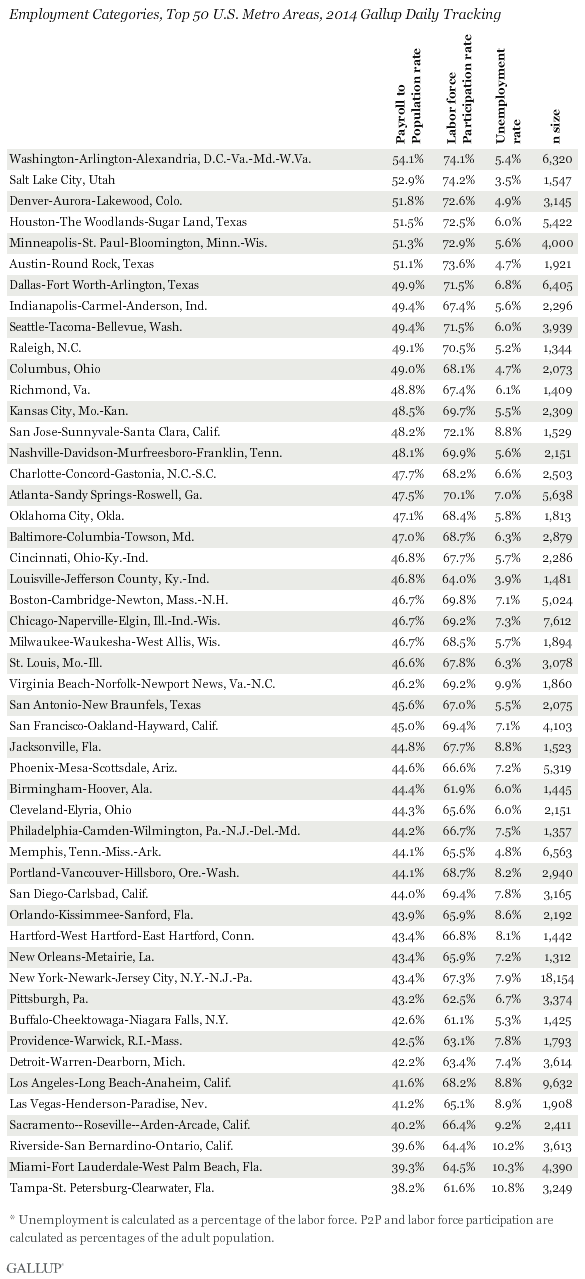
The Gallup polling organization’s P2P measurements (payroll-to-population employment rates) are an interesting metric and add an extra dimension of understanding as to what’s happening with employment across the United States.

Gallup’s evaluation is limited to the top 50 most populous SMSAs (metropolitan statistical areas).  But because of the large number of phone interviews conducted within each metro area (ranging from ~1,300 to 18000+ depending on the population), the findings are statistically significant whether looking nationally or within a particular urban area.

The latest surveys, conducted by Gallup in 2014 among nearly 355,000 households, find that two metro areas with the highest P2P measures are Washington, DC and Salt Lake City, UT — urban centers that couldn’t be more dissimilar in other ways.

For DC, the P2P rate is 54.1.  The calculation is derived from the percentage of the adult population (age 18+) who are employed full-time for an employer for at least 30 hours per week.

For Salt Lake City, the P2P rate is just slightly lower, at 52.9.

Other top scoring metro areas include three markets in Texas (Austin, Dallas-Ft. Worth and Houston).

What about metro areas at the other end of the scale?  Those would be Miami (38.2 score) and Tampa (39.3).

Three other low-scoring MSAs are located in California:  Los Angeles, Riverside and Sacramento.

What do these stats mean in a broader sense?

For one thing, there’s a direct relationship between employment stats and P2P performance:  Metro areas with the highest unemployment rates correlate to those with low P2P scores.

For instance, Miami’s unemployment rate in 2014 was 10.3%.  It was 10.2% in Riverside, CA.

That’s a big contrast with Salt Lake City, which had an unemployment rate of just 3.5%.

I find one interesting deviation from the norm:  Buffalo, NY.  There, while the unemployment rate is one of the ten lowest in the country, its labor force participation rate is also very low — bottoms among all 50 metro areas, in fact.

Shown below are the figures for all of the 50 largest U.S. metro areas based on the interviews conducted by Gallup in 2014:

Gallup full results

More details on the research findings are available here.

Coming Up: A Labor Shortage?

The coming labor shortageIt may seem fanciful, but a new report published last week by The Conference Board concludes that the United States and other advanced economies will actually face significant labor shortages over the coming decade and a half.

This forecast has been made primarily based on the Baby Boomer workforce departing the labor market over this period.

The Baby Boomer phenomenon is what makes things different in now compared to the decades previously:  For the first time since World War II, working age populations will actually be declining in mature markets.

Conference Board logoAs Dr. Gad Levanon, director of macroeconomics at The Conference Board reported, “The global financial crisis and its aftermath – stubbornly high unemployment in many countries – have postponed the onset of this demographic transformation, but will not prevent it from taking hold.”

According to The Conference Board’s analysis, several countries have already begun to see this happen, as their natural rates of employment have now fallen below their pre-recession levels:  Japan, Germany, South Korea and Canada.

The same thing is expected to happen in the United States and the United Kingdom by 2015 … and in the Scandinavian countries, the Benelux countries plus Australia by 2016 or 2017.

Other mature economies like those of Spain, France, Portugal, Italy and Greece won’t experience this until the years further out – but The Conference Board predicts that it will happen there as well.

U.S. market sectors that are expected to experience the most severe labor shortages include healthcare occupations, STEM occupations (science, technology, engineering and mathematics), as well as skilled trades that don’t require a college degree but that do require specialist training.

Among the challenges The Conference Board envisions in these three major categories are the following:

  1. Skilled labor occupations like construction, transportation and utility plant operations are going to be adversely affected by many more retirements happening than new job seekers coming in to fill the void.
  2. STEM occupations won’t be as stressed as some might imagine, because higher productivity will alleviate the pressure on hiring more workers in IT and high-tech manufacturing segment. That being said, certain sub-segments such as information security, environmental and agricultural engineering, and applied mathematics are expected to face severe labor shortages.
  3. The numbers of new entrants in various healthcare occupations are constrained by high barriers to entry such as extensive education and experience requirements, along with accreditation requirements.

The Conference Board report has constructed a Labor Shortage Index covering 32 countries.  The index combines current labor-market tightness with future demographic trends to predict the likelihood of the different countries experiencing labor shortages.

The bottom line on the index:  with the exception of the Mediterranean countries, all of the labor markets in developed economies are expected to be squeezed pretty tightly starting within the next few years.

It’s been quite a while since we’ve been hearing about pending labor shortages … but that’s exactly what The Conference Board is predicting.  Here’s a link to more details about the report, which is appropriately titled From Not Enough Jobs to Not Enough Workers.

If you have thoughts or personal observations to share on the job markets on the domestic scene or internationally, please share them with other readers here.

Vacationing Americans and the “Work Martyr Complex”

American workers on vacationI’ve blogged before about the propensity for Americans to forego using all of their allotted vacation time in a given year.

But that was back in 2012, in the waning months of the “Great Recession,” so perhaps one reason for those dynamics was leaner workforces and the need for “all hands on deck.”

A few years have gone by since then, and … very little has changed in these dynamics.

That’s the conclusion in a report released this week by the U.S. Travel Association.  Titled “Overwhelmed America: Why Don’t We Use Our Paid Time Off?”, the study included a survey of ~1,300 American workers and senior business leaders, conducted by GfK.

What the survey found was that 40% of workers fail to take all of their allotted paid time-off.

When asked why this was the case, look at the reasons that were cited:

  • Taking time off will cause my work to pile up: ~40% cited
  • Nobody else can do my job while I’m on vacation: ~35%
  • I can’t afford to take time off:  ~33%
  • I don’t want to be seen as “replaceable”: ~22%

The study characterizes the atmospherics surrounding the phemonemon as a “work martyr complex.”

As U.S. Travel’s chief executive puts it, “busyness” is something Americans wear as a “badge of honor.”

But there may be a bit more to it than that.

The survey also found that two-thirds of the respondents feel that their employer sends mixed messages about taking vacation … says nothing at all about it … or actually discourages people from taking paid time off.

What appears to motivate workers to take their full allotted vacation time is the implementation of “use it or lose it” policies.  When such policies are in place, ~84% of workers take all of their allotted time.

By contrast, for companies that offer the ability for workers to roll over vacation time, bank it, or be paid for time not taken, only about half of their employees (~48%) use all of their time.

The big question is whether most companies truly buy into the notion that taking vacation time is important for overall employee health, well-being and relationships – because the survey found that only a distinct minority of companies (one in four) maintain a “use it or lose it” PTO policy.

Of course, the members of the U.S. Travel Association would certainly benefit if more Americans took paid time off and used it to travel to vacation destinations.   Still, Roger Dow’s contention that “it’s time to start a conversation and reclaim the benefits we work so hard to earn” makes sense to me.  The full report can be viewed here.

At our company, we’ve a “use it or lose it” PTO policy in place for years.  What’s your own situation?

Work/family gender roles are changing … even if the media portrayals of them aren’t.

Work and family nexusIt may be the year 2014, but many people continue to wander gracelessly through the gender minefield when it comes to the workplace.

We saw this in spades two weeks ago, when the Today Show’s Matt Lauer asked General Motors Chief Executive Mary Barra how she successfully balanced her role as CEO of a large corporation with that of being a Mom.

Mr. Lauer was excoriated for asking the question, with criticism coming from all quarters (left and right).  He was accused of sexist questioning.  Several commentators pointed out that he had never asked such a question of the male top executives he had interviewed earlier at GM and Chrysler.

Mr. Lauer correctly noted that Ms. Barra had addressed this very issue proactively in a magazine article, and hence he thought the line of questioning was fair game.

Still, the fact that a flurry of controversy was stirred up at all reminds us how emotionally charged questions about gender roles continue to be, several generations after the birth of the feminist movement.

In point of fact, gender roles have been evolving pretty rapidly in the past two or three decades.  Sparked by economic and employment forces as well as changes in social norms, more men than ever are choosing to stay home with family, even as the participation of women in the workforce has reached all-time highs.

And field research conducted in May 2014 by consulting firm Insights in Marketing suggests that it’s men more than women who now feel that they’re facing struggles and stigmas associated with achieving a good work/family balance.  To wit:

Among men surveyed who have children under the age of 18, ~35% report that they are “feeling more torn between work and family” … whereas with women with children under the age of 18, only ~26% report the same feelings.

Here’s another result from the same survey:  By a 57% to 41% margin, men are more likely than women to agree with the following statement:  “A man’s primary duty is to financially provide for his family.”

Those figures may not come as a surprise.

By contrast, nearly the same percentages of men (78%) and women (74%) disagree with the statement that “A woman’s primary duty is to be a full-time caretaker for her family.”

According to the research summary issued by Insights in Marketing, these findings suggest that certain gender stereotypes are no longer accurate:  Society truly accepts (and even expects) women to be a part of the workforce, while expecting men to care only about their careers.

Instead, the survey reveals much more similarities than differences in how women and men see their family and work roles:

  • ~81% of women surveyed feel that their first obligation is to their home and family … and ~75% of the men surveyed feel the same way.
  •   ~48% of men surveyed feel that their career gives their lives purpose … but ~40% of the women surveyed also reported the same feeling.

Even though real change is happening on the ground, it’ll probably take more time before we start seeing the change being reflected in popular culture — and so that Matt Lauer can ask a question without incurring the wrath of a thousand baying wolves.

Remember that, too, the next time you see a TV commercial for laundry detergent.  You know — the one where Dad is some doofus who puts way too much soap in the washing machine and then can’t figure out when to add the fabric softener …

More findings from the Insights in Marketing report are available here.

Ipsos Reid Poll: Female Execs Gauge Their Advances

women managers and executivesAn interesting Ipsos Reid poll of female executives conducted late last year sheds light on what the perceived career holdbacks are for women in the workforce these days.

The results of the online survey, which queried ~500 American women working in managerial or executive roles, suggest that women continue to face obstacles in advancing their careers to upper-level management and executive positions … although the disparities are less today – and hopefully continuing the trend toward parity.

An example of one perception which continues to show a big divide between women and men is this:  While ~37% the survey respondents feel that physical appearance and personal image are factors in career progression for men, nearly all (~90%) believe that they are for women.

On the other hand, the perceived differences are less stark when it comes to opportunities for career progression based on the gender of a female employee’s immediate superior.  When asked how gender affects the chances for women to obtain a managerial position, here’s how the respondents answered:

If the superior is a woman …

  • 26% better chance for advancement
  • 30% worse chance for advancement
  • 44% no difference

If the superior is a man …

  • 26% better chance for advancement
  • 25% worse chance for advancement
  • 49% no difference

… Which translates into trust levels that aren’t so very different at all:

  • ~22% would trust a man more for help with career advancement
  • ~18% would trust a woman more for help with career advancement
  • ~60% express no difference in trust levels

Positive Work Attributes

The Ipsos/Reid survey also found that nearly two-thirds of the respondents consider women to be better leaders than men, primarily for these five reasons:

  • Women are better communicators
  • They are more organized
  • They are more empathetic
  • They have a better understanding of the needs of their employees
  • They are more open to changing their approach

For the record, two attributes that respondents do not attribute to women over men are:

  • Women have better instincts than men
  • They are more invested in an organization’s success compared to men.

With a confident self-image and backed by positive work habits, what do these respondents see as the biggest continuing challenges to their career growth?  Here’s what the Ipsos Reid survey found:

  • The requirement for women to work harder and put in longer hours to prove themselves: ~77%
  • Managing work and family balance: ~61%
  • External factors (economic climate/job loss): ~56%
  • Being welcomed into an established senior management team:  ~48%
  • Dealing with outdated perceptions of women in managerial and executive roles: ~48%
  • Lack of female mentors: ~47%

Moreover, ~78% of respondents discern a “noticeable” different in salaries between men and women.

Asked what a company might “fear” about promoting women to senior managerial and executive posts, the respondents cited several probable factors:  the fear that an executive might want to start and maintain a family … and the fear of too many absences from work due to family obligations.

Bottom line, the Ipsos Reid survey reveals some continuing obstacles for women in the executive-level work force.  But there’s positive news, too.  Additional survey findings can be found here.

If you have additional observations or perspectives on this topic, please share them with other readers here.