It’s a question many people are asking: To what extent is the digital revolution fundamentally changing shopping habits?
A new report from Forrester Research titled “U.S. Cross-Channel Retail Forecast, 2012 to 2017” attempts to answer this question.
Its prediction: just over 10% of total U.S. retail sales will be online purchase in five years’ time.
By comparison, in 2012, e-commerce accounted for about 5% of total U.S. retail spending, so Forrester is projecting a doubling of e-commerce volume.
Forrester also projects that by 2017, ~60% of retail sales in the United States will involve the Internet – either as a direct commercial transaction or as part of buyers’ pre-purchase research on laptops, tablets or smartphones.
The sectors most likely to be influenced by online research are grocery, apparel, home improvement and consumer electronics – no doubt abetted by the ability to access customer reviews and comparison prices during shopping excursions, Forrester reports.
These findings and more are included in Forrester’s report which can be found here (it’s a for-purchase study).
Indeed, in certain states that are in close physical proximity to time zone boundaries, the issue can be controversial enough to affect the popularity of elected officials, as has happened in Indiana and Arizona.
Daylight savings time, an innovation that became popular in the 1970s, continues to be a nettlesome issue because of when it is in effect in the United States – nearly a month earlier and a month later than before … and no longer in sync with other countries (if they even observe DST — and many of them don’t).
Daylight savings time is supposed to be more energy-efficient. But it turns out the energy savings are minimal if any. Uncoordinated time changes could very well undermine economic efficiency far more than any positive impact in energy savings.
A case in point: Lack of synchronization with European time changes is estimated to cost the airline industry nearly $150 million in travel disruptions each year.
Does the current time zone structure have to be cast in stone? Of course not. The history of “time” is actually one of pretty constant change, dating all the way back to when time zones were first implemented in the 1880s.
Before then, each city and town had its own local time which was established by calculating the solar time in the local location using sundials. Effectively, this meant that there were more than 300 different time zones in the U.S.A.
The American railroads were more streamlined: They operated with only about 100 time zones.
Clearly, introducing four time zones for the continental U.S. was a way to introduce simplicity while compromising only a little regarding human biorhythms.
Of course, it took awhile for the time zone system to be adopted worldwide, but eventually it happened.
The economic and commercial landscape looks far different today than in the late 19th Century. We are no longer bound by the physical limitations of geography in terms of how we do business.
As a result, some economists are suggesting that it’s time to overhaul the time zone structure and to move to a system that is even simpler and less disruptive to people’s lives.
One economist, Allison Schrager, has come up with the most radical solution I’ve seen yet. Drawing from economic models plus her own experiences working across multiple time zones, Dr. Schrager has put forward the following recommendations:
Scrap daylight savings time altogether
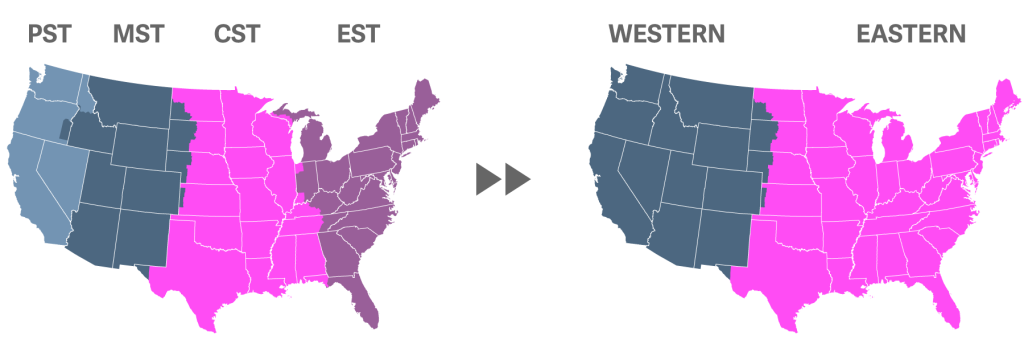
Consolidate and reduce the four current continental U.S. time zones (Eastern, Central, Mountain, Pacific) to just two (Eastern, Western)
Under the Schrager scenario, the new time zone map for the continental United States would look like this:
Dr. Schrager points out that, while a fewer number of larger time zone geographies would seem to remove some people further from their “true” time zone, the realities of global commerce are already doing that anyway.
By contrast, she sees the benefits as more major. For example, frequent travel between time zones under today’s four zones causes jet lag, robbing employees of productive work time.
With just a one-hour time difference between New York and California, bi-coastal travel would become almost effortless in that regard, Schrager maintains.
As for the disruption such a change might cause to international business coordination, Dr. Schrager contends that just as it took one or two countries to start things off in the 1880s, someone needs to step up to the plate today to start a new trend.
She says: “… America won’t line up with the time zones of countries directly north and south unless this catches on as a global trend. But the discontinuity ship already sailed when rich Western countries haphazardly adopted daylight savings time and most other countries didn’t. Time is already arbitrary; why not make it work in our favor?”
Does Dr. Schrager raise some good points? Would simplifying the time zone map and ditching daylight savings time be a “net positive” or not?
Some of her arguments seem to make sense to me. What do you think? Please share your thoughts with other readers if you’re so inclined.
For those of us who came of age during the oil embargo of 1973 and the subsequent decades of high-priced, restricted-supply petroleum coupled with a contorted foreign policycontinuously buffeted by those economic realities … the recent news that the United States is poised to become the world’s top oil supplier in 2013 comes as a bit of a surprise.
But it’s right there in black-and-white, in data published by PIRA Energy Group, a New York-based energy markets consulting firm:
This year, the United States is projected to produce an average of ~12 million barrels per day of liquid oil products (crude oil, natural gas liquids and biofuels together).
That’s ~300,000 barrels per day higher than Saudi Arabia … and ~1.6 million more than Russia.
The other countries that make up the “Big Ten” oil producers – China, Canada, the United Arab Emirates, Iran, Iraq, Kuwait and Mexico – don’t even come close to the “Big Three.”
Where’s Venezuela on the list? Nowhere to be found.
Take that, Carlos Chávez and Nicolás Maduro!
The United States is forecast to pump approximately 7.5 million barrels per day of crude and concentrate in 2013. That’s actually 3 million barrels less than Saudi Arabia and Russia.
But the shortfall is more than made up by the ~2.5 million in natural gas liquids and ~1 million of biofuels America is also producing every day.
The rise in U.S. production is practically unprecedented. Only once before has a country raised its production faster (Saudi Arabia in 1970-74).
The reason for the rise in American production? Two words: “shale oil.”
U.S. shale oil and condensate production now stands at ~2.5 million barrels per day. That’s slightly over one-third of total U.S. crude production.
And shale natural gas liquid production, at ~1.2 million barrels per day, is nearly half of total NGL production.
America’s shale oil boom could turn out to be of far greater import than all of the renewable or “alternative energy” schemes put together – despite the political attention and funding these more “sexy” technologies have had lavished on them by federal and state governments and research foundations.
Abetted by the explorationof shale oil formations via horizontal drilling and fracking, the impact of shale oil reserves isn’t a flash in the pan, either. According to PIRA Energy, America’s position as the largest oil supplier in the world looks to be secure for many years.
Production growth rates may level off eventually, but PIRA forecasts that the United States will continue to increase its lead over Saudi Arabia and Russia until 2020 at least.
… And retain its production lead over all other countries until at least 2030.
What a relief all of this is. Speaking for myself, I’m loving the fact that America is no longer so beholden to offshore energy resources controlled by people who “might” be our friends one day … and who “might” not be the next.
It’s like financial debt: Having too much debt is really bad. Having no debt at all is really nice.
Energy independence — or something close to it — is really nice, too.
When it comes to cyber-security, high-visibility data breaches get all the press, which is understandable.
But small businesses are also victims of cyber-attacks. And sometimes those events can be financially devastating.
Now a newly published survey quantifies the extent to which small businesses are at risk. The National Small Business Association polled nearly 850 U.S. small business owners (most with annual revenues between $500,000 and $25 million) in August 2013). The NSBA survey found that nearly 45% of the respondents’ businesses had been the victim of cyber attacks such as malware, spyware or banking Trojans.
The average cost of these cyber attacks was reportedly nearly $9,000 – with some dollar amounts going much higher.
Separately, another study shows that a record number of cyber attacks targeted small businesses in 2012. Verizon’s Data Breach Investigations Report examined 855 data breaches and found that over 70% of them involved victim companies with fewer than 100 employees.
Verizon’s 2013 report is showing a continuing increase in cyber attacks on small business, meaning that 2012 was no fluke.
What’s going on here?
According to the Verizon study’s conclusions as well as comments from security experts like Vikas Bhatia, small and medium-sized businesses could be doing a better job of “offensive defense.”
Among the mistakes commonly observed in small businesses are these:
Lack of conducting regular backups of business data
Neglecting to store backed up data offsite
Failing to test data restore functions on a periodic basis
Neglecting to keep antivirus software up to date, including software patches and updates
Practicing sloppy password protection behaviors (using plain-language passwords … using identical passwords across multiple accounts, etc.)
Not understanding cloud-based data storage and what outsourced providers’ liabilities are (and are not) for protecting data
There’s no question that cyber-security continues to be a big challenge – and probably a growing one – for many companies.
But it’s also pretty evident that many businesses could be doing more to protect themselves from the heartburn (and financial fallout) along the way.
“Big data” is definitely one of the more commonly heard business buzz terms these days.
But beyond the general impression that “big data” represents the ability to collect and analyze lots and lots of information in some efficient manner, most people have a difficult time explaining with any specificity what the term really means.
Moreover, for some people “big data” isn’t very far removed from “big brother” – and for that reason, there’s some real ambivalence about the concept. Consider these recent “man on the street” comments about big data found online:
“Big data: Now they can crawl all the way up your *ss.”
“The scary thing about big data is knowing [that] Big Brother can know every single thing you do – and realizing your life is too unimportant for Big Brother to even bother.”
“Big data is what you get after you take a big laxative.”
The book explores the potential for creating, mining and analyzing massive information sets while also pointing out the potential pitfalls and dangers, which the authors characterize as the “dark side of big data.”
The book also exposes the limitations of “sampling” as we’ve come understand it and work with it over the past decades.
Authors Viktor Mayer-Schonberger (l) and Kenneth Cukier (r).
Cukier and Mayer note that sampling works is fine for basic questions, but is far less reliable or useful for more “granular” evaluation of behavioral intent. That’s where “big data” comes into play big-time.
The authors are quick to note that advancements in data collection tend to come along, shake things up, and then quickly become routine.
Mayer calls this “datafication,” and describes how it works in practice:
“At first, we think it is impossible to render something in data form. Then somebody comes up with a nifty and cost-efficient idea to do so, and we are amazed by the applications that this will enable – and then we come to accept it as the ‘new normal.’ A few years ago, this happened with geo-location, and before it was with web browsing data gleaned through ‘cookies.’ It is a sign of the continuing progress of datafication.”
Causality is another aspect that may be changing how we go about treating the data we collect.
According to Cukier and Mayer, making the most of big data means “shedding some of the obsession for causality in exchange for simple correlations: not knowing why but only what.”
So then, we may have less instances when we come up with a hypothesis and then test it … but rather just use the data to determine what is important and act on whatever information is revealed in the process.
One example of this practice that’s cited in the book is how Wal-Mart determined that Kellogg’s® Pop-Tarts® should be positioned at the front of the store in selected regions of the country during hurricane season to stimulate product sales.
It wasn’t something anyone had thought about in advance and then decided to verify; it was something the retailer discovered by mining product purchase data and simply “connecting the dots.”
Author Mayer explains further:
“There is a value in having conveniently placed Pop-Tarts, and it isn’t just that Wal-Mart is making more money. It is also that shoppers find faster what they are likely looking for. Sometimes ‘big data’ gets badly mischaracterized as just a tool to create more targeted advertising … but UPS uses ‘big data’ to save millions of gallons of fuel – and thus improve both its bottom line and the environment.”
One area of concern covered by the authors is the potential for using “big data predictions” to single out people based on their propensity to commit certain behaviors, rather than after-the-fact. In other words, to treat all sorts of conditions or possibilities in the same manner we treat sex offender lists today.
Author Kenneth Cukier believes that the implications of a practice like this – focusing on the use of data as much as the collection of the data – is “sadly missing from the debate.”
This book fills a yawning gap in the business literature. And for that, we should give Dr. Mayer-Schönberger and Mr. Cukier fair dues. If any readers have become acquainted with the book and would care to weigh in with observations, please share your thoughts here.
There’s no question that Spotify has been an up-and-comer in the music streaming business. Speaking anecdotally, over time more and more of my friends and family members have been signing up for the service.
And now, Spotify is pushing forward with an even more aggressive growth strategy … and it’s not aiming low at all.
In fact, the company is seeking backers at an eye-popping valuation level of $5.3 billion.
And to top it off, the company’s co-founders (Daniel Ek and Martin Lorentzon) intend to raise the funds not through equity investment, but through loans.
It seems neither person wishes to give up any more of the company to investors than has already happened.
What makes the $5.3 billion valuation so startling is not just the amount – big though it is. It’s because that the last business valuation of Spotify, done less than 12 months ago, pegged the company’s value at just $3 billion.
That time around, a number of institutional investors stepped up to the plate (including Coca Cola, Fidelity and Goldman Sachs). But don’t look for more institutional investment in this round of funding.
In the case of Spotify, being second or third in the music streaming market segment has turned out to be a good thing. Pandora and others were the pioneers, laboring in the vineyards for many long years before proving out the business model.
Then along comes Spotify and cleans up in a market space that people now understand fully.
At the moment, Spotify has around 6 million paying users in 28 countries — along with several times that number of people who use Spotify’s free, ad-funded services. Spotify streams music across desktops and mobile devices along with other music gear.
The company reports that it pays approximately 70% of total revenues back to music rights-holders. It’s not profitable yet … but how many years was Pandora bleeding red ink? The better part of a decade, certainly.
There continues to be some low-level grumbling about how Spotify handles payouts to the “bigger name” performers in the music industry.
According to some reports, Spotify pays only about $0.005 per stream. That means only big stars (the likes of Beyoncé and others) can make any meaningful money from the service.
But for anyone who thinks that $5 billion+ is a tad rich when it comes to the valuation of a business property like Spotify … remember that Skype was sold to Microsoft for $8.5 billion in 2011, after having been valued at just $2.75 billion two short years before.
So maybe the whole thing isn’t so far-fetched after all.
Can it be possible that widespread public revulsion at the level of federal government conference and travel expenditures has actually had a positive impact?
It seems so, if new financial reporting is to be believed.
According to recent reports filed by the General Services Administration, federal travel card spending has declined ~17% so far in FY 2013 compared with the same period last year.
That’s for the GSA’s SmartPay charge card program which covers more than 2.5 million cardholders. And it’s the second year in a row that we’ve seen a drop in expenditures:
FY 2011: $9.6 billion
FY 2012: $8.9 billion
FY 2013 (YTD): $6.0 billion
According to GSA officials, the decline in travel-related spending has happened because of “aggressive steps” taken to cut conference spending in the wake of embarrassing revelations that a single GSA conference in Las Vegas in 2010 had cost American taxpayers nearly $825,000.
The fact that this meeting included paying clowns and mindreaders to lead group discussions added an absurd twist on the entire affair.
In May 2012, the Office of Management and Budget issued a memo directing federal agencies to reduce their travel-related spending by 30% compared to 2010 levels – and to maintain those levels through FY 2016.
Another directive required agencies to report spending on any conference that exceeds $100,000.
Looking out over the government agency landscape, it appears that most agencies have made some pretty big strides towards meeting the new standards.
Comparative travel expense figures released by the GSA for FY 2013 through July against FY 2012 over the same period show these declines:
General Services Administration: -62%
Veterans Administration: -31%
Treasury: -30%
Energy: -25%
Commerce: -23%
Labor: -23%
Environmental Protection Administration: -21%
Housing & Urban Development: -21%
Defense: -19%
Justice: -19%
Transportation: -18%
State: -16%
Interior: -12%
A few agencies did show increased travel expenditures. Most significantly, the Small Business Administration doubled its expenses due to Hurricane Sandy and other natural disasters that required additional travel associated with putting manpower on location to provide financial assistance to homeowners, renters and businesses.
But taken as a whole, these expenditure drops are unprecedented.
I wonder how many people would have predicted it – even though most people I know figure that there’s plenty of “fat” to cut within these agencies without hurting the programs.
It’s just that … we so rarely hear of reports like this in government.
And of course, there’s plenty of grousing to go around about the new realities. One Department of Defense official who requested anonymity was quoted as saying, “When someone craps their pants, we all have to wear diapers. This is hardly the way to run the DOD efficiently.”
And then there’s this: Lest you think that we’ve put a lid on excess travel-related expenditures for good, the GSA has just announced that it will be unfreezing per diem rates for FY 2014.
That is correct: The GSA is now increasing the lodging, meal and incidental allowances that federal employees are reimbursed for expenses incurred while on official travel. It’s going up to $129 in most markets within the 48 contiguous states.
Directors Vincent Vittorio and Nathan McGill have produced a film that’s both realistic and optimistic – two words that aren’t often used in conjunction with one another when the topic is manufacturing.
The directors don’t shy away from the facts: U.S. manufacturing jobs shrinking from ~$17 million to just ~$12 million in the past 20 years due to technology, global competitiveness and outsourcing.
But there are signs of recovery. At least the anectodal evidence for it is strong.
In August, Wal-Mart organized a manufacturers’ summit which was attended by ~1,500 people including U.S. and foreign-based companies, Department of Commerce and Federal Reserve officials, and eight state governors.
At this meeting, Wal-Mart affirmed its commitment to buy $50 billion in additional American-made products over the next 10 years. GE, Element and other companies also announced plans to boost domestic manufacturing activities.
These developments aren’t merely patriotic or altruistic — although there may be some of that factoring into the decision.
In fact, with Chinese labor costs rising 15% to 20% each year, that country’s labor cost advantage is narrowing compared to the United Sates.
Harold Sirkin of Boston Consulting Group points out that factoring in raw materials and other costs, China maintains only a ~3% lead on product costs. Add in transportation costs from Asia, and the “Made in America” alternative takes on new validity.
“We are at an inflection point,” Sirkin has stated, noting that the United States is now competitive with China.
GE’s chief executive officer Jeff Immelt echoes these sentiments, contending that on a relative basis, America has never been more competitive thanks to technology and improved productivity.
“High transportation costs mean you want to be closer. It’s not just pure labor arbitrage,” Immelt notes.
As for productivity, the mere three hours it takes to assemble a GE refrigerator in America makes its total cost lower than a similar Chinese or Mexican-made models destined for the American market, according to Immelt.
I like what I’m hearing about the coming resurgence in American manufacturing … but I think we’ve heard this prediction before.
The film directors discovered this inconvenient issue when traveling the United States and visiting manufacturing plants from large cities to small towns: There’s a sizable gap between what manufacturers need in human capital, and the ability of the labor force to meet those requirements – whether it be older workers, or young workers right out of school.
“American Made Movie” documentary film directors Vittorio and McGill.
“We need to provide the apprenticeship training necessary for a new generation of American workers to grow as fast as our technology is changing,” the documentary movie directors contend.
That may be happening at some technical colleges and a few community colleges across America. But it’s not happening nearly enough if, like me, you hear constant complaints from manufacturing execs about the disconnect between the lack of (even basic) job skills and (increasingly sophisticated) job requirements on the manufacturing line.
Maybe it’s time to look harder at appropriating pieces of the German/Austrian apprenticeship model, wherein talented students are plucked from high school and placed with manufacturing firms for on-the-job training in lieu of college.
In such environments, a structured program of learning and training provides the roadmap for successful transition and integration into the job force.
An apprenticeship may not seem as “classy” an accomplishment as a college diploma. But a college diploma doesn’t mean nearly as much these days.
What once was a sure-fire ticket to a career has given way to an environment in which half of all new college graduates are unemployed, underemployed, or working jobs for which their degree is irrelevant or unnecessary.
To that half of the young labor force, the near-100% placement/success rate for apprenticeships must seem awfully attractive now.
What are your thoughts about a coming manufacturing renaissance in America? Please share your comments here.
The most recently published Temkin Web Experience Ratings of more than 200 companies across 19 industries reveals continuing widespread disappointment with the quality of the “web experience.”
The Temkin Web Experience Ratings are compiled annually by Temkin Group, a Newton, MA-based customer experience research and consulting firm. The ratings are based on consumer feedback when asked to rate their satisfaction when interacting with each company’s website.
Temkin ratings are established for companies garnering responses from 100 or more of the ~10,000 randomly selected participants in an online survey conducted by the research firm in January 2013.
Rankings are calculated via a “net satisfaction” score based on a 7-point rating scale from “completely satisfied” to “completely dissatisfied” by taking the percentage of consumers selecting the two highest ratings and subtracting the percentage who selected the bottom three ratings.
Just 6% of the brands earned strong or very strong “net” trust ratings, while ten times as many (~63%) were given weak or very weak scores.
And there’s this, too: Not much improvement is happening. More than half of the ~150 companies that were included in both the 2012 and 2013 Temkin evaluations earned lower scores this year than last.
Managing partner Bruce Temkin summarized it succinctly: “The web is a key channel, but online experiences aren’t very good – and are heading in the wrong direction.”
The latest Temkin ratings give Amazon the top-rank position with a 77% overall rating score. Other companies ranked near the top include Advantage Rent A Car, U.S. Bank and QVC.
At the other end of the scale, MSN, EarthLink and Cablevision earned the lowest ratings – MSN worst of all.
Indeed, the following industries had composite company ratings that ended up in the “very weak” column:
Airlines
Health plans
Internet service providers
TV service providers
Wireless carriers
Do any of these industries seem like ones that shouldn’t be on this list?
I didn’t think so, either.
Which ones are the industries that score best in the Temkin analysis? By order of rank, they are as follows:
Banks
Investment firms
Retailers
Credit card issuers
Hotel chains
Come to think of it, I haven’t encountered problems online with companies or bands in any of these five industries.
It’s also interesting to consider which companies have improved the most over time. When comparing year-over-year results for the ~150 companies that were included in both the 2012 and 2013 studies, eight of them showed double-digit improvements in their scores:
Blue Shield of California
Citibank
Humana
Old Navy
Safeway
Toyota
TriCare
U.S. Bank
On the other hand, a much bigger contingent of 21 companies saw their ratings decline by at least 10 points; the six firms that dropped by 15 points of more were these:
If you notice any rankings that seem surprising – or that don’t comport with your own online experiences – please share your thoughts and perspectives below.
After reading one too many articles about patent issuance failures on the part of the United States Patent and Trademark Office, I’ve come to the conclusion that the USPTO just isn’t able to keep up with galloping technology.
How else to explain its staff lawyers granting patents for applications they have no business authorizing?
Even worse … through ineptitude, completely obvious ideas get patented, inhibiting innovation and keeping beneficial technology out of the hands of the public – which goes completely counter to the USPTO’s stated aims.
One of the USPTO’s doozies that has made it into the news was issuing a patent for scanning a document and then e-mailing it.
That is correct: the USPTO viewed this simple function as a “unique” invention worthy of patent protection.
… Never mind the fact that thousands of people had already “invented” this idea before – but never in their right minds would they have thought it was patentable!
Today, this firm’s legal counsel is demanding $1,000 in licensing fees from anyone who scans a document and then e-mails it.
At least Hewlett-Packard decided to fight back earlier this year, pointing out that it had been selling printers that could scan and e-mail documents long before the patent in question was ever granted.
But why do we even have to go there? Is it really appropriate for a patent to be granted to someone who didn’t really invent anything … nor create a new technology … nor develop a unique engineering design or manufacturing process?
Patenting ideas for computer-related functions and programs as falling under the general category of “business methods” – a dreadful practice the USPTO started allowing about 20 years ago – is partially how we got into this mess.
The unfortunate part is this: There will be major challenges facing anyone who decides to promote patent reform. Too many “patent trolls” and their partner-in-crime attorneys have a vested interest in a current system which – similar to the cyber-squatting industry – enables them to make a tidy sum for very little effort.
Expect these “upstanding corporate citizens” to obstruct any moves to change the system with the same kind of zeal they employ to go after the citizens and companies who are the hapless targets of their extortion efforts.
In fact, a 2012 study commissioned by the Government Accountability Office found that of ~500 randomly selected patent lawsuits that were filed the previous year, nearly 40% of the cases were brought by “patent monetizers” (trolls). And that doesn’t even begin to account for the untold numbers of threatened suits that were settled without going to court.
But I’m pleased to see that several states have taken up the gauntlet in the MPHJ saga. The attorneys general of Nebraska and Vermont have sent letters to the company and its legal counsel, warning them to leave their state residents alone.
Greed is never pretty – but especially when greed is this transparently obvious. It would be nice if the USPTO started contributing to the solution by making some much-needed changes of its own.

 It’s a question many people are asking: To what extent is the digital revolution fundamentally changing shopping habits?












 Nones Notes