What’s driving innovation in consumer packaged goods these days?

Consumer packaged goodsWith the steady rise in the number (and variety) of consumer packaged goods offerings, one might wonder if the factors that drive CPG innovation are the same today as they’ve been in the past.

There’s no dearth of research to help give us clues to the answer.  In the first half of this year alone, major CPG research results have been published by the likes of Accenture, Deloitte, Forrester, IRI and Kantar – and that just covers the first half of the alphabet!

The broad takeaway from these reports is that there are six major trends driving innovation in the industry.  Three of them are just as important as they’ve ever been, and three additional ones are becoming more significant as time goes on.

The three “classic” trends that drive CPG innovation as much as ever are convenience, value, and specialization.

They’re fundamental, they’re significant, and they haven’t lost their importance based on what’s happening in the larger marketplace or the economy:

Convenience is a major driver because consumers are always looking to get what they need faster and with less effort than before.  If a product saves time and delivers multi-benefit solutions, consumers will respond.

Value is always perennially important.  When the perceived value of a product goes down because of price pressures or a lack of differentiating benefits, brand loyalty is adversely affected.

Specialization – Product formulation and packaging can affect the way consumers feel about products.  The more that can be provided in the way of a “just-for-me” solution as opposed to “one-size-fits all,” the better.

If they concentrate on these three trends, most CPG brands do pretty well.  But there are three additional trends that appear to be gaining momentum.  Add them to the repertoire, and an additional competitive edge can be established:

Portability – As consumers’ lives have become more mobile than ever, a premium is placed on brand that can deliver on-the-go offerings.

Environmental Impact – It’s been a long time coming, but this trend finally appears to be reaching some semblance of critical mass. More consumers are considering environmental factors — not just as attributes for products that are “nice to possess,” but actually necessary for making a responsible choice. It’s more than the product itself; it’s also sourcing, manufacturing, distribution and disposal.

Health Impact – The days of CPG products being big on convenience but bad on health are numbered. Thanks to better education and more out-of-pocket medical-related cost responsibilities, health awareness among consumers has never been higher. It may not be translating yet into improved health metrics like lower obesity rates, but there’s pretty clear evidence that more people understand health risks and are taking more responsibility for their own personal health and that of their family members.  Products that can credibly claim to “healthy” benefits stand to gain in the competitive landscape.

Do you feel that there are other trends besides these six that that are influencing the development of consumer packaged goods today?  Perhaps ones associated with cultural diversity … or something else?  If so, please share your thoughts with other readers here.

Which brands are America’s most “patriotic”?

patriotismWith the 4th of July holiday nearly upon us, sharing the results of a recent brand study seems particularly apropos.

Since 2013, Brand Keys, a branding consulting firm, has conducted an annual evaluation of famous American brands to determine which ones are considered by consumers to be the most “patriotic.”

In order to discover those attitudes, Brand Keys surveyed nearly 5,500 consumers between the ages of 16 and 65, asking them to evaluate American brands on a collection of 35 cross-category values – one of which was “patriotism.”  (The number of brands included in the evaluation has varied somewhat from year to year, ranging between 195 and 225.)

Of course “patriotism” is a hyper-qualitative measure that’s based as much on emotion and each individual person’s own point of reference as on anything else.

Brand familiarity and longstanding engagement in the marketplace helps, too.

So it’s not surprising that the American brands scoring highest on the patriotism meter are some of the best-known, iconic names.

For the record, listed below are the “Top 10” most patriotic American brands based on Brand Keys’ most recent survey – the ones that scored 91% or higher on the patriotism scale (out of a possible 100 percentage points):

  • Jeep (98%)
  • Coca-Cola (97%)
  • Disney (96%)
  • Ralph Lauren (95%)
  • Levi Strauss (94%)
  • Ford Motor (93%)
  • Jack Daniels (93%)
  • Harley Davidson (92%)
  • Gillette (92%)
  • Apple (91%)
  • Coors (91%)

The next highest group of ten patriotic brands scored between 85% and 90% on the survey:

  • American Express (90%)
  • Wrigley’s (90%)
  • Gatorade (89%)
  • Zippo (89%)
  • Amazon (88%)
  • Hershey’s (87%)
  • Walmart (87%)
  • Colgate (86%)
  • Coach (85%)
  • New Balance (85%)

[As an aside … the only entity to score a perfect patriotism rating of 100% was the U.S. Armed Services.]

To be sure, “rational” aspects like being an American-based company whose products are actually made in the United States affect the patriotism rating of individual brands.

But other attributes — such as nationally directed customer-service activities and highly publicized involvement in sponsorships and causes that tie to the American experience — are attributes that add to a general image of being patriotic.

Robert Passikoff, Brand Keys’ president, expanded on the idea, stating,

“Today, when it comes to engaging consumers, waving an American flag and actually having an authentic foundation for being able to wave the flag are two entirely different things — and the consumer knows it. 

“If you want to differentiate via brand values – especially one this emotional – if there is believability, good marketing just gets better.” 

This is the third annual report issued by Brand Keys that’s been focused on brand patriotism – one of 35 brand values comparatively surveyed.  Over the three years, there’s been some change in the patriotism rankings, with Colgate, Wrigley’s and Zippo falling out of the Top Ten and being replaced by Jack Daniels, Gillette, Apple and Coors in 2015.

What I find intriguing about the findings is that there isn’t a very strong correlation between the perceived patriotism of specific American brands and whether or not most of their products are made in the United States versus offshore.   Of course, foreign production is more the norm than ever in the global economy.  What’s important is how the consumer reacts to that reality.

jeep patriotismWith that point in mind … what about Jeep?  Now that it is part of the global Fiat organization, should Jeep no longer be considered an American brand?  Whether it is or not, the brand has the distinction of achieving the highest patriotism score outside of the U.S. Armed Services.

The bottom line is this:  Brands, what they “mean” and what they stand for are based on the emotional as well as the rational – with the emotional aspect being the trump card with consumers.

Jeep, with all of its associations with winning  wartime campaigns (particularly World War II), likely will always be a beloved “patriotic” U.S. brand, regardless of its recent Italian parent company ownership.

Are there brands not listed above that you would consider to be “highly patriotic”?  If so, please share your thoughts with other readers here.

Are young marketers now the “smartest people in the room”?

Deanie Elsner
Deanie Elsner

Recently I read about some interesting remarks made by Deanie Elsner, who is the former executive vice president and chief marketing officer of Kraft Foods.

Ms. Elsner made them as the keynote speaker at the Tapad Unify Tech 2015 cross-screen technology conference held in mid-June.  The gist of her argument was that senior-level marketers and heads of companies are most often the ones who are the “ball and chain” in a company when it comes to following effective marketing practices.

The way Elsner sees it, too few of these officials understand digital marketing as an integrated program that commingles data with a coordinated brand strategy:

“When you ask marketers to define digital strategy, they will give you ‘random acts of digital’ rather than an holistic strategy informed by data, with KPSs and data points that prove success.”

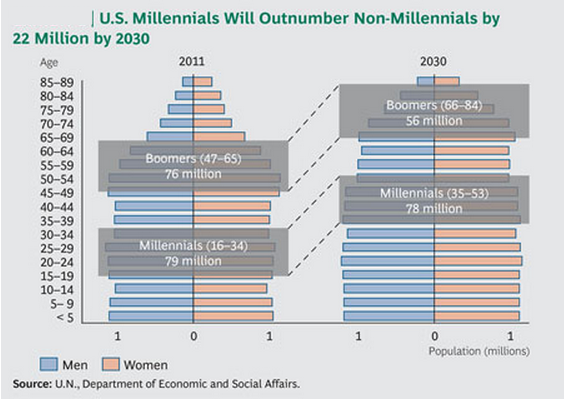
It doesn’t help that most upper-level managers are part of the Baby Boomer generation or just slightly younger, whereas most of the big developments in marketing technology and the communications landscape are being driven by Millennials.

[An aside:  recently we learned that Millennials, at 87 million strong, are now this country’s largest age cohort — ~14% larger than Baby Boomers.  And they’ll only grow more important in the coming decade or two as the Boomer generation passes into retirement and then into history.]

Millennials-vs-Boomers

In Elsner’s view, Millennial employees understand something that their older counterparts generally don’t see, which is that the “one-way communications” perspective on advertising and promotion is no longer so important — or even relevant.

I can see her point.  Consumers today are the ones determining the conversation and the agenda.  It’s up to marketers to figure out the best ways to follow that agenda and to use the best tools to make it happen.

But then Elsner makes this bold statement that I’m not sure is totally accurate:

“Your smartest person is your most junior talent.  The most dangerous, potentially, is the current CEO, because what they know doesn’t exist anymore.”

I don’t disagree that junior talent “gets” the modern communications environment more inherently than older employees.  However … younger talent is prone to the opposite extreme:  making assumptions based the latest trends for the youngest audiences.

When that happens, people can misread how industry changes affect consumers of all age levels, other demographics and psychographics.

In fact, in my work with numerous corporate clients, often the “smartest person in the room” is the one who’s over the age of 65.  And why not?  The reality is that irrespective of the seismic changes in marketing, there’s a lot to be said for 20 or 30 years of life experience to truly understand what makes human beings “tick” … why people are often so different … and what makes them choose to do the things that they do.

So the bottom line is actually this:  Both younger and older marketers are important and can bring a lot to the table, and there’s more than enough respect to go around.

Amazon turns the page on yet another publishing maxim.

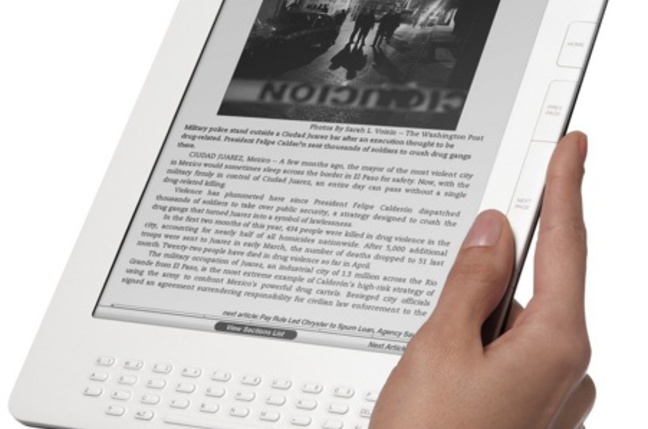
The publishing industry’s “primary disruptor” will start paying authors based on pages read, not e-books purchased. 

AmazonBeginning next month, Amazon is ushering in its next big change in the world of publishing … and it’s a pretty fundamental shift.

Instead of paying royalties to authors based on how many e-books have been sold, Amazon will start paying authors based on how many pages of their books consumers have read.

For now, the program applies just to self-published authors who are on Amazon’s KDP Select Program — but you can bet that if the experiment plays out well, it’ll likely expand.

Currently, Amazon remunerates its native authors on a monthly bases based on the number of times their e-books are accessed through two Kindle service programs:

The new change will shift away from paying authors based on each book accessed, and instead pay based on each page that readers access (and that remains on the screen long enough to be parsed).

Who will be the winners and losers in this new approach to compensation?  Certainly, some people have criticized the current payment scheme for benefiting authors of smaller books more than those who write longer tomes.  The change may improve matters for the latter because of the additional pages that make up their e-books.

But is that really the case?  Many large volumes are reference-oriented book or fall into other non-fiction categories, such that a reader may be interested in accessing only a few pages within the books in any case.

But on the fiction side, authors may find themselves attracted to writing the kind of “cliffhanger” story lines that keep readers turning the pages.

However it shakes out, one thing seems destined to change.  The old saw that “it doesn’t matter how many people read a book — only how many purchase it” may well be on the way out.

What are your thoughts about Amazon’s new remuneration policy?  On balance, is it good for authors — or for the world of books in general?  Feel free to share your comments with other readers.

(Still) Too Much Irritating Online Advertising

online advertisingTime was, the online experience was blissfully free of annoying advertising.  (Of course, that was back in the very early days of the Internet.)

Then things got pretty bad pretty quickly, as publishers became forced to find ways to make up for lost advertising revenues from their print vehicles.

One of the most egregious examples of the explosion in online advertising were pop-up and pop-under ads.

So infamous, in fact, that an entire industry of ad blocking software sprang up, eventually providing the ability to eradicate most of them.

Not all of them, of course, but enough so that for those who use the programs, those ads are no longer quite as pernicious as before.

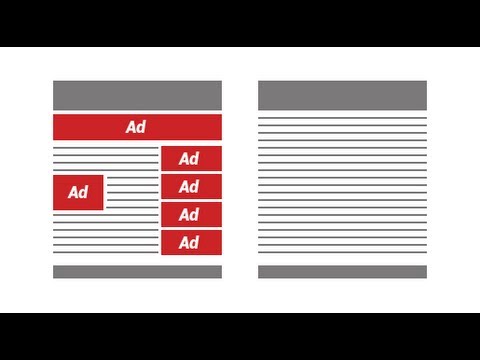
And yet … the arsenal of publisher’s revenue-generating ad tricks is still quite large — and pretty irritatingly effective, too.  Here are the most pervasive ones:

Slideshows – Some publishers use a picture slideshow format at every opportunity as a way of increasing page views and ad impressions.  Each click to view the next slide means more opportunities to collect revenue from serving up more display ads.  Using this scheme, publishers can end up with ten times the ad volume compared to if they had presented the information and images on a single page.

Pagination – Related to the slideshow scheme is the idea of publishing an online news story on two or three pages, whereas it could easily have been presented on just one.  If you ask people, most would be quite happy simply scrolling down the page to read the entire story.  On the other hand, publishers love this tactic because it enables them to double or triple their ad impressions.

Autoplay video – Even though most viewers hate autoplay videos, publishers think this tactic is great because they can gain revenue from video serves without having to wait until a user clicks on it to play.

Autopage refreshing – The obnoxious practice of refreshing and reloading a web page every 30 or 60 seconds has little to do with fresh new content being added to the page – unless that “fresh new content” is new advertising impressions.  And that’s precisely why it happens – so that publishers can get credit and revenues from significantly more ad impressions than they would otherwise.

Add to these techniques the age-old practice of attracting attention via “cheesecake” or other questionable images – no matter that they have nothing to do with the product or service being promoted – and you have a veritable rogues gallery of obnoxious “tips and tricks” – all designed to serve up as many ads as possible and generate Potemkin Village-like “engagement” along with the heightened ad revenues.

And who’s surprised?  After all, it’s only “mere money” we’re talking about …

If you find certain advertising practices particularly detrimental to your online experiences, I’m sure other readers would love to hear about them.  Please share your thoughts in the comment section below — and what you’ve done about it in response.

Criptext: When a recall actually looks pretty good.

Criptext logo

I doubt there are many of us in business who have never inadvertently sent an e-mail to the wrong person … or sent a message before it was fully complete … or forgot to include an attachment.

In such cases, it would be so nice to be able to recall the e-mail — just like we used to do in the days of postal mail simply by retrieving the letter from the outgoing mail bin.

Recent news reports reveal that this capability is actually a reality now.

In the fast lane?  Criptext principals just completed a successful round of investment funding.
In the fast lane? Criptext principals just completed a successful round of investment funding.

A start-up firm called Criptext has just raised a half-million dollars in private investment funds to help it perfect and expand a product that allows any sent e-mail to be recalled — even if the recipient has already opened and read it.

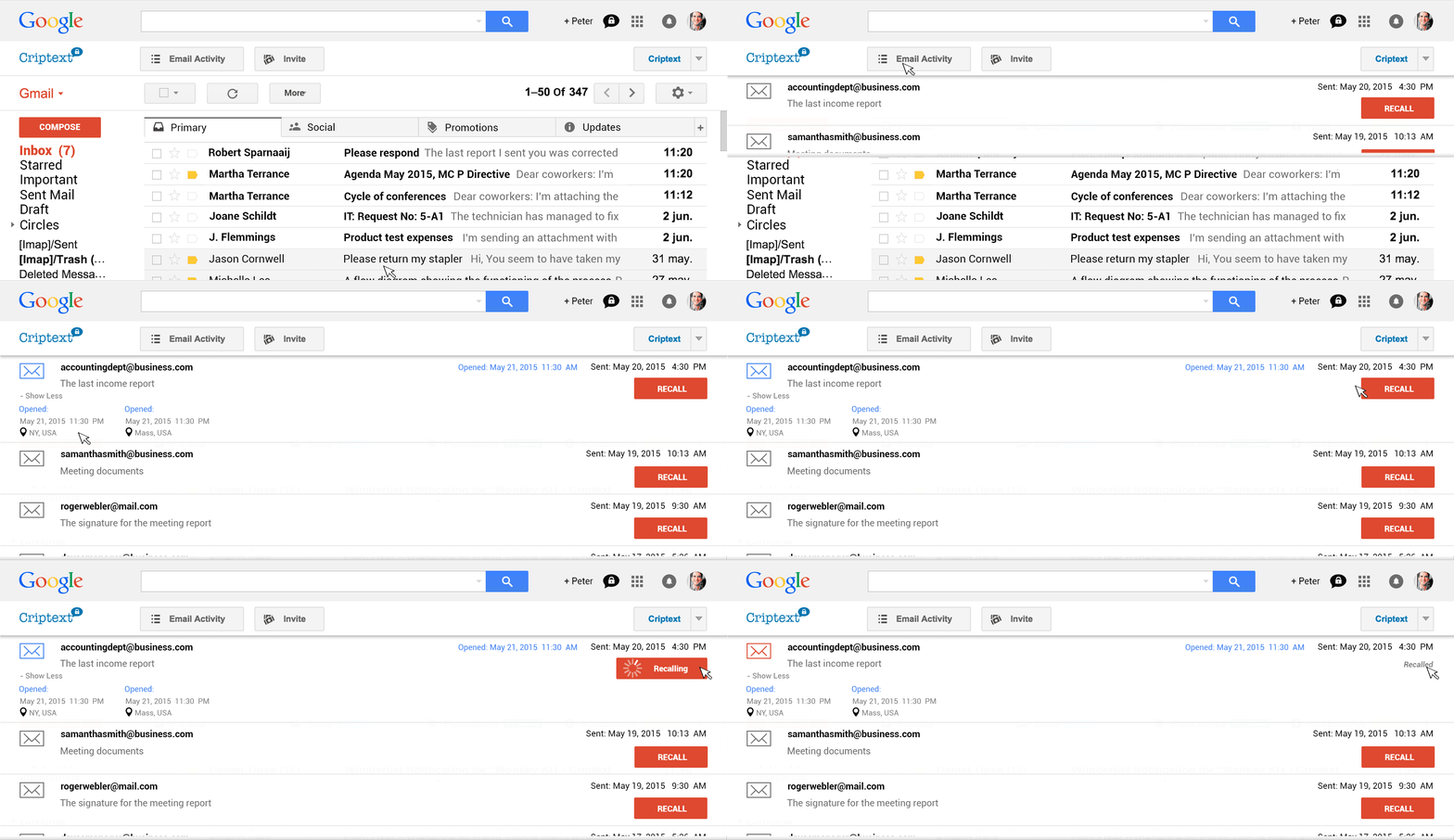
According to a report from Business Insider, Criptext is currently available as a plugin and a browser extension for the popular Outlook and Gmail email services.  It operates inside of the email, enabling the sender to track when, where and who has opened emails and/or downloaded attachments within them.

In addition, Criptext also enables the sender to recall emails, and even to set a self-destruct timer to automatically recall emails after a specified length of time.

Viewing a screenshot of how Criptext works (in this case with the Gmail service), things look pretty simple (and pretty cool, too):

Criptext activity panel example

I thought it would be only a matter of time before some developer would figure out a way to “unwind” an email communiqué once the “send” button was hit.  And now we have it.

Of course, time will tell whether Criptext can live up to its billing … or if it turns out to be more of a nightmare of glitches than a dream come true.

It would be great to hear from anyone who may have first-hand experience with Criptext — or other similar email functionalities.  Please share your experiences and perspectives pro or con with other readers here.

Big, brawny behemoth: Google’s Gmail email service reaches 900 million active users.

Google GMailIt’s been several years since Google gave us an official report on Gmail’s user base.

But now we have a new announcement from one of Google’s senior vice presidents,  reporting that Google’s Gmail service has now reached a new milestone of 900 million active users.

Three years ago — the last time Google commented officially on the Gmail active user base — the company had reported ~425 million users.

… Which means that in the past three years alone, Gmail’s active user base has more than doubled — and doubled from an already strong baseline figure.

In fact, Gmail had already become the most popular email service in America by 2012.

Despite the fact that most other email services have failed to report newer stats since then, it’s a safe bet that Google remains King of the Hill when it comes to the number of active users of its Gmail email service.

[Related to this, the same Google spokesperson is also reporting that three out of four active Gmail service users are accessing their accounts on mobile devices.  I’m sure this doesn’t come as a surprise to anyone.]

The continued robust growth in Gmail users may explain why Google hasn’t been making significant changes to the service or the user interface.  Any service that’s the largest one out there can’t risk irritating or alienating large swaths of its users.

Indeed, even when an email service isn’t the biggest or most important one in the market, making changes can still be a risky move.  Just recall the howls of protest from users (and even some of Yahoo’s own employees) when Yahoo made sweeping changes to its e-mail service about 18 months ago.

No doubt, Yahoo has lost a certain number of subscribers who simply couldn’t abide the changes.

Google InboxIn Google’s case, what it’s doing is using Inbox, which Gmail users see on top of the Gmail platform, as an area to experiment with new email features and such — without upsetting satisfied Gmail users who may have little appetite for those changes.

Inbox is an email app by Google for Android and iOS, along with web browsers Chrome, Firefox, and Safari.  In a hint at things to come, Google has now made Inbox open to all users.

Google claims that its Gmail and Inbox services serve different functions and needs, and that it will continue to work on enhancements and updates for both.

But it’s pretty clear that Inbox is where the bulk of Google’s developmental effort and energy are being directed these days.

The Ideal Privacy Policy?

policyRecently, I came upon a column written by software entrepreneur and business author Cyndie Shaffstall in which she proposes the following policy for any company to adopt that truly cares about its customers’ privacy:

The Ideal Privacy Policy:

1.  We have on file only your first name, last name, and e-mail address.

2.  We ask for nothing else.

3.  We send you only e-mails you request.

4.  We have nothing to share with others – and wouldn’t if they asked.

5.  We won’t change this policy without prior notice – ever. 

Thank you for being our customer, 

~ Your Grateful Vendor 

Cyndie Shaffstall
Cyndie Shaffstall

As Shaffstall herself acknowledges, she’s never actually seen a policy like this.

But if a company actually adopted such a policy, it would certainly make people more comfortable about purchasing its products — particularly things like phones, wearables and other products that capture and process user-specific data as part of their functionality.

Unfortunately, Shaffstall is correct in asserting that few if any companies would actually adopt such a privacy policy.  Because if they did, they’d be voluntarily walking away from so much of what makes the online world such a lucrative business proposition.

But think for a moment:  Wouldn’t it be absolutely wonderful if we didn’t have to consider such privacy policies “too good to be true”?

Do you know any real-live examples of companies whose privacy policies come close to this ideal?  If so, please share them with readers here.

On the march: Ad blocking tools continue their rise in popularity.

What Adblock PromisesI’ve blogged before about the rise of online ad blocking tools and their growing popularity with consumers.

One example:  AdTrap – a device that intercepts online ads before they reach any devices that access a person’s Internet connection.

AdTrap’s motto is simple and powerful:  “The Internet is yours again.”

In the months and years since I first blogged about it, ad blocking has only become more popular – so much so that it’s no longer just a mild irritant to advertisers and publishers, but rather a commercial threat that has a significant impact on publishers’ financial bottom lines.

It’s hardly surprising.  Most people want to run as far away from advertising as they can.  For years, we’ve taken trips to the kitchen or bathroom during TV commercial breaks.  We’ve TiVo’d ads out of existence.

And the participation levels in online ad blocking bear this out now as well.  According to data from PageFair, a company that measures publishers’ ad blocking rates and provides alternative non-intrusive advertising options, the number of ad blocker tool users reached nearly 145 million people in 2014.

That’s more than five times the 21 million users of ad blocker tools we had in 2010.

Growth continues apace:  Adblock Plus, which is the biggest of the ad blocking tools, reports more than 2.3 million downloads each week, on average.

Where are people blocking online ads?  In all sorts of areas.  But the most frequent incidence of ad blocking is on gaming sites, where blocking rates are in excess of 50%.

But blocking is happening on other online sites, too, including entertainment, fashion and lifestyle sites – albeit at about half the degree as on gaming sites.

[Tellingly, ad blocking is happening on technology sites, too, where about a quarter of the ads are being blocked.]

One of the more interesting nuggets of information reported by PageFair is the difference in ad blocking rates by country.  What we see is that Americans lag well-behind a number of other countries:

  • Argentina: ~34 of online ads are blocked
  • Poland: ~34% are blocked
  • Sweden: ~33%
  • Finland: ~32%
  • Germany: ~30%
  • United States: ~15%

Germany, in particular, has been the scene of several fervent legal skirmishes in recent years.  There, the publisher of the news magazine Die Zeit sued the parent company of AdBlock, claiming that the ad blocking tool is “illegal and anti-competitive.”  (The suit went nowhere, incidentally.)

Some observers speculate that the higher incidence of ad blocking in certain countries may be tied to those nations’ sociological profiles.  “I personally suspect that in some of these countries, citizens are more concerned about their personal privacy – perhaps for historical reasons,” Sean Blanchfield, PageFair’s CEO, has remarked.

One might wonder if, in the age of Edward Snowden and the Patriot Act (now superseded by new legislation ironically called the “USA Freedom Act”), Americans’ ad blocking practices might now be poised to align more closely with Europeans’.

I imagine we’ll know more about that degree of convergence within a year or two.

Gallup’s Payroll-to-Population Rates Pinpoint the Go-Go Metro Areas

Commuters in New York City.

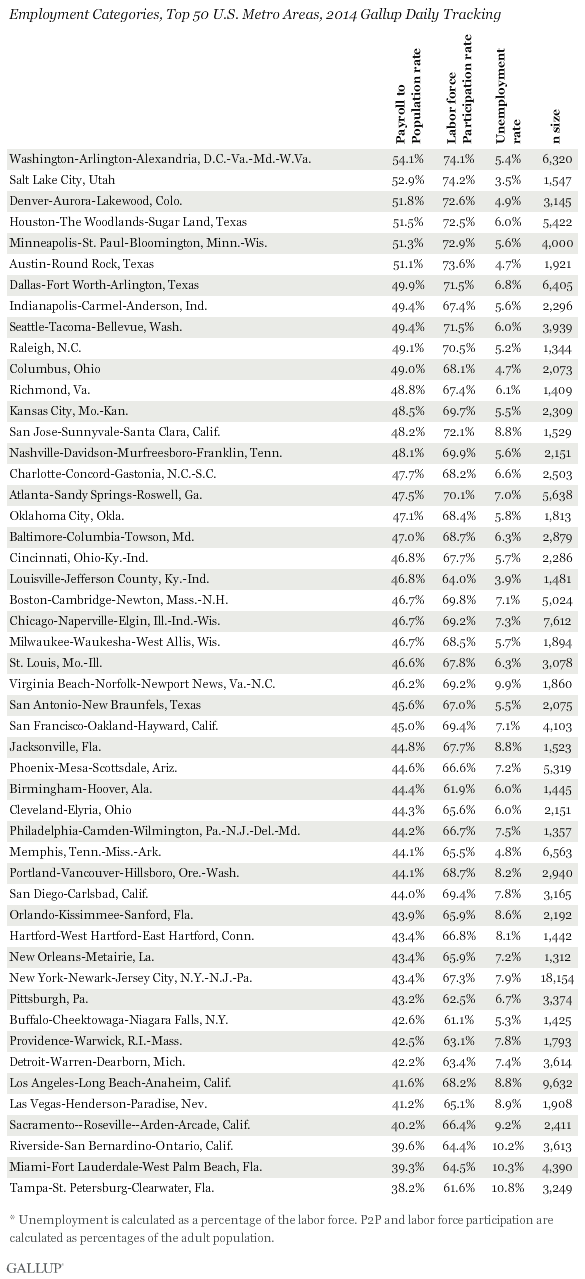
The Gallup polling organization’s P2P measurements (payroll-to-population employment rates) are an interesting metric and add an extra dimension of understanding as to what’s happening with employment across the United States.

Gallup’s evaluation is limited to the top 50 most populous SMSAs (metropolitan statistical areas).  But because of the large number of phone interviews conducted within each metro area (ranging from ~1,300 to 18000+ depending on the population), the findings are statistically significant whether looking nationally or within a particular urban area.

The latest surveys, conducted by Gallup in 2014 among nearly 355,000 households, find that two metro areas with the highest P2P measures are Washington, DC and Salt Lake City, UT — urban centers that couldn’t be more dissimilar in other ways.

For DC, the P2P rate is 54.1.  The calculation is derived from the percentage of the adult population (age 18+) who are employed full-time for an employer for at least 30 hours per week.

For Salt Lake City, the P2P rate is just slightly lower, at 52.9.

Other top scoring metro areas include three markets in Texas (Austin, Dallas-Ft. Worth and Houston).

What about metro areas at the other end of the scale?  Those would be Miami (38.2 score) and Tampa (39.3).

Three other low-scoring MSAs are located in California:  Los Angeles, Riverside and Sacramento.

What do these stats mean in a broader sense?

For one thing, there’s a direct relationship between employment stats and P2P performance:  Metro areas with the highest unemployment rates correlate to those with low P2P scores.

For instance, Miami’s unemployment rate in 2014 was 10.3%.  It was 10.2% in Riverside, CA.

That’s a big contrast with Salt Lake City, which had an unemployment rate of just 3.5%.

I find one interesting deviation from the norm:  Buffalo, NY.  There, while the unemployment rate is one of the ten lowest in the country, its labor force participation rate is also very low — bottoms among all 50 metro areas, in fact.

Shown below are the figures for all of the 50 largest U.S. metro areas based on the interviews conducted by Gallup in 2014:

Gallup full results

More details on the research findings are available here.