How China’s economic woes will affect the United States: A view from East Asia.

Chinese economyIt’s only natural for Americans to be somewhat spooked about what’s happening in the financial markets, what with thousand-point drops on the stock exchanges and all.

It’s even more disconcerting to realize that the forces in play are ones that have little to do with the American economy and a lot more to do with Europe and China. (China in particular, where bubbles seem to be bursting all over the place with the fallout being felt everywhere else.)

In times like this, I seek out the thoughts and perspectives of my brother, Nelson Nones, an IT specialist and business owner who has lived and worked outside the United States for nearly 20 years — much of that time spend in the Far East.

To me, Nelson’s thoughts on world economic matters are always worth hearing because he has the benefit of weighing issues from a global perspective instead of simply a more parochial one (like mine).

Nelson Nones
Nelson Nones

Yesterday, I had the opportunity to ask Nelson a few questions about what’s happening in the Chinese economy, how it is affecting the U.S. economy, and what he sees coming down the road. Here are his perspectives:

PLN: What is your view of the Chinese economy — and what does the future portend?

NMN: I’m a real pessimist when it comes to the current state of the Chinese economy. I also think the Chinese will turn on themselves politically as their economic house of cards is collapsing — so look for a sharp upturn in political and social turmoil as well.

Just as the bubble burst in the U.S. and Europe in 2007-08, it’s bursting now in China — and the rest of East Asia (South Korea, Japan, Thailand and Singapore) are going to get caught in the fallout because of the extent to which their economies are reliant on trade with China.

 PLN: What do you look at, specifically, for clues as to future economic movements?

NMN: The barometer to watch is the price of oil. It plummeted in 2007, presaging the “great recession” in the West.

untitledOil prices began to drop again in 2014.  The U.S. oil benchmark fell below $40 per barrel on August 24, 2015, a level not seen since 2009. I believe the underlying root cause is a sharp contraction of East Asian demand due to the economic bubbles bursting over here, coupled with persistently high supply as Middle Eastern oil exporters compete against American producers to protect market share.

PLN: How will these developments affect the U.S. economy?

NMN: The oil bust will continue in the U.S., dragging the economy down. But energy prices will be lower, buoying other parts of the American economy.  For instance, the domestic airline sector will benefit and consequential demand for Boeing jets will grow.

U.S. imports — specifically, imports from China and the rest of East Asia — will become cheaper as China and other countries allow their currencies to fall in order to protect their exports.

This is probably a “net-neutral” for the US economy in that American exports will be hurt due to the relatively stronger U.S. Dollar, but American consumers will benefit from lower prices. So, the direct economic impact is likely to be mixed.

PLN: So, why worry?

NMN: The real risk, in my opinion, is a global liquidity crisis. Over the past quarter-century, China and other East Asian countries have accrued enormous wealth. But they didn’t hoard their newfound wealth; they invested it both domestically and overseas.

China has invested ginormous amounts of cash in domestic infrastructure and housing. That money is already spent, and a sizeable part of the investment has already gone to waste in the form of corruption, new housing that nobody wants, underutilized transport infrastructure and non-performing loans made to inefficient state-owned enterprises. 

All of this will eventually need to be written off (that’s why their bubble is bursting).

But China has also invested lots of money in overseas financial instruments. Think of the Chinese as the folks who financed the Federal Reserve’s Quantitative Easing program as well as Federal debt in the U.S. But as the Chinese run out of cash at home, they will increasingly need to liquidate their overseas investments just to pay their bills.

This poses a very real threat to the fiscal stability of U.S. and European governments, and to the supply of capital in U.S. and European financial markets.

The Federal Reserve is likely to be caught in a double-bind. On the one hand, if the Fed raises interest rates in response to the reduced supply of capital (as it is widely assumed they will, later this year), they risk choking off the tepid U.S. recovery currently underway.

This would also cause the U.S. Dollar to strengthen further, thereby exacerbating the negative impact of the Chinese bust by making U.S. exports less competitive in global markets.

On the other hand, if the Fed leaves interest rates where they are (basically zero), then they won’t be able to attract enough capital to roll over the public debt that the Chinese are trying to liquidate. In other words, the Fed risks a “run on the bank.”

The Fed can deal with this by printing more money (more or less what the Chinese did in 2007-8), but this would inevitably introduce inflationary pressures in the U.S. It would also lengthen the time it takes for the Chinese to right their ship, because it will put downward pressure on the U.S. Dollar, thereby constraining whatever the East Asians can do to boost exports.

My guess is that the Federal Reserve will “blink” and keep interest rates at zero (and also print more money to pay off the Chinese) in hopes that (somewhat) cheaper imports will offset (some of) the inflationary impact of printing more money.

This is equivalent to kicking the can down the road.

PLN: Do you see any impact on the 2016 Presidential race in the United States?

NMN: As a result of kicking the can down the road, I foresee little impact on the 2016 U.S. Presidential race — but watch out in 2020 when the hangover is well underway.

Alternatively if the Fed raises interest rates, I suspect the Democratic Party candidate will be more vulnerable because the short-term economic pain will be much higher in the U.S. The incumbent party will get most of the blame. Fair or not, that’s just the way bread-and-butter issues play out in American politics.

PLN: What about unrest in China — might that have political repercussions in America? 

NMN: The way I see it, political or social turmoil in China will have zero impact on the U.S. Presidential race. Americans of nearly every political stripe or ideology dislike or distrust Chinese governance, yet unlike the “China lobby” of the Cold War era, they have no appetite to intervene in what they rightly perceive to be internal Chinese affairs.  

Or they’re clueless about events in East Asia. Or they just don’t care.

So there you have it — a view from the Far East. If you have other perspectives, please share them with our readers here.

______________

Update (8/28/15):  A few days after this post was uploaded, I received this follow-up from Nelson:

Just as I had predicted, check out this link.  Federal debt is getting more expensive to finance, because the drop in demand for U.S. Treasury bonds (caused by the Chinese liquidation apparently underway) is driving yields up.  According to the article, “The liquidation of such a large position, if it continues, could wreak havoc on the Treasuries market.”
Now look here:  http://www.bloombergview.com/quicktake/federal-reserve-quantitative-easing-tape. It’s an easily understandable explanation of how the Federal Reserve’s quantitative easing (QE) program worked.  Essentially the Fed, like China, stepped in to buy Treasuries also. The Fed also bought mortgage-backed securities.
The Fed’s purchases of Treasuries and mortgage-backed securities now make up ~85% of the Fed’s assets.  The Fed hasn’t indicated what it will do when these assets mature, but if it doesn’t roll over this debt (or a portion thereof) then we can expect Treasury yields to rise yet again. Even if the Fed decides to keep interest rates where they are, at near-zero, rising Treasury yields could bring on a liquidity crunch within the private sector as capital is increasingly drawn away from private investments (loans, corporate bonds and equities) to government-issued bonds paying higher yields with little risk.
Facing the Chinese liquidation, this is why I suspect the Fed will opt to roll over its holdings of Treasuries and mortgage-backed securities, and keep interest rates at near-zero, at least through the 2016 Presidential election cycle.  The Bloomberg article cited above describes QE as an alternative to printing more money, but in the end it’s really the same thing.

Have we become too complacent about cyber-security threats?

cyber warfareThe scandal involving the security risk to U.S. State Department e-mails is just the latest in a long list of news items that are bringing the potential dangers of cyber-hacking into focus.

But of course, we’ve seen it before — and it involves far more than just “potential” risk.  From Target, Best Buy and other retailers to Ashley Madison customer profiles, IRS taxpayer information and the U.S. government’s personnel records, the drumbeat of cyber-security threats that’s turned out to be all-too-real is persistent and ongoing.

In the realm of marketing and public relations, recent breaches of PR Newswire and Business Wire data gave hackers access to pre-release earnings and financial reports that have been used to enrich nefarious insider traders around the world to the tune of $100 million or more in ill-gotten gains.

These and other events are occurring so regularly, it seems that people have become numb to them.  Every time one of these news items breaks, Instead of sparking outrage, it’s a yawner.

But Jane LeClair, COO of the National Cybersecurity Institute at Excelsior College, is pleading for an organized effort to thwart the continuing efforts — one of which could end up being the dreaded “Cyber Pearl Harbor” that she and other experts have warned us about for years.

“We certainly can’t go on this way — waiting for the next biggest shoe to drop when hundreds of millions — perhaps billions — will be looted from institutions … It’s time we stopped making individual efforts to build cyber defenses and started making a collective effort to defeat … the bad actors that have kept us at their mercy,” LeClair contends.

I think that’s easier said than done.

Just considering what happened with the newswire services is enough to raise a whole bevy of questions:

  • Financial reports awaiting public release were stored on the newswires’ servers … but what precautions were taken to protect the data?
  • How well was the data encrypted?
  • What was the firewall protection? Software protection?
  • What sort of intruder detection software was installed?
  • Who at the newswire services had access to the data?
  • Were the principles of “least privilege access” utilized?
  • How robust were the password provisions?

In the case of the newswire services, the bottom-line explanation appears to be that human error caused the breaches to happen.  The attackers used social engineering techniques to “bluff” their way into the systems.

Mining innocuous data from social media sites enabled the attackers to leverage their way into the system … and then use brute force software to figure out passwords.

Once armed with the passwords, it was then easy to navigate the servers, investigating e-mails and collecting the relevant data. The resulting insider trading transactions, made before the financial news hit the streets, vacuumed up millions of dollars for the perpetrators.

Now the newswire services are stuck with the unenviable task of attempting to “reverse engineer” what was done — to figure out exactly how the systems were infiltrated, what data was taken, and whether malicious computer code was embedded to facilitate future breaches.

Of course, those actions seem a bit like closing the barn door after the cows have left.

I, for one, don’t have solutions to the hacking problem. We can only have faith in the experts inside and outside the government for determining those answers and acting on them.

But considering what’s transpired in the past few months and years, that isn’t a particularly reassuring thought.

Would anyone else care to weigh in on this topic and on effective approaches to face it head-on?

State of the States: CNBC’s take on the best ones for business.

In CNBC’s recently published scorecard, don’t look to the Northeast or California to find the states that are best ones for business.

CNBC State Rankings for Business
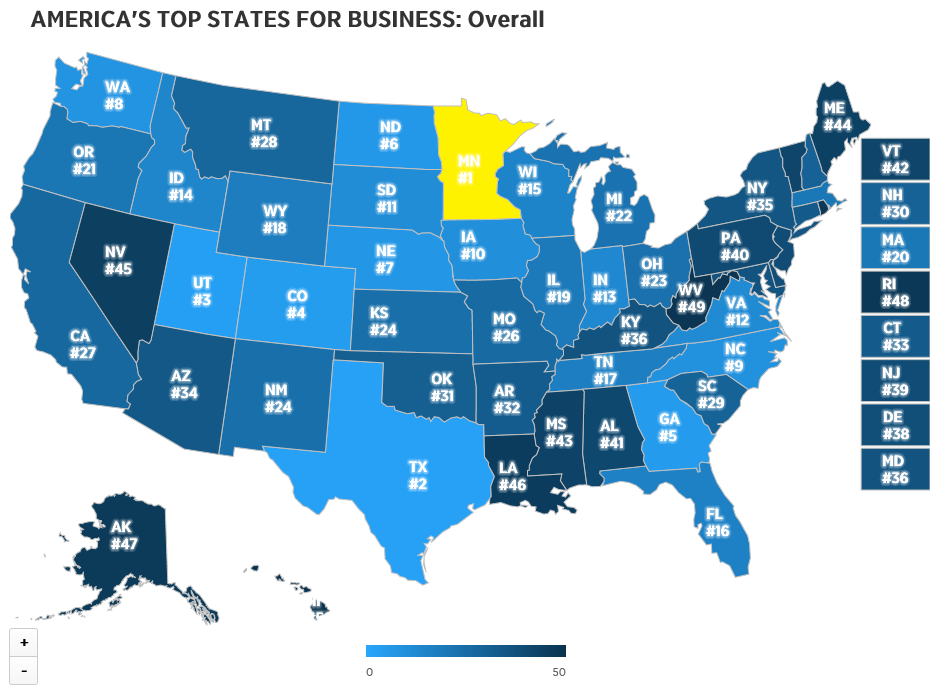
L’Etoile du nord: Just as in its state motto “Star of the North,” Minnesota is the stellar performer in CNBC’s 2015 state ranking of business competitiveness. (Click on the map for a larger view.)

State and city rankings are a source of fascination for many people. Of course, there are many ways to fashion them to place nearly any state or city you like at the top of the heap.  Some of the lists use criteria that are so convoluted, it stretches credulity.

Since when is Baltimore the best city in America for single men?  Since it was ranked #1 in this evaluation, evidently.  Many of us who know the city’s innards really well would disagree heartily, of course.

But I think the CNBC 2015 scorecard on state business climates, published earlier this month, is based on a more solid set of criteria.

CNBC created it by scoring all 50 states on approximately 60 separate measures of competitiveness – a list that was developed with input from an array of business and policy experts, official government sources, and CNBC’s own Global CFO Council, and that uses government-generated data.

CNBC then grouped these measures into ten broader categories, weighting the results based on how often each is used as “selling point” in state economic development marketing and promotional efforts. This was done in order to rank the states based on the criteria they themselves use to showcase their attractiveness to businesses considering expansion or relocation.

Here are the ten broad categories in the CNBC evaluation, and which states ranked first and last within them:

  • Access to capital: #1 North Carolina … #50 Wyoming
  • Business friendliness: #1 North Dakota … #50 California
  • Cost of doing business: #1 Indiana … #50 Hawaii
  • Cost of living: #1 Mississippi … #50 Hawaii
  • Economy: #1 Utah … #50 Mississippi
  • Education: #1 Massachusetts … #50 Nevada
  • Infrastructure: #1 Texas … #50 Rhode Island
  • Quality of life: #1 Hawaii … #50 Tennessee
  • Technology/innovation: #1 Washington … #50 West Virginia
  • Workforce: #1 North Dakota … #50 Maine

Do we see any surprises here?  To my mind, the high and low rankings look pretty well-aligned with the anecdotal information we hear all the time.

Perhaps we might consider several other states besides Nevada to be “bottoms” in education. And personally, I am pretty shocked to see Tennessee ranked last in quality of life. Having lived there during my college years at Vanderbilt University, I never considered the state to be substandard when it came to that attribute.

But It’s when CNBC amalgamates all of the rankings to come up with its overall state ranking that a few surprises emerge.

Such as … Minnesota notches first place overall. I’m sure some people are genuinely surprised to see that.

For the record, here is CNBC’s list of the Top 10 states for business in 2015:

  • #1 – Minnesota
  • #2 – Texas
  • #3 – Utah
  • #4 – Colorado
  • #5 – Georgia
  • #6 – North Dakota
  • #7 – Nebraska
  • #8 – Washington
  • #9 – North Carolina
  • #10 – Iowa

We see that four of the ten top states are in the Midwest … three are in the South … three are in the West … but none are in the Northeast.

CNBC study on business competitiveness
The center holds: According to CNBC, most of the most competitive states for business are in the Mid-Continent region.

By contrast, for the most part the Bottom 10 states are clustered in other areas of the country … including four Northeastern states plus Alaska and Hawaii, two states that clearly have unique locational circumstances:

Hawaii lacks business competitiveness
Not so sunny: Hawaii’s bad business climate.
  • #40 – Pennsylvania
  • #41 – Alabama
  • #42 – Vermont
  • #43 – Mississippi
  • #44 – Maine
  • #45 – Nevada
  • #46 – Louisiana
  • #47 – Alaska
  • #48 – Rhode Island
  • #49 – West Virginia
  • #50 – Hawaii

CNBC has issued a raft of charts and maps providing details behind how their ratings were formulated, and the results for each of the major categories. You can view the data here.

Speaking for yourselves, in what ways would you challenge the rankings? What strikes you here as different from your own personal experience in doing business in various states? Please share your perspectives with other readers.

Gallup’s Payroll-to-Population Rates Pinpoint the Go-Go Metro Areas

Commuters in New York City.

The Gallup polling organization’s P2P measurements (payroll-to-population employment rates) are an interesting metric and add an extra dimension of understanding as to what’s happening with employment across the United States.

Gallup’s evaluation is limited to the top 50 most populous SMSAs (metropolitan statistical areas).  But because of the large number of phone interviews conducted within each metro area (ranging from ~1,300 to 18000+ depending on the population), the findings are statistically significant whether looking nationally or within a particular urban area.

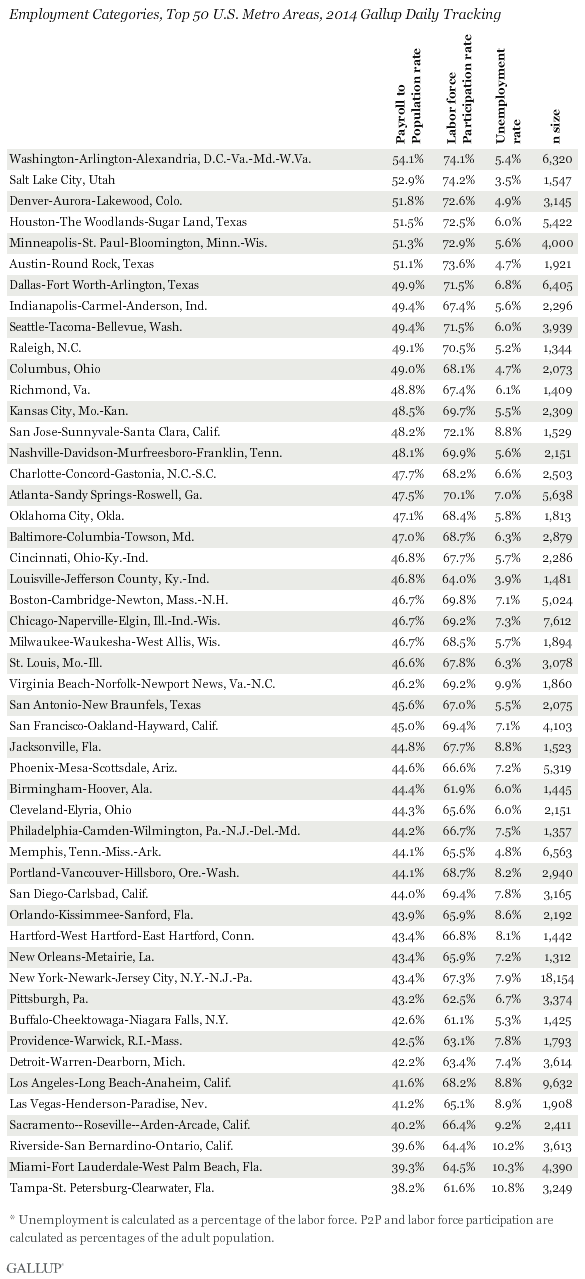
The latest surveys, conducted by Gallup in 2014 among nearly 355,000 households, find that two metro areas with the highest P2P measures are Washington, DC and Salt Lake City, UT — urban centers that couldn’t be more dissimilar in other ways.

For DC, the P2P rate is 54.1.  The calculation is derived from the percentage of the adult population (age 18+) who are employed full-time for an employer for at least 30 hours per week.

For Salt Lake City, the P2P rate is just slightly lower, at 52.9.

Other top scoring metro areas include three markets in Texas (Austin, Dallas-Ft. Worth and Houston).

What about metro areas at the other end of the scale?  Those would be Miami (38.2 score) and Tampa (39.3).

Three other low-scoring MSAs are located in California:  Los Angeles, Riverside and Sacramento.

What do these stats mean in a broader sense?

For one thing, there’s a direct relationship between employment stats and P2P performance:  Metro areas with the highest unemployment rates correlate to those with low P2P scores.

For instance, Miami’s unemployment rate in 2014 was 10.3%.  It was 10.2% in Riverside, CA.

That’s a big contrast with Salt Lake City, which had an unemployment rate of just 3.5%.

I find one interesting deviation from the norm:  Buffalo, NY.  There, while the unemployment rate is one of the ten lowest in the country, its labor force participation rate is also very low — bottoms among all 50 metro areas, in fact.

Shown below are the figures for all of the 50 largest U.S. metro areas based on the interviews conducted by Gallup in 2014:

Gallup full results

More details on the research findings are available here.

The Affordable Care Act: Still unpopular with physicians after all these years.

ACAOne of the predictions we’ve heard about the admittedly controversial Affordable Care Act is that acceptance of it will grow over time, as people become more familiar and comfortable with its provisions.

So far at least, we haven’t seen this happening in the public polling about the law.

And now we’re seeing similar dynamics playing out in the all-important physician community.

In fact, the latest findings are that the ACA is more unpopular than ever, if the results of a new survey of physicians are to be believed.

The survey was conducted in January 2015 by LocumTenens, a physician staffing firm and online job board.

The headline finding must be this:  While ~44% of the survey respondents reported that they had been opposed to the Affordable Care Act legislation prior to its implementation, now ~58% are opposed to it after a year of working under the confines of the law.

R. Shane Jackson, president of LocumTenens, had this to say about the key finding:

“After a year in the trenches trying to help patients understand this legislation, physicians by and large feel the law hasn’t done a lot to help improve healthcare.”

More specifically, Jackson noted,

“Physicians feel the ACA has made serving patients and running their businesses much harder.  A year after implantation – and years after the political debate started – doctors are still passionate about how this law should have been designed, and would still like to see changes made that will make it simpler for their staffs and patients to understand.”

Among the negatives physicians see with the current ACA law are these aspects:

  • Lower reimbursement rates to hospitals and physicians
  • Increased compliance burdens for physician practices
  • Higher patient debt due to high-deductible plans

ACA healcare premium changesAlso faulted are the insurance companies for not doing more to inform newly insured patients about their premiums, deductibles and coverage limits.

It isn’t all poor marks for the ACA, however.  Physicians in the LocumTenens survey do credit the legislation for a number of positive outcomes including:

  • Helping more people gain access to healthcare
  • Expanding coverage to more children and young adults
  • Eliminating coverage denials due to pre-existing health conditions
  • Placing more focus on preventive healthcare measures
  • Decreasing the costs of end-of-life care

So what is the “net-net” on all of this?

Two-thirds of the physician respondents want the ACA law repealed (and three-fourths think it will be, incidentally).  But physicians want it replaced by something else that retains the positive aspects of the ACA while doing away with the negatives.

That’s the same message we’ve been hearing from politicians, too.  So the bigger question is how to unscramble the ACA egg … and whether anything actually better can come out of the effort.

Would anyone care to weigh in with their thoughts and ideas in this never-ending debate?

Gallup’s CEO Calls the Official U.S. Unemployment Rate a “Big Lie”

American consumersI’ve blogged before about how the American public doesn’t seem to be responding to the news that the country has been out of its economic recession for a number of years now.

It’s not for lack of trying.  From the White House and other politicians to government agencies, financial industry practitioners and news media articles, there’s been a steady stream of speeches, announcements, news items and commentary lamenting the disconnect between the perception and the reality.

Plus … I’m reminded often by my business counterparts who work in Europe and Asia that the situation is much better in America than in many other countries.  I consider it advice to “count our blessings,” as it were.

With this as backdrop, it’s easy to fall into the paradigm of thinking that the American public is simply being unrealistic in its expectations for economic recovery — and the recovery’s ability to reach into all strata of society.

But then … along comes a commentary by Jim Clifton, chairman and CEO of the Gallup polling organization.

Jim Clifton Gallup CEO
Jim Clifton

In addition to heading what is arguably America’s most famous polling company, Mr. Clifton is a keen observer of economics and public policy.  He is also the author of the book The Coming Jobs War (published in 2011).

The gist of Clifton’s commentary is that the official unemployment rate, as reported by the U.S. Department of Labor, is very misleading.

Moreover, it’s Clifton’s contention that the very way the Department of Labor calculates the unemployment rate goes straight to the heart of the disconnect between the experts and the “person on the street.”

Here’s what Clifton wrote in a column released earlier this month:

“If a family member or anyone is unemployed and has subsequently given up on finding a job — if you are so hopelessly out of work that you’ve stopped looking [for work] over the past four weeks — the Department of Labor doesn’t count you as unemployed. 

That’s right:  While you are as unemployed as one could possibly be, and tragically may never find work again, you are not counted in the [unemployment] figure we see relentlessly in the news — currently 5.6%.”  

official U.S. unemployment rate
The official U.S. unemployment rate as reported by the United States Department of Labor’s Bureau of Labor Statistics.

In Clifton’s estimation, right now as many as 30 million Americas are either out of work or severely unemployed.  That would equate to an unemployment rate far higher than the reputed 5.6% figure.

But it goes even beyond that.  Clifton points out another clue as to why the perception gulf between the “statisticians” and the “street” seems so wide — and he puts it in the form of two examples:

“Say you’re an out-of-work engineer or healthcare worker or construction worker or retail manager.  If you perform a minimum of one hour of work in a week and are paid at least $20 — maybe someone pays you to mow their lawn — you’re not officially counted as unemployed in the much-reported 5.6% [figure]  

Few Americans know this. 

Yet another figure of importance that doesn’t get much press:  those working part time but wanting full-time work.  If you have a degree in chemistry or math and are working 10 hours part time because it is all you can find — in other words, you are severely unemployed — the government doesn’t count you in the 5.6%.   

Few Americans know this.”

Clifton doesn’t mince words in his characterization of the official unemployment rate; he calls it a “Big Lie” — one which has consequences that go well-beyond simply the stats being arguably wrong.

Here’s how he puts it:

“… It’s a lie that has consequences because the Great American Dream is to have a good job — and in recent years, America has failed to deliver that dream more than it has in any other time in recent memory.   

A good job is an individual’s primary identity — their very self-worth, their dignity.  It establishes the relationship they have with their friends, community and country.  When we fail to deliver a good job that fits a citizen’s talents, training and experience, we are failing the American Dream.”

Statisticians and economic policy experts can and do disagree about what constitutes a “good job” in America.  The Gallup organization defines it as working 30 or more hours per week for an organization that provides a regular paycheck, with or without other benefits.

That’s actually a pretty low-bar for what defines a “good job.”  But however jobs are defined, the U.S. economy is currently delivering at a rate of just 44%, which equates to the number of full-time jobs as a percent of the adult population (age 18 and over).

It would seem that the 44% figure would need to be significantly higher to really solve the challenge of available jobs.

Clifton concludes his commentary by issuing this challenge:

“I hear all the time that ‘unemployment is greatly reduced, but the people aren’t feeling it.’  When the media, talking heads, the White House and Wall Street start reporting the truth — the percent of Americans in good jobs; jobs that are full time and real — then we will quit wondering why Americans aren’t ‘feeling’ something that doesn’t remotely reflect the reality in their lives. 

And we will quit wondering what hollowed out the middle class.”

I’ve devoted significant space in this blog post to quoting Jim Clifton’s words verbatim, so as not to change their tenor or dilute them in any way.

What do you think?  Is Clifton speaking truth to power?  Or is he painting an overly negative view of things?  I welcome your thoughts and comments.

America’s small businesses: Quite bullish on 2015 … but with no thanks to the government.

Small Business Economic OutlookRecent reports on economic activity appear to show a continuation of a rather wobbly recovery of the U.S. economy since coming out of the Great Recession.

It’s a repeating pattern of one quarter of strong growth followed by the next one with weaker indices — sometimes with the stats from earlier quarters revised downward.

Still, things are still better for the U.S. economy as compared to many others around the world.

America’s small businesses appear to feel similarly about the U.S. economy.  Their perspective may be even more positive, in fact.

Illustrating this perspective, a January 2015 survey of ~850 U.S. businesses (ones that employ ten or fewer full-time or part-time workers) finds small business owners having a pretty bullish outlook on the year ahead.

In a survey conducted by web hosting company Endurance International Group (formerly Bizland), two-thirds of the respondents reported positive prospects for their businesses for 2015:

  • General business outlook is very positive: ~26% of respondents
  • Generally positive outlook: ~45%
  • Neutral outlook: ~25%
  • Negative outlook: ~5%

These findings align quite neatly with how these business owners see 2015 as compared to 2014’s performance:

  • 2015 will be positive compared to 2014: ~66% of respondents
  • 2015 will be about the same: ~29%
  • 2015 will be negative compared to 2014: ~5%

But … these positive impressions happen with no thanks to the government.  When asked if they felt that the U.S. Congress is effective in addressing the issues that are important to small businesses, a whopping 87% gave thumbs-down.

Even the changes in Congressional leadership that came about as a result of the 2014 midterm elections have done little to improve the perceptions of these business owners, as ~69% do not believe that the new leadership in Congress will be any more effective in addressing small business issues in 2015.

And what are those issues that are so important to small businesses?

They’re the usual things:  business taxes first and foremost … followed by the ability to obtain financing.

The next tier of issues includes the ability to hire workers with the appropriate skills, along with the ongoing healthcare coverage challenges.

Any other issues are basically just an asterisk at the bottom of the page …

More details on the survey results can be found here.

In the U.S. Postal Service’s own words: “Letters are going away.”

Actually, the pronouncement isn’t really all that earth-shattering.

USPS Mail DeliveryBut the fact that “letters are going away” has been stated by a spokesperson for the United States Postal Service speaks volumes.

The comment came after a not-for-profit interest group calling itself the “Taxpayers Protection Alliance” released a video that admonishes the USPS to “stick to delivering our letters.”

In the cartoon video, a girl is mailing a holiday card to her grandmother while complaining that it’s getting harder and harder to send First Class mail.

TPA videoReferring to the package delivery and grocery delivery services that the USPS now offers, the cartoon character pleads for the USPS “stop cutting mail services in favor of these other costly things and stick to what we really need them to do:  deliver our letters.”

The Postal Service’s response can be summed up in two words:  “Dream on.”

In fact, here’s what a USPS spokesperson stated to Target Marketing magazine about single-piece First Class mail, which includes personal correspondence and bill payments:

“[It] historically has funded the organization, since we do not receive tax dollars.  Package volume is growing exponentially … The mail mix is changing and the Postal Service welcomes that change.”

Indeed, First Class mail volume — and particularly single-piece First Class mail — has been declining rapidly, as can be seen in the USPS’s annual volume figures shown below:

First Class Mail Volume Trends
First Class Mail Volume Trends: 2005 – 2014. (Source: U.S. Postal Service)

By comparison, package delivery has grown by nearly 20% over the past five years.

Target Marketing and others have done a bit of digging to learn more about the “Taxpayers Protection Alliance” … and they’ve discovered that the group is particularly perturbed about the USPS getting into the grocery products delivery business.

“Expanding services into the private market is not only wrong because it undercuts private competitors,” the TPA organization’s president David Williams complains, “but because it is coming at the expense of its government-granted monopoly – mail delivery.”

TPA logoAll of which makes it intriguing to speculate who is actually behind the “Taxpayers Protection Alliance” and what particular agenda they may have.  Hint:  private companies that offer grocery delivery services, perhaps?

But the bigger news is this:  The USPS is no longer even pretending to claim that First Class mail is a central part of its business model looking to the future.  And that’s a huge change from only a couple of years ago.

Does Social Media Buzz Actually Win Elections?

social media politicsWes Green, one of the faithful readers of the Nones Notes Blog, posed a question as part of a comment on my recent post about the disconnect Gallup has observed between social media marketing promise and reality.

Wes’ question asked to what degree social media activity actually decides U.S. elections.

In other words, is social media “buzz” enabling campaigns to win elections that would have been won by a different candidate otherwise?

If you look at the sheer volume of YouTube posts, Facebook pages and sharing of breaking news on Twitter that’s being pushed out there by political campaigns, surely they must think that these social platforms are having an impact.

But what about a more scientific look into it?  I searched around for answers and found one such analysis.

Shortly before NM Incite, a social media intelligence joint venture of Nielsen and McKinsey, was shut down in 2013, it had looked at precisely these dynamics through the prism of the U.S. federal election campaigns of 2010 and 2012.

Here are two important pieces of data NM Incite uncovered:

  • Observation #1: In three out of four election campaigns, the candidate who was the most frequently mentioned on social media was the one who ultimately won the election.
  • Observation #2: The share of online “buzz” for each winning candidate was higher than the share of votes the winner actually won.

These two observations raise the next question: Is there a “causal” relation between social media presence and positive results on election night?  These findings don’t tell us that.

Instead, it may be that winning candidates are doing a better job at more than merely social media to win their races.  Their campaigns are just better organized and more adept at hitting on all cylinders.

Here’s one other finding from NM Incite’s evaluation that suggests that social may be an ornamentation and not the tree:  States with higher levels of voter turnout tend to be the ones with lower levels of online buzz about their candidates.

So there’s little evidence to suggest that social media buzz is generating higher voter participation.

I’d say we need more research on this topic. It’s a rapidly changing environment, no doubt.  An analysis that dates back to 2010 and 2012 is like a lifetime in online political campaigning.  Has anyone come across any newer research?

The “Snowden Effect”: The U.S. cloud computing industry is getting hammered.

cloud computing securityI’ve blogged before about the fallout from the Edward Snowden affair and its effects on the U.S. cloud computing industry.

In fact, back in the summer of 2013 I read an interesting thought piece published by my brother, Nelson Nones, Chairman of Geoprise Technologies.  His experiences as an IT specialist who has lived and worked outside the United States for two decades has made him particularly sensitive to what the international implications of the Snowden revelations may be.

In his 2013 analysis, he claimed that the NSA spying revelations would likely have serious consequences for the cloud computing industry.  As he wrote at the time:

“… these threats will be perceived to be so serious that many businesses could decide to abandon the use of cloud computing services going forward — or refuse to consider cloud computing at all — because they bear full responsibility for compliance yet now realize that they have little or no ability to control the attendant non-compliance risks when utilizing major cloud services providers.  

Out front: Geoprise Technologies' Nelson Nones was among the first to warn about the negative consequences of NSA surveillance programs on the U.S. cloud computing industry.
Out front: Geoprise Technologies’ Nelson Nones was among the first to warn about the negative consequences of NSA surveillance programs on the U.S. cloud computing industry.


In view of recent revelations, the tantalizing cost savings and efficiencies from cloud computing may be overwhelmed by the financial, business continuity and reputational risks.”

And his prediction as to what would likely happen as a result if these concerns played out in the market was even more chilling:

“Revenues and profits of U.S.-based service providers will suffer to the extent that businesses of every nationality abandon the public cloud computing services they are now using, or refuse to consider public cloud computing services offered by U.S.-based providers, in response to the heightened customer risks that have now been revealed.”

itif_logoShortly thereafter, I began to notice similar writings back here in the United States – in particular those by members of the Information Technology & Innovation Foundation (ITIF), a DC-based think tank focusing on technology policies.  It projected that the U.S. cloud computing industry would forfeit somewhere between $22 billion and $35 billion in lost business as a result of the NSA-related revelations.

For anyone keeping score, that’s between 10% and 20% of the worldwide cloud computing market.

New-America-Foundation-logoAnd now, one year later, the full scope of the impact is being realized.   New America Foundation, a not-for-profit, non-partisan organization focusing on public policy issues, released a report this past week which outlines the impact of Snowden’s NSA revelations.

Here are just two examples of the findings it published:

  • Within days of the first NSA revelations, cloud computing services such as Dropbox and Amazon Web Services reported measurable sales declines.
  • Qualcomm, IBM, Microsoft, HP, Cisco and others have reported sales declines in China – as much as a 10% drop in overall revenue.

Not only that, foreign governments are giving U.S. tech firms wide berth when it comes to contracting for a range of products and services that go well-beyond cloud computing.

Among the casualties:  The German government ended its contract with Verizon as of June … while the Brazilian government selected Swedish-based Saab over Boeing in a contract to replace fighter jets.

In the current environment of security jitters, it’s much easier for foreign competitors to portray themselves as “NSA-proof” — and the “safer choice” for protecting sensitive information.

Hans-Peter Friedrich

And unambiguous comments like this one made by Germany’s Interior Minister Hans-Peter Friedrich just add fuel to the fire:

“Whoever fears their communication is being monitored in any way should use services that don’t go through American servers.”

Even more ominous, a number of countries are debating – and indeed close to enacting – new legislation that would require companies doing business within their local to use local data centers.

Sure, some of the countries – Vietnam, Brunei, Greece – aren’t overly significant players in the grand scheme of things.  But others certainly are; Brazil and India aren’t inconsequential markets by any measure.

In all, the New America Foundation report forecasts that the fallout from the NSA’s PRISM program will cost cloud-computing companies multiple billions in lost revenues – from $20 billion on the low end to nearly $200 billion on the high end.

This, plus the collateral damage of lost contracts involving ancillary and even unrelated tech services and manufactured products, may result in a contraction of the U.S. tech industry’s growth by as much as 4% — not to mention seriously undermining the United States’ credibility around the world.

Isn’t that just what America needs to have right now:  international credibility problems not only in the political sphere, but also in the economic one.

Unfortunately, what I wrote in my blog post a year ago still stands true today:  “OK, U.S. government and administration officials:  Have fun unscrambling this egg!”