Chief Marketing Officers and the revolving door.

If it seems to you that chief marketing officers last only a relatively short time in their positions, you aren’t imagining things.

The reality is, of all of the various jobs that make up senior management positions at many companies, personnel in the chief marketing officer position are the most likely to be changed most often.

To understand why, think of the four key aspects of marketing you learned in business school: Product-Place-Price-Promotion.

Now, think about what’s been happening in recent times to the “4 Ps” of the marketing discipline. In companies where there are a number of “chief” positions – chief innovation officers, chief growth officers, chief technology officers, chief revenue officers and the like – those other positions have encroached on traditional marketing roles to the extent that in many instances, the CMO no longer has clear authority over them.

It’s fair to say that of the 4 Ps, the only one that’s still the clear purview of the CMO is “Promotion.”

… Which means that the chief marketing officer is more accurately operating as a chief advertising officer.

Except … when it comes to assigning responsibility (or blame, depending on how things are going), the chief marketing officer still gets the brunt of that attention.

“All the responsibility with none of the authority” might be overstating it a bit, but one can see how the beleaguered marketing officer could be excused for thinking precisely that when he or she is in the crosshairs of negative attention.

Researcher Debbie Qaqish at The Pedowitz Group, who is also author of the book The Rise of the Revenue Marketer, reports that as many as five C-suite members typically share growth and revenue responsibility inside a company … but the CMO is often the one held responsible for any missed targets.

With organizational characteristics like these, it’s no wonder the average CMO tenure is half that of a CEO (four years versus eight). Research findings as reported by Neil Morgan and Kimberly Whitler in the pages of the July 2017 issue of the Harvard Business Review give us that nice little statistic.

What to do about these issues is a tough nut. There are good reasons why many traditional marketing activities have migrated into different areas of the organization.  But it would be nice if company organizational structures and operational processes would keep pace with that evolution instead of staying stuck in the paradigm of how the business world operated 10 or 20 years ago.

Rapid change is a constant in the business world, and it’s always a challenge for companies to incorporate changing responsibilities into an existing organizational structure.  But if companies want to have CMOs stick around long enough to do some good, a little more honesty and fairness about where true authority and true responsibility exist would seem to be in order.


Employee churn rates underscore the volatile nature of e-mail contact databases.

Most marketers are well-familiar with the challenges of e-mail list maintenance. In the business-to-business world in particular, e-mail databases can become pretty stale pretty quickly, due to the horizontal and vertical movement of employees inside organizations as well as jumping to other companies.

Whether they’re moving up or out, often they’re no longer good prospects.

Based on my experience, my personal rule of thumb has been that approximately one-fifth of any given list of B-to-B names will “churn” within a 12-month period, meaning that any such contact database will rapidly lose its effectiveness unless assiduously maintained.

And now we have a new report from Salesforce Research that confirms this basic rule of thumb.

Salesforce looked to LinkedIn, exploring this social platform’s data from more than 7 million records over a 48-month period to gauge the lifecycle of the typical “persona.”

The research considered not only changes that result in the deactivation of an e-mail address, but also circumstances where individuals may keep the same e-mail address but still should be removed as a target because a horizontal or vertical change within the same organization places them in a different employee function.

What the new research found was that the average annual B-to-B churn rate for such “personas” is ~17%.

That figure turns out to be fairly close to my basic rule of thumb based on years of observing not only e-mail contact databases, but also the postal mail databases we’ve worked with in my company or with our clients.

Beyond the broad average, there are some small but meaningful differences in the B-to-B churn rate depending on the product focus and on the type of employee function.

In high-tech fields, the average annual churn rate is higher than the average. And it’s across the board, too:  23% churn in marketing … 20% in sales and in HR personnel … 19% in IT, and 18% in finance.

People employed in the retail and consumer products industries also clock in at or higher than the overall churn average, but the annual churn rate is a tad lower in the medical and transportation fields.

Another interesting finding from the Salesforce evaluation is that annual churn rates are somewhat lower than the average for personnel at director levels and higher in companies (around 15%). For managers, the churn rate matches the overall average, while “worker bees” have a higher churn rate averaging around 20%.

Considering the critical importance of e-mail marketing efforts in the B-to-B environment, Salesforce’s finding that it takes only 4.2 years for an e-mail database to churn completely means that the value of these marketing assets will decline dramatically unless cultivated and maintained on an ongoing basis.

The volatile nature of e-mail contact databases also helps explain why so many companies have adopted a multi-channel approach to marketing, including interacting on social media platforms. Yes, those platforms do have their place in the B-to-B world …

The full report of the Salesforce findings can be downloaded here.

For job seekers in America, the compass points south and west.

Downtown Miami

Many factors go into determining what may be the best cities for job seekers to find employment. There are any number of measures – not least qualitative ones such as where friends and family members reside, and what kind of family safety net exists.

But there are other measures, too – factors that are a little easier to apply across all workers:

  • How favorable is the local labor market to job seekers?
  • What are salary levels after adjusting for cost-of-living factors?
  • What is the “work-life” balance that the community offers?
  • What are the prospects for job security and advancement opportunities?

Seeking to find clues as to which metro areas represent the best environments for job seekers, job posting website Indeed set about analyzing data gathered from respondents who live in the 50 largest metro areas on the Indeed review database.

Indeed’s research methodology is explained here. Its analysis began by posing the four questions above and applying a percentile score for each one based on the feedback it received, followed by additional analytical calculations to come up with a consolidated score for each of the 50 metro areas.

The resulting list shows a definite skew towards the south and west. In order of rank, here are the ten metro areas that scored as the most attractive places for job seekers:

#1. Miami, FL

#2. Orlando, FL

#3. Raleigh, NC

#4. Austin, TX

#5. Sacramento, CA

#6. San Jose, CA

#7. Jacksonville, FL

#8. San Diego, CA

#9. Houston, TX

#10. Memphis, TN

Not all metro areas ranked equally strongly across the four measurement categories. Overall leader Miami scored very highly for work-life-balance as well as job security and advancement, but its cost-of-living factors were decidedly less impressive.

“Where are cities in the Northeast and the Midwest?”, you might ask. Not only are they nowhere to be found in the Top 10, they aren’t in the second group of ten in Indeed’s ranking, either:

#11. Las Vegas, NV

#12. San Francisco, CA

#13. Riverside, CA

#14. Atlanta, GA

#15. Los Angeles, CA

#16. San Antonio, TX

#17. Seattle, WA

#18. Hartford, CT

#19. Charlotte, NC

#20. Tampa, FL

… except for one: Hartford (#18 on Indeed’s list).

Likely, the scarcity of Northeastern and Midwestern cities correlates with the loss of manufacturing jobs, which have typically been so important to those metro areas.  Many of these markets have struggled to become more diversified.

If there are similar characteristics between the top-scoring cities beside geography, it’s that they’re high-tech bastions, highly diversified economies or – very significantly – the seat of state government.

In fact, if you look at the Top 10 metro areas, three of them are state capital cities; in the next group, there are two more.  Not surprisingly, those cities were ranked higher than others for job security.  And salary levels compared to the cost of living in those areas were also quite lucrative.

So much for the adage that a government paycheck is low but the job security is high; it turns out, they both are.

For more details on the Indeed listing, how the ranking was derived, and individual scores by metro area for the four criteria shown above, click here.

Are boomerang kids the “new normal” now?

I’ve blogged before about how the Great Recession and resulting high unemployment rates drove a significant number of young adults back into their childhood homes — or relying on Mom and Dad for financial support at least. It affected millions of young adults.

The economy and job prospects have been steadily improving since those dark days – even if the improvement hasn’t been as rapid as people would like to see …

But here’s an interesting finding: Those new jobs and the improving economy haven’t resulted in the kids moving back out of the house.

In fact, two studies conducted by the Pew Research Center in 2016 have determined that “living with parents” is now the single most common living arrangement for America’s 18-34 year olds.

That is correct: Instead of living with a spouse, a partner, a roommate or on his or her own, the largest single segment of millennials lives full-time with parents.  The phenomenon is most prevalent in Connecticut, New Jersey and New York, where it’s no coincidence that the cost of living is much higher than the national average.

For marketers, this means that the once-coveted 18-34 year-old cohort is today made up of many people who are consuming other people’s resources (e.g., the resources of their parents) rather than making all of their own purchase decisions and spending their own money.

Furthermore, Pew Research has determined that living with parents isn’t merely about employment (or the lack thereof). Over the past eight years, adults age 18-34 have continued to move back home in greater numbers — even as more of them have been able to find jobs.

The Pew findings suggest yet another surprising trend that appears to be in the making – that this is the first American generation where a large portion of the people won’t ever purchase a home.

It’s easy to figure that trends of this kind are transitory. But Pew cautions that the trends may well be more fundamental than the implications of an economic recession.  Instead, there are broader cultural dynamics at play – as well as the long-term challenges of economic independence for this generation of people.

The implications for marketers are intriguing, too.  For some, it will mean placing more emphasis on marketing initiatives aimed at parents, who are the now ones making purchase decisions within a larger multi-generational household — often one that stretches over three generations rather than just two.

And consider these dynamics as well: How do young adults and their parents work through multi-generational purchase decisions?  What are the most effective ways to target and reach multiple generations living under one roof who are making coordinated purchase decisions?  Maybe the old ideas of targeting each audience separately no longer make as much sense as before.

One thing’s for sure – it’s risky for marketers to wait for a return to normal … because that “normal” likely isn’t coming back.  Better to come up with new tactics and new messaging to reach and influence buyers in the new multi-generational environment.

Downtown turnaround? In these places, yes.

Downtown Minneapolis (Photo: Dan Anderson)

For decades, “going downtown” meant something special – probably from its very first use as a term to describe the lower tip of Manhattan, which was then New York City’s heart of business, commercial and residential life.

Downtown was literally “where it was at” – jobs, shopping, cultural attractions and all.

But then, beginning in post-World War II America, many downtowns lost their luster, as people were drawn to the suburbs thanks to cheap land and easy means to traveling to and fro.

In some places, downtowns and the areas immediately adjoining them became places of high crime, industrial decay, shopworn appearances and various socio-economic pathologies.

Things hit rock bottom in the late 1970s, as personified by the Times Square area of New York City. But since then, many downtowns have slowly come back from those near-death experiences, spurred by new types of residents with new and different priorities.

Dan Cort, author of the book Downtown Turnaround, describes it this way:  “People – young ones especially – love historical buildings that reintroduce them to the past.  They want to live where they can walk out of the house, work out, go to a café, and still walk to work.”

There are a number of cities where the downtown areas have come back in the big way over the past several decades. Everyone knows which ones they are:  New York, Seattle, San Francisco, Minneapolis …

But what about the latest success stories? Which downtowns are those?

Recently, Realtor.com analyzed the 200 largest cities in the United States to determine which ones have the made the biggest turnaround since 2012. To determine the biggest successes, it studied the following factors:

  • Downtown residential population growth
  • Growth in the number of restaurants, bars, grocery stores and food trucks per capita
  • Growth in the number of independent realtors per capita
  • Growth in the number of jobs per capita
  • Home price appreciation since 2012 (limited to cities where the 2012 median home price was $400,000 or lower)
  • Price premium of purchasing a home in the downtown district compared with the median home price of the whole city
  • Residential and commercial vacancy rates

Based on these criteria, Realtor.com’s list of the Top 10 cities where downtown is making a comeback are these:

  • #1 Pittsburgh, PA
  • #2 Indianapolis, IN
  • #3 Oakland, CA
  • #4 Detroit, MI
  • #5 Columbus, OH
  • #6 Austin, TX
  • #7 Los Angeles, CA
  • #8 Dallas, TX
  • #9 Chicago, IL
  • #10 Providence, RI

Some of these may surprise you. But it’s interesting to see some of the stats that are behind the rankings.  For instance, look at what’s happened to median home prices in some of these downtown districts since 2012:

  • Detroit: +150%
  • Oakland: +111%
  • Los Angeles: +63%
  • Pittsburgh: +31%

And residential population growth has been particularly strong here:

  • Pittsburgh: +32%
  • Austin: +25%
  • Dallas: +25%
  • Chicago: +21%

In the coming years, it will be interesting to see if the downtown revitalization trend continues – and spreads to more large cities.

And what about America’s medium-sized cities, where downtown zones continue to struggle. If you’ve been to Midwestern cities like Kokomo, IN, Flint, MI or Lima, OH, those downtowns look particularly bleak.  Can the sort of revitalization we see in the major urban centers be replicated there?

I have my doubts … but what is your opinion? Feel free to share your thoughts below.

Where’s the Best Place to Live without a Car?

For Americans who live in the suburbs, exurbs or rural areas, being able to live without a car seems like a pipedream. But elsewhere, there are situations where it may actually make some sense.

They may be vastly different in nearly every other way, but small towns and large cities share one trait – being the places where it’s more possible to live without a car.

Of course, within the larger group of small towns and larger cities there can be big differences in relative car-free attractiveness depending on differing factors.

For instance, the small county seat where I live can be walked from one side of town to the other in under 15 minutes. This means that, even if there are places where a sidewalk would be nice to have, it’s theoretically possible to take care of grocery shopping and trips to the pharmacy or the cleaners or the hardware store on foot.

Visiting restaurants, schools, the post office and other government offices is also quite easy as well.

But even slightly bigger towns pose challenges because of distances that are much greater – and there’s usually little in the way of public transport to serve inhabitants who don’t possess cars.

At the other end of the scale, large cities are typically places where it’s possible to move around without the benefit of a car – but some urban areas are more “hospitable” than others based on factors ranging from the strength of the public transit system and neighborhood safety to the climate.

Recently, real estate brokerage firm Redfin took a look at large U.S. cities (those with over 300,000 population) to come up with its listing of the 10 cities it judged the most amenable for living without a car. Redfin compiled rankings to determine which cities have the better composite “walk scores,” “transit scores” and “bike scores.”

Here’s how the Redfin Top 10 list shakes out. Topping the list is San Francisco:

  • #1: San Francisco
  • #2: New York
  • #3: Boston
  • #4: Washington, DC
  • #5: Philadelphia
  • #6: Chicago
  • #7: Minneapolis
  • #8: Miami
  • #9: Seattle
  • #10: Oakland, CA

Even within the Top 10 there are differences, of course. This chart shows how these cities do relatively better (or worse) in the three categories scored:

Redfin has also analyzed trends in residential construction in urban areas, finding that including parking spaces within residential properties is something that’s beginning to diminish – thereby making the choice of opting out of automobile ownership a more important consideration than in the past.

What about your own experience? Do you know of a particular city or town that’s particularly good in accommodating residents who don’t own cars?  Or just the opposite?  Please share your observations with other readers.

Cross-Currents in the Minimum Wage Debate

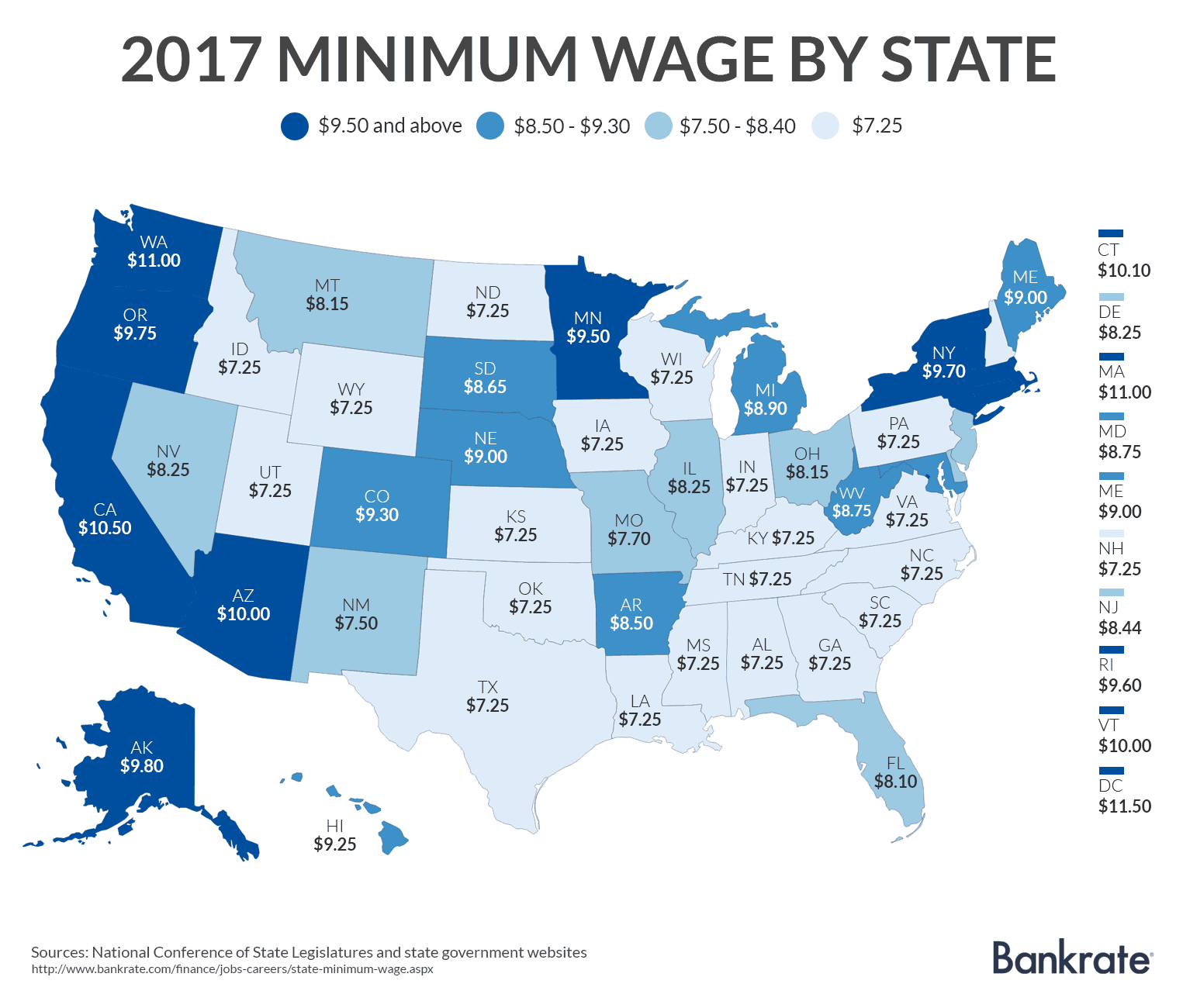
usmap-minimum-wages-2017This past November, there were increased minimum wage measures on the ballet in four states – Arizona, Colorado, Maine and Washington. They were approved by voters in every instance.

But are views about the minimum wage actually that universally positive?

A survey of ~1,500 U.S. consumers conducted by Cincinnati-based customer loyalty research firm Colloquy around the same time as the election reveals some contradictory data.

Currently, the federal minimum wage rate is set a $7.25 per hour. The Colloquy research asked respondents for their views in a world where the minimum wage would $15 per hour — a figure which is at the upper limit of where a number of cities and counties are now pegging their local minimum wage rates.

The survey asked consumers if they’d expect to receive better customer service and have a better overall customer experience if the minimum wage were raised to $15 per hour.

Nearly 60% of the respondents felt that they’d be justified in expecting to receive better service and a better overall experience if the minimum wage were raised to that level.  On the other hand, nearly 70% believed that they wouldn’t actually receive better service.

The results show pretty clearly that consumers don’t see a direct connection between workers receiving a substantially increased minimum wage and improvements in the quality of service those workers would provide to their consumers.

Men feel even less this way than women: More than 70% of men said they wouldn’t expect to receive better service, versus around 65% of women.

Younger consumers in the 25-34 age group, who could well be among the workers more likely to benefit from an increased minimum wage, are just as likely to expect little or no improvement in service quality. Nearly 70% responded as such to the Colloquy survey.

One concern some respondents had was the possibility that a dramatic rise in the minimum wage to $15 per hour could lead retailers to add more automation, resulting in an even less satisfying overall experience. (For men, it was ~44% who feel that way, while for women it was ~33%.)

Along those lines, we’re seeing that for some stores, labor-saving alternatives such as installing self-service checkout lanes have negative ramifications to such a degree that any labor savings are more than offset by incidences of merchandise “leaving the store” without having been paid for properly.

Significant numbers of consumers aren’t particularly thrilled with the “forced march” to self-serve checkout lines at some retail outlets, either.

Perhaps the most surprising finding of all in the Colloquy research was that only a minority of the survey respondents were actually in support of raising the minimum wage to $15 per hour. In stark contrast to the state ballot measures which were supported by clear majorities of voters, the survey found that just ~38% of the respondents were in favor.

The discrepancy is likely due to several factors. Most significantly, the November ballot measures were not stipulating such a dramatic monetary increase, but rather minimum wage rates that would increase to only $12 or $13 – and only by the year 2020 rather than immediately.

That, coupled with concerns about automation and little expectation of improved service quality, and it means that this issue isn’t quite as “black-and-white” as some might presume.

A Generational Shift within the American Workforce

bmI’ve blogged before about the cultural differences between older and younger Americans in the workforce. Some observers consider the differences to be of historic significance compared to previous eras, due to the confluence of various “macro” forces driving change at an extraordinary pace.

And somewhere along the way when few were looking, the millennial generation has now become the largest cohort in the American workforce.

And it isn’t even a close call: As of this year, millennials make up nearly 45% of all American workers, whereas baby boomer generation now comprises just over a quarter of the workforce.

According to a new report by management training and consulting firm RainmakerThinking titled The Great Generational Shift, there are actually seven groups of people currently in the workplace at this moment in time:

  • Pre-Baby Boomers (born before 1946): ~1% of the American workforce
  • Baby Boomers first wave (born 1946-1954): ~11%
  • Baby Boomers second wave (born 1955-1964): ~16%
  • GenXers (born 1965-1977): ~27%
  • Millennials first wave (born 1978-1989): ~27%
  • Millennials second wave (born 1990-2000): ~17%
  • Post-Millennials (born after 2000): ~1%

roowPersonally, I don’t know anyone born before 1946 who is still in the workforce, but there are undoubtedly a few of them — one out of every 100, to be precise.

But the older members of the Baby Boomer generation are fast cycling out of the workforce as well, with more than 10,000 of them turning 70 years old every day.

By the year 2020, the “first wave” Boomers are expected to be only around 6% of the workforce.  Meanwhile, Millennials are on track to represent more than 50% of the workforce by 2020.

Now, that makes some of us feel old!

The Great Generational Shift report can be downloaded here.

For physicians on the front lines, burnout is a real concern.

bdoIf you’re like many people, you may have begun to notice some telling changes in the “atmospherics” you encounter in your visits to the doctor’s office.

Perhaps the signs are just subtle, but things seem to be a little more stressed in the office – and a little less comforting for patients.

With the big changes happening in how healthcare services are delivered and how care providers are compensated, perhaps those changes are to be expected.

But a new survey of more than 500 physicians by InCrowd, a Boston-based market intelligence company focusing on the healthcare, pharmaceutical and life sciences fields, points to some unwelcome “collateral damage” that has to be concerning to everyone.

According to the InCrowd research results, three-fourths of the physicians surveyed do not feel that their healthcare facility or practice is doing enough to address the issue of physician burnout.

For the purposes of the research, burnout was defined as “decreased enthusiasm for work, depersonalization, emotional exhaustion, and a low sense of personal accomplishment.”

If three-quarters of the physicians think that too little attention is being paid to burnout issues, that may be one explanation for the changes in the “dynamics” many patients sense when they pay a visit to their doctor.

This doesn’t mean that the majority of physicians feel that they themselves have experienced burnout. But in two particular physician categories – emergency care and primary care – nearly 60% of the physicians surveyed reported that they had personally experienced burnout.

And most of the remaining respondents know other physicians who have experienced the same.

While burnout may be a more extreme condition, for many physicians the average day presents any number of challenges and frustrations. Nearly four in ten respondents reported that they “feel frustrated” by their work at least a few times weekly — or even every day.

dtThe two biggest contributors to this frustration? Time pressures, and working with electronic medical records.

Perhaps the most startling finding from the InCrowd survey is that ~58% of the physician respondents say that they’re either unsure or wouldn’t recommend a career in medicine to a family member or child.

To me, that finding says volumes. When a profession goes from being the object of aspiration to something to be avoided … we really do have a problem.

What’s been your experience at your doctor’s office on recent visits?  Do you sense a degree of tension or stress that’s more than before?  Please share your thoughts with other readers.

The Top Ten U.S. Cities for Stretching a Dollar

… They’re pretty nice in other ways, too.

Wausau, Wisconsin
Wausau, Wisconsin

A few months ago, my eldest daughter received her graduate degree in higher education academic counseling, and immediately thereafter started a new career position at a university located in a medium-sized city in the state of Wisconsin.

Of course, the main attraction was the job position itself and the potential it offers for professional growth.

But another important factor was the cost-of-living dynamics in an urban area where real estate and other costs are clearly more “friendly” to a career person just starting out.

Along those lines, the recent publication of CareerCast.com‘s newest “Ten Best Cities for Return on Salary” is revealing.

What it shows is that for young professionals just beginning in their careers – and likely saddled with student loans that are a significant chunk of change – the top cities for “stretching a dollar” aren’t particularly known for being the hippest places around.

By the same token, they aren’t the dregs, either.

Here’s CareerCast’s “Top 10” listing in order of the most budget-friendly cities:

  • #1 most budget-friendly: Wausau, WI
  • #2: Tucson, AZ
  • #3: Pittsburgh, PA
  • #4: Midland, TX
  • #5: Lincoln, NE
  • #6: Houston, TX
  • #7: Fort Worth, TX
  • #8: Durham, NC
  • #9: Columbus, OH
  • #10: Austin, TX

Scanning the roster, you might see a few surprises.

One shows up as #10 on the list; certainly no one is going to accuse Austin of being anything less than trendy.  Houston and Fort Worth (#6 and #7 on the list) are major metropolises.

Affordable, livable housing in Pittsburgh, Pennsylvania

And more people are falling in love with the charms of Pittsburgh, PA (#3 on the list) – especially when compared to its old, worn-out and unsafe urban counterpart on the other side of the state.

The Midwestern cities on the list might not be the end-all in trendiness, but one can’t complain about quality-of-life factors like friendly neighborhoods and lower crime rates in places like Lincoln, Columbus and Wausau.

And if nothing else, Midland is the city that played host to President George W. Bush in his formative years …

Overall, I think it can be said that these ten cities aren’t a bad set of choices for young working professionals. The fact that they also happen to be the best ones for stretching a dollar is just icing on the cake.