You probably suspected this already, but employee surveys continue to show that open-plan workplaces are a source of job dissatisfaction.
One of the most recent research studies surveyed ~4,000 adults who work in offices and found that employees dislike open office concepts for a host of reasons, including:
Lack of privacy
Interruption and/or distraction from fellow employees
Noise levels
Inescapable odors
Temperature control issues
In fact, feelings run so strongly against open offices that employees would prefer to give up the following perks as a tradeoff:
Vacation days
Year-end bonus
Office coffee machine
Access to a window or natural light
And for the cherry on top, a significant percentage of respondents claimed that an open office environment would be a deal-breaker when considering a new job — either inside their current company or going someplace else.
At a time when companies are having a difficult time finding qualified candidates to fill open positions, that factor is perhaps the most impactful one of all.
Against this backdrop of “passive-aggressive” attitudes about open-plan workspaces, many companies keep on merrily designing open-office environments or renovating existing spaces to conform to new open-plan design schemes.
Purportedly the reason for open office environments is to save money — but is that really the case? It’s true that some building and partition costs can be reduced, but how about the impact on worker productivity?
Actually, there’s another, perhaps unspoken reason why companies love open offices: they can monitor (read: spy on) their employees more easily. That’s something most people find quite distasteful — at least here in America where “individualism” continues to thrive as a bedrock cultural principle. And the plain truth is that people like having some control over their workspace. After all, it’s a place where they spend eight hours of every workday.
But even with these basic truisms at work, there are new developments that could be changing the whole notion of the office environment. It’s more than just conceivable that we’ll be seeing more spaces adapt to accommodate workers who move from environment to environment based on the needs of the moment.
As more of the “guts” of the office are housed electronically — and portably — the whole notion of a “home desk” may be becoming less and less relevant. Jay Osgerby, a partner in workspace design firm Barber & Osgerby puts it this way:
“The desk is dead. I don’t even know if the office building as we know it today will be in existence.”
I’m not at all sure that Osgerby’s prediction will come true any time soon. Who knows, his view might turn out to be as off-base as the open-office concept. But it is interesting to observe how the office environment is changing as the nature of business evolves.
What about your own office environment? What’s good and not-so-good about the concept? What sort of personal horror stories do you have — or conversely, do you have good tales to tell? Please share your observations with other readers here.
Google Maps admits its business listings are riddled with errors and outright fraudulent entries.
The news reports hit fast and furious this week when the media got wind of the millions upon millions of “faux” business listings on Google Maps, thanks to a new Wall Street Journal exposé.
It’s true that there are a ton of map listings displayed by Google on search engine results pages, but the latest estimates are that there are more than 11 million falsely listed businesses that pop up on Google searches on any given business day.
That number may seem eyebrow-raising, but it’s hardly “new news.” Recall the reports that date as far back as a half-decade — to wit:
In 2014, cyber-security expert Bryan Seely showed how easy it was to use the Internet’s open architecture to record telephone conversations and create fraudulent Google Maps listings and locations.
In 2017, Google released a report titled Pinning Down Abuse on Google Maps, wherein it was estimated that one in ten fake listings belonged to actual real-live businesses such as restaurants and motels, but that nefarious third-parties had claimed ownership of them. Why do this? So that the unscrupulous bad-actors could deceive the targeted businesses into paying search referral fees.
Google is owning up to its continuing challenges, this week issuing a statement as follows:
“We understand the concerns of those people and businesses impacted by local business scammers, and back in 2017 we announced the progress we’d made. There was still work to be done then, and there’s still work to be done now. We have an entire team dedicated to addressing these issues and taking constant action to remove profiles that violate our policies.”
But is “constant action” enough? Certain business trades are so riddled with fake listings, it’s probably best to steer clear of them altogether. Electricians, plumbers and other contractors are particularly sketchy categories, where roughly 40% of Google Maps listings are estimated to be fraudulent entries.
The Wall Street Journal‘s recent exposé, published on June 24th, reported on a search its researchers conducted for plumbers in New York City. Of the top 20 Google search results returned, only two actually exist where they’re reported to be located and accept customers at the addresses listed. That’s pretty awful performance even if you’re grading on a curve.
A measure of progress has been made; Google reports that in 2018 it removed some 3 million fake business listings. But that still leaves another 11 million of them out there, silently mocking …
Relying on Key Performance Indicators has become the norm in many business operations. And why not? Properly defined and managed, KPIs help businesses focus on the right priorities and chart progress towards their goals.
But even well-designed KPIs have their limitations. By their nature, they’re not greatly insightful (they’re indicators, after all). The problem is that very often, KPIs are used as if they are.
One of the attractions of focusing on KPIs is their simplicity. Managers love boiling things down to concise, action-oriented statements and phrases. We hear it all the time from senior leadership. “Give us the bottom-line finding,” they emphasize.
“Business by bullet-point,” if you will.
But here’s the thing: Because of their distilled simplicity, KPIs can lure many a businessperson into overestimating the insights that they’re able to provide.
KPIs do provide a jumping-off point, but the underlying “why” is often still conjecture or a hypothesis. It takes discipline to look for deeper insights and corroborating evidence to really understand what KPIs are saying to us.
Addressing this issue, Shiv Gupta, data analytics specialist par excellence and head of Quantum Sight, has noted:
“Anyone who has worked on developing KPIs knows that it is a game of balance and compromise based on business objectives. The need for actionable information battles with the desire for simple metrics.”
“We all have seen many “death by KPI” [situations] when organizations look at things the wrong way. When someone is lost while driving, [to] keep looking at the dashboard of the car won’t get the driver out of trouble. In a time like that, one must turn on a navigator. Different solutions call for different analytics, and popular KPIs – no matter how insightful they may have been – often do not lead to solutions.”
What have been your experiences in working with KPIs in your business? How have they helped … or not? Please share your thoughts and perspectives with other readers here.
Not all-smiles at the moment … Chinese leader Xi Jinping.
In China, it’s difficult to discern where private industry ends and the government begins. At some level, we’ve been aware of that conundrum for decades.
Still … opportunities for doing business in the world’s largest country have been a tempting siren call for American companies. And over the past 15+ years, conducting that business has seemed like the “right and proper” thing to do — what with China joining the G-8+5 economic powers along with incessant cheerleading by the U.S. Department of Commerce, abetted by proactive endeavors of other quasi-governmental groups promoting the interests of American commerce across the globe.
But it’s 2019 and circumstances have changed. It began with a change in political administrations in the United States several years ago, following which a great deal more credence has been given to the undercurrent of unease businesspeople have felt about the manner in which supposedly proprietary engineering and manufacturing technologies have suddenly popped up in China as if by magic, pulling the rug out from under American producers.
Nearly three years into the new presidential administration, we’re seeing evidence of this “new skepticism” begin to play out in concrete ways. One of the most eye-catching developments – and a stunning fall from grace – is Huawei Technologies Co., Ltd. (world headquarters: Shenzhen, China), one of the world’s largest makers of cellphones and high-end telecom equipment.
As recounted by NPR’s Weekend Edition reporter Emily Feng a few days ago, Huawei stands accused of some of the most blatant forms of technology-stealing. Recently, the Trump administration banned all American companies from using Huawei equipment in its 5G infrastructure and is planning to implement even more punitive measures that will effectively prevent U.S. companies from doing any business at all with Huawei.
Banning of Huawei equipment in U.S. 5G infrastructure isn’t directly related to the theft of intellectual property belonging to Huawei’s prospective U.S. suppliers. Rather, it’s a response to the perceived threat that the Chinese government will use Huawei equipment installed in U.S. 5G mobile networks to surreptitiously conduct espionage for military, political or economic purposes far into the future.
In other words, as one of the world’s largest telecom players, Huawei is perceived as a direct threat to non-Chinese interests not just on one front, but two: the demand side and the supply side. The demand-side threat is why the Trump administration has banned Huawei equipment in U.S. 5G infrastructure, and it has also publicly warned the U.K. government to implement a similar ban.
As for the supply side, the Weekend Edition report recounts the intellectual property theft experience of U.S.-based AKHAN Semiconductor when it started working with Huawei. AKHAN has developed and perfected an ingenious form of diamond-coated glass – a rugged engineered surface perfectly suited for smartphone screens.
Huawei expressed interest in purchasing the engineered glass for use in its own products. Nothing wrong with that … but Huawei used product samples provided by AKHAN under strict usage-and-return guidelines to reverse-engineer the technology, in direct contravention of those explicit conditions – and in violation of U.S. export control laws as well.
AKHAN discovered the deception because its product samples had been broken into pieces via laser cutting, and only a portion of them were returned to AKHAN upon demand.
When confronted about the matter, Huawei’s company officials in America admitted flat-out that the missing pieces had been sent to China. AKHAN enlisted the help of the FBI, and in the ensuing months was able to build a sufficient case that resulted in a raid on Huawei’s U.S. offices in San Diego.
The supply side and demand side threats are two fronts — but are related. One of the biggest reasons why Huawei kit has been selected, or is being considered, for deployment on 5G mobile networks worldwide is due to its low cost. The Chinese government, so the thinking goes, “seduces” telecom operators into buying the Huawei kit by undercutting all competitors, thereby gaining access to countless espionage opportunities. To maintain its financial footing Huawei must keep its costs as low as it can, and one way is to avoid R&D expenses by stealing intellectual property from would-be suppliers.
AKHAN is just the latest – if arguably the most dramatic – example of Huawei’s pattern of technology “dirty tricks” — others being a suit brought by Motorola against Huawei for stealing trade secrets (settled out of court), and T-Mobile’s suit for copying a phone-testing robot which resulted in Huawei paying millions of dollars in damages.
The particularly alarming – and noxious – part of the Huawei saga is that many of its employees in the United States (nearly all of them Chinese) weren’t so keen on participating in the capers, but found that their concerns and warnings went unheeded back home.
In other words – the directive was to get the technology and the trade secrets, come what may.
This kind of behavior is one borne from something that’s far bigger than a single company … it’s a directive that’s coming from “China, Inc.” Translation: The Chinese government.
The actions of the Trump administration regarding trade policy and protecting intellectual property can seem boorish, awkward and even clumsy at times. But in another sense, it’s a breath of fresh air after decades of the well-groomed, oh-so-proper “experts” who thought they were the smartest people in the room — but were being taken to the cleaners again and again.
What are your thoughts about “yesterday, today and the future” of trade, industrial espionage and technology transfer vis a vis China? Are we in a new era of tougher controls and tougher standards, or is this going to be only a momentary setback in China’s insatiable desire to become the world’s most important economy? Please share your thoughts and perspectives with other readers here.
Debris field from the Ethiopian Airlines plane crash (March 10, 2019).
It’s been exactly two months since the crash of the Ethiopian Airlines 737 Max 8 Boeing plane that killed all 157 passengers and crew on board. But as far as Boeing’s PR response is concerned, it might as well never ever happened.
Of course, sticking one’s corporate head in the sand doesn’t make problems go away — and in the case of Boeing, clearly the markets have been listening.
Since the crash, Boeing stock has lost more than $27 billion in market value — or nearly 15% — from its top value of $446 per share.
The problem is, the Ethiopian incident has laid bare stories of whistle blowers and ongoing maintenance issues regarding Boeing planes. But the company seems content to let these stories just hang out there, suspended in the air.
With no focused corporate response of any real coherence, it’s casting even greater doubt in the minds of the air traveling public about the quality and viability of the 737 planes — and Boeing aircraft in general.
Even if just 20% or 25% of the air traveling public ends up having bigger doubts, that would have (and is having) a big impact on the share price of Boeing stock.
And so the cycle of mistrust and reputational damage continues. What has Boeing actually done in the past few months to reverse the significant market value decline of the company? Whatever the company may or may not be undertaking isn’t having much of an impact on the “narrative” that’s taken shape about Boeing being a company that doesn’t “sweat the small stuff” with proper focus.
For an enterprise of the size and visibility of Boeing, being reactive isn’t a winning PR strategy. Waiting for the next shoe to drop before you develop and launch your response narrative doesn’t cut it, either.
Far from flying below radar, Boeing’s “non-response response” is actually saying something loud and clear. But in its case, “loud and clear” doesn’t seem to be ending up anyplace particularly good for the Boeing brand and the company’s
What are your thoughts about the way Boeing has handled the recent news about its mode 737 aircraft? What do you think could have done better? Please share your thoughts with other readers here.
Astonishingly tone-deaf and factually questionable: “China is going to eat our lunch? Come on, man … they can’t even figure out how to deal with the fact that they have this great division between the China Sea and the mountains … in the west. They can’t figure out how they’re going to deal with the corruption that exists within the system. I mean, you know, they’re not bad folks, folks. But guess what? They’re not competition for us.” (Former Vice President Joe Biden, May 1, 2019)
In recent months, we’ve been hearing a wide range of views about China’s economic and political aspirations and their potential implications for the United States.
Some of the opinions being expressed seem to be polar opposites — such as President Donald Trump’s pronouncements that the United States has been “ripped off” by China for decades. Contrast this with former Vice President Joe Biden’s dismissive contention that China represents no competition for the United States at all.
The column is titled Trump Is Waging (and Winning) a Peaceful World War III Against China. My curiosity aroused, I decided to get in touch with my brother, Nelson Nones, who has lived and worked in the Far East for the past 20+ years. Being an American “on the ground” in countries like China, Taiwan, South Korea, Thailand and Malaysia gives Nelson an interesting perspective from which to be a “reality check” on the views we’re hearing locally.
I sent Nelson a link to the Morris op-ed and asked for his reaction. Here is what he communicated back to me:
I think Dick Morris is correct to contend that the Chinese government’s long-term vision is bigger than just accumulating more wealth and power. In fact, I wrote about this topic in the book I co-authored with Janson Yap, when describing China’s “Belt and Road” initiatives as a geographic positioning threat to Singapore.
I wrote:
“As a land-based strategy, the SREB [Silk Road Economic Belt] promises greater long-term rewards for China than the MSR [Maritime Silk Road]; these would echo the impact of the completion of the first transcontinental railroad in 1869, which marked the beginning of the ascendancy of the U.S. to becoming one of the preeminent economic empires of all time.”
The context here is, if you look back through history, the world’s most dominant economic empires were either terrestrial or maritime — but not both — until the U.S. came along. As I further wrote in the book:
“After gaining control over both strategic land and maritime trade routes with the completion of the Panama Canal in 1913, America became the first land-based and maritime economic empire in history; its dominance has spanned over a century, from 1916 to the present. Uncoincidentally, the American economic empire began when the Panama Canal was completed, but the Panama Canal has arguably contributed far less to America’s GDP than the country’s investments in transcontinental rail and road transportation infrastructure.”
In short, I am absolutely sure China’s government aspires to overtake the U.S. as the world’s dominant terrestrial and maritime economic empire, and to hold that position for at least a century if not longer. But this would not be the first time in history that China has held such a position.
For the historical context, refer to: http://fortune.com/2014/10/05/most-powerful-economic-empires-of-all-time/. There you will see that the U.S. produced half the world’s economic output in circa 1950. China’s Song Dynasty was the world’s preeminent economic empire in circa 1200 AD, producing 25% to 30% of global output. Only the U.S. and the Roman Empire have ever matched or exceeded that marker.
I can tell you from my considerable experience on the ground in China that the strategic vision of its leaders is grounded in much more than just backward-looking grievance and necessity. Although the 19th Century Opium Wars (which were fought during the Qing Dynasty against the British Empire, and occurred during the period of the British Empire’s economic ascendancy) are often trotted out in China’s government-controlled English language dailies, the Chinese people I know have little or no knowledge of the Opium Wars or the colonial victimization China allegedly suffered a century and a half ago.
But they are acutely aware, and genuinely proud, of China’s emergence as a leading economic powerhouse; and this is how the Chinese government maintains its legitimacy.
China’s ambitions, in other words, have much more to do with reinstating its former glory (the Song Dynasty economic empire) than with righting wrongs (dominance by colonial powers), and are fundamental props for maintaining the Chinese Communist Party’s grip on power.
This view renders many of Dick Morris’ comments unnecessarily hyperbolic; for example “[China’s] goal is to reduce the rest of the world to colonial or dominion status, controlled politically, socially, intellectually, and economically by China. In turn, China is run by a handful of men in Beijing who need not pay the slightest attention to the views of those they govern or the nations they dominate.”
No, China’s goal is to become the world’s dominant economic empire but, just as the Americans before them, they don’t have to exert the same degree of control over the rest of the world as they do within their own territory to achieve this goal.
And no, they require constant support from the Chinese population to achieve this goal, even though they run an authoritarian state. Why else would they devote so many resources to the “Great Chinese Firewall” if there is no need to “pay the slightest attention to the views of those they govern”?
Yes, Trump’s trade war with China is important but his motive is to reverse the flow of jobs and capital out of the U.S. to China, which is not the same thing as launching an “economic World War III.” At a more practical and mundane level, it’s to fulfil a pile of campaign promises which Trump made when he was running for President, and to secure the loyalty of his base.
_______________________________
So there you have it: the perspectives of someone “on the scene” in the Far East — holding a view that is more nuanced than the hyperbole of the alarmists, but also clear-eyed and miles apart from the head-in-the-sand naiveté of other politicians like Joe Biden.
Let’s also hope for a more meaningful and reality-based discourse on the topic of China in the coming months and years.
This past week, I heard from a business colleague who heads up a firm that operates in the IT sector. It isn’t a large company, but its business is international in scope and its entire employee workforce would certainly be considered tech-savvy.
Nevertheless, the company suffered a serious security breach affecting its e-mail system … and it took nearly one week of investigation, diagnosis and repair to deal with the fallout. Ultimately, the system was secured with everything restored and running again, but it took much longer than expected.
What had happened was that an unknown attacker obtained the user ID and password for one of the company’s e-mail accounts, and used those credentials to log on to the mail system as the legitimate user. The attacker then changed the contact name on the account to a fake U.S. telephone number – we’ll call it “+1(4XX) 6XX-9XXX” – and launched a program from his/her/its host computer (hosted by Microsoft and located in in a different country than the affected user) which sent out thousands of e-mails having the subject “Missed call from +1(4XX) 6XX-9XXX” and an attachment that looked like a harmless audio file containing a voicemail message.
This type of phishing attack is well-known, and it would be dangerous to open the attachment (no one at the company attempted to do so). The company’s e-mail server eventually blocked the account because it exceeded the maximum outgoing e-mail limit, but strangely enough the administrator was never notified of this fact. The company only discovered the breach after the user called in to complain about receiving thousands of “failed delivery” messages. It took the better part of a full business day just to piece together what was going on, and why.
The attacker also installed a rule on the compromised account which moved all incoming email to an obscure folder. The rule was cleverly disguised, making it easy to overlook and hence more time-consuming to find and remove.
This friend advised that there are a number of “lessons learned” from his company’s experience, which should be considered for implementation by businesses of all sizes everywhere:
1.Implement security policies requiring strong passwords (big, long, hard-to-guess ones) and frequent password changes (once every 90 days or more frequently). In the case of this particular company, its password strength policy was up to snuff but it wasn’t enforcing rotation. That changed immediately after the breach.
2.Require multi-factor authentication (MFA). This is where a user doesn’t merely enter a password to log on, but also has to enter a one-time code sent via SMS or a smartphone app. It’s inconvenient, but regrettably it’s the world we live in today. In the case of this particular company, it hadn’t been using MFA. They are now.
3.Be vigilant in reminding users NEVER to click on links or file attachments embedded in received e-mails unless they absolutely trust the sender. Some larger companies have “drills” which broadcast fake phishing emails to their employees. Those who click are identified and sent to “dum-dum school” for remedial training.
Failing that, companies should adopt policies wherein any employee who receives anything via e-mail that looks like particularly clever or tempting phishing, to notify the company about it immediately for investigation.
4.Discourage users from logging on to their mail accounts from public locations using unencrypted WiFi. It’s easy to sniff WiFi signals and it’s even easier to read the data in unencrypted signals, which appear as plain text. Typically, if the WiFi connection requires a passphrase to be entered in order to connect, then it’s encrypted WiFi. If not … watch out.
5.Monitor the e-mail server at least once each day to discover any security breaches or threats, since those servers may not always notify administrators automatically. The sooner a problem is discovered, the quicker and easier it will be to contain and kill it.
6.Require users to archive messages in their Inbox and Sent Items folders regularly. The moment an attacker is able to access an account, he/she/it can easily retrieve and quickly download all the messages on the server, and those messages could contain confidential or sensitive data. Therefore, taking this action will move those messages to each user’s device and purge them from the central server.
I’m thankful that my friend was willing to share his experience and suggestions for how to avoid a similar breach happening at my own company. Based on the “lessons learned,” we performed an audit of our own procedures and made several adjustments to our protocols as a result – small changes with potentially large consequences. I suggest you do the same.
With the proliferation of mobile screens in both the business and personal environments, it was bound to have an impact on the way that people interact with e-communications.
And now we see the extent. Recently-released stats from e-mail software and analytics company Litmus in its 2019 State of Email report reveal that ~43% of all e-mails are now being opened on mobile devices.
That compares to ~39% being opened in webmail and just ~18% in desktop applications.
How this is playing out is pretty clear. People are riffling through e-mails on their mobile devices to determine what to keep and what to delete. They might come back to the saved e-mails on a different (larger) device, but the first cut is most often via mobile.
This sort of “triage” behavior is happening in the workplace as much as in personal communications. What it means is that the initial impression an e-mail leaves has to be super-effective like never before. The “from” line and the “subject” line have to work harder than ever to draw the attention of the viewer and avoid a quick consignment to the recycle bin.
Only slightly less important are the first one or two sentences of the e-mail content — particularly for those people who choose to have preview options activated.
It’s putting more emphasis than ever on “mere words” rather than photos, other images or eye-catching design. In an ironic twist, we’ve come full circle and are now back to where it all started with messages hundreds of years ago: words, words and words.
Another interesting consequence is the second look that some marketers are giving to direct mail, which — although clearly more costly than e-communications – does provide far better way to draw attention of a target audience through design and imagery instead of the quick trip to the trash bin.
The Litmus 2019 State of Email report can be downloaded here.
It happens all the time because it’s part of human nature.
In the business world as in any other realm, it can be frustrating when emails that need a reply languish in a state of suspended animation.
And it happens a lot. A workplace study conducted recently by Dr. Bahareh Sarrafzadeh of the Cheriton School of Computer Science at the University of Waterloo in Canada, in concert with several Microsoft co-researchers, has found that putting off responding to incoming emails that need a reply happens in more than a third of the cases.
Titled Characterizing and Predicting Email Deferral Behavior, the research was compiled from interviews with Microsoft employees involved in product development, product management, software development and administrative management. All participants in the research used the Microsoft Outlook platform on a daily basis.
Dubbing it “email triage,” the study defines the phenomenon as “the process of going through unhandled email and deciding what to do with it.”
Email deferral (as opposed to moving an email message to the trash folder), occurs because “people have insufficient time to take an immediate action, or they need to gather information before they can act on a message,” the study states.
Among the factors typically weighed during triage include these questions that people ask themselves:
Do I know the answer?
Does it require any task to be done?
What is the level of complexity involved?
Can I handle it independently?
So, the reasons for putting off a reply are perfectly reasonable ones. The problem comes after the fact, because delaying an immediate reply can sometimes turn into complete inaction.
The reasons for this are understandable as well — even if they are inconsiderate to the person who sent the original e-communique:
If other people are copied on the incoming email, the recipient may assume that someone else is handling the issues raised.
Emails that contain attachments – particularly larger documents – are often put off for scrutiny at a later time, thereby delaying a response.
Emails that don’t specify a deadline for receiving a response can easily get pushed to the bottom of the pile.
Thus, a delayed response often means procrastination — or simply “out of sight/out of mind” forgetfulness as other business tasks intervene.
The published research paper can be viewed in its entirety here. Bear in mind that the University of Waterloo research studied email triage behaviors in a business- and project-management environment. It’s even more dicey when we think of sales- and marketing-oriented communications. If more than one-third of business management emails aren’t getting timely attention, we can be pretty certain that the engagement with other e-communications is lower still.
But there’s a cost to all of this delayed action (or inaction). In the “business of business,” putting off providing a response contributes to a loss of project or organizational momentum. Sometimes all it takes is inaction on the part of one or two pivotal players to make an important project initiative grind to a complete halt.
That doesn’t work well for anyone.
Sitting on my desk now, I have no fewer than five projects that have limped along for the better part of two years, simply because at too many points along the way, email responses that should have taken days (or mere hours) to be received have taken weeks or even months instead. Recurring queries to see if the projects are still active or relevant are answered in the affirmative … but then the waiting game continues.
What about your experiences? Does email triage hurt your own personal productivity or that of your office? What have you done to get around the hurdles?
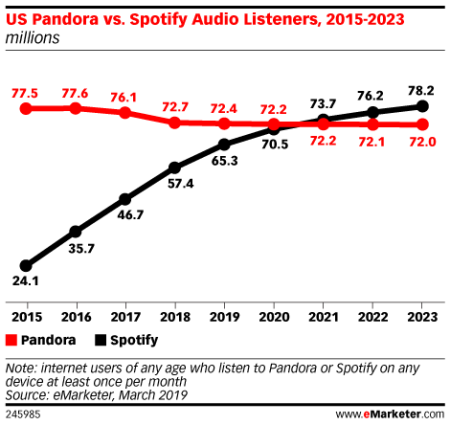
This past month, digital marketing research firm eMarketer issued its new forecast on music streaming activities in the United States. What it shows is that Pandora, which has dominated the market ever since the category was created in 2000, will likely fall to the #2 position, overtaken by Spotify.
Based on a calculation of internet users of any age who listen to music streaming on any device at least once per month, Pandora jas occupied a narrow band of between 72 million and 77 million listeners since 2015.
During that same period, Spotify users have increased dramatically, from ~24 million to ~65 million Americans. And eMarketer projects that Spotify will overtake Pandora by 2021. The chart below shows the trajectory:
Actually, the trend had been building since even before 2015. In 2012, Pandora had ~67 million users compared to Spotify’s paltry ~5 million. But Pandora has been shedding users in recent years. As the chart above illustrates, by 2023 Pandora will have lost nearly 10% of its users since 2014.
To be sure, Pandora still holds a robust ~35% of audio listener penetration in the United States as of this year. But Spotify is nipping at its heels with a ~32% share. Amazon Music (~18%) and Apple Music (~16%) are further back, but with still-significant chunks of the marketing. (It should be noted that there is overlap, as some listeners may engage with more than one music streaming service during the month.)
What has caused the change in fortunes? Christ Bendtsen, an eMarketer forecasting analyst, says this:
“Pandora lost users last year because of tough competition from other services attracting people to switch. Apple Music has been successful in converting its iPhone user base. Amazon Music has grown with smart speaker adoption, and Spotify’s partnerships have expanded its presence across all devices.”
Speaking in particular about Spotify’s rapid surge, Bendtsen notes:
“Spotify’s initial growth was driven by its unique combination of music discovery, playlists and on-demand features. But now that all music streaming services [possess] the same features, Spotify’s future success will rely on partnerships with other companies. It has teamed up with Samsung, Amazon, Google and Hulu to be on all devices and provide bundled offerings. We expect more partnerships to come, leveraging multiple brands, devices and services to drive user growth.”
As for Apple Music, there’s a reason it lags behind other music streaming services in the rankings. That service operates on a subscription-only model and doesn’t offer any form of advertiser-supported free usage. Forecasters expect it to remain in the #4 position with its “premium-only” business model.
More information about the eMarketer music streaming forecast is available here.
What are your own music streaming listening habits? Have they changed in recent years, and if so, how and why? Please share your thoughts with other readers.

 You probably suspected this already, but employee surveys continue to show that open-plan workplaces are a source of job dissatisfaction.








 Nones Notes