Frequent flyer programs: No longer going the distance.

What took so long?

frequent flyer programsDelta and United Airlines have announced what they hope will be an industry-pacesetting change in the way frequent flyer programs are administered by the world’s biggest airlines.

The two air passenger carriers are shifting away from awarding points based on flight distance, and instead will award points based on the actual airfare paid by the traveler.

The change in procedures will become effective in 2015 (in January for Delta and in March for United).

In retrospect, one wonders why it took so long for the big airlines to make this move.

After all, the very nature of loyalty programs is to reward a company’s best and most profitable customers.

Business travelers who book a flight a few days ahead – not to mention people who prefer to travel first class – are far more valuable to an airline than someone who books the “Cheapy Charlie” web-only fare months in advance.

Besides, prominent low-cost air carriers like JetBlue, Southwest and Virgin have been using revenue-based methods of calculating their frequent-flier points for a good while now.

As for which types of travelers will come out winners vs. losers in the frequent flyer program changes, it’s exactly who you’d expect:

  • Big Winners:  Business passengers traveling internationally and on refundable-fare domestic flights + first-class passengers.
  • Big Losers:  Leisure fliers in coach class + business flyers who travel on cheap fares.
  • In-Betweeners:  Business passengers who travel using a mix of business and economy fares.

The recent announcements by Delta and United leave only American Airlines as the last big U.S.-based global carrier that still maintains the traditional distance-based calculation for earning miles.

I wonder how much longer they’ll hold out?

Only a matter of months, I’m guessing.

What are your opinions about the changing policies?  Are there particular frequent flyer programs you love?  … Or love to hate?  Feel free to share your thoughts with other readers.

The hybrid car sizzle is fast becoming the hybrid car fizzle.

Well, that sure didn’t last long.

Hybrid autos:  Already riding off into the sunset?
Hybrid autos: Already riding off into the sunset?

News reports this week are stating that the market share of hybrid vehicles is now on the decline.

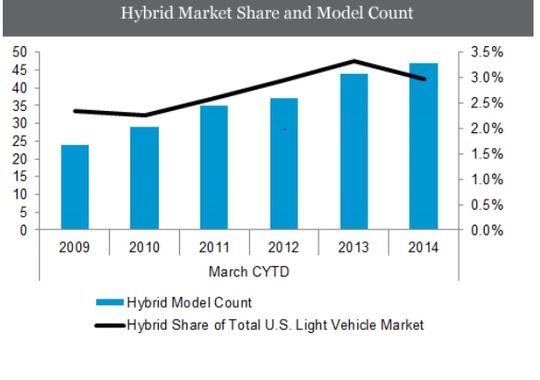
That is correct:  As of 1st Quarter 2014, hybrids only make up around 3% of the total car and light truck market in America.

Rather than an increase, that represents a pretty significant drop from nearly a 3.5% share of market just one year ago.

Here are the trend stats in graphic detail, courtesy of automotive statistics and intelligence firm IHS/Polk:

Hybrid Vehicle Stat ChartActually, the number of new hybrid car models being offered is still on the increase — now there are 47 different choices compared to around 25 in 2009, with Toyota’s five Prius models collected representing ~40% of the total hybrid market.  (The Prius share is down from ~55% in 2011, by the way.)

New model offerings or not … it’s pretty clear that the public’s interest in hybrid vehicles isn’t going up commensurately.  And the litany of reasons is all-too-familiar:

  • High car sticker price
  • Costly and complex batteries
  • Improved gas mileage and energy efficiency of conventional vehicles

Looking at the year-over-year trends, I think it’s doubtful that hybrid vehicles will ever achieve the high hopes the EPA and other federal officials have had for their adoption.

How embarrassing for them.

Instead, it seems more likely that the market will gravitate from the internal combustion engine straight to all-electric vehicles.  None of this “automotive hermaphrodite” stuff in between.

The more interesting question is this:  When will that shift occur?

To that one … not many people seem to have a definitive answer.

Patent Trolls: Is a Day of Reckoning Finally at Hand?

When the banks get involved … watch out.

patent holding companiesIn recent weeks, I’ve begun reading more news items about legislation being passed to limit the damage so-called “patent trolls” can do to unsuspecting businesses.

These are the bottom-feeding firms which exist only to collect royalty payments and fines from companies due to supposed infringement on patents the firms have purchased.

Many of the victims of these schemes are smaller businesses with fewer than $10 million in annual revenues.

The reasons they’re targeted are pretty obvious:  smaller companies are less able to defend themselves against such charges, and it’s often easier and less expensive to settle out of court — and avoid all the hassles that accompany litigation as well.

But the cumulative impact is pretty enormous.  Patent risk specialist RPX Corporation estimates that it’s nearly $13 billion in legal fees, settlements or judgments.

The University of California’s Hastings College of the Law has also been studying the numbers.  It finds that patent infringement claims against the portfolio companies of venture-capital firms cost an average of $100,000 each to settle.

Predictably, only a smidgeon of the monies collected by these patent-holding companies actually makes it back to the inventors.  The rest goes right in the deep pockets of the people trolling the business world for easy money.

And then …

come down hardThen some patent trolls made the mistake of sending demand notifications to banking firms, related to things like the software used in ATMs.

Oops.  Bad move.

Once the banking institutions got sensitized to the issue,  a lot of legislators did, too.  Funny how that works.

The results are now beginning to show.  In recent months, more states have enacted legislation curbing the ability of patent trolls to make “bad faith” assertions of patent claims.

What is a questionable patent claim?  It’s a claim that isn’t based on any clear evidence of infringement — but instead on vague accusations.

(In other words, these questionable claims represent the vast majority of the notifications delivered to the unsuspecting victims.)

States jumping on the “put the trolls on trial” bandwagon range from New York, Vermont to Oklahoma and Minnesota.  Twelve so far, and the tally will surely increase in the coming months.

One of the interesting twists is the fact that most of new legislation also allows targeted companies to strike back in state courts with their own litigation … against the patent-holding companies themselves.

I guess turnabout is fair play.

Another twist …

Here’s an interesting case where financial institutions – an industry not particularly loved in many quarters – is helping to rout a particularly pernicious and avaricious bunch of businesspeople.

This sort of activity, based not only on any sense of commercial fair play but instead on playing mercantile “gotcha” games, is reprehensible and gives “the business of business” a bad name.

Too, it has to have had a chilling effect on the activities of smaller businesses in particular – especially those who rely on established technologies to create and commercialize new products.

Constantly looking over one’s shoulder to make sure no one is coming after you for something as innocuous as using an e-mail tool on a FAX machine is hardly the kind of environment that fosters innovation.

So let the cheering begin … and no stopping until these trolls are banished back under the bridge.

Companies Continue to Increase their Investment in Social Media

InvestmentSocial media may have its share of nettlesome issues … but that doesn’t mean companies aren’t spending more effort and energy on these platforms.

To illustrate, a new online survey of ~1,060 business owners, senior management personnel and social strategists that was conducted in April 2014 by Social Media Marketing University finds that a clear majority of companies are investing more time and/or dollar resources on social media as compared to a year ago.

And three-fourths feel that this investment is worth it.

Here are some of the SMMU survey’s key findings:

  • ~74% of companies are devoting more time to social media.
  • ~54% are spending more dollars on social media.
  • Nearly 70% are managing four or more social profiles.

The most significant expenditures for social media programs fall into these four categories:

  • Compensation of in-house staff: ~37% of all social media program expenditures
  • Social media advertising: ~18% of program expenditures
  • Compensation of external staff: ~10% of expenditures
  • Content development: ~7% of expenditures

According to the SMMU survey, smaller businesses – those with fewer than 50 employees – face the biggest challenge in terms of the increased time and cost commitments to social media.

As SMMU Principal John Souza puts it:

“Because many small businesses don’t have the skill-set or the staff to properly manage social media, they are outsourcing their social, or spending an excessive amount of time on tasks as they learn social by trial-and-error.”

Not surprisingly, having some focused training on the “how-to” of social media can make a pretty big difference in the effectiveness of the people charged with planning and carrying out a company’s social media program.

The question is how many businesses actually feel the need for such training, seeing as how some of the recent press about social platforms hasn’t been all that positive.

The answer, based on my own personal interaction with numerous small and medium-sized firms is … not very many of them.

Ipsos Reid Poll: Female Execs Gauge Their Advances

women managers and executivesAn interesting Ipsos Reid poll of female executives conducted late last year sheds light on what the perceived career holdbacks are for women in the workforce these days.

The results of the online survey, which queried ~500 American women working in managerial or executive roles, suggest that women continue to face obstacles in advancing their careers to upper-level management and executive positions … although the disparities are less today – and hopefully continuing the trend toward parity.

An example of one perception which continues to show a big divide between women and men is this:  While ~37% the survey respondents feel that physical appearance and personal image are factors in career progression for men, nearly all (~90%) believe that they are for women.

On the other hand, the perceived differences are less stark when it comes to opportunities for career progression based on the gender of a female employee’s immediate superior.  When asked how gender affects the chances for women to obtain a managerial position, here’s how the respondents answered:

If the superior is a woman …

  • 26% better chance for advancement
  • 30% worse chance for advancement
  • 44% no difference

If the superior is a man …

  • 26% better chance for advancement
  • 25% worse chance for advancement
  • 49% no difference

… Which translates into trust levels that aren’t so very different at all:

  • ~22% would trust a man more for help with career advancement
  • ~18% would trust a woman more for help with career advancement
  • ~60% express no difference in trust levels

Positive Work Attributes

The Ipsos/Reid survey also found that nearly two-thirds of the respondents consider women to be better leaders than men, primarily for these five reasons:

  • Women are better communicators
  • They are more organized
  • They are more empathetic
  • They have a better understanding of the needs of their employees
  • They are more open to changing their approach

For the record, two attributes that respondents do not attribute to women over men are:

  • Women have better instincts than men
  • They are more invested in an organization’s success compared to men.

With a confident self-image and backed by positive work habits, what do these respondents see as the biggest continuing challenges to their career growth?  Here’s what the Ipsos Reid survey found:

  • The requirement for women to work harder and put in longer hours to prove themselves: ~77%
  • Managing work and family balance: ~61%
  • External factors (economic climate/job loss): ~56%
  • Being welcomed into an established senior management team:  ~48%
  • Dealing with outdated perceptions of women in managerial and executive roles: ~48%
  • Lack of female mentors: ~47%

Moreover, ~78% of respondents discern a “noticeable” different in salaries between men and women.

Asked what a company might “fear” about promoting women to senior managerial and executive posts, the respondents cited several probable factors:  the fear that an executive might want to start and maintain a family … and the fear of too many absences from work due to family obligations.

Bottom line, the Ipsos Reid survey reveals some continuing obstacles for women in the executive-level work force.  But there’s positive news, too.  Additional survey findings can be found here.

If you have additional observations or perspectives on this topic, please share them with other readers here.

LinkedIn: The “Other” Social Network Makes its Move

linkedinWe may be reading quite a few news reports these days about Facebook and Twitter facing a plateau in usage … but LinkedIn’s fortunes continue to be on the upswing (financial losses notwithstanding).

In late April, the social network reported that it now has more than 300 million active members throughout the world, which is up more than 35% since the beginning of the year.

Too, the gender gap in membership is narrowing, albeit more slowly:  Today, ~44% of LinkedIn members are women, up from ~39% in 2009.

Even more impressive for a network that has the lofty goal of “creating economic opportunity for every one of the 3.3 billion people in the global workforce,” is the fact that two-thirds of LinkedIn’s active members are located outside the United States.

This is underscored by the top three countries represented  in LinkedIn’s membership, which are the U.S. (#1), India (#2) and Brazil (#3).

worldwide membersLinkedIn’s latest international push is into China, where it seeks to add more than 140 million Chinese professionals to its membership rolls.

Mobile Movement

The increased use of “smart” mobile units has affected the ways users interact with LinkedIn as well; mobile traffic is expected to overtake desktop access later this year.

[In fact, that’s already happened in markets like the United Kingdom, Singapore and Sweden.]

Here are a few “factoids” that illustrate how significant mobile has become for LinkedIn operating as the world’s mobile employment bazaar:

  • Average number of LinkedIn profiles viewed daily via mobile devices:  ~15 million
  • Average number of job position openings viewed daily via mobile:  ~1.5 million
  • Average number of job applications submitted daily via mobile:  ~44,000

Despite these healthy usage figures, a continuing challenge for LinkedIn is the degree to which it has been able to “monetize” its membership.  Among U.S. members, the average revenue-per-user is hovering around $11.30.

That’s much better than the ~$3.75 average revenue-per-user amount for members overseas.  But it’s still well below the revenue-per-member figures being charted by Facebook, which helps explain LinkedIn’s continuing revenue and profit challenges.

Still, when you consider that LinkedIn is becoming the de facto “Help Wanted” public square for the professional world, it’s hard to criticize its business model as the “go-to resource” for human resources professionals involved in personnel recruitment.

And now that the platform has a an active membership north of 300 million people, it’s hard seeing how that dynamic is going to change going forward; LinkedIn really is in the catbird seat when it comes to recruitment.

Speaking personally, I’m glad LinkedIn is resisting going the route of Facebook and Twitter in their evolving “all advertising, all the time” revenue models.  If LinkedIn can continue to derive a large chunk of its revenue stream from recruitment solutions instead of relying on display advertising or sponsored posts that are too often distracting or irritating, so much the better for us.

Less is less? What’s happening with customer loyalty programs.

CustomersWhen it comes to customer loyalty programs, here’s a sobering statistic: Only about 15% of consumers redeem loyalty rewards.

This finding comes from a report by Forrester Research, based on results from an in-depth survey it conducted last fall of 50 member companies of Loyalty360, a major loyalty marketing association.

What Forrester found is that fewer than half of the surveyed companies’ customers are enrolled in their loyalty programs. And of those customers, only about 35% of them are actually redeeming their loyalty awards.

Hence the 15% “effective” participation rate.

At first blush, the paltry participation makes one wonder what all the fuss is about when it comes to loyalty marketing.  But more than half of the companies surveyed by Forrester reported that they view their loyalty program as a strategic priority, not merely a marketing afterthought..

Clearly, there seems to be a bit of a “disconnect” between those lofty aims and the not-so-airborne reality. The question is how companies can encourage greater participation in their loyalty programs, thereby using them to improve consumer brand loyalty in addition to retaining customers over time.

Forrester offered several recommendations in its report:

1. Use advances in analytics to act on customer insights, rather than just relying on the purchase transactional history of loyalty program members. 

2. Balance the “reward mix” with personalized offers that present rewards program customers with unique experiences that are different from simply offering “more of the same.” (In many cases, offering discounts on more of the same merchandise a customer has already purchased won’t qualify as anything particularly special.) 

3. Break out from the traditional e-mail/web portal/call center communication vehicles to embrace more social media channels featuring two-way interaction. (Surprisingly, only about half of Forrester’s survey respondents reported that social media is an important part of their loyalty programs’ methods of communication.)

Speaking personally, I’m not particularly surprised at the relatively low engagement levels reported in this study. Many companies and brands have reached out to me over the years with offers to join loyalty programs, using various incentives – often purchase discounts or sign-on points as an incentive for joining.

apathyFor me, it’s a matter of “time” and “mindshare” as to which of these programs qualify for my participation. If a brand isn’t that important to me in terms of how I live my daily life, it – and its loyalty program – isn’t ever going to be big on my radar screen.

I suspect there are quite a few other consumers like me. But if you have different take, leave a comment and share your perspective with other readers.


Boomers and Millennials: Destined always to be different … or on the same trajectory?

NeuroWhen it comes to advertising, it turns out that the Baby Boomer generation sees things quite a bit differently than the Millennial generation.

In fact, based on neuromarketing research conducted last year by Nielsen NeuroFocus, generational differences account for some interesting neurological contrasts between Boomer and Millennial brains.

The research results also point to how companies might find it wise to tweak the design and presentation of their advertising based on the age levels of their audiences.

Consider these distinct differences found by Nielsen NeuroFocus in its research:

Brain Function: The Boomer Brain likes repetition. Boomers also tend to believe that information that is “familiar” is true. On the other hand, the Millennial brain is more stimulated by dynamic elements such as rich media, animation, and lighting that cuts through their “perception threshold.”

Distractions: Boomer brains are more easily distracted, whereas Millennials are adept at dealing with “bleeding-over” communications such as those found in dynamic banner ads and in contemporary magazine layouts.

Attention Spans: Boomers have a broader attention span and are open to processing more information, whereas Millennials prefer at-the-ready, multi-sensory communications. (And “impatience” is their middle name.)

Colors: In advertising, contrasts gain the attention of Boomers in advertising. With Millennials, it’s more the intensity of the color palette overall rather than contrasts within it that does the trick.

Humor: The Boomer generation prefers lighthearted, clever humor in advertising messages – positive and not mean-spirited. Boomers also like relatable characters that aren’t much younger than themselves. Millennials tend to prefer offbeat, sarcastic or slapstick humor – basically, the kind of humor that many Boomers find offputting or even offensive. Making special effects and other visual hi-jinks part of the shtick attracts the attention and interest of Millennials, too.

It turns out, there’s some real science behind these findings, too. Nielsen NeuroFocus reports that when people are in their mid-50s, distraction suppression mechanisms tend to weaken. Even as early as the mid-40s there are dramatic declines in neurotransmitter levels – particularly serotonin and dopamine.

How does that manifest itself in situations where we see “Boomers behaving badly?” Dopamine declines can lead to thrill-seeking behaviors to compensate. And a drop in serotonin levels can lead to the feeling that “something is missing” – thereby leading to classic midlife crisis behaviors affecting a person’s professional life and personal relationships.

… And as we know, that often doesn’t end up particularly well.

But here’s the more central takeaway from the research: Boomer-Millennial differences don’t turn out to be so much a function of differing world views; it’s more a function of the aging process itself.

So look for the Millennials to begin responding more like Boomers in the coming years.

What do B-to-B buyers really want in a website?

Hint:  Forget social media.

btob web surfingAs online communications continues to evolve, B-to-B marketers have more options than ever to interface with prospects and suspects.

In fact, it’s pretty easy to get distracted by the latest “shiny objects” in marketing … and we sometimes see a lack of focus — and “prioritization all over the map” — as a result.

With company websites serving as the “hub” of marketing communications, it’s only natural to try to align the information provided to prospective customers with what they’re seeking.

A recent survey of several hundred B-to-B companies conducted by DH Communications and KoMarketing Associates sought to determine what business-to-business buyers are doing once they land on a vendor website. Which elements on the site increase a vendor’s credibility … and at the other end of the scale, what causes visitors to leave?

The results of this survey confirm what many have suspected. In a nutshell:

  • Buyers come to a vendor’s website with one thought foremost in mind: to qualify the company in order to begin the process of moving towards a purchase.

And this:

  • Buyers believe the vendor qualification process should be simple and straightforward, and they don’t have time to deal with it any other way.

This mission manifests itself in the following typical behaviors when landing on a website:

  1. The first place visitors go is straight to the products and services pages.
  2. They want to see technical information … and published pricing information, too.
  3. They look for testimonials or case examples to see how others have solved their problems using the products or services.
  4. If they don’t already know the company, they check out the “about us” pages to gauge its credibility as a supplier – but only after they’ve determined that its products or services are aligned with their needs.
  5. They have little interest in social media – and hence mostly ignore those elements.

Website Must-Haves

The survey asked respondents which informational content elements are “must-haves” for a B-to-B website. It found that these elements are of greatest importance:

  • Contact information: ~68% consider a “must-have”
  • Pricing information: ~43%
  • Technical information: ~38%
  • Case studies/white papers/articles: ~38%
  • Shipping information: ~37%

The first item on the list above may seem like a given. But it turns out that many websites don’t offer visitors the most preferred methods of contact: an e-mail address (~81% want this option) and/or a phone number (~57% want this).

What about “Contact Us” forms? It turns out that quite a few visitors don’t like them at all. It makes sense to offer them … but also to provide other contact options. Otherwise, some visitors will leave the site without any further engagement — or so they claim.

Axing the Distractions

Because most visitors come to vendor websites to gather information and research products in preparation for making a buying decision, things that detract from those objectives are viewed as an interruption and a distraction.

Some elements are so irritating, they’ll compel visitors to leave the website altogether.  What are those? Video and/or audio clips that play automatically, animated web designs and other visual hijinks, plus pop-up messages are the worst offenders.

Basically, anything that interrupts the visitor’s train of thought reduces the vendor’s credibility and helps the push the company further down the buyer’s list of prioritized vendors.

What’s Missing from Vendor Websites

The survey also asked respondents to cite what they feel is lacking on many vendor sites. Their responses to this question could be considered an indictment of B-to-B websites the world over!

  • Case studies/white papers/articles: ~54% say these are most lacking on websites
  • Pricing information: ~50%
  • Product reviews: ~42%
  • Technical support details: ~42%
  • Testimonials/client list: ~31%

Social Media?

To consider the social media attitudes revealed in this survey of B-to-B buyers is to wonder what all the fuss has been about over the past five years. In citing how impactful social media is on the buying process … it’s clear that the impact isn’t great at all:

  • Social media isn’t a factor: ~37%
  • Neutral feelings about social media: ~26%
  • Social media is a factor, but not a “deal-breaker”: ~30%
  • Social media is a big factor: ~6%

The takeaway?  If B-to-B web content managers spent less time on social media and more time on pricing information, case study testimonials and robust technical data, it would be a more valuable use of their energies.

I’ve summarized some of the key survey results above – but there are more research findings available in a 32-page report summary just published by KoMarketing Associates. You can download it here.

The Day-to-Day Things Bothering B-to-B Marketers

Marketing Executives Group (LinkedIn)The discussion boards on LinkedIn are often good places to capture the pulse of what’s happening “on the ground” in the marketing field.

A case in point is a discussion started recently on the Marketing Executives Group on LinkedIn by Carson Honeycutt, an account executive at marketing research firm Mintel.

Honeycutt’s question was, “What are the biggest day-to-day issues for marketing execs?”

He was interested in getting input to help him speak to needs and offer solutions when interfacing with his customers and prospects – even if those solutions meant referring them to other vendors.

According to Honeycutt, he often hears responses like, “Too busy to talk. I’m swamped and we have no budget anyway.”

His query generated some interesting feedback. Comments ranged from the succinct (“sounds like you’re getting the brush-off”) to ones that were more helpful and useful.

The OfficeOne response I liked particularly well came from Brent Parker David, a marketing strategist at CRE8EGY. His listing of the day-to-day issues for marketing execs were to-the-point:

  • Too many meetings;
  • Lack of experienced creative thinking;
  • Personal and political agendas overshadowing the mission and the marketing objectives;
  • Too many “experts” who have never truly accomplished anything — but are very comfortable telling others what to do or how to behave.

I think most of us involved the marketing field for any length of time will be nodding knowingly at the above points …

Another response — more nuanced — came from Matt Smith, a marketing strategist in the consumer packaged goods  field. Here’s what he contributed:

“When Marketing doesn’t provide deep insights and a strategy to leverage them, price discounting takes over. This gives Sales the lead, as they are the executors. Growing sales, no matter how it’s done, is taken as progress. Sales is the hero, even though margins [may] have eroded.

“The byproduct of this is increasing their trade spend budgets — and by extension, their political clout. Conversely, Marketing loses clout as they don’t have an answer that drives sales AND margins. In the zero-sum budget game, the increased trade spend comes out of the advertising/promotion/innovation budget.”

Smith went on to add that “marketing is only stifled by bean-counters if they don’t know their customers and [can’t] devise a creative strategy to get them to buy more at higher margins.”

What are your own thoughts about the biggest day-to-day challenges facing marketing execs? Please share your thoughts with other readers here.