Online Marketplaces: The Brightest Stars in the e-Commerce Galaxy?

online commerceGiven a choice between buying a branded product from Amazon and a similarly priced one from an e-commerce store on the brand’s own website, which purchase option do most people choose?

In most cases, people opt for Amazon.

And why wouldn’t they? Online marketplaces like Amazon devote the vast bulk of their energies to removing the obstacles to purchasing products and improving the overall buyer experience.

The e-commerce stores on most company or brand websites don’t get nearly the same degree of laser-focused attention.

So it comes as little surprise that as online e-commerce continues to evolve, marketplaces like Amazon, eBay and Grainger are outpacing general e-commerce websites in terms of their growth and popularity.

Let’s face it, compared to most standard e-commerce sites, e-marketplace sites do a superior job dealing with the four major customer drivers:  selection, value, convenience and user confidence.

It shows in the growth statistics. Looking back over the past decade, Amazon’s yearly growth has averaged around 32%.  Compare those stats to standard sites … and there isn’t much of a comparison.

If anything, the future looks even brighter for marketplaces. With the increased adoption of mobile devices for online shopping, dedicated mobile apps from marketplaces like eBay and Amazon are making buying by phone easier and more convenient than ever.

Their mobile apps iron out the “payment kinks and concerns” that have bothered some mobile purchasers. These apps solve the potential security problem of having to input payment or address/shipping information into the phone when the purchase is made.

The rise of online marketplaces isn’t limited to just Amazon and eBay, either. Numerous other robust e-commerce marketplaces in both the B-to-C and B-to-B realm are thriving, too – not just in the United States but in the developing world also.

The global aspect is quite important, actually. Marketplace e-commerce may represent only about one-third of total online sales in the U.S. … but in China, such marketplaces are capturing closer to 80% of the online business.

It helps that these marketplaces offer many PayPal-like payment options. This solves the problems of payment when fewer people overseas use credit cards for purchases. (In China, less than 5% of online customers pay via credit card.)

These developments don’t presage the end of “conventional” e-commerce sites, of course. But they do suggest that companies should seriously consider online marketplaces as a prime channel for getting their products into the hands of end-users.

After all, it’s only natural that customers are going to take the “path of least resistance” – making the buying process as effortless as possible.

Online marketplaces have that game down to a science. No one does it better.

Fast Fade: Unpaid brand posts on Facebook are getting rarer by the day.

Lower ReachIt was just a matter of time.

Once Facebook ramped up its advertising program in order to monetize its platform and mollify its investors, unpaid posts by companies and brands were sure to be the collateral damage.

Sure enough, the recent monthly stats show that the “organic reach” of unpaid content published on company and brand pages on Facebook has been cut in half from where it was just a short time ago.

To illustrate, look at these stark figures gathered in an analysis by Ogilvy of 100+ country-level brand pages measuring the average reach of unpaid posts:

  • October 2013: 12.2%
  • November 2013: 11.6%
  • December 2013: 8.8%
  • January 2014: 7.7%
  • February 2014: 6.2%

What these stats show is that within the span of less than six months, the average reach of unpaid brand posts dropped by nearly 50%

To go even further, an anonymous source familiar with Facebook’s long-term strategy is claiming that its new algorithm could ultimately reduce the reach of organic posts to 2% or less.

Actually, the reason for the squeeze is more than just Facebook’s desire to increase advertising revenue.

Here’s a dynamic that’s also significant:  A Pew Research study conducted in mid-2013 found that the typical adult American Facebook user has around 340 friends.

That average is up nearly 50% from approximately 230 friends in 2010.

Of course, more friends mean more status updates eligible for feeds … and Facebook’s not going to display them all to everyone — even if it wanted to.

Also, Facebook users “like” an average of 40 company, brand, group or celebrity pages each, according to a 2013 analysis done by Socialbakers, a social media analytics firm.  That translates into an average of ~1,440 updates every month.

Compare those figures to five years ago, when the average number of page “likes” was fewer than five … yielding fewer than 25 monthly updates on average.

Clearly, there’s no way Facebook is going to to be able to display all of these updates to followers.  So … the content is squeezed some more.

The final nail in the coffin is the rise in “promoted” posts – the ones that brands pay dollars to promote. It’s only natural that Facebook is going to give those posts priority treatment.

Thus, the hat-trick combination of more friends, more likes and more promoted posts is what’s causing “organic” brand posts to go the way of the dodo bird.

In retrospect, it was only a matter of time before a major social platform like Facebook would seek to monetize its program in a big way.

In some respects, it’s amazing that the free ride lasted as long as it actually did …

The Continuing Ambivalence about Twitter

Or is it more a division of the house?

ambivalenceOf all of the social media platforms that have taken root, the one that seems to cause the most divided opinions among the marketing and communication specialists I know is Twitter.

… And these are the folks who have been diligent about “following the script” for crafting tweets that are interesting, informative, and get noticed.

Each social platform has its strong and weak attributes, of course … but I hear far more mixed views about Twitter than I do about Pinterest, Facebook and LinkedIn.

This is amply illustrated in a recent discussion that was started on LinkedIn’s B2B Marketing Group, of which I’m a member.

Joel Harrison, Editor-in-Chief of B2BMarketing.net, posed this question to the group’s members:

“If Twitter ceased to exist tomorrow, would we all be better off?”

This rather provocative query elicited a range of reactions pro and con – which was to be expected.

However, I was a little surprised that the comments were weighted roughly two-thirds negative about Twitter versus positive.

Remember, this is a discussion group made up of marketing professionals — people you’d expect to be keen on pretty much any established social platform that has an extensive following for marketing purposes.

… Which, even if you discount the ~30% of accounts that “fake, faux and farcical” – still makes Twitter qualify as one of the leading social media platforms.

But consider these comments about Twitter posted by members of the B2B Marketing Group on LinkedIn:

“16 characters solve this dilemma: ‘Don’t take part.’”

 “I once read a tweet that said, ‘This is the generation that had nothing to say, and said it.’ Sums it up pretty well.”

 “My target audiences … have not mentioned that they prefer to communicate on that channel, so until that happens, there isn’t much going on.”

 “I like the old BBC mission: ‘Entertain, inform and educate.’ If you don’t do any of that, I ain’t following.”

 “Useful as an additional channel for customer service and sharing experiences – if the customer wants it.”

 “It depends on the industry and the target audience.”

 “As a marketer, it’s useful.  On a personal level, it annoys the hell out of me.”

These statements don’t sound like a ringing endorsement of the platform, do they?

Of course, they were posted on a business-to-business discussion board, so presumably people were commenting based on their B-to-B perspective; consumer marketing opinions are likely somewhat different.

What are your opinions about Twitter? Based on your own experience, how important and how effective has Twitter been to your marketing efforts?  Is it a critical component … or is it just one more ornament on the MarComm tree? Please share your comments for the benefit of other readers.

Social Branding: Reality-Check Time

social brandingWith all of the attention marketers have been paying to social media, it’s always helpful to look and re-look at information that gives us clues as to how customers are actually interfacing with brands in the social sphere.

Statistics published in a just-released report titled Digital Brand Interactions Survey, based on research conducted by web content management company Kentico Software, gives us a reality check on just how [non-]essential social media actually is in the greater branding picture.

The Kentico research queried approximately 300 American consumers age 18 or older via an online survey administered in February 2014.  Let’s start with the most basic finding:  the degree to which consumers “like” or “follow” brands on social networks such as Twitter, Facebook and Instagram:

  • No brands followed on social media:  ~40%
  • 1 to 10 brands followed:  ~39%
  • 11 to 20 brands followed:  ~7%
  • 21 to 30 brands followed:  ~6%

Considering how many different brands the typical consumer encounters in his or her daily life (dozens? … hundreds?), following ten or fewer brands on social media represents only a very small proportion of them.

Yet that’s exactly where four in five consumers are when it comes to social branding.

So … how do companies get into that rarefied group of brands that are, in fact, followed by consumers?  Here’s what the Kentico survey discovered:

  • Already interested in the brand and wanted to stay informed:  ~40%
  • Followed on social media to receive special offers:  ~39%
  • Followed because of a recommendation from a friend or family member:  ~12%
  • Didn’t really know the brand before, but wanted to learn more about it:  ~8%

These results suggest that the notion that social branding is an easy way to attract new customers may be flawed.  Instead, social branding is better-suited to deepening brand engagement with existing customers.

Money talks as well (discounts or other special offers) – and be sure to offer them often.

kentico logoIn another piece of evidence that points to social branding’s relatively weak ability to drive incremental sales … Kentico found that ~72% of its survey respondents “never” or “hardly ever” purchase a product after hearing about it on a social network.

An equal percentage of respondents have “never” or “hardly ever” had brand encounters online that altered their already-existing perception of those brands.

So it would seem that much of the “heat” generated by social branding may be adding up to very little “light.”

On the other hand, there is also some good news for brands in the social realm:  The incidence of people “unliking” or “unfollowing” brands is quite low:  Only about 5% of the survey respondents reported such actions.

When that does happen, it’s often because a brand has been publishing too many social posts – or the content of the posts themselves is uninteresting.

The biggest takeaway notion from the Kentico research is to remind us to maintain a degree of skepticism about the impact of social branding – and to understand that in most cases, social media activities are going to remain the “ornaments” on the marketing tree rather than be the “tree” itself.

In fact, that’s probably the case even more now — as consumers become bombarded with ever-more marketing messages from ever-more brands with every passing day.

The [dis]connect between content “quality” and online advertising.

Jack Marshall
Digiday’s Jack Marshall

I really appreciate the work of Jack Marshall, a reporter at marketing e-zine Digiday, who is helping to expose and explain the “brave new world” of online display advertising and how it has evolved into something that’s rife with problems.

ad exchangesConsider a recent column of Marshall’s titled “Is this the worst site on the Internet?”

In it, he notes that for “legitimate” online publishers that rely on advertising as their revenue model, that model is becoming a more daunting proposition with each passing day.

And a big reason is the emergence of other websites that are “gaming” the online system – not to mention the ad tech middlemen that are their willing accomplices.

Essentially, what’s happening is that ad dollars are being siphoned away from websites that provide professionally produced content and are going to sites that are explicitly constructed to serve up as many ad impressions as possible.

These sites contain little or no original content.

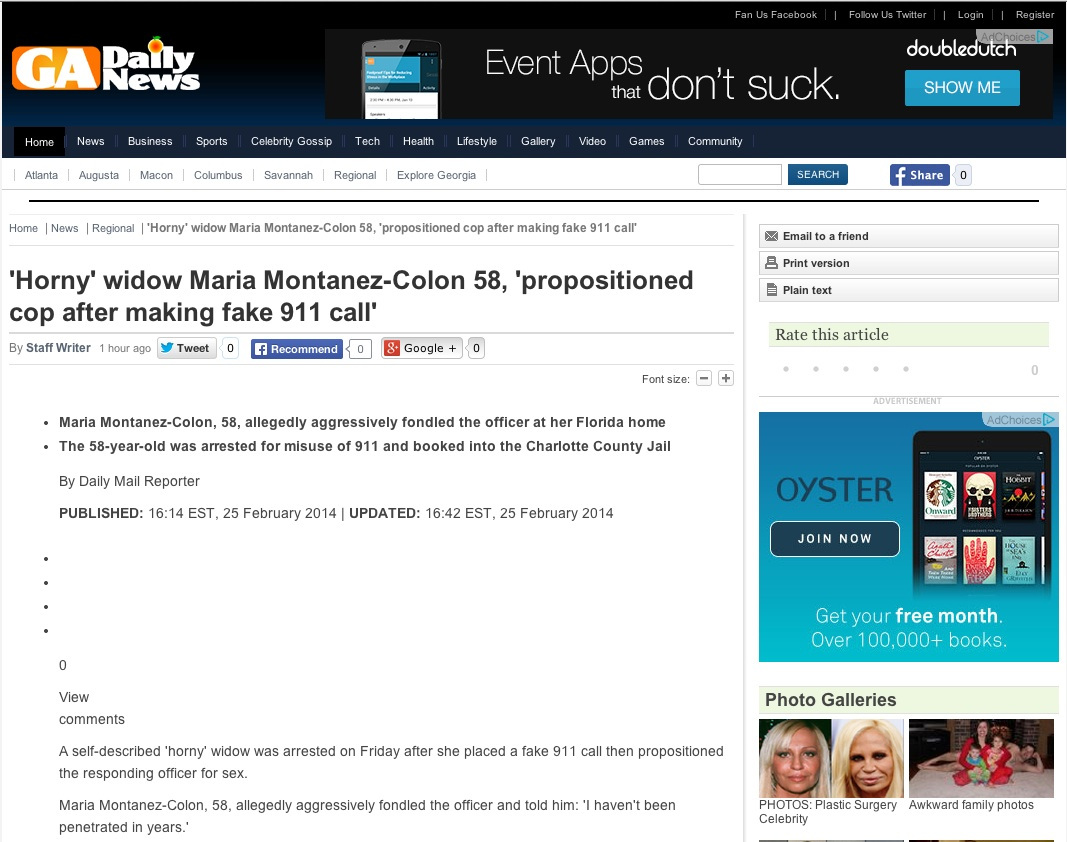
Marshall’s “Exhibit A” is Georgia Daily News, a website which purports to cover “news, traffic, sports, politics, entertainment, gossip and local events in Atlanta.”

As Marshall contends, “What it actually features is content ‘curated’ from elsewhere on the web, and some it has simply stolen from other major news sites” such as the Daily Mail.

Sizable chunks of the website’s content have nothing to do with Atlanta.

GADailyNews home pageConsidering the type of general news site it purports to be, GADailyNews.com doesn’t attract very much traffic at all.  And why would it? — since it contains precious little information of value or interest to anyone who is actually “seeking news about Atlanta.”

But it sure does generate a lot of ad impressions.  According to Marshall, each article page on the site features seven display ad units – all of which refresh every 20 seconds or so.

In the two-minute span of time it took him to read an article about Katy Perry and John Mayer (content copied from an Australian news site), Marshall was served more than 40 ad impressions.

Marshall continues:

“One page has served me nearly 500 ads in just 20 minutes – and I couldn’t stop refreshing them even if I wanted to.”

[And these ads aren’t for B-list advertisers, either.  They’re for brands like American Airlines, Hilton Hotels, Charles Schwaab and others.]

What’s happening here, of course, is that websites and ad tech middlemen have figured out that the algorithms of even the “quality” ad vendors like Google, AdRoll, and Bizo can be gamed pretty easily to serve ads on a low-quality site like Georgia Daily News, which is owned by a single-person entity called Integrated News Media Corporation.

It’s hardly the type of media vehicle that big-brand advertisers would normally wish to use for advertising.  But thanks to the vagaries and complexity of the ad exchange landscape, they are.

For every Georgia Daily News site, there are hundreds of others like it that cobble together seemingly valuable content with a passably convincing set of audience characteristics.

Put it together, and it adds up to problems on two levels.

First, advertisers are paying for impressions that are near-worthless.

Second, since there are finite ad dollars available, legitimate online publishers are losing out on those funds, which are far more important to their well-being than they are for sites that don’t engage in any true journalism at all.

As Jack Marshall concludes:

“Thanks to fraudulent traffic, dubious sites and middlemen with low quality standards, life is only getting harder for those publishers with expensive content teams to support.”

At Times Square, it’s “location-location-location” when it comes to advertising.

The building at 1 Times Square in New York City is nearly 100% vacant.

One Times Square Building (2010).

But if you’re the owner of the building, why should you even care?

That’s because the building takes in a reported near-$25 million per year in advertising revenues – thanks to the digital signage on the building being rented to top brands like Anheuser-Busch, Dunkin’ Donuts and Sony (among others).

Media, Sports & Entertainment Marketing Officer Blaise D’Sylva of Anheuser-Busch keeps it pithy:

“There’s a statement we make in being there – and we think the placement we’ve got is outstanding.”

Of course, there’s more to it than simply “making a statement.”  According to the Times Square Alliance, each year more than 100 million pedestrians pass through Times Square.

Moreover, foot traffic volume is running ~90% higher compared to 1996.

I’m quite sure these traffic volumes are central to any go/no-go advertising decisions being made by the big brands.

Where night is day:  Times Square advertising.
Where the night is as bright as day: Times Square advertising.

The Wall Street Journal reports that billboard signage in Times Square is actually the priciest outdoor advertising in the world.

Considering its location at the intersection of “high traffic” and “high trend,” marketers think it’s an investment worth making — and the rates they’re willing to pay proves the point.

e-Invoicing: Losing Luster … or Wave of the Future?

e-Invoice ServicesWhat’s happening with e-invoicing support services for small businesses these days?

Minneapolis, MN-based financial services industry market research firm Barlow Research Associates, Inc. reported in January 2014 that two of the three large banking institutions that had been offering e-invoicing services have now retired those programs.

Indeed, you won’t find mention of them anywhere on their small business online banking websites.

Donna Arce, Barlow Research Associates
Donna Arce

According to Donna Arce, a Barlow Research client executive, both Chase and Wells Fargo dropped e-invoicing in 2013, making Bank of America the only one of the nation’s 14 top banks still offering this service.  (Existing e-invoicing customers at Chase remain grandfathered in … for now.)

Reportedly, the reason behind the elimination of e-invoicing services was low usage.

But was this usage a function of low demand … or was it actually the result of limited market availability?

After all, Arce reports that overall invoice volumes are notable.  For the typical small business enterprise, approximately 75 paper invoices and 10 electronic invoices are generated in any given month.

In the middle market segment, the volume of invoices is quite a bit higher:  Those companies average just over 1,250 paper invoices and more than 250 electronic invoices in the average month.

For answers to the question about inherent e-invoicing demand, we can look to PayPal, one of several non-bank providers of e-invoicing services.

PayPalAccording to Chris Morse, a PayPal spokesperson, “millions of users” have accessed company’s online invoicing services – particularly since 2011 when the product was redesigned with more robust functionality and features.

For an analyst’s column she wrote on the topic, Barlow Research’s Donna Arce reported on remarks made by René Lacerte, founder and CEO of invoice management firm Bill.com, on the elements that are essential for making sure that e-invoicing is a viable solution for business owners.

Quoting Lacerte:

  • “Working in an entirely online environment is not realistic for many businesses, [which] need a receivables solution that will track and manage both paper-based and electronic invoices and payments in one system.
  • “Integration with accounting software is key to businesses adopting any financial management tool, including e-invoicing.  Without integration, businesses must re-key data from one system to another, which is both time-consuming and can be fraught with errors. 
  • “Issuing the invoicing and accepting payment are just part of the overall receivables process … The ability to collaborate with customers via a portal where invoices can be referenced, documents shared and notes exchanged, dramatically reduces the time businesses spend managing these inquiries.”

The PayPal approach is quite flexible in terms of the payment options for the recipient of the invoice.  Choices include its own PayPal bill payment option, along with credit and debit card payments as alternatives.

Contrast this with Bank of America, which requires the recipient to log on to a payment center, agree to terms, and then upload account information to make a payment – debit and credit cards not accepted.

Contrasting PayPal and the approach of the commercial banks, is it any wonder that the one is experiencing growth … while the others have seen low usage?

Of course, there’s also the issue of fees charged for e-invoicing services.  PayPal’s fee structure is different than how the commercial banks have charged for services, in that a portion of PayPal’s fee is based on a percentage of the transaction value (currently around 3%).  Depending on each company’s individual characteristics, that pricing model may or may not be the most lucrative for users.

Bottom-line, it’s clear that e-invoicing isn’t a dying service.  But how flexibly it’s presented – and the degree to which it can actually reduce inherently labor-intensive in-house administrative activities – spells the difference between its success or failure as a business service.

In other words … the difference between PayPal and the giant commercial banks.

Bitcoin currency: You’ve got a long way to go, baby.

bitcoin

Whether it’s defaulting to preparing the same half-dozen dinner recipes, always taking the same travel route, or preferring traditional hyms and liturgy at religious services, humans tend to be creatures of habit.

Of course, there will always be the minority who revel in being the first to try out novel communications technologies … adopt the newest fashions … or take advantage of the latest investment schemes.

But most people would prefer to hold back and let someone else take the plunge first.

That’s precisely where things stand at the moment with the Bitcoin alternative currency.  The “virtual currency” has been around long enough so that it’s now getting coverage in the “popular” press … and there are even a few folks who have begun using it as an alternative to established currencies.

Indeed, for the past year now, a few national retailers and chain foodservice establishments have been accepting payments in Bitcoin currency.

But a just-released survey that queried consumer attitudes about the new-fangled currency – referred to as a “crypto-currency” by some – underscores how steep a climb the Bitcoin has before it can ever be considered a viable alternative to the Dollar or other established currencies.

TheStreet, a digital financial media company, commissioned the survey which was conducted in January 2014 by GfK Custom Research North America’s OMNITEL unit  A total of 1,005 telephone surveys were conducted with Americans age 18 or older.

Let’s start out with the most basic finding from the survey:  Three out of four respondents aren’t even familiar with the Bitcoin term.

So right off the bat, that’s a major hurdle.  The Bitcoin may have been the subject of numerous press stories and broadcast reports, but the news hasn’t seeped into the larger market consciousness to any great extent.

NoNext … even after the concept of the Bitcoin was described to them, the survey respondents remained distinctly chilly to the idea:

  • Nearly 80% would “never consider” using an alternative form of currency like the Bitcoin.
  • ~80% would rather own gold than Bitcoin currency.

Did the survey uncover different attitudes based on the age of the respondents?  Yes – to a degree:

  • Just under one-third of young respondents (age 18 to 24) would consider using an alternative form of currency like the Bitcoin … versus only about one in ten seniors (over age 65).
  • ~15% of the young respondents would prefer to own Bitcoin over gold … versus only ~4% of seniors.
  • ~57% of young respondents feel that Bitcoin currency helps the global economy … while just ~14% of senior feel the same way.

The main takeaway from the GfK/OMNITEL research?  Bitcoin proponents are going to have to keep plugging away for a good long time before positive public perceptions of an alternative currency take hold — including needing to focus on the most basic educational elements.

Considering the level of financial literacy out there … good luck with that effort.

If any readers have ever used Bitcoin as a currency and would care to comment on their experience pro or con, please share your thoughts here.

It had to happen: Google Glass begets facial recognition apps.

Google Glass wearerWell, that didn’t take long:  Now that Google Glass devices have started to be worn by more than just the first few early adopters, a new facial recognition app has promptly been developed.

It’s an app that enables users to snap a photo of someone, and then search the Internet for more information about the image – essentially, to identify the person by name.

Of course, Google has always maintained that such activities are an inappropriate use of Google Glass devices.  But that hasn’t stopped an outside app developer from doing just that.

The app is called NameTag, and it was introduced in late 2013 by a developer group known as FacialNetwork.  In December, the developer uploaded a video showing how NameTag works.  You can view it on YouTube here — and note that it’s quite controversial with more “dislikes” than “likes” from voters; how often does that happen?

Basically, the Google Glass wearer snaps a picture and the app runs the photo through a database containing ~2.5 million facial images.  If a match is found, it returns that finding along with the name and profile associated with the facial match (e.g., occupation, personal interests and relationship status).

According to the developers, NameTag can detect an image match even from behind obstructions like glasses and a hat.

What does FacialNetwork see as the benefit of its new NameTag app?  The developer touts the potential for dating and relationship-building.  On its website, the following scenario is presented:

“Jane has lots of different social media profiles and loves to meet new people.  By using NameTag, she can link all her social networks to her face and share her information, and meet new people in an instant.”

Personal privacy concernsRight. 

… And I’m sure “Jane” doesn’t worry one bit about the “creepiness” factor of someone learning her name and her personal information before she’s even aware of it …

As if pre-anticipating all of the hackles, NameTag quickly goes on to explain that people can choose whether to have their name and profile information displayed to others.

As entrepreneur and NameTag’s co-creator Kevin Tussy notes, “It’s not about invading anyone’s privacy; it’s about connecting people that [sic] want to be connected … We will even allow users to have one profile that is seen during business hours, and another that is only seen in social situations.”

If all of this sounds like it’ll be a tad more difficult to carry out in real life than it sounds like in theory – that you’re not fully comfortable “assuming” an app like this will actually offer the proper degree of safeguarding – I’m sure you’re not alone in your concerns.

In fact, some people aren’t waiting around to see what “might” happen, but are moving now to take preemptive action.  Certain congresspeople are in on the action.  And consumer advocacy group Public Citizen notes that Google Glass users in certain states could potentially face criminal prosecution in addition to civil penalties for recording people without their knowledge or consent.

Up to now, no one has faced such legal action – but that could be because the technology remains so new that few people are actually using Google Glass devices at this point.

The question is this:  Are people giving their “implicit consent” to be recorded just by talking with someone who’s wearing the device?  (The devices are fairly distinctive looking, after all.)

The answer may lie in whether the person even knows what Google Glass devices are.  One person speaking to another automatically means they know they’re being recorded seems to assume too much – at least at this relatively early stage in the product adoption cycle.

Things remain murky at this point because we’re still in an emerging phase in the application of the technology.  But one thing that seems clear is that we haven’t yet seen the beginning of what promises to be an airing of “dueling rights” in this area of the law.

For those who may already be using Google Glass (I’m not one, by the way), here’s your chance to share your perspectives with other readers here.

HubSpot’s Marketing Predictions: Hits and Misses

soothsayingOne of the things I like about SaaS inbound marketing firm HubSpot is the steady stream articles and white papers the company publishes on varied facets of marketing and communications. 

They’re often quite meaty and beneficial as informational resources.

Moreover, HubSpot isn’t afraid to go out on a limb and render a pretty strong “point of view” about various factors and trends in the fast-evolving marketing world.

The risk is that some of those perspectives can end up being “off” – or looking even a bit silly – in retrospect. 

But more often than not, HubSpot’s trendspotting is on the money.

Marketing Prediction Hits & Misses (HubSpot)Here’s a case in point:  HubSpot’s team of analysts made a number of marketing predictions for the year 2013.  Recently, it revisited those predictions to judge whether they’d turned out to be on the mark or not.

These are HubSpot’s 2013 marketing predictions that it feels were on target: 

  • Content and social will matter even more for search engine optimization.
  • Stop-and-start campaigns will fade, and real-time will be ‘in.’
  • E-mail will live on.
  • Inbound marketing will spread enterprise-wide.

At the same time, four other marketing predictions for 2013 didn’t pan out so well, as underscored by HubSpot’s own cheeky editorial commentary about them:

  • Mobile or bust … “Not so hot.”
  • Marketing becomes accountable for revenue generation … “Meh.”
  • ‘Big data’ becomes real for businesses … “Nope.”
  • Print is dead … “Not even close.”

HubSpot’s post-mortem discussion points on these “misses” are interesting.  Quoting from its report:

  • Mobile or bust:  “Customers pay attention to multiple screens … and smart marketers capture attention by adding value wherever a consumer pays attention  … we need to be prepared, not by targeting just [mobile] but by embracing them all according to our specific customers and data.”
  • Marketing becomes accountable for revenue generation:  “The biggest challenge … has been proving ROI.       Even more frustrating … has been the lack of sales and marketing alignment in many companies.  Tracking can also get tricky, thanks to trying to reach fragmented digital audiences against so many channels … As much as lots of us really want this prediction to be a hit, it’s still largely aspirational.”
  • ‘Big data’ becomes real:  “Big data remains mainly a buzzword to many companies and markets — and continues to be more of a prediction than a reality …”
  • Print is dead:  “Saying ‘print is dead’ has lost pretty much all of its roots in reality … nor will it die in the next few years.”

Ever intrepid, HubSpot isn’t shying aware from new forecasts for 2014.  Looking forward, what do its analysts predict for this year?

  • Podcasting will continue to grow substantially.
  • Marketing departments will become more like engineering departments.
  • Social listening tools will gain context and get smarter.
  • The economy will become highly collaborative.
  • Marketers will become more holistic and less channel-focused.

And one more HubSpot prediction that’s a particular favorite of mine:

We’ll check back again a year from now to see how well HubSpot’s prognosticators fared this time around.