Will consumer spending bring holiday cheer to businesses in 2016?

hdsThe holiday season isn’t yet upon us, and already there are a plethora of prognostications being made as to how holiday sales will stack up compared to prior years.

These predictions come courtesy of numerous forecasters including the National Retail Foundation, Deloitte, Kantar Media, eMarketer, the International Council of Shopping Centers, Market Track and others.

So what’s in store? On balance, forecasters predict that holiday sales in the United States will post an increase of approximately 3.5%.  That’s higher than the 10-year rolling average of 2.5% but down a tick from last year’s 3.7% increase.

Still, at more than $655 billion in total sales, holiday spending continues to be the biggest single driver of the U.S. consumer market.

Hardly surprising, e-commerce sales are expected to continue their double-digit growth over last year’s holiday season, with various predictions ranging from 14% to 17% growth in this sector. Not only are consumers attracted by the convenience of online shopping, many of them believe they can find products at the cheapest price via online sources rather than taking a trip to the shopping mall.

Another factor that drives at least some people to shop on their online devices is their aversion to the crush of holiday shopping at the stores. A McKinsey study has found that nearly one-third of U.S. consumers basically hate Black Friday (the day after Thanksgiving), and make it a point to stay as far away from it as possible.

But there’s one drawback for businesses about online holiday shopper dynamics, however:  Those consumers tend to be less brand loyal than is typical. RJ Metrics calculates that the typical e-commerce business acquires nearly 25% of its new customers during just the months of November and December.  Tempering that healthy statistic is the lifetime value of those consumers, which RJ Metric has determined is about 13% lower than the lifetime value of customers acquired at other times of the year.

You might be wondering what amount of money the typical U.S. consumer will spend on his or her holiday shopping this year. Wait for it:  The 2015 per capita amount is expected to be $935.

That figure may seem quite rich … but it’s actually a little bit lower than 2015’s average spend-per-person, which at $953 happens to have been the all-time high ever recorded.

Does the new $935 forecast signify a reversal of a trend … or is it just a pause in an otherwise ever-increasing amount of money that consumers are willing to plunk down as part of their celebration of the holiday season?

Check back in about a year and we should have an answer.

Downsizing hits America’s most prestigious business media properties.

bwsjThis past week, the business media world was buzzing about the inadvertent release of information concerning pending layoffs at Barron’s magazine, thanks to editor-in-chief Ed Finn mistakenly hitting “reply all” on a message intended for just one person.

But the more interesting news is what’s happening right now with two of America’s most important national print publishing properties: Barron’s and The Wall Street Journal.

Up until now, it was thought that a select handful of America’s largest and most pervasive publications with national reach and reputation would be the ones least susceptible to problems befalling the industry regarding declining advertising revenues and changing news consumption habits.

At or near the top of the list of those rarefied properties were these two publications for sure.

But now we know a different reality — or at least a more complicated one. WSJ editor-in-chief Gerard Baker announced last week that the publication is seeking a “substantial number” of employee buyouts to limit the extent of involuntary layoffs that will need to happen otherwise.

The WSJ buyout offer been extended to all news employees worldwide – managerial and non-managerial – and includes a lucrative voluntary severance benefit that’s 1.5 times larger than the company’s standard buyout package.

WSJ employees will need to make up their minds quickly, as the buyout offer is good only until the end of October.

wsjbAs for Barron’s, its situation became public only after the Ed Finn memo was received in the New York City newsroom of The Wall Street Journal in error.  The Finn memo, which had been intended for Dow Jones Media Group publisher Almar Latour, speculates on how The Wall Street Journal’s announcement might affect an upcoming round of layoffs at Barron’s.

That bit was “new news” to pretty much everyone.

Aside from the “drama” of news scoops happening because of unintentional actions, the bigger question is this: What do these layoffs and buyouts portend?  Is it the end of the adjustments – or just the beginning?

Clues to that answer come in Gerard Baker’s memo, where he reveals that The Wall Street Journal has “begun an extensive review of operations as part of a broader transformation program.”

Let’s see what kind of “silver bullet” business strategy they end up devising – and whether it will have its intended effect.

The ad blocking phenomenon: It’s all about human nature.

noadThe rapid rise in consumer adoption of ad blocking software is threatening the traditional advertising model for publishers. For some, it seems like a topsy-turvy world where none of the old assumptions or the old rules apply.

But author and MarComm über-thought leader Gord Hotchkiss reminds us that the consumer behaviors we are witnesses are as old as the hills.

In a recent MediaPost column titled “Why Our Brains Are Blocking Ads,” Hotchkiss points out that the environment for online ads is vastly different from the environment where traditional advertising flourished for decades – primarily in magazines, newspapers and television.

Gord Hotchkiss
Gord Hotchkiss

He notes that in the past, the majority of people’s interaction with advertising was done while our brains were in “idling” mode – meaning that they had no specific task at hand. Instead, people were looking for something to capture their attention within a TV program, a newspaper or magazine article.

Hotchkiss contends that in such an environment, the brain is in an “accepting” state and thus is more open to advertising messages:

“We were looking for something interesting, we were primed to be in a positive frame of mind, and our brains could easily handle the contextual switches required to consider an ad and its message.”

Contrast this to the delivery of most digital advertising in today’s world, which is happening when people are in more of a “foraging” mode – involved in a task to find information and answers with our attention focused on that task.

In such an environment, advertising isn’t only a distraction; often, it’s a source of frustration. As Hotchkiss notes:

“The reason we’re blocking [digital] ads is that in the context those ads are being delivered, irrelevant ads are – quite literally – painful. Even relevant ads have a very high threshold to get over.”

Hotchkiss concludes that the rapid rise of ad blocking adoption isn’t about the technology per se.  It has to do with the hardwiring of our brains.  New technologies haven’t caused fundamental changes in human behavior – they’ve simply enabled new behaviors that weren’t an option before.

adbAs is becoming increasingly obvious, the implications for the advertising business are huge:  Ad blocking software is projected to lower digital ad revenues by more than $40 billion in 2016 alone, according to estimates by digital data research firm eMarketer.

Looking back on it, actually it seems like it was all so inevitable.

The “Millennial Effect” – and how it’s affecting the Boomer Generation.

bm

In the world of marketing communications, it seems that confluence is in the air. This point was underscored recently by Eric Trow, a MediaPost columnist who is also vice present of strategic services at Pittsburgh, PA-based marketing communications firm Gatesman+Dave.

Trow’s main point is this:  Despite the big differences that marketers have traditionally noted between members of the Boomer Generation and their younger Millennial counterparts, today the two groups are becoming more similar than they are different.

In particular, Boomers are beginning to act more like Millennials.

Trow identifies a set of fundamental trending characteristics that underscore his belief:

  • Boomers increasingly want instant gratification – and related to that, they want convenience as well.
  • Boomers are embracing technology more every day, including being nearly as dependent on mobile devices as their younger counterparts.
  • Boomers connect online – with adults over the age of 65 now driving social media growth more than any other generation at the moment.
  • Boomers want control – and to that end, they do their research as well.
  • Boomers want to live healthier – with levels of interest in natural, healthy and environmentally responsible products rivaling those of younger age groups.
  • Boomers are more questioning of traditional authority – and not just because of the 2016 U.S. presidential election race, either.

Putting it all together, Trow concludes that he and many other Boomers could, in practice, be classified more accurately as “middle-aged Millennials.”

Speaking as someone who falls inside the Boomer generation age range, I concede many of Trow’s points.

But how about you?  Do they ring true to you as well?

Ad fraud: It’s worse than you think.

It isn’t so much the size of the problem, but rather its implications.

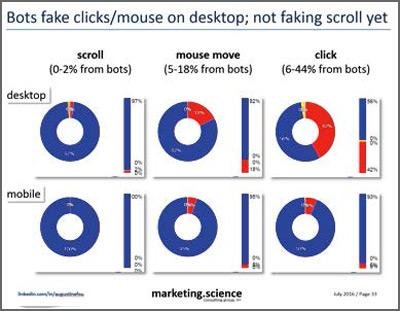
affaA recently published report by White Ops, a digital advertising security and fraud detection company, reveals that the source of most online ad fraud in the United States isn’t large data centers, but rather millions of infected browsers in devices owned by people like you and me.

This is an important finding, because when bots run in browsers, they appear as “real people” to most advertising analytics and many fraud detection systems.

As a result, they are more difficult to detect and much harder to stop.

These fraudulent bots that look like “people” visit publishers, which serve ads to them and collect revenues.

faaf

Of course, once detected, the value of these “bot-bound” ads plummets in the bidding markets.  But is it really a self-correcting problem?   Hardly.

The challenge is that even as those browsers are being detected and rejected as the source of fraudulent traffic, new browsers are being infected and attracting top-dollar ad revenue just as quickly.

It may be that only 3% of all browsers account for well over half of the entire fraud activity by dollar volume … but that 3% is changing all the time.

Even worse, White Ops reports that access to these infected browsers is happening on a “black market” of sorts, where one can buy the right to direct a browser-resident bot to visit a website and generate fraudulent revenues.

… to the tune of billions of dollars every year.  According to ad traffic platform developer eZanga, advertisers are wasting more than $6 billion every year in fraudulent advertising spending.  For some advertisers involved in programmatic buying, fake impressions and clicks represent a majority of their revenue outlay — even as much as 70%.

The solution to this mess in online advertising is hard to see. It isn’t something as “simple and elegant” as blacklisting fake sites, because the fraudsters are dynamically building websites from stolen content, creating (and deleting) hundreds of them every minute.

They’ve taken the very attributes of the worldwide web which make it so easy and useful … and have thrown them back in our faces.

Virus protection software? To these fraudsters, it’s a joke.  Most anti-virus resources cannot even hope to keep pace.  Indeed, some of them have been hacked themselves – their code stolen and made available on the so-called “deep web.”  Is it any wonder that so many Internet-connected devices – from smartphones to home automation systems – contain weaknesses that make them subject to attack?

The problems would go away almost overnight if all infected devices were cut off from the Internet. But we all know that this is an impossibility; no one is going to throw the baby out with the bathwater.

It might help if more people in the ad industry would be willing to admit that there is a big problem, as well as to be more amenable to involve federal law enforcement in attacking it.  But I’m not sure even that would make all that much difference.

There’s no doubt we’ve built a Frankenstein-like monster.  But it’s one we love as well as hate.  Good luck squaring that circle!

E-Mail Marketing: On the Subject of Subject Lines …

emWith groaning inboxes, is it any wonder why so many e-mail messages get ignored by their recipients?

Indeed, with it costing so little to send an e-mail – especially when compared to the “bad old days” of postal mail – it’s too irresistible for marketers and others to deploy hundreds or thousands of e-mail missives at a pop, even if the resulting engagement levels are so paltry.

And therein lies the problem: The “value” of such e-mails diminish to the point where recipients have a very good idea of their (lack of) worthiness without needing to open them.

In such an environment, what’s the the likelihood of something important inadvertently slipping through the cracks? Not so great.  And so users go on their merry way, hitting the delete key with abandon.

Faced with these realities, anything senders can do to improve the odds of their e-mails being opened is worth considering.

As it turns out, some of those odds can be improved by focusing on the e-mail’s subject line.

We know this from research conducted recently by e-mail platform provider Yesware. As reported this week in Fast Company, Yesware’s data scientists took a look at ~115 million e-mails of all kinds, gathered over the course of a 12-month period, to see how open rate dynamics might be affected positively or negatively by differences in the subject line.

ywThe Yesware analysis was carried by analyzing most- and least-used words and formats to determine which ones appeared to be more effective at “juicing” open rates.

As the benchmark, the overall e-mail open rate observed across all 115 million e-mails was 51.9% and the overall reply rate was about 29.8%. But underneath those averages are some differences that can be useful for marketers as they consider how to construct different subject lines for better impact and recipient engagement.

The findings from Yesware’s subject line analysis point to several practices that should be avoided:

Subject line personalization actually works against e-mail engagement.

It may seem counterintuitive, but adding personalization to an e-mail subject turns out to suppress the open rate from 51.9% to 48.1% — and the reply rate goes down even more dramatically from 29.8% to 21.2%.

Yesware surmises that this seemingly clever but now overused technique bears telltale signs of a sales solicitation. No one likes to be fooled for long … and every time one of these “personalized” missives hits the inbox, the recipient likely recalls the very first time he or she expected to open a personal e-mail based on such a subject line – only to be duped.

“First time, shame on you; second time, shame on me.”

Turning your subject line into a question … is a questionable practice.

Using a question mark in a subject line may seem like a good way to add extra curiosity or interest to an e-mail, but it turns out to be a significant turnoff for many recipients. In fact, Yesware found that when a question mark is used in the subject line, the open rate drops a full 10 percentage points (from 51.9% to 41.6%) – and the reply rate also craters (dropping to 18.4%).

It may be that turning a subject line into a question has the effect of reducing the power of the message. Yesware data engineer Anna Holschuh notes that posing a question is “asking a lot of an already-busy, stressed-out professional.  You’re asking them to do work without providing value up front.”

On the other hand, two subject line practices have been shown to improve e-mail open rates – at least to a degree:

Include numbers in the subject line.

Subject lines that contain “hard” numbers appear to improve the e-mail open rate slightly. Yesware found that open rates in such cases were 53.2% compared to 51.9% and the reply rate improved as well (to 32%).  Using precise numbers – the more specific the better – can add an extra measure of credibility to the e-mail, which is a plus in today’s data-rich environment.

Use title case rather than sentence case.

Similarly, Yesware has found that the “authority” conveyed by using title case (initial caps on the key words) in e-mail subject lines helps them perform better than when using the more informal sentence case structure.

The difference? Open rates that have title case subject lines came in at 54.3%, whereas when using sentence case in the subject line resulted in open rates at just 47.6%.

Similarly, reply rates were 32.3% for e-mails with subject lines using title case compared to 25.7% for e-mails where the subject line was sentence case — an even more substantial difference.

Generally speaking, e-mail marketing succeeds or fails at the margins, which is why it’s so important to “calibrate” things like subject lines for maximum advantage. The Yesware analysis demonstrates how those tweaks can add up to measurable performance improvements.

Online shopping insights: Why is the in-store pick-up option so popular?

With online shopping so popular these days, why are consumers electing to pick up the merchandise they’ve ordered at the store?

spu

While it isn’t a pervasive practice, a study published recently by consumer analytics firm Connexity/Bizrate Insights finds that more than 30% of online shoppers have used in-store pick-up at least once during the past 12 months.

Even more surprising, perhaps, is that ~13% of respondents reported that they had considered abandoning a purchase because in-store pick-up wasn’t offered as an option.

As it turns out, people choose the in-store pick-up option for four major reasons:

  • To avoid paying shipping charges: ~55% cited
  • For the convenience: ~43%
  • Need to receive the order quickly: ~36%
  • Shopping online to ensure the item is available: ~29%

At first blush, I wouldn’t think that “convenience” means having to drive to a store versus having the product delivered right to the house. But perhaps “convenience” in this sense is related to product availability – avoiding a fruitless trip to the store only to find out after-the-fact that the desired product isn’t in stock.

But the other reasons cited make good sense, too. Everyone understands the desire to save money – if not on the product itself, then by avoiding shipping charges.  And if a quick drive to the store gets you the items compared to waiting a few days for the shipment to arrive, that’s understandable as well.

The Connexity findings underscore how important it is for retailers to align their e-commerce setups to allow for in-store pick-up – especially if the economics don’t allow them to offer a free shipping option. There’s simply too much competition from online-only retailers to afford losing sale to them based on any of the four factors listed above.

Digital display advertising: (Still) looking like the weakest online promo tactic.

untitledI’ve blogged before about the lack of engagement with online banner advertising, and as time goes on … the picture doesn’t change much at all.

When you break it down, online banner advertising is a bust on several levels:


  • As of the most recent stats, clickthrough rates on online banner advertising are running about 0.08%. That translates to fewer than one click for every 1,000 times the ad is served.


  • Based on current pricing for online banner ads, that one click might be costing anywhere from $5 to $10 (and it might have even been an accidental click).


Despite these “inconvenient truths,” nearly two-thirds of digital ad spending continues to go to online banner advertising based on a “cost per impression” pricing model. Why?

One answer is that it’s an easy way to advertise a product or service. Simply supply ad creative to the publisher and let it be served online.

Another may be that advertisers consider banner advertising to be a basic component of any promotional campaign: prepare a mix of direct marketing, some search engine marketing, some print advertising and some digital display advertising, and you’re off to the races.

A third reason — related to the one above and I suspect one big reason why so much digital display advertising persists in the B-to-B realm in particular — is that publishers who offer a suite of promo tactics as part of a specially priced integrated program always throw in digital display advertising as part of the mix. It becomes the default option for advertisers as they approve bundled programs and the discount rates that come along with them.

Here’s a suggestion for advertisers going forward: Push back a bit and ask publishers to come up with alternative program options that don’t include digital display advertising.  The revised program might not look as promising at first blush, but then remember the stats above and you may well see the attributes of the alternative program in a more positive light.

Tech meets traditional: Digital marketing drives more phone calls by far.

CCIn a classic case of marrying tech with traditional marketing, digital channels are driving more calls to businesses than ever before.

What’s more, digital channels are now responsible for nine out of ten phone calls made to companies as a result of promotional efforts using the ten most popular marketing channels.

These findings come from the 2016 Call Intelligence Index published by Invoca, a phone call tracking and analytics firm that evaluates phone call activity across 40 industry segments.

Invoca’s 2016 evaluation covers more than 58 million phone calls generated from ten marketing channels — six of them digital and four of them “traditional offline” channels.

According to Invoca’s analysis, the biggest single source of phone queries is mobile search — representing nearly half of all phone call volume. But the next five channels that follow in line are all digital as well, as can be seen in this list:

  • INMobile search: Drives 48% of phone calls to businesses from marketing channels
  • Desktop search: 17%
  • Desktop display advertising: 11%
  • Content / review websites: 9%
  • Mobile display advertising: 3%
  • E-mail marketing: 3%
  • Total digital channels: 91%


  • Radio advertising: 3%
  • TV advertising/infomercials: 2%
  • Newspaper advertising: 2%
  • Directory advertising: 2%
  • Total non-digital channels: 9%

Comparing the 2016 results against a similar analysis conducted by Invoca in 2014, digital marketing channels have continued to rise in prominence — from representing 84% of the total phone call activity to 91% today.

The Invoca research also finds that phone calls are supplementing digital interactions, which is the result of consumers shifting between various different digital channels as they go about their research — often employing several different ones during the same mission task.

One of the biggest jumps in digital channel usage is in the automotive segment, where it’s clear that a big shift is underway from offline to digital channels — particularly mobile. The automotive industry experienced nearly a 120% increase in digital sources driving phone calls in the current Invoca research compared to the previous one.

So there’s no question that digital now “rules” when it comes to marketing channels. But far from causing the demise of a traditional channel like a phone call — as some people predicted not so long ago — digital channels have simply changed where the consumer might be just prior to heading for the (smart)phone.