The FTC Cracks Down on Native Advertising Abuse

But what difference will it make? Only time will tell …

FTIt had to happen: After years of publications uploading native advertising content that’s barely labeled as such, the Federal Trade Commission has handed down new guidelines that leave very little wiggle room in what constitutes proper labeling of paid advertising material.

Published under the title Enforcement Policy Statement on Deceptively Formatted Advertisements, the FTC’s new guidelines, which run more than 10 pages in length, make it more difficult than ever to “camouflage” advertising as “legitimate” news content.

What it boils down to is the stipulation that any sponsored content must be clearly labeled as advertising – using wording that the vast majority of readers will understand instantly.

Here’s how the FTC guidelines describe it:

“Terms likely to be understood include ‘Ad,’ ‘Advertisement,’ ‘Paid Advertisement,’ ‘Sponsored Advertising Content,’ or some variation thereof. Advertisers should not use terms such as ‘Promoted’ or “Promoted Stories,’ which in this context are, at best, ambiguous and potentially could mislead consumers that advertising content is endorsed by a publisher site.”

Another key provision is warning against advertising content mimicking the look and feel of surrounding editorial content – things like the layout characteristics, headline design treatment, the use of fonts and photography.

And here’s another kicker: the FTC lumps offending advertisers in the same pile as the people who create the materials, in that its policy statement doesn’t apply just to advertisers.  So ad agencies, MarComm companies and graphic designers, beware.

Quoting again from the FTC document:

“In appropriate circumstances the FTC has taken action against other parties who helped create deceptive advertising content – for example, ad agencies and operators of affiliate advertising networks. Everyone who participates directly or indirectly in creating or presenting native ads should make sure that ads don’t mislead consumers about their commercial nature. 

“Marketers who use native advertising have a particular interest in ensuring that anyone participating in the promotion of their products is familiar with the basic truth-in-advertising principle that an ad should be identifiable as an ad to consumers.”

Of course, these new guidelines are only going to make it harder for advertisers – and publishers – to be able to utilize advertising techniques that have, up to now, been far more effective than online display advertising.

iab-logoPredictably, we’re hearing mealy-mouthed statements from the industry in response. A spokesperson for the Interactive Advertising Bureau had this to say:

“While guidance serves great benefit to the industry, it must also be technically feasible, creatively relevant, and not stifle innovation. To that end, we have reservations about some elements of the Commission’s guidance.”

What bothers the Interactive Advertising Bureau in particular is the “plain language” provisions in the FTC’s guidelines, which IAB considers “overly descriptive.”

Translation: there’s concern that publishers can no longer label advertising using such euphemisms as “partner content” or “promoted post.”

Others seem less concerned, however. Sites such as Mashable and Huffington Post appear to be onboard with the new guidelines.

Besides, as one spokesperson said, “When the FTC issues guidelines, you’re better off when you follow them than when you don’t.”

… That sounds about right.

Consumer E-Mail Marketing: Too Much of a Good Thing?

igAdvertisers often complain about the drawbacks of online display advertising — and it’s not hard to figure out why.

Online display ad viewability, which is defined by the Media Rating Council as at least 50% of an ad’s pixels being in-view for at least one continuous second, is running under 45% these days — meaning that fewer than half of online display ads meet the definition of being viewable.

That’s actually a lower percentage than before; viewability charted closer to 50% in 2014, according to the global media valuation platform Integral Ad Science.

Because of these middling viewability rates, many advertisers look to e-mail marketing as the panacea. Not only is e-mail marketing inexpensive, the rational goes, it’s also more likely to attract and engage recipients.

But here too, the evidence is that there is mediocre visibility, too. And in this case, it’s actual willful ignorance.

According to the results of a study conducted earlier this year by business technology research firm Technology Advice, ~40% of the ~1,300 U.S. adults surveyed reported that they completely ignore marketing-oriented e-mails.

Of the ~60% who reported that they do open marketing e-mails, only a little over 15% do so on a regular basis.

Here’s a breakdown of the underwhelming stats that were gathered by Technology Advice:

  • ~58% of recipients read from 0 to 25% of marketing-oriented e-mails sent to them
  • ~21% read 25% to 50% of the marketing e-mail sent to them
  • ~13% read 50% to 75% of them
  • Just ~8% read 75% to 100% of them

In an attempt to “juice” these figures, marketers are experimenting with robust personalization in e-mails that become evident even before anyone opens them (e.g., personalization showing in the subject line), along with offering clearly marked discounts and other promo attractions.

In this regard, consumers do expect businesses to provide “value” in exchange for their attention, which explains by ~40% of the survey’s respondents are responding to discounts and similar promotional offers above all other types of e-communiqués.

But with such modest levels of people interacting with any marketing-oriented e-mails at all, there’s a question as to how whether these ploys to improvement engagement are just nibbling around the edges.

Because the reality is, there’s a big portion of the market that’s become jaded about e-mail.

Another approach seems counter-intuitive but just might be working better: reducing the frequency of e-mail solicitations from advertisers.  That theory is supported by the Technology Advice research, which found that nearly 45% of respondents feel that businesses would improve their marketing effectiveness by actually sending them less frequent e-mails.

A case of “less is more”? Probably so.

The disappearing American middle class? The Pew Research Center weighs in.

mcIn this political season in the United States — when is it ever not, one wonders? — we hear many of the presidential candidates refer to the so-called “crisis” of the middle class.

It matters not the political party nor ideological stripe of the candidate, we hear copious references to “the disappearing middle class” … the “middle class squeeze” … and that the middle class is “just getting by.”

Considering that the middle class income group represent the single largest block of voters in the country, it isn’t at all surprising that the presidential contenders would talk about middle class issues — and to middle class voters — so frequently.

The question is … is the hand-wringing warranted?

PewWell, if one believes a new Pew Research study on the subject, it may well be the case.

Based on its most recent analysis of government data going back nearly 50 years, Pew reports that there are now fewer Americans in the “middle” of the economic spectrum than at the lower and upper ends.

This is a major development, and it is new.

Pew defines a middle class household as one with annual income ranging from ~$42,000 to ~$126,000 during 2014. Using that definition, Pew calculates that there are now 120.8 million adults living in middle class households, but 121.3 million who are living in either upper- or lower-income households.

Pew characterizes this new set of figures as a kind of tipping point. And it helps to underscore the narrative wherein certain presidential candidates — you-all know which ones — are tapping into a collective “angst” about the decline in middle-income families, and the notion that they are falling behind compared to upper-income adults while unable to access many of the support services available to lower-income households.

Looking at things in a bit more depth, however, one can find explanations — as well as other data points that go against the “narrative” to some degree. Consider the following:

  • Senior citizens have done quite well shifting into the upper category since the 1970s — their share increasing by well over 25% in the upper-income bracket.
  • African-Americans have experienced the largest increase in income status over the same period, meaning that their lower-income category share is lower today.
  • The rapid rise in the number of immigrants in the late 20th century has pushed down median incomes because those new arrivals, on average, make less in income.

I suspect the Pew study findings will be fodder for more discussion — and perhaps some additional sloganeering — in the upcoming weeks and months. But you can judge for yourself whether that’s warranted by reviewing more findings from Pew’s report here.

If you have your own perspectives about what’s happening with (or to) the middle class, I’m sure other readers would be quite interested in hearing them.  Please share your comments here.

What’s in a name? When it comes to senior living communities – plenty.

BrooksideFor those of us “of a certain age,” it seems hard to believe that within five years, most of the Baby Boomer generation will be of retirement age.

… This also means that millions of people will be thinking about downsizing, right-sizing, or whatever the applicable term may be.

All sorts of considerations come into play when making such a decision; climate, social, cultural and recreation opportunities, plus proximity to relatives are some of the most common.

But when the dust settles, most people will actually end up “aging in place.”

That’s one key finding from a recent survey of ~4,000 American Baby Boomer households that was conducted by the Demand Institute Housing & Community.

Not only do nearly two-thirds of the respondents plan to stay in their current homes, the majority of them feel that their homes are well-suited for aging – even if they’re multi-story, don’t offer accessibility features, or aren’t particularly low-maintenance structures.

But the survey suggests another interesting dynamic that may also be at work:  the notion that senior living communities are primarily places for people who have serious health issues or who can’t take care of themselves on their own.

Let’s face it.  Baby Boomers don’t consider themselves part of that cohort at all, which they equate with people who are substantially more elderly than themselves.

When you think about it, so many of the terms used to describe senior living facilities convey exactly the wrong thing to Baby Boomers.  The names may well be accurate descriptions of the properties in question, but they fairly scream “geriatrics.”

community

I’ve run across quite a few descriptors.  A good number of them reside in the same wheelhouse – which is to say, distinctly unattractive.  Meanwhile, other alternative names are often too narrowly descriptive as well, because one important aspect of senior living is to access to continuing care if and when that becomes necessary.

Either way, those charged with marketing these properties clearly prefer the word “community” over the word “center” or “home.”  But you can be the judge of how successful these names really are:

  • 55+ communities
  • Active adult communities
  • Age-restricted communities
  • Continuing care retirement communities
  • Elder cohousing communities
  • Independent living communities
  • Leisure communities
  • Mature living communities
  • Senior housing communities
  • Senior living communities

The bottom line on this is pretty fundamental:  Few people – regardless of how old they are – wish to be reminded of the limitations of life on a downward curve.  It’s just not compatible with the positive attributes that are so much a part of human nature.  Anything we can do to avoid being reminded of our mortality, we’ll do.

Obviously, that reluctance to face the reality of aging is of concern to property developers in the housing industry as well.  One of the actions coming out of field research such as the Diamond study is a new initiative to establish an alternative “umbrella descriptor” that works across the entire spectrum of senior living facilities.

It will be interesting to see where that exercise will end up.  As for me, I’m guessing it’ll still telegraph “geriatric.”  But perhaps we’ll end up being surprised.

Old Forester: A storied brand attempts a comeback.

Old Forrester bourbonA half century ago, Old Forester bourbon was the big brand name in the spirits business.  As the flagship brand of the Brown-Forman Corporation, it routinely sold in quantities approaching one million cases each year.

Back in the day, Old Forester was marketed as “America’s Guest Whiskey” – the one to bring out when company came to visit.  (I remember finding an ancient bottle of Old Forrester when cleaning out my late mother-in-law’s liquor cabinet.)

Forward to today.  Despite a recent rise in bourbon sales, Old Forester is a near-forgotten brand entry.  Shipments barely topped 100,000 cases last year, and nearly half of all sales came from just two states:  Alabama and Kentucky.

What the heck happened?

In broad terms, American tastes in distilled beverages shifted away from scotch and bourbon to vodka and gin.  Wine became more popular, too.

But those changes affected the entire market for bourbon, scotch and other whiskeys.  What made Old Forrester sink so low in a category that’s actually been on an upward trend since 2000?

Two words:  “Jack Daniels.”

BF logoIn 1956, Louisville-based Brown-Forman, the makers of Old Forrester, acquired the iconic Jack Daniels brand, and promptly started marketing it big-time.

Jack Daniels advertising has been pretty constant in the decades since.

Then in the mid-1990s, Brown-Forman introduced Woodford Reserve, which it marketed as premium bourbon — much as Old Forester had been a half-century before.

With all of the attention lavished on these two brands, Old Forester got squeezed out of the action.

But as it turns, out, there may be a second act for Old Forrester after all.  Starting in 2001, bourbon shipments have been on a pretty steady upward trend, with total shipments now topping 1 billion liters annually.

Mad-Men-Season-6Some have attributed the growth in bourbon consumption to the success of the Mad Men TV series, but I suspect there’s a lot more to it than just that.

Besides, even with Mad Men going off the air, market forecast firm Cowen & Company predicts American whiskey growth rates will clock in at nearly 10% per year until 2020 at least.

Because of those dynamics, it comes as little surprise that brands like Bulleit Bourbon have been so very aggressive in the market.

New entrants abound, too, as there are now more than 26 distillery licenses issued by the state of Kentucky (up from just ten in 2011).

Evidently, the key managers at Brown-Forman must have decided that they weren’t going to let the market pass them by, and so they’ve committed to a major initiative to resuscitate the Old Forester brand name.  Major commitments and goals include:

  • Building a new distillery in Louisville that will open next year
  • Expanding the geographic reach of brand sales
  • Undertaking a $20 million marketing effort including digital advertising, point-of-sale promotion and bar promotions
  • Increasing annual shipments to 500,000+ cases within five years

What are the chances that Old Forester can regain its lost luster and once again become one of America’s esteemed bourbon brands?

Brown-Forman's Campbell Brown, a fifth-generation family member, heads up the Old Forrester branding initiative.
Brown-Forman’s Campbell Brown, a fifth-generation family member, heads up the Old Forrester branding initiative.

There are no guarantees, of course.  But starting with a venerable brand name … and then appointing a seasoned industry veteran — and fifth generation Brown family member as well — to head the effort may give this initiative pretty decent odds of success.

We’ll check back in four or five years and see how it all turns out.

The Ad Fraud Gravy Train Keeps Chugging Along — No Matter What …

xbnAd fraud is quite a large issue for online advertisers – and it’s been on many companies’ radar screens for a long time.

But even with the higher visibility and greater scrutiny of online ad fraud, it seems to be a problem that only gets bigger.

The most recent example of the phenomenon came to light a few weeks ago, when ad fraud prevention consulting firm Pixalate announced that a newly discovered botnet has been draining literally billions of dollars from advertisers’ MarComm coffers.

The botnet is dubbed Xindi – the same name as the hostile aliens in the Star Trek sci-fi TV series.

Xindi is making money for its creators by serving actual ads – but to simulated audiences.  It has spread via familiar methods such as phishing.

Pixalate estimates that just shy of 78 billion fake ad impressions have been racked up so far.  Even at low cost-per-impression revenue figures, the high volume amounts to several billions of dollars of illicit revenues siphoned (and counting).

What makes the Xindi botnet particularly nettlesome is that it’s designed to go after computers and networks at high-end organizations, enabling it to “mimic” desirable web traffic (i.e. affluent consumers).

xbotAccording to Pixalate, already there could be as many as 8 million computers compromised in more than 5,000 networks, including a goodly number of Fortune 500 companies as well as university and governmental networks.

Such desirable locations and ad audiences translate into lucrative online ad pricing (CPMs of $200 or more).

In the event, advertisers are paying high prices … for nothing.

To counteract Xindi, Pixalate recommends that the Internet Advertising Bureau update its protocols to factor in the pace of ad requests, so that impression generated after a certain time period cannot be accepted as valid — and hence would be non-billable.

Whether this or other remedies will actually happen is up in the air at the moment (the IAB isn’t onboard with the recommendations).

Either way, what seems clear is that whatever the remedial actions that are taken, burgeoning ad fraud activity is bound to continue.

The question is, can it ever be contained, or will it just continue to grow and grow?  If you have any thoughts or ideas on the challenge, please share them with other readers.

As the U.S. Postal Service girds for processing 15 billion pieces of mail this holiday season …

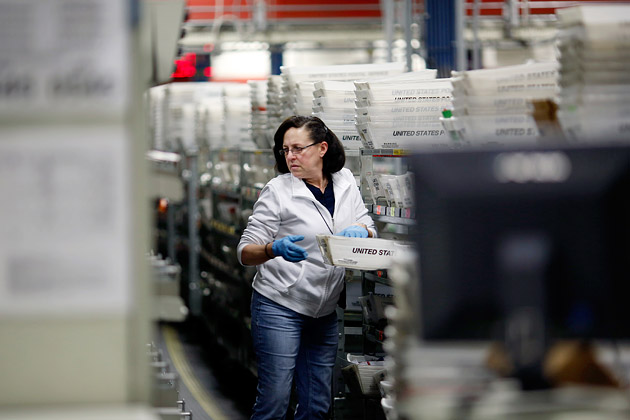
workerConsidering the many dire predictions about the perils of the out-of-date business model of the United States Postal Service, one might surmise that its very future is in doubt.

But then we read the following news about the upcoming holiday mail season:

  • 15 billion+ pieces of mail are expected to be processed by the USPS this holiday season.
  • That represents an increase of ~10.5% compared to last year.
  • Of the 15 billion items processed, more than 500 million will be packages.

There’s a new benefit being offered to USPS customers, too. Ahead of the holiday season, the USPS is now offering real-time delivery notification.  People who register will receive real-time e-mail alerts when delivery scans are made by postal workers.

That new function may well be why the new USPS slogan has been unveiled as “One more reason this is our season.”

Normally, all of the additional volume would be cause for celebration – tapping unused capacity while growing revenues during this busy time of year.

But here’s the rub: In order to handle the added volume, the USPS needs to hire ~30,000 temporary workers.

This could mean that substantially all of the added revenues are immediately sucked out of the USPS’s coffers in order to pay for the added labor resources.

“It’s always something …”

Marketing Technology: Is “Implosion” Where We’re Headed?

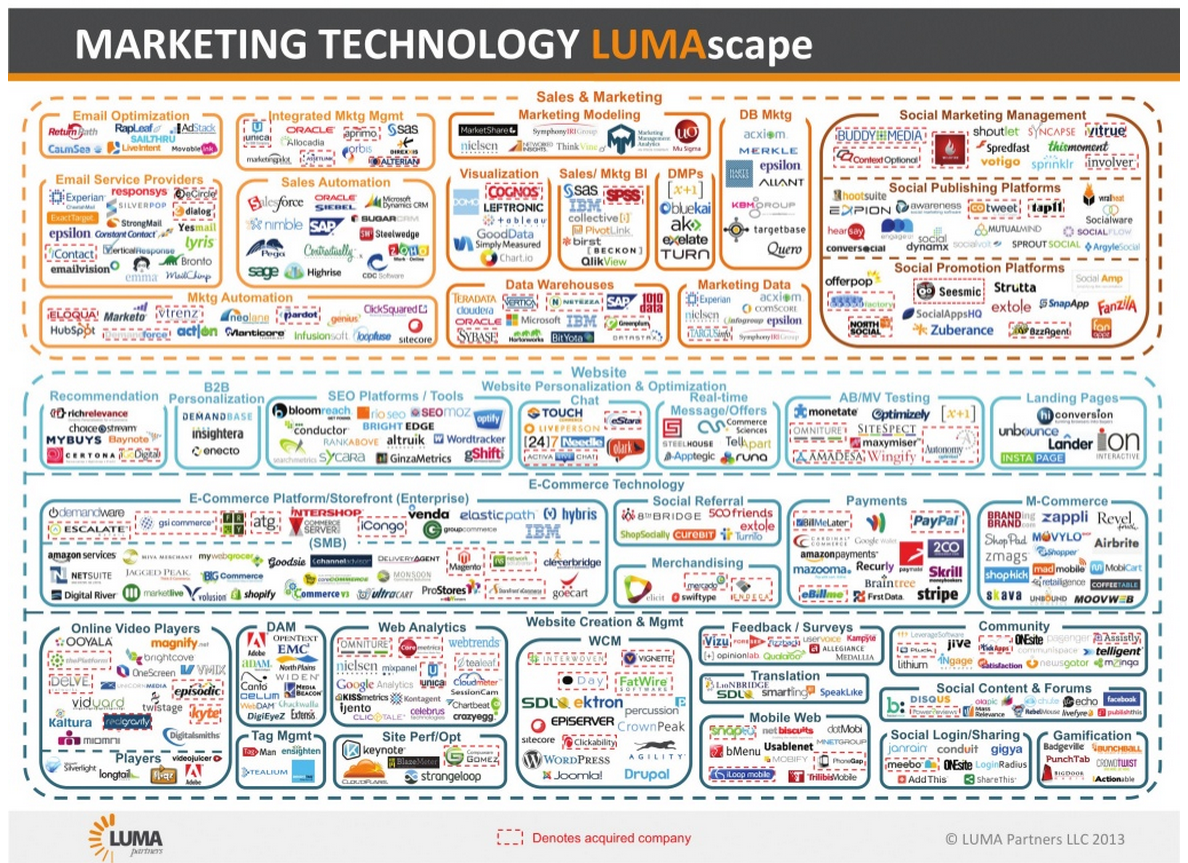
A chart of just some of the major marketing technology platforms -- and this is as of 2013!
A chart of just some of the major marketing technology platforms — and this was in 2013!

It seems that with each passing day, one or two new technology products are announced by MediaPost and other publishers in the marketing field.

The numbers tell the story. The marketing technology industry website chiefmartec.com lists nearly 1,900 marketing technology vendors in more than 40 categories.

That’s nearly double last year’s tally of around 950 vendors.

Software clearinghouse Capterra lists even more: a whopping 3,000+ marketing technology products across 30 categories.

These firms account for well over $20 billion in financing – the dollars that can be tracked, that is – including around 30 companies that are valued at $1 billion or more each.

That’s a lot of companies and vendors. Of course, there are many customers who are looking for tech-driven marketing solutions as well.  The question is whether things have gotten out of balance.

Business writer and marketing tech specialist Malcom Friedberg thinks so. He’s Chief Marketing Officer at CleverTap, and he also publishes columns on a variety of business topics.

In Friedberg’s view, the sheer number of marketing technology vendors and products means that the segment may now be on the brink of an implosion.

Friedman references a recent CMO Council document that reports that more than 80% of marketers are using as many as ten different marketing-related technologies or cloud solutions.

And as new technologies are added, the problem is finding educated staff – and enough hours in the day – to cover all of these products well. In many instances, users may be just scratching the surface of what these products can provide; the “multiple hat” dynamics of many marketing departments mean that very few people qualify as being “advanced” users.

The problems boil down to this: Even if a department has two or three marketing people devoted exclusively to tech-related responsibilities (at tall order in most companies) – this assumes that those people can work equally well on multiple different platforms.

The reality is quite different. It’s more like a big jumble – with consultants brought in to sort things out.  It may get the job done, but it isn’t pretty – and it’s hardly a recipe for “the best of best practices.”

Survey work by the CMO Council supports this hypothesis. The Council has found that fewer than on in ten of the marketers it surveyed reported that they possess a highly evolved digital marketing model that has a proven, clear path of evolution.

Malcolm Friedberg
Malcolm Friedberg

Friedman thinks he knows where things are heading. Not to more choices, but rather to less:

“In my opinion, we’ll start to see massive consolidation and uber-marketing systems. Think super-integrated marketing and advertising clouds … the preoccupation with ‘best-of-breed’ in every category will be replaced by a ‘tree-and-branch’ model, with one core technology and a few ‘good enough’ complementary ones.”

Friedman calls it “an expensive French meal” instead of “a Vegas buffet.” While there will always be new products promising incremental improvements, he predicts that by 2020, the common business model will be super-integrated marketing and advertising clouds as we see already with the likes of Marketo and Hubspot.

What do you think? Is Friedman onto something … or is the orgy of new marketing technology products going to continue unabated?  Please share your thoughts with other viewers here.

Who Trusts the Media?

Americans give a big thumbs-down when it comes to having “trust and confidence” in mass media – TV, radio and newspapers.

MediaAre Americans’ attitudes about the press becoming more negative over time? If the latest survey figures on media trust are any guide, the answer is a pretty stark “yes.”

According to a recent Gallup field survey of ~1,025 American citizens aged 18 or over, trust and confidence in the mass media in the United States has reached a new low.

Today, just ~40% of respondents report that they have “a great deal” or “a fair amount” of confidence that newspapers, TV and radio report the news “fully, accurately and fairly.”

What’s more, trust levels have been on a downward trajectory ever since the late 1990s, when Gallup began surveying Americans’ attitudes on an annual basis.

Here’s what the trend looks like in the “off-election” years:

  • 1999: ~55% have “a great deal” or “a fair amount” of trust in mass media (TV/radio/newspapers)
  • 2003: ~54%
  • 2005: ~50%
  • 2007: ~47%
  • 2009: ~46%
  • 2011: ~44%
  • 2013: ~44%
  • 2015: ~40%

Moreover, the notion that young people might be more inclined to trust the media isn’t borne out in the Gallup survey results. The trust of Americans age 18-49 has dropped from 53% in 2005 to only 36% now.

Contrast this with older Americans (age 50 or older): 45% of them reported that they had trust and confidence in mass media in 2005, and today that trust level is … still 45%:

Media trust by age

Giving further credence to the oft-stated claim that American mass media are slanted towards one political party, ~55% of self-identified Democrats express trust in the media, compared to just 32% of Republicans and 33% of independents.

Gallup can’t resist editorializing a bit about its most recent media trust figures:

“Americans’ trust level in the media has drifted downward over the past decade, but some of the loss in trust may have been self-inflicted, as major venerable news organizations have been caught making serious mistakes in the past several years.”

Additional information on the Gallup survey can be accessed here.

“Immigration Nation”: Pew Research Projects U.S. Population Demographics into the Future

immigrantsI’ve blogged before about the immigration issue and its potential impact on the U.S. economy and society.

Now the Pew Research Center has released a report that predicts the U.S. becoming a “no ethnic majority” nation within the next 35 years.

When one considers that the United States population was nearly 85% white Anglo in 1965 … and that percentage has dropped to about 62% now, it isn’t that hard to imagine Pew’s prediction coming true.

Here’s the trajectory Pew predicts over the coming ten-year periods:

  • 2015: ~62% estimated U.S. white Anglo population percentage
  • 2025: ~58% projected white Anglo population percentage
  • 2035: ~56% projected
  • 2045: ~51% projected
  • 2055: ~48% projected
  • 2065: ~46% projected

Perhaps what’s more intriguing is that Pew projects the largest future percentage gains will be among Asian-Americans rather than Latino or Black Americans. The Asian share of the American population is expected to double over the period:

  • 2015: ~6% estimated U.S. Asian population percentage
  • 2025: ~7% projected Asian population percentage
  • 2035: ~9% projected
  • 2045: ~10% projected
  • 2055: ~12% projected
  • 2065: ~14% projected

If these projections turn out to be accurate, the Asian population percentage is on tap to become the nation’s third highest group.

By contrast, the Hispanic population, while continuing to grow, looks as if it will level off at about 22% of the country’s population by 2045. For Black Americans, Pew projects the same dynamics at work, but at the 13% level.

citizenship ceremonyAccording to Pew’s analysis, the biggest driving force for the projected Asian population growth is immigration. By 2055, Pew expects that Asians will supplant Latinos as the largest single source of immigrants — and by 2065 the difference is expected to be substantial (38% Asian vs. 31% Latino immigrants).

Conducted in parallel with Pew’s projection analysis was an online opinion research survey of American adults (18 and over) it conducted in March and April of this year.

Among the attitudinal findings Pew uncovered were these:

  • “Immigrants in the U.S. are making society better”: ~45% of respondents agree … ~37% disagree
  • “I would like to see a reduction in immigration”: ~50% agree
  • “I would like to see the immigration system changed or completely revamped”: ~80% agree

Again, no great surprises in these figures — although if one paid attention only to news accounts in the “popular media,” one might find it surprising to learn that a plurality of Americans actually consider immigration a net positive for American society …

Additional findings from the Pew survey as well as its demographic projections can be found here.