Any way you slice it, Google continues to dominate the search ecosystem.

Just how big is Google in the world of search? I’ve seen percentages that are all over the map, but one thing is undeniable:  Google remains the overwhelming leader in search.

And it isn’t even close. Runners-up in the search engine derby include Bing/Yahoo and DuckDuckGo, but they’re so small so as to be mere asterisks at the bottom of the page.

… Which might be surprising to some. After all, as late as 2015 comScore was reporting that Google’s market share of desktop search was running around 64%, whereas the Bing family of search products (including Yahoo and AOL) was tracking in the low 30s.

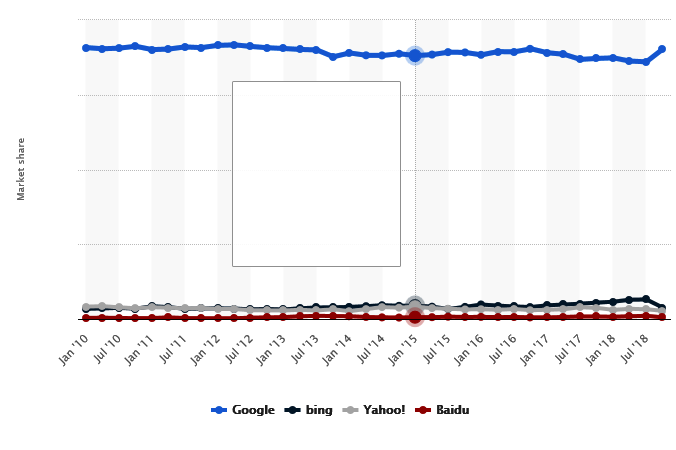
But it’s all in how you make the calculations. At the very same time, Statista was reporting that Google’s worldwide share of desktop search was approximately 89%.

Moreover, Statista’s trend line for Google between 2010 and the end of 2018 is remarkably consistent, with Google’s share of desktop search charting in a narrow range between 86% and 90%:
But I think it’s the data from marketing intelligence and analytics firm Jumpshot that gets us closest to what’s actually happening in the world of search. Jumpshot licenses anonymized ClickStream data from hundreds of millions of users.  It finds that ~63% of all online searches are through Google’s “core” function.

But then one needs to factor in additional Google-related search activity that occurs on Google Maps, Google image search and YouTube, which is owned by Google. When those figures are added to the mix, Google’s market share of search is indeed in excess of 90%, with all other players way, way behind.

This graph shows the makeup of Google’s dominant position as compared to its search competitors:

Source: Jumpshot (based on ClickStream data), 2018.

These dynamics explain why Google remains so entrenched – and why advertisers continue to devote so much of their search engineering advertising dollars to Google properties.

A “constant” in Google’s market strategy over the years has been to make it easy and effortless for users to perform a Google search wherever they are.  In years past, that meant making Google the Home Page on as many Internet browsers a possible. In more recent times it’s taken the form of building activity on Google-centric browsers (Google Chrome), mobile market share (Android), acquiring the dominant video platform (YouTube), and making a major push into voice search with Google Home.

Essentially, wherever someone is … Google is there as well. It’s very much like a commodity or a utility.  (Indeed, its very name has become synonymous with the verb “to search.”)

In case anyone is counting, Google processes an eye-popping 3.5 billion searches per day.  Is it any wonder that any competitor – even a platform like Bing with resources to spend – would have a near-insurmountable challenge getting millions of people to just try a different search option (much less start using it regularly).

Could the situation change?  I suppose nothing is immutable.  The market share figures don’t yet factor in iPhone data at scale.  Some other search product might emerge that is dramatically better-performing than Google.

But none of those factors are likely to change the overall search ecosystem. The fact is, Google dominates search … it has dominated search for years … and it’s on track to continue doing so in the future.

I close with a question to readers. If any of you prefer using a different search product besides Google, please share your reasons why in the comment section below.

Klout’s gone (thankfully) … but get ready for Skorr.

Social influence/reputation scores – what no one really wants – come back for Round 2.

Who remembers Klout anymore?  When the social media “influence rater” was quietly shuttered in mid-2018,

Klout was just a faint glimmer of what it had once been.  Over a 10-year arc, the social influence “Klout Score” went from being something some people cared about to being something no one bothered with.

Through some rather opaque algorithms, Klout purported to measure the reach and influence of people’s social networks and correlate the content they created to measure how others interacted with that content.

Klout used major social media platforms including Facebook, Instagram, Twitter, YouTube, Wikipedia and LinkedIn (plus a few less important ones like Foursquare and Google+, but not SnapChat or Pinterest) to create a person’s so-called “Klout Score” ranging from 0 to 100.  The higher the score, the more “social clout” the person presumably had.

The resulting score was something that many people discounted, noting that prolific bloggers ended up having Klout Scores significantly higher than even the president of the United States.

Others looked at their own modest Klout Scores and freaked out.

But as it turned out, all of it was “much ado about nothing” — so much blue smoke and mirrors.  MediaPost columnist Kaila Colbin put her finger on the reality of it all when she wrote this about the foundation upon which Klout was built:

[The idea that] “the carrot, the reward, is the influence you have — that is backwards. Influence is not a reward or an end-result.  It is a byproduct of actually being good …”

Colbin continued:

“A service like Klout promotes the ambition of being influential, but there are no shortcuts. Show up. Express yourself wholeheartedly. Deliver value. Ask yourself what you can give your community. The influence will take care of itself.”

As if on cue, starting about halfway into its decade-long life, Klout began to show significant cracks in its foundation. Klout’s presence began to weaken as more people raised questions about the company’s well-guarded methodology by which its scores were determined.

Still others began to label the scheme “socially evil” in that Klout was in the business of exploiting the “status anxiety” of the people who paid attention to the scores.

But perhaps the biggest knock came when search engine specialist Sean Golliher analyzed the Klout scores of Twitter users and discovered that the number of Twitter followers was sufficient to explain 95% of the Klout scores assigned to those users. That finding validated the suspicions many had about Klout all along that its rating system was an elaborate architecture based on very little at all.

The last few years of Klout played out like so many other high-flying wonders of the cyberworld:  A change of ownership that failed to stem the negative trends, followed by mounting irrelevance and finally closing down the entire enterprise.

At the time Klout was shuttered in May 2018, few even noticed. Indeed, for many Internet users it was as if Klout had never existed.

But cyberspace being what it is, no sooner had Klout disappeared than a new social influence/reputation protocol emerged to take its place.

This time it’s Skorr, sporting the high-minded tagline “grow socially” and described by its backers as follows:

“[We] are now building a decentralized reputation protocol for the Internet: making reputation immutable and anonymity accountable … This reputation protocol allows individuals, organizations and things to create one or multiple reputations, depending on their identity.  Each reputation will be immutable, verifiable and traceable — and as such, the actor can be held accountable.”

Over on the company’s website, we read that not only will Skorr allow people to measure their influence, it “will also allow you to challenge your friends on different social contests and invite them to social media disputes.”

Isn’t that just what we need: more ways to help people argue more online.

Let’s hope that this new influence/reputation “protocol” will go the way of the last one — and that it happens a whole lot quicker this time around.

Reuters: In 2019, publishers will experience “the biggest wave of layouts in years” … and massive burnout among the journalists who remain.

The bad news continues for the publishing industry in 2019.

I’ve blogged before about the employment picture in journalism, which has been pretty ugly for the past decade.   And just when it seems that news in the publishing industry couldn’t get much worse … along comes a new study that further underscores the systemic problems the industry faces.

The results from a recent Reuters survey of publishers worldwide point to declines that will only continue in 2019.  In fact, Reuters is predicting that the industry will experience its largest wave of layoffs in years, coming off of a decade of already-steadily shrinking numbers.

The main cause is the continuing struggle to attract ad revenues – revenues that have been lost to the 600-lb. gorillas in the field – particularly Facebook, Google and Amazon.

Growing subscription revenue as opposed to a failing attempt to attract advertising dollars is the new focus, but that will be no panacea, according Nic Newman, a senior research associate at Reuters:

“Publishers are looking to subscriptions to make up the difference, but the limits of this are likely to become apparent in 2019.”

In addition to boosting subscription revenue, publishers are looking to display advertising, native advertising and donations to help bankroll their businesses, but advertising is the main focus of revenue generation for only about one in four publishers — a far cry from just a few years ago.

Putting it all together, Reuters predicts that it will lead to the largest wave of publishing job layoffs “in years” – and this in an industry where employment has been shrinking for some time now.

With yet more layoffs on the horizon, it’s little wonder that the same Reuters research finds employee burnout growing among the employees who remain. As Newman states:

“The explosion of content and the intensity of the 24-hour news cycle have put huge pressure on individual journalists over the last few years, with burnout concerns most keenly felt in editorial roles.”

A major reason why:  Even more is being asked from the employee who remain – and who are already stretched.

Journalism salaries are middling even in good times – which these certainly are not.  How many times can an employee be asked to “do more with less” and actually have it continue to happen?

Even the bragging rights of journalists are being chipped away, with more of them relegated to spending their time “aggregating” or “curating” coverage by other publishers instead of conducting their own first-hand reporting. That translates into perceptions of lower professional status as well.

In such an environment, it isn’t surprising to find editorial quality slipping, contributing to a continuing downward spiral as audiences notice the change — and no doubt some turn elsewhere for news.

Last but not least, there’s the bias perception issue. Whether it’s true or not, some consumers of the news suspect that many publishers and journalists slant their news reporting.  This creates even more of a dampening effect, even though in difficult times, the last thing publishers need is to alienate any portion of their audience.

How have your periodical and news reading habits changed in the past few years? Do you continue to “pay” for news delivery or have you joined the legions of others who have migrated to consuming free content in cyberspace?

(For more details from the Reuters research, you can sign up here to access the report.)

Yet another knock on business travel.

“Don’t let the bed bugs bite” becomes harder to do …

Recently, an article in Meetings & Conventions magazine caught my eye – and not in a good way.  The big headline blared that Baltimore has kept its title as the “Bed Bug Capital of the United States.”

Seeing as how Baltimore is the big city closest to where I live, this didn’t come as particularly welcome news. No one wants to be singled out for such a dubious “honor.”

Adding insult to injury, nearby Washington, DC came in second on the list, which was compiled based on metropolitan area statistics of the national pest control service provider Orkin, and where that company has performed the most bed bug treatments over the past year.

For the record, making up the Top Ten bed bug infestation listing are the following metro areas:

  1. Baltimore
  2. Washington, DC
  3. Chicago
  4. Los Angeles
  5. Columbus, OH
  6. New York
  7. Cincinnati
  8. Detroit
  9. Atlanta
  10. Philadelphia

For Baltimore, it was the third year in a row landing on top of the metro area list.  Meanwhile, several others made it onto the list that weren’t there previously (Atlanta and Philadelphia).

On the other hand, Dallas and San Francisco have now dropped out of the Top Ten.

Entomologist Chelle Hartzer, an Orkin spokesperson, was quick to point out that being on the Top Ten list shouldn’t be viewed as a reflection of general lack of sanitation or cleanliness, stating:

“Bed bugs are the #1 urban pest in many cities today. They are master hitchhikers, so no one is immune.  Sanitation has nothing to do with prevention; from public transit to 5-star resorts, bed bugs have been and can be found everywhere humans are.”

When you think of it in that context, it’s actually little wonder that Baltimore and DC have so many incidences of bed bug infestations requiring treatment, considering the amount of travel to and from the National Capital region from all over the world.

[I’m completely clueless as to how and why Columbus, OH should come to outrank New York City, however.]

The bigger question is … what to do about it?

For its part, Orkin has come up with some suggested personal “dos” and “don’ts” for travelers regarding managing their exposure to beg bugs.

Among the precautions Orkin recommends that people take are these when checking into your hotel or motel room:

  • Lift and look around typical hiding spots including the mattress, box spring, behind baseboards, pictures, and torn(!) wallpaper.
  • Check carefully for tiny, ink-colored stains on mattress seams, in soft furniture and behind headboards.
  • Avoid placing your luggage on beds, and also avoid proximity to walls and carpeted surfaces(!). Whenever possible, keep luggage elevated, such as on a hard-surface counter.
  • The safest location is placing your luggage in the bathroom(!).

Reading the ways Orkin recommends limiting exposure to bed bugs while on a trip seems designed to take all the pleasure out of traveling. Maybe it’s time to consider Plan B:  staying home!

Speaking personally, I have yet to be subjected to a bed bug infestation — either on the road or “hitchhiked home.” But I know several people who have – and their stories weren’t pretty.  Do you have any personal experiences of your own to share?

Chief Marketing Officer: The most thankless job in the corporate world?

Few people I know would claim that being the Chief Marketing Officer of a company is a job without risks. Indeed, numerous articles in the business press point to an average length of tenure in a CMO position that is often measured in months rather than in years – indeed, the shortest length of time among all C-level jobs.

And now, a recently completed survey of CMOs  underscores just how wide-ranging the reasons are for those employment characteristics. Branding consulting firm Brand Keys tested a number of issues to see which are the ones that keep CMOs “awake at night.”

Three-quarters or more of the respondents to the Brand Keys survey reported that every factor presented was significant enough to cause them to lose sleep.  Leading the list with near-universal high-alert concern is ROI factors. Other factors of concern to nearly every respondent in the survey are big tech and data security issues.

Listed below is how each of the factors tested by Brand Keys turned out with CMOs in terms of “losing sleep” over them.

90%+ lose sleep worrying about:

  • ROI/ROMI factors
  • Big data, big tech and big security issues
  • Establishing trust with customers
  • Innovation, AI, technology and marketing automation developments
  • Consumer expectations regarding privacy and transparency

80%-90% lose sleep worrying about:

  • Managing social networking
  • Creating relevant advertising content
  • Successfully deploying predictive consumer behavior analytics/technologies
  • Dealing with consumer advocacy and social activism
  • Developing long-term strategies that align with corporate growth goals
  • Having the ability to engage with audiences – not just find them

At the “bottom” of the pile … 75%-80% lose sleep worrying about:

  • “Democratization” of the digital world and protecting brand equity within it
  • “Political tribalism” and its effect on brand reputation
  • Being relevant when tweeted about
  • Keeping consumers engaged with the brand
  • Creating better cross-platform synergies for marketing campaigns
  • Creating an “unlearning curve” to move away from legacy marketing metrics
  • Creating marketing synergies among different generational/age cohorts
  • Being replaced by the chief revenue officer

This last worry factor – losing their job – seems almost preordained given the tenuous circumstances more than a few CMOs deal with in their positions.

… and likely made more so because CMO’s are quick to be blamed when things don’t go well, even if they aren’t in the strongest position to effect the changes that may be needed. “Responsibility without authority” is the stark reality for too many of them.

What are your thoughts about the dynamics faced by CMOs in their companies?  Whether you speak from personal experience or not, I’m sure other readers would be interested in hearing your views.


Facebook’s bad publicity in 2018 lands it at the top of the “least-trusted technology company” list.

The trust is gone …

One has to assume it’s a citation Facebook CEO Mark Zuckerberg has tried mightily to avoid receiving. But with a massive data breach last year and poor marketing decision-making accompanied by a wave of bad publicity, it shouldn’t come as a major shock that Facebook is now considered the least trusted major technology brand by consumers.

The real surprise is by how much it outscores everyone else. Really, Facebook’s in a class by itself.

Recently, online survey research firm Toluna conducted a poll of ~1,000 adults age 18 or older in which it asked respondents to identify their “least trusted” technology company.

The results of the survey show the degree to which Facebook has become the “face” of everything that’s wrong with trust in the world of technology.

Here’s what Toluna’s found when it asked consumers to name the technology company they trusted least with their personal information:

  • Facebook: ~40% of respondents trust least
  • Amazon: ~8%
  • Twitter: ~8%
  • Uber: ~7%
  • Google (Gmail): ~6%
  • Lyft: ~6%
  • Apple: ~4%
  • Microsoft: ~2%
  • Netflix: ~1%
  • Tesla: ~1%

The yawning gap between Facebook’s unflattering perch at the top of the listing and the next most-cited companies — Amazon and Twitter — says everything anyone needs to know about the changing fortunes of company image and how fast public opinion can turn against it.

About the only thing worse is not showing up on the Top 10 list at all – which is the case for Oath (the parent of Yahoo and AOL).  That entity has become so inconsequential, it doesn’t even enter into the conversation anymore.  That’s a “diss” on a completely different level, of course. As Oscar Wilde once said, “The only thing worse than being talked about is … not being talked about.”

What about you? Do you think that Facebook should be tops on this list?  Let us know your opinion below.

No End in Sight to the Challenge of Email Deliverability

When it comes to e-mail communications in the B-to-B world, yet another study is underscoring just how challenging it is to reach corporate inboxes.

A new report by cyber-security firm FireEye, Inc. reveals that fewer than one-third of e-mails sent are actually making it into corporate inboxes. The FireEye analysis was based on tracking more than a half-billion e-mails sent between January and June of 2018.

The majority of those e-mails were deemed to be spam or malicious in their intent. Nearly 60% were blocked by threat intelligence and around 10% more were halted by attack prevention tactics such as URL inspection and attachment detonation.

E-mails were deemed suspicious because they triggered one or more of the following “red-light” cautions:

  • Malware-less impersonations
  • Malware viruses
  • Phishing attacks
  • Ransomware
  • Spyware
  • Trojan horses
  • Worms

Interestingly however, it turns out that only a small fraction of the e-mails actually had malicious intent, meaning that the super-strict filters being employed by companies are capturing a huge number of perfectly legitimate e-mail messages in their dragnet and rejecting them out of hand.

On the other hand, the FireEye analysis also determined that impersonation attacks have undergone a shift from domain name spoofing to “friendly” domain name scams – ones in which an e-mail address is manipulated to impersonate a trusted source.

As the study cautions:

“This shift in tactics may be driven by how easily cyber criminals can ‘spoof’ the display name and username potion of an e-mail header. Instead of having to go through the process of buying and registering a domain similar to – or one that sounds like – the recipient’s domain, they can simply change the display/user name.”

The FireEye analysis is a reminder that because of its sheer pervasiveness, e-mail communications are also the most popular conduit for potentially significant cyberattacks. No wonder companies have their guard up.

The problem is, clearly a whole lot of wheat is being thrown out with the chaff.  And that makes e-communications hardly the slam-dunk communications tactic that many people assume it to be.

Salon takes another crack at generating revenue from viewers.

But will the results be any different this time around?

Since the emergence of digital magazines, salon.com has been the poster child for experimentation on figuring out the best ways for news and opinion publications to make money.

It hasn’t been an easy journey. Over a period of 15+ years, Salon has tried various different approaches – with never more than middling success.

Salon was one of the very first publications to erect a paywall for content, way back in 2001.  Over the ensuring eight years, it tried several different paywall programs before dropping the paywall plan entirely in 2009.

At its height, Salon had attracted nearly 90,000 subscribers, each paying around $30 per year.  But that represented less than $3 million in annual subscription revenues.  Those paltry numbers were one reason why the subscription model was dropped by the publisher.

The fundamental challenge – the same one faced by so many other digital news sites – is whether people think a publication is worth paying “real money” to access when so much alternative content is available online free of charge.

Even with free access, Salon’s unique users have slipped in their totals so that in some months, they’ve barely exceeded 1 million users.  Compare that to the average monthly traffic of 9 million that the publication was experiencing as late as 2016.

The user statistics for Salon do point to a certain measure of brand loyalty, with nearly 40% of the site’s desktop traffic being direct (the other key sources of traffic are search and social channels).  But even with Salon’s level of brand loyalty, it remains a difficult slog.  As Rob Ristagno, CEO of media technology consultancy Sterling Woods Group, puts it:

“If you can’t prove to me that your content is better than anything I can get [for free] on YouTube or through a Google search, you should probably find a new business.”

But hope springs eternal, and Salon is now trying to go back to the revenue-producing well by offering ad-free options.  It’s now launched a feature that allows visitors to try out an ad-free version of the site over small windows of time – as little as an hour of viewing for 50 cents.

Other viewers can sign up for larger blocks of ad-free reading — all the way up to a year’s supply of ad-free viewing for a flat rate of $99.

In 2019, Salon also plans to return to putting some content behind a paywall, in a two-pronged effort to drive more readership toward paying for the information they see and consume on the site, while diversifying away from the programmatic ad revenue model that’s been driving most of Salon’s business of late.

One of the reasons the company predicts success in this latest endeavor is due to heightened consumer awareness of user tracking. Here’s what Salon Media Group’s CEO, Jordan Hoffner, has noted:

“I believe you’re going to see a shift in consumer demand around tracking-free [sites]. I just think that with everything that’s gone on in the industry over the last two years, I believe that people are tired of being followed.”

That sounds more like a wing and a prayer – especially when we learn that Salon‘s ad-free testing has reportedly received only “hundreds” of viewer signups so far.

In the coming months, we’ll see if Salon’s latest gambit is working. But why should we expect this foray to be any different?  True, there is heightened consumer awareness of viewing tracking … but I have my doubts as to whether very many people will be prompted to pay for web content as a result.

How about you – do you feel differently? Let us know your thoughts.

KISS and tell: Testing the notion that the world’s strong brands are “simple” ones.

When you think of strong brands, the notion of their “simplicity” might seem a bit surprising. And yet this is the contention of Siegel+Gale, a leading brand strategy firm.

S+G has gathered together its research findings in an annual ranking it calls the World’s Simplest Brands.  These are the brands that deliver best on their promise with simple, clear, intuitive experiences.

Howard Belk, the company’s CEO and chief creative officer, explains it this way:

World’s Simplest Brands quantifies the substantial monetary value of investing in simplifying.  Now in its eighth year, our study reaffirms an increasing demand for transparent, direct, simple experiences that make peoples’ lives easier … the data prove that simplicity pays.”

In order to research brand simplicity, S+G queried ~15,000 people living in nine countries (the United States, India, China and Japan plus several European and Middle Eastern nations) to evaluate well-known brands and industries on their perceived simplicity.

Among the findings in its most recent annual evaluation, S+G reports that political, economic and cultural uncertainty coupled with shifting customer expectations are contributing to a heightened desire for simplicity.

The value of simplicity manifests itself in a number of ways; two key ones are:

  • A clear majority of people (~64%) are more likely to recommend a brand that delivers simple experiences.
  • A majority of the survey respondents (~55%) report that they are willing to pay more for simpler experiences.

S+G calculates that companies which fail to provide simple brand experiences forego nearly $100 billion in sales revenues collectively.

Based on its research, S+G ranks the Top 10 World’s Simplest Brands, as well as a Top 10 ranking for brands in the United States. Netflix, ALDI and Google top the worldwide rankings:

  • #1. Netflix
  • #2. ALDI
  • #3. Google
  • #4. Lidl
  • #5. Carrefour
  • #6. McDonald’s
  • #7. Trivago
  • #8. Spotify
  • #9. Uniqlo
  • #10. Subway

Explaining how several of the key brands made it to the pinnacle, S+G reported the following:

  • Netflix achieved top spot for the first time, thanks to its ease of experience allowing users to stream, pause and resume viewing without commercials or commitments.
  • ALDI scores well because they surpass big-box competitors with their clear communications, affordable prices, and premium private-label products.

U.S. Brand Simplicity Rankings are Different

Not surprisingly, S+G’s Top 10 list of the simplest brands looks different from a purely American perspective, with just four brands ranking in the Top 10 on both the USA and world lists. Here are the top-performing brands based on just American respondents:

  • #1. Lyft
  • #2. Spotify
  • #3. Amazon
  • #4. Costco Wholesale
  • #5. Subway
  • #6. Google
  • #7. McDonald’s
  • #8. KFC
  • #9. Southwest Airlines
  • #10 Zappos

What’s also interesting is what kinds of brands aren’t showing up on the Top Ten lists. News and social media industry participants aren’t ranking well – think platforms like Facebook, Twitter and LinkedIn and broadcast networks like CNN, NBC and ABC.

Also failing to show up are brands operating in industries that are steeped in complexity – fields like car rental services, insurance services and the worst one of all, TV/cable and other telecommunications brands.

The S+G report concludes by stating companies and brands “benefit greatly by keeping it simple for customers … or [they] suffer the consequences.” Moreover, companies that are operating in highly competitive marketplaces can cut through and rise to the top based on their brand simplicity.

More information about the Siegel+Gale research findings can be accessed here.

What about you?  Which brands would you classify as particularly noteworthy in their simplicity appeal? Please share your thoughtss with other readers.

The ignominious end of Google+.

… And who cares?

How many of us have predicted the demise of Google+? Over the years, the ill-fated social network wasn’t ever able to gain much traction.

Its “hangouts” and “rooms” functionality, trumpeted with great fanfare when launched, never really amounted to much.  The few times I attempted to engage with people in any of those spaces, it was akin to being the only person in a restaurant at 3:00 in the afternoon.

Several months ago, Google finally bowed to the inevitable and announced that it would be shuttering Google+, effective in August 2019.

But even this end-date has turned out to be star-crossed. In one final ignominy, Google discovered a bug in a Google+ API which appears to have affected potentially more than 52 million users.

Specifically, apps that have requested permission to view the profile information that users had added to their Google+ profiles – basic things like name, age, occupation and e-mail address – were granted permission to do so even when the users’ profiles weren’t set to “public.”

On a brighter note, the bug didn’t allow access to more sensitive information such as financial figures, passwords, or similar data typically used for identity theft, nor does it appear that any of the personal information has been misused – at least not yet.

But as a result of discovering this bug, Google has now decided to shut down the Google+ social platform this coming April – four months earlier than planned.

So, what we have is that the final exit of Google+ from the scene further underscores its underwhelming existence. As Ben Smith, a Google vice president of engineering, stated candidly, the social platform “has not achieved broad consumer or developer adoption and has seen limited user interaction with apps.”

Which is another way of saying, “It’s been a failure.”

And while a few souls may be lamenting its demise, for the vast majority of people, the platform expired years ago.

What about you?  Did you ever engage with this social media network?  And if you did, what was your experience.  Most tellingly, when did you cease you interaction?