Americans’ Personal Outlook for 2014: The “Blahs” Have It

economic pessimismThe U.S. stock market may have achieved record-high performance in 2013, but a December 2013 poll of American consumers, conducted by Harris Interactive, is painting a decidedly different picture when it comes to the outlook for the New Year.

The degree of pessimism manifests itself in a higher percentage of adults believing that the economy will get worse (~32%) compared to those who feel it will get better (~27%).

The most optimistic contingent are Baby Boomers (age 49 to 67), where nearly 30% feel the economy will improve in 2014.  The opposite is true with the very youngest group (age 18 to 36), where only ~23% think the American economy will improve this year.

And the most pessimistic group when it comes to believing the economy will get worse?  That would be the oldest contingent (people age 68 and older), ~40% of whom share this opinion.

The message Americans seem to be sending is this:  “We may be in the fifth year of a recovery … but we’re still waiting for it to hit us.”

Comparing these Harris figures to what the pollsters recorded a year earlier, it’s interesting that the percentage of people who envision the economy “staying the same” has grown by ~11 percentage points.  So, treading water appears to be the order of the day.

How Americans are responding in their own personal lives to their views of the economy correlate to their level of general optimism or pessimism.  Here’s what the survey found in terms of their intentions for the year:

  • Cut back on my household spending:  ~45%
  • Save more in the year ahead:  ~40%
  • Pay down my debt level:  ~40%
  • Save more for retirement:  ~23%
  • Get rid of one or more credit card:  ~15%

Broadly speaking, the Harris poll findings point to a distinctly blasé environment.  And it helps explain the mediocre holiday shopping season we just witnessed – more than inclement weather and a shorter shopping days calendar can explain.

More Harris Interactive poll result details are available here.

Memo to web users with “Do Not Track” enabled: You’re being tracked anyway.

do not trackFor anyone who thinks he or she is circumventing web tracking via enabling Do Not Track (DNT) functionality … think again.

A recently released study from researchers at KU Leuven-iMinds, a Dutch-based university think tank, shows that nearly 150 of the world’s leading websites have ditched tracking cookies in favor of “device fingerprinting” (or “browser fingerprinting” as it’s sometimes called).

What’s that?  It’s the practice of evaluating selected properties of desktop computers, tablets and smartphone to build a unique user identifier.  These properties include seemingly innocuous details found on each device, such as:

  • Versions of installed software and plugins
  • Screen size
  • A listing of installed fonts

An analysis by the Electronic Frontier Foundation (EFF) has shown that for the majority of browsers, the combination of these properties creates a unique ID – thereby allowing a user to be tracked without the perpetrator needing to rely on cookies — or having to deal with pesky legal restrictions pertaining to the restriction of cookies’ use.

Overwhelmingly, browser fingerprinting targets popular and commonly used JavaScript or Flash functions, so that nearly every person who accesses the web is a target – without their knowledge or consent.

According to the Leuven-iMinds analysis, the use of JavaScript-based fingerprinting allows websites to track non-Flash mobile phones and devices.  So it’s cold comfort thinking that the iPad platform will offer protection against this form of “non-cookie tracking.”

Is there anything good about device fingerprinting?  Perhaps … in that it can be used for some justifiable security-related activities such as protection against account hijacking, fraud detection, plus anti-bot and anti-scraping services.

But the accompanying bad news is this:  It can also be used for analytics and marketing purposes via the fingerprinting scripts hidden behind banner advertising.

How to fight back, if one is so-inclined?  The Leuven-iMinds researchers have developed a free tool that analyzes websites for suspicious scripts.  Known as FPDetective, it’s being made available to other researchers to conduct their own investigations.

So you’re able to identify the offenders.  But then what — short of never visiting their websites again?

Twitter’s “Potemkin Village Problem” Isn’t Getting Any Better

“Millions of fake accounts dog Twitter.”

“Twitter dogged by bogus accounts.”

social-media-inflated-statsI’ve blogged before about the scads of Twitter accounts that are accounts in name only.

It’s been a problem for years.

But now, it takes on even greater significance as the market valuation of Twitter is being measured in the tens of billions as the company issues publicly traded stock in its IPO.

To this end, I found a recent Wall Street Journal article penned by technology reporter Jeff Elder particularly interesting in that it pulls together various pieces of evidence that have been building … and which together showcase the extent of Twitter’s “Potemkin Village” problem.  (Note the headlines from this article displayed above.)

Essentially, the problem is a plethora of “faux” Twitter accounts being created by an underground network of sellers – including 20 or so major operations scattered around the world – that then offer these accounts for sale to companies and brands wishing to “juice” their Twitter follower statistics to appear more consequential than they actually are.

Consider these points from Mr. Elder’s article:

  • Faux accounts abound on Twitter because users aren’t limited to having a single account – nor are they required to use their real names.
  • In securities filings, Twitter claims that “fake” accounts represent fewer than 5% of its active user accounts.
  • But this past summer, security researchers Andrea Stroppa and Carlo de Micheli reportedly uncovered more than 20 million fake accounts for sale on Twitter – which is closer to 10% of Twitter’s active account base.  (Twitter had no comment on this report.)
  • Stroppa and de Micheli also unearthed the existence of software programs that allow spammers to create unlimited fake accounts on Twitter.  (Twitter had no comment on this report.)

Evidently, Twitter has taken stabs at reducing fakery among its account base — however sporadically.

About a year ago, the company reportedly worked with a team of researchers from UC Berkeley and George Mason University to identify fake Twitter accounts and minimize “robot” activity.  This was done by actually purchasing fake Twitter accounts on the black market and then identifying their common characteristics.

A filter subsequently developed was then able to block ~95% of such accounts – but it was only a matter of days before the underground market figured out ways to get around the new filters.

Within two short weeks, the filters were successfully blocking only about 50% of new fake Twitter accounts, and that percentage has continued to decline further since then.

And these faux accounts are available for a ridiculously small amount of money.  For instance, this past November one marketer purchased 1,000 accounts from an online vendor located in Pakistan … for a whopping $58.

This marketer then programmed them to “follow” the Twitter account of a rap artist client who was interested in boosting his standing on the social network.

In addition, those same accounts have been used to retweet the rapper’s own tweets, thereby giving them greater exposure on Twitter.

And believe it or not, this sort of ruse often works, because prominence on Twitter can lead to legitimate attention by an unwitting press and other “influencers.”

But it’s all blue smoke and mirrors, of course.

The downside?  As more of these stories get reported and shine a light on the seedy underside of the Twittersphere, it can’t help but have a negative impact on the social platform’s reputation.

… Beginning with people like you and me.

JWT’s Annual Forecast of Key Trends for Upcoming Year: “All About Me”

JWT (J Walter Thompson)For the past decade or so, marketing communications firm JWT Worldwide (for the tradition-minded, the alternate name for J. Walter Thompson) has issued an annual forecast of key trends for the upcoming year.

For 2014, JWT has identified certain key trends it believes will “shape our world” in the upcoming year and beyond.  They’re pretty interesting – and it’s hard to argue with most of them.

Here are four trends that struck me as the most interesting and significant:

  • The Age of Impatience – With the mainstreaming of the on-demand economy and an “always-on” culture, consumers want what they want now – or yesterday preferably!
  • The End of Anonymity – The NSA surveillance revelations were the icing on the cake here:  Unless you’re a monk on Mount Athos, it’s no longer possible to remain unobserved or untracked by corporations and governments – and you might not even be able to fly below radar on Mt. Athos.
  • Rage Against the Machine – In the inevitable backlash against the “end of anonymity,” many consumers resent or fear technology, even as they embrace it.  But like that second dark chocolate truffle, it’s the classic conundrum of hating the very thing you can’t resist.
  • Remixing Tradition – Taking cherished traditions and recasting them in a new light – whatever “feels right” today.  The burgeoning support for gay marriage is just one manifestation of this trend.

In order to develop its annual key trends forecast, JWT engages in a combination of qualitative and quantitative research and analysis.  For this year’s report, that included an online survey of ~1,000 adults in the U.S. and U.K., along with input from ~70 JWT planners and researchers across numerous markets.

The JWT forecast includes a total of ten trends.  The 2014 JWT report outlines all ten of them.  Are there any you particular agree with — or disagree perhaps?

Customer testimonials and user reviews: Social media takes a time-honored marketing tactic … and puts it on steroids.

product and service ratingsThere’s no question that most people value hearing the opinions of others when deciding whether to purchase a new product.

But in the fast-evolving world of social media where there’s been an exponential increase in testimonials, ratings and recommendations about various products and services, what types of recommendations resonate most?

We may have some answers to that question in results from a recent survey sponsored by marketing firm Social Media Link, which was issued in October to all members within the company’s Smiley360 community brand activation program.

Dubbed the “Social Recommendation Index,” the 20-question online survey was answered by more than 10,300 respondents.

The survey isn’t exactly a true cross-section of American consumers in that the vast majority of the respondents were women.  Moreover, most respondents were between the ages of 25 and 45.  Still, the results are certainly worth a look.

For starters, three-fourths of the respondents stated that fewer than 10 reviews are all that they need to make a purchase decision.

Moreover, the most valuable reviews tend to be the ones that include personal stories, rather than a laundry list of product benefits.

By contrast, “star” ratings are the least influential type of review by far:  Only ~15% of respondents report that those ratings are the most important way to influencing their purchase decisions.

The degree of impact of a product review also depends on who’s doing the reviewing:

  • 86% cite reviews by friends and family members as having the  biggest impact
  • 39% are influenced by blogger reviews 
  • Only 11% report that celebrity reviews have the most impact

I’m not at all surprised about the paltry figure for celebrities.  Celebrity endorsements in general are far less influential than many marketers would like to admit – a topic I’ve blogged about in the past.

"It's OK.  Your cousin Merlin also likes the product!"
“It’s OK. Your cousin Merlin also likes the product!”

Considering that “friends and family” are the most influential reviewers, it also comes as little surprise that survey respondents view Facebook as the most trusted of all the major social platforms:

  • Facebook:  ~68% consider highly trustworthy
  • Pinterest:  ~56%
  • YouTube:  ~51%
  • Twitter:  ~41%

Commenting on the research conclusions, Social Media Link’s CEO Susan Frech stated this:  “The survey found that people don’t need hundreds of recommendations and reviews to entice purchase; it’s really about receiving a quality message from a trusted source.”

Click here to view an infographic summarizing the Social Recommendation Index key findings.

What about you?  Is your view different from what’s been reported in this study?  If so, please share your observations with other readers here.

Raspberry Chorus: Yahoo’s Newest E-Mail Interface

If you use Yahoo’s e-mail platform and can’t stand its new interface (actually there have been two of them within the past year, with the second one even more irritatingly clunky than the first), raise your hand.

Yahoo's e-mail interface failIf you did, you’re among the scads of people who are unimpressed, irritated or even angry about the changes.

As it turns out, even Yahoo’s own employees are in a negative frame of mind about using Yahoo’s e-mail (or its search tool).

That fact was inadvertently revealed to the world in November when an internal company memo was leaked.  In the memo, Yahoo senior vice president of communications Jeff Bonforte and chief information officer Randy Roumillat wrote:

“Earlier this year we asked you to move to Yahoo Mail for your corporate email account.  25 percent of you made the switch (thank you).  But even if we used the most generous of grading curves … we have clearly failed in our goal to move our co-workers to Yahoo Mail. 

“It’s time for the remaining 75 percent to make the switch.  Beyond the practical benefits of giving feedback to your colleagues on the Mail team, as a company it’s a matter of principle to use the products we make.  (BTW, same for Search.)

Messrs. Bonforte and Roumillat seem to forget that this is America of the 21st Century — not the Soviet Union of the 1960s. 

If three-fourths of a company’s employees won’t use its own products, those products can’t be very good.  And the notion of coercion seems only destined to backfire – witness the leaking of the company memo. 

That’s Raspberry #1.

It doesn’t help that the two principals chose as their e-mail subject line this little bon mot:  “Windows 95 called and they want their mail app back.”

Implying that your recipients are mindless rubes isn’t a way to foster much in the way of cooperation and goodwill …

That’s Raspberry #2.

If Yahoo’s top brass were smart, they’d spend less time trying to pressure their employees – who must know a thing or two about the (de)merits of the interface. 

Instead, they should listen to the millions of Yahoo e-mail account holders who are none-too-pleased with the company’s latest “innovations.” 

That would be Raspberries #3 through #500,000 or so.  And yes, I’m in that category.

Consider comments like these that have been appearing all over cyberspace:

  • “The new Yahoo Mail is awful.  At least Yahoo Classic worked.  I’ll be moving everything I can from Yahoo.  Ugh.”
  • “Yahoo Mail seems as slow as treacle after the recent ‘forced march’ out of Yahoo Classic.  If it doesn’t get better soon, they are not going to have any users left.”
  • “I get buttonholed almost everywhere I go by [Yahoo email] users – including prominent techies – who complain about the new version.”
  • “Yahoo email and search are horrible … Yahoo email needs to be thrown out and rebuilt from scratch.  They need to also get someone who has a clue to create a spam filter.  The ‘stickiness’ of Yahoo email, search and other products sucks, plain and simple.”

This last comment also refers to a related issue.  As Wall Street Journal writer Kara Swisher noted in a story published in the industry website AllThingsD:

“A relentless and vocal group of Yahoo Mail users have been complaining vociferously after the Silicon Valley Internet giant drastically revamped its popular email service in October.  The ire includes a lot of distress over the removal of its tabs function and the addition of a multi-tasking feature in its place.”

As for me, I’d been struggling with the latest e-mail interface for awhile, thinking I might eventually come to like it (or at least to tolerate it).  After a few weeks, I came to the realization that this was never going to happen. 

That’s when I decided to figure out if there was to get the old interface back. 

The good news – at least for now – is this:  You can restore Yahoo Classic email. 

Yahoo doesn’t make it obvious, but by following the steps below, you can get yourself back out of e-mail purgatory:

  • After you open your Yahoo email, click on the small steamboat wheel located at the top right corner and select “Settings” from the dropdown menu.
  • Click on “Viewing Email” … then click on the box at the bottom labeled “Basic” and your screen will update to the classic version of Yahoo email.
  • Click on your browser’s “Back” button, and you will be returned to the original Mail Plus version of Yahoo (with the tabs).

These procedures should work with all of the major browsers (IE, Firefox and Safari).  But you may need to repeat these steps whenever you refresh your browser, or close mail and reopen. 

Even so, that’s way better than having to struggle with the new Yahoo interface.

What are your thoughts?  Do you agree or disagree that the new Yahoo email interface is a “huge leap backwards” in terms of user-friendly functionality?  Please share your comments pro or con with other readers here.

What Will Retail Look Like in Five Years?

retailIt’s a question many people are asking:  To what extent is the digital revolution fundamentally changing shopping habits? 

A new report from Forrester Research titled “U.S. Cross-Channel Retail Forecast, 2012 to 2017” attempts to answer this question.

Its prediction:  just over 10% of total U.S. retail sales will be online purchase in five years’ time.

By comparison, in 2012, e-commerce accounted for about 5% of total U.S. retail spending, so Forrester is projecting a doubling of e-commerce volume.

Forrester also projects that by 2017, ~60% of retail sales in the United States will involve the Internet – either as a direct commercial transaction or as part of buyers’ pre-purchase research on laptops, tablets or smartphones.

The sectors most likely to be influenced by online research are grocery, apparel, home improvement and consumer electronics – no doubt abetted by the ability to access customer reviews and comparison prices during shopping excursions, Forrester reports.

These findings and more are included in Forrester’s report which can be found here (it’s a for-purchase study).

Americans fall out of love … again.

The thrill has gone, to linger on would spoil it anyhow … for the party’s over now.

— Noël Coward

Presidential Approval

The chart above isn’t the descent of the Matterhorn … it’s the downward trajectory of Barack Obama’s approval ratings in the Gallup Poll since his reelection last year.

Descent of the Matterhorn (Edward Whymper)
No good end: Explorer Edward Whymper’s climbing team shortly after reaching the summit of the Matterhorn (1865).

So it is a descent of sorts.  And it’s beginning to look eerily similar to what befell George W. Bush and his poll numbers at roughly the same period in his presidency, as this comparative graph prepared by the Pew Research Center illustrates:

Presidential poll comparisonsOne can point to specific events during each administration that could be inflection points in the public’s changing perception of presidential performance:  The Iraq War surge … Hurricane Katrina … the Affordable Care Act rollout … the Benghazi Consulate attack … the NSA eavesdropping scandal and so forth.

But I wonder if it’s actually those elements … or is it more that we fickle Americans are prone to tire of our presidents after about the fifth year or so.

Hearing one speech or one press conference too many … or perhaps hearing a statement or two by the administration that doesn’t ring quite true.  It’s not a big step to go from those unpleasant interactions to simply tuning out.

Whatever it is, we’re probably in the midst of witnessing a break between the public and the Obama administration that’s here to stay for the remainder of the President’s term.

Of course, the chart above also reminds us that second term presidential popularity trends looked somewhat different if we dip back in history 15 years or further.

What are your thoughts on today’s developments?  Is this the “new normal” for Americans in our “instant gratification” age?  Or do you see the dynamics differently?  Feel free to share your comments with other readers here.

Is it time to change daylight savings time – and time zones – once and for all?

changing the timeEach time we Americans need to change our clocks, it’s accompanied by an undercurrent of grumbling about how disruptive it can be to our daily routines.

Indeed, in certain states that are in close physical proximity to time zone boundaries, the issue can be controversial enough to affect the popularity of elected officials, as has happened in Indiana and Arizona.

Daylight savings time, an innovation that became popular in the 1970s, continues to be a nettlesome issue because of when it is in effect in the United States – nearly a month earlier and a month later than before … and no longer in sync with other countries (if they even observe DST — and many of them don’t).

Daylight savings time is supposed to be more energy-efficient.  But it turns out the energy savings are minimal if any.  Uncoordinated time changes could very well undermine economic efficiency far more than any positive impact in energy savings.

A case in point:  Lack of synchronization with European time changes is estimated to cost the airline industry nearly $150 million in travel disruptions each year.

Moreover, some investigations have found that daylight savings time may actually cause worker productivity to be lower.

Does the current time zone structure have to be cast in stone?  Of course not.  The history of “time” is actually one of pretty constant change, dating all the way back to when time zones were first implemented in the 1880s.

Before then, each city and town had its own local time which was established by calculating the solar time in the local location using sundials.  Effectively, this meant that there were more than 300 different time zones in the U.S.A.

The American railroads were more streamlined:  They operated with only about 100 time zones.

Clearly, introducing four time zones for the continental U.S. was a way to introduce simplicity while compromising only a little regarding human biorhythms.

Of course, it took awhile for the time zone system to be adopted worldwide, but eventually it happened.

The economic and commercial landscape looks far different today than in the late 19th Century.  We are no longer bound by the physical limitations of geography in terms of how we do business.

As a result, some economists are suggesting that it’s time to overhaul the time zone structure and to move to a system that is even simpler and less disruptive to people’s lives.

One economist, Allison Schrager, has come up with the most radical solution I’ve seen yet.  Drawing from economic models plus her own experiences working across multiple time zones, Dr. Schrager has put forward the following recommendations:

  • Scrap daylight savings time altogether
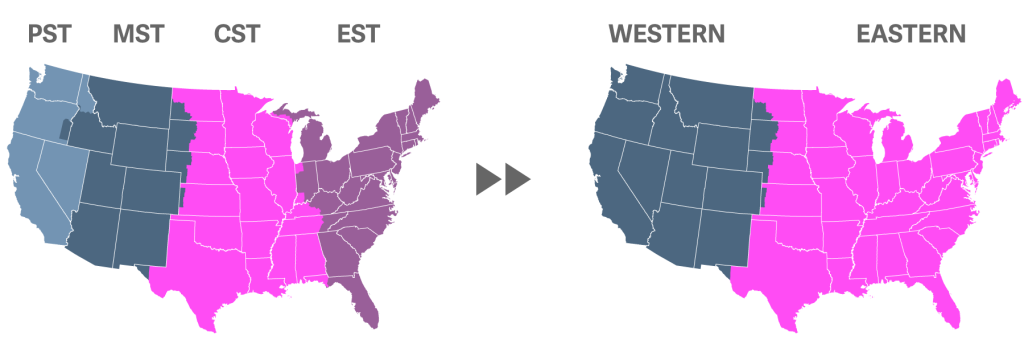
  • Consolidate and reduce the four current continental U.S. time zones (Eastern, Central, Mountain, Pacific) to just two (Eastern, Western)

Under the Schrager scenario, the new time zone map for the continental United States would look like this:

simplified time zone mapDr. Schrager points out that, while a fewer number of larger time zone geographies would seem to remove some people further from their “true” time zone, the realities of global commerce are already doing that anyway.

By contrast, she sees the benefits as more major.  For example, frequent travel between time zones under today’s four zones causes jet lag, robbing employees of productive work time.

With just a one-hour time difference between New York and California, bi-coastal travel would become almost effortless in that regard, Schrager maintains.

As for the disruption such a change might cause to international business coordination, Dr. Schrager contends that just as it took one or two countries to start things off in the 1880s, someone needs to step up to the plate today to start a new trend.

She says:  “… America won’t line up with the time zones of countries directly north and south unless this catches on as a global trend.  But the discontinuity ship already sailed when rich Western countries haphazardly adopted daylight savings time and most other countries didn’t.  Time is already arbitrary; why not make it work in our favor?”

Does Dr. Schrager raise some good points?  Would simplifying the time zone map and ditching daylight savings time be a “net positive” or not?

Some of her arguments seem to make sense to me.  What do you think?  Please share your thoughts with other readers if you’re so inclined.

A surprising development? America is now the world’s largest oil supplier.

number-1For those of us who came of age during the oil embargo of 1973 and the subsequent decades of high-priced, restricted-supply petroleum coupled with a contorted foreign policy continuously buffeted by those economic realities … the recent news that the United States is poised to become the world’s top oil supplier in 2013 comes as a bit of a surprise.

But it’s right there in black-and-white, in data published by PIRA Energy Group, a New York-based energy markets consulting firm:

  • This year, the United States is projected to produce an average of ~12 million barrels per day of liquid oil products (crude oil, natural gas liquids and biofuels together).
  • That’s ~300,000 barrels per day higher than Saudi Arabia … and ~1.6 million more than Russia.
  • The other countries that make up the “Big Ten” oil producers – China, Canada, the United Arab Emirates, Iran, Iraq, Kuwait and Mexico – don’t even come close to the “Big Three.”

Where’s Venezuela on the list?  Nowhere to be found.

Take that, Carlos Chávez and Nicolás Maduro!

The United States is forecast to pump approximately 7.5 million barrels per day of crude and concentrate in 2013.  That’s actually 3 million barrels less than Saudi Arabia and Russia.

But the shortfall is more than made up by the ~2.5 million in natural gas liquids and ~1 million of biofuels America is also producing every day.

The rise in U.S. production is practically unprecedented.  Only once before has a country raised its production faster (Saudi Arabia in 1970-74).

The reason for the rise in American production?  Two words:  “shale oil.”

USA Shale Gas Exploration ZonesU.S. shale oil and condensate production now stands at ~2.5 million barrels per day.  That’s slightly over one-third of total U.S. crude production.

And shale natural gas liquid production, at ~1.2 million barrels per day, is nearly half of total NGL production.

America’s shale oil boom could turn out to be of far greater import than all of the renewable or “alternative energy” schemes put together – despite the political attention and funding these more “sexy” technologies have had lavished on them by federal and state governments and research foundations.

Abetted by the explorationof shale oil formations via horizontal drilling and fracking, the impact of shale oil reserves isn’t a flash in the pan, either.  According to PIRA Energy, America’s position as the largest oil supplier in the world looks to be secure for many years.

Production growth rates may level off eventually, but PIRA forecasts that the United States will continue to increase its lead over Saudi Arabia and Russia until 2020 at least.

… And retain its production lead over all other countries until at least 2030.

What a relief all of this is.  Speaking for myself, I’m loving the fact that America is no longer so beholden to offshore energy resources controlled by people who “might” be our friends one day … and who “might” not be the next.

It’s like financial debt:  Having too much debt is really bad.  Having no debt at all is really nice.

Energy independence — or something close to it — is really nice, too.