Uber über alles? Ride-hailing services are coming on stronger than ever.

Business travelers have spoken with their wallets.

Uber logoIt looks as if a major milestone has been reached in the battle between “old world taxis” and “new world Uber.” An expense report study covering the second quarter of 2015 is showing that Uber and other ride-hailing services have overtaken the use of taxis – at least when it comes to business travelers.

The quarterly report was released by Certify, an expense management system provider. It reveals that Uber accounted for ~55% of ground transportation receipts, whereas taxi services accounted for only ~43% of receipts.

That’s a big jump from previous quarters; taxi services long dominated, staying well above 50% as recently as the first quarter of this year.

And this report isn’t based on some small data set, either. Certify’s stats are derived from millions of trip receipts submitted by its North American client base – nearly 30 million receipts over the course of a single year.

Clearly, Uber and other services that connect travelers through smartphone apps have succeeded beyond many people’s expectations.

But not everyone is pleased – beginning with taxicab services and their political allies.  Understandably, they’re frightened by the prospects of seeing the most fundamental tenets of their “business protection plan” melt away before their very eyes.

Depending on how people come down on the issue, opinions can be particularly passionate. Consider these responses prompted by a recent AP article on the topic published by ABC News:

Pro-Taxi Reader: Uber is breaking laws and evading taxes and municipal dues on a mass scale. How do you “adapt” to that? How to adapt to this unfairness and criminality? I personally suggest stop paying taxes, or start a strike like they did in Paris. It seems that in [the] U.S., Uber’s lobbyists and endless BS-PR campaigns control the country.

Pro-Uber Reader: Is it really “fair” for a city to charge one million dollars to have a taxi license (New York City)? Most of the taxi BS is from mafia-run business[es] who have fought for the last 70 years to keep competition out.

Another Pro-Uber Reader: The current system of licensing taxis should be reconsidered.  This system smacks of monopolies, with barriers to entry that are impossible.  There is no free market when you can’t get a license to operate.

Certain national politicians are even getting into the game, finding fodder for campaign rhetoric aimed at constituents who are frightened by the implications of the new work paradigm.

Here’s an excerpt from a speech by Hillary Clinton:

“Many Americans are making extra money renting out a small room, designing websites, selling products they design themselves at home, or even driving their own car. … This on-demand, or so-called ‘gig economy,’ is creating exciting opportunities and unleashing innovation. But it’s also raising hard questions about workplace protections and what a good job will look like in the future.”

These are good points to raise, and it’s certainly fine to weigh the pros and cons of the so-called “new economy.”

At the same time, it’s pretty ironic to see how people supporting a candidate who questions ride-hailing services are so “onboard” with Uber – at least in practice if not in their rhetoric.

To illustrate, take a look at these Federal Election Commission filings from the Ready PAC (the pro-Clinton SuperPAC formerly known as Ready for Hillary PAC) here and here and here.  There’s a “whole lotta Uber” going on!

Getting back to the real world of business travel, in nearly every city, Uber is offering better pricing than taxi services – at least when it comes to services like UberX which typically involve transport in smaller cars like a Honda Civic or Toyota Camry.

SUVs and limo cars are pricier, of course, and may not represent a major cost improvement. And Uber’s prices charged also rise during periods of “surge” usage.

taxi cabBut considering the comparative cost as well as the quality of service, in some markets Uber beats out taxis by a city mile.

How else to explain results in the most recent quarter where ~60% of rides in Dallas expensed through Certify were for Uber vehicles rather than taxis. In San Francisco, Uber’s share was even higher:  nearly 80%.

No wonder taxi services are running off to local elected officials, boards and commissioners to try to shore up their faltering business model.

It’s worth noting that some employers harbor reservations about ride-hailing services — particularly concerns about lack of regulation, safety and liability. But even in non-regulated locations, protections exist. Uber as well as Lyft, another industry participant, provide driver insurance during paid rides, and they require drivers to carry their own personal auto insurance as well.

It would be interesting to hear the views of people who have used Uber or other ride-hailing services. Do you see them as the wave of the future? Or are there drawbacks? Please share your experiences and observations with other readers here.


TV’s Disappearing Act

Television viewing among 18- to 24-year-olds reaches its lowest level yet. 

TV watchingThe latest figures from Nielsen are quite telling:  The decline in TV watching by younger viewers is continuing – and it’s doing so at an accelerating pace.

Looking at year-over-year numbers and taking an average of the four quarters in each year since 2011, we see that the average number of hours younger viewers (age 18-24) spend watching television has been slipping quite dramatically:

  • 2011: ~24.8 hours spent watching TV weekly
  • 2012: ~22.9 hours
  • 2013: ~22.0 hours
  • 2014: ~19.0 hours

It’s nearly a 25% decline over just four years.  More significantly, the most recent yearly decline has been at a much faster clip than Nielsen has recorded before:

  • 2011-12 change: -7.7%
  • 2012-13 change: -3.9%
  • 2013-14 change: -13.6% 

So far this year, the trend doesn’t appear to be changing.  1st quarter figures from Nielsen peg weekly TV viewing by younger viewers at approximately 18 hours.  If this level of decline continues for the balance of the year, watching TV among younger viewers will be off by an even bigger margin than last year.

There’s no question that the “great disappearing television audience” is due mainly because of the younger generation of viewers.  By contrast, people over the age of 50 surveyed by Nielsen watch an average of 47.2 hours of television per week — nearly three times higher.

picLest you think that the time saved by younger viewers is going into outdoor activities or other recreational pursuits and interests, that’s certainly not the case.  They’re spending as much time using digital devices (smartphones, tablets and/or PCs) as they are watching TV.

So, it’s a classic case of shifting within the category (media consumption), rather than moving out of it.

I don’t think very many people are surprised.

… And then there were two: Facebook is nipping at YouTube’s heels.

Facebook “grows up great” to challenge YouTube for video supremacy online.

FB vs YTOnly few years ago, YouTube was pretty much the only game in town when it came to online video.  And Facebook wasn’t even in the picture.

Today, the online video landscape looks far different.

In fact, Facebook is on track to deliver more than two-thirds as many video views as YouTube this year.  And both services have a comparable number of monthly users overall.

Recently, market forecasting firm Ampere Analysis surveyed ~10,000 consumers in North America and Europe.  Approximately 15% of them had watched at least one video clip on Facebook within the past month.

While Facebook hasn’t exactly caught up with YouTube, its rise has been pretty stunning — especially when you consider the massive head-start YouTube had.  More than five years, in fact, which is a lifetime in the cyberworld.

Undoubtedly, one reason for Facebook’s success in video is its “autoplay” feature which snags viewers who might otherwise scroll by video postings.  Facebook reports that it has experienced a ~10% increase in engagement as a result of adding this functionality.

And there’s another big advantage for advertisers that Facebook possesses.  Since its viewers are always logged in, Facebook has the potential to collect far more demographic and behavioral data on its viewers that advertisers can tap into to target specific demographics.

For now at least, Facebook doesn’t offer the option for ads to run before video clips begin playing (the ads appear after the content).  Also, Facebook’s ad charges kick in after just three seconds of the ad being shown, compared to YouTube which sets the bar higher for ad charges to take effect.

[Incidentally, Twitter has the same 3-second policy as Facebook, whereas Hulu charges only for ads viewed all the way through.]

Another difference is that Facebook charges for every ad view, so if a viewer watches a video twice — even if it’s the same video in the same viewer session — Facebook counts it as two views.  On YouTube, that would be considered one view, regardless of how many times the video is watched.

Of course, these kinds of differences can be adjusted — and there’s no reason to think that Facebook won’t do just that if it determines that making those changes are in their best business interest.

Besides, advertising rates are already similar between the two platforms, which suggests that advertisers have come to place a high value on Facebook’s robust audience targeting.

Autoplay features have raised some questions as to what constitutes a true video “view.”  If video ads are being autoplayed, views are easier to get, but are they worthwhile?  Also, the fact that autoplay videos are running without sound until such time as the viewer chooses to engage is causing some advertisers to create content that “make sense” even on mute.

But the bottom line on Facebook’s foray into video seems to be that the demographic and psychographic audience targeting Facebook can deliver is of important value to advertisers.

Add the fact that YouTube is no longer the only major online video platform, and it’s easy to see how significant competition from Facebook risks the loss of advertising dollars for YouTube, along with damaging YouTube’s growth prospects over time.

This is getting interesting …

Which brands are America’s most “patriotic”?

patriotismWith the 4th of July holiday nearly upon us, sharing the results of a recent brand study seems particularly apropos.

Since 2013, Brand Keys, a branding consulting firm, has conducted an annual evaluation of famous American brands to determine which ones are considered by consumers to be the most “patriotic.”

In order to discover those attitudes, Brand Keys surveyed nearly 5,500 consumers between the ages of 16 and 65, asking them to evaluate American brands on a collection of 35 cross-category values – one of which was “patriotism.”  (The number of brands included in the evaluation has varied somewhat from year to year, ranging between 195 and 225.)

Of course “patriotism” is a hyper-qualitative measure that’s based as much on emotion and each individual person’s own point of reference as on anything else.

Brand familiarity and longstanding engagement in the marketplace helps, too.

So it’s not surprising that the American brands scoring highest on the patriotism meter are some of the best-known, iconic names.

For the record, listed below are the “Top 10” most patriotic American brands based on Brand Keys’ most recent survey – the ones that scored 91% or higher on the patriotism scale (out of a possible 100 percentage points):

  • Jeep (98%)
  • Coca-Cola (97%)
  • Disney (96%)
  • Ralph Lauren (95%)
  • Levi Strauss (94%)
  • Ford Motor (93%)
  • Jack Daniels (93%)
  • Harley Davidson (92%)
  • Gillette (92%)
  • Apple (91%)
  • Coors (91%)

The next highest group of ten patriotic brands scored between 85% and 90% on the survey:

  • American Express (90%)
  • Wrigley’s (90%)
  • Gatorade (89%)
  • Zippo (89%)
  • Amazon (88%)
  • Hershey’s (87%)
  • Walmart (87%)
  • Colgate (86%)
  • Coach (85%)
  • New Balance (85%)

[As an aside … the only entity to score a perfect patriotism rating of 100% was the U.S. Armed Services.]

To be sure, “rational” aspects like being an American-based company whose products are actually made in the United States affect the patriotism rating of individual brands.

But other attributes — such as nationally directed customer-service activities and highly publicized involvement in sponsorships and causes that tie to the American experience — are attributes that add to a general image of being patriotic.

Robert Passikoff, Brand Keys’ president, expanded on the idea, stating,

“Today, when it comes to engaging consumers, waving an American flag and actually having an authentic foundation for being able to wave the flag are two entirely different things — and the consumer knows it. 

“If you want to differentiate via brand values – especially one this emotional – if there is believability, good marketing just gets better.” 

This is the third annual report issued by Brand Keys that’s been focused on brand patriotism – one of 35 brand values comparatively surveyed.  Over the three years, there’s been some change in the patriotism rankings, with Colgate, Wrigley’s and Zippo falling out of the Top Ten and being replaced by Jack Daniels, Gillette, Apple and Coors in 2015.

What I find intriguing about the findings is that there isn’t a very strong correlation between the perceived patriotism of specific American brands and whether or not most of their products are made in the United States versus offshore.   Of course, foreign production is more the norm than ever in the global economy.  What’s important is how the consumer reacts to that reality.

jeep patriotismWith that point in mind … what about Jeep?  Now that it is part of the global Fiat organization, should Jeep no longer be considered an American brand?  Whether it is or not, the brand has the distinction of achieving the highest patriotism score outside of the U.S. Armed Services.

The bottom line is this:  Brands, what they “mean” and what they stand for are based on the emotional as well as the rational – with the emotional aspect being the trump card with consumers.

Jeep, with all of its associations with winning  wartime campaigns (particularly World War II), likely will always be a beloved “patriotic” U.S. brand, regardless of its recent Italian parent company ownership.

Are there brands not listed above that you would consider to be “highly patriotic”?  If so, please share your thoughts with other readers here.

Criptext: When a recall actually looks pretty good.

Criptext logo

I doubt there are many of us in business who have never inadvertently sent an e-mail to the wrong person … or sent a message before it was fully complete … or forgot to include an attachment.

In such cases, it would be so nice to be able to recall the e-mail — just like we used to do in the days of postal mail simply by retrieving the letter from the outgoing mail bin.

Recent news reports reveal that this capability is actually a reality now.

In the fast lane?  Criptext principals just completed a successful round of investment funding.
In the fast lane? Criptext principals just completed a successful round of investment funding.

A start-up firm called Criptext has just raised a half-million dollars in private investment funds to help it perfect and expand a product that allows any sent e-mail to be recalled — even if the recipient has already opened and read it.

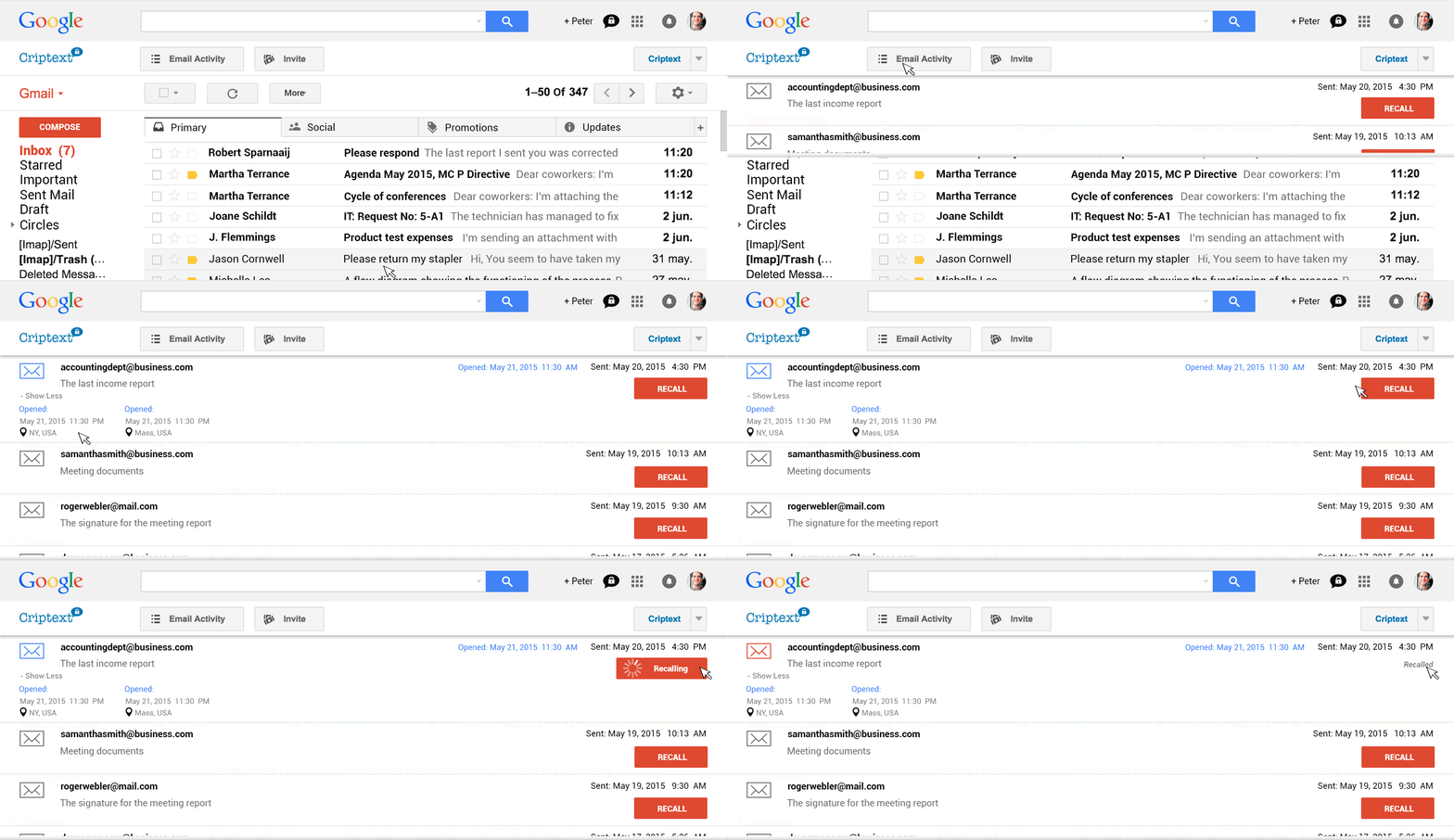
According to a report from Business Insider, Criptext is currently available as a plugin and a browser extension for the popular Outlook and Gmail email services.  It operates inside of the email, enabling the sender to track when, where and who has opened emails and/or downloaded attachments within them.

In addition, Criptext also enables the sender to recall emails, and even to set a self-destruct timer to automatically recall emails after a specified length of time.

Viewing a screenshot of how Criptext works (in this case with the Gmail service), things look pretty simple (and pretty cool, too):

Criptext activity panel example

I thought it would be only a matter of time before some developer would figure out a way to “unwind” an email communiqué once the “send” button was hit.  And now we have it.

Of course, time will tell whether Criptext can live up to its billing … or if it turns out to be more of a nightmare of glitches than a dream come true.

It would be great to hear from anyone who may have first-hand experience with Criptext — or other similar email functionalities.  Please share your experiences and perspectives pro or con with other readers here.
Big, brawny behemoth: Google’s Gmail email service reaches 900 million active users.

Google GMailIt’s been several years since Google gave us an official report on Gmail’s user base.

But now we have a new announcement from one of Google’s senior vice presidents,  reporting that Google’s Gmail service has now reached a new milestone of 900 million active users.

Three years ago — the last time Google commented officially on the Gmail active user base — the company had reported ~425 million users.

… Which means that in the past three years alone, Gmail’s active user base has more than doubled — and doubled from an already strong baseline figure.

In fact, Gmail had already become the most popular email service in America by 2012.

Despite the fact that most other email services have failed to report newer stats since then, it’s a safe bet that Google remains King of the Hill when it comes to the number of active users of its Gmail email service.

[Related to this, the same Google spokesperson is also reporting that three out of four active Gmail service users are accessing their accounts on mobile devices.  I’m sure this doesn’t come as a surprise to anyone.]

The continued robust growth in Gmail users may explain why Google hasn’t been making significant changes to the service or the user interface.  Any service that’s the largest one out there can’t risk irritating or alienating large swaths of its users.

Indeed, even when an email service isn’t the biggest or most important one in the market, making changes can still be a risky move.  Just recall the howls of protest from users (and even some of Yahoo’s own employees) when Yahoo made sweeping changes to its e-mail service about 18 months ago.

No doubt, Yahoo has lost a certain number of subscribers who simply couldn’t abide the changes.

Google InboxIn Google’s case, what it’s doing is using Inbox, which Gmail users see on top of the Gmail platform, as an area to experiment with new email features and such — without upsetting satisfied Gmail users who may have little appetite for those changes.

Inbox is an email app by Google for Android and iOS, along with web browsers Chrome, Firefox, and Safari.  In a hint at things to come, Google has now made Inbox open to all users.

Google claims that its Gmail and Inbox services serve different functions and needs, and that it will continue to work on enhancements and updates for both.

But it’s pretty clear that Inbox is where the bulk of Google’s developmental effort and energy are being directed these days.

The Ideal Privacy Policy?

policyRecently, I came upon a column written by software entrepreneur and business author Cyndie Shaffstall in which she proposes the following policy for any company to adopt that truly cares about its customers’ privacy:

The Ideal Privacy Policy:

1.  We have on file only your first name, last name, and e-mail address.

2.  We ask for nothing else.

3.  We send you only e-mails you request.

4.  We have nothing to share with others – and wouldn’t if they asked.

5.  We won’t change this policy without prior notice – ever. 

Thank you for being our customer, 

~ Your Grateful Vendor 

Cyndie Shaffstall
Cyndie Shaffstall

As Shaffstall herself acknowledges, she’s never actually seen a policy like this.

But if a company actually adopted such a policy, it would certainly make people more comfortable about purchasing its products — particularly things like phones, wearables and other products that capture and process user-specific data as part of their functionality.

Unfortunately, Shaffstall is correct in asserting that few if any companies would actually adopt such a privacy policy.  Because if they did, they’d be voluntarily walking away from so much of what makes the online world such a lucrative business proposition.

But think for a moment:  Wouldn’t it be absolutely wonderful if we didn’t have to consider such privacy policies “too good to be true”?

Do you know any real-live examples of companies whose privacy policies come close to this ideal?  If so, please share them with readers here.

On the march: Ad blocking tools continue their rise in popularity.

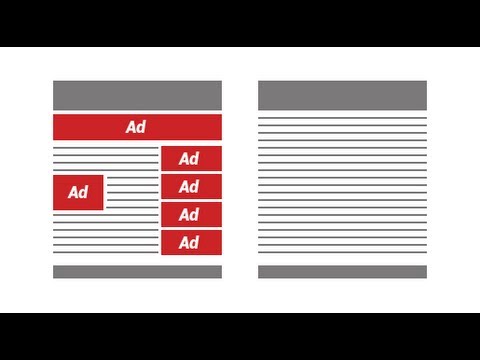
What Adblock PromisesI’ve blogged before about the rise of online ad blocking tools and their growing popularity with consumers.

One example:  AdTrap – a device that intercepts online ads before they reach any devices that access a person’s Internet connection.

AdTrap’s motto is simple and powerful:  “The Internet is yours again.”

In the months and years since I first blogged about it, ad blocking has only become more popular – so much so that it’s no longer just a mild irritant to advertisers and publishers, but rather a commercial threat that has a significant impact on publishers’ financial bottom lines.

It’s hardly surprising.  Most people want to run as far away from advertising as they can.  For years, we’ve taken trips to the kitchen or bathroom during TV commercial breaks.  We’ve TiVo’d ads out of existence.

And the participation levels in online ad blocking bear this out now as well.  According to data from PageFair, a company that measures publishers’ ad blocking rates and provides alternative non-intrusive advertising options, the number of ad blocker tool users reached nearly 145 million people in 2014.

That’s more than five times the 21 million users of ad blocker tools we had in 2010.

Growth continues apace:  Adblock Plus, which is the biggest of the ad blocking tools, reports more than 2.3 million downloads each week, on average.

Where are people blocking online ads?  In all sorts of areas.  But the most frequent incidence of ad blocking is on gaming sites, where blocking rates are in excess of 50%.

But blocking is happening on other online sites, too, including entertainment, fashion and lifestyle sites – albeit at about half the degree as on gaming sites.

[Tellingly, ad blocking is happening on technology sites, too, where about a quarter of the ads are being blocked.]

One of the more interesting nuggets of information reported by PageFair is the difference in ad blocking rates by country.  What we see is that Americans lag well-behind a number of other countries:

  • Argentina: ~34 of online ads are blocked
  • Poland: ~34% are blocked
  • Sweden: ~33%
  • Finland: ~32%
  • Germany: ~30%
  • United States: ~15%

Germany, in particular, has been the scene of several fervent legal skirmishes in recent years.  There, the publisher of the news magazine Die Zeit sued the parent company of AdBlock, claiming that the ad blocking tool is “illegal and anti-competitive.”  (The suit went nowhere, incidentally.)

Some observers speculate that the higher incidence of ad blocking in certain countries may be tied to those nations’ sociological profiles.  “I personally suspect that in some of these countries, citizens are more concerned about their personal privacy – perhaps for historical reasons,” Sean Blanchfield, PageFair’s CEO, has remarked.

One might wonder if, in the age of Edward Snowden and the Patriot Act (now superseded by new legislation ironically called the “USA Freedom Act”), Americans’ ad blocking practices might now be poised to align more closely with Europeans’.

I imagine we’ll know more about that degree of convergence within a year or two.

Gallup’s Payroll-to-Population Rates Pinpoint the Go-Go Metro Areas

Commuters in New York City.

The Gallup polling organization’s P2P measurements (payroll-to-population employment rates) are an interesting metric and add an extra dimension of understanding as to what’s happening with employment across the United States.

Gallup’s evaluation is limited to the top 50 most populous SMSAs (metropolitan statistical areas).  But because of the large number of phone interviews conducted within each metro area (ranging from ~1,300 to 18000+ depending on the population), the findings are statistically significant whether looking nationally or within a particular urban area.

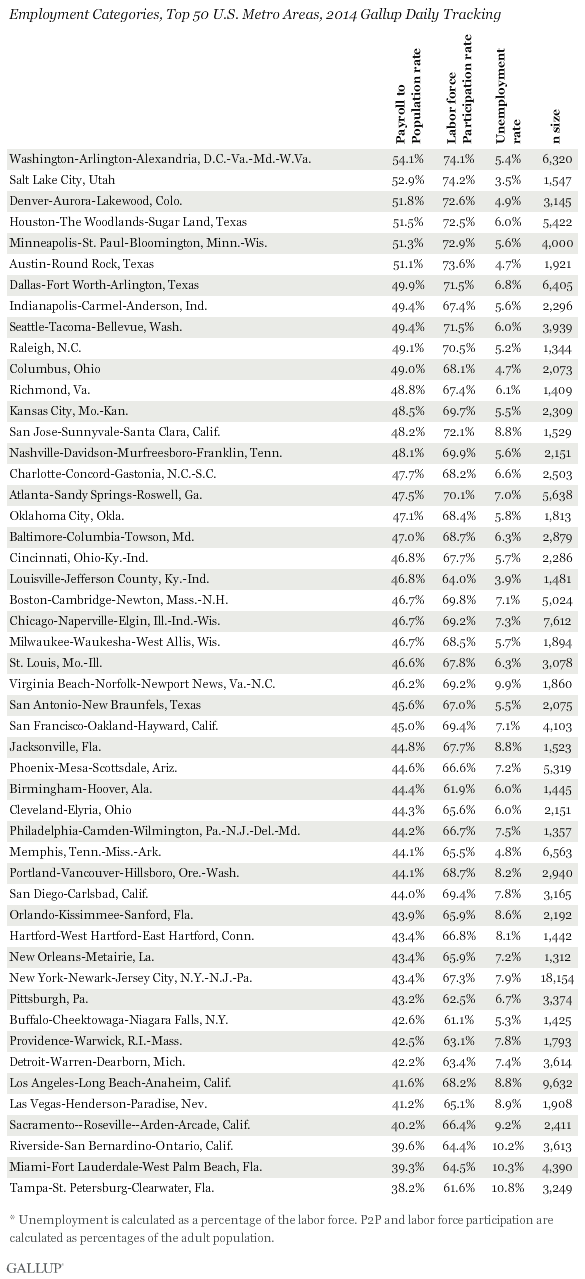
The latest surveys, conducted by Gallup in 2014 among nearly 355,000 households, find that two metro areas with the highest P2P measures are Washington, DC and Salt Lake City, UT — urban centers that couldn’t be more dissimilar in other ways.

For DC, the P2P rate is 54.1.  The calculation is derived from the percentage of the adult population (age 18+) who are employed full-time for an employer for at least 30 hours per week.

For Salt Lake City, the P2P rate is just slightly lower, at 52.9.

Other top scoring metro areas include three markets in Texas (Austin, Dallas-Ft. Worth and Houston).

What about metro areas at the other end of the scale?  Those would be Miami (38.2 score) and Tampa (39.3).

Three other low-scoring MSAs are located in California:  Los Angeles, Riverside and Sacramento.

What do these stats mean in a broader sense?

For one thing, there’s a direct relationship between employment stats and P2P performance:  Metro areas with the highest unemployment rates correlate to those with low P2P scores.

For instance, Miami’s unemployment rate in 2014 was 10.3%.  It was 10.2% in Riverside, CA.

That’s a big contrast with Salt Lake City, which had an unemployment rate of just 3.5%.

I find one interesting deviation from the norm:  Buffalo, NY.  There, while the unemployment rate is one of the ten lowest in the country, its labor force participation rate is also very low — bottoms among all 50 metro areas, in fact.

Shown below are the figures for all of the 50 largest U.S. metro areas based on the interviews conducted by Gallup in 2014:

Gallup full results

More details on the research findings are available here.

Conundrum Corner: Europe, Google and “The Right to be Forgotten”

file and forgetThis past week, The Wall Street Journal published an article which reported on the fallout from the European Court of Justice’s 2014 ruling that Google is required to remove links in European search results for individuals whose reputations are harmed by them.

In practice, it’s turned out to be quite a conundrum.  Since the ruling went into effect, Google has had to field requests to remove nearly 950,000 links from European search results.

Each request is deliberated on a case-by-case basis by a panel of specialists.  Reportedly, Google has dozens of attorneys, paralegals and engineers assigned to the task, which is based at its European headquarters facilities in Dublin, Ireland.

So far, approximately one-third of the links in question have been removed while about half were deemed acceptable to continue displaying in search results.  The remaining cases – the gnarliest ones – are still under review.

Unfortunately, the European Court of Justice hasn’t been very specific on the standards to apply when evaluating each request – other than to assert that search results should be removed that include links to information that is:

  • Irrelevant
  • Inadequate
  • Excessive
  • Harmful
  • Outdated

Which, of course, could encompass practically anything.  But the broader standard the Court has sought to uphold is “the right to be forgotten.”

Google hasn’t exactly been a willing participant in these mini-dramas.  Peter Fleischer, Google’s global privacy counsel, contends that Google has been compelled “to play a role we never asked to play – and don’t want to play.”

Lisa Fleisher and Sam Schechner, the authors of the Wall Street Journal article, noted several examples of criteria that Google appears to be using when evaluating individual requests for removal.

More likely to be removed are search entries pertaining to crimes committed long ago and expunged from criminal records … nude or other revealing photos published without the permission of the subjects … and arrest records for petty infractions.

Less likely to be removed:  stories about public figures.

As for the “group dynamics” involved in the decision-making, Fleischer reports that the committee’s votes are normally “a large majority in favor of one decision or the other.”

Looking ahead, as the experiment in parsing web search results to remove certain links while retaining others continues, it’s sure to have implications worldwide.

One reason is that, for now at least, Google has been removing search results only from European domains such as google.it or google.es, but not from the far-more-ubiquitous U.S.-based google.com – even when accessed from Europe.

This means that the “offending” search results can continue to be viewed, retrieved and opened easily.

That fact isn’t sitting well with EU privacy regulators.  In fact, they’ve already issued an opinion contending that Google’s actions are insufficient, and they are seeking wider compliance.  The potential price for not doing so is – you guessed it – legal action.

As time goes on, it will be interesting to see what ends up leeching into the American sphere when it comes to the ability of people to have erroneous or unflattering information about them that is currently so readily visible removed from view.

Clearly there are competing principals at work:  freedom of information versus reputation protection.

paper documents on fileCourt documents and similar documentation have always been public-access information, of course.  But up until a few years ago, anyone interested in trolling for “dirt” on an individual or a company had to do costly, proactive searching through reams of paper-based documents.

Not only was it a labor-intensive process that might or might not result in anything of substance, the source information itself was scattered among thousands of county seats all across America.

That alone was enough to guarantee that most documents were effectively far away from public view.

But in today’s everything-digitized world, court documents – many dating back decades – have been optically scanned and can now be keyword-searched within an ounce of your life.

digitized docsWhat used to take months and cost plenty can now be researched in a matter of minutes.

And beyond court or government documentation is the press, which can get things very wrong (or simply premature) when reporting on controversial or titillating news items.

It affects companies as well as individuals.  I recall one such example in Baltimore from a number of years ago.  The local business press reported on a lawsuit brought by a disgruntled creditor against another company.  (I’m not naming the companies in question in deference to their reputations.)

The press reporting focused on the plaintiff’s petition to force the company into bankruptcy by virtue of the alleged “unpaid debt.”  The fact that the substance of the suit was found wanting and the defendant firm cleared of wrongdoing made little difference when it came to the reputation of the company and its principals;  the original news reports continue to have a life online, years later.

As the CEO the defendant company wrote to the publication involved,

“We now live in an age where digital documents take on a life of their own, and where it is no longer sufficient to consider whether someone might read a newspaper article on a given page on a given day.  Now, with the press of a button articles are stored in massive servers and retrieved by anyone around the world, leaving innocent people branded forever by erroneous words and faulty assumptions. 

It is your ethical responsibility to avoid causing undue harm to innocent parties by prematurely publishing information that others will negative construe and act upon.  Waiting a little longer to clarify the facts and determine the truth is sensible public policy and only makes your paper’s articles more trustworthy and fair, thereby avoiding the journalistic equivalent of shouting ‘fire’ in a crowded theater.”

It seems to me that we’re just starting down a road with this issue, and we don’t really know where it’s going to end up.

Considering everything – the European Court of Justice, Google and the global nature of “search and destroy,” I’d be interested in hearing what readers think about the situation, the competing issues, and the ultimate destination.