What’s the Latest Forecast on U.S. Ad Spending?

ad forecastingMost observers agree that 2015 will be a decent-or-better year for ad spending.  But how will it break down by media segment?

Industry and market forecasting firm Strategy Analytics has just released its latest U.S. advertising spend forecast, which it expects to total almost $190 billion.  That’s about a 3% increase over 2014.

But there are wide variations in the growth expectations depending on the media type.

Digital advertising leads the pack, with an expected growth increase in double digits, while at the other end of the scale, print advertising is forecast to drop by approximately 8%:

  • Digital advertising: 13.0% increase in 2015 U.S. ad spend
  • Outdoor advertising: +4.8%
  • Cinema advertising: +3.4%
  • Radio advertising: +1.8%
  • TV advertising: +1.7%
  • Print advertising: -7.9%

Of course, “digital advertising” is a broad category, and within it Strategy Analytics expects certain sub-categories to grow at a faster clip:  Social media advertising looks to be the star in 2015 (+31%), followed by video advertising (+29%) and mobile advertising (+20%).

Even with these lucrative growth expectations, search advertising (SEM) will continue to represent the lion’s share of digital ad revenues – around 45%.

Also, despite the dramatic growth of digital, the segment isn’t expected to break 30% of all U.S. advertising in 2015.  The more traditional TV ad segment continues to lead all others, although it has fallen below the 50% share of all advertising in recent years.

Here’s what Strategy Analytics is forecasting for ad expenditures by media segment for 2015:

  • TV advertising: ~$79 billion in 2015 U.S. ad spending
  • Digital advertising: ~$53 billion
  • Print advertising: ~$28 billion
  • Radio advertising: ~$18 billion
  • Outdoor advertising: ~$9 billion
  • Cinema advertising: ~$1 billion

Strategy AnalyticsLeika Kawasaki, a digital media analyst and one of the Strategy Analytics Advertising Forecast report’s co-authors, notes that  looking ahead to 2018, TV’s share of advertising revenue is expected to fall further to ~40%, while digital advertising’s share will reach ~35%.

However, it’s not that TV’s volume will be declining — it’s more that digital will be robbing more funds from other segments (particularly radio and print).

Additional details on the 2015 forecast can be viewed here — if you wish to shell out $7,000 for the report, that is.


Social media and marketing: Is the honeymoon over?

social mediaIt’s no secret that companies large and small have been putting significant energy into social media marketing and networking in recent years.

It’s happened for a variety of reasons – not least as a defensive strategy to keep from losing out over competitors who might be quicker to adopt social media strategies and leverage them for their business.

And yet …

Now that the businesses have a good half-decade of social media marketing under their belt, it’s pretty safe to say that social tactics aren’t very meaningful sales drivers.

That’s not just me talking.  It’s also Forrester Research, which as far back as 2011 and 2012 concluded this after analyzing the primary sales drivers for e-commerce.  Forrester found that less than 1% was driven by social media.

And in subsequent years, it’s gotten no better.

A case in point:  IBM Smarter Commerce, which tracks sales generated by 500 leading retail sites, has reported that Facebook, LinkedIn, YouTube and Twitter combined represent less than 0.5% of the sales generated on Black Friday in the United States.

Those dismal results aren’t to say that social media doesn’t have its benefits.  Generating “buzz” and building social influence certainly have their place and value.

But considering what some businesses have put into social media in terms of their MarComm resources, a channel that contributes less than 1% of sales revenues seems like a pretty paltry result – and very likely a negative ROI, too.

Going forward, it would seem that more companies should pursue social media marketing less out of a fear of losing out to competitors, and more based on whether it proves itself as an effective marketing tactic for them.

Consider the points listed below.  They’ve been true all along, but they’re becoming even more apparent with the passage of time:

1.  Buying “likes” isn’t worth much beyond the most basic tactical “bragging rights” aspects, because “likes” have little intrinsic value and can’t be tied directly to an increased revenue stream.

2.  A great social media presence doesn’t trump having good products and service; even dynamite social media can’t camouflage shortcomings of this kind for long.

3.  Audiences tend to “discount” the value of content that comes directly from a company.  This means publishing compelling content that clears that hurdle requires more skill and expertise than many companies have been willing to allocate to social media content creation.

Calibrating the way they look at social media is the first step companies can take to establish the correct balance between social media marketing activities and expected results.  Instead of treating social media as the connection with customers, view it as a tool to connect with customers.

It’s really just a new link in the same chain of engagement that successful companies have forged with their customers for decades.  In working with my clients, I’ve seen this scenario play out the same basic way time and again; it matters very little what type of business or markets they serve.

What about you?  Have your social media experiences been similar to this — or different?  I welcome hearing your perspectives.

Banner Ads Turn 20 This Year …

… But who really wants to celebrate?

paint the town red
Celebrating in the geriatric ward: The online banner ad turns 20.

It might come as a surprise to some, but the online banner ad is 20 years old this year.

In general, 20 years doesn’t seem very old, but in the online word, 20 years is ancient.

Simply put, banner ads represent the geriatric ward of online advertising.

In fact, there’s very little to love anymore about an advertising tool that once seemed so fresh and new … and now seems so tired and worn-out.

Furthermore, banner ads are a symbol of what’s wrong with online advertising.  They’re unwelcome.  They intrude on people’s web experience.  And they’re ignored by nearly everyone.

Old banner advertising
A whole lotta … nothing? Online banner ads in 2015.

But despite all of this, banner ads are as ubiquitous as ever.

Consider these stats as reported by Internet analytics company ComScore:

  • The number of display ads served in the United States approaches 6 trillion annually.
  • Fewer than 500 different advertisers alone are responsible for delivering 1 billion of these ads. 
  • The typical Internet user is served about 1,700 banner ads per month. (For 25 to 34 year-olds, it’s around 2,100 per month.) 
  • Approximately 30% of banner ad impressions are non-viewable.

paying no attention to advertisingAnd when it comes to banner ad engagement, it’s more like … disengagement:

  • According to DoubleClick, Google’s ad serving services subisidary, banner ads have a click rate of .04% (4 out of every 10,000 served) for ads sized 468×60 pixels. 
  • According to GoldSpot Media, as many as 50% of clicks on mobile banner ads are accidental. 
  • According to ComScore, just 8% of Internet users are responsible for ~85% of the clicks on banner ads.

Come to think of it, “banner blindness” seems wholly appropriate for an advertising vehicle that’s as old as this one is in the web world.

The final ignominy is that people trust banner ads even less than they do TV ads:  15% vs. 29%, according to a survey conducted by market research company eMarketer.

Despite the drumbeat of negative news and bad statistics, banner advertising continues to be a bulwark of the online advertising system.

Publishers love them because they’re easy to produce and cost practically nothing to run.

Ad clients understand them better than other online promotional tactics, so they’re easier to sell either as premium content or as part of ad networks and exchanges.

There’s plenty of talk about native advertising, sponsored content and many other advertising tactics that seem a lot fresher and newer than banner ads.  But I suspect we’ll continue to be inundated with them for years to come.

What do you think?  Do you have a different prediction?  Please share your thoughts with other readers here.

The world of social media: Facebook here, there and everywhere.

If you think that Facebook has a hammerlock on social media across the world … you’re not off by much.

Facebook NetworkSocial media strategist Vincenzo Cosenza publishes a periodic world map of social networks in which he identifies the social networks that are the most popular in each of the 137 countries he tracks.

His evaluation is facilitated by a combination of website tracking data as aggregated by Alexa and other similar tools.

In viewing how the social media map has changed over time, what we see is that “Facebook blue” now dominates to such a major extent that the world map is looking more and more like a map of the British Empire – with the Spanish and Portuguese Empires thrown in for good measure.

In fact, according to Cosenza’s latest map, Facebook is the dominant social network in no fewer than 130 of the 137 countries being tracked.

That’s ~95% of them.

Not surprisingly considering their large populations, Facebook boasts the most members in the United States, followed by Brazil and then India.  (Brazil overtook India in the rankings in 2012.)

Each year, a few new counties are added to the Facebook column.  Sometimes the shifts are small (Moldova and Latvia are the latest), but this comparison between 2009 and 2014 maps certainly shows the overall trend towards Facebook, including such high-population countries as India, Brazil, Mexico and the Philippines:


global map of social media networks

Of course, a few of the non-Facebook countries are home to a big chunk of the world’s population:

  • China is dominated by QZone
  • VKontakte is the social platform of choice in Russia
  • Iran remains closed to Facebook or any other Western social media, although long-dominant Cloob has been replaced by Facenama as the largest social network there.

As for which social networks are vying for the #2 position after Facebook – in most cases, it’s LinkedIn, Badoo and Twitter.

But when it comes to true competition, it’s really just Facebook and then … all the rest.

So Many Magazines … So Little Time?

Who wants easy, unlimited access to thousands of publications?

magazinesYou might not, but millions of other people do, apparently.

And the crowd is getting ready to increase more, most likely.

As if there wasn’t enough material to read already, some online publication bundlers are making sure that people have unlimited access to the world’s most important periodicals for one low price.

This week, The Wall Street Journal blog reported that Magzter, a company that provides a single access point for more than 5,000 magazines published around the world, has now introduced a service plan it calls Magzter Gold.

logoIt’s an “all-you-can-read” option that gives subscribers online access to approximately 2,000 publications – many of them top-circulation magazines like ESPN, Maxim, New York Magazine and Forbes – for a flat rate of just $9.99 a month or $99.99 per year.

And access to this huge repository of publications is quick and easy via desktops, laptops and tablets, plus iOS and Android phone apps.

There’s also a plan called Magzter Gold Lite, allowing access to the subscriber’s choice of any five magazine titles (which can be changed from month to month).

The cost of that subscription?  $5 per month.

These two new programs are aimed at increasing Magzter’s subscriber base, which already numbers more than 4 million active monthly users.

Magzter isn’t the only company offering online access to a family of publications.  Other providers like Readly and Next Issue also offer programs encompassing the stable of magazine titles belonging to various different publishing arms (Condé Nast, Hearst, Meredith, Time).

But none of them have anything like the sheer number of titles Magzter is offering.

Readers of my generation (over the age of 50) grew up with print magazines and are preternaturally drawn to the tactile sensation of reading a physical magazine.  But I suspect that publication bundlers like Magzter represent the tip of the spear rather than simply a passing fancy.

The question is whether the changing mode of delivery ends up destroying the actual product that Magzter and others are able to peddle.  After all, were it not for the print magazines to begin with, what would these aggregators have to sell?

If what it boils down to is offering fee-based premium content that is no longer tied to a print magazine because the publication is no longer available in hard-copy form, will the quality of that content continue to be as high?

In many — perhaps most — cases, I think it’s doubtful.

If the print magazines that underlie the digital product offerings disappear, it wouldn’t surprise me if millions of readers fall away from subscription services in favor of trolling the Internet for similar content that’s easily available for the bargain price of … goose egg.

For those who are using access services like Magzter or Readly today, would you recommend them to others?  Is it the wave of the future?  Please share your perspectives with other readers here.

Native Advertising, Sponsored Content and “Truthiness”

There are just a few slight problems with sponsored content:  Readers consider it less trustworthy … and value it less.

Lack of trust in sponsored content
It’s really not that interesting — and I don’t trust you, anyway.

Here’s a behavioral statistic that should be a little disconcerting to marketers:  Only about one in four readers scroll down on sponsored content (native advertising) on publisher websites.

Compare that to ~70% of those same readers who scroll down on other types of news content.

That’s what the chief executive officer of Chartbeat, a developer and purveyor of real-time web analytics software for media publishers, has contended, leading others to try to probe these attitudes further and try to find out more about the dynamics that are at work.

One such effort is online field research conducted this past summer by Contently, a freelance writing services clearinghouse.  It discovered that the difference in engagement levels relates to “trust.”

Generally speaking, readers trust sponsored content a whole lot less than they do “normal” content.

More specifically, here’s what Contently’s research, which targeted ~550 U.S. adults ages 18 to 65, found in terms of trust attitudes:

  • I generally don’t trust sponsored content: ~54%
  • I trust the content only if I trust the brand already: ~22%
  • I trust the content only if I trust the publication: ~19%
  • I generally trust sponsored content:  ~5%

It gets even murkier when we consider that not all readers agree on the same definition of “sponsored content.”

While the largest proportion of people consider “sponsored content” on a news website to be an article that an advertiser paid to be created as well as had input into its content, it was only a plurality of respondents:

  •  A sponsor paid and influenced the article: ~48%
  • A news site wrote it, but a sponsor paid money for it to run: ~20%
  • A sponsor paid for its name to appear next to news content: ~18%
  • A sponsor wrote the article:  ~13%

And here’s a real kick in the gut:  More people in the Contently survey would rather be served “bad ol’ banner ads” than encounter sponsored news and other posts:

  • Would rather see banner ads:  ~57% of respondents
  • Prefer sponsored posts because banner ads are annoying: ~26%
  • Prefer sponsored posts because they’re more interesting than banner ads: ~18%

The findings aren’t much different based on the age or education levels of respondents, either.

If anything, more highly educated people (those with graduate degrees) are most likely to prefer banner ads over sponsored posts.  The reason boils down to concern over the issue of deception:  A large majority of respondents reported that they have ever “felt deceived” upon realizing an article was actually sponsored by an advertiser.

Considering the disapproving numbers collected in the survey, it’s not surprising that Contently also found that respondents are far prone to click on a piece of sponsored content compared to other content:

  • Less likely to click on sponsored content: ~66%
  • More likely: ~1%
  • Equally likely: ~33%

credible sourceLastly, publishers should take note that their credibility is being diminished in the eyes of many, based on the practice of publishing native advertising.  The Contently survey found that nearly 60% expressed the view that publishers lose credibility when they run such sponsored content.

Of course, native advertising and sponsored content isn’t going to go away.  It’s too wrapped up in today’s business models for successful publishing and successful brand engagement.

But it’s clear that publishers, advertisers and the brands they represent have a bigger hurdle to clear in order for their content to be considered worthy of their readers’ attention and engagement.

Google Comes Clean on Ad Viewability (or Non-Viewability?)

clear view or no clear viewThere have been quite a few reports in recent times pointing to the lack of viewability of online display advertising, and I’ve blogged about this topic before.

And now, we have the $55-billion “advertising vacuum-cleaner company” Google itself admitting as much.

It comes in a study that Google has just released.  The report presents findings from its analysis of display ad programs using its “active view” technology (like DoubleClick) to determine which factors are affecting the viewability of ads.

The results aren’t pretty; more on that below.

But first … why is Google doing this?

I suspect it’s because more advertisers are now insisting on paying only for their ads that have been actually viewed, as compared to those simply served.

Now, to what Google is reporting.  It turns out that fewer than half of all ad impressions served on Google’s display platforms are ever seen, because they’re served outside of the viewer’s browser window.

That is correct:  A huge chunk of Google’s billions in ad revenues that it collects come from ads that no one ever saw.

What digital advertising platforms love to remind us is that their programs are superior to “bad old television and radio advertising” because of their sophisticated targeting capabilities and their superior measurement metrics.

That may be.  But how is it all that different for TV viewers to miss an ad because they took a kitchen or bathroom break, compared to people who never even had the opportunity to see an ad that was “served” in a dead zone?

The next question is, “What can advertisers do to help minimize the incidence of phantom online advertising?”

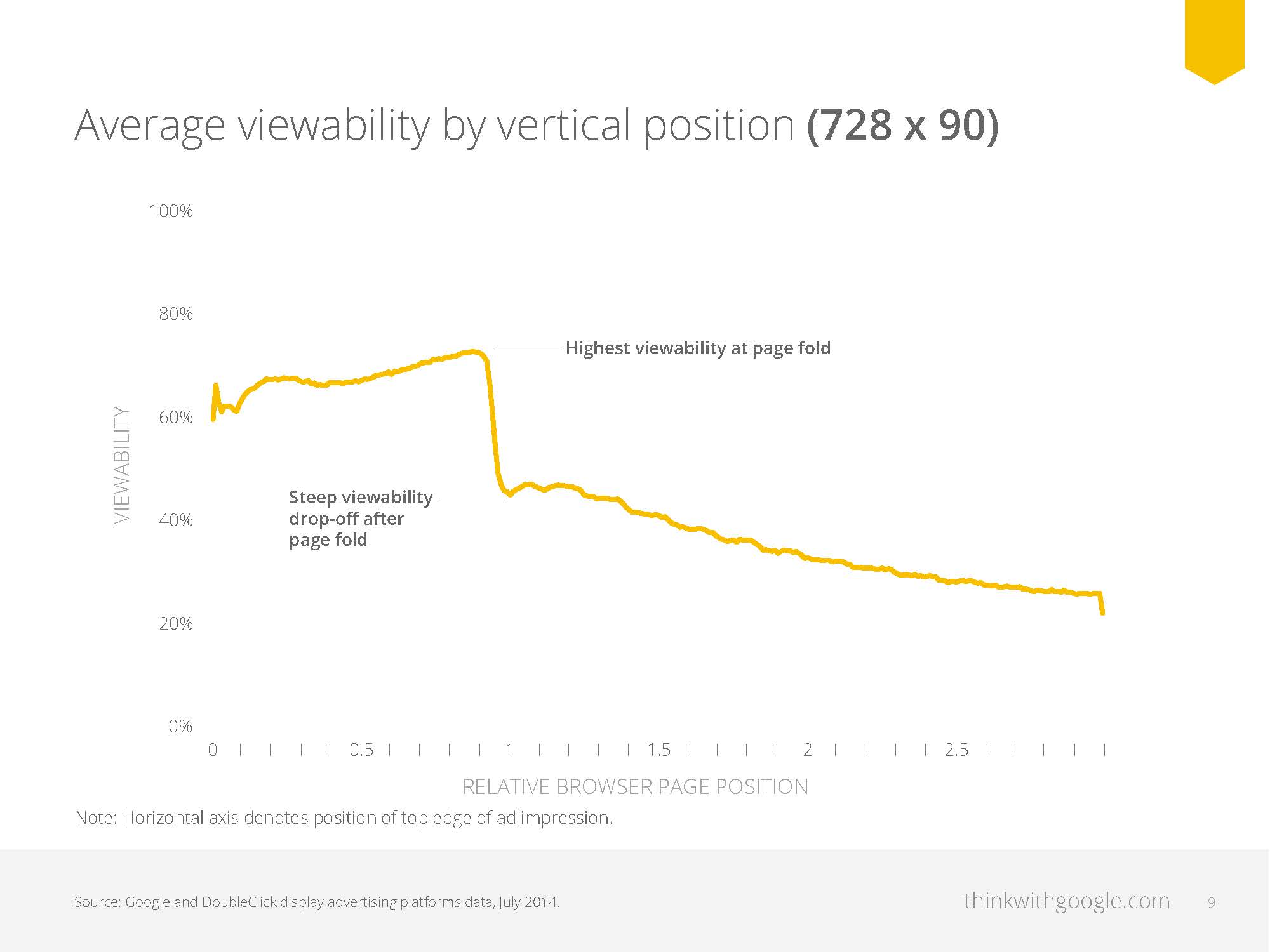
Helpfully, Google provides some clues in its report.  For instance, the highest viewability for ads is immediately above the “fold” – in other words, at the point where the viewer must begin to scroll down to see the rest of the page.

Surprisingly, viewability right above the fold is slightly higher than at the very top of the page.  But it’s massively less so just below that magic spot.  Google pressented five charts in its report to illustrate this drop-off phenomenon; the one reproduced below shows viewability of vertical position ads sized 728 x 90 pixels:

Average viewability by vertical position on online ads


Less surprising, perhaps, is the fact that vertical ads have higher viewability than horizontal or block ads, for the simple reason that they stay on the page longer:

Most viewable online display ad sizes


By publishing this data, Google purports to want to help their advertisers understand high- and low-value inventory better so they can target their campaigns more appropriately and effectively.

Google is also encouraging publishers to strive for delivering viewability rates in excess of 50% by offering ad inventory that will perform more effectively in its respective positions.

My only question is … why has it taken Google so long to set these standards and to publicize them in the first instance?

Sure, Google’s only the middleman between publishers and their viewers.  But it’s a pivotally important one.

America’s Smallest Businesses Get Hands-On with Digital Marketing

DIYAs more MarComm activities increasingly migrate to the web and to social media platforms, small businesses are increasingly taking a DIY approach in their marketing programs.

That’s the major takeaway from a survey of nearly 2,600 small business owners conducted by Insight By Design for Webs, a subsidiary of Vistaprint.

For purposes of the study, small businesses were defined as those having 10 or fewer employees.  The results of the field survey, which was conducted in the spring of 2014, were published in Vistaprint’s 2014 Digital Usage Study.

vistaprint-logoTwo-thirds of the small business respondents reported that they are actively using digital products to market their businesses.  Of those who have websites for their business, nearly 60% of them created their own websites using DIY tools.

An even larger proportion — 80% — act as their own webmasters.

Small businesses consider customer acquisition and generating new customer leads as the most important reasons for maintaining a web presence.

In the social media realm, Facebook is the most popular platform for promoting small businesses — so said nearly 90% of the survey respondents who are active in social media marketing.

Facebook is viewed as not only a vehicle for building brand awareness and acquiring new customers, but also for building a network of followers and engaging with them over time.

The survey’s respondents reported that all of the other major social platforms lag far behind Facebook in importance:

  • Facebook: ~88% consider it to be a highly important social media channel for their business
  • LinkedIn: ~39%
  • Twitter: ~31%
  • Google+: ~22%
  • Pinterest: ~20%
  • YouTube: ~17%

In line with its perceived importance as a marketing channel, about two-thirds of businesses that have Facebook business profiles are also engaged with paid advertising campaigns on the social platform — or are considering doing so.

No question, small businesses have concluded that social media marketing is the best way for them to create brand awareness and expand their reach in a very low-cost yet effective manner.  So don’t look for any slowdown in the adoption of social strategies going forward.

The Quiet Revolution in Automotive Advertising

New Car ShowroomA new milestone is set to be reached in 2014.  For the first time, digital advertising will represent over half of all ad spending in the U.S. automotive sector.

That means that TV, radio, outdoor, newspaper and other print advertising, taken together, will represent only a minority of the roughly $36 billion advertising industry, the second largest advertising category in the United States (behind general merchandise stores).

This is great news for all of us who have suffered through high-decibel radio advertising, TV ads with sophomoric production values, and “carnival barking” poster-like print ads that have been so ubiquitous in the automotive category for so many decades.

A just-released report from media research company Borrell Associates, titled 2014-2015 Automotive Advertising Outlook, notes the following key factors that have influenced the “drive towards digital” in the automotive advertising category:

•     Over the past decade, the number of franchise auto dealers has dropped by ~3,500 (18%), even as the number of new vehicles sold per dealer has grown by ~18%. Fewer-and-larger dealerships reduce marketplace clutter and the clamor for audience attention.

•     Also contributing to reduced clutter, six major car brands have disappeared from the market over the past 10 years: Hummer, Mercury, Plymouth, Pontiac, Oldsmobile and Saturn.

•    The per-vehicle cost of advertising for a new car has declined ~20%.  No it’s only about $500.

•     More than 90% of auto purchases begin with consumer online research. This change in behavior has transformed auto dealerships from acting like showrooms to being more like fulfillment centers.

•     As their “media channel,” dealerships are able to use the Internet to offer special customer deals in the form of rebates, incentives and loyalty programs. These marketing schemes now amount to ~$2,400 per vehicle sold — dwarfing the amount spent on advertising.

Automotive print advertising is declining -- thankfully.
The end of an era? Thankfully, yes.

Thanks to these major trends and developments, we’re now spared the volume and intensity of intrusive automotive advertising that was so common before.

Instead, car dealerships are ready and waiting for us when we’re in the market to purchase a new automobile by using online ads, search engine marketing, social media and other digital platforms to be easily accessible and available when we go online.

According to Borrell, nearly $300 per vehicle will be spent on online advertising this year, whereas just a little over $200 will be spent on traditional advertising.

Five years ago, online ad spending was about one third the amount of traditional advertising.

The information-rich web is also changing another aspect of the car buying experience:  It’s making the job of automotive sales easier rather than more difficult.

Here’s proof:  Only a few years ago, more than half of all car shoppers would end up not buying a vehicle.  Today, that proportion has now dropped to just 25%.

When customers come into the showroom today, they’re better informed, they know what they want to purchase, and they’re up on various the options and pricing deals.  In short, they’re ready to buy.

Fewer intrusive ads … better educated consumers … less stress on sales personnel … satisfied buyers.  It seems like a win-win for everyone, doesn’t it?

From Consumer Reports: The MarComm Tactics People Dislike the Most

imagesMost of us have a few “pet peeves” when it comes to the advertising and promotional tactics we find obtrusive or just plain irritating.

Recently, Consumer Reports studied this issue.  In June 2014, it published an article citing the marketing tactics Americans say they like the least.  The findings were collected via its own survey of a cross-section of U.S. adults age 18 or over.

Of the tactics covered in the survey, some might be considered only mildly irritating … but others are horribly intrusive.

Let’s start with the marketing tactics that the survey respondents roundly disliked:

#1. Telemarketing robocalls:  ~77% dislike

#2. False claims of winning a prize:  ~74%

#3. “Official” direct mail that appears to be an invoice or a check:  ~71%

#4. Pop-up ads on websites:  ~70%

#5. Ads for nutritional supplements making exaggerated claims:   ~70%

#6. Videos that play before viewers can view their desired web content:  ~66%

#7. TV advertising that plays louder than the program itself:  ~63%

Another three marketing tactics were also disliked, but by a smaller proportion of respondents:

#8. Fast-talking disclaimers on broadcast ads:  ~50%

#9. Infomercials:  ~42%

#10. Ads for sensitive personal medical conditions:  ~38%

Wrapping up the list were these four tactics which respondents considered least objectionable:

#11. Products advertised as “American made” that actually aren’t

#12. “Free” offers – but with strings attached

#13. Targeted online ads that show based on viewer purchases, behavior or demographics

#14. Product placement in TV programs and movies

#15. Billboard advertising 

Of all the 15 MarComm tactics evaluated, my own “Top 2” personal dislikes are #4 and #6.

I’m in the marketing field myself, so I guess I should be tolerant of these techniques … but I think my time online is way more valuable than that!

How about you?