Memo to newspaper publishers: Don’t ‘diss’ your print subscribers.

nindA few weeks ago, the Boston Globe stubbed its toe in major fashion when it changed the company it uses to deliver ~115,000 hard-copy versions of the daily paper in the Boston metro area.

And the problems continue to persist even now.

No doubt, the decision to switch home delivery services was made out of a desire to save money rather than to improve service.  And one can understand why management might have been looking for ways to cut production costs on the print version compared to the “go-go” online/digital realm.

But focusing on solely millennials and other younger customers can come back to “bite you on the bottom line” – which is exactly what happened in the case of the Globe.

Evidently, the new delivery service was untested – at least in terms of taking on a client with volumes as large as Boston’s leading newspaper.

As it turned out, tens of thousands of papers weren’t delivered, sparking a cataclysm of loud, negative feedback.

The pique of customers went well-beyond failing to receive something that had been paid for. In the case of the Globe’s extensive Baby Boomer subscriber base, missing home delivery struck at the heart of the time-honored rituals of how they receive and consume their news.

Consider this: The average subscriber to the Boston Globe pays around $700 per year for their home-delivery subscription.

That’s more than $80 million per year in income for the paper – before factoring in advertising revenue.

Of course, the costs of producing and delivering the print product exceeds that of digital. But this subscription base is more loyal than digital news consumers precisely because they value how the news is presented to them.

Let’s not forget that for people born before 1965, most are emotionally attached to print far more than those in other demographic groups. As Gordon Plutsky, a director of applied intelligence at IDG, writes about the Boston Globe snafu:

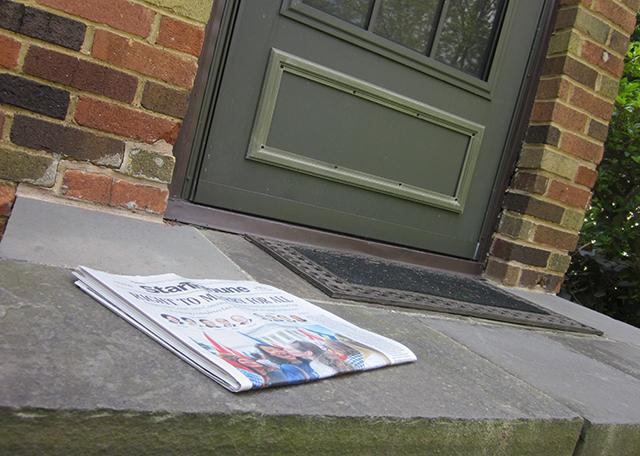
“[It’s] not just the physical paper, but the ritual of getting the paper off their driveway or front steps and starting their day spreading out the broadsheet and scanning the news. They missed curling up with coffee or tea and working the crossword puzzle or cutting coupons.  It is easy to forget that until the mid-‘90s, this was the only way to read the news and, for Boomers, it is how they learned to read and interact with the world.  Their brains are wired for print in the same way Gen Z is wired for mobile.”

Perhaps the Globe’s business and administrative staffers lost sight of that fact. Maybe they treated their “unsexy” print subscribers as an afterthought while forgetting that this segment of their customer base is critical to the very survival of their paper – and the industry – in a period of transition.

True, delivering the news to print customers is more expensive than doing so digitally. But these customers are more predictable and loyal, versus fickle and finicky.

… But only if the product is delivered. Fail in that fundamental function, and the gig is up.
nosThe Boston Globe’s print readers are hardly unique. Recently, Pew Research Center surveyed consumers in three urban markets.  Despite the differences in these markets (geographic, economic, social), a highly significant percentage of respondents in all three metro areas reported that they read only the print version of their local newspaper:

  • Denver, CO: ~46% read only the print version of their local newspaper
  • Macon, GA: ~48% read print only
  • Sioux City, IA-NE-SD: ~53% read print only

This isn’t to suggest that Boomer audiences are a bunch of rubes who aren’t connected to the digital world. Far from it:  They tend to be better educated and more wealthy (with more disposable income) than other demographic segments.  Their attachment to print isn’t in lieu of digital, but more in concert with their online habits.

Unlike other generations, they’re not single-channel as much as omni-channel consumers. The keys to newspaper publishers’ continued relevance are bound up in how they serve this older but critically important segment of their customer base.

Speaking personally, I can “take it or leave it” when it comes to print.  I don’t subscribe to a daily print paper, and the bulk of my news comes to me from digital sources.  But there’s something quite comfortable about sitting down with a quality daily paper and reading the news stories therein — including long-form journalism pieces that are difficult to find very many places these days.

There are millions more people across the country that are happy to continue paying for the privilege of consuming the news in just such a fashion.  Indeed, they’re the newspaper industry’s most loyal readers.

The FTC Cracks Down on Native Advertising Abuse

But what difference will it make? Only time will tell …

FTIt had to happen: After years of publications uploading native advertising content that’s barely labeled as such, the Federal Trade Commission has handed down new guidelines that leave very little wiggle room in what constitutes proper labeling of paid advertising material.

Published under the title Enforcement Policy Statement on Deceptively Formatted Advertisements, the FTC’s new guidelines, which run more than 10 pages in length, make it more difficult than ever to “camouflage” advertising as “legitimate” news content.

What it boils down to is the stipulation that any sponsored content must be clearly labeled as advertising – using wording that the vast majority of readers will understand instantly.

Here’s how the FTC guidelines describe it:

“Terms likely to be understood include ‘Ad,’ ‘Advertisement,’ ‘Paid Advertisement,’ ‘Sponsored Advertising Content,’ or some variation thereof. Advertisers should not use terms such as ‘Promoted’ or “Promoted Stories,’ which in this context are, at best, ambiguous and potentially could mislead consumers that advertising content is endorsed by a publisher site.”

Another key provision is warning against advertising content mimicking the look and feel of surrounding editorial content – things like the layout characteristics, headline design treatment, the use of fonts and photography.

And here’s another kicker: the FTC lumps offending advertisers in the same pile as the people who create the materials, in that its policy statement doesn’t apply just to advertisers.  So ad agencies, MarComm companies and graphic designers, beware.

Quoting again from the FTC document:

“In appropriate circumstances the FTC has taken action against other parties who helped create deceptive advertising content – for example, ad agencies and operators of affiliate advertising networks. Everyone who participates directly or indirectly in creating or presenting native ads should make sure that ads don’t mislead consumers about their commercial nature. 

“Marketers who use native advertising have a particular interest in ensuring that anyone participating in the promotion of their products is familiar with the basic truth-in-advertising principle that an ad should be identifiable as an ad to consumers.”

Of course, these new guidelines are only going to make it harder for advertisers – and publishers – to be able to utilize advertising techniques that have, up to now, been far more effective than online display advertising.

iab-logoPredictably, we’re hearing mealy-mouthed statements from the industry in response. A spokesperson for the Interactive Advertising Bureau had this to say:

“While guidance serves great benefit to the industry, it must also be technically feasible, creatively relevant, and not stifle innovation. To that end, we have reservations about some elements of the Commission’s guidance.”

What bothers the Interactive Advertising Bureau in particular is the “plain language” provisions in the FTC’s guidelines, which IAB considers “overly descriptive.”

Translation: there’s concern that publishers can no longer label advertising using such euphemisms as “partner content” or “promoted post.”

Others seem less concerned, however. Sites such as Mashable and Huffington Post appear to be onboard with the new guidelines.

Besides, as one spokesperson said, “When the FTC issues guidelines, you’re better off when you follow them than when you don’t.”

… That sounds about right.

Who Trusts the Media?

Americans give a big thumbs-down when it comes to having “trust and confidence” in mass media – TV, radio and newspapers.

MediaAre Americans’ attitudes about the press becoming more negative over time? If the latest survey figures on media trust are any guide, the answer is a pretty stark “yes.”

According to a recent Gallup field survey of ~1,025 American citizens aged 18 or over, trust and confidence in the mass media in the United States has reached a new low.

Today, just ~40% of respondents report that they have “a great deal” or “a fair amount” of confidence that newspapers, TV and radio report the news “fully, accurately and fairly.”

What’s more, trust levels have been on a downward trajectory ever since the late 1990s, when Gallup began surveying Americans’ attitudes on an annual basis.

Here’s what the trend looks like in the “off-election” years:

  • 1999: ~55% have “a great deal” or “a fair amount” of trust in mass media (TV/radio/newspapers)
  • 2003: ~54%
  • 2005: ~50%
  • 2007: ~47%
  • 2009: ~46%
  • 2011: ~44%
  • 2013: ~44%
  • 2015: ~40%

Moreover, the notion that young people might be more inclined to trust the media isn’t borne out in the Gallup survey results. The trust of Americans age 18-49 has dropped from 53% in 2005 to only 36% now.

Contrast this with older Americans (age 50 or older): 45% of them reported that they had trust and confidence in mass media in 2005, and today that trust level is … still 45%:

Media trust by age

Giving further credence to the oft-stated claim that American mass media are slanted towards one political party, ~55% of self-identified Democrats express trust in the media, compared to just 32% of Republicans and 33% of independents.

Gallup can’t resist editorializing a bit about its most recent media trust figures:

“Americans’ trust level in the media has drifted downward over the past decade, but some of the loss in trust may have been self-inflicted, as major venerable news organizations have been caught making serious mistakes in the past several years.”

Additional information on the Gallup survey can be accessed here.

The “100% ad viewability” gambit: Gimmick or game-changer?

Say hello to the ad industry’s newest acronym: vCPM (viewable cost-per-thousand).

viewabilityA few weeks back, Google announced that it will be introducing 100% viewable ads in the coming months, bringing all online ad campaigns bought on a CPM basis into view across its Google Display Network.

The news comes as a relief to advertisers, who have long complained about the high percentage of ads that never have a chance to be viewed by “real people.”

The statistic that Google likes to reference is that approximately 55% of all display ads are never viewed due to a myriad of factors — such as appearing being below the fold, being scrolled out of view, or showing up in a background tab.

And the problem is only growing larger with the increased adoption of ad blocker software tools.

Google isn’t the only that’s one coming up with in-view advertising guarantees. Facebook recently announced that it will begin selling 100% viewable ads in its News Feed area.

But some are questioning how much of a better benefit 100% viewability will be in actuality. For one thing, ad rates for these program are sure to be higher than for conventional ad buying contracts.

For another, neither Facebook nor Google have stated how long an ad would need to remain in view before an advertiser gets charged. Whether it’s 1 second, 2 seconds or 5 seconds makes a huge difference in the real worth of that exposure to the consumer.

Then there’s the realm of mobile advertising. In a startling analysis conducted and reported on by The New York Times, a mix of advertising and editorial on the mobile home pages of the top 50 news sites was measured.  What the analysis found was that mobile airtime is being chewed up by advertising content far more than by the editorial content people are tuning in to view.

Boston.com mobile readers are a case in point. The analysis found that its readers spend an average of ~31 seconds waiting for ads to load versus ~8 seconds waiting for the editorial content to load.  That translates into a home page visitor paying $9.50 per month — just to view the ads.

ad blockerWhen there’s suddenly a cost implication in addition to the basic “irritation factor,” expect more smartphone and tablet users to avail themselves of ad blockers even more than they do today.

As if on cud, Apple is now allowing ad blockers on the iPhone, giving consumers the ability to conserve data, make websites load faster, and save on usage charges all in one fell swoop.

Sounds like a pretty sweet deal all-around.

Surprising statistic? One-third of American adults still aren’t on social media.

social mediaFor the many people who use social media on a daily basis, it may seem inconceivable that there are a substantial number of other Americans who aren’t on social media at all.

But that’s the case. The Pew Research Center has been tracking social media usage on an annual basis over the past decade or so, and it finds that about one-third of Americans still aren’t using any social networking sites.

To be sure, today’s ~65% participation rate is about ten times higher than the paltry ~7% participation rate Pew found the first time it surveyed Americans about their social media usage back in 2005.

According to Pew’s field research findings, here’s how the percentage of social media involvement has risen in selected years in the decade since. (The figures measure the percentage of Americans age 18 or over who use at least one social networking site.)

  • 2006: ~11% using at least one social networking site
  • 2008: ~25%
  • 2010: ~46%
  • 2012: ~55%
  • 2015: ~65%

In more recent years, the highest growth in social media participation rates has been among older Americans (over the age of 65), ~35% of whom are using social media today compared to just 11% five years ago.

That still pales in comparison to younger Americans (age 18-29), ~90% of whom use social media platforms.

While it’s a common perception that women are more avid users of social media than men, Pew’s research shows that the participation rate is actually not that far apart. Statistically it isn’t significant, in fact: a ~68% social media participation rate for women versus ~62% for men.

pew-research-centerSimilarly, there are more similarities than differences among the various racial and ethnic groups that Pew surveys — and the same dynamics are at work when it comes to differing education levels, too.

Regional differences in social media practice continue to persist, however, with rural residents less likely to use social media than suburban residents by a ten-point margin (58% versus 68%). City dwellers fall in between.

More details on Pew’s most recent field research on the topic of social media participation can be accessed here. See if you notice any surprising findings among them.

In the “right to be forgotten” battles, Google’s on the defensive again.

untitledSuddenly, the conflict between Google and the European Union countries regarding the censoring of search results has taken on even wider worldwide proportions.

This past week, the courts have upheld the French government’s data protection office (CNIL) order for Google to broaden the “right to be forgotten” by censoring search results worldwide — not just in Europe.

Google had appealed the initial CNIL ruling.

The CNIL rejected Google’s argument that a worldwide implementation of the European standard of censoring search results would mean that the Internet would be only as free as the “least free place.” (Think Belarus or Syria.)  But in its ruling, the CNIL noted that a country-by-country implementation of the “right to be forgotten” would mean that the right could be circumvented too easily.

While it’s true that more than 95% of Google searches in Europe are performed via European versions of the company’s search engine tool, such as google.fr and google.co.uk, identical searches can be performed easily using google.com, meaning that anyone trying to find “forgotten” information on an individual can do so easily, irrespective of the European standard.

file-and-forgetAs I blogged back in May, The European Court of Justice’s 2014 ruling meant that Google is required to allow residents of EU countries to delete links to certain harmful or embarrassing information that may appear about themselves in Google search results.

The directive has turned into a real thicket of challenges for Google.

What the definition of “harmed and embarrassing” is is somewhat amorphous, as the court’s ruling encompassed links to information ranging from excessive and harmful on one end of the scale all the way down to links that are merely outdated, inadequate or irrelevant.

Since the ruling went into effect, Google has had to field requests to remove more than one million links from European search results.

Link removal isn’t accomplished via some sort of “bot” procedure.  Instead, each request is considered on a case-by-case basis by a panel of arbiters made up of attorneys, paralegals and search engineers.

Approximately one-third of the links in question have been removed following panel review, while about half have remained in search results.

The rest – the real toughies – are still under review, and their status as yet unresolved.

Obviously, for this activity to spread from covering just European search engines to include potentially the entire world isn’t what Google has in mind at all.  (If Google could have its way, doubtless the whole notion of “the right to be forgotten” would be off the table.)

But the situation is getting pretty hot now. French authorities imposed a 15-day compliance deadline, after which Google could be fined nearly US$350,000.

Of course, the amount of that penalty pales in comparison to the cost Google would incur to comply with the directive.

But that fine is just the opening salvo; there’s no telling what the full degree of financial penalties might turn out to be for continued non-compliance.

I wrote before that it’s difficult to know where the world will eventually end up on the issue of censoring search engine results.  Today, I don’t think we’re anywhere closer to knowing.

Six years on … and the U.S. ad economy is still in recession?

recession recoveryTwo reports from advertising research sources released in the past month reveal that the advertising field doesn’t appear to be rebounding in strongly – at least not to same degree as the economy as a whole.

One report, from U.S. Ad Market Tracker, is an index that pools electronic media buys processed by major agency holding companies and their brand marketers.

It’s true that this report shows an increase in the overall ad activity index year-over-year of about 18 points (it’s 184 today … 166 a year ago … and 100 back in the recession year of 2009).

But when we look at the breakdown where most of the advertising growth is coming from, it’s nearly all from a handful of categories: social media advertising, advertising on video, Internet radio, plus ad network marketplaces.

By contrast, search advertising is growing at a much slower rate, and the most “commoditized” segments – particularly online display advertising – are doing little better than treading water.

This isn’t the robust rebound that many business and ad industry observers were expecting to see by 2015.

advertisingOver at Kantar Media, the statistics are even less encouraging.

In fact, Kantar projects that the 2015 ad economy will underperform U.S. economic growth for the fifth straight year.

Considering how lethargic in general the U.S. economy has been over that period, to be growing at less than the average is almost an indictment of the industry.

That’s what Kantar Media Chief Research Officer Jon Swallen suggests:  a “streak that might have once seemed unimaginable, but now would seem par for the course.”

Second-quarter 2015 data released by Kantar estimates annualized measured media ad spending declines in the neighborhood of 4%.

More to the point, Kantar is seeing increases in just 7 of the 22 individual ad media categories it tracks, led by the same categories U.S. Ad Market Tracker identifies as the most healthy ones.

Perhaps a surprise — considering the overall disappointing numbers — is that Kantar has tracked two analogue categories as experiencing growth:  radio and out-of-home advertising.

But print continues to decline at pronounced rates, and Internet display advertising has also officially joined the ranks of media segments that are contracting.

Is the disappointing performance of advertising a function of a weak market overall?  Or is it the result of structural changes and the reallocation of promo dollars into different, in some cases non-advertising MarComm vehicles?

I’m not completely sure.  It’s true that certain advertising categories that are “newer” ones are attracting more attention (and more dollars).  But Kantar’s 2nd Quarter reporting of advertising expenditures by major industry category finds just one – one – segment that has experienced an overall increase year-over-year — pharmaceuticals:

Ad economy chart

When just one industry segment out of ten is showing an increase, it suggests more than just some restructuring or re-jiggering is going on. Instead, it’s just as likely that the U.S. advertising economy remains stuck in a recession, even if the overall economy has finally emerged from it.

What are your thoughts on the tepid advertising results? Please share your views with other readers.

Social media data mining: Garbage-in, garbage-out?

gigoIt’s human nature for people to strive for the most flattering public persona … while confining the “true reality” only to those who have the opportunity (or misfortune) to see them in their most private moments.

It goes far beyond just the closed doors of a family’s household. I know a recording producer who speaks about having to “wipe the bottoms” of music stars — an unpleasant thought if ever there was one.

In today’s world of interactivity and social platforms, things are amplified even more — and it’s a lot more public.

Accordingly, there are more granular data than ever about people, their interests and their proclivities.

The opportunities for marketers seem almost endless. At last we’re able to go beyond basic demographics and other conventional classifications, to now pinpoint and target marketing messages based on psychographics.

And to do so using the very terms and phrases people are using in their own social interactions.

The problem is … a good deal of social media is one giant head-fake.

Don’t just take my word for it. Consider remarks made recently by Rudi Anggono, one of Google’s senior creative staff leaders. He refers to data collected in the social media space as “a two-faced, insincere, duplicitous, lying sack of sh*t.”

Anggono is talking about information he dubs “declared data.” It isn’t information that’s factual and vetted, but rather data that’s influenced by people’s moods, insecurities, social agenda … and any other set of factors that shape someone’s carefully crafted public image.

In other words, it’s information that’s made up of half-truths.

This is nothing new, actually. It’s been going on forever.  Cultural anthropologist Genevieve Bell put her finger on it years ago when she observed that people lie because they want to tell better stories and to project better versions of themselves.

What’s changed in the past decade is social media, of course.  What better way to “tell better stories and project better versions of ourselves” than through social media platforms?

Instead of the once-a-year Holiday Letter of yore, any of us can now provide an endless parade of breathless superlatives about our great, wonderful lives and the equally fabulous experiences of our families, children, parents, A-list friends, and whoever else we wish to associate with our excellent selves.

Between Facebook, Instagram, Pinterest and even LinkedIn, reams of granular data are being collected on individuals — data which these platforms then seek to monetize by selling access to advertisers.

In theory, it’s a whole lot better-targeted than the frumpy, old fashioned demographic selects like location, age, income level and ethnicity.

But in reality, the information extracted from social is suspect data.

This has set up a big debate between Google — which promotes its search engine marketing and advertising programs based on the “intent” of people searching for information online — and Facebook and others who are promoting their robust repositories of psychographic and attitudinal data.

There are clear signs that some of the social platforms recognize the drawbacks of the ad programs they’re promoting — to the extent that they’re now trying to convince advertisers that they deserve consideration for search advertising dollars, not just social.

In an article published this week in The Wall Street Journal’s CMO Today blog, Tim Kendall, Pinterest’s head of monetization, contends that far from being merely a place where people connect with friends and family, Pinterest is more like a “catalogue of ideas,” where people “go through the catalogue and do searches.”

Pinterest has every monetary reason to present itself in this manner, of course.  According to eMarketer, in 2014 search advertising accounted for more than 45% of all digital ad spending — far more than ad spending on social media.

This year, the projections are for more than $26 billion to be spent on U.S. search ads, compared to only about $10 billion in the social sphere.

The sweet spot, of course, is being able to use declared data in concert with intent and behavior. And that’s why there’s so much effort and energy going into developing improved algorithms for generating data-driven predictive information than can accomplish those twin goals.

Rudi Anggono
Rudi Anggono

In the meantime, Anggono’s admonition about data mined from social media is worth repeating:

“You have to prod, extrapolate, look for the intent, play good-cop/bad-cop, get the full story, get the context, get the real insights. Use all the available analytical tools at your disposal. Or if not, get access to those tools. Only then can you trust this data.”

What are your thoughts? Do you agree with Anggono’s position? Please share your perspectives with other readers here.

Magazine readership preferences confirm the continued primacy of print.

pileIn my line of work, I receive many magazines and other publications covering not only the marketing and advertising field, but also the industries and markets of our corporate clients.

Every time one of these subscriptions comes up for renewal, I’m strongly urged to choose the online/electronic offering instead of the print edition.

I know why, of course. Between the printing, postage and shipping considerations, magazines and other printed media represent the most involved (and the most costly) form of delivery.

And there’s also the issue of “currency” and “recency,” with breaking news being covered much quicker and more efficiently online.

Still, I generally opt for print for the simple reason that a physical magazine, newspaper or newsletter is easier to browse and to read. I like the “linearity” of a print magazine and find magazine reading less satisfactory online.

Don’t get me wrong — I’m very happy digital versions of the print editions exist. I love the fact that I can go online and access an article of particular interest that I may wish to archive in electronic form, or pass along to friends and colleagues.

So, consider me an “all of the above” sort of person. Still, there are times when I think that I represent a more traditional way of thinking about consuming news articles — one that’s decidedly losing popularity.

But then … we see the results of a new digital magazine market study, published by Mequoda Group, a media consulting firm.

The survey, which was conducted in July 2015 among ~3,650 Americans adults age 18 or higher who have access to the Internet, found that digital magazine consumption has now reached ~43% of print magazine consumption.

So digital is rising.

But the Mequoda research also finds that ~70% of American adults who have access to the Internet have read an average of three print magazine issues in the past 30 days. (2.91 print magazine issues, to be precise.)

Here are the findings for print magazines read over the previous month:

  • Read one print magazine: ~18%
  • Read two: ~19%
  • Read three: ~13%
  • Read four: ~8%
  • Read five or more: ~13%

At the same time, ~37% of American adults who have access to the Internet have read an average of 2.37 digital magazine issues over the past month. Here’s how that breakdown looks:

  • Read one digital/online magazine: ~14%
  • Read two: ~8%
  • Read three: ~5%
  • Read four: ~3%
  • Read five or more: ~7%

What this means is that in 2015, print magazine readership activity outnumbers digital by a 2-to-1 margin.

The Mequoda research tested five reasons why people might prefer reading digital versions over printed versions of magazines. Of those who read digital magazines, here are the percentages who deemed those reasons “very important”:

  • Offers immediate delivery: ~42% consider very important
  • Portability / easy to carry: ~40%
  • Environmentally friendly: ~40%
  • Cheaper than print: ~39%
  • Thousands of titles: ~35%

The bottom line on this topic appears to be that the demand for print delivery of periodicals remains significant … and that publishers who elect to shift to “all-digital” delivery stand to lose at least some of their reader engagement.

Even so, I have no doubt that publishers will continue to push electronic delivery in the hopes that print can eventually fall completely by the wayside.

The full report is available free of charge from Mequoda here.

Offline America: Pew’s latest research shows that 15% of American adults don’t use the Internet at all.

Internet usageFor those of us who spend practically every living minute of our day online, it seems almost unbelievable that there are actually some people in the United States who simply never go online.

The Pew Research Center has been researching this question for the past 15 years. And today, the percentage of “offline American adults” (people age 18 or over who don’t use the Internet) remains stuck at around 15% — a figure that has been stubbornly consistent for the past three years or so:

Pew Research Center Americans Not Online 2000-2015 survey results

But up until then, the percentage had been declining, as can be seen in these milestone Pew survey years:

  • 2000: ~48% of American adults not using the Internet
  • 2005: ~32% not using
  • 2010: ~24% not using
  • 2015: ~15% not using

Part of the long-term shift has been new people interfacing with the Internet.  But another factor is simply the “aging out” of older populations as they pass from the scene.

The demographic dynamics Pew finds on Internet usage show relatively little difference in behavior based on ethnicity — except that only about 5% of Asian-Americans never go online.

Rather, it’s differences in age particularly — but also in income levels and education levels — that are more telling.

offline AmericansThe age breakdown is stark, and shows that at some point, we are bound to have near-total adoption of the Internet:

  • Age 18-29: ~3% don’t use the Internet
  • Age 30-49: ~6% don’t use
  • Age 50-64: ~19% don’t use
  • Age 65+: ~39% don’t use

Income levels are also a determining factor when it comes to Internet usage:

  • Less than $30,000 annual household income: ~25% don’t use the Internet
  • 30,000 – 50,000 annual HH income: ~14% don’t use
  • $50,000 – $75,000 annual HH income: ~5% don’t use
  • Over $75,000 annual HH income: ~3% don’t use

And Pew also finds significant differences based on the amount of formal education:

  • Some high-school level education: ~33% don’t use the Internet
  • High school degree: ~23% don’t use
  • Some college: ~9% don’t use
  • College graduate or post-graduate education: ~4% don’t use

Lastly, while no difference in Internet usage has been found between urban and suburban Americans, the adoption rate in rural areas continues to lag behind:

  • Urban dwellers: ~13% don’t use the Internet
  • Suburban residents: ~13% don’t use
  • Rural areas: ~24% don’t use

One reason for the lower adoption rate in rural areas may be limited Internet access or connectivity problems — although these weren’t one of the key reasons cited by respondents as to why they don’t go online. Pew’s research has found these points raised most often:

  • Have no interest in using the Internet / lack of relevance to daily life: ~34%
  • The Internet is too difficult to use: ~32%
  • The expense of Internet service and/or owning a computer: ~19%

The results of Pew’s latest survey, which queried ~5,000 American adults, can be viewed here. Since the research is conducted annually, it will be interesting to see if Internet usage resumes its drive towards full adoption, or if the ~85% adoption rate continues to be a “ceiling” for the foreseeable future.