Brands and “cause marketing”: How much is too much?

cmWhen brands conduct attitudinal studies of their customer base, the research often finds that people respond favorably to so-called “positive” or “progressive” causes.

The ALS “Ice-Bucket Challenge” is probably Exhibit A for the potency of such an initiative — including its fantastically successful viral component.

So it’s only natural that brand managers would think in terms of tying their brands to high-profile events such as Earth Day or popular health causes such as efforts to cure cancer or heart disease.

Perhaps the activity is doing a highly publicized community initiative … hosting a well-publicized 5K run or similar event … or donating funds for the cause in a new and attention-grabbing way.

But here’s the rub: With so many national brands doing precisely these sorts of things, it’s become something of an echo chamber.  What once was fresh and novel now seems decidedly ho-hum.

Besides, with so much breathless “cause activity” happening, it’s little wonder that many consumers are seeing through all the hype and attaching near-zero attribution to the brands involved.

The situation is even more problematic when there’s little or no connection between the brand’s products or services and the cause being supported.  The problem is, when brands start vying for attention — especially allying with causes that have nothing at all to do with their core business — “authenticity” goes out the window.

In the process, the brands may telegraph something even worse than irrelevancy; they look desperate for attention.

Of course, all of this evidence doesn’t mean that major brands aren’t continuing to try to attach themselves to the positive vibes of social action. Some recent examples are these:

More problematic than these campaigns was the Starbucks initiative last year in which its baristas were encouraged to start conversations about race relations, interacting with customers waiting in line for their espressos and muffins.

Let’s just say that the idea looked better on paper compared to how it panned out in real life — with more than a few Starbucks customers finding the initiative awkward, intrusive and off-putting (and taking to Twitter to vent their feelings).

Thinking about the good and the not-so-good of “cause marketing,” it appears that the more successful of these initiatives are ones which hew more closely to a brand’s own essence.

Patagonia is a good example of this. Its mission has always been to design and manufacture quality products in an environmentally responsible way, and it promotes proper stewardship of the land and of material possessions through many initiatives that just “feel right” for this particular brand.

And in the realm of apparel and cosmetics, a whole bevy of brands have jumped into conversations about “positive self-image.” While to some people it may seem self-serving for brands like Dove® soap, American Eagle lingerie and Lane Bryant plus-size apparel to become active in such causes, one can also see the logical connection between the products these brands sell and the themes they are spotlighting in these campaigns.

Authenticity and genuineness: Not only are they the hallmark of successful brands, they’re the acid test for successfully grabbing a share of the “social good” pie.  Who’s doing it right … and who’s missing the mark?  Let us know your nominations.

Bing Plays the Bouncer Role in a Big Way

untitledMicrosoft Bing has just released stats chronicling its efforts to do its part to keep the Internet a safe space. Its 2015 statistics are nothing short of breathtaking.

Bing did its part by rejecting a total of 250 million ad impressions … banning ~150,000 advertisements … and blocking around 50,000 websites outright.

It didn’t stop there. Bing also reports that it blocked more than 3 million pages and 30 million ads due to spam and misleading content.

What were some of the reasons behind the blocking? Here are a few clues as to where Bing’s efforts were strongest (although I don’t doubt that there are some others that Bing is keeping closer to its vest so as not to raise any alarms):

  • Healthcare/pharma phishing attacks: ~2,000 advertisers and ~800,000 ads blocked in 2015
  • Selling of counterfeit goods: 7,000 advertisers and 700,000+ ads blocked
  • Tech support scams: ~25,000 websites and ~15 million ads blocked
  • Trademark infringement factors: ~50 million ad placements rejected

Bing doesn’t say exactly how it identifies such a ginormous amount of fraudulent or otherwise nefarious advertising, except to report that the company has improved its handling of many aspects based on clues ranging from toll-free numbers analysis to dead links analysis.

According to Neha Garg, a program manager of ad quality at Bing:

“There have even been times our machine learning algorithms have flagged accounts that look innocent at first glance … but on close examination we find malicious intent. The back-end machinery runs 24/7 and used hundreds of attributes to look for patterns which help spot suspicious ads among billions of genuine ones.”

We’re thankful to Bing and Google for all that they do to control the incidence of advertising that carries malicious malware that could potentially cause many other problems above and beyond the mere “irritation factor.”

Of course, there’s always room for improvement, isn’t there?

Mobile shopping goes majorly mainstream.

untitledFor years, the common perception has been that consumers tend to use their laptops, tablets or mobile devices to research purchases while ultimately visiting a store to make the actual purchase.

And up until now, most studies have shown that no matter what type of digital device consumers use to shop, large majorities prefer to complete the sale in a store or at the mall.

But now a new study is telling us something different. The research, conducted by questioning ~1,000 U.S. consumers by research firm Ipsos, shows that shopping frequency in physical stores hasn’t kept pace with the growth of smartphone shopping.

According to Ipsos, over the past year there has been a significant increase in the amount of smartphone shopping, with two-thirds of respondents reporting that they are doing more of this today:

  • Shopping more frequently via smartphone: ~64%
  • Shopping more frequently via tablet: ~60%
  • Shopping more frequently via desktop computer: ~57%
  • Shopping more frequently via laptop computer: ~57%

At first blush, these figures don’t seem startling at all, considering the rise in the consumer economy over the past year or so.  Moreover, ~41% of the survey’s respondents reported that they haven’t made a significant change in their frequency of shopping in physical stores.

But in considering the ways respondents reported how and where they’ve been shopping less frequently over the past year, the differences appear much more stark:

  • Shopping less frequently via physical store: ~30%
  • Less frequently via desktop computer: ~11%
  • Less frequently via laptop computer: ~11%
  • Less frequently via tablet: ~11%
  • Less frequently via smartphone: ~9%

It even goes further than that. The two groups which seemed most inclined to shop less frequently in physical stores were younger consumers (age 25 and under) as well as consumers who earn more than $100,000 per year.

Add to this the propensity for younger consumers to be using smartphones and tablets more often than their older counterparts, and it’s clear that some of the most prized demographic categories are migrating to smartphone shopping in a big way.

The implications for traditional retail could not be more clear:  adapt your business model or else.

Checking messages: First, last and always.

cemIf you think your personal and professional life has become consumed with checking messages ad nauseum, you’re not alone.

Recently, Adestra and Flagship Research surveyed Internet-using Americans for eMarketer to find out just how pervasive the practice of checking messages has become.

The results surprise no one — even if they’re a bit depressing to contemplate.

Asked to cite when their first message check of the day is typically done, here’s what the eMarketer survey found:

  • I check messages first thing, before anything else: ~39% reported
  • After coffee/tea but before breakfast: ~22%
  • After breakfast but before departing for work: ~20%
  • On the way to work: ~4%
  • Once at work: ~8%
  • Later in the day: ~3%
  • Other responses: ~4%

[I was a little surprised to find myself in a distinct minority (checking messages upon arriving at work) … but I suppose when one gets to the office at 07:00 hrs. each workday, as I do, that may be when most others are en route to the office or still at home.]

Not surprisingly, the “check messages before anything else” contingent is more heavily represented by younger people, with over 45% of the survey’s respondents under the age of 35 reporting that they check messages first thing in the day.

The type of messages in question run the gamut from e-mail to text, social media and voicemail. But it’s overwhelmingly e-mail and text messaging apps that smartphone users check first thing in the day:

  • Text messaging: ~67% check this mobile app first
  • E-mail: ~63%
  • Facebook: ~48%
  • Weather app: ~44%
  • Calendar app: ~30%
  • News app: ~21%
  • Games: ~19%
  • Instagram: ~16%
  • Pandora: ~16%
  • Other social media: ~9%
  • Other apps: ~7%

More details on the eMarketer survey can be found here.

What are your message checking practices — and how are they different or similar to these survey results?

Saints and Sinners: The Ten Most Sinful Cities in the United States … and the most Saintly

deWhich cities in America are the “most sinful” of the bunch? Perhaps they’re the ones whose monikers or mottos seem to suggest as much:

  • Always turned on.
  • Big beach. Big fun.
  • The city that never sleeps.
  • Glitter Gulch
  • Live large. Think big.
  • More than you ever dreamed.
  • Sin City
  • Sleaze City
  • Tinseltown
  • Town on the make.
  • What happens here, stays here.
  • What we dream, we do.
  • The wickedest little city in America.

While some of the descriptions above hardly represent what city boosters would want to convey about their burgs, a surprising number of them are actually the end-result of formal marketing and branding efforts – focus-group tested and all.

[How many cities do you think you can name for these slogans?]

tr logoBut put all of that aside now … because the online residential real estate website Trulia has been busy doing its own analysis of which cities qualify as being among the nation’s most “sinful.” Earlier this month, it published its listing of the ten most “sinful cities” in the United States.

How did Trulia compile the list? For starters, it limited its research to the 150 largest metropolitan areas.

Next, it used a variety of data such as drinking habits, the number of adult entertainment venues and the number of gambling establishments to determine the cities where it’s easiest to succumb to the eight deadly sins – among them gluttony, greed, lust, sloth and vanity.

For each “offense,” Trulia examined statistical measures that serve as key clues – stats like how many adult entertainment venues there are (for lust), and exercise statistics (for sloth).

Obviously, a mega-city like New York or Los Angeles is going to offer many more outlets catering to the sinful nature of mankind compared to smaller urban centers. So Tulia has “common-sized” the data based on per capita population, making it possible to determine the destination in which it’s easiest to satisfy one’s whims (or vices).

So – drumroll please – here’s the resulting Trulia Top Ten, listed below beginning with #10 and moving up to the ignominious honor of being the most sinful city of the bunch:

  • #10 Columbus, OH
  • #9   San Antonio, TX
  • #8   Las Vegas, NV
  • #7   Shreveport, LA
  • #6   Louisville, KY
  • #5   Toledo, OH
  • #4   Tampa, FL
  • #3   Philadelphia, PA
  • #2   Atlantic City, NJ
  • #1   New Orleans, LA  

I suppose few people would quarrel with New Orleans coming in at #1 on the list; anyone who has spent any time in that city knows must know how much of an “anything goes” atmosphere exists there. (Few tourists seem to avert their eyes to what they see, either.)

Atlantic City? Las Vegas?  Pretty much the same thing.

But what about Louisville, or Toledo, or … Shreveport?? OMG!

Of course, the same statistics Trulia crunched to determine who sits atop the “Sin City” list also reveal which cities are their polar opposites – the places Trulia calls America’s “saintly sanctuaries.”

Which cities are those?  Here’s that list:

  • #10 Cambridge, MA
  • #9   Greeley, CO
  • #8   Asheville, NC
  • #7   Boise, ID
  • #6   Claremont-Lebanon, NH
  • #5   Raleigh, NC
  • #4   Tuscaloosa, AL
  • #3   Ft. Collins, CO
  • #2   Ogden, UT
  • #1   Provo, UT

I think fewer surprises are on this list.

Tr

For details on the Trulia analysis and to read more about the methodology employed, click here.

What’s your take? Based on your own personal observations or even first-hand experience, which cities would you characterize as the most “sinful” … and the most “saintly”?  We’re all interested to know!

Who are the World’s Most Reputable Companies in 2016?

I’ve blogged before about the international reputation of leading companies and brands as calculated by various survey firms such as Harris Interactive.

RI logoOne of these ratings studies is conducted by market research firm Reputation Institute, which collected nearly 250,000 ratings during the first quarter of 2016 from members of the public in 15 major countries throughout the world.

The nations included in the company reputation evaluation were the United States, Canada, Mexico and Brazil in the Americas … France, Germany, Italy, Spain, the United Kingdom and Russia in Europe … India, China, South Korea and Japan in Asia … as well as Australia.

Approximately 200 leading companies were rated by respondents on a total of seven key dimensions of reputation, including:

  • Products and services
  • Innovation
  • Workplace
  • Governance
  • Citizenship
  • Leadership
  • Performance

In the 2016 evaluation, the top-rated companies scored “excellent” (a rating of 80 or higher on a 100-poinst scale) or “strong” (a rating of 70-79) in all seven reputation categories. 2016’s “Top 10” most reputable firms turned out to be these (ranked in order of their score):

#1 Rolex

#2 The Walt Disney Company

#3 Google

#4 BMW Group

#5 Daimler

#6 LEGO Group

#7 Microsoft

#8 Canon

#9 Sony

#10 Apple

Different companies scored highest on specific attributes, however:

  • Apple: #1 in Innovation and in Leadership
  • Google: #1 in Performance and in Workplace
  • Rolex: #1 in Products & Services
  • The Walt Disney Company: #1 in Citizenship and in Governance

VAt the other end of the scale, which company do you suppose was the one that suffered the worst year-over-year performance?

That dubious honor goes to Volkswagen.  In the wake of an emissions scandal affecting the brand internationally, VW’s reputation score plummeted nearly 14 points, which was enough to drop it out of the Top 100 brand listing altogether.

It’s quite a decline from the VW’s #14 position last year.

The complete list of this year’s Top 100 Reputable Companies can be accessed via this link. You may see some surprises …

Our Visual World

vcThe old adage that a picture is worth a thousand words has ever-greater resonance as time goes on. And when visuals come up against text – it’s really no contest at all.

Marcel Just, PhD, who directs the Center for Cognitive Brain Imaging at Carnegie Mellon University in Pittsburgh, PA, states the case plainly:

“Processing print isn’t something the human brain was built for. The printed word is a human artifact.  It’s very convenient and it’s worked very well for us for 5,000 years, but it’s an invention of human beings.   

By contrast, Mother Nature has built into our brain our ability to see the visual world and interpret it. Even the spoken language is much more a ‘given’ biologically than reading written language.”

So it’s fundamental that photos, other pictorial graphics and videos are effective with audiences across the board – not just with certain demographics. This universality makes the visual world so much more universal than the world as seen through an “education level” or a “language” prism.

3M Company has done research to attempt to measure this impact quantitatively. It has found that ~90% of all information transmitted to the brain is visual.  And now, the growth of digital communications has provided all sorts of ways to gauge the effectiveness of those visual communications.

Consider these points:

  • Visual content is processed 60,000 times faster than text.
  • Humans retain only about 20% of what they read … just ~10% of what they hear … but ~80% of what they see.
  • ~80% of the text on most pages of content doesn’t get read.
  • Twitter tweets containing images generate ~20 more clickthroughs … ~90% more “favorites” … and ~150% more re-tweets.
  • Social media posts including video clips do dramatically better – outstripping text-only posts by a factor of ten times.

The implications for advertisers couldn’t be clearer. The explosion in digital content only makes it that much more important to catch the audience’s attention, because typically advertisers have only seconds to do so.

And that attention-getting content is going to be visual.

Twitter’s Continuing Monetization Challenge

Press reports have been pretty consistent over the past year or so about the underwhelming financial performance of Twitter.  Here’s the trend line for Twitter shares of stock since the beginning of 2014:


Twitter share price trend


… And beyond the financial performance, I’ve been writing about Twitter’s fundamental business challenges off and on for well over five years now.

While Twitter undoubtedly has its place in the social realm — its place in “breaking news” is a biggie — it remains a frustrating platform for advertisers, which is one reason Twitter’s business model has turned out to be less effective than Facebook’s.

Recent stats from eMarketer reveal that over 50 million Internet users in the United States are accessing their Twitter accounts via any device at least monthly.

That equates to about fifth of U.S. Internet users — and nearly three in ten people active on social networks.

So … this means that many people are seeing ads on Twitter. And that’s confirmed through an evaluation conducted by Cowen & Company which finds that well over half of U.S. adult Twitter users are e encountering ads on their Twitter feed at least every 10 or 20 tweets.

Predictably, most of the advertising pertains to retail, app installations and travel. Those are pretty relevant as broad advertising categories.

It’s just … many Twitter users aren’t finding the ads effective.  Here’s what Cowen’s findings show in terms of user feelings about Twitter advertising:

  • Ads on Twitter are relevant and/or insightful: ~3%
  • Ads are OK: ~26%
  • Ads are not really relevant: ~45%
  • Ads are usually a poor fit: ~14%

These results suggest that advertisers need to improve their targeting capabilities significantly if they wish to reach the right audience segments with relevant messages.

More fundamentally, current attitudes about Twitter advertising pose continuing challenges for Twitter as it attempts to further-monetize its platform. The tepid performance of Twitter shares since the beginning of 2014 underscores how the company continues to cast about for answers to that fundamental challenge.  I wonder when (or if) the company will ever figure it all out.

Sea change: Today, Americans are receiving their political news in vastly different ways.

pnWhere are Americans getting their political news in this very intensive Presidential election year?

There’s no question that the season is turning out to be a news bonanza, beginning with the string of debates featuring interesting and entertaining candidates and continuing on with near-nonstop political coverage on the cable networks.

And then there’s the endless chatter over on talk radio …

Recently, the Pew Research Center asked Americans where they’re receiving their political news. According to its just-issued report, Pew found that nine in ten American adults age 18+ typically consume some sort of news about the presidential election in any given week’s time.

When asked to cite which sources of information of political news are “most helpful,” here’s how the respondents answered:

  • Cable TV news: ~24% cited as the “most helpful” source of information
  • Local TV news: ~14%
  • Social media: ~14%
  • Website or apps: ~13%
  • Radio: ~11%
  • Network nightly news broadcasts: ~10%
  • Late-night comedy TV: ~3%
  • Local newspapers: ~3%
  • National newspapers: ~2%

Looking at this pecking order, several things stand out:

  • Even a few years ago, I doubt social media would have outstripped network TV or radio as a more helpful source of political news.
  • And look at where cable TV news is positioned — not only at the top of the list, but substantially above any other source of political information.
  • As for newspapers … even accounting for the fact that some websites or apps cited as helpful political news sources may actually be digital outlets for newspapers, newspapers’ position at the bottom of the list underscores their rapid loss of importance (and influence) in the political sphere. Aside from inflating a candidate’s own ego, who really cares about newspaper endorsements anymore?

Not surprisingly, the Pew research finds noticeable differences in the preference of political news sources depending on the age of the respondents. For instance, among respondents age 65+, here are the top four “most helpful” sources:

  • Cable TV news: ~43%
  • Network nightly news broadcasts: ~17%
  • Local TV news: ~10%
  • Local newspapers: ~6%

Contrast this with the very youngest respondents (age 18 to 29), where the two most helpful sources of information are social media (~35%) and websites or apps (~18%).

I’m sure readers have their own personal views as to which of the sources of political news are preferable in terms of their veracity. For some, social media and late-night TV comedy programs illustrate a general decline in the “quality” of the news, whereas others might look at radio programs or cable TV news in precisely the same negative terms.

More details on the Pew Research study can be found here.

Memo to newspaper publishers: Don’t ‘diss’ your print subscribers.

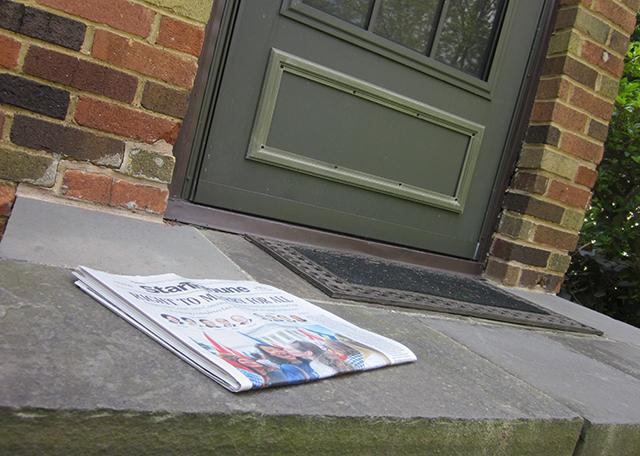
nindA few weeks ago, the Boston Globe stubbed its toe in major fashion when it changed the company it uses to deliver ~115,000 hard-copy versions of the daily paper in the Boston metro area.

And the problems continue to persist even now.

No doubt, the decision to switch home delivery services was made out of a desire to save money rather than to improve service.  And one can understand why management might have been looking for ways to cut production costs on the print version compared to the “go-go” online/digital realm.

But focusing on solely millennials and other younger customers can come back to “bite you on the bottom line” – which is exactly what happened in the case of the Globe.

Evidently, the new delivery service was untested – at least in terms of taking on a client with volumes as large as Boston’s leading newspaper.

As it turned out, tens of thousands of papers weren’t delivered, sparking a cataclysm of loud, negative feedback.

The pique of customers went well-beyond failing to receive something that had been paid for. In the case of the Globe’s extensive Baby Boomer subscriber base, missing home delivery struck at the heart of the time-honored rituals of how they receive and consume their news.

Consider this: The average subscriber to the Boston Globe pays around $700 per year for their home-delivery subscription.

That’s more than $80 million per year in income for the paper – before factoring in advertising revenue.

Of course, the costs of producing and delivering the print product exceeds that of digital. But this subscription base is more loyal than digital news consumers precisely because they value how the news is presented to them.

Let’s not forget that for people born before 1965, most are emotionally attached to print far more than those in other demographic groups. As Gordon Plutsky, a director of applied intelligence at IDG, writes about the Boston Globe snafu:

“[It’s] not just the physical paper, but the ritual of getting the paper off their driveway or front steps and starting their day spreading out the broadsheet and scanning the news. They missed curling up with coffee or tea and working the crossword puzzle or cutting coupons.  It is easy to forget that until the mid-‘90s, this was the only way to read the news and, for Boomers, it is how they learned to read and interact with the world.  Their brains are wired for print in the same way Gen Z is wired for mobile.”

Perhaps the Globe’s business and administrative staffers lost sight of that fact. Maybe they treated their “unsexy” print subscribers as an afterthought while forgetting that this segment of their customer base is critical to the very survival of their paper – and the industry – in a period of transition.

True, delivering the news to print customers is more expensive than doing so digitally. But these customers are more predictable and loyal, versus fickle and finicky.

… But only if the product is delivered. Fail in that fundamental function, and the gig is up.

nosThe Boston Globe’s print readers are hardly unique. Recently, Pew Research Center surveyed consumers in three urban markets.  Despite the differences in these markets (geographic, economic, social), a highly significant percentage of respondents in all three metro areas reported that they read only the print version of their local newspaper:

  • Denver, CO: ~46% read only the print version of their local newspaper
  • Macon, GA: ~48% read print only
  • Sioux City, IA-NE-SD: ~53% read print only

This isn’t to suggest that Boomer audiences are a bunch of rubes who aren’t connected to the digital world. Far from it:  They tend to be better educated and more wealthy (with more disposable income) than other demographic segments.  Their attachment to print isn’t in lieu of digital, but more in concert with their online habits.

Unlike other generations, they’re not single-channel as much as omni-channel consumers. The keys to newspaper publishers’ continued relevance are bound up in how they serve this older but critically important segment of their customer base.

Speaking personally, I can “take it or leave it” when it comes to print.  I don’t subscribe to a daily print paper, and the bulk of my news comes to me from digital sources.  But there’s something quite comfortable about sitting down with a quality daily paper and reading the news stories therein — including long-form journalism pieces that are difficult to find very many places these days.

There are millions more people across the country that are happy to continue paying for the privilege of consuming the news in just such a fashion.  Indeed, they’re the newspaper industry’s most loyal readers.