More Trouble in the Twittersphere

With each passing day, we see more evidence that Twitter has become the social media platform that’s in the biggest trouble today.

The news is replete with articles about how some people are signing off from Twitter, having “had it” with the politicization of the platform. (To be fair, that’s a knock on Facebook as well these days.)

Then there are reports of how Twitter has stumbled in its efforts to monetize the platform, with advertising strategies that have failed to generate the kind of growth to match the company’s optimistic forecasts. That bit of bad news has hurt Twitter’s share price pretty significantly.

And now, courtesy of a new analysis published by researchers at Indiana University and the University of Southern California, comes word that Twitter is delivering misleading analytics on audience “true engagement” with tweets.  The information is contained in a peer-reviewed article titled Online Human-Bot Interactions: Detection, Estimation and Characterization.

According to findings as determined by Indiana University’s Center for Complex Networks & Systems Research (CNetS) and the Information Sciences Institute at the University of Southern California, approximately 15% of Twitter accounts are “bots” rather than people.

That sort of news can’t be good for a platform that is struggling to elevate its user base in the face of growing competition.

But it’s even more troubling for marketers who rely on Twitter’s engagement data to determine the effectiveness of their campaigns. How can they evaluate social media marketing performance if the engagement data is artificially inflated?

Fifteen percent of all accounts may seem like a rather small proportion, but in the case of Twitter that represents nearly 50 million accounts.

To add insult to injury, the report notes that even the 15% figure is likely too low, because more sophisticated and complex bots could have appeared as a “humans” in the researchers’ analytical model, even if they aren’t.

There’s actually an upside to social media bots – examples being automatic alerts of natural disasters or customer service responses. But there’s also growing evidence of nefarious applications abounding.

Here’s one that’s unsurprising even if irritating: bots that emulate human behavior to manufacture “faux” grassroots political support.  But what about the delivery of dangerous or inciting propaganda thanks to bot “armies”?  That’s more alarming.

The latest Twitter-bot news is more confirmation of the deep challenges faced by this particular social media platform.  What’s next, I wonder?

B-to-B content marketers: Not exactly a confident bunch.

In the world of business-to-business marketing, all that really matters is producing a constant flow of quality sales leads.  According to Clickback CEO Kyle Tkachuk, three-fourths of B-to-B marketers cite their most significant objective as lead generation.  Pretty much everything else pales in significance.

This is why content marketing is such an important aspect of commercial marketing campaigns.  Customers in the commercial world are always on the lookout for information and insights to help them solve the variety of challenges they face on the manufacturing line, in their product development, quality assurance, customer service and any number of other critical functions.

Suppliers and brands that offer a steady diet of valuable and actionable information are often the ones that end up on a customer’s “short-list” of suppliers when the need to make a purchase finally rolls around.

Thus, the role of content marketers continues to grow – along with the pressures on them to deliver high-quality, targeted leads to their sales forces.

The problem is … a large number of content marketers aren’t all that confident about the effectiveness of their campaigns.

It’s a key takeaway finding from a survey conducted for content marketing software provider SnapApp by research firm Demand Gen.  The survey was conducted during the summer and fall of 2016 and published recently in SnapApp’s Campaign Confidence Gap report.

The survey revealed that more than 80% of the content marketers queried reported being just “somewhat” or “not very” confident regarding the effectiveness of their campaigns.

Among the concerns voiced by these content marketers is that the B-to-B audience is becoming less enamored of white papers and other static, lead-gated PDF documents to generate leads.

And yet, those are precisely the vehicles that continue to be used most often used to deliver informational content.

According to the survey respondents, B-to-B customers not only expect to be given content that is relevant, they’re also less tolerant of resources that fail to speak to their specific areas of interest.

For this reason, one-third of the content managers surveyed reported that they are struggling to come up with effective calls-to-action that capture attention, interest and action instead of being just “noise.”

The inevitable conclusion is that traditional B-to-B marketing strategies and similar “seller-centric” tactics have become stale for buyers.

Some content marketers are attempting to move beyond these conventional approaches and embrace more “content-enabled” campaigns that can address interest points based on a customer’s specific need and facilitate engagement accordingly.

Where such tactics have been attempted, content marketers report somewhat improved results, including more open-rate activity and an in increase in clickthrough rates.

However, the degree of improvement doesn’t appear to be all that impressive. Only about half of the survey respondents reported experiencing improved open rates.  Also, two-thirds reported experiencing an increase in clickthrough rates – but only by 5% or less.

Those aren’t exactly eye-popping improvements.

But here’s the thing: Engagement levels with traditional “static” content marketing vehicles are likely to actually decline … so if content-enabled campaigns can arrest the drop-off and even notch improvements in audience engagement, that’s at least something.

Among the tactics content marketers consider for their creating more robust content-enabled campaigns are:

  • Video
  • Surveys
  • Interactive infographics
  • ROI calculators
  • Assessments/audits

The hope is that these and other tools will increase customer engagement, allow customers to “self-quality,” and generate better-quality leads that are a few steps closer to an actual sale.

If all goes well, these content-enabled campaigns will also collect data that helps sales personnel accelerate the entire process.

Cross-Currents in the Minimum Wage Debate

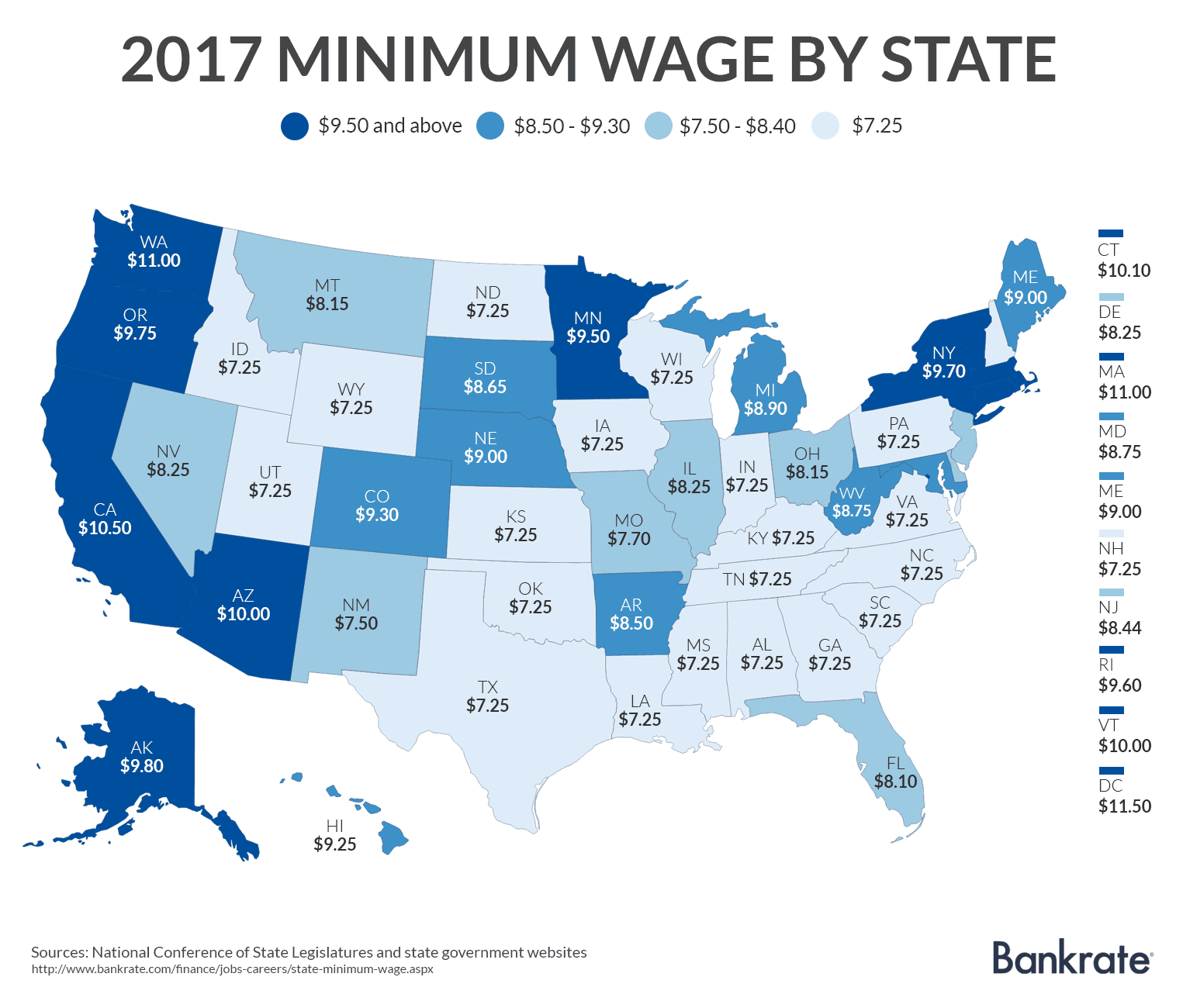
usmap-minimum-wages-2017This past November, there were increased minimum wage measures on the ballet in four states – Arizona, Colorado, Maine and Washington. They were approved by voters in every instance.

But are views about the minimum wage actually that universally positive?

A survey of ~1,500 U.S. consumers conducted by Cincinnati-based customer loyalty research firm Colloquy around the same time as the election reveals some contradictory data.

Currently, the federal minimum wage rate is set a $7.25 per hour. The Colloquy research asked respondents for their views in a world where the minimum wage would $15 per hour — a figure which is at the upper limit of where a number of cities and counties are now pegging their local minimum wage rates.

The survey asked consumers if they’d expect to receive better customer service and have a better overall customer experience if the minimum wage were raised to $15 per hour.

Nearly 60% of the respondents felt that they’d be justified in expecting to receive better service and a better overall experience if the minimum wage were raised to that level.  On the other hand, nearly 70% believed that they wouldn’t actually receive better service.

The results show pretty clearly that consumers don’t see a direct connection between workers receiving a substantially increased minimum wage and improvements in the quality of service those workers would provide to their consumers.

Men feel even less this way than women: More than 70% of men said they wouldn’t expect to receive better service, versus around 65% of women.

Younger consumers in the 25-34 age group, who could well be among the workers more likely to benefit from an increased minimum wage, are just as likely to expect little or no improvement in service quality. Nearly 70% responded as such to the Colloquy survey.

One concern some respondents had was the possibility that a dramatic rise in the minimum wage to $15 per hour could lead retailers to add more automation, resulting in an even less satisfying overall experience. (For men, it was ~44% who feel that way, while for women it was ~33%.)

Along those lines, we’re seeing that for some stores, labor-saving alternatives such as installing self-service checkout lanes have negative ramifications to such a degree that any labor savings are more than offset by incidences of merchandise “leaving the store” without having been paid for properly.

Significant numbers of consumers aren’t particularly thrilled with the “forced march” to self-serve checkout lines at some retail outlets, either.

Perhaps the most surprising finding of all in the Colloquy research was that only a minority of the survey respondents were actually in support of raising the minimum wage to $15 per hour. In stark contrast to the state ballot measures which were supported by clear majorities of voters, the survey found that just ~38% of the respondents were in favor.

The discrepancy is likely due to several factors. Most significantly, the November ballot measures were not stipulating such a dramatic monetary increase, but rather minimum wage rates that would increase to only $12 or $13 – and only by the year 2020 rather than immediately.

That, coupled with concerns about automation and little expectation of improved service quality, and it means that this issue isn’t quite as “black-and-white” as some might presume.

Getting a handle on survey response rates.

It turns out, there are some predictive factors.

sgOne of the nice things about the proliferation on online surveys in recent years is that, over time, we’ve come to understand survey response dynamics much better.

Of course, predicting response rates with flawless precision is impossible due to the individual attributes of each individual survey, the sample composition and so forth.  But thanks to a 2015 compilation of “bottom-line” information by content marketing specialist Andrea Fryrear, the following points are good ones for marketing personnel undertaking market survey work.

Surveys aimed at “internal audiences” outperform external ones.

Targeting an internal audience such as a company’s own employee base is likely going to generate higher response rates (in the neighborhood of 35% to 40%, give or take). For surveys of an external audience, it’s more like 10% or perhaps even lower.

The reason is simple: Surveys aimed at internal audiences are likely very-well targeted, whereas with an external audience, often it’s difficult to reach only the right type of respondents.  At least some of them will turn out to be poor targets.

Additional motivating factors.

Other factors that can influence survey response rates include:

  • Customer loyalty – People who feel a connection with the brand conducting a survey tend to be more likely to participate.
  • Brand recognition – Surveys that focus on well-known brands will typically outperform ones from an unknown source or dealing with unfamiliar brands.
  • Perceived benefit – The “WIIFM” factor.  For example, response rates can soar even higher if the respondent population is motivated by serious incentives.  I recall getting more than a 60% response rate on a mail survey and an external sample because the monetary incentive was a $2 bill.
  • Demographics – The reality is that certain segments of the population are more likely to respond to surveys than others.  Think everything from age and gender to ethnicity and geographic location.
  • Survey distribution – Certain audiences are used to interacting on social media … others online … still others offline.  Chances are, you already know which type of research targets those are within your target markets, and it should influence your choice of survey delivery.

Survey length can make or break your response and completion rates.

To achieve the highest response rates, ideally surveys should take five minutes or less to complete. Ten minutes or less is probably OK, too.  But anything longer than that will likely have deleterious effect on your response rate.

How many questions does this mean? On average, respondents can complete five closed-ended questions in a minutes’ time … but only two open-ended ones.

Survey reminders? Yes.

Particularly with online surveys, it’s a good idea to send reminder notices to those who haven’t completed surveys as you get closer to the cut-off date. Sending two or three reminders is a good rule of thumb … and try sending them at different times of the day or different days of the week to that you can reach as many different prospective respondents as possible.

Learning from the experience of the thousands of surveys administered every month should make it easier for marketers to ensure their next survey will generate successful results instead of flame out.  There’s really no reason for failure considering the wealth of “experiential information” that’s out there.

Internet-connected TVs now dominate the market.

ictvRecently I blogged about how many Americans are now living in cellphone-only households.

Bottom-line:  It’s a major percentage.

A parallel development is the extent of Internet-connected TVs that are now in place in U.S. households. According to a recent survey of ~2,000 U.S. adult broadband users by The Diffusion Group, Internet-connected TV penetration has now risen to 74%.

This chart shows the penetration trends over the past four years:

  • 2013 Internet-connected TV penetration: ~50%
  • 2014: ~61%
  • 2015: ~70%
  • 2016: ~74%

What these figures show is that almost three fourths of U.S. households now have an Internet-connectable television, which is up about 50% since 2013.

With more consumers wanting to set up their own in-home networks, TV manufacturers saw this trend developing and began flooding the retail market with “smart” televisions. As a result, most any consumer looking to purchase a TV set these days is likely to end up with one that is Internet-connectable, whether they feel they need it or not.

This is a back door into the world of consumer IoT; both the TV and the smartphone are the prime facilitators for the adoption of the Internet of Things in the home.

But like with many other technological waves, actual adoption rates can lag. For many people, watching TV on Internet-connected equipment is still only “potential” viewing rather than actual viewing.  Just as some consumers who own the latest smartphone models never use them to watch videos, homes that replace a TV set with the latest Internet-connectable model don’t necessarily use the added built-in functionality — at least initially.

Still, one suspects that with this technology now at people’s fingertips, it won’t be much longer before we start seeing actual usage catch up with the potential that’s there.

Will consumer spending bring holiday cheer to businesses in 2016?

hdsThe holiday season isn’t yet upon us, and already there are a plethora of prognostications being made as to how holiday sales will stack up compared to prior years.

These predictions come courtesy of numerous forecasters including the National Retail Foundation, Deloitte, Kantar Media, eMarketer, the International Council of Shopping Centers, Market Track and others.

So what’s in store? On balance, forecasters predict that holiday sales in the United States will post an increase of approximately 3.5%.  That’s higher than the 10-year rolling average of 2.5% but down a tick from last year’s 3.7% increase.

Still, at more than $655 billion in total sales, holiday spending continues to be the biggest single driver of the U.S. consumer market.

Hardly surprising, e-commerce sales are expected to continue their double-digit growth over last year’s holiday season, with various predictions ranging from 14% to 17% growth in this sector. Not only are consumers attracted by the convenience of online shopping, many of them believe they can find products at the cheapest price via online sources rather than taking a trip to the shopping mall.

Another factor that drives at least some people to shop on their online devices is their aversion to the crush of holiday shopping at the stores. A McKinsey study has found that nearly one-third of U.S. consumers basically hate Black Friday (the day after Thanksgiving), and make it a point to stay as far away from it as possible.

But there’s one drawback for businesses about online holiday shopper dynamics, however:  Those consumers tend to be less brand loyal than is typical. RJ Metrics calculates that the typical e-commerce business acquires nearly 25% of its new customers during just the months of November and December.  Tempering that healthy statistic is the lifetime value of those consumers, which RJ Metric has determined is about 13% lower than the lifetime value of customers acquired at other times of the year.

You might be wondering what amount of money the typical U.S. consumer will spend on his or her holiday shopping this year. Wait for it:  The 2015 per capita amount is expected to be $935.

That figure may seem quite rich … but it’s actually a little bit lower than 2015’s average spend-per-person, which at $953 happens to have been the all-time high ever recorded.

Does the new $935 forecast signify a reversal of a trend … or is it just a pause in an otherwise ever-increasing amount of money that consumers are willing to plunk down as part of their celebration of the holiday season?

Check back in about a year and we should have an answer.

E-Mail Communications and the “Always On” Culture

It’s a common complaint of people in business:  E-mail is this great big blob that consumes way too much of their day. 

tme

And now we know just how much.  According to a recent report published by Adobe —  “E-Mail Survey 2016,” — white collar adults around the world are spending ~17% more time on e-mail activities today compared to last year.  And on the business side, the growth is even bigger.

According to the findings of this research, which included surveys of ~1,000 American and ~3,000 European white collar workers, the time spent on work e-mails on a typical day is ~4 hours, while personal e-mail communications account for an additional ~3.3 hours.

This combined total of nearly 7.5 hours means that nearly one third of the typical day is spent working with e-mail communication.

Those findings suggest that other than sleeping, people spend more time on e-mail than on any other type of activity.  How frightening is that?

[Findings among Europeans are much different, either, as this infographic illustrates.]

Contributing to the “always on” atmosphere, is the fact that smartphones have definitely become the “go-to” device for e-mail activities. Nearly 85% of the survey respondents reported that they check e-mail regularly on their smartphone, compared to around 70% who check their desktop or laptop regularly for e-mail.

In the workplace, the two devices are used approximately equally for e-mail activities, but on the personal side, smartphones have it all over other desktops and laptops.  Nearly two-thirds report that they use their smartphones regularly for e-mail, compared to fewer than 30% who use other devices.

The other attribute that e-mail affects is the speed at which e-mails engage their recipients. The nature of e-mail is that it is “intrusive” and engenders a sense of time-sensitivity.  For work e-mails that require a response, here’s how quickly those responses happen:

  • Within a few minutes: ~14%
  • Within 1 hour: ~29%
  • 1 to 2 hours: ~24%
  • Within half a day: ~16%
  • Within 1 day: ~10%
  • 1 to 2 days: ~5%
  • Longer than 2 days: ~2%

This means that two-thirds of work-related e-mails elicit a response from the recipient in two hours or sooner. But believe it or not, that’s not good enough; nearly three-fourths of the respondents expect to receive a response to their e-mail within that time period.

What this research proves is that although many people like to complain about e-mail communications taking over their lives, it’s actually become an integral part of daily life, to the degree that those same people are now conditioned to expect e-mail engagement in real-time.

In short, “always on” e-mail is now the norm. And if you don’t like that very much, there’s basically nothing you can do about it.

For more information on the results of the Adobe research, click here.

What’s Up with Apps These Days?

Results from comScore’s latest annual U.S. Mobile App Report point to some interesting user behaviors.

No one needs to be reminded of how important mobile apps have become in today’s world of communications. Just looking around any crowd of people, it’s clear that usage has become well-nigh ubiquitous.

And now, we have some new stats that help quantify what’s happening, courtesy of the most recent annual Mobile App Report published by global media measurement and analytics firm comScore.

Among the salient findings from this report:

  • Today, mobile devices represent two of every three minutes spent on digital media.
  • Smartphone apps alone account for nearly half of all digital media time spent – and three of every four minutes spent while on mobile.
  • Over the past three years, total time spent on digital media has grown by over 50%. Most all of that growth has been because of mobile apps.
  • Indeed, time spent on desktop media has actually dropped by more than 10%.

Despite the rapid rise of mobile app usage, there are a few findings in the comScore report that point toward some consolidation of the market, with certain apps being the recipient of strong brand loyalties.

Typically, while smartphone users have uploaded many apps on their devices – and may use several dozens of them on a monthly basis – nine out of every ten mobile app minutes are spent with just five top apps.

[Good luck to any app provider attempting to break into that rarefied group of top performers!]

At the same time, “push notification fatigue” appears to be a growing issue: More smartphone users are rejecting app update notifications than ever before.  According to comScore’s recent report, nearly 40% of users rarely or never agree to such update notifications – up significantly from around 30% last year.

Conversely, only about 25% often or always agree to updates, which is down from about one-third of users in last year’s survey.

This last set of figures doesn’t surprise me in the least. With so many apps housed on so many devices, one could easily spend an hour each day accessing nothing but app updates.

Especially considering how little additional functionality these ongoing updates actually deliver, the whole operation falls into the “life’s too short” category.

The ad blocking phenomenon: It’s all about human nature.

noadThe rapid rise in consumer adoption of ad blocking software is threatening the traditional advertising model for publishers. For some, it seems like a topsy-turvy world where none of the old assumptions or the old rules apply.

But author and MarComm über-thought leader Gord Hotchkiss reminds us that the consumer behaviors we are witnesses are as old as the hills.

In a recent MediaPost column titled “Why Our Brains Are Blocking Ads,” Hotchkiss points out that the environment for online ads is vastly different from the environment where traditional advertising flourished for decades – primarily in magazines, newspapers and television.

Gord Hotchkiss
Gord Hotchkiss

He notes that in the past, the majority of people’s interaction with advertising was done while our brains were in “idling” mode – meaning that they had no specific task at hand. Instead, people were looking for something to capture their attention within a TV program, a newspaper or magazine article.

Hotchkiss contends that in such an environment, the brain is in an “accepting” state and thus is more open to advertising messages:

“We were looking for something interesting, we were primed to be in a positive frame of mind, and our brains could easily handle the contextual switches required to consider an ad and its message.”

Contrast this to the delivery of most digital advertising in today’s world, which is happening when people are in more of a “foraging” mode – involved in a task to find information and answers with our attention focused on that task.

In such an environment, advertising isn’t only a distraction; often, it’s a source of frustration. As Hotchkiss notes:

“The reason we’re blocking [digital] ads is that in the context those ads are being delivered, irrelevant ads are – quite literally – painful. Even relevant ads have a very high threshold to get over.”

Hotchkiss concludes that the rapid rise of ad blocking adoption isn’t about the technology per se.  It has to do with the hardwiring of our brains.  New technologies haven’t caused fundamental changes in human behavior – they’ve simply enabled new behaviors that weren’t an option before.

adbAs is becoming increasingly obvious, the implications for the advertising business are huge:  Ad blocking software is projected to lower digital ad revenues by more than $40 billion in 2016 alone, according to estimates by digital data research firm eMarketer.

Looking back on it, actually it seems like it was all so inevitable.

The “Millennial Effect” – and how it’s affecting the Boomer Generation.

bm

In the world of marketing communications, it seems that confluence is in the air. This point was underscored recently by Eric Trow, a MediaPost columnist who is also vice present of strategic services at Pittsburgh, PA-based marketing communications firm Gatesman+Dave.

Trow’s main point is this:  Despite the big differences that marketers have traditionally noted between members of the Boomer Generation and their younger Millennial counterparts, today the two groups are becoming more similar than they are different.

In particular, Boomers are beginning to act more like Millennials.

Trow identifies a set of fundamental trending characteristics that underscore his belief:

  • Boomers increasingly want instant gratification – and related to that, they want convenience as well.
  • Boomers are embracing technology more every day, including being nearly as dependent on mobile devices as their younger counterparts.
  • Boomers connect online – with adults over the age of 65 now driving social media growth more than any other generation at the moment.
  • Boomers want control – and to that end, they do their research as well.
  • Boomers want to live healthier – with levels of interest in natural, healthy and environmentally responsible products rivaling those of younger age groups.
  • Boomers are more questioning of traditional authority – and not just because of the 2016 U.S. presidential election race, either.

Putting it all together, Trow concludes that he and many other Boomers could, in practice, be classified more accurately as “middle-aged Millennials.”

Speaking as someone who falls inside the Boomer generation age range, I concede many of Trow’s points.

But how about you?  Do they ring true to you as well?