Magazine Profitability Strategies: Prevention Magazine Goes for a Radical Solution

pmWhen a business model becomes problematic, sometimes the only solution is to step outside the circle with some seriously radical thinking.

That seems to be what magazine publisher Rodale has done with its flagship media property, Prevention magazine.

As reported by Jeffrey Trachtenberg this past week in The Wall Street Journal, beginning with the July issue, Prevention will no longer accept print advertising.

It’s a major step for a publication as venerable as Prevention, in print since 1950 and an important player in the magazine segment focusing on nutrition, fitness and weight loss.

According to the Trachtenberg piece, Prevention magazine has actually seen an increase in ad pages – up over 8% to 700+ ad pages in 2015 over the year before.  But here’s the rub:  ad revenues were actually down because of circulation losses.

The magazine hasn’t turned a profit in a number of years, either, although other related Rodale titles have (Runner’s World and Men’s Health).

The radical surgery planned for the publication means that the number of pages of a typical magazine issue will decline dramatically. So the cost of printing and shipping will go down.  In order to make up for the loss in ad revenue, the magazine’s subscription price is set to more than double to nearly $50 per year.

Price-conscious as consumers are, that action is expected to drive circulation figures down even further – from around 1.5 million to roughly 500,000 if the company’s projections are correct.

Is this an ingenious idea that will preserve and strengthen a highly regarded publication? Or a desperate action that will end up simply driving this magazine into oblivion in a novel way?

Maria Rodale

Maria Rodale, CEO of the family-owned publication company, thinks the former. As she stated to reporter Trachtenberg:

“We’re walking away from revenue but we’re also walking away from a lot of expense. Let’s serve our readers and charge them for it.”

Rodale anticipates that Prevention magazine’s operating expenses will be reduced by more than 50%.

What are the implications of that?  Maria Rodale again:

“If you have to run the numbers out with an advertising model, it’s hard to see it ever getting to profitability. With a non-advertising model, it quickly becomes profitable.”

… But I’m not so sure. This radical departure from the traditional ad-supported publication model may pay short-term dividends.  But will it turn out to be merely a momentary respite before the next downward slide – this time into irrelevance?

With so much information being so easily accessible online (and free of charge) – particularly in the areas of preventive health – I can easily envision fewer and fewer people wishing to shell out $50+ per year for the benefit of receiving a monthly publication that may or not contain highly relevant and valuable information each and every issue.

What do you think? Is this a silver-bullet solution?  Or a zinc zeppelin?

Is Apple setting itself up for failure in the FBI’s Syed Farook Probe?

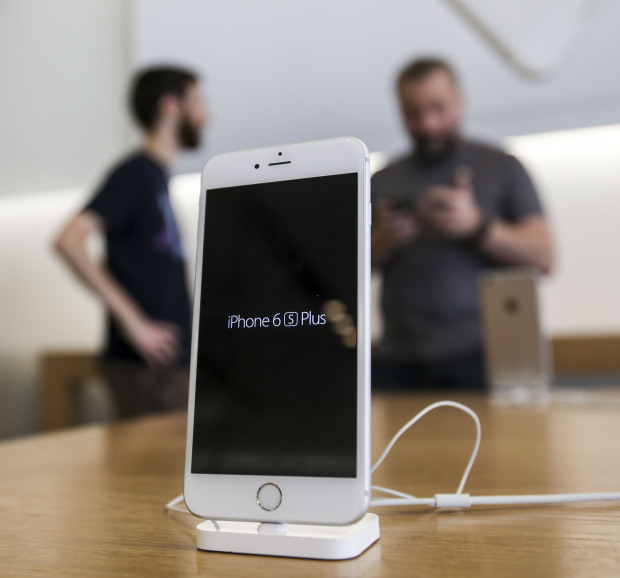
ipThere’s no question that Apple’s refusal to help the FBI gain access to data in one of the iPhones used during the San Bernardino massacre has been getting scads of coverage in the news and business press.

Apple’s concerns, eloquently stated by CEO Tim Cook, are understandable. From the company’s point of view, it is at risk of giving up a significant selling feature of the iPhone to enable a “back door” access to encrypted data..  Apple’s contention is that many people have purchased the latest models of iPhones for precisely the purpose of protecting their data from prying eyes.

On the other hand, the U.S. government’s duty is to protect the American public from terrorist activities.

Passions are strong — and they’re lining up along some predictable social and political fault lines. After having read more than a dozen news articles in the various news and business media over the past week or so, I decided to check in with my brother, Nelson Nones, for an outsider’s perspective.

As someone who has lived and worked outside the United States for decades, Nelson’s perspectives are invariably interesting because they’re formed from the vantage point of “distance.”

Furthermore, Nelson has held very strongly negative views about the efforts of the NSA and other government entities to monitor computer and cellphone records. I’ve given voice to his perspectives on this topic on the Nones Notes blog several times, such as here and here.

So when I asked Nelson to share his perspectives on the Apple/FBI, I was prepared for him to weigh in on the side of Apple.

Well … not so fast. Shown below what he wrote to me:

______________________

This may come as a surprise, but I’m siding with the government on this one. Why?  Three reasons:

Point #1: The device in question is (and was) owned by San Bernardino County, a government entity.

The Fourth Amendment of the U.S. Constitution provides, “The right of the people to be secure in their persons, houses, papers, and effects, against unreasonable searches and seizures, shall not be violated …”

The investigation that the FBI wants to conduct could either be thought of as a seizure of property (the iPhone), or as a search (accessing the iPhone’s contents). Either way, Fourth Amendment protections do not apply in this case.

Within the context of the Fourth Amendment, seizure of property means interfering with an individual’s possessory interests in the property. In this case, the property isn’t (and never was) owned by an individual; it is public property.  Because Farook, an individual, never had a possessory interest in the property, no “unreasonable seizure” can possibly occur.

Also, within the meaning of the Fourth Amendment, an “unreasonable search” occurs when the government violates an individual’s reasonable expectation of privacy. In this case the iPhone was issued to Farook by his employer.  It is well known and understood through legal precedent that employees have no reasonable expectation of privacy when using employer-furnished equipment.  For example, employers can and do routinely monitor the contents of the email accounts they establish for their employees.

Point #2: The person who is the subject of the investigation (Syed Farook) is deceased.

According to Paul J. Stablein, a U.S. criminal defense attorney, “Unlike the concept of privilege (like communications between doctor and patient or lawyer and client), the privacy expectations afforded persons under the Fourth Amendment do not extend past the death of the person who possessed the privacy right.”

So, even if the iPhone belonged to Farook, no reasonable expectation of privacy exists today because Farook is no longer alive.

Point #3: An abundance of probable cause exists to issue a warrant.

In addition to protecting people against unreasonable searches and seizures, the Fourth Amendment also states, “… no warrants shall issue, but upon probable cause, supported by oath or affirmation, and particularly describing the place to be searched, and the persons or things to be seized.”

I strongly believe the U.S. National Security Agency’s mass surveillance was unconstitutional and therefore illegal, due to the impossibility of establishing probable cause for indiscriminately searching the records of any U.S. citizen who might have placed or received a telephone call, sent or received an email message or logged on to their Facebook account.

That’s because these acts do not, in and of themselves, provide any reasonable basis for believing that evidence of a crime exists.

I also strongly believe that U.S. citizens have the right to encrypt their communications. No law exists preventing them from doing so for legal purposes. Conducting indiscriminate searches through warrantless “back door” decryption would be just as unconstitutional and illegal as mass surveillance.

In this case, however, multiple witnesses watched Farook and his wife, Tashfeen Malik, open fire on a holiday party, killing 14 people, and then flee after leaving behind three pipe bombs apparently meant to detonate remotely when first responders arrived on the scene.

Additional witnesses include the 23 police offers involved in the shootout where Farook and Malik eventually were killed.

These witnesses have surely given sworn statements attesting to the perpetrators’ crimes.

It is eminently reasonable to believe that evidence of these crimes exists in the iPhone issued to Farook. So, in this case there can be no doubt that all the requirements for issuing a warrant have been met.

For these three reasons, unlike mass surveillance or the possibility of warrantless “back door” decryption, the law of the land sits squarely and undeniably on the FBI’s side.

Apple’s objections.

Apple’s objections, seconded by Edward Snowden, rest on the notion that it’s “too dangerous” to assist the FBI in this case, because the technology Apple would be forced to develop cannot be kept secret.

“Once [this] information is known, or a way to bypass the code is revealed, [iPhone] encryption can be defeated by anyone with that knowledge,” says Tim Cook, Apple’s CEO. Presumably this could include overreaching government agencies, like the National Security Agency, or criminals and repressive foreign regimes.

It is important to note that Apple has not been ordered to invent a “back door” that decrypts the iPhone’s contents. Instead, the FBI wants to unlock the phone quickly by brute force; that is, by automating the entry of different passcode guesses until they discover the passcode that works.

To do this successfully, it’s necessary to bypass two specific iPhone security features. The first renders brute force automation impractical by progressively increasing the minimum time allowed between entries.  The second automatically destroys all of the iPhone’s contents after the maximum allowable number of consecutive incorrect guesses is reached.

Because the iPhone’s operating system must be digitally signed by Apple, only Apple can install the modifications needed to defeat these features.

It’s also important to note that Magistrate Judge Sheri Pym’s order says Apple’s modifications for Farook’s iPhone should have a “unique identifier” so the technology can’t be used to unlock other iPhones.

This past week, Apple has filed a motion to overturn Magistrate Judge Pym’s order. In its motion, the company offers a number of interesting arguments, three of which stand out:

Contention #1: The “unreasonable burden” argument.

Apple argues that complying with Magistrate Judge Pym’s order is unreasonably burdensome because the company would have to allocate between six and ten of its employees, nearly full-time over a 2 to 4 week period, together with additional quality assurance, testing and documentation effort.  Apple also argues that being forced to comply in this case sets a precedent for similar orders in the future which would become an “enormously intrusive burden.”

Contention #2: Contesting the phone search requirement.

Apple isn’t contesting whether or not the FBI can lawfully seize and search the iPhone.  Instead it is contesting Magistrate Judge Pym’s order compelling Apple to assist the FBI in performing the search.  As such, Apple is an “innocent third party.”  According to Apple, the FBI is relying on a case, United States v. New York Telephone, that went all the way to the Supreme Court in 1977.  Ultimately, New York Telephone was ordered to assist the government by installing a “pen register,” which is a simple device for monitoring the phone numbers placed from a specific phone line.

The government argued that it needed the phone company’s assistance to execute a lawful warrant without tipping off the suspects.  The Supreme Court found that complying with this order was not overly burdensome because the phone company routinely used pen registers in its own internal operations, and because it is a highly regulated public utility with a duty to serve the public.  In essence, Apple is arguing that United States v. New York Telephone does not apply, because (unlike the phone company’s prior use of pen registers) it is being compelled to do something it has never undertaken before, and also because it is not a public utility with a duty to serve.

Contention #3: The requirement to write new software.

Lastly, Apple argues that it will have to write new software in order to comply with Magistrate Judge Pym’s order. However, according to Apple, “Under well-settled law, computer code is treated as speech within the meaning of the First Amendment,” so complying with the order amounts to “compelled speech” that the Constitution prohibits.

What do I think of Apple’s arguments?

Regarding the first of the them, based on its own estimates of the effort involved, I’m guessing that Apple wouldn’t incur more than half a million dollars of direct expense to comply with this order. How burdensome is that to a company that just reported annual revenues of nearly $234 billion, and over $53 billion of profit?

Answer:  To Apple, half a million dollars over a four-week period is equivalent to 0.01% of last year’s profitability over an equivalent time span. If the government compensates Apple for its trouble, I don’t see how Apple can win this argument.

Regarding the other two arguments above, as Orin Kerr states in his Washington Post blog, “I don’t know which side would win … the scope of authority under the [All Writs Act] is very unclear as applied to the Apple case.  This case is like a crazy-hard law school exam hypothetical in which a professor gives students an unanswerable problem just to see how they do.”

My take:  There’s no way a magistrate judge can decide this.  If Apple loses, and appeals, this case will eventually end up at the Supreme Court.

What if the back door is forced open?

The concerns of privacy advocates are understandable. Even though I’m convinced the FBI’s legal position is solid, I also believe there is a very real risk that Apple’s modifications, once made, could leak into the wrong hands. But what happens if they do?

First, unlike warrantless “back door” decryption, this technique would work only for iPhones — and it also requires physical possession of a specifically targeted iPhone.

In other words, government agencies and criminals would have to lawfully seize or unlawfully steal an iPhone before they could use such techniques to break in. This is a far cry from past mass surveillance practices conducted in secret.

Moreover, if an iPhone is ever seized or stolen, it is possible to destroy its contents remotely, as soon as its owner realizes it’s gone, before anyone has the time to break in.

Second, Apple might actually find a market for the technology it is being compelled to create. Employers who issue iPhones to their employees certainly have the right to monitor employees’ use of the equipment.  Indeed, they might already have a “duty of care” to prevent their employees from using employer-issued iPhones for illegal or unethical purposes, which they cannot fulfill because of the iPhone’s security features.

Failure to exercise a duty of care creates operational as well as reputational risks, which employers could mitigate by issuing a new variety of “enterprise class” iPhones that they can readily unlock using these techniques.

____________________

So that’s one person’s considered opinion … but we’d be foolish to expect universal agreement on the Apple/FBI tussle. If you have particular views pro or con Apple’s position, please join the discussion and share them with other readers here.


Old Forester: A storied brand attempts a comeback.

Old Forrester bourbonA half century ago, Old Forester bourbon was the big brand name in the spirits business.  As the flagship brand of the Brown-Forman Corporation, it routinely sold in quantities approaching one million cases each year.

Back in the day, Old Forester was marketed as “America’s Guest Whiskey” – the one to bring out when company came to visit.  (I remember finding an ancient bottle of Old Forrester when cleaning out my late mother-in-law’s liquor cabinet.)

Forward to today.  Despite a recent rise in bourbon sales, Old Forester is a near-forgotten brand entry.  Shipments barely topped 100,000 cases last year, and nearly half of all sales came from just two states:  Alabama and Kentucky.

What the heck happened?

In broad terms, American tastes in distilled beverages shifted away from scotch and bourbon to vodka and gin.  Wine became more popular, too.

But those changes affected the entire market for bourbon, scotch and other whiskeys.  What made Old Forrester sink so low in a category that’s actually been on an upward trend since 2000?

Two words:  “Jack Daniels.”

BF logoIn 1956, Louisville-based Brown-Forman, the makers of Old Forrester, acquired the iconic Jack Daniels brand, and promptly started marketing it big-time.

Jack Daniels advertising has been pretty constant in the decades since.

Then in the mid-1990s, Brown-Forman introduced Woodford Reserve, which it marketed as premium bourbon — much as Old Forester had been a half-century before.

With all of the attention lavished on these two brands, Old Forester got squeezed out of the action.

But as it turns, out, there may be a second act for Old Forrester after all.  Starting in 2001, bourbon shipments have been on a pretty steady upward trend, with total shipments now topping 1 billion liters annually.

Mad-Men-Season-6Some have attributed the growth in bourbon consumption to the success of the Mad Men TV series, but I suspect there’s a lot more to it than just that.

Besides, even with Mad Men going off the air, market forecast firm Cowen & Company predicts American whiskey growth rates will clock in at nearly 10% per year until 2020 at least.

Because of those dynamics, it comes as little surprise that brands like Bulleit Bourbon have been so very aggressive in the market.

New entrants abound, too, as there are now more than 26 distillery licenses issued by the state of Kentucky (up from just ten in 2011).

Evidently, the key managers at Brown-Forman must have decided that they weren’t going to let the market pass them by, and so they’ve committed to a major initiative to resuscitate the Old Forester brand name.  Major commitments and goals include:

  • Building a new distillery in Louisville that will open next year
  • Expanding the geographic reach of brand sales
  • Undertaking a $20 million marketing effort including digital advertising, point-of-sale promotion and bar promotions
  • Increasing annual shipments to 500,000+ cases within five years

What are the chances that Old Forester can regain its lost luster and once again become one of America’s esteemed bourbon brands?

Brown-Forman's Campbell Brown, a fifth-generation family member, heads up the Old Forrester branding initiative.
Brown-Forman’s Campbell Brown, a fifth-generation family member, heads up the Old Forrester branding initiative.

There are no guarantees, of course.  But starting with a venerable brand name … and then appointing a seasoned industry veteran — and fifth generation Brown family member as well — to head the effort may give this initiative pretty decent odds of success.

We’ll check back in four or five years and see how it all turns out.

China’s controversial product supplier pledge: An “on the ground” view from the Far East.

The business world is abuzz about the latest moves by China to regulate the behavior of U.S. and other foreign companies that choose to do business in that country.  What’s the real skinny?

contract

While much of the reporting and commentary has been decidedly scant on details, we can actually take a look at the official document that contains the various provisos the Chinese government is intending to impose on foreign companies.

Ostensibly, the declaration is aimed at “protecting user security.” Here are the six provisions that make up the declaration:

Information Technology Product Supplier Declaration of Commitment to Protect User Security

Our company agrees to strictly adhere to the two key principles of “not harming national security and not harming consumer rights” and hereby promises to:

#1.  Respect the user’s right to know. To clearly advise users of the scope, purpose, quantity, storage location, etc. of information collected about the user; and to use clear and easy-to-understand language in the user agreement regarding policies and details of protecting user security and privacy.

#2.  Respect the user’s right to control. To permit the user to determine the scope of information that is collected and products and systems that are controlled; to collect user information only after openly obtaining user permission, and to use collected user information to [sic] the authorized purposes only.

#3.  Respect the user’s right to choice. To allow the user to agree, reject or withdraw agreement for collection of user information; to permit the user to choose to install or uninstall non-essential components; to not restrict user selection of other products and services.

#4.  Guarantee product safety and trustworthiness. To use effective measures to ensure the security and trustworthiness of products during the design, development, production, delivery and maintenance processes; to provide timely notice and fixes upon discovery of security vulnerabilities; to not install any hidden functionalities or operations the user is unaware of [sic] within the product.

#5.  Guarantee the security of user information. To employ effective measures to guarantee that any user information that is collected or processed isn’t illegally altered, leaked, or used; to not transfer, store or process any sensitive user information collected within the China market outside China’s borders without express permission of the user or approval from relevant authorities.

#6.  Accept the supervision of all parts of society. To promise to accept supervision from all parts of society, to cooperate with third-party institutions for assessment and verification that products are secure and controllable and that user information is protected etc. to prove actual compliance with these commitments.

Often with China, there are “official” pronouncements … and then there’s what’s “really” going on behind the curtain.

So to find out the real skinny, I decided to ask my brother, Nelson Nones, who has lived and worked in East Asia for years.  Since Nelson’s business activities take him to China and all of the other key Asian economies on a regular basis, I figured that his perspectives would be well-grounded and worth hearing.  Here’s Nelson’s take:

Points 1 through 3 are fundamentally no different from the provisions of personal data protection laws already on the books in the 27 member states of the European Union, plus Australia, Hong Kong, Iceland, India, Japan, South Korea, Liechtenstein, Macau, Malaysia, New Zealand, Norway, Singapore, the Philippines, Taiwan and some U.S. states.  Nor do they materially differ from privacy policy best practices — so I would not see these as particularly onerous or unreasonable.

The key difference is that these points are not enshrined in law in Mainland China, so compliance is voluntary at the moment (as it was in Singapore until 2013) – presumably binding on only those companies that sign this declaration. 

News reports also indicate that China has asked only American technology companies to sign its Declaration of Commitment, implying that domestic Chinese companies aren’t necessarily held to the same standards — although if this is truly the case, it might actually put Chinese companies at a competitive disadvantage by enhancing the appeal of American technology products to discerning Chinese users.

Point 4 doesn’t generally fall within the scope of existing personal data protection laws, but in my view its provisions fall well within the QA and warranty commitments that any legitimate technology company should be prepared to make in today’s competitive environment.

Comparing Point 5 with legislation currently in force within the European Union, Australia, Hong Kong, Iceland, India, Japan, South Korea, Liechtenstein, Macau, Malaysia, New Zealand, Norway, Singapore, the Philippines, Taiwan and some U.S. states, this point lacks some really key definitions, including:  

  • Who exactly is a “data subject” who is entitled to personal (i.e. user) data protection?
  • Who exactly is the “data controller” who owns the user information that is being collected or processed?
  • Who might be the “data processor” who stores and/or processes user information on behalf of the “data controller”?

EU Data Protection DirectiveThe legislation and regulations I’ve reviewed in this realm provide very explicit (and varied) definitions of these entities. Unlike China’s Declaration of Commitment, for instance, the E.U. Data Protection Directive allows “data controllers” or “data processors” to transfer user data outside the E.U., as long as the country where the data is transferred protects the rights of “data subjects” as much as the E.U. 

It also defines which “data controllers” and “data processors” must comply with E.U. law, based on whether or not they store or process personal information with the E.U., or operate within the E.U. (regardless of where the data is actually stored or processed).

The requirement to keep sensitive user information within China’s borders, in the absence of permission from users or “relevant authorities” to transfer, store or process it elsewhere, could also be seen as an attempt by the Chinese government to enlist the help of American technology companies in circumventing the U.S. government’s ongoing Internet data-gathering programs.

If this attempt succeeds, it might further enhance the appeal of American technology products to discerning Chinese users. 

Point 6 is garnering the most headlines in the West because of the implied threat that cooperating with “third-party institutions for assessment and verification … to prove actual compliance with these commitments” could mean being forced to reveal source code or encryption algorithms.  

However, in classic Chinese style, none of that is actually spelled out. 

Green Dam Youth Escort ServiceA little history about this: Over the past decade, the Chinese government has put forward various proposals for controlling IT – and then abruptly withdrawing them in the face of domestic as well as global criticism. Here are two: 

As for implications, China’s Declaration of Commitment shouldn’t have significant impact on companies that aren’t in the consumer IT market.  At best, its first five points could potentially improve the competitiveness of American IT products in the  Chinese market.    

However, I would advise any tech companies that may be wondering what to do, to sit on their hands for a while. Law in China is always a “work in progress,” so the safest bet is to wait for that “progress” for as long as possible.

So there you have it – the view from someone who is smack in the middle of the business economy in East Asia. If you have your own perspectives to share on the topic, I’m sure other readers would be interested to hear them as well.

Is the Apple Watch already proving the naysayers wrong?

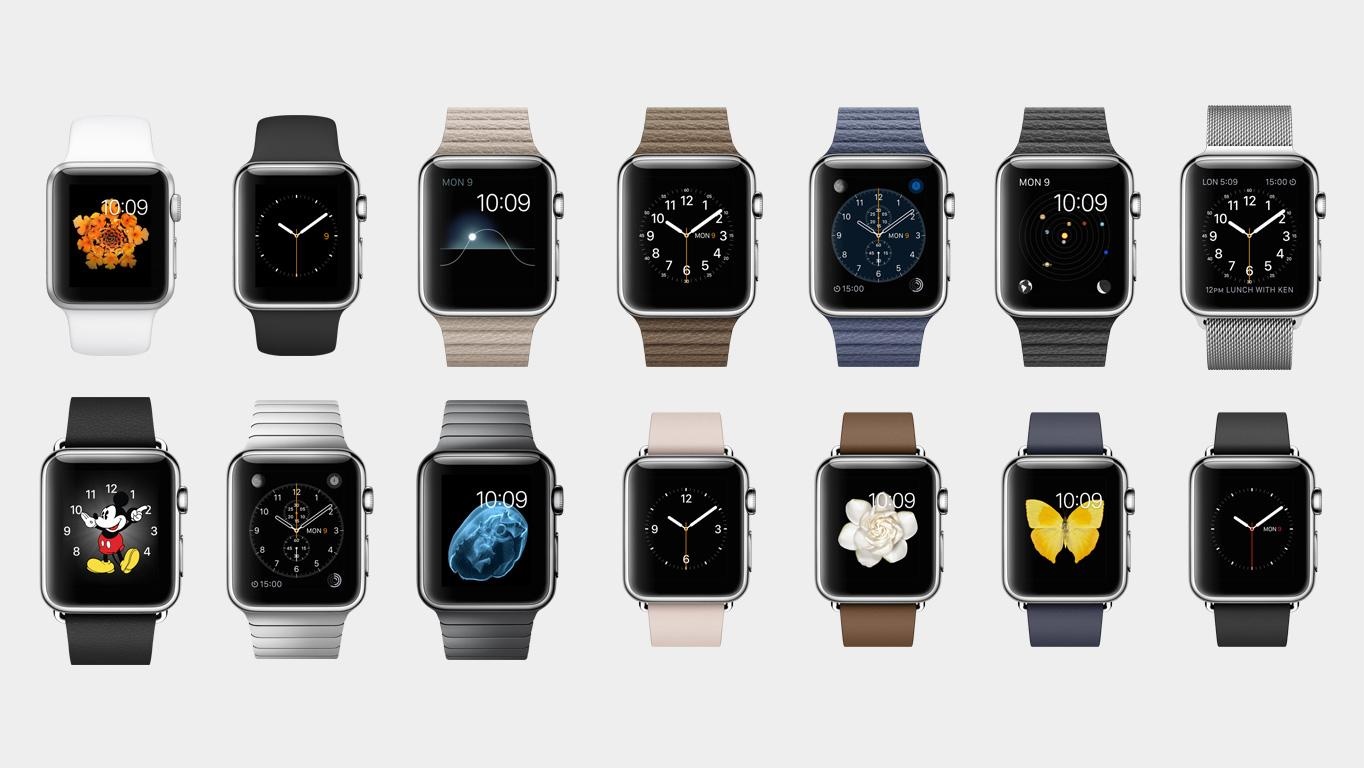
Apple WatchI’ve blogged recently about the market reception to the Apple Watch, which seemed to be somewhat less “ecstatic” compared with previous Apple product introductions — at least in the first few weeks after its unveiling.

Now we have several months behind us — as well as some field research that suggests that the Apple Watch is being very well-received by early adopters.

logoThe findings come courtesy of a research panel of 145 Apple Watch owners who were contacted in late July and early August 2015 by consumer market research company 451 Research. The research sample was drawn from the company’s ChangeWave network of ~25,000 business and technology professionals.

The overall satisfaction level with the Apple Watch among these respondents is ~83%, with ~54% stating that they are “very satisfied” with the product.

In terms of how well the watch is performing in relation to owners’ expectations, almost the same percentage (~79%) state that the Apple Watch is meeting them.

The three attributes of the Apple Watch that are most well-liked are these:

  • Notifications/alerts: ~49% mentioned
  • Health and fitness monitoring: ~41%
  • Design aesthetics of the product: ~30%

The three concerns about the Apple Watch mentioned most frequently are these:

  • Battery life is too short: ~37% mentioned
  • Tied to the iPhone: ~31%
  • Product is not waterproof: ~25%

The battery life issue really is one to “watch,” as it were:  Tracking surveys of Apple Watch owners reveal that more people are checking their battery status at least once per day than are checking their watch faces for the time (!).

Not surprisingly, the Apple Watch poses a competitive threat to more traditional digital watches, as more than four in five respondents report that the Apple Watch has replaced the traditional watches if they had worn one earlier.  (On the other hand, about one third of owners didn’t wear anything on their wrist at all before acquiring their Apple Watch.)

Fitness monitors: Odd man out?

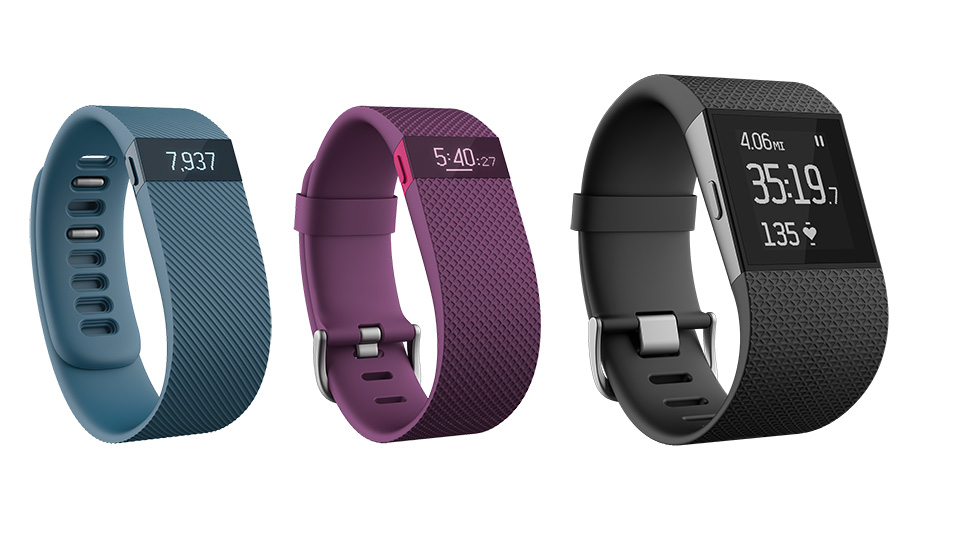
The popularity of the Apple Watch’s health and fitness monitoring capabilities portends problems for competing monitors as well. Nearly half of the Apple Watch owners surveyed by 451 Research reported that they have previously planned on purchasing a monitor, but have since decided not to, thanks to the Apple Watch’s functionality.

As for whether the Apple Watch is becoming an indispensible part of the fabric of daily life with these users as compared to being more of a novelty gadget, the behavior is looking a lot more like the former:

  • Use daily for health and fitness monitoring: ~79% of respondents reported
  • Send and receive text messages daily: ~63%
  • Check weather information daily: ~52%

Perhaps the best indication of how satisfied these early adopters are with the Apple Watch is how they responded to the question, “Would you recommend the Apple Watch to a friend or colleague?”

The answer? More than four in five respondents (~83%) answered in the affirmative: ~55% reported “very likely” and ~28% reported “somewhat likely.”

If consumer response continues along the same lines in the upcoming months, it may well mean that the Apple Watch is on the path to gaining impressive adoption figures — and proving the naysayers wrong.

The real proof will be in the sales figures, of course.  But seeing these indications of early adopters being quite satisfied ith the product’s performance — and willing to recommend it to friends and colleagues — is a very good first step.

If you have begun using an Apple Watch, I’m sure other readers would be interested to know what appeals to you most about it — and what attributes might not be living up your expectations. Please share your experiences here.

State of the States: CNBC’s take on the best ones for business.

In CNBC’s recently published scorecard, don’t look to the Northeast or California to find the states that are best ones for business.

CNBC State Rankings for Business
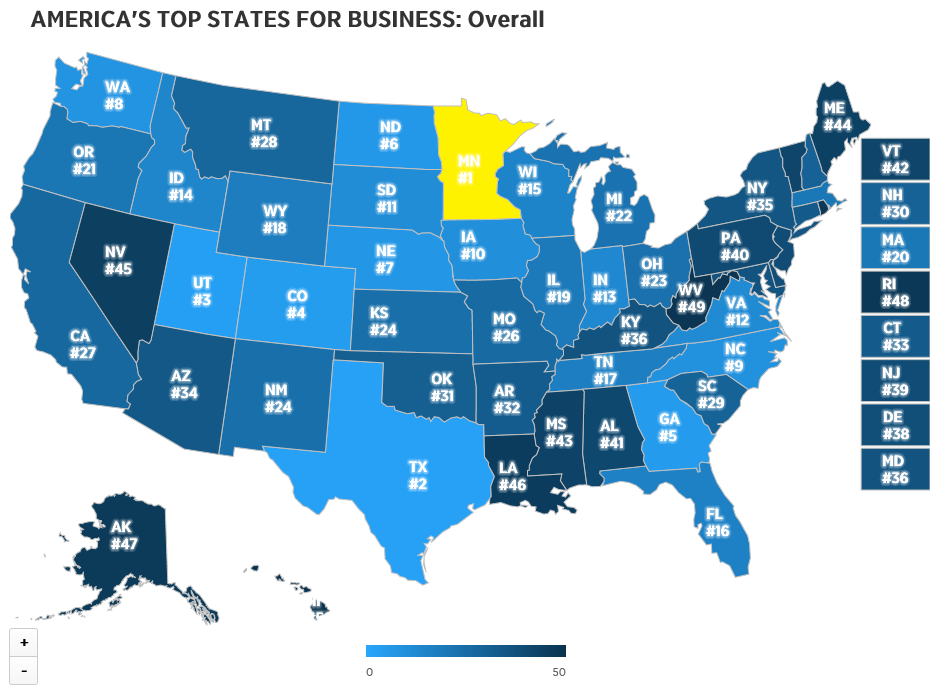
L’Etoile du nord: Just as in its state motto “Star of the North,” Minnesota is the stellar performer in CNBC’s 2015 state ranking of business competitiveness. (Click on the map for a larger view.)

State and city rankings are a source of fascination for many people. Of course, there are many ways to fashion them to place nearly any state or city you like at the top of the heap.  Some of the lists use criteria that are so convoluted, it stretches credulity.

Since when is Baltimore the best city in America for single men?  Since it was ranked #1 in this evaluation, evidently.  Many of us who know the city’s innards really well would disagree heartily, of course.

But I think the CNBC 2015 scorecard on state business climates, published earlier this month, is based on a more solid set of criteria.

CNBC created it by scoring all 50 states on approximately 60 separate measures of competitiveness – a list that was developed with input from an array of business and policy experts, official government sources, and CNBC’s own Global CFO Council, and that uses government-generated data.

CNBC then grouped these measures into ten broader categories, weighting the results based on how often each is used as “selling point” in state economic development marketing and promotional efforts. This was done in order to rank the states based on the criteria they themselves use to showcase their attractiveness to businesses considering expansion or relocation.

Here are the ten broad categories in the CNBC evaluation, and which states ranked first and last within them:

  • Access to capital: #1 North Carolina … #50 Wyoming
  • Business friendliness: #1 North Dakota … #50 California
  • Cost of doing business: #1 Indiana … #50 Hawaii
  • Cost of living: #1 Mississippi … #50 Hawaii
  • Economy: #1 Utah … #50 Mississippi
  • Education: #1 Massachusetts … #50 Nevada
  • Infrastructure: #1 Texas … #50 Rhode Island
  • Quality of life: #1 Hawaii … #50 Tennessee
  • Technology/innovation: #1 Washington … #50 West Virginia
  • Workforce: #1 North Dakota … #50 Maine

Do we see any surprises here?  To my mind, the high and low rankings look pretty well-aligned with the anecdotal information we hear all the time.

Perhaps we might consider several other states besides Nevada to be “bottoms” in education. And personally, I am pretty shocked to see Tennessee ranked last in quality of life. Having lived there during my college years at Vanderbilt University, I never considered the state to be substandard when it came to that attribute.

But It’s when CNBC amalgamates all of the rankings to come up with its overall state ranking that a few surprises emerge.

Such as … Minnesota notches first place overall. I’m sure some people are genuinely surprised to see that.

For the record, here is CNBC’s list of the Top 10 states for business in 2015:

  • #1 – Minnesota
  • #2 – Texas
  • #3 – Utah
  • #4 – Colorado
  • #5 – Georgia
  • #6 – North Dakota
  • #7 – Nebraska
  • #8 – Washington
  • #9 – North Carolina
  • #10 – Iowa

We see that four of the ten top states are in the Midwest … three are in the South … three are in the West … but none are in the Northeast.

CNBC study on business competitiveness
The center holds: According to CNBC, most of the most competitive states for business are in the Mid-Continent region.

By contrast, for the most part the Bottom 10 states are clustered in other areas of the country … including four Northeastern states plus Alaska and Hawaii, two states that clearly have unique locational circumstances:

Hawaii lacks business competitiveness
Not so sunny: Hawaii’s bad business climate.
  • #40 – Pennsylvania
  • #41 – Alabama
  • #42 – Vermont
  • #43 – Mississippi
  • #44 – Maine
  • #45 – Nevada
  • #46 – Louisiana
  • #47 – Alaska
  • #48 – Rhode Island
  • #49 – West Virginia
  • #50 – Hawaii

CNBC has issued a raft of charts and maps providing details behind how their ratings were formulated, and the results for each of the major categories. You can view the data here.

Speaking for yourselves, in what ways would you challenge the rankings? What strikes you here as different from your own personal experience in doing business in various states? Please share your perspectives with other readers.

What’s happening with the Apple Watch these days?

Not all that much, it turns out.

Apple Watch LineWhen is the last time you heard about a product introduction where initial sales were off by 90% barely three months after coming on the market?

If you’re thinking the Blackberry 10 … you’re wrong.

It’s the Apple Watch. Its introduction in April was made with a big amount of fanfare, promoted before and after the launch by PR, TV and online advertising, and even outdoor billboards.

But the hard truth is that aside from the tech community, few people are buying the Apple Watch.

According to Slide Intelligence, weekly Apple Watch sales have plummeted from around 200,000 per day at launch to fewer than 20,000 per day now. Moreover, most sales have been of the least expensive Sport model ($349).

Even worse, of those who have purchased an Apple Watch, fewer than four in ten would recommend the device to others.

You know there’s a problem when a new product engenders ridicule such as this brief, highly dismissive video review.

It may be too soon to write off the Apple Watch introduction as an abject failure. But I know one thing: The market’s (lack of) receptivity so far can’t be what Apple execs were hoping for.

It must be quite a comedown for a company that experienced the dizzying popularity of the iPod, iPhone and iPad right out of the box — and where those product sales continued to climb at an increasing rate for months or years after their debut.

google-glass-fashionSome people are comparing the Apple Watch introduction to what happened to Google Glass – likewise the victim of tepid sales to the point where Google quietly removed the product from the market after making a go of it for about two years.

Actually, I’m not quite sure the comparison is completely apt.

For starters, Google Glass didn’t come on the market backed by a ginormous PR and advertising campaign. In fact, it wasn’t really presented as a full-blown product – but more like a project with a beta test component.

Also, it was never made available in wide release; some people I know who wanted to “kick the tires” with Google Glass had difficulty finding out how they could do so.

But besides the very different rollout strategies, another factor might explain a more fundamental difference – and which has hugely negative potential impact on the Apple Watch.

Whereas Google Glass offered its wearers some truly new functionality, what does the Apple Watch deliver besides being merely a miniature version of an iPhone?

When something is less user-friendly (too miniature for many) … doesn’t offer any new functionality over alternative products … and is pretty expensive to boot, is it any wonder that the Apple Watch’s debut has had all the pizzazz of a cold mashed potato sandwich?

Speaking personally, I don’t consider a multipurpose device about an inch square in size as a “must-have” gadget, and I’m pretty sure others would agree with me.

Technology writer and CRM specialist Gene Marks cautions that the Apple Watch’s future isn’t likely to be much brighter than its less-than-impressive performance to date because of this fundamental liability: “The Apple Watch is not making people or companies quicker, better or wiser,” he contends.

In the world of technology and gadgets, that’s not recipe for success. Just ask Blackberry.

Now … let’s hear from Apple Watch users.  What’s your take?

B-to-B Buyers: Who’s Engaging with What Content?

Different Types of ContentIn my work with manufacturing companies and other B-to-B firms, I’m often asked what type of informational content is the most worthwhile and valuable from a marketing standpoint and for attracting and converting customers.

The question is relevant for most companies because there are limits on marketing resources (both time and dollars), while the methods companies can use to communicate with their target audiences are far more extensive and varied than they were in the not-too-distant past.

The answer to the question about the best information content is always one of “degree” … because the most valuable piece of content for any single prospect or customer is the one that sparks him or her to buy.

And that one piece of critical content could be one of many things.

Helpfully, we now have a new survey that can help with a bit more quantification.  The research, which was conducted by content marketing firm Eccolo Media, surveyed technical buyers (engineers, managers and directors).

It’s a relatively small sample (fewer than 200 respondents), but the directional results are worth consideration.  I also think that the results can be applied to other B-to-B buyer types as well.

One finding that came as a bit of a surprise to me was that most buyers read just two to five pieces of content before making their decisions.

What kind of content do they consult most often?  Here’s what these respondents reported:

  • Product brochures and data sheets: ~57% consult this type of content
  • E-mail communiqués: ~52% consult
  • White papers: ~52%
  • Competitive vendor worksheets: ~42%
  • Case studies/success stories: ~42%
  • Technical guides: ~35%
  • Custom magazines/publications: ~35%
  • Video content: ~35%
  • Social media content: ~34%
  • Webinars: ~34% 

As for which of these types of content are considered the most worthwhile and influential to buyers, the ranking is somewhat different:

  • Product brochures and data sheets: ~39% rate as highly influential content (top five resources)
  • White papers: ~33%
  • Case studies/success stories: ~31%
  • Technical guides: ~23%
  • Competitive vendor worksheets: ~22%
  • Videos:  ~17%
  • E-mail communiqués: ~15% 
  • Social media content:  ~14%
  • Custom magazines/publications:  ~14%

The Eccolo Media report draws this conclusion from its research:

“Marketers have been good at producing large volumes of content, but not quality content and not the right type of content … The more content we produce, the more likely it is to fail.”

One thing the research clearlyshows is that companies need to spend more effort in collecting and publishing customer case examples and success stories, because those appear to have a disproportionately higher degree of influence over potential buyers — if only they are available to consult.

More broadly, the types of content that are of greater value to buyers tend to be the ones that require more time and effort to prepare.  The adage that “success is 20% inspiration and 80% perspiration” appears to apply to marketing content development as well.

More summary findings from Eccolo Media’s 2015 B2B Technology Content Survey Report can be accessed here.

What are your thoughts as to the relative merits of different types of content?  Whether you’re a B-to-B marketer or a B-to-B buyer, please share your thoughts with other readers here.

Considering the Ramifications of the Emerging “Metaphysical Corporation”

Gord Hotchkiss
Gord Hotchkiss

The articles of business thinker and writer Gord Hotchkiss are some of my favorite “go-to” columns on the web because they’re invariably thought-provoking pieces to read.

In one recent column, Hotchkiss poses an interesting set of questions and points surrounding what he dubs the emerging “metaphysical corporation.” He notes that more business today is being conducted in non-physical markets.

As he points out, “Businesses used to produce stuff.  Now they produce ideas.”

To illustrate this claim, Hotchkiss cites a recent evaluation issued by intellectual property merchant bank Ocean Tomo, which reports that the asset mix of companies has undergone a massive shift over the past 40 years.

In 1975, tangible assets — equipment, buildings, inventory and land — made up more than 80% of the asset market value of the S&P 500 companies.

In just 35 years, that ratio has flipped completely. Intangible assets — patents, trademarks, goodwill, brand equity — now make up 80% of the S&P 500’s asset market value.

To Hotchkiss, this trend promised to have major implications on the future structure of corporations. He notes:

  • Historically, companies that made physical products needed a supply chain. Vertical integration was the common way to remove physical “transactional friction” from the manufacturing process. And vertical integration was best managed through hierarchical management styles.


  • On the other hand, companies that sell ideas or intangible products need to have a network. By their very nature, these networks don’t have physical friction, so supply chains aren’t required. In fact, attempting to control a network via a centralized organizational structure tends to be counterproductive, as branches of the network are prone to wither under such constraints.

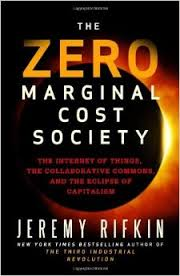
Zero Marginal Cost Society by Jeremy RifkinEconomic and social theorist Jeremy Rifkin takes this point even further. In his new book The Zero Marginal Cost Society, Rifkin contends that capitalism as we know it is dying a slow death, to be replaced by a new “collaborative common market” made possible by the shrinkage of marginal costs.

Building on this notion, Hotchkiss concludes:

“As we move from the physical to the metaphysical, the cost of producing consumable services or digital concept-based products … drops dramatically. Capital was required to overcome physical transactional friction.  If that friction disappears, so does the need for capital.”

Like other big trends, this transformation won’t happen overnight.  But it will happen by degrees in the coming years and decades, according to Hotchkiss.

… So much so that the corporates structure we know today will be all-but-unrecognizable to workers 50 years from now.

I find this theory pretty fascinating, and I certainly recognize the logic behind it. What are your thoughts about it?  Are Hotchkiss and Rifkin onto something?  Please share your thoughts with other readers here.

Coming Up: A Labor Shortage?

The coming labor shortageIt may seem fanciful, but a new report published last week by The Conference Board concludes that the United States and other advanced economies will actually face significant labor shortages over the coming decade and a half.

This forecast has been made primarily based on the Baby Boomer workforce departing the labor market over this period.

The Baby Boomer phenomenon is what makes things different in now compared to the decades previously:  For the first time since World War II, working age populations will actually be declining in mature markets.

Conference Board logoAs Dr. Gad Levanon, director of macroeconomics at The Conference Board reported, “The global financial crisis and its aftermath – stubbornly high unemployment in many countries – have postponed the onset of this demographic transformation, but will not prevent it from taking hold.”

According to The Conference Board’s analysis, several countries have already begun to see this happen, as their natural rates of employment have now fallen below their pre-recession levels:  Japan, Germany, South Korea and Canada.

The same thing is expected to happen in the United States and the United Kingdom by 2015 … and in the Scandinavian countries, the Benelux countries plus Australia by 2016 or 2017.

Other mature economies like those of Spain, France, Portugal, Italy and Greece won’t experience this until the years further out – but The Conference Board predicts that it will happen there as well.

U.S. market sectors that are expected to experience the most severe labor shortages include healthcare occupations, STEM occupations (science, technology, engineering and mathematics), as well as skilled trades that don’t require a college degree but that do require specialist training.

Among the challenges The Conference Board envisions in these three major categories are the following:

  1. Skilled labor occupations like construction, transportation and utility plant operations are going to be adversely affected by many more retirements happening than new job seekers coming in to fill the void.
  2. STEM occupations won’t be as stressed as some might imagine, because higher productivity will alleviate the pressure on hiring more workers in IT and high-tech manufacturing segment. That being said, certain sub-segments such as information security, environmental and agricultural engineering, and applied mathematics are expected to face severe labor shortages.
  3. The numbers of new entrants in various healthcare occupations are constrained by high barriers to entry such as extensive education and experience requirements, along with accreditation requirements.

The Conference Board report has constructed a Labor Shortage Index covering 32 countries.  The index combines current labor-market tightness with future demographic trends to predict the likelihood of the different countries experiencing labor shortages.

The bottom line on the index:  with the exception of the Mediterranean countries, all of the labor markets in developed economies are expected to be squeezed pretty tightly starting within the next few years.

It’s been quite a while since we’ve been hearing about pending labor shortages … but that’s exactly what The Conference Board is predicting.  Here’s a link to more details about the report, which is appropriately titled From Not Enough Jobs to Not Enough Workers.

If you have thoughts or personal observations to share on the job markets on the domestic scene or internationally, please share them with other readers here.