Have we become too complacent about cyber-security threats?

cyber warfareThe scandal involving the security risk to U.S. State Department e-mails is just the latest in a long list of news items that are bringing the potential dangers of cyber-hacking into focus.

But of course, we’ve seen it before — and it involves far more than just “potential” risk.  From Target, Best Buy and other retailers to Ashley Madison customer profiles, IRS taxpayer information and the U.S. government’s personnel records, the drumbeat of cyber-security threats that’s turned out to be all-too-real is persistent and ongoing.

In the realm of marketing and public relations, recent breaches of PR Newswire and Business Wire data gave hackers access to pre-release earnings and financial reports that have been used to enrich nefarious insider traders around the world to the tune of $100 million or more in ill-gotten gains.

These and other events are occurring so regularly, it seems that people have become numb to them.  Every time one of these news items breaks, Instead of sparking outrage, it’s a yawner.

But Jane LeClair, COO of the National Cybersecurity Institute at Excelsior College, is pleading for an organized effort to thwart the continuing efforts — one of which could end up being the dreaded “Cyber Pearl Harbor” that she and other experts have warned us about for years.

“We certainly can’t go on this way — waiting for the next biggest shoe to drop when hundreds of millions — perhaps billions — will be looted from institutions … It’s time we stopped making individual efforts to build cyber defenses and started making a collective effort to defeat … the bad actors that have kept us at their mercy,” LeClair contends.

I think that’s easier said than done.

Just considering what happened with the newswire services is enough to raise a whole bevy of questions:

  • Financial reports awaiting public release were stored on the newswires’ servers … but what precautions were taken to protect the data?
  • How well was the data encrypted?
  • What was the firewall protection? Software protection?
  • What sort of intruder detection software was installed?
  • Who at the newswire services had access to the data?
  • Were the principles of “least privilege access” utilized?
  • How robust were the password provisions?

In the case of the newswire services, the bottom-line explanation appears to be that human error caused the breaches to happen.  The attackers used social engineering techniques to “bluff” their way into the systems.

Mining innocuous data from social media sites enabled the attackers to leverage their way into the system … and then use brute force software to figure out passwords.

Once armed with the passwords, it was then easy to navigate the servers, investigating e-mails and collecting the relevant data. The resulting insider trading transactions, made before the financial news hit the streets, vacuumed up millions of dollars for the perpetrators.

Now the newswire services are stuck with the unenviable task of attempting to “reverse engineer” what was done — to figure out exactly how the systems were infiltrated, what data was taken, and whether malicious computer code was embedded to facilitate future breaches.

Of course, those actions seem a bit like closing the barn door after the cows have left.

I, for one, don’t have solutions to the hacking problem. We can only have faith in the experts inside and outside the government for determining those answers and acting on them.

But considering what’s transpired in the past few months and years, that isn’t a particularly reassuring thought.

Would anyone else care to weigh in on this topic and on effective approaches to face it head-on?
State of the States: CNBC’s take on the best ones for business.

In CNBC’s recently published scorecard, don’t look to the Northeast or California to find the states that are best ones for business.

CNBC State Rankings for Business
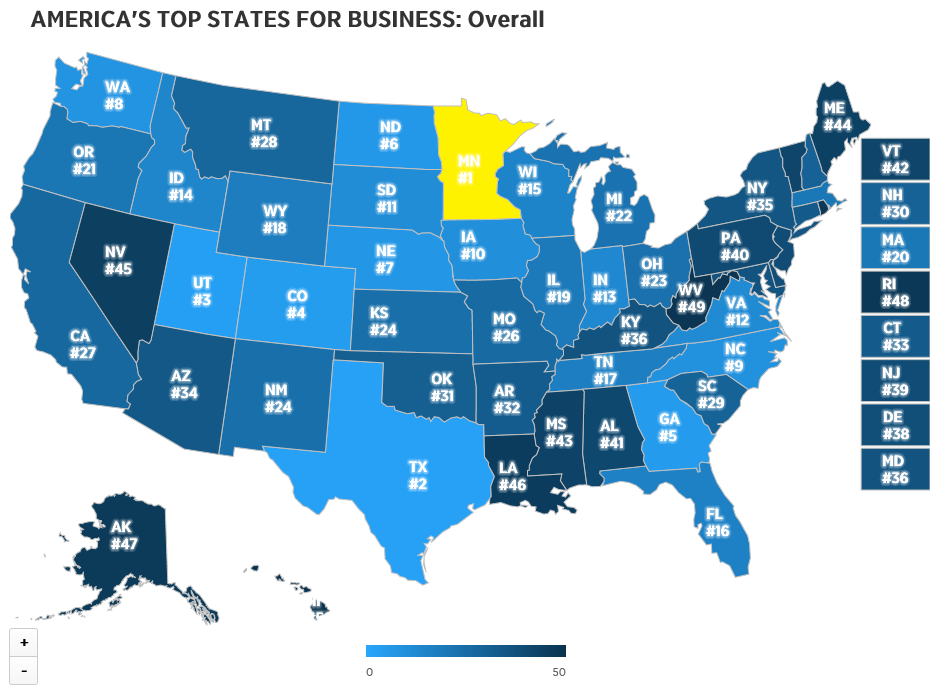
L’Etoile du nord: Just as in its state motto “Star of the North,” Minnesota is the stellar performer in CNBC’s 2015 state ranking of business competitiveness. (Click on the map for a larger view.)

State and city rankings are a source of fascination for many people. Of course, there are many ways to fashion them to place nearly any state or city you like at the top of the heap.  Some of the lists use criteria that are so convoluted, it stretches credulity.

Since when is Baltimore the best city in America for single men?  Since it was ranked #1 in this evaluation, evidently.  Many of us who know the city’s innards really well would disagree heartily, of course.

But I think the CNBC 2015 scorecard on state business climates, published earlier this month, is based on a more solid set of criteria.

CNBC created it by scoring all 50 states on approximately 60 separate measures of competitiveness – a list that was developed with input from an array of business and policy experts, official government sources, and CNBC’s own Global CFO Council, and that uses government-generated data.

CNBC then grouped these measures into ten broader categories, weighting the results based on how often each is used as “selling point” in state economic development marketing and promotional efforts. This was done in order to rank the states based on the criteria they themselves use to showcase their attractiveness to businesses considering expansion or relocation.

Here are the ten broad categories in the CNBC evaluation, and which states ranked first and last within them:

  • Access to capital: #1 North Carolina … #50 Wyoming
  • Business friendliness: #1 North Dakota … #50 California
  • Cost of doing business: #1 Indiana … #50 Hawaii
  • Cost of living: #1 Mississippi … #50 Hawaii
  • Economy: #1 Utah … #50 Mississippi
  • Education: #1 Massachusetts … #50 Nevada
  • Infrastructure: #1 Texas … #50 Rhode Island
  • Quality of life: #1 Hawaii … #50 Tennessee
  • Technology/innovation: #1 Washington … #50 West Virginia
  • Workforce: #1 North Dakota … #50 Maine

Do we see any surprises here?  To my mind, the high and low rankings look pretty well-aligned with the anecdotal information we hear all the time.

Perhaps we might consider several other states besides Nevada to be “bottoms” in education. And personally, I am pretty shocked to see Tennessee ranked last in quality of life. Having lived there during my college years at Vanderbilt University, I never considered the state to be substandard when it came to that attribute.

But It’s when CNBC amalgamates all of the rankings to come up with its overall state ranking that a few surprises emerge.

Such as … Minnesota notches first place overall. I’m sure some people are genuinely surprised to see that.

For the record, here is CNBC’s list of the Top 10 states for business in 2015:

  • #1 – Minnesota
  • #2 – Texas
  • #3 – Utah
  • #4 – Colorado
  • #5 – Georgia
  • #6 – North Dakota
  • #7 – Nebraska
  • #8 – Washington
  • #9 – North Carolina
  • #10 – Iowa

We see that four of the ten top states are in the Midwest … three are in the South … three are in the West … but none are in the Northeast.

CNBC study on business competitiveness
The center holds: According to CNBC, most of the most competitive states for business are in the Mid-Continent region.

By contrast, for the most part the Bottom 10 states are clustered in other areas of the country … including four Northeastern states plus Alaska and Hawaii, two states that clearly have unique locational circumstances:

Hawaii lacks business competitiveness
Not so sunny: Hawaii’s bad business climate.
  • #40 – Pennsylvania
  • #41 – Alabama
  • #42 – Vermont
  • #43 – Mississippi
  • #44 – Maine
  • #45 – Nevada
  • #46 – Louisiana
  • #47 – Alaska
  • #48 – Rhode Island
  • #49 – West Virginia
  • #50 – Hawaii

CNBC has issued a raft of charts and maps providing details behind how their ratings were formulated, and the results for each of the major categories. You can view the data here.

Speaking for yourselves, in what ways would you challenge the rankings? What strikes you here as different from your own personal experience in doing business in various states? Please share your perspectives with other readers.

Uber über alles? Ride-hailing services are coming on stronger than ever.

Business travelers have spoken with their wallets.

Uber logoIt looks as if a major milestone has been reached in the battle between “old world taxis” and “new world Uber.” An expense report study covering the second quarter of 2015 is showing that Uber and other ride-hailing services have overtaken the use of taxis – at least when it comes to business travelers.

The quarterly report was released by Certify, an expense management system provider. It reveals that Uber accounted for ~55% of ground transportation receipts, whereas taxi services accounted for only ~43% of receipts.

That’s a big jump from previous quarters; taxi services long dominated, staying well above 50% as recently as the first quarter of this year.

And this report isn’t based on some small data set, either. Certify’s stats are derived from millions of trip receipts submitted by its North American client base – nearly 30 million receipts over the course of a single year.

Clearly, Uber and other services that connect travelers through smartphone apps have succeeded beyond many people’s expectations.

But not everyone is pleased – beginning with taxicab services and their political allies.  Understandably, they’re frightened by the prospects of seeing the most fundamental tenets of their “business protection plan” melt away before their very eyes.

Depending on how people come down on the issue, opinions can be particularly passionate. Consider these responses prompted by a recent AP article on the topic published by ABC News:

Pro-Taxi Reader: Uber is breaking laws and evading taxes and municipal dues on a mass scale. How do you “adapt” to that? How to adapt to this unfairness and criminality? I personally suggest stop paying taxes, or start a strike like they did in Paris. It seems that in [the] U.S., Uber’s lobbyists and endless BS-PR campaigns control the country.

Pro-Uber Reader: Is it really “fair” for a city to charge one million dollars to have a taxi license (New York City)? Most of the taxi BS is from mafia-run business[es] who have fought for the last 70 years to keep competition out.

Another Pro-Uber Reader: The current system of licensing taxis should be reconsidered.  This system smacks of monopolies, with barriers to entry that are impossible.  There is no free market when you can’t get a license to operate.

Certain national politicians are even getting into the game, finding fodder for campaign rhetoric aimed at constituents who are frightened by the implications of the new work paradigm.

Here’s an excerpt from a speech by Hillary Clinton:

“Many Americans are making extra money renting out a small room, designing websites, selling products they design themselves at home, or even driving their own car. … This on-demand, or so-called ‘gig economy,’ is creating exciting opportunities and unleashing innovation. But it’s also raising hard questions about workplace protections and what a good job will look like in the future.”

These are good points to raise, and it’s certainly fine to weigh the pros and cons of the so-called “new economy.”

At the same time, it’s pretty ironic to see how people supporting a candidate who questions ride-hailing services are so “onboard” with Uber – at least in practice if not in their rhetoric.

To illustrate, take a look at these Federal Election Commission filings from the Ready PAC (the pro-Clinton SuperPAC formerly known as Ready for Hillary PAC) here and here and here.  There’s a “whole lotta Uber” going on!

Getting back to the real world of business travel, in nearly every city, Uber is offering better pricing than taxi services – at least when it comes to services like UberX which typically involve transport in smaller cars like a Honda Civic or Toyota Camry.

SUVs and limo cars are pricier, of course, and may not represent a major cost improvement. And Uber’s prices charged also rise during periods of “surge” usage.

taxi cabBut considering the comparative cost as well as the quality of service, in some markets Uber beats out taxis by a city mile.

How else to explain results in the most recent quarter where ~60% of rides in Dallas expensed through Certify were for Uber vehicles rather than taxis. In San Francisco, Uber’s share was even higher:  nearly 80%.

No wonder taxi services are running off to local elected officials, boards and commissioners to try to shore up their faltering business model.

It’s worth noting that some employers harbor reservations about ride-hailing services — particularly concerns about lack of regulation, safety and liability. But even in non-regulated locations, protections exist. Uber as well as Lyft, another industry participant, provide driver insurance during paid rides, and they require drivers to carry their own personal auto insurance as well.

It would be interesting to hear the views of people who have used Uber or other ride-hailing services. Do you see them as the wave of the future? Or are there drawbacks? Please share your experiences and observations with other readers here.

Amazon turns the page on yet another publishing maxim.

The publishing industry’s “primary disruptor” will start paying authors based on pages read, not e-books purchased. 

AmazonBeginning next month, Amazon is ushering in its next big change in the world of publishing … and it’s a pretty fundamental shift.

Instead of paying royalties to authors based on how many e-books have been sold, Amazon will start paying authors based on how many pages of their books consumers have read.

For now, the program applies just to self-published authors who are on Amazon’s KDP Select Program — but you can bet that if the experiment plays out well, it’ll likely expand.

Currently, Amazon remunerates its native authors on a monthly bases based on the number of times their e-books are accessed through two Kindle service programs:

The new change will shift away from paying authors based on each book accessed, and instead pay based on each page that readers access (and that remains on the screen long enough to be parsed).

Who will be the winners and losers in this new approach to compensation?  Certainly, some people have criticized the current payment scheme for benefiting authors of smaller books more than those who write longer tomes.  The change may improve matters for the latter because of the additional pages that make up their e-books.

But is that really the case?  Many large volumes are reference-oriented book or fall into other non-fiction categories, such that a reader may be interested in accessing only a few pages within the books in any case.

But on the fiction side, authors may find themselves attracted to writing the kind of “cliffhanger” story lines that keep readers turning the pages.

However it shakes out, one thing seems destined to change.  The old saw that “it doesn’t matter how many people read a book — only how many purchase it” may well be on the way out.

What are your thoughts about Amazon’s new remuneration policy?  On balance, is it good for authors — or for the world of books in general?  Feel free to share your comments with other readers.

Gallup’s Payroll-to-Population Rates Pinpoint the Go-Go Metro Areas

Commuters in New York City.

The Gallup polling organization’s P2P measurements (payroll-to-population employment rates) are an interesting metric and add an extra dimension of understanding as to what’s happening with employment across the United States.

Gallup’s evaluation is limited to the top 50 most populous SMSAs (metropolitan statistical areas).  But because of the large number of phone interviews conducted within each metro area (ranging from ~1,300 to 18000+ depending on the population), the findings are statistically significant whether looking nationally or within a particular urban area.

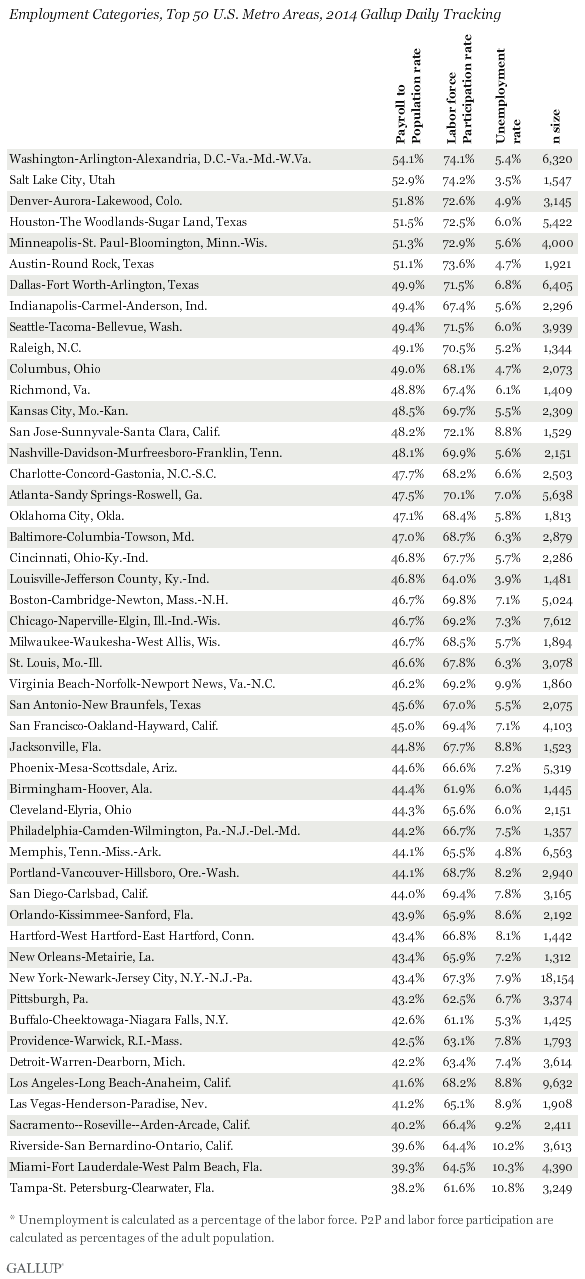
The latest surveys, conducted by Gallup in 2014 among nearly 355,000 households, find that two metro areas with the highest P2P measures are Washington, DC and Salt Lake City, UT — urban centers that couldn’t be more dissimilar in other ways.

For DC, the P2P rate is 54.1.  The calculation is derived from the percentage of the adult population (age 18+) who are employed full-time for an employer for at least 30 hours per week.

For Salt Lake City, the P2P rate is just slightly lower, at 52.9.

Other top scoring metro areas include three markets in Texas (Austin, Dallas-Ft. Worth and Houston).

What about metro areas at the other end of the scale?  Those would be Miami (38.2 score) and Tampa (39.3).

Three other low-scoring MSAs are located in California:  Los Angeles, Riverside and Sacramento.

What do these stats mean in a broader sense?

For one thing, there’s a direct relationship between employment stats and P2P performance:  Metro areas with the highest unemployment rates correlate to those with low P2P scores.

For instance, Miami’s unemployment rate in 2014 was 10.3%.  It was 10.2% in Riverside, CA.

That’s a big contrast with Salt Lake City, which had an unemployment rate of just 3.5%.

I find one interesting deviation from the norm:  Buffalo, NY.  There, while the unemployment rate is one of the ten lowest in the country, its labor force participation rate is also very low — bottoms among all 50 metro areas, in fact.

Shown below are the figures for all of the 50 largest U.S. metro areas based on the interviews conducted by Gallup in 2014:

Gallup full results

More details on the research findings are available here.

The fine art of negotiation: It never goes out of style.

Harvey Mackay
Harvey Mackay

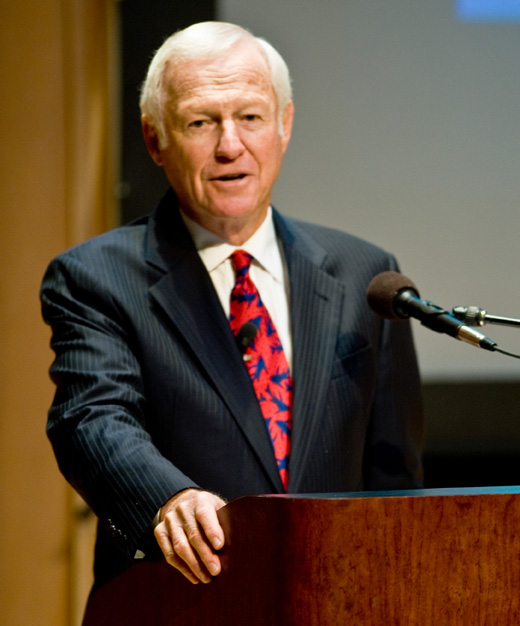
Many people in business know about Harvey Mackay.  The chairman of Twin Cities-based MackayMitchell Envelope Company became famous as the author of the book Swim with the Sharks Without Being Eaten Alive, and six subsequent business best-sellers.

In the years following the release of his first book, Mackay became something of a business guru in the same mold as General Electric retired chairman and CEO Jack Welch.

The advice of these two men, borne out of their experiences in the corporate world, was a refreshing change of pace from the pronouncements of other authors who speak from their perches in academia.

In recent times, the thoughts and ideas of “sages” like Mackay and Welch might seem to some a little old-school – even quaint.  But I don’t think that’s the case.

Take Mackay’s thoughts on the art of negotiation.  The other day, I came across some points on that topic that Mackay first put forward about 20 years ago.  Reading through his points now, the advice seems as valid today as it was back then.

As for particular “do’s” and “don’ts” of the art of negotiating, here are a few points that Mr. Mackay makes:

  • Never accept any proposal immediately – no matter how good it sounds. 
  • Don’t negotiate with yourself – don’t raise a bid or lower an offer without first getting a response from your original position.       Otherwise, you’ll give the other side information and ammunition they might never have found out themselves. 
  • Don’t negotiate a deal with a person who has to get someone else’s approval. Effectively, it means that they can take any deal you’re willing to make and then renegotiate it. Why give them two chances to your one? 
  • Nothing is ever truly non-negotiable, no matter what someone might have you think at the outset. 
  • If you can’t say ‘yes’ … say ‘no’ and step away. (‘No’ can be just as good an end-result as ‘yes’.)

negotiatingAs for the dynamics of effective negotiating, Mackay’s pointers are equally valid:

  • Instinct is no match for preparation: Rehearse your positioning and pre-anticipate the other side’s response. (Even try role-playing.) 
  • Be respectful and courteous when negotiating. If you don’t think you can do that, have someone else negotiate your side of the deal instead.

As a final note, Mackay makes the point that “a deal can always be made when both parties see their own benefit in making it.”

It’s a positive parting thought – and it’s even better because it’s true.

Companies behaving (not quite so) badly: Financial services firms continue their slow reputation recovery.

Financial services industryBack in 2009, no industry in the United States took such reputation beating as the financial services segment.  And to find out how much, we needn’t look any further than Harris survey research.

The Harris Poll Reputation Quotient study of American consumers is conducted annually.  The most recent one, which was carried out during the 4th Quarter of 2014, encompassed more than 27,000 people who responded to online polling by Harris.

In the survey, companies are rated on their reputation across 20 different attributes that fall within the following six broad categories:

  • Products and services
  • Financial performance
  • Emotional appeal
  • Social responsibility
  • Workplace environment
  • Vision and leadership

Taken together, the ratings of each company result in calculating an overall reputation score, which the Harris researchers also aggregate to broader industry categories.

Most everyone will recall that in 2009, the U.S. was deep in a recession that had been brought about, at least in part, by problems in the real estate and financial services industry segments.

This was reflected in the sorry performance of financial services firms included in the Harris polling that year.

Back then, only 11% of the survey respondents felt that the financial services industry had a positive reputation.

So it’s safe to conclude that there was no place to go but “up” after that.  And where are we now?  The latest survey does show that the industry has rebounded.

In fact, now more than three times the percentage of people feel that the financial services industry has a positive reputation (35% today vs. 15% then).

But that’s still significantly below other industry segments in the Harris analysis, as we can see plainly here:

  • Technology: ~77% of respondents give positive reputation ratings
  • Consumer products: ~60% give positive reputation ratings
  • Manufacturing: ~54%
  • Telecom: ~53%
  • Automotive: ~46%
  • Energy: ~45%
  • Financial services: ~35%

So … it continues to be a slow slog back to respectability for firms in the financial services field.

Incidentally, within the financial services category, insurance companies tend to score better than commercial banks and investment companies when comparing the results of individual companies in the field.

USAA, Progressive, State Farm and Allstate all score above 70%, whereas Wells Fargo, JP Morgan Chase, Citigroup, BofA and Goldman Sachs all score in the 60% percentile range or below.

Wendy Salomon, vice president of reputation management and public affairs for the Harris Poll, contends that financial services firms could be doing more to improve their reputations more quickly.  Here’s what she’s noted:

“Most financial companies have done a dismal job in recent years of connecting with customers and with the general public on what matters to them.  Yet there’s no reason Americans can’t feel as positively toward financial services firms as they do towards companies they hold in high esteem, such as Amazon or Samsung, which have excellent reputations because they consistently deliver what the general public cares about …  

[Individual] financial firms have a clear choice now:  Prioritize building their reputations and telling their stories, or let others continue to fill that void and remain lumped together with the rest of the industry.”

Here’s another bit of positive news for companies in the financial services field:  They’re no longer stuck in the basement when it comes to reputation.

That honor now goes to two sectors that are Exhibits A and B in the “corporate rogues’ gallery”:  tobacco companies and government.

Both of these choice sectors come in with positive reputation scores hovering around 10%.

I suspect that those two sectors are probably doomed to bounce along the bottom of the scale pretty much forever.

With tobacco, it’s because the product line is no noxious.

And with government?  Well … with the bureaucratic dynamics (stasis?) involved, does anyone actually believe that government can ever instill confidence and faith on the part of consumers?  Even governments’ own employees know better.

Economic Reality Comes to College Campuses

Finally, colleges get schooled in Economics 101.

Sweet Briar College (1901-2015?)

For a long time, “market forces” didn’t really apply to institutions of higher learning — at least not in the classic sense.

In a social environment where nearly everyone buys into the notion that more education is good, government and educators fostered policies where no one need be prevented from getting a college education because of lack of funding.

Accordingly, in the past several decades, loans and grants became easier to obtain than ever.

Unfortunately, one of the consequences of easy money in education was that tuitions rose at a faster rate than the economy as a whole.  After all, the third-party money spigot seemed never-ending.

For a good while tuition spikes weren’t a particular concern, because it still seemed as though a college-level education was a great way to earn substantially more money in one’s career — even if racking up student loans at the outset.

But in recent years, we no longer see an automatic positive correlation between a higher education degree and the ability to earn increased income.

In the sluggish economy of the 2000s, a college diploma in the right field may well be a good investment.  But with many college majors, oftentimes it isn’t.

The situation is even dicier for the many students who attend community colleges or four-year institutions but who never graduate.  The chasm between their educational loans and their earning power is even more deep.

Corinthian Colleges
Corinthian Colleges (1995-2015)

And for those students unlucky enough to attend for-profit institutions like those run by Corinthian Colleges, Inc., which is in the process of closing the last two dozen of its schools across the country, the situation is even worse.

Saddled with student debt, stuck with degrees or half-completed courses of study of dubious value, and with school credits unlikely to be transferred to other schools in order to finish their education, the situation for those  unlucky students can only be described as dire.

How did we get to this place?

One big reason is that over the years, many colleges got into the habit of simply expecting sufficient numbers of students to enroll in their institutions regardless of the sticker price to attend.  If anything, high tuition “list prices” were a badge of honor.

At the same time, substantial grants (essentially discounts off of the published tuition rates), together with irresistible financial aid packages, continued to attract students to private as well as public institutions of all stripes.

Running in parallel with this were lavish, ongoing projects involving the construction of fancy new dorms, state-of-the-art athletic facilities, and all sorts of other creature-comfort-like amenities to lure students to campus.

And let’s not forget another not-so-welcome outcome of this fantasyland of higher education economics – call it “degree inflation.”  With so many students obtaining undergraduate degrees, their “worth” became devalued.

In this high-stakes derby, a BS degree in business is no longer enough – it has to be an MBA.  A BS degree in engineering isn’t nearly as prestigious as a Master’s degree or a PhD.  There’s really no end to it.

The convergence of these sobering economic and social trend lines makes it pretty clear that the “old” business model is no longer working for colleges and universities.  With the economic realities of today, college administrators are discovering that, sooner or later, market forces work.  And the resulting picture isn’t very pretty.

So now we’re witnessing the lowest percentage increases in tuition sticker prices we’ve seen in years, across private institutions and even some public ones as well.  Bloated administrative staffs  — their numbers dwarfing the number of teachers at some colleges — have finally plateaued or even begun to decline.

Being the parent of two children who graduated from college within the past five years, naturally I’ve been quite interested in these trends – and I’ve viewed them pretty close-up.

What I’ve determined is that for years, administrators at many colleges and universities didn’t see themselves as working within a market system — having to compete where market forces were at work.  The often-unappealing business of being disciplined by market forces didn’t pertain to them — or so they thought.

That’s certainly not the case anymore.

And there’s another huge factor looming on the horizon:  Distance learning.  I’ll be here big-time before we know it … and it promises to upend the college education business model as never before.

What are your thoughts on this topic?  Please share them with other readers here.

The Affordable Care Act: Still unpopular with physicians after all these years.

ACAOne of the predictions we’ve heard about the admittedly controversial Affordable Care Act is that acceptance of it will grow over time, as people become more familiar and comfortable with its provisions.

So far at least, we haven’t seen this happening in the public polling about the law.

And now we’re seeing similar dynamics playing out in the all-important physician community.

In fact, the latest findings are that the ACA is more unpopular than ever, if the results of a new survey of physicians are to be believed.

The survey was conducted in January 2015 by LocumTenens, a physician staffing firm and online job board.

The headline finding must be this:  While ~44% of the survey respondents reported that they had been opposed to the Affordable Care Act legislation prior to its implementation, now ~58% are opposed to it after a year of working under the confines of the law.

R. Shane Jackson, president of LocumTenens, had this to say about the key finding:

“After a year in the trenches trying to help patients understand this legislation, physicians by and large feel the law hasn’t done a lot to help improve healthcare.”

More specifically, Jackson noted,

“Physicians feel the ACA has made serving patients and running their businesses much harder.  A year after implantation – and years after the political debate started – doctors are still passionate about how this law should have been designed, and would still like to see changes made that will make it simpler for their staffs and patients to understand.”

Among the negatives physicians see with the current ACA law are these aspects:

  • Lower reimbursement rates to hospitals and physicians
  • Increased compliance burdens for physician practices
  • Higher patient debt due to high-deductible plans

ACA healcare premium changesAlso faulted are the insurance companies for not doing more to inform newly insured patients about their premiums, deductibles and coverage limits.

It isn’t all poor marks for the ACA, however.  Physicians in the LocumTenens survey do credit the legislation for a number of positive outcomes including:

  • Helping more people gain access to healthcare
  • Expanding coverage to more children and young adults
  • Eliminating coverage denials due to pre-existing health conditions
  • Placing more focus on preventive healthcare measures
  • Decreasing the costs of end-of-life care

So what is the “net-net” on all of this?

Two-thirds of the physician respondents want the ACA law repealed (and three-fourths think it will be, incidentally).  But physicians want it replaced by something else that retains the positive aspects of the ACA while doing away with the negatives.

That’s the same message we’ve been hearing from politicians, too.  So the bigger question is how to unscramble the ACA egg … and whether anything actually better can come out of the effort.

Would anyone care to weigh in with their thoughts and ideas in this never-ending debate?

What are the short- and long-term implications of self-driving automobiles?

McKinsey’s take:  In a world where people don’t take charge of the wheel themselves … we’ll all be better off.

The Google Driverless Car

From Google’s fleet of driverless cars to the Mercedes-Benz Robo-Car concept, self-driving automobiles are stepping off the pages of science fiction and into real life.

But how many of us have really stopped to think about how the adoption of self-driving vehicles will change everyday life as we know it?

Consulting firm McKinsey & Co. has done so, and a recently released report predicts some pretty major changes – most of them very fine, indeed.  Here’s a sampling:

  • The number of car crashes will plummet.
  • “Drivers” will become “riders,” with more time for working, leisure and interaction with others.
  • “Dead time” in commuting will decrease, and productivity will increase as a result.
  • The ubiquity of the multi-car household will change.

And it’s not just McKinsey that is looking at self-driving cars with such optimism.

Even the normally dour and scolding National Highway Traffic Safety Administration predicts that consumer adoption of self-driving vehicles will usher in “completely new possibilities for improving highway safety, increasing environmental benefits, expanding mobility, and creating new economic opportunities for jobs and investment.”

But self-driving cars won’t overtake conventional automobiles in one fell swoop.  The McKinsey report outlines a timeline for adoption of self-driving features — and it’s pretty drawn-out.

Within the next three to five years, McKinsey anticipates that cars will self-handle highway cruising and traffic jams.

The more difficult challenges of driving in urban areas and dealing with variables like pedestrians, cyclists and so forth will be tackled over the coming 25 years.

Thus, the impact of “autonomous” technology will be limited until about 2020.  McKinsey figures that the technology will experience growing pains in the years 2020-2035 as driverless cars go more mainstream.

During this period, there will be numerous issues that will need to be resolved, with clear hub-and-spoke implications:

  • The development of comprehensive rules regarding how self-driving cars are developed, tested, approved and licensed (on an international basis)
  •  Changes in insurance practices – migrating from individual coverage to automaker policies that cover technical failures
  •  The growth of remote diagnostics and over-the-air updates
  •  The decline in importance of independent automotive repair shops
  •  The reduced need for taxi drivers and long-haul carrier jobs

The McKinsey report takes us beyond the year 2040, too, which is the point when McKinsey predicts that autonomous cars will become the primary means of transport in the United States.

The implications of this are guesstimates more than anything else, but McKinsey speculates on the following long-term effects:

Mercedes-Benz "car of the future":  Seats facing every which-way.
Mercedes-Benz “car of the future”: Seats facing every which-way.
  • Car designs will change dramatically – no more need for mirrors and pedals … and car seats will face any direction.
  • Space savings on streets, roadways and parking lots from more efficient vehicle use.
  •  Fewer cars will be needed compared to today, with one autonomous car doing the job of two conventional vehicles in the typical household. The vehicles will be more expensive but fewer of them will be needed, for net savings for consumers.

As for the economic impact, the figures are difficult to quantify as some sectors of the economy will be up and others down.  But with a projected 90% drop in car crashes, the savings in auto repair and healthcare bills alone are project to be around $180 billion.

If we accept the McKinsey report’s bottom-line findings, it seems the “brave new world” of self-driving cars can’t come soon enough.  But what are your thoughts?  Are there negative implications  or “unintended consequences” that will be part of the revolution?  Please share your perspectives here.