Marketing Technology: Is “Implosion” Where We’re Headed?

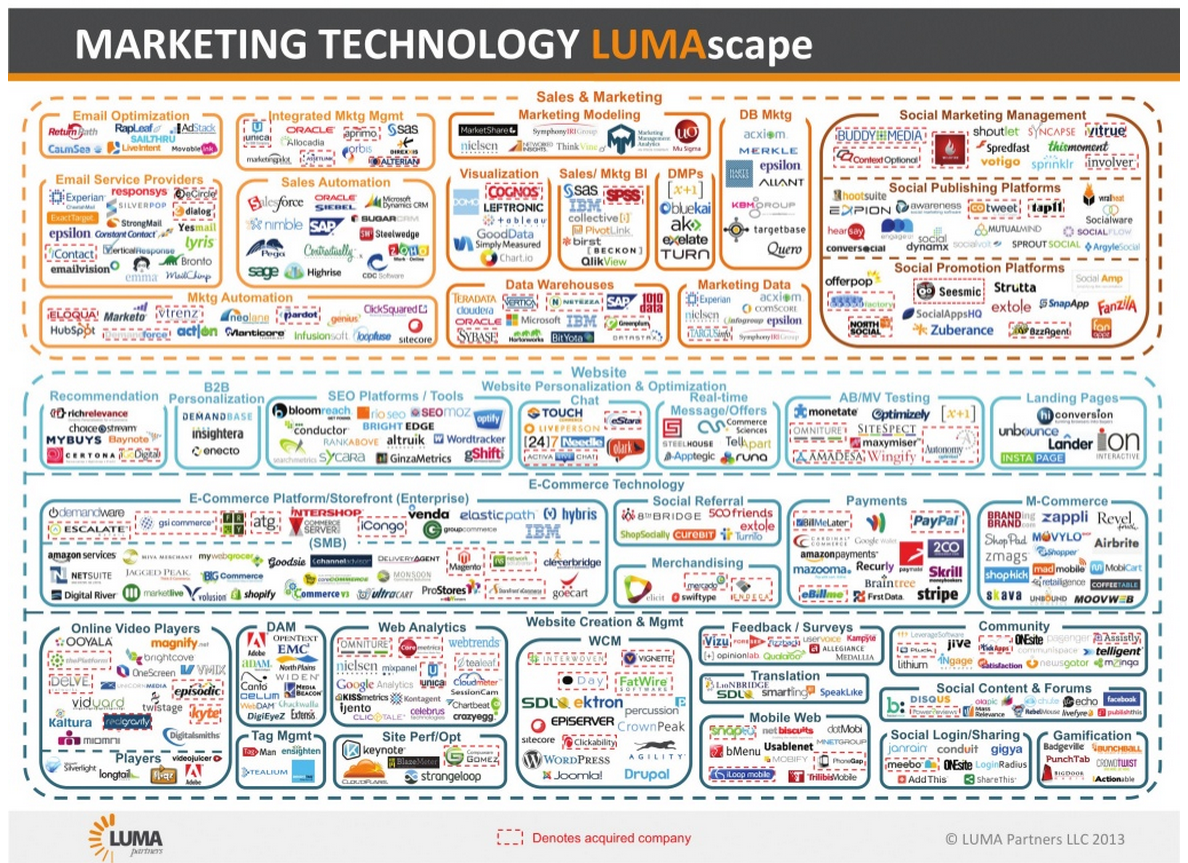
A chart of just some of the major marketing technology platforms -- and this is as of 2013!
A chart of just some of the major marketing technology platforms — and this was in 2013!

It seems that with each passing day, one or two new technology products are announced by MediaPost and other publishers in the marketing field.

The numbers tell the story. The marketing technology industry website chiefmartec.com lists nearly 1,900 marketing technology vendors in more than 40 categories.

That’s nearly double last year’s tally of around 950 vendors.

Software clearinghouse Capterra lists even more: a whopping 3,000+ marketing technology products across 30 categories.

These firms account for well over $20 billion in financing – the dollars that can be tracked, that is – including around 30 companies that are valued at $1 billion or more each.

That’s a lot of companies and vendors. Of course, there are many customers who are looking for tech-driven marketing solutions as well.  The question is whether things have gotten out of balance.

Business writer and marketing tech specialist Malcom Friedberg thinks so. He’s Chief Marketing Officer at CleverTap, and he also publishes columns on a variety of business topics.

In Friedberg’s view, the sheer number of marketing technology vendors and products means that the segment may now be on the brink of an implosion.

Friedman references a recent CMO Council document that reports that more than 80% of marketers are using as many as ten different marketing-related technologies or cloud solutions.

And as new technologies are added, the problem is finding educated staff – and enough hours in the day – to cover all of these products well. In many instances, users may be just scratching the surface of what these products can provide; the “multiple hat” dynamics of many marketing departments mean that very few people qualify as being “advanced” users.

The problems boil down to this: Even if a department has two or three marketing people devoted exclusively to tech-related responsibilities (at tall order in most companies) – this assumes that those people can work equally well on multiple different platforms.

The reality is quite different. It’s more like a big jumble – with consultants brought in to sort things out.  It may get the job done, but it isn’t pretty – and it’s hardly a recipe for “the best of best practices.”

Survey work by the CMO Council supports this hypothesis. The Council has found that fewer than on in ten of the marketers it surveyed reported that they possess a highly evolved digital marketing model that has a proven, clear path of evolution.

Malcolm Friedberg
Malcolm Friedberg

Friedman thinks he knows where things are heading. Not to more choices, but rather to less:

“In my opinion, we’ll start to see massive consolidation and uber-marketing systems. Think super-integrated marketing and advertising clouds … the preoccupation with ‘best-of-breed’ in every category will be replaced by a ‘tree-and-branch’ model, with one core technology and a few ‘good enough’ complementary ones.”

Friedman calls it “an expensive French meal” instead of “a Vegas buffet.” While there will always be new products promising incremental improvements, he predicts that by 2020, the common business model will be super-integrated marketing and advertising clouds as we see already with the likes of Marketo and Hubspot.

What do you think? Is Friedman onto something … or is the orgy of new marketing technology products going to continue unabated?  Please share your thoughts with other viewers here.

Social media data mining: Garbage-in, garbage-out?

gigoIt’s human nature for people to strive for the most flattering public persona … while confining the “true reality” only to those who have the opportunity (or misfortune) to see them in their most private moments.

It goes far beyond just the closed doors of a family’s household. I know a recording producer who speaks about having to “wipe the bottoms” of music stars — an unpleasant thought if ever there was one.

In today’s world of interactivity and social platforms, things are amplified even more — and it’s a lot more public.

Accordingly, there are more granular data than ever about people, their interests and their proclivities.

The opportunities for marketers seem almost endless. At last we’re able to go beyond basic demographics and other conventional classifications, to now pinpoint and target marketing messages based on psychographics.

And to do so using the very terms and phrases people are using in their own social interactions.

The problem is … a good deal of social media is one giant head-fake.

Don’t just take my word for it. Consider remarks made recently by Rudi Anggono, one of Google’s senior creative staff leaders. He refers to data collected in the social media space as “a two-faced, insincere, duplicitous, lying sack of sh*t.”

Anggono is talking about information he dubs “declared data.” It isn’t information that’s factual and vetted, but rather data that’s influenced by people’s moods, insecurities, social agenda … and any other set of factors that shape someone’s carefully crafted public image.

In other words, it’s information that’s made up of half-truths.

This is nothing new, actually. It’s been going on forever.  Cultural anthropologist Genevieve Bell put her finger on it years ago when she observed that people lie because they want to tell better stories and to project better versions of themselves.

What’s changed in the past decade is social media, of course.  What better way to “tell better stories and project better versions of ourselves” than through social media platforms?

Instead of the once-a-year Holiday Letter of yore, any of us can now provide an endless parade of breathless superlatives about our great, wonderful lives and the equally fabulous experiences of our families, children, parents, A-list friends, and whoever else we wish to associate with our excellent selves.

Between Facebook, Instagram, Pinterest and even LinkedIn, reams of granular data are being collected on individuals — data which these platforms then seek to monetize by selling access to advertisers.

In theory, it’s a whole lot better-targeted than the frumpy, old fashioned demographic selects like location, age, income level and ethnicity.

But in reality, the information extracted from social is suspect data.

This has set up a big debate between Google — which promotes its search engine marketing and advertising programs based on the “intent” of people searching for information online — and Facebook and others who are promoting their robust repositories of psychographic and attitudinal data.

There are clear signs that some of the social platforms recognize the drawbacks of the ad programs they’re promoting — to the extent that they’re now trying to convince advertisers that they deserve consideration for search advertising dollars, not just social.

In an article published this week in The Wall Street Journal’s CMO Today blog, Tim Kendall, Pinterest’s head of monetization, contends that far from being merely a place where people connect with friends and family, Pinterest is more like a “catalogue of ideas,” where people “go through the catalogue and do searches.”

Pinterest has every monetary reason to present itself in this manner, of course.  According to eMarketer, in 2014 search advertising accounted for more than 45% of all digital ad spending — far more than ad spending on social media.

This year, the projections are for more than $26 billion to be spent on U.S. search ads, compared to only about $10 billion in the social sphere.

The sweet spot, of course, is being able to use declared data in concert with intent and behavior. And that’s why there’s so much effort and energy going into developing improved algorithms for generating data-driven predictive information than can accomplish those twin goals.

Rudi Anggono
Rudi Anggono

In the meantime, Anggono’s admonition about data mined from social media is worth repeating:

“You have to prod, extrapolate, look for the intent, play good-cop/bad-cop, get the full story, get the context, get the real insights. Use all the available analytical tools at your disposal. Or if not, get access to those tools. Only then can you trust this data.”

What are your thoughts? Do you agree with Anggono’s position? Please share your perspectives with other readers here.

This email signature block says it all …

signature areaOver the years, I’ve noticed how signature blocks at the bottom of business e-mails have been getting longer and more elaborate.

Remember the days of simply showing an office address, phone, FAX and e-mail? That disappeared a long time ago.

Why it’s happened is all a function of the many ways people can and do choose to communicate today.

For folks in the marketing and sales field, sometimes the contact options go overboard. Not long ago, I received an e-mail pertaining to a business service pitch. Here’s what the sender had included in the signature area at the bottom of his e-mail message:

  • If you’re a phone person, here’s my mobile number:
  • If you’re a text person, send a message to my cell:
  • If you’re an email person, here’s my address:
  • If you’re an instant message person, here’s my Google ID:
  • If you’re a Skype person, here’s my handle:
  • If you’re a Twitter person, here’s my username:
  • If you’re a Facebook person, here’s my page:
  • If you’re a face-to-face person, here’s my office location:

The only thing missing was Pinterest, and a FAX number …

Seeing this signature block was a stark reminder of the myriad ways people are connecting with their business and personal contacts.

Nothing new in that, of course — but seeing it presented in one big bundle really drove the point home.

Scott Ginsberg
Scott Ginsberg

Later, I discovered that this litany of contact options was first popularized four or five years ago by the business author and blogger Scott Ginsberg. Evidently, others have now picked up and run with the same concept.

Taken together, it’s no wonder people feel busier today than ever before, despite all of the ways in which digital technology purports to simplify communication and make it more efficient.

I wouldn’t want to go back to the old days … but at times, there’s a certain attraction to the idea of not having to be “always on” in “so many places,” no?

The mouse that roared: Smartphones take on bigger screens – and they’re winning.

The key takeaway message from MarketLive’s latest e-commerce statistics is that smartphones are where the go-go action is in e-commerce.

SmartphonesIf there’s any lingering doubt that smartphones are really on the march when it comes to e-commerce activity, the latest user stats are erasing all vestiges of it.

MarketLive’s 2nd Quarter e-commerce stats for 2015 reveal that mass-market consumers purchased ~335% more items via their smartphones than they did during the comparable quarter last year.

MarketLive’s report covers the buying activity of millions of online consumers. And the uptick it’s showing is actually more like a flood of increased activity.  That’s plain to see in these year-over-year 2nd Quarter comparative figures for smartphones:

  • Catalog merchandise: +374%
  • Merchandise sold by brick-and-mortar establishments’ online stores: +207%
  • Furnishings and houseware items: +163%

The critical mass that’s finally been reached is most likely attributable to these factors:

  • The growing number of “responsive-design” websites that display and work equally well on any size device
  • One-click purchasing functionality that simplify and ease e-commerce procedures

Interestingly, the dramatic growth in smartphone usage for online shopping appears to be skipping over tablets. Smartphones now account for more than twice the share of online traffic compared to tablets (~30% versus ~13%).

Total e-commerce dollar sales on tablets have also fallen behind smartphones for the first time ever.

Evidently, some people are now gravitating from desktops or laptops straight to smartphones, with nary a passing glance at tablets.

Another interesting data point among the MarketLive stats is the fact that traffic emanating from search (paid as well as organic), is actually on the decline.  By contrast, growth in traffic from e-mail marketing continues on its merry way, increasing ~18% over the same quarter last year.

One aspect remains a challenge in online commerce, however: The cart abandonment rate actually ticked up between 2014 and 2015. And conversion rates aren’t improving, either.

Marketlive logoFor the bottom line on what these new findings mean, I think Ken Burke, CEO of MarketLive, has it correct when he contends:

“Shoppers are seeking out their favorite brick-and-mortar brands online and expecting their websites to work on any device. We’re calling this trend ‘Commerce Anywhere the Customer Wants It.’ The more agile retailers and category leaders are outpacing their competitors by constantly adapting to – and embracing – a retail landscape where technology, consumers and markets are evolving at breakneck speed.” 

Details on MarketLive’s statistics can be accessed here.

Copywriting by computer: Wave of the future? … or wild-ass pipe dream?

persado logoIn recent years, computers have upended many a job category.  And they include quite a few positions involving “language” – from foreign language translators to medical transcriptionists.

And now, it looks like copywriting itself may be the next domino to fall.

Earlier this year, The Wall Street Journal published a story about Persado, a company which has developed a software algorithm that enables it to write copy without the human element.

David Atlas, the company’s chief marketing officer, refers to it as “algorithmic copywriting.”  The process creates sentences with a maximum length of 600 characters that are used for e-mail subject lines and other short persuasive copy.

Persado builds the copy by sending thousands of different e-mail subject lines to the e-databases of its clients, which include large retailers and financial services firms such as Overstock.com, AMEX and Neiman Marcus.  Response rates are measured and used to refine the subject lines to narrow them down to just the most effective.

Company PR spokesperson Kirsten McKenna explains the Persado edge further:

“Typical A/B testing will send out only a few messages – then go with the one that gives the best response.  Persado can send out thousands of permutations of the same message to determine which would be the most successful.”

Alex Vratskides
“We have never lost to a human.” — Alex Vratskides of Persado

Comparing Persado’s machine-generated results with traditional copywriting, “We have never lost to a human,” Alex Vratskides, the company’s president, claimed to The Wall Street Journal.

Those results would suggest that Persado is doing things right.  And here’s another positive indicator of success:  The company raised over $20 million in venture capital earlier this year.

The bigger question is whether Persado will be able to scale its simple and short-sentence copywriting into persuasive copy for longer-form marketing materials such as sales letters and brochures – which would make it an even bigger threat and seriously threaten to upend the traditional copywriting field.

For the answer to that question, I’d never want to take issue with the views of veteran copywriter Bob Bly, whose perspectives I respect a great deal.  In writing on this topic, he states:

Bob Bly
Bob Bly

“I do think that either already or very soon, software will equal or surpass the performance of human writers in both simple content and short copy.  We have to prepare for the eventuality that computers may someday beat human direct response copywriters in long-form copy, just as Deep Blue beat Kasparov in chess and Watson clobbered Ken Jennings in Jeopardy.  Ouch.”

What do you think?  Is computer copywriting the wave of the future?  Let’s hear your own perspectives.

The Ideal Privacy Policy?

policyRecently, I came upon a column written by software entrepreneur and business author Cyndie Shaffstall in which she proposes the following policy for any company to adopt that truly cares about its customers’ privacy:

The Ideal Privacy Policy:

1.  We have on file only your first name, last name, and e-mail address.

2.  We ask for nothing else.

3.  We send you only e-mails you request.

4.  We have nothing to share with others – and wouldn’t if they asked.

5.  We won’t change this policy without prior notice – ever. 

Thank you for being our customer, 

~ Your Grateful Vendor 

Cyndie Shaffstall
Cyndie Shaffstall

As Shaffstall herself acknowledges, she’s never actually seen a policy like this.

But if a company actually adopted such a policy, it would certainly make people more comfortable about purchasing its products — particularly things like phones, wearables and other products that capture and process user-specific data as part of their functionality.

Unfortunately, Shaffstall is correct in asserting that few if any companies would actually adopt such a privacy policy.  Because if they did, they’d be voluntarily walking away from so much of what makes the online world such a lucrative business proposition.

But think for a moment:  Wouldn’t it be absolutely wonderful if we didn’t have to consider such privacy policies “too good to be true”?

Do you know any real-live examples of companies whose privacy policies come close to this ideal?  If so, please share them with readers here.

Promo emails: What’s the right length … What’s too long?

email lengthI’m sure all of us receive some promotional e-mails with content that just seems to go on forever.

There’s no way that’s accomplishing the company’s marketing and sales goals.

But just what exactly is the right length of content in a promotional e-mail communiqué?

Assuming that “the wisdom of crowds” can get us pretty close to whatever that sweet spot is, looking at findings helpfully collected and aggregated by research firm and direct mail archive Who’s Mailing What! provide some pretty good clues.

WMW! tracks nearly 225 business categories, looking at the word count of e-mail messages deployed by companies active within each of them.

The average e-mail length for nearly all of the categories that WMW! tracks is substantially below 300 words.

[To compare, that’s shorter than the length of this blog post, which is around 300 words.]

And there are very few exceptions – fewer than ten, according to WMW.  In those seven categories, customers and prospects are used to encountering more verbiage in order to remain interested in the message.

The few business categories with the highest average content length (350 or more words on average) turn out to be the following:

  • Business/financial magazines
  • Newsletters
  • Political fundraising
  • Religious magazines
  • Seminars and conferences
  • Social action fundraising
  • Special interest magazines

Incidentally, the two categories with the absolutely highest number of words are social action fundraising (nearly 650 words) and seminars/conferences (around 620 words).

… Which for those two categories makes complete sense.  Donor prospects are going to need to read a good deal about a cause before opening their pocketbooks.  And people are going to need details about a seminar’s content and quality before agreeing to pay the typically high fees charged to attend.

But for everyone else, short e-mail promos are clearly the name of the game.  If word counts go much above 200, it’s probably getting a tad too long.