The world of blogging: Just how does it operate?

wbMost people in business know at least one or two people who publish a blog. Chances are, they know people who blog on non-business topics as well.

Have you ever wondered what are the common practices followed by these bloggers? Speaking as someone who has published blog posts since 2009, I certainly have.

Now the “wondering” is over, because Chicago-based web design firm Orbit Media Studies has just published its 2016 Blogger Research Study, which presents the results of surveying ~1,050 bloggers about how they go about their blogging business.

Here are some of the most interesting highlights from the study:

Where do bloggers write their articles?

According to Orbit’s findings, the vast majority of bloggers are creating their content at home or at their home office:

  • At home/home office: ~81% of respondents cited
  • At the office: ~32%
  • Coffee shops or other foodservice establishments: ~19%
  • Co-working spaces: ~4%
  • Other locations: ~7% (primarily on trains or planes, or at a library)

What is the length of a typical blog post?

From the Orbit research findings, it’s pretty clear that the most popular blog post length is 500 to 1,000 words. (This one is, for instance.)  Anything longer than that quickly migrates into the “feature story” mode:

  • Less than 500 words: ~21% of respondents cited
  • 500 – 1,000 words: ~61%
  • 1,000 – 1,500 words: ~13%
  • 1,500 – 2,000 words: ~4%
  • More than 2,000 words: ~1%

Do bloggers use editors, or act as their own editor?

There’s little differentiation in behaviors here; the vast majority of bloggers report that they edit their own work. An even greater ~91% of the survey respondents either edit their own work or use an ad hoc review process.  Bottom line, most blog posts have never been seen by anyone other than the author before going live:

  • Edit own work: ~73% of respondents
  • Show it to one or two people: ~30%
  • Use a formal editor: ~12%
  • Use more than one editor: ~3%

How long does it take to write the typical blog post?

The responses ranged widely, but the most common length of time is between one and two hours:

  • Less than 1 hour: ~17% of respondents cited
  • 1-2 hours: ~37%
  • 2-3 hours: ~20%
  • 3-4 hours: 13%
  • More than 4 hours: ~13%

Are bloggers writing for other people besides themselves?

Generally speaking, bloggers are writing for their own publication, but there are many instances where bloggers are writing for clients as well.

  • 75% – 100% of blogger’s posts written for clients: ~9% of respondents cited
  • 50% – 75%: ~6%
  • 25% – 50%: ~9%
  • 5% – 25%: ~13%
  • 1% – 5%: ~18%
  • 0%: ~47%

How are bloggers driving traffic to their posts?

Two words: social media.  Direct e-mail marketing is also a common technique, as is search engine optimization:

  • Social media marketing:  ~94% of respondents cited
  • Search engine optimization: ~51%
  • E-mail marketing: ~35%
  • Influencer outreach: ~15%
  • Paid services (SEM/social media advertising): ~5%

The high SEO figure is hardly surprising, considering that bloggers are, by definition, focused on writing inherently interesting, newsworthy content.

More details from the Orbit survey can be accessed here.

The fundamental problem with newspapers’ online endeavors.

olnIt’s no secret that the newspaper industry has been struggling with finding a lucrative business model to augment or replace the traditional print medium supported by subscriptions and advertising.

The problem is, their efforts are thwarted by market realities at every intersection, setting up the potential for head-on crashes everywhere.

In October, the results of an analysis conducted by several University of Texas researchers were published that illustrate the big challenges involved.

The researchers pinpointed 2007 as the year in which most large newspapers’ online versions had been available for about a decade, meaning that they had become “mature” products. The evaluation looked at the total local online readership of the Top 50 American newspapers, and found that nearly all of them have been stagnant in terms of growth over the past decade.

Even worse, since 2011 more than half of the papers have actually lost online readership.

The issue isn’t that people aren’t going online to consume news; the precipitous drop in print newspaper subscriptions proves otherwise. The problem is that many consumers are going to news aggregator sites – places like Yahoo News, CNN.com and other non-newspaper websites – rather than to sites operated by the newspapers.

That leaves online newspapers attracting disappointing advertising revenues that can’t begin to make up for the loss of those dollars on the print side. To wit, the University of Texas study reported that total newspaper industry digital ad revenues increased only about 15% between 2010 and 2014, going from ~$3 billion to ~$3.5 billion.  That’s pretty paltry.

The problem goes beyond ad revenue concerns too. In a market survey conducted in 2012, two-thirds of newspaper subscribers stated that preferred the print version of their daily newspaper over the web version.

I find that finding totally believable. I am a print subscriber to The Wall Street Journal whereas I read other newspaper fare online.  My daily time spent with the print WSJ ranges from 30 minutes to an hour, and I peruse every section of the paper “linearly.”  It’s an immersive experience.

With online newspaper sites, I hunt for one or two topics, check out the headlines and maybe a story or two, and that’s it. It’s more a “hit and run” operation, and I’m out of there in five minutes or less.

The notion of carefully picking my way through all of the menu items on an online newspaper’s navbar? Forget it.

And with such a tentative relationship with online newspapers, do I want to pay for that online access? Nope.

Magnify that to the entire market, and the web traffic stats show the same thing, which is why online advertising revenues are so underwhelming.

Once again, the optimistic goals of newspaper marketers are running up against cold, hard reality. The fact is, people don’t “read” online in the traditional sense, and they’re quick to jump from place to place, in keeping with the “ADD” most all of us have developed in our online behaviors.

There just isn’t a good way that newspapers can take their product and migrate it to the web without losing readers, losing ad revenue – and indeed, losing the differentiation they’ve built for quality long-form journalism.  And so the conundrum continues …

What about your print vs. online newspaper reading habits?  Are your experiences different from mine?  Please leave a comment for the benefit of other readers.

“Dying on the Vine”: Why the video sharing service is now history.

vineRemember back in 2012 when Twitter introduced its Vine video sharing service?

Back then, observers were positively breathless in their accolades for the service, with some positing that Vine represented some sort of tipping point in the world of instant communications.

A little more than four years later … and as of November 1, Vine has just been shuttered. How is it that such a vaunted social media platform went from de rigeur to rigor mortis in such a short time?

There are several key reasons why.

Time and place: The year 2012 was a perfect time to launch Vine, as it coincided with when many companies and brands were shifting their focus towards video communications.  At the time, short-form video was a novelty, making it a kind of dog whistle in the market.  But Instagram, newly acquired by Facebook, swooped in and made a big splash, too, while Snapchat attracted younger audiences.  What was Vine’s response to these competitor moves?  If there was much of any, no one seems to have noticed.

Competing … with yourself: Strange as it may seem, Twitter itself ended up competing with Vine in 2015, launching its own branded video playback capabilities.  When something like that happens, what’s the purpose of the older brand that’s doing the same thing?  Twitter’s simultaneous foray into live-streaming was a further blow to a brand that simply couldn’t compete with these newer video services introduced by Vine’s very own parent company.

Commercial viability? — What commercial viability? In all its time on the scene, Vine never figured out a way to sell advertising on its network.  It had a good germ of an idea in sponsored content, but never seemed to capitalize on the opportunities that presented, either.

Knowing your audience: From the outset, Vine attracted a fairly unique and crowd of users, such as people involved in the hip-hop music scene.  It was vastly different from the typical user base in social media – and yet Vine never did all that much to support these users.  As a result, there was little brand affinity to keep them close when the next “bright, shiny object” came their way.

In the social media space, the rise and fall of platforms can happen with amazing speed. Unlike some other platforms, Vine was a big hit from the get-go … but perhaps that turned out to be a double-edged sword.  Vine never did figure out a way to “mature” with its audiences – which eventually left it behind.

In the end, Vine went out not with a bang, but with a whimper.

Ad fraud: It’s worse than you think.

It isn’t so much the size of the problem, but rather its implications.

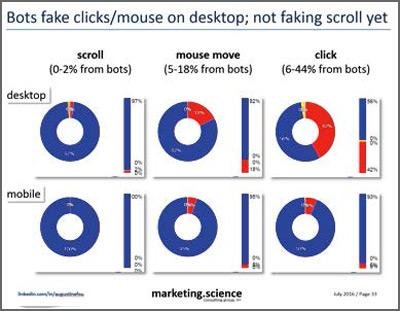
affaA recently published report by White Ops, a digital advertising security and fraud detection company, reveals that the source of most online ad fraud in the United States isn’t large data centers, but rather millions of infected browsers in devices owned by people like you and me.

This is an important finding, because when bots run in browsers, they appear as “real people” to most advertising analytics and many fraud detection systems.

As a result, they are more difficult to detect and much harder to stop.

These fraudulent bots that look like “people” visit publishers, which serve ads to them and collect revenues.

faaf

Of course, once detected, the value of these “bot-bound” ads plummets in the bidding markets.  But is it really a self-correcting problem?   Hardly.

The challenge is that even as those browsers are being detected and rejected as the source of fraudulent traffic, new browsers are being infected and attracting top-dollar ad revenue just as quickly.

It may be that only 3% of all browsers account for well over half of the entire fraud activity by dollar volume … but that 3% is changing all the time.

Even worse, White Ops reports that access to these infected browsers is happening on a “black market” of sorts, where one can buy the right to direct a browser-resident bot to visit a website and generate fraudulent revenues.

… to the tune of billions of dollars every year.  According to ad traffic platform developer eZanga, advertisers are wasting more than $6 billion every year in fraudulent advertising spending.  For some advertisers involved in programmatic buying, fake impressions and clicks represent a majority of their revenue outlay — even as much as 70%.

The solution to this mess in online advertising is hard to see. It isn’t something as “simple and elegant” as blacklisting fake sites, because the fraudsters are dynamically building websites from stolen content, creating (and deleting) hundreds of them every minute.

They’ve taken the very attributes of the worldwide web which make it so easy and useful … and have thrown them back in our faces.

Virus protection software? To these fraudsters, it’s a joke.  Most anti-virus resources cannot even hope to keep pace.  Indeed, some of them have been hacked themselves – their code stolen and made available on the so-called “deep web.”  Is it any wonder that so many Internet-connected devices – from smartphones to home automation systems – contain weaknesses that make them subject to attack?

The problems would go away almost overnight if all infected devices were cut off from the Internet. But we all know that this is an impossibility; no one is going to throw the baby out with the bathwater.

It might help if more people in the ad industry would be willing to admit that there is a big problem, as well as to be more amenable to involve federal law enforcement in attacking it.  But I’m not sure even that would make all that much difference.

There’s no doubt we’ve built a Frankenstein-like monster.  But it’s one we love as well as hate.  Good luck squaring that circle!

E-Mail Marketing: On the Subject of Subject Lines …

emWith groaning inboxes, is it any wonder why so many e-mail messages get ignored by their recipients?

Indeed, with it costing so little to send an e-mail – especially when compared to the “bad old days” of postal mail – it’s too irresistible for marketers and others to deploy hundreds or thousands of e-mail missives at a pop, even if the resulting engagement levels are so paltry.

And therein lies the problem: The “value” of such e-mails diminish to the point where recipients have a very good idea of their (lack of) worthiness without needing to open them.

In such an environment, what’s the the likelihood of something important inadvertently slipping through the cracks? Not so great.  And so users go on their merry way, hitting the delete key with abandon.

Faced with these realities, anything senders can do to improve the odds of their e-mails being opened is worth considering.

As it turns out, some of those odds can be improved by focusing on the e-mail’s subject line.

We know this from research conducted recently by e-mail platform provider Yesware. As reported this week in Fast Company, Yesware’s data scientists took a look at ~115 million e-mails of all kinds, gathered over the course of a 12-month period, to see how open rate dynamics might be affected positively or negatively by differences in the subject line.

ywThe Yesware analysis was carried by analyzing most- and least-used words and formats to determine which ones appeared to be more effective at “juicing” open rates.

As the benchmark, the overall e-mail open rate observed across all 115 million e-mails was 51.9% and the overall reply rate was about 29.8%. But underneath those averages are some differences that can be useful for marketers as they consider how to construct different subject lines for better impact and recipient engagement.

The findings from Yesware’s subject line analysis point to several practices that should be avoided:

Subject line personalization actually works against e-mail engagement.

It may seem counterintuitive, but adding personalization to an e-mail subject turns out to suppress the open rate from 51.9% to 48.1% — and the reply rate goes down even more dramatically from 29.8% to 21.2%.

Yesware surmises that this seemingly clever but now overused technique bears telltale signs of a sales solicitation. No one likes to be fooled for long … and every time one of these “personalized” missives hits the inbox, the recipient likely recalls the very first time he or she expected to open a personal e-mail based on such a subject line – only to be duped.

“First time, shame on you; second time, shame on me.”

Turning your subject line into a question … is a questionable practice.

Using a question mark in a subject line may seem like a good way to add extra curiosity or interest to an e-mail, but it turns out to be a significant turnoff for many recipients. In fact, Yesware found that when a question mark is used in the subject line, the open rate drops a full 10 percentage points (from 51.9% to 41.6%) – and the reply rate also craters (dropping to 18.4%).

It may be that turning a subject line into a question has the effect of reducing the power of the message. Yesware data engineer Anna Holschuh notes that posing a question is “asking a lot of an already-busy, stressed-out professional.  You’re asking them to do work without providing value up front.”

On the other hand, two subject line practices have been shown to improve e-mail open rates – at least to a degree:

Include numbers in the subject line.

Subject lines that contain “hard” numbers appear to improve the e-mail open rate slightly. Yesware found that open rates in such cases were 53.2% compared to 51.9% and the reply rate improved as well (to 32%).  Using precise numbers – the more specific the better – can add an extra measure of credibility to the e-mail, which is a plus in today’s data-rich environment.

Use title case rather than sentence case.

Similarly, Yesware has found that the “authority” conveyed by using title case (initial caps on the key words) in e-mail subject lines helps them perform better than when using the more informal sentence case structure.

The difference? Open rates that have title case subject lines came in at 54.3%, whereas when using sentence case in the subject line resulted in open rates at just 47.6%.

Similarly, reply rates were 32.3% for e-mails with subject lines using title case compared to 25.7% for e-mails where the subject line was sentence case — an even more substantial difference.

Generally speaking, e-mail marketing succeeds or fails at the margins, which is why it’s so important to “calibrate” things like subject lines for maximum advantage. The Yesware analysis demonstrates how those tweaks can add up to measurable performance improvements.

The Gawker saga: Are there any good guys in this drama?

gmSome people I’ve spoken to about blog collective Gawker Media’s recent legal and corporate tribulations have expressed concerns about the chilling effect well-funded lawsuits may be having on a free and unfettered press.  But it’s hard to find any angels in the ongoing saga of Gawker Media and its many detractors.

The latest news is that Gawker is filing for Chapter 11 bankruptcy protection even as it entertains an acquisition bid from publishing firm Ziff Davis.

Reportedly, Ziff Davis is offering $90 million to purchase Gawker Media.  This compares to the $140 million judgment against Gawker handed down by the courts in March in the Hulk Hogan defamation lawsuit.

hhLooking at the sordid details, it’s hard to find sympathy for any of the major players.  In the choice words of journalist and writer Bob Garfield:

“[Gawker Media is a] snide, predatory gossip site that built a reputation cutting hypocritical big shots down to size, but soon ran out of big shots and turned its sneering animus on any anonymous medium-shot unfortunate enough to fall into its sights … Gawker.com is in the schadenfreude business.”

Professional wrestler and television personality Hulk Hogan (aka Terry Gene Bollea) isn’t a paradigm of virtue, either – what with his history of obnoxious statements and what we’ll call euphemistically “other activities” that fall pretty low on the class-meter.

ptTech industry billionaire Peter Thiel, who provided the financial backing for Hulk Hogan’s successful lawsuit, was once a victim of Gawker himself – being “outed” as gay by the media site.  But Thiel’s über-libertarian pronouncements appear churlish on the one hand, while his legal takedown of Gawker seems to be at cross-purposes with the “anything goes” free speech premises of libertarianism.

Nick Denton, Gawker founder and CEO, has remained defiant even in the wake of the latest turn of events:  “Even with his billions, Thiel will not silence our writers.  Our sites will thrive – under new ownership,” Denton has been quoted, adding that court appeals will continue.

Clearly, this drama isn’t ending anytime soon. But with no sympathetic characters in this drama — and that’s about the most positive thing one can say about it — who’s ready to take a shower right about now?

In the Facebook-faceprint tussle, score one for the little guys.

Is that Maria Callas? Check with Facebook -- they'll know.
Is that Maria Callas? Check with Facebook — they’ll know.

I blogged last year about privacy concerns surrounding Facebook’s “face geometry” database activities, which have led to lawsuits in Illinois under the premise that those activities run afoul of that state’s laws regarding the use of biometric data.

The Illinois legislation, enacted in 2008, requires companies to obtain written authorization from subjects prior to collecting any sort of face geometry or related biometric data.

The lawsuit, which was filed in early 2015, centers on Facebook’s automatic photo-tagging feature which has been active since around 2010. The “faceprints” feature – Facebook’s term for face geometry – recognizes faces based on the social network’s vast archive of users and their content, and suggests their names when they appear in photos uploaded by their friends.

The lawsuit was filed by three plaintiffs in a potential class-action effort, and it’s been mired in legal wrangling ever since.

From the outset, many had predicted that Facebook would emerge victorious.  Eric Goldman, a law professor at Santa Clara University, noted in 2015 that the Illinois law is “a niche statute, enacted to solve a particular problem.  Seven years later, it’s being applied to a very different set of circumstances.”

But this past week, a federal judge sided not with Facebook, but with the plaintiffs by refusing to grant a request for dismissal.

In his ruling issued on May 5th, U.S. District Court Judge James Donato rejected Facebook’s contention that the Illinois Biometric Privacy Information Act does not apply to faceprints that are derived from photos, but only when it’s based on a source other than photos, such as in-person scans.

The Judge roundly rejected this contention as inconsistent with the purpose of the Illinois law. Donato wrote:

“The statute is an informed consent privacy law addressing the collection, retention and use of personal biometric identifiers and information at a time when biometric technology is just beginning to be broadly deployed. Trying to cabin this purpose within a specific in-person data collection technique has no support in the words and structure of the statute, and is antithetical to its broad purpose of protecting privacy in the face of emerging biometric technology.”

This isn’t the first time that the Illinois law has withstood a legal challenge. Another federal court judge, Charles Norgle, sided against Shutterfly recently on the same issues.

And Google is now in the crosshairs; it’s facing a class-action lawsuit filed early this year for its face geometry activities involving Google Photos.

Clearly, this fight has a long way to go before the issues are resolved.

If you have strong opinions pro or con about social networks’ use of face geometry, please share your views with other readers in the comment section below.

For many people, what’s “breaking news” isn’t breaking on traditional news media outlets.

First it was Jon Stewart. Now it’s social media. 

(AP)
(AP)

If you suspect that Americans are increasingly getting their news from someplace other than the standard TV/cable, print and online news outlets, you’re right on the money.

In fact, research conducted by the Pew Center in association with the Knight Foundation during 2015 reveals that the share of people for whom Facebook and Twitter serve as a source of news is continuing to rise.

More specifically, nearly two thirds of the 2,000+ Americans age 18 and older surveyed by Pew (~63%) reported that they’re getting news reporting from Facebook.

A similar percentage reported receiving news from Twitter as well.

That compares with ~52% reporting that they received news from Twitter back in 2013 … and ~47% from Facebook.

Although both of these social networks now have the same portion of people getting news from these two sources, the Pew research discovered some nuanced differences as to their strengths.

smnA far bigger portion of people follow “breaking news” on Twitter compared to Facebook (~59% versus ~31%), which underscores Twitter’s strength in providing immediate “as-it-happens” coverage and commentary on live events.

Seeing such behaviors, it shouldn’t come as any surprise that both social networks have been implementing more initiatives that strengthen their positions as news sources even more:

  • Facebook has launched Instant Articles, a functionality that allows media companies to publish stories directly to the Facebook platform instead of linking to outside websites.
  • Facebook has also introduced a new Trending sidebar that allows users to filter news by major topic categories such as sports, entertainment, politics, technology and science.
  • Twitter has introduced live events to its roster, thanks to its purchase of the live video-streaming app Periscope.
  • A related Twitter initiative, dubbed Moments (aka: Project Lightning), allows anyone – even a person without a Twitter account – to view ongoing feeds of tweets, images and videos pertaining to live events.

According to Pew, news exposure is on social media roughly equal among all demographic factors including gender, ethnicity and income. The one exception, of course, is age.

All of these developments underscore the fact that the “traditional” TV, print and online outlets are no longer dominant when it comes to news consumption. And it’s highly unlikely that the trend will ever be reversed, either.

The Federal Trade Commission vs. Native Advertising: Score One for the FTC

ptpbIt’s pretty much a given these days that “native advertising” has it all over traditional advertising when it comes to prompting prospects to try a new product or service. Study after study shows that positive recommendations and ratings from family members, friends, key influencers and even simply fellow users are what prompt people to try it for themselves.

These dynamics mean that suppliers are looking for as many opportunities to publicize their offerings through these native channels as they can.

There’s a bit of a problem, however. Bloggers and other influencers have become wise to this reality — and many are taking it all the way to the bank.  The market is replete with conventions and other events such as the annual Haven Conference, at which these key influencers congregate and “hold court” with suppliers.

While there is no prescribed agenda regarding what’s discussed between suppliers and influencers, generally speaking there’s a whole lot of quid pro quo going on:  Things like receiving copious free samples in exchange for publishing product reviews, receiving monetary payments for mentioning products and brands in blog articles and on social media posts, and more.

One can’t really blame the influencers for peddling their influence to the highest bidder. After all, many successful bloggers and other influential people derive most or all of their livelihood from their online activities.  It’s only natural for someone whose influences ranges widely and deep to expect to be compensated for publicizing a product, a service or a brand — whether or not they themselves think it’s the best thing since sliced bread.

But there’s a growing problem regarding the “pay to play” aspects of native advertising. This past December, the Federal Trade Commission reiterated its opinion that such sweetheart deals are tantamount to advertising, and therefore must be prominently identified as such in online and other informational content.

Of course, including a prominent announcement that payment has been exchanged for an influencer’s commentary significantly lowers the positive impact of native advertising, in that the commentary being valued by consumers precisely because of its inherent objectivity and credibility is no longer much of a hook.

Until recently, it wasn’t clear how strict the FTC was going to be about enforcing its stated policy about disclosing financial remuneration for brand coverage by influencers.

L+TLWell, now we know.  It’s in the form of a settlement reach this month by the FTC with retailer Lord & Taylor over a particular online ad campaign that contained native advertising and social media components.  It’s the first time the FTC has brought an enforcement action since its native ad guidelines were published.

The settlement pertains to a promotional campaign for Lord & Taylor’s Design Lab private-label line of spring dresses. The initiative reached more than 11 million Instagram users, and the particular sundress at the center of the publicity campaign sold out quickly as a result.

The native advertising portion of the promo effort stemmed from an article about DesignLab that appeared in the online magazine Nylon.  That article was paid for by Lord & Taylor, which also reviewed and approved the article’s content prior to publication.

As could be expected, no notification that the piece was a paid ad placement was included when the article was published.

Skating close to the edge even more, the social portion of the promo campaign involved the retailer giving the sundress to approximately 50 top fashion bloggers, along with paying each blogger between $1,000 and $4,000 to model the dress in photos that were then posted to Instagram.

The bloggers were allowed to style the dress in their own way, but they were asked to reference the dress in their posts by using the campaign hashtag #DesignLab as well as @lordandtaylor.

Furthermore, the retailer reviewed and approved these social media posts before they went live, which enabled them to make stylistic edits before-the-fact as well.

Here’s an excerpt from the FTC’s statement about the Lord & Taylor action:

“None of the Instagram posts presented to respondents for pre-approval included a disclosure that the influencer had received the dress for free, that she had been compensated for the post, or that the post was a part of a Lord & Taylor advertising campaign.”

Clearly, the FTC is now putting muscle behind its 2009 opinion (and reiterated last year) that failing to disclose that an endorsement has been paid for is a deceptive practice.

In this particular “test case,” Lord & Taylor is getting off somewhat easy in that there have been no monetary penalties levied against the retailer. However, the company has signed a consent decree that is in place for the next two decades, which would mean “swift and stiff” penalties if the retailer were to transgress in the future.

Other terms of the settlement mandate that Lord & Taylor require its endorsers to sign and submit written statements outlining their obligation to “clearly and conspicuously” disclose any monetary or other material connections they have to the retailer.

Clearly, the Lord & Taylor settlement is a shot across the bow by the FTC, signifying that it means business when it comes to alerting consumers of the financial or other material connections that exist between influencers who are making value judgments on products and services.  In effect, the FTC is saying to the marketing world, “Be very careful …”

It’ll be interesting to see how marketers finesse the challenge of figuring out how to corral the obvious benefits of native advertising while mitigating the dampening effects of “full disclosure.”

Perhaps bloggers and other influencers will need to re-think their own business models as well, seeing as how the “golden goose” of supplier perks seems to have lost some of its luster now.

Stay tuned — this new “lay of the land” is still unfolding.

Antisocial behavior: Major retailers do much better broadcasting on social media than they do responding.

untitledWhen it comes to social media, it turns out that the major U.S. retail brands are a lot better at dishing it out than consuming it.

On the “dishing out” side of the ledger, these retailers have been posting an ever-increasing number of social messages aimed at their target audiences.

A recent report from Sprout Social Index titled Snubbed on Social shows just how much:  In the 3rd Quarter of 2014, the average number of messages deployed by the typical major retailer was around 150, but in the 3rd Quarter of 2015, the number had grown to in excess of 350.

But what happens when these retailers are on the receiving end of social messages? Sprout Social has determined that the typical retailer receives around 1,500 inbound social messages over a busy quarter (such as during the holiday season).

Of these, approximately 40% of the messages are ones that warrant a response.

But only about 1 in 6 – fewer than 20% of them — actually get one.

And those consumers who are fortunate enough to receive a response are waiting approximately 12 hours to get it. That’s up from ~11 hours a year earlier.

One interesting factoid from the Sprout Social reporting is that customer messages on Twitter tend to get a better response from brands.

But it’s the difference between merely poor (~14% on Twitter) and downright embarrassing (~9% on Facebook).

untitledScott Brandt, chief marketing officer at Sprout Social, states it succinctly: “More often than not, brands are silent when their customers reach out.”

What are the implications of this (non-)behavior?

For one thing, interacting with customers helps drive more interesting and more purchases.  Sprout reports that consumers are seven times more likely to respond to social promotions and other social news if they have had meaningful interaction with the brand.

Obviously, ignoring the social messages that come through isn’t the way to build that engagement.

One dynamic that appears to be at work is that brands continue to use social media as a vehicle for broadcast messaging, whereas many consumers view social platforms as the place for a more conversational, two-way level of engagement.

You know – just like social media is supposed to work.

But there are some seemingly intractable reasons why it’s difficult to put the “theory” of social interaction into “practice.”

For starters, there are so many ways for people to communicate with companies and brands today (versus only by letter, phone or in person not that many years ago), that too many businesses are either stretched to thin or simply don’t feel the need to respond urgently if at all.

Another issue is similarly personnel-related. For brands to respond better would mean hiring and training people who possess the authorization to actually do something about a question or concern.  Low-level staff with low wages and benefits and with no authority to resolve issues is a clear ticket to nowhere.

At the very least, putting a process in place that provides a quick response to all inquiries – even if the initial response is auto-generated – is just plain common sense. The value to the consumer of a response that comes within just a few minutes – even if the message was posted in the dead of night – is what makes consumers bond with a brand.  (Just having their existence validated is huge for some people.)

Contrast that to the other, more common experience of brands ignoring their consumers to death … and where people never forget which companies aren’t good at responding to their questions or concerns. Does anyone think that reputation doesn’t have a dampening effect on sales?

More information about the Spout Social Index can be found here.