Print vs. online newspaper readership behaviors don’t look promising at all for media properties.

New York Times CEO Mark Thompson

From the New York Times on down, leading publishers are telling us that print versions of their newspapers will eventually disappear.  The only question is how soon it will happen.

But what are the implications of this pending shift to all-digital? Will online news consumers be as strongly engaged as they have been with the print newspaper product?

We now have a window into answering this question by looking at the experience of The Independent, a UK national daily paper.  Two years ago, The Independent made the shift to become an online-only publication.

And the result was … no measurable increase traffic shifting from offline to online. That finding comes from a before/after analysis of the publication’s performance as conducted by European communications industry researchers Neil Thurman and Richard Fletcher.

What they learned is that shutting down the print property didn’t drive those news consumers to print-like consumption habits on digital devices.

Instead, these customers became like other digital readers. That is to say, in the words of the researchers, “easily distracted, flitting from link to link, and a little allergic to depth.”

Let’s drill down a little deeper. At the time it ceased publishing a print edition of its newspaper, The Independent had a paid print circulation of approximately 40,000, along with ~58 million monthly unique visits on its digital platform.

That a humongous chasm … but the researchers found that the publication’s relatively small number of print readers were responsible for more than 80% of all time spent consuming all of The Independent’s news content – print and digital.

That is correct: Considering engagement on all of its digital platforms, all of that added up to fewer than 20% of the time collectively spent reading the print publication.

The chart below shows what happened to readership. All of the time The Independent’s print readers spent with the paper seems to have simply disappeared when the company ceased publishing a print version.  It didn’t transition to independent.co.uk.
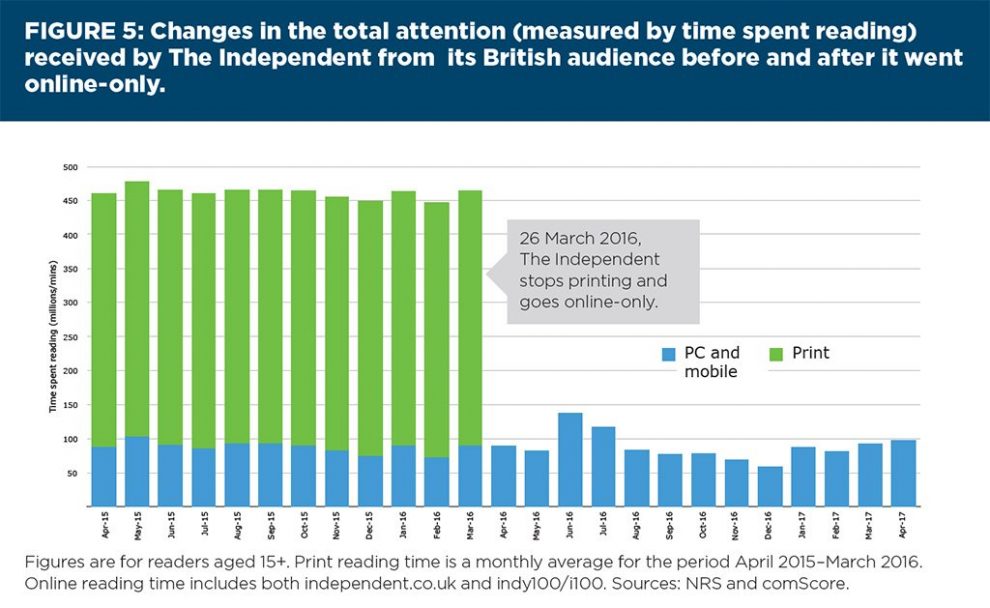
Even more telling, the researchers found that half of print recipients had read the newspaper “almost every day,” whereas online visitors read a news story in The Independent, on average, a little more than twice per month.

While print readers typically spent from 40 to 50 minutes reading each daily edition of The Independent, online readers spent, on average, just 6 minutes over the entire month.

Here’s the thing: Whereas print newspapers usually have few if any competitors in their immediate space, online there are an unlimited number of competing sites to attract (and distract) the reader – all of them just a mouse-click away.

Even if we discount a measure of exaggeration on the part of respondents in terms of how much time they actually expend on their reading consumption versus what they reported to survey-takers, the print/online dynamics reveal stark differences. As researcher Thurman reports:

“By going online-only, The Independent has decimated the attention it receives. The paper is now a thing more glanced at, it seems, than gorged on.  It has sustainability but less centrality.”

There is one silver-lining of shifting to an all-digital platform, at least in the case of The Independent.  That shift has resulted in increased international reach by the publication.

But The Independent is a national newspaper, unlike most of America’s leading papers, and so that sort of positive aspect can’t be expected to apply very easily to those other media properties.  How many people outside of central Colorado can be expected to read a digital edition of the Denver Post?

The main takeaway from The Independent’s experience is that for any paper choosing to go all-digital, chances are high that the audience isn’t going to follow along – certainly not at the level of loyal, in-depth time once spent with the print product.

Sure, the very real costs of printing and delivery will now be a thing of the past. But a significant – even dramatic – decline in reach, influence and impact will be the new reality for the publishers

Baby, meet bathwater.

Airline fees go through the roof … but are we actually surprised?

For airline consumers, the news has been unremittingly bleak in the past few years, what with ancillary fees rising and in-flight comfort going the way of the dodo bird.

But when you think about it, this is something that was bound to happen.

According to the Associated Press, the average roundtrip fare for domestic flights in the United States today is approximately $500.

Let’s compare this to when I was a student in college 40+ years ago. Back then, coach airfare between Minneapolis-St. Paul and Nashville, TN typically ran approximately $250 — so roughly half of what today’s figure would be.

But when we calculate the inflation factor, that $250 fare translates to nearly $1,200.

The equivalent of $1,200 a pop explains why it was financially necessary for me to stay in Nashville over various holidays such as Thanksgiving break instead of flying home for only a few days or a week.

On the plus side, flying back then was a breeze compared to today. Not just the stress and irritation of the terminal security lines, but also far fewer travelers, with planes often only one-third or half-full.

Deregulation followed by vastly cheaper airfares have led to flying being within nearly everyone’s budget, which is all very egalitarian but also making the air travel experience high on the “frustration factor.”

How about the airlines? They’ve had to deal with all sorts of regulatory developments along with sharply higher operating costs — jet fuel just for starters.

And while the airlines have benefited from serving more travelers, that hasn’t made up for the decline in fare prices.  So it isn’t surprising that the airlines started cutting in other ways.

First it was in-flight meals, moving away from delicious hot platters to sandwiches … then to peanuts or pretzels … and now to nothing sometimes.

Next, it was the removal of pillows and blankets.

Accessing in-flight entertainment costs extra, too — as well as gaining access to cyber-communications.

And has anyone noticed the “squeeze play” going on in the coach section? That isn’t your imagination.  Today’s typical coach seat is 17 inches wide, which is nearly a 10% decrease from the 18.5 inches from about a decade ago.  (That corresponds with an average 8% heavier traveler over the same period, by the way.)

Space constraints spill over into the ever-smaller footprint of airplane lavatories. If you find that you can’t turn around in them, that’s because they’re literally smaller than a phone booth.  I know I try to avoid using them as much as possible.

In any case, all this nibbling around the edges hasn’t been able to make up for airline revenue losses elsewhere. So now we have fees being levied for checked luggage — in the range of $25 to $40 per item.  For a while the charges were levied on extra pieces of luggage, but now Delta, American Airlines and United Airlines are charging for the first checked item, too.  Among the major carriers, only Southwest remains a holdout — but one wonders for how much longer.

And reservation change fees? They’re increasing for everyone — even people who have traditionally been willing to pay more for an air ticket if they’d have the opportunity alter their travel plans without a being charged whopping change fee.  Those fees can sometimes go as high as $200 — nearly the cost of purchasing an entirely new one-way ticket.

According to transportation and hospitality marketing firm IdeaWorks, in 2017 the top 10 airlines brought in nearly $30 billion in ancillary revenues — a figure that’s sure to be significantly larger in 2018. It’s almost as if the ancillary revenues are as important as the base fare.  As Aditi Shrikant, a journalist for Vox puts it, “Buying a plane ticket has been stripped down to mean that you are paying for your mere right to get on the plane.  Anything else is extra.”

In their own lumbering way, the U.S. Congress is now making noises about cracking town on what it characterizes as unreasonable airline fees.  I’m not sure that any such legislative moves would have the desired effect.  Already, Doug Parker, American Airlines’ CEO, predicts that of Congress moves in that direction, the industry would respond by making airline tickets nonrefundable:  “We — like the baseball team, like the opera — would say, ‘We’re sorry, it was nonrefundable.'”

What are your thoughts about the unbundling of services and fees in the airline industry? While that business model gives passengers the choice of flying for less without access to the amenities, it turns the process of purchasing an airline ticket into something that seems akin to a fleecing.

Do you have particular criticisms about the current state of affairs? What would you prefer to be different about the scenario?  Please share your comments below.

Fake e-mails: A small percentage … but a big number.

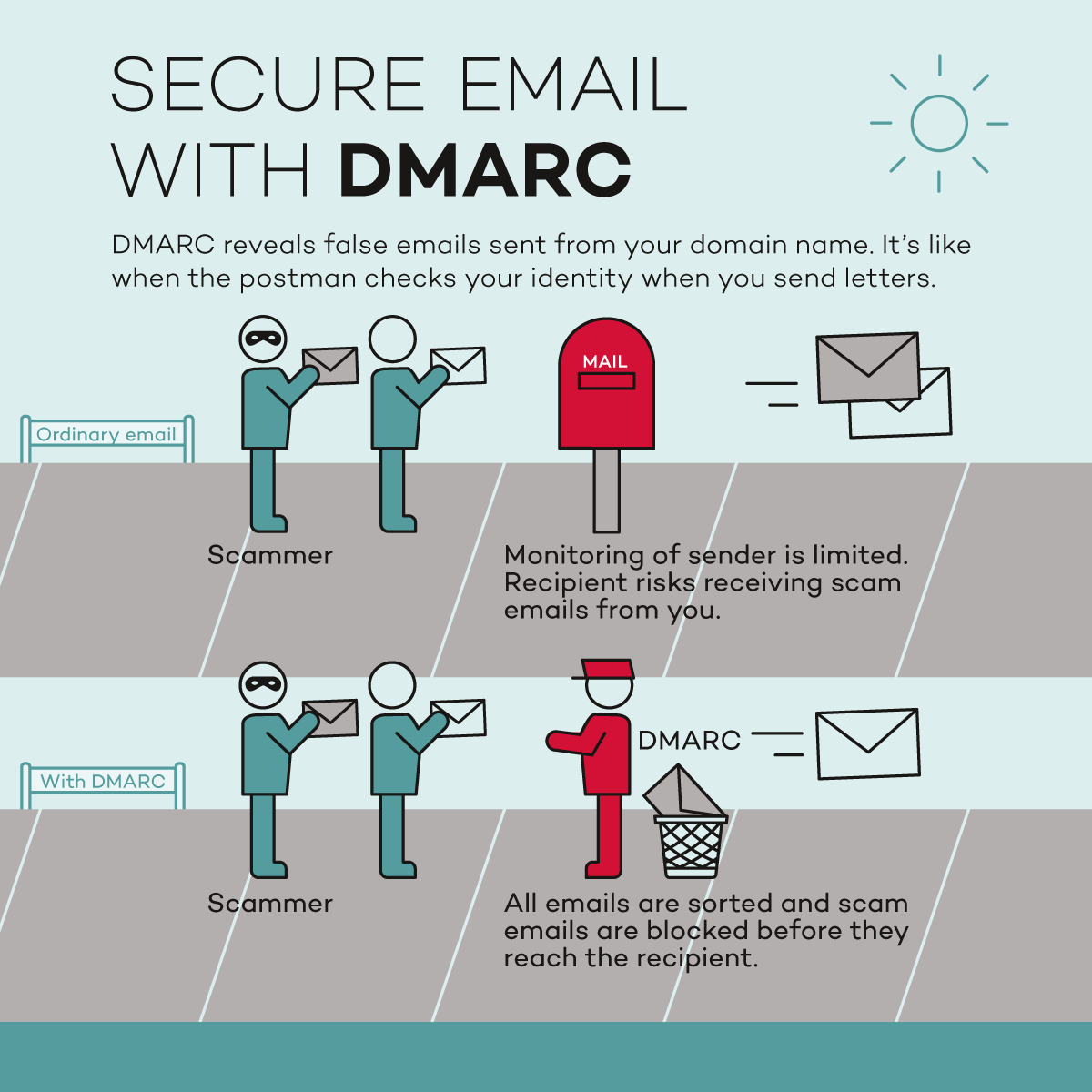
Recently released statistics by e-mail security and authentication service provider Valimail tell us that ~2% of e-mail communications worldwide are deemed “potentially malicious” because they’ve failed DMARC testing (domain-based message authentication, reporting and conformance) and also don’t originate from known, legitimate senders.

That’s a small percentage — seemingly trivial.  But considering the volume of e-mail messages sent every day, it translates into nearly 6.4 billion e-mails sent every day that are “fake, faux and phony.”

Interestingly, the source of those fake e-mails is most often right here in the United States.  Not Russia or Ukraine.  Or Nigeria or Tajikistan.

In fact, no other country even comes close to the USA in the number of fraudulent e-mails.

The good news is that DMARC has made some pretty decent strides in recent times, with DMARC support now covering around 5 billion inboxes worldwide, up from less than 3 billion in 2015.

The federal government is the biggest user of DMARC, but nearly all U.S. tech companies and most Fortune 500 companies also participate.

Participation is one thing, but doing something about enforcement is another. At the moment, Valimail is finding that the enforcement failure rate is well above 70% — hardly an impressive track record.

The Valimail study findings came as the result of analyzing billions of e-mail message authentication requests, along with 3 million+ publicly accessible DMARC records. So, the findings are meaningful and provide good directional indications.

But what are the research implications? The findings underscore the degree to which name brands can be “hijacked” for nefarious purposes.

Additionally, there’s consumer fallout in that many people are increasingly skittish about opening any marketing-oriented e-mails at all, figuring that the risk of importing a virus outweighs any potential benefit from the marketing pitch.

That isn’t an over-abundance of caution, either, because 9 in 10 cyber attacks begin with a phishing e-mail.

It’s certainly enough to keep many people from opening the next e-mail that hits their inbox from a Penneys(?), DirecTV(?) or BestBuy(?).

How about you?  Are you now sending those e-mails straight to the trash as a matter of course?

Amazon and its sellers need each other.

If you speak with small businesses that sell products online, many will tell you that they chafe under the strong-arm tactics of Amazon and its seller policies.

On the other hand, what’s their alternative?

The reality is that it takes about the same amount of time and effort to run a Walmart or eBay store as it does to run a store at Amazon.

The difference? The sales revenue of a Walmart or eBay store is typically less than 10% of what businesses would generate on Amazon for that same amount of work.  That interesting informational nugget comes from James Thompson, a partner at the Buy Box Experts e-tailing consultancy.

(And for small retailers attempting to run their own e-commerce sites, the revenue stream is even lower.)

But even with Amazon’s ascendancy in the world of online commerce, its retail platform remains a frustration to small sellers due to its level of responsiveness to questions and concerns (low) and its sudden, sometimes inexplicable policy changes.

Consumer advocates would counter-argue that Amazon’s seller policies are focused in the right place:  looking out for the end-user customer. But others contend that Amazon’s actions aren’t even-handed, nor applied equally.

Take Amazon’s policies on dealing with product shipments and defects. When a seller’s defect order rate goes as high as 1%, Amazon deactivates the vendor’s account automatically.  To be reinstated, a seller has to go through an arduous vetting process, during which time Amazon holds all monies due to the seller until every order is shipped and received – even orders that are in dispute.

To make matters even more onerous, the customer service phone number of the seller disappears, making it next-to-impossible for the vendor to clear up any misunderstandings with an end-customer other than by going through the Amazon portal.

Here’s another example:  Without prior notification, last month Amazon instituted a new “Pay by Invoice” policy that allows corporate customers a pay period of 30 days.

While this is a great move from the customer’s point of view, most small businesses are used to being paid in two weeks.  The new invoice payment policy squeezes the resources of smaller sellers, which often operate under tighter cashflow conditions than larger retailers.

It is true that bigger brands make up an increasing share of volume in the world of Amazon sellers. Those brands bring in the most money, but small businesses round out the portfolio and remain an important component of realizing Amazon’s aims of becoming the big behemoth with an “always and everywhere” presence in the world of retail.

Considering everything, it would seem that Amazon and its sellers should recognize each other’s worth and how much they mean to each other. Amidst everything, there has to be a win-win position that can be reached to the benefit of everyone.

The closed world of open office environments.

If you ask company managers and CFOs if they prefer “open office” concepts over private offices, you may well get a different answer than if you ask the people who actually work in open office environments.

There are two attractive aspects about open office plans that surely warm the hearts of many business managers. One is the notion that an open office environment encourages more interaction and spontaneous collaboration among employees.

The other is that open office concepts don’t cost as much to build and maintain as do private offices.

So … let’s break this down a bit.

Speaking personally, I’ve visited numerous company headquarters and branch locations where open office plans are prevalent … but what I see and hear isn’t interaction. Instead, it’s more likely to be mounds of white noise with employees sitting at their desks focusing intently on their computer screens.

Any interaction that may be happening is closer to the hushed sounds of a reference library — or even the confessional zone in the back of a Roman Catholic or Anglican church — than it is to any kind of bright, casual conversation with ideation happening all over the place.

This can’t be what managers had in mind – even if they’re shaving 25% or more off of their facilities management budget.

Now we have some new evidence to support the anecdotal evidence. Researchers at the Harvard Business School studied two Fortune 500 companies that made the transition to an open office plan from one where workers had more privacy.  The firms agreed to allow themselves to be the subjects of before/after evaluation.

The research wasn’t done via a survey, which would likely be susceptible to respondent bias (a fear of being honest and saying something that goes against the common managerial POV). Instead, the actual worker behaviors were charted using “sociometric” electronic badges and microphones that were worn by the employees for several weeks before and after the office redesigns.

The badges worn by the participants included an infrared sensor, a Bluetooth® sensor and an accelerometer that, when combined with a microphone, could discern when two people had a face-to-face interaction (but without recording the actual words spoken).

The Harvard research also studied before/after data pertaining to the volume of e-mail and instant messenger use by the employees.

Even though other variables remaining the same in the before/after evaluation (the same employees … before/after study periods occurring during the same business cycle), the changes in behavior were startling:

  • Employees spent ~73% less time in face-to-face interactions
  • E-mail use rose by ~67%
  • Instant messenger use grew by ~75%

The research also looked at shifts in interactions between specific pairs of work colleagues, where it found a similar dropoff in face-to-face communications along with increased electronic correspondence (although not to the same degree as the overall research results showed).

Furthermore, the research determined that workers tended to interact with different groups of people online than they did in person, which opens up even more potential concerns about the reduction in collaboration that would be happening as a result of moving to the open office concept.

Speaking in a post-study interview, Harvard Business School professor Ethan Bernstein’s conclusion was that there’s “a natural human desire for privacy — and when we don’t have privacy, we find ways of achieving it.”

In the case of preferred office configurations, people simply don’t like fishbowls. Deskside chats don’t happen, and other face-to-face interaction is severely limited as well.

In other words, open office plans don’t result in increased personal interaction, but they do create a more digital environment.  That seems like the polar opposite of what management wants.

Of course, to reduce a company’s facilities budget, an open office environment remains the preferred thing to do.  So maybe companies need to drop all of the pretense about “facilitating positive collaboration and spontaneous brainstorming.” Just tell employees what’s really behind shifting to an open office concept:  spending fewer dollars.

At least employees might appreciate the honesty rather than the obfuscation …

A detailed article summarizing the research, co-authored by Harvard researchers Ethan Bernstein and Stephen Turban, can be accessed here.

Grunts and groans in the e-mail sector.

Want to work as a drone for middling pay? Then a job in e-mail marketing may be right for you!

There’s an oft-repeated axiom that success in business is 20% inspiration and 80% perspiration.

If that’s the case, then the field of e-mail marketing is proving the rule – in spades.

Recently, e-mail service provider MessageGears surveyed workers in the business-to-consumer e-mail enterprise space. All survey respondents worked in companies that deploy 10 million or more e-mails per month.  More to the point, two thirds of the respondents worked in companies that send more than 50 million e-mails monthly.

So, we’re talking about companies that are on their game when it comes to the e-mail discipline – presumably aware of the latest operational and analytical tools to make their businesses as efficient as possible.

Here’s what MessageGears discovered in its survey:

  • More than 90% of respondents that have purely strategic roles in e-mail marketing are “very satisfied” with their jobs … and ~81% would again choose the e-mail discipline as a career.
  • More than two-thirds of respondents who are unhappy with their jobs spend 50% or more of their time on operational work tasks … and half of those would choose a different career if they were starting over.

Clearly, the creative and strategic parts of e-mail marketing are more popular than the operational aspects. Indeed, respondents rated the following job tasks the most fulfilling ones personally:

  • Designing customer-centric e-mails
  • Creating e-mail content
  • Devising new ways to engage with customers via e-mail communications

On the other hand, the lowest marks were recorded for these tasks:

  • E-mail testing
  • Analytics
  • Data segmenting

Unfortunately, it’s these latter types of tasks that take up the majority of daily job responsibilities for many workers in the e-mail sector: According to the survey results, nearly half of the workers spend more time on testing, analytics and data segmenting than they do on anything else.

MessageGears claims that there’s a direct link between the heavy proportion of operational tasks and the lack of creativity and strategic thinking in the field of e-mail.

Whether this linkage results in a loss of efficiency may be open to question … but what it does suggest is that working in e-mail isn’t the most personally fulfilling path for a marketing career – at least for most people.

More about the MessageGears survey results can be accessed here.

3D printing: The newest market disrupter?

3D printing was in the “popular press” a few weeks back when there was a dust-up about plans to publish specifications online for the manufacturing of firearms using 3D technology.

Of course, that news hit the streets because of the hot-button issues of access to guns, the lack of ability to trace a firearm manufactured via 3D printing, plus concerns about avoiding detection in security screenings due to the composition of the pieces and parts (in this case, polymer materials).

But 3D printing should be receiving more press generally. It may well be the latest market disrupter because of its promise to fundamentally change the way parts and components are designed, sourced and made.

3D printing technologies – both polymer and metal – have been emerging for some time now, and unlike some other technologies, they have already found a highly receptive commercial audience. That’s because 3D printing technology can be used with great efficiency to manufacture production components for applications that are experiencing some of the hottest market demand – like medical instrumentation as well as aerospace, automation and defense products.

One the baseline benefits of 3D printing is that it can reduce lead times dramatically on custom-designed components. Importantly, 3D printing requires no upfront tooling investment, saving both time and dollars for purchasers.  On top of that, there are no minimum order requirements, which is a great boon for companies that may be testing a new design and need only a few prototypes to start.

Considering all of these benefits, 3D printing offers customers the flexibility to innovate rapidly with virtually no limitations on design geometries or other parameters. Small minimum orders (even for regular production runs) enable keeping reduced inventories along with the ability to rely on just-in-time manufacturing.

The question is, which industry segments will be impacted most by the rise of 3D printing? I can see ripple effects that potentially go well-beyond the mortal danger faced by tool and die shops.  How many suppliers are going to need to revisit their capabilities in order to support smaller production runs and über-short lead-times?

And on the plus side, what sort of growth will we see in companies that invest in 3D printing capabilities?  Most likely we’ll be seeing startup operations that simply weren’t around before.

One thing’s for sure – it will be very interesting to look back on this segment five years hence to take stock of the evolution and how quickly it came about.  Some market forecasts have the sector growing at more than 25% per year to exceed $30 billion in value by that time.

Like some other rosy predictions in other emerging markets that ultimately came up short, will those predictions turn out to be too bullish?

For brand loyalty … follow the money.

When it comes to brand loyalty, are we mercenaries? Loyalists?  Cultists?

Or maybe we’re just lazy?

With major brands spending billions of dollars each year using various strategies to build and keep brand loyalty, these questions are important.

Recently-published consumer research by Maritz Motivation Solutions and Wise Marketer Group seeks to get to the nub of the issue.

Maritz/Wise surveyed nearly 2,100 American adults age 18 and over via online questionnaires and consumer research panels. The respondents were filtered to include purchase decision-makers or key influencers within one or more of six major consumer categories:

  • Airline travel
  • Banking services
  • Credit card services
  • Hotels/lodging
  • Restaurants
  • Specialty retails

The results of the research reveal that brand loyalty isn’t one monolithic mindset, but consumers tend to fall into one of four categories, as follows:

  • “Mercenaries” – Loyal to brands that pay them to be loyal: ~55% of respondents
  • “True loyalists” – Stay true to a brand because people connect with it above and beyond any explicit incentives to do so: ~30%
  • “Sloths” – Can’t be bothered to switch brands due to inertia: ~8%
  • “Cultists” – The brand represents their personal identity: ~7%

What the Maritz/Wise research also tells us is where people come down on brand loyalty attributes is based more on attitudinal characteristics than something that can be segmented easily based on conventional demographics.

In other words, brand loyalty characteristics aren’t driven by age, gender or income level; mercenaries and cultists are found in their expected proportions across the spectrum of loyalty.

In another finding, when it comes to the “transactional” nature of brand loyalty, the research discovered that the “art of the deal” is based on money.

Gift cards, cash-back and credits are overwhelmingly preferred forms of reward for brand loyalty – and these apply to everyone no matter where they may land on the brand loyalty spectrum.

So, the next time we hear the old saw that “money can’t buy love” … we all know that the truth is a bit more nuanced.

Celebrity endorsements run out of steam.

“Paid product endorsements are meaningless. I want to learn about the product from experts who are advocating for it – not just some random person who happens to have a job that makes them well-known.” 

— Consumer panel participant, ExpertVoice, May 2018.

The next time you see a celebrity spokesperson speaking about a product or a service … don’t think much of it.

Chances are, the celebrity isn’t doing a whole lot to increase a company’s sales or enhance its brand image.

We have affirmation of this trend in a report issued in June 2018 by marketing firm ExpertVoice, which recently investigated a Census-weighted audience of ~500 U.S. consumers on the issue of who consumers trust for recommendations on what to buy.

The findings confirm that while celebrity endorsements do raise awareness, typically it fails to move the needle in terms of sales. In fact, just ~4% of the participants in the ExpertVoice research study reported that they trust celebrity endorsements.  (And even that percentage is juiced by professional athletes who are more influential than other celebrities.)

As for the reason for the lack of trust, more than half of the respondents noted that their greatest concern is the monetary compensation given to the people from the brands they’re endorsing. Consumers are wise to the practice – and they reject the notion that the endorser has anything other than self-dealing in mind.

By way of comparison, here are how celebrities stack up against others when it comes to influencing consumer purchases:

  • Trust recommendations from friends/family members: ~83% of respondents
  • … from a professional expert (e.g., instructor or coach): ~54%
  • … from a co-worker: ~52%
  • … from a retail salesperson: ~42%
  • … from a professional athlete: ~6%
  • … from any other kind of celebrity: ~2%

A big takeaway from the ExpertVoice research is that more people are influenced by individuals who are making recommendations based on actual experiences with the products in question. Moreover, if it’s people they know they know personally, they’re even likelier to be swayed by their opinions.

In a crowded marketplace full of many purchase choices, consumers are looking for trusted recommendations. That means something a lot more authentic than a celebrity endorser.  Considering the amount of money companies and brands have historically had to pony up for celebrity pitches, it seems an opportune time for marketers to be looking at alternative methods to influence their audiences.

Click here for more information regarding the ExpertVoice research findings.

GDPR: What’s the big whoop?

This past week, the European Union’s General Data Protection Regulation (GDPR) initiative kicked in. But what does it mean for businesses that operate in the EU region?

And what are the prospects for GDPR-like privacy coming to the USA anytime soon?

First off, let’s review what’s covered by the GDPR initiative. The GDPR includes the following rights for individuals:

  1. The right to be informed
  2. The right of access
  3. The right to rectification
  4. The right to be forgotten
  5. The right to restrict processing
  6. The right to data portability
  7. The right to object
  8. Rights in relation to automated decision making and profiling

The “right to be forgotten” means data subjects can request their information to be erased. The right to “data portability” is also a new factor.  Data subjects now have the right to have data transferred to a third-party service provider in machine-readable format.  However, this right arises only when personal data is provided and processed on the basis of consent, or when necessary to perform a contract.

Privacy impact assessments and “privacy by design” are now legally required in certain circumstances under GDPR, too. Businesses are obliged to carry out data protection impact assessments for new technologies.  “Privacy by design” involves accounting for privacy risk when designing a new product or service, rather than treating it as an afterthought.

Implications for Marketers

A recent study investigated how much customer data will still be usable after GDPR provisions are implemented. Research was done involving more than 30 companies that have already gone through the process of making their data completely GDPR-compliant.

The sobering finding:  Nearly 45% of EU audience data is being lost due to GDPR provisions.  One of the biggest changes is that cookie IDs disappear, which is the basis behind so much programmatic and other data-driven advertising both in Europe and in the United States.

Doug Stevenson, CEO of Vibrant Media, the contextual advertising agency that conducted the study, had this to say about the implications:

“Publishers will need to rapidly fill their inventory with ‘pro-privacy’ solutions that do not require consent, such as contextual advertising, native [advertising] opportunities and non-personalized ads.”

New platforms are emerging to help publishers manage customer consent for “privacy by design,” but the situation is sure to become more challenging in the ensuing months and years as compliance tracking the regulatory authorities ramps up.

It appears that some companies are being a little less proactive than is advisable. A recent study by compliance consulting firm CompliancePoint shows that a large contingent of companies, simply put, aren’t ready for GDPR.

As for why they aren’t, nearly half report that they’re taking a “wait and see” attitude to determine what sorts of enforcement actions ensue against scofflaws. Some marketers admit that their companies aren’t ready due to their own lack of understanding of GDPR issues, while quite a few others claim simply that they’re unconcerned.

I suspect we’re going to get a much better understanding of the implications of GDPR over the coming year or so. It’ll be good to check back on the status of implementation and enforcement measure by this time next year.