When “Push” Comes to “Pull” in Marketing

Push versus pull marketing.  "Push" has the upper hand now.
"Push" vs. "pull" marketing: Does "pull" have the upper hand now?
It’s clear that social media is delivering a wide range of interesting and beneficial online experiences for people. One that’s among the most highly valued is the ability to “vet” products, services and brands through reading reviews posted by “real people.”

According to a survey of ~3,330 consumers conducted in late 2011 by Deloitte’s Global Consumer Products Group, a large majority of consumers report that they rely on user reviews to guide their purchase decisions, rather than merely being influenced by brand advertising.

The Deloitte survey found that nearly two-thirds of consumers read consumer-written product reviews online. Of that group, 82% report that their purchase decisions have been directly influenced by these reviews – either confirming their decision to buy or causing them to switch to an alternative product or service.

Because of the perceived value of these consumer reviews, most people begin their search for information via a search engine query or by going to blogs, e-commerce sites such as Amazon that also feature consumer reviews, or review sites like TripAdvisor and Yelp.

By contrast, the incidence of people beginning their information quest at a company or brand website is far lower.

These dynamics are part of the reason why so many companies and brands are looking to increase their engagement with the online public. They’re particularly keen on ferreting out their natural allies – people who have a strong positive opinions about their brand – and turning them from armchair advocates into vocal cheerleaders.

For many marketers, this means going well-beyond collecting “likes” and similar “trophy counts.” They’re also continually monitoring comments in the social sphere concerning the quality of their products and customer service in order to make sure they deal with any issues or complaints expeditiously in order to minimize negative fallout in the “review” environment.

There’s also a powerful impulse for brands to offer “incentives” to customers in exchange for posting positive reviews. Those incentives can range from the small or innocuous – offering discount coupons or inexpensive product samples – all the way to incentives that seem more like bribes. (Here’s the latest example of this, courtesy of Honda.)

The keen attention companies are paying to social platforms reminds us that we’re in the midst of a migration away from traditional “push” marketing into a land of “pull” marketing.

There have always been “push” and “pull” aspects to marketing, advertising and PR, of course. But the balance of energy these days appears to be shifting quite sharply in the direction of “pull.”

There’s no reason to think that pattern will change anytime soon.

Retailing Comes Full Circle … Courtesy of Amazon

Amazon’s been busy revolutionizing the world of retailing for well over a decade now. So what’s its latest trick? Bricks-and mortar stores.

Yes, you read that right. Amazon’s going into the physical retail game.

What’s behind this seemingly bizarre turn away from 21st century online retailing back to something that seems almost quaint? It’s pretty fundamental, actually. There are many products that consumers find easier to purchase after being able to interact with them physically and personally.

From apparel to electronics to sporting goods, sometimes there’s no substitute for the visceral, sensory experience. Online images, videos, product ratings and customer reviews all have their place, and Amazon doesn’t see those aspects becoming any less important over time.

Indeed, the Amazon store concept builds on all that, attempting to create a multi-channel retailing structure that truly serves the needs to consumers whenever and however they wish.

If what Amazon is developing is “just another” retail shop, it’ll be much ado about nothing. But it’s more likely that Amazon will try to create a retail experience in the manner of an Apple store – creating an environment that has its own special personality and attracts shoppers because of it.

Amazon may generate a good deal of buzz about its newest venture and the novelty of it all. Good for them. But the Amazon initiative also speaks to a more fundamental truth: reminding us that the marketplace is made up of human beings, not machines. People are social … and sometimes we hunger for more than just looking at an image on a computer screen.

If Amazon can successfully integrate its new physical stores concept with its phenomenally successful online retail business, it’ll be another step forward in the creation of truly integrated, multi-channel retailing.

It’s good to see that people are at the center of the model – literally and figuratively.

“Fanning out” when it comes to brands and social media engagement.

Social media may well be taking the famous 90-9-1 principle of online engagement … and bringing it to new lows.

It’s hard not to come to this conclusion when reviewing the results of research conducted by the Ehrenberg-Bass Institute for Marketing Science. This Australian-based University think-tank studied the actual engagement levels of people who have “liked” the top 200 brands on Facebook by considering the degree to which fans actually shared posts or commented on the brand.

Over a six-week period of study, Ehrenberg-Bass found that fewer than one half of one percent of the brand fans actually “engaged” in any way at all.

The conclusion? It turns out that social media fan bases and actual engagement are two very different things.

Categories that do somewhat better in “engagement” are ones like alcohol, cars and electronics. But interestingly enough, the study also found that the so-called “passion” brands – such as Harley-Davidson, Porsche or Nike – don’t perform much better than “regular” brands: 0.66% engagement versus 0.35%.

In its report conclusions, Ehrenburg-Bass questions whether the Herculean efforts being made by some brands to “bribe” their way to thousands of “fans” and “likes” is really worth the cost in terms of the added product discounts, coupons and other goodies that are being proffered to entice consumers to become brand fans.

When you boil it down, the Ehrenburg-Bass research confirms yet again a basic truism about branding: Much as we would love to think otherwise, the marketplace isn’t nearly as enamored with our brands and products as we think they should be.

To us, the branding so important. To them … it’s just one big shrug of the shoulders.

Are Mobile Communications Taking Over the World?

Mobile communications taking over the worldHow hot is mobile communications these days? Extremely, according to Internet marketing über-specialist Aaron Goldman, who recently cited a number of information factoids to back up his contention:

 There will be ~5 billion mobile devices in use by 2012. That’s the equivalent of ~70% of the world’s entire population.

 Penetration of smartphones has now reached ~38% in the United States … and higher in Europe and Asia.

 The average smartphone user in the U.S. and U.K. has 23 mobile apps on his or her phone. (In Japan, it’s even higher at 45 apps.)

 Four out of five smartphone users use their phone to shop or research purchases while they’re in the store.

 Even more interestingly, ~43% of mobile Internet usage actually happens at home. Evidently, the desktop being mere steps away isn’t as convenient as whipping out the phone to get the needed information..

 Mobile makes up ~20% of all searches on Yahoo, which translates into ~528 million Yahoo searches on mobile devices every month. (Google isn’t far behind, with ~15% of its searches on mobile.)

 Mobile is clearly making strides in the local market; just under 30% of all mobile search queries are ones with “local intent.” For desktops and laptop PCs, only about half of that proportion are “local.”

And Goldman has another interesting stat to share: Nearly 40% of smartphone users access the Internet while using the lavatory.

Now, when Internet surfing takes over from bathroom reading … that’s proof above all else that mobile has definitely arrived!

Amazon continues to push the envelope … while pushing books right off the table.

Amazon Kindle continues to push the envelope in book publishingIt’s hard to deny that the growth and success of Amazon has had a huge impact on the book industry. The liquidation of Borders Books is just the latest evidence of that.

But other market moves by Amazon demonstrate that the company has set its sights on far more than just owning the traditional retail book and recorded music segments. The introduction of the Kindle e-reader and release of subsequent newer, cheaper models proves that Amazon seeks to dominate the “information” space no matter what form it takes.

Two recent developments show how this is continuing to happen. First, the company announced that it is launching a new public-library feature that gives the Kindle the same library-borrowing abilities as competing e-reader devices like the Nook offer.

Public libraries have taken notice of the announcement, because Kindle so dominates the e-reader market. According to Forrester Research, an estimated 7.5 million Kindles are being used in America; that’s about two-thirds of all e-readers in the country.

Already, large public library systems such as those in Chicago and New York offer free digital-book lending. A trip to the library is not needed. Instead, patrons simply use their library card ID numbers to download books from the library’s website.

As with conventional “paper and glue” books (I love that new term!), there are “lending periods” for e-books usually ranging 2-3 weeks. Libraries purchase the e-books from publishers as they do bound books, and only one borrower can check out an e-title at a time.

How are Amazon’s latest e-lending developments affecting book publishers? For one thing, e-books never wear out, which means publishers (and authors) can’t benefit from reorders of popular titles due to book wear. Partially for this reason, several major publishers such as Simon & Schuster and Macmillan don’t sell their digital works to libraries … yet.

Adam Rothberg, senior vice president and director of corporate communications at Simon & Schuster, commented, “We value libraries for their work of encouraging literacy and the habit of reading, but we haven’t yet found a business model we’re comfortable with.”

Another publisher, HarperCollins, decided to set a checkout limit for each title of 26 times, after which a library would need to repurchase the book in order to continue lending it out.

Not surprisingly, that policy has been greeted with hoots and catcalls by the library industry.

Regardless of the selling policies under consideration, one wonders how much longer the major publishers can continue to hold out, as the entry of market-dominant Kindle should significantly raise consumer demand for library e-titles.

And in another move that is sure to shake up another segment of the book world – educational textbooks – Amazon announced several weeks ago that it has opened up a “textbook store” for the Kindle platform. That store is already offering thousands of textbook titles for rental, with many more in the offing.

Here’s how it works: Amazon will allow buyers to acquire textbooks at a deep-discount off of the standard print pricing. The charge will be based on the amount of time the student plans to hold the book – with a minimum rental period of 30 days (which can be extended, if desired).

And to further sweeten the pot, borrowers will be able to access any “notes” and “highlights” they’ve made to their texts even after they’ve “returned” the textbooks.

I’ve blogged before about the college textbook publishing segment — a niche some see as an unholy alliance between book publishers and college bookstores that more resembles a “racket” than a fair business model.

Charging ridiculously high textbook prices along with releasing suspiciously frequent “updated” new editions that change perhaps 2% or less of a book’s content have been all too common.

Moves by Amazon – along with similar programs introduced by smaller providers like Chegg, Inkling and Kno – may finally usher in an end to the indefensibly high prices of textbooks that have long been the bane of students (and their parents). And no one is mourning that.

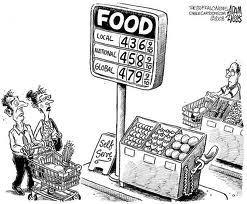
Move over, energy costs … Here come higher food prices.

Higher food prices like higher energy pricesIf it seems as if food prices have been increasing at a faster clip in recent months, you’re not dreaming.

Despite an overall inflation rate that seems low (although the federal government’s controversial exclusion of certain key components like gasoline makes its stats suspicious at best), we now have solid evidence that worldwide food cost increases are happening across the board.

Here’s a list of some of the most dramatic cost increases for key foodstuffs recorded since May 2010:

 Coconut oil: +134%
 Corn/maize: +111%
 Wheat: +75%
 Coffee: +70%
 Sugar: +55%
 Soybeans: +45%
 Palm oil: +42%
 Orange juice: +35%
 Beef and pork: +20%

Considering that this represents a time period of just a little over a year, these increases are some the largest recorded in decades.

What caused it to happen? Poor weather and bad harvests are two of the reasons. But high demand from developing countries – particularly China – is another important factor.

“This is a pretty sustainable increase … A number of factors have been building over time in terms of the commodity increase: world economic growth, rising crude oil prices, increased Chinese import demand have all conspired,” is how Bill Lapp, president of commodity analytical company Advanced Economic Solutions, puts it.

Unfortunately, the problem promises to persist, since many of the items above are ingredients that go into other prepared food items. Initially, packaged food makers that had locked in purchases for some items over certain time periods were able to delay delay passing on cost increases because of those hedges. But the bulk of those contracts have run their course by now.

So, even if commodity prices don’t go any higher, we’re likely to see the ripple effects in pass-along price increases all throughout the “food chain” in the months to come.

This isn’t news anyone wants to hear, considering how fragile (non-existent?) the economic recovery is here in the U.S. and in many other countries as well.

The sober truth is, high food costs coupled with increased energy prices have a chokehold on the world economy that is more consequential than many would care to admit.

Fasten your seatbelts, folks. We may be in for yet another wild ride on the economic roller-coaster …

The Twitter Machine: Keeping Hype Alive

Americans' Twitter usage isn't getting anywhere near Facebook'sI’ve blogged before about Twitter’s seeming inability to break out of its “niche” position in communications. We now have enough time under our belt with Twitter to begin to draw some conclusions rather than simply engage in speculation.

Endlessly hyped (although sometimes correctly labeled as a revolutionary communications tool – see the North African freedom movements) the fact is that Twitter hasn’t been adopted by the masses like we’ve witnessed with Facebook.

The Pew Research Center’s Internet & American Life Project estimates that fewer than 10% of American adults who are online are Twitter users. That equates to about 15 million Americans, which is vastly lower than Twitter’s own claims of ~65 million users.

But whether you choose to believe the 15 million or the 65 million figure, it’s a far cry from the 150+ million Americans who are on Facebook – which represents about half of the entire American population.

You can find a big reason for Pew’s discrepancy by snooping around on Twitter a bit. It won’t take you long to find countless Twitter accounts that are bereft of any tweet activity at all. People may have set their acount up at one time, but long ago lost interest in using the platform – if indeed they ever had any real Twitter zeal beyond “follow-the-leader.” (“Everybody’s going on Twitter … shouldn’t I sign up, too?”)

This is the purest essence of hype: generating a flurry of interest that quickly dissipates as the true value (or lack thereof) is discerned by users.

Of course, Twitter does have its place. Some brands find the platform to be a good venue for announcing new products and sales deals. And it doesn’t take long for the best of those deals promoted on Twitter to leech their way into the rest of the online world.

Other companies – although far fewer – are using Twitter as a kind of customer service discussion board.

And as we all know, celebrities l-o-v-e their Twitter accounts. What a great, easy way to generate an endless stream of sound-bite information about their favorite topic: themselves.

Analyses of active Twitter accounts have shown that a sizable chunk of the activity is made up of media properties and brands tweeting each other … a lot of inside-the-park baseball.

What’s missing from the equation is the level of “real people” engagement one can find on Facebook in abundance … and maybe soon on Google+ as well. That’s real social interaction – in spades.

Actually, you mightn’t be too far off the mark if you deduced that Twitter is the digital equivalent of a bunch of industry insiders at a cocktail party … saying little of real importance while trying to appear “impressive” and “hip” at the same time.

But who’s being fooled by that?

Home Ownership as an Investment Comes Under Fire

Home ownership isn't quite the financial investment many think it is.
Home ownership as a foolproof way to financial well-being? Think again.
Here’s an interesting statistic: Market observers including Deloitte and Oxford Economics estimate that there are ~10.5 million households in the United States that have a net worth of $1 million or more. (The number is calculated including the primary home.)

I for one was a bit surprised by the number, figuring it might be higher.

But here’s another interesting number – and one that explains a lot: There were ~12.7 million such “millionaire households” in America back in 2006.

The difference? Housing property values, of course. They’ve declined by ~15% since 2006 … which makes it little surprise that the number of millionaire households in the country has dropped by a similar percentage.

Over past several years we’ve witnessed millions of homeowners become upside down in their home mortgages. For this reason alone, it would be nice if more people’s net worth wasn’t so tied up in houses.

It’s as if we’re all farmers, the ultimate “land poor” demographic group.

Many people have an aversion to other types of investment, pointing to a stock market that has seen little net upward movement over the past decade. Others simply prefer a solid asset like owning property – or maybe gold.

But if the past few years have taught us anything, it’s that home ownership isn’t always the road to financial well-being.

In fact, real estate specialist and Wall Street Journal editor David Crook wrote an article recently (“Why Your Home Isn’t the Investment You Think It Is“) which spells out a pretty convincing argument that home ownership doesn’t work as the best investment vehicle.

And that’s not just by looking over the past few years … but over the past several decades.

It’s a thought-provoking article that’s well worth a read.

What do consumers think of America’s corporations?

Corporate Trust ... Corporate ReputationWith the budget negotiations in full swing – and high dudgeon – on Capital Hill, naturally the public’s critical eye is trained on our political figures. And Congress is most assuredly taking a beating in the political polls, with approval ratings plunging astonishly below the 20% figure.

[Of course, is that really so surprising? After all, Congress is pretty evenly matched between the two parties … so partisans see much to criticize on both sides.]

The focus of attention on Washington has taken the spotlight off of corporate America – at least in terms of media attention. But that doesn’t mean that “John Q. Public” is giving companies much of a break.

I’ve blogged before about corporate reputations — most recently commenting on a field survey conducted early this year by Harris Interactive that measured the appeal of 60 of the “most visible” American corporate brands. That survey showed an uptick in positive opinions about those firms when compared to prior-year results.

But a May 2011 survey by GfK Custom Research North America shows otherwise. The findings from GfK’s online field survey of ~1,000 U.S. consumers include this doozy: Two-thirds of respondents believe that it’s harder today for American companies to be trusted than it was three years ago.

Furthermore, ~55% say it will be harder for companies to gain their trust in the years to come.

What’s bothering people about U.S. corporations? In order of significance, here are the key concerns:

 The perception that CEOs and other senior executives of corporations are overpaid.

 Corruption in senior management circles.

 Companies make up lost earnings at the expense of their customers.

 More products than ever are being manufactured overseas.

Interestingly, there’s less concern about declining product or service quality as a reason for lower levels of trust. And as has been found in other studies, the public’s view of technology companies is somewhat higher than its trust for companies in other industry segments.

But back to the rather grim overall findings … fewer than one in five survey respondents anticipate that corporate corruption will become better over time – a result that’s substantially lower than what was found in similar field research conducted by GfK a few years ago.

This survey underscores the fact that corporate America has a long way to go to change the sharply negative impressions consumers have of the world of business. Clearly, the financial crisis of 2008 continues to extend its long shadow more than two years later.

And it looms over everyone – public and private sector alike.

This helps explain the generally sour mood people are in these days.

Celebrating American Pioneers of Industrial Design

USPS Pioneers of American Industrial Design Postage Stamp Set

Russel Wright American Modern dinnerware: Water Pitchers
Russel Wright American Modern dinnerware: Water pitchers from outer space.
The U.S. Postal Service has just issued its newest series of commemorative stamps, and it’s a marvelous set. Instead of honoring yet another crop of political leaders, sports figures or performing arts stars, these postage stamps commemorate 12 American pioneers of industrial design.

Names like Norman Bel Geddes, Gilbert Rohde, Russel Wright and Dave Chapman may not be known to many people today, but they were among a rarefied group of forward thinkers who revolutionized the way we think about design.

In part a reaction against the delicate fussiness of the beaux arts and art nouveau styles, these visionaries sought simplicity in form, celebrating the “utilitarian” aspects of the products they designed while eschewing any purely decorative elements.

From the clock radios of Norman Bel Geddes to the rotary telephone of Henry Dreyfuss, these designs placed “function” front and center. And they were indeed eyebrow-raising – in some cases shocking – to American consumers of the 1940s and 1950s.

But unlike the often ugly, relentlessly boring steel-and-glass boxes that came to symbolize modern architectural style, the items these industrial designers created possessed a style and elegance all their own – and many went on to become icons of design in their respective product categories.

In my youth, our household was one of many that owned a set of American Modern dinnerware, designed by Russel Wright and manufactured by Steubenville Pottery. These dishes were the epitome of “functional simplicity” – used and abused in kitchens and dining rooms during the 1940s, 1950s and 1960s.

And yet, despite all of their simplicity, they had a style that was so distinct, no one who lived with them could ever forget them. “Vegetable bowls from outer space,” a friend of mine remarked once.

But Russel Wright and his fellow designers were doing far more than just paring down to the essentials; they aimed to simplify daily life itself. As a parallel to designing tableware, furniture and decorative objects, Russel Wright and his wife, Mary Wright, published a book titled The Guide to Easier Living.

Aiming to sweep away the last vestiges of the “old order,” when the well-heeled and bourgeois alike relied on “the help” to carry out elaborate dinner parties and other social functions, this book was a veritable how-to guide for the modern 1950s family.

How to organize and decorate the home … how to go about daily living … how to entertain without all of the fussy trappings: This and more were spelled out in suggestions and step-by-step instructions.

Originally published in 1950, the book was an instant success. Amazingly, it would be re-released in 2003 in its original form – without any editorial updates or adjustments – its content remaining surprisingly up-to-date.

The same timeless quality characterizes the work of the other 11 industrial designers featured in the USPS commemorative postage stamp series as well. Time and time again, people have returned to the work of these designers for inspiration.

Indeed, some of today’s most talked-about products, such as Target’s Michael Graves series of teapots or the new Dyson line of bladeless fans, trace their design inspiration straight back to the work of these pioneers – revolutionary in their day, but true classics now.