Tripping the E-Mail Spam Alarm

Today, it’s more than just the “usual suspect” keywords that are landing e-mails in the junk folder.

se-mMost of us are aware of the kinds of words that trip spam alarms and cause e-mails to be sent straight to the junk folder – or not to be delivered at all.

How about these for starters:

  • Cash
  • Congratulations
  • Discount
  • Free
  • Income
  • Make Money
  • Urgent
  • Viagra
  • $$ / $$$

But research done by MailJet, an international e-mail service provider, looked at more than 14 billion e-mail communiqués and found that a bunch of other keywords are setting off alarm bells nearly as often as terms like “Urgent” or “Viagra.”

… Especially when considering the business categories that are so active in e-mail communications — retail goods, pharmaceuticals, providers of personal services, and the like.

Some of the other terms MailJet has found to be nearly as “toxic” are these:

  • bdcstDear Friend
  • FedEx
  • Increase Sales
  • Increase Traffic
  • Internet Marketing
  • Invoice
  • Lead Generation
  • Lose Weight
  • Marketing Solutions
  • Online Degree
  • Online Pharmacy
  • Order
  • PayPal
  • Search Engine Optimization
  • Sign Up
  • Trial Offer
  • Visa/Mastercard
  • Winning

… And there are more, of course – including various permutations of the words and phrases above.

The inevitable conclusion:  It’s becoming more difficult all the time to use the most common phrases in “subject” lines and “from” lines that’ll land your e-mail in someone’s inbox successfully.

And getting into the inbox just the first step, of course.  The next is motivating the recipient to actually open your e-mail and engage with it, which are additional hurdles in themselves.

What words or phrases have you found to be surprisingly problematic in getting your e-mails delivered to your customers’ inboxes?  How have you dealt with it?  Please share your experiences with other readers here.

Google and the multi-billion dollar pay-per-click money tree.

moneyIt’s no secret that Google has been trying to diversify its revenue stream away from clickthrough advertising, which historically has accounted for the overwhelming majority of its income.

How else to explain Google’s shopping spree over the past decade, scooping up a veritable smorgasbord of industry players like these:

  • AdMob (mobile)
  • Adometry (attribution)
  • Channel Intelligence (product feeds)
  • DoubleClick (display)
  • Invite Media (programmatic creative and media buying)
  • Teracent (programmatic creative and media buying)
  • YouTube (video)
  • Wildfire (social)

So the next question is, “How much have these acquisitions and investments done to diversify Google’s sources of revenue?”

The answer:  Hardly anything.

Consider this statistic:  In 2011, nearly all of Google’s revenue came from online pay-per-click advertising, as reported by SEO firm WordStream.

Now let’s look at 2014 figures:  WordStream reports that the percentage of Google revenues from pay-per-click advertising is actually higher than in 2011, at 97%.

So much for the “diversifying effects of diversity.”

Within PPC advertising, a number of keyword terms are continuing to haul in the big bucks for Google.  A few years back, the priciest keyword term of all was mesothelioma, at more than $100 a click.

Mesothelioma continues to attract a lot of ad dollars, but it’s no longer commanding $100 a pop as it once did.  In fact, it’s no longer on the Top 10 most expensive keywords list.

That list looks like this now (in descending order of bid pricing, starting at over $50 per click and dropping to “only” around $45 for the #10 keyword):

  • Insurance
  • Loans
  • Mortgage
  • Attorney
  • Credit
  • Lawyer
  • Donate
  • Degree
  • Hosting
  • Claim

In developing the ranking, WordStream determined which keywords reside in the stratosphere by compiling data from its own large keyword dataset and the Google Keyword Tool (over a 90-day period) to determine the 10,000 most expensive keywords.

These were then organized into categories like “credit” and “insurance” by weighting the number of keywords in each category, estimating the monthly search volume as well as the average cost-per-click for each keyword.

Notice the preponderance of financial and legal terms – both of them key to sectors that attract and manage a ton of money.

The word degree is right up there, too, underscoring how important the educational complex has become to the ad business.

It must be pretty unappealing to be active in these industries and have to pony up such big dollars to participate in the pay-per-click advertising space.  But how else do we think Google racks up annual advertising revenues that are north of $32 billion?

How does the market sort out which keywords are worthy of commanding $40 or $50 per click?  Essentially, it boils down to this:  Invariably, the most expensive niches paying for the most costly keywords are ones with very high lifetime customer value – where the customer pay-off is high.

Think about it:  The amount of money an insurance company gets from an individual signing up for coverage makes the high cost-per-click rates – even at $50 a pop — worth it.

Business observers point to long-range trends that may make search engine marketing increasingly irrelevant as the growth of multichannel, multi-device marketing picks up steam.

But don’t hold your breath; Google will likely be earning billions off of pay-per-click advertising for years to come.

So Many Marketing Channels … So Many Vendors …

Managing multiple vendors has become nearly a full-time job for some marketers.

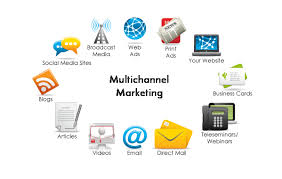
marketing channelsManaging channel communications isn’t very easy for marketers these days, that’s for sure.  It’s because so many companies are using multiple outbound channels to connect with their customers.

Illustrating this point, at the Direct Marketing Association’s 2014 annual conference, some 250 marketers were surveyed by Yes Lifecycle Marketing about their activities.

The results of that survey revealed that more than half of the marketers are using at least six outbound channels to connect with customers.  And another 20% use more than ten channels.

Guess what this means?  Nearly 30% of these marketers report that they’re managing (or more likely juggling) seven or more technology vendors and service providers as part of their MarComm duties.

More to the point, many marketers are devoting huge chunks of their week just coordinating all of these tech and service providers.

For an unlucky ~20% of the respondents, the time commitment is upwards of 15 hours each week – more than a third of the time that makes up a 40-hour week.  (“What’s a 40-hour week in marketing?” one might ask, of course.)

Even for marketers who are using a smaller number of vendors to support their media and communications channel efforts, the involvement of various internal stakeholders is high – more than seven, on average, during the vendor selection process.  So the coordination responsibilities just keep adding up.

What this means … 

The Yes Lifecycle Marketing Survey found a correlation between the “choreography” demands of managing multiple vendors and the fact that other marketing activities suffer as a result — namely, market strategizing, business operations and customer relationship-building.

And even with those duties getting shorter shrift, the marketers surveyed still complained about having too many vendors to coordinate … significant challenges with properly integrating the various functions … insufficient budgets … and above all, a lack of adequate staffing.

To top it off, the typical tenure of a Chief Marketing Officer at a company isn’t exactly lengthy — ~45 months at last count.  It’s enough to make one wonder if a job in marketing is worth it.

The answer to that question can be summed up this way (with credit to Oscar Wilde and apologies for the riff):  “The only thing worse than being busy is … not being busy.”

What’s the Latest Forecast on U.S. Ad Spending?

ad forecastingMost observers agree that 2015 will be a decent-or-better year for ad spending.  But how will it break down by media segment?

Industry and market forecasting firm Strategy Analytics has just released its latest U.S. advertising spend forecast, which it expects to total almost $190 billion.  That’s about a 3% increase over 2014.

But there are wide variations in the growth expectations depending on the media type.

Digital advertising leads the pack, with an expected growth increase in double digits, while at the other end of the scale, print advertising is forecast to drop by approximately 8%:

  • Digital advertising: 13.0% increase in 2015 U.S. ad spend
  • Outdoor advertising: +4.8%
  • Cinema advertising: +3.4%
  • Radio advertising: +1.8%
  • TV advertising: +1.7%
  • Print advertising: -7.9%

Of course, “digital advertising” is a broad category, and within it Strategy Analytics expects certain sub-categories to grow at a faster clip:  Social media advertising looks to be the star in 2015 (+31%), followed by video advertising (+29%) and mobile advertising (+20%).

Even with these lucrative growth expectations, search advertising (SEM) will continue to represent the lion’s share of digital ad revenues – around 45%.

Also, despite the dramatic growth of digital, the segment isn’t expected to break 30% of all U.S. advertising in 2015.  The more traditional TV ad segment continues to lead all others, although it has fallen below the 50% share of all advertising in recent years.

Here’s what Strategy Analytics is forecasting for ad expenditures by media segment for 2015:

  • TV advertising: ~$79 billion in 2015 U.S. ad spending
  • Digital advertising: ~$53 billion
  • Print advertising: ~$28 billion
  • Radio advertising: ~$18 billion
  • Outdoor advertising: ~$9 billion
  • Cinema advertising: ~$1 billion

Strategy AnalyticsLeika Kawasaki, a digital media analyst and one of the Strategy Analytics Advertising Forecast report’s co-authors, notes that  looking ahead to 2018, TV’s share of advertising revenue is expected to fall further to ~40%, while digital advertising’s share will reach ~35%.

However, it’s not that TV’s volume will be declining — it’s more that digital will be robbing more funds from other segments (particularly radio and print).

Additional details on the 2015 forecast can be viewed here — if you wish to shell out $7,000 for the report, that is.

Is Mobile Fraud Getting Set to Balloon?

mobileMobile commerce is the latest big development in e-commerce.  So it’s not surprising that nearly all companies engaged in e-commerce expect their mobile sales revenues to grow significantly over the next three to five years.

In fact, a new survey of ~250 such organizations conducted by IT services firm J. Gold Associates, Inc. finds that half of them anticipate their mobile revenue growth to be between 10% and 50% over the next three years.

Another 30% of the companies surveyed expect even bigger growth:  between 50% and 100% over the period.

So … how could there be any sort of negative aspect to this news?

One word:  Fraud.

Fraud in e-commerce is already with us, of course.  For mobile purchases made now, a third of the organizations surveyed by Gold Associates reported that fraud losses account for about 5% of their total mobile-generated revenues.

For an unlucky 15% of respondents, fraud makes up around 10% of their mobile revenues.

And for an even more miserable 15%, the fraud losses are a whopping 25% of their total mobile revenues.

Risk management firm LexisNexis Risk Solutions has also been crunching the numbers on e-commerce fraud.  It’s found that mobile fraud grew at a 70% rate between 2013 and 2014.

That’s a disproportionately high rate, as it turns out, because mobile commerce makes up ~21% of all fraudulent transactions tracked by LexisNexis, even though mobile makes up only ~14% of all e-commerce transactions.

The propensity for fraud to happen in mobile commerce is likely related to the dynamics of mobile communications.  Unlike desktops, laptops and tablets, “throwaway” phone devices are a fact of life, as are the plethora of carriers — some of them distinctly less reputable than others.

fraudsterConsidering the growth trajectory of mobile e-commerce, doubtless there will be efforts to rein in the incidence of fraud – particularly via analyzing the composition and source of cellphone data.

Some of the data attributes that are and will continue to be the subject of real-time scrutiny include the following “red flags”:

>   A phone number being assigned to non-contracted carrier instead of a contracted one means the propensity for fraud is higher. 

>   Mobile traffic derived from subprime offers could be a fraud breeding-ground. 

>   Multiple cellphones (five or more) associated with the same physical address can be a strong indicator of throwaway phones and fraudulent activity. 

The question is whether this degree of monitoring will be sufficient to keep the incidence of mobile fraud from “exploding” – to use Gold Associates’ dramatic adjective.

I think the jury’s out on that one … but what do you think?

Social media and marketing: Is the honeymoon over?

social mediaIt’s no secret that companies large and small have been putting significant energy into social media marketing and networking in recent years.

It’s happened for a variety of reasons – not least as a defensive strategy to keep from losing out over competitors who might be quicker to adopt social media strategies and leverage them for their business.

And yet …

Now that the businesses have a good half-decade of social media marketing under their belt, it’s pretty safe to say that social tactics aren’t very meaningful sales drivers.

That’s not just me talking.  It’s also Forrester Research, which as far back as 2011 and 2012 concluded this after analyzing the primary sales drivers for e-commerce.  Forrester found that less than 1% was driven by social media.

And in subsequent years, it’s gotten no better.

A case in point:  IBM Smarter Commerce, which tracks sales generated by 500 leading retail sites, has reported that Facebook, LinkedIn, YouTube and Twitter combined represent less than 0.5% of the sales generated on Black Friday in the United States.

Those dismal results aren’t to say that social media doesn’t have its benefits.  Generating “buzz” and building social influence certainly have their place and value.

But considering what some businesses have put into social media in terms of their MarComm resources, a channel that contributes less than 1% of sales revenues seems like a pretty paltry result – and very likely a negative ROI, too.

Going forward, it would seem that more companies should pursue social media marketing less out of a fear of losing out to competitors, and more based on whether it proves itself as an effective marketing tactic for them.

Consider the points listed below.  They’ve been true all along, but they’re becoming even more apparent with the passage of time:

1.  Buying “likes” isn’t worth much beyond the most basic tactical “bragging rights” aspects, because “likes” have little intrinsic value and can’t be tied directly to an increased revenue stream.

2.  A great social media presence doesn’t trump having good products and service; even dynamite social media can’t camouflage shortcomings of this kind for long.

3.  Audiences tend to “discount” the value of content that comes directly from a company.  This means publishing compelling content that clears that hurdle requires more skill and expertise than many companies have been willing to allocate to social media content creation.

Calibrating the way they look at social media is the first step companies can take to establish the correct balance between social media marketing activities and expected results.  Instead of treating social media as the connection with customers, view it as a tool to connect with customers.

It’s really just a new link in the same chain of engagement that successful companies have forged with their customers for decades.  In working with my clients, I’ve seen this scenario play out the same basic way time and again; it matters very little what type of business or markets they serve.

What about you?  Have your social media experiences been similar to this — or different?  I welcome hearing your perspectives.

Online user reviews: People trust their own motives for posting … but not others’.

user reviewsOne of the most important uses of the web today is for people to seek out user reviews of products and services before they buy.

Research shows that people place a high value on these user reviews, and they are more likely to influence purchase decisions than brand advertising and other forms of promotion.

The famous 90-9-1 rule — of every 100 people, 1 creates content, 9 respond to created content and 90 simply are just lurkers — may no longer be accurate.  But even if the rule still holds, that still means quite a few people are engaging in the practice of posting customer reviews and comments.

For most people who post reviews, their reasons for doing so are positive, if the results from a recent YouGov survey of U.S. consumers are any guide.  The research was conducted in November 2014 among American respondents age 18 or older.

When asked why they post consumer reviews online, the survey respondents cited the following reasons:

  • To help other people make better purchase decisions: ~62% cited as a reason why they post
  • It’s polite to leave feedback: ~35% of respondents cited
  • It’s a way to share a positive experience: ~27%
  • To make sure good vendors get more business: ~25%
  • To warn others about a bad experience: ~13%
  • To expose bad vendors: ~12%

Interestingly, the older the age of reviewers, the more likely it is that they upload reviews for the reasons listed above:  Respondents age 55 or older cited all but one of the six reasons in greater percentages than the average for all age groups.

What about the flip side of the equation?  Do those who post feel that others are posting reviews for the same reason?

thumbs up and downThat’s where the picture gets a bit murkier.  It appears that those who post do so for positive reasons … but they don’t necessarily think others are posting for similarly positive purposes.

In fact, about two-thirds of the survey respondents felt that some reviews are written by people who haven’t actually purchased the product or service.

A large portion — 80% — think that businesses write positive online review about themselves.

And nearly 70% believe that businesses post negative feedback about competitors’ products.

So it’s interesting:  People see themselves participating in online ratings and reviews for the right reasons, yet they suspect that other posters may not be playing fairly — or maybe even gaming the system.

It’s an indication that while user reviews are welcomed in practice, there are also nagging doubts about the veracity of what people are reading.

Still, surveys find that many consumers cast those doubts to the side, and continue to read user reviews and be influenced by them.

The 2015 Marketing Buzz-Meter Kicks into Gear

We’re only a few weeks into 2015, and already the marketing buzz-meter is operating at full force.

amplificationThe latest marketing buzz phrases are always interesting because, while they surely relate to trends and tactics that are taking on greater importance, they can also be short-hand references that “everyone” uses but “no one” really understands.

Consider one popular buzz-phrase example from 2014:  “Big Data.”

I don’t think I’ve heard the same definition of what “big data” is from any two people.  Yet it’s a term that was bandied about throughout the entire year.

No doubt, “big data” will continue to be a popular buzz phrase in 2015 as well.  But you can be sure it’ll be joined by a number of others.  As Natasha Smith, editor of Direct Marketing News magazine reports, get ready to hear many of mentions of these buzz terms as well this year:

Dark Social:

This references online content, information or traffic that’s hard to measure because it occurs in messaging apps, chat and e-mail communications.  Purportedly first coined by Atlantic magazine, it’s a term whose very name conjures up all sorts of mysterious and vaguely sinister connotations about behaviors that are at work below the surface – thereby making it an irresistible phrase for some people to use.

Viewability:

This term is becoming increasingly popular due to people’s concerns that much of what makes up “viewed” online content turns out to be hardly that.  For instance, there’s a difference between a simple video impression (merely an open) and a “viewable” one (opened and staying open for at least a few seconds).

More than likely, over the coming year the Interactive Advertising Bureau and other “great experts” will be debating over what actually constitutes a “viewable” impression.  All the while, you can be sure that marketers will be referencing the term with abandon.

Attention Metrics:

Dovetailing “viewability” is the idea that traditional online marketing metrics such as unique visitors, clickthroughs, and page views are too shallow in that they don’t really measure the true consumption of content.

Enter the buzz term “attention metrics.”  No doubt, marketers will be all over this one in 2015 as they focus more on the time and attention people are spending with content, not merely the fact that some form of engagement happened.

The Internet of Things:

This term started appearing on the radar screen in 2014 but is really coming into its own now.  It even has its own Wikipedia page entry.  While the commercialization of data-collecting devices such as wearable sensors and sensors embedded in appliances and other electronics is an undeniably significant development, this term has to be one of the most pretentious-sounding phrases ever coined.

… Which makes it an irresistible entry in the buzz-meter lexicon, of course.

Conscious Capitalism:

Rounding out the 2015 list – at least for now – is a buzz phrase that captures the essence of what every socially aware marketer wishes his or her company to be.  “Conscious capitalism” refers to companies and brands that are purportedly socially responsible and “in sync” with the needs of the community and the world.

This is considered important because so much survey research shows that people respond positively to companies that “do well by doing good.”

what's all the buzz aboutExpect many people to embrace this approach – and the accompanying buzz phrase – because it sounds so perfect.

[Never mind that things often come crashing down to earth if and when consumers are asked to pay more for the “socially responsible” products and services, or to make unpleasant or unexpected adjustments to their routine in the event.]

Do you have any other examples of marketing buzz terms that you think are poised for stardom (or notoriety) in 2015?  Please share your thoughts with other readers here.

Google Comes Clean on Ad Viewability (or Non-Viewability?)

clear view or no clear viewThere have been quite a few reports in recent times pointing to the lack of viewability of online display advertising, and I’ve blogged about this topic before.

And now, we have the $55-billion “advertising vacuum-cleaner company” Google itself admitting as much.

It comes in a study that Google has just released.  The report presents findings from its analysis of display ad programs using its “active view” technology (like DoubleClick) to determine which factors are affecting the viewability of ads.

The results aren’t pretty; more on that below.

But first … why is Google doing this?

I suspect it’s because more advertisers are now insisting on paying only for their ads that have been actually viewed, as compared to those simply served.

Now, to what Google is reporting.  It turns out that fewer than half of all ad impressions served on Google’s display platforms are ever seen, because they’re served outside of the viewer’s browser window.

That is correct:  A huge chunk of Google’s billions in ad revenues that it collects come from ads that no one ever saw.

What digital advertising platforms love to remind us is that their programs are superior to “bad old television and radio advertising” because of their sophisticated targeting capabilities and their superior measurement metrics.

That may be.  But how is it all that different for TV viewers to miss an ad because they took a kitchen or bathroom break, compared to people who never even had the opportunity to see an ad that was “served” in a dead zone?

The next question is, “What can advertisers do to help minimize the incidence of phantom online advertising?”

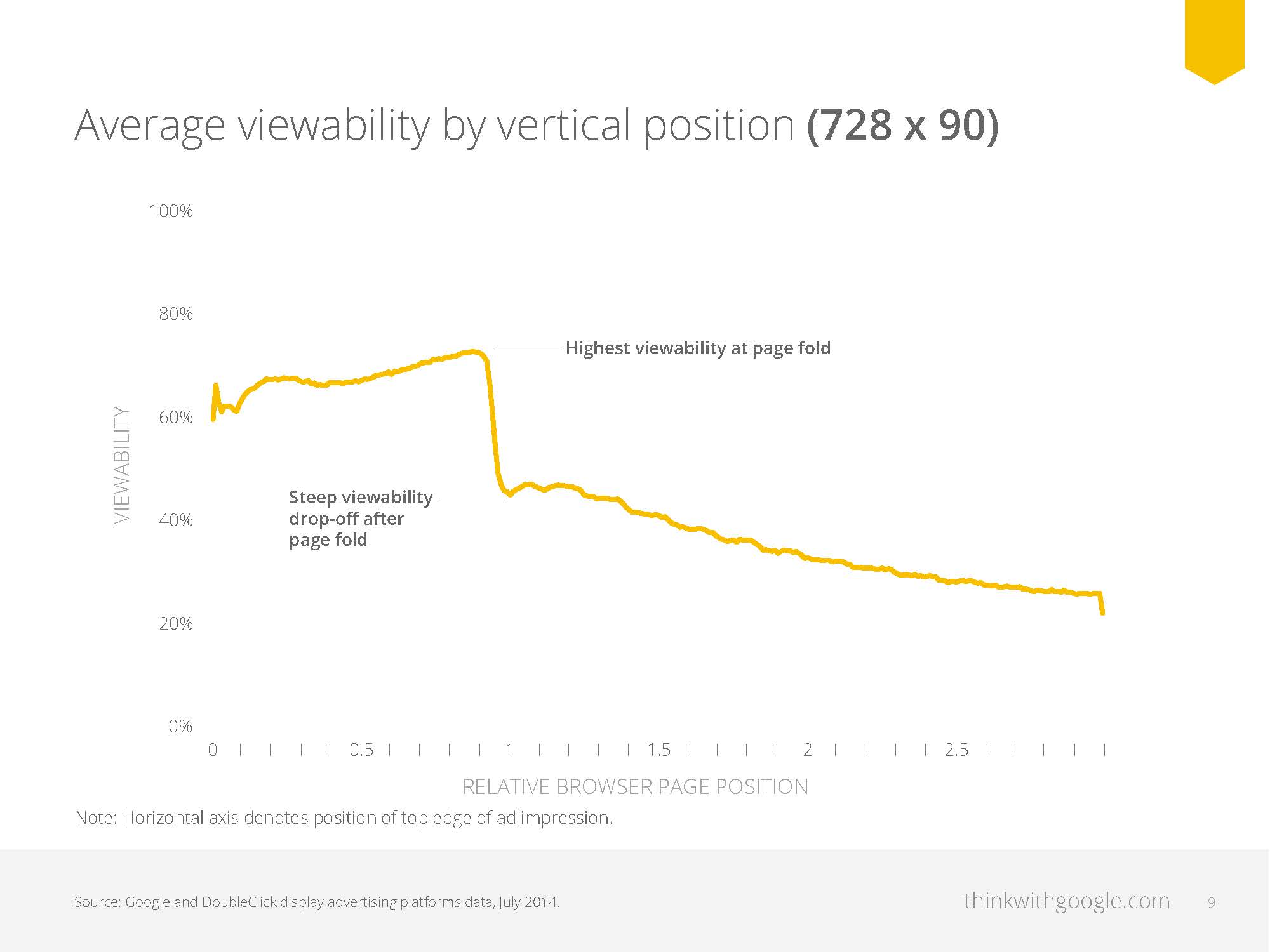
Helpfully, Google provides some clues in its report.  For instance, the highest viewability for ads is immediately above the “fold” – in other words, at the point where the viewer must begin to scroll down to see the rest of the page.

Surprisingly, viewability right above the fold is slightly higher than at the very top of the page.  But it’s massively less so just below that magic spot.  Google pressented five charts in its report to illustrate this drop-off phenomenon; the one reproduced below shows viewability of vertical position ads sized 728 x 90 pixels:

Average viewability by vertical position on online ads


Less surprising, perhaps, is the fact that vertical ads have higher viewability than horizontal or block ads, for the simple reason that they stay on the page longer:

Most viewable online display ad sizes


By publishing this data, Google purports to want to help their advertisers understand high- and low-value inventory better so they can target their campaigns more appropriately and effectively.

Google is also encouraging publishers to strive for delivering viewability rates in excess of 50% by offering ad inventory that will perform more effectively in its respective positions.

My only question is … why has it taken Google so long to set these standards and to publicize them in the first instance?

Sure, Google’s only the middleman between publishers and their viewers.  But it’s a pivotally important one.

Company and brand positioning statements: Some laudable … some lousy … many just lame.

Positioning: The Battle for your Mind Al RiesAbout 15 years ago a book was published titled Positioning:  The Battle for Your Mind, authored by Al Ries and Jack Trout.

Although the examples cited by the writers are a little outdated by now, the book remains an important contribution to the literature on the subject of brand positioning and what it takes for a company to build, strengthen and protect it.

Unfortunately, too few companies are paying heed to some of the basic tenets of proper positioning.

Indeed, based on the way many businesses approach their positioning — and the typical positioning statements one encounters — it seems less like a battle for someone’s mind and an exercise in mind-numbing irrelevance, instead.

Here’s a positioning statement I came across recently, from a firm my own industry (MarComm).  I’m shielding the name of the company to be charitable.  But tell me if this isn’t just dreadful:

“[Company X] is a creative marketing communications firm that delivers fresh ideas and authentic solutions that drive measurable business results. 

Our strategic, problem-solving approach generates marketing and communications programs that increase brand awareness, improve sales productivity, increase marketing response, drive revenues and support business goals. 

We plan and implement creative solutions that leverage our clear insight, strategic business skills, team building, proven process, distinctive design and measurement methodology.

… and so on.  (It continues for another two paragraphs.)

The big problem is that there’s little being said that’s either informative or differentiating.

Worse yet, enveloping a wholly indistinctive positioning statement with a bunch of forgettable adjectives, mealy-mouthed platitudes and other “weasel words” just makes things worse.

To my view, when it comes to company positioning, directness and simplicity is always the better route.

For starters, go for facts.  If a company offers what many others also do, that’s no indictment of the business.  It’s fruitless to try to communicate “uniqueness” where there is none, because people won’t be fooled for long anyway.

brand positioningCut the “marketing buzz-speak,” too.  People hear those overused terms as mere noise.  And noise is irritating.

If there is demonstrated singular competence in one or more areas, it’s OK to tout that, of course.  But throttle back on the hype and leave it to the audience to draw its own conclusions.

Speaking personally, when I read a company’s positioning statement, I’m looking for the quintessential “elevator speech” that covers the “Five Ws” as succinctly as possible.

And spare the marketing fluff, please.

More than anything, going beyond “just the facts” is insulting to the readers’ intelligence.  If they want to learn more, they’ll do it on their own terms, thank you very much.

Do you know of any company positioning statements that are particularly effective?  If so, please share them here.  (On the other hand, if the ones you know are dreadful, perhaps keep those ones to yourself!)