Going up against Goliath: The latest privacy tussle with Facebook.

Is that Maria Callas?  Check with Facebook -- they'll know.
Is that Maria Callas? Check with Facebook — they’ll know.

It had to happen eventually:  Facebook’s “faceprints” database activities are now the target of a lawsuit.

The suit, which has been filed in the state of Illinois, alleges that Facebook’s use of its automatic photo-tagging capability to identify people in images is a violation of Illinois’ state law regarding biometric data.

Facebook has been compiling faceprint data since 2010, and while people may choose to opt out of having their images identified in such a way, not surprisingly, that option is buried deep within the Facebook “settings” area where most people won’t notice it.

Moreover, the “default” setting is for Facebook to apply the automatic photo-tagging feature to all users.

Carlo Licata, the lead individual in the class-action complaint filed in Illinois, contends that Facebook’s practices are in direct conflict with the Illinois Biometric Information Privacy Act.  That legislation, enacted in 2008, requires companies to obtain written authorization from persons before collecting any sort of “face geometry” or related biometric data.

The Illinois law goes further by requiring the companies gathering biometric data to notify people about the practice, as well as to publish a schedule for destroying the information.

Here’s how the lawsuit states its contention:

“Facebook doesn’t disclose its wholesale biometrics data collection practices in its privacy policies, nor does it even ask users to acknowledge them.  With millions of users in the dark about the true nature of this technology, Facebook [has] secretly amassed the world’s largest privately held database of consumer biometrics data.”

The response from Facebook has been swift – and predictable.  It contends the lawsuit is without merit.

As much as I’m all for of individual privacy, I suspect that Facebook may be correct in this particular case.

<em>Brave New World:</em>  Biometrics
Brave New World: Biometrics

For one thing, the Illinois law doesn’t reference social networks at all.  Instead, it focuses on the use of biometrics in business and security screening activities — citing examples like finger-scan technologies.

As Eric Goldman, a professor of law at Santa Clara University notes, the Illinois law is “a niche statute, enacted to solve a particular problem.  Seven years later, it’s being applied to a very different set of circumstances.”

And there’s this, too:  The Illinois law deals with people who don’t know they’re giving data to a company.  In the case of Facebook, it’s commonly understood user data is submitted with consent.

That may not be a particularly appealing notion … but it’s the price of gaining access to the fabulous networking functionality that Facebook offers its users – all at no expense to them.

And of course, millions of people have made that bargain.

That being said, there’s one nagging doubt that I’m sure more than a few people have about the situation:  The folks at Facebook now aren’t the same people who will be there in the future.  The use of faceprint information collected on people may seem quite benign today, but what about tomorrow?

The fact is, ultimately we don’t have control over what becomes the “tower of power” or who resides there.  And that’s a sobering thought, indeed.

What’s your own perspective?  Please share your thoughts with other readers here.

Is Mobile Fraud Getting Set to Balloon?

mobileMobile commerce is the latest big development in e-commerce.  So it’s not surprising that nearly all companies engaged in e-commerce expect their mobile sales revenues to grow significantly over the next three to five years.

In fact, a new survey of ~250 such organizations conducted by IT services firm J. Gold Associates, Inc. finds that half of them anticipate their mobile revenue growth to be between 10% and 50% over the next three years.

Another 30% of the companies surveyed expect even bigger growth:  between 50% and 100% over the period.

So … how could there be any sort of negative aspect to this news?

One word:  Fraud.

Fraud in e-commerce is already with us, of course.  For mobile purchases made now, a third of the organizations surveyed by Gold Associates reported that fraud losses account for about 5% of their total mobile-generated revenues.

For an unlucky 15% of respondents, fraud makes up around 10% of their mobile revenues.

And for an even more miserable 15%, the fraud losses are a whopping 25% of their total mobile revenues.

Risk management firm LexisNexis Risk Solutions has also been crunching the numbers on e-commerce fraud.  It’s found that mobile fraud grew at a 70% rate between 2013 and 2014.

That’s a disproportionately high rate, as it turns out, because mobile commerce makes up ~21% of all fraudulent transactions tracked by LexisNexis, even though mobile makes up only ~14% of all e-commerce transactions.

The propensity for fraud to happen in mobile commerce is likely related to the dynamics of mobile communications.  Unlike desktops, laptops and tablets, “throwaway” phone devices are a fact of life, as are the plethora of carriers — some of them distinctly less reputable than others.

fraudsterConsidering the growth trajectory of mobile e-commerce, doubtless there will be efforts to rein in the incidence of fraud – particularly via analyzing the composition and source of cellphone data.

Some of the data attributes that are and will continue to be the subject of real-time scrutiny include the following “red flags”:

>   A phone number being assigned to non-contracted carrier instead of a contracted one means the propensity for fraud is higher. 

>   Mobile traffic derived from subprime offers could be a fraud breeding-ground. 

>   Multiple cellphones (five or more) associated with the same physical address can be a strong indicator of throwaway phones and fraudulent activity. 

The question is whether this degree of monitoring will be sufficient to keep the incidence of mobile fraud from “exploding” – to use Gold Associates’ dramatic adjective.

I think the jury’s out on that one … but what do you think?

Social media and marketing: Is the honeymoon over?

social mediaIt’s no secret that companies large and small have been putting significant energy into social media marketing and networking in recent years.

It’s happened for a variety of reasons – not least as a defensive strategy to keep from losing out over competitors who might be quicker to adopt social media strategies and leverage them for their business.

And yet …

Now that the businesses have a good half-decade of social media marketing under their belt, it’s pretty safe to say that social tactics aren’t very meaningful sales drivers.

That’s not just me talking.  It’s also Forrester Research, which as far back as 2011 and 2012 concluded this after analyzing the primary sales drivers for e-commerce.  Forrester found that less than 1% was driven by social media.

And in subsequent years, it’s gotten no better.

A case in point:  IBM Smarter Commerce, which tracks sales generated by 500 leading retail sites, has reported that Facebook, LinkedIn, YouTube and Twitter combined represent less than 0.5% of the sales generated on Black Friday in the United States.

Those dismal results aren’t to say that social media doesn’t have its benefits.  Generating “buzz” and building social influence certainly have their place and value.

But considering what some businesses have put into social media in terms of their MarComm resources, a channel that contributes less than 1% of sales revenues seems like a pretty paltry result – and very likely a negative ROI, too.

Going forward, it would seem that more companies should pursue social media marketing less out of a fear of losing out to competitors, and more based on whether it proves itself as an effective marketing tactic for them.

Consider the points listed below.  They’ve been true all along, but they’re becoming even more apparent with the passage of time:

1.  Buying “likes” isn’t worth much beyond the most basic tactical “bragging rights” aspects, because “likes” have little intrinsic value and can’t be tied directly to an increased revenue stream.

2.  A great social media presence doesn’t trump having good products and service; even dynamite social media can’t camouflage shortcomings of this kind for long.

3.  Audiences tend to “discount” the value of content that comes directly from a company.  This means publishing compelling content that clears that hurdle requires more skill and expertise than many companies have been willing to allocate to social media content creation.

Calibrating the way they look at social media is the first step companies can take to establish the correct balance between social media marketing activities and expected results.  Instead of treating social media as the connection with customers, view it as a tool to connect with customers.

It’s really just a new link in the same chain of engagement that successful companies have forged with their customers for decades.  In working with my clients, I’ve seen this scenario play out the same basic way time and again; it matters very little what type of business or markets they serve.

What about you?  Have your social media experiences been similar to this — or different?  I welcome hearing your perspectives.

America’s small businesses: Quite bullish on 2015 … but with no thanks to the government.

Small Business Economic OutlookRecent reports on economic activity appear to show a continuation of a rather wobbly recovery of the U.S. economy since coming out of the Great Recession.

It’s a repeating pattern of one quarter of strong growth followed by the next one with weaker indices — sometimes with the stats from earlier quarters revised downward.

Still, things are still better for the U.S. economy as compared to many others around the world.

America’s small businesses appear to feel similarly about the U.S. economy.  Their perspective may be even more positive, in fact.

Illustrating this perspective, a January 2015 survey of ~850 U.S. businesses (ones that employ ten or fewer full-time or part-time workers) finds small business owners having a pretty bullish outlook on the year ahead.

In a survey conducted by web hosting company Endurance International Group (formerly Bizland), two-thirds of the respondents reported positive prospects for their businesses for 2015:

  • General business outlook is very positive: ~26% of respondents
  • Generally positive outlook: ~45%
  • Neutral outlook: ~25%
  • Negative outlook: ~5%

These findings align quite neatly with how these business owners see 2015 as compared to 2014’s performance:

  • 2015 will be positive compared to 2014: ~66% of respondents
  • 2015 will be about the same: ~29%
  • 2015 will be negative compared to 2014: ~5%

But … these positive impressions happen with no thanks to the government.  When asked if they felt that the U.S. Congress is effective in addressing the issues that are important to small businesses, a whopping 87% gave thumbs-down.

Even the changes in Congressional leadership that came about as a result of the 2014 midterm elections have done little to improve the perceptions of these business owners, as ~69% do not believe that the new leadership in Congress will be any more effective in addressing small business issues in 2015.

And what are those issues that are so important to small businesses?

They’re the usual things:  business taxes first and foremost … followed by the ability to obtain financing.

The next tier of issues includes the ability to hire workers with the appropriate skills, along with the ongoing healthcare coverage challenges.

Any other issues are basically just an asterisk at the bottom of the page …

More details on the survey results can be found here.

B-to-B Buyers: Who’s Engaging with What Content?

Different Types of ContentIn my work with manufacturing companies and other B-to-B firms, I’m often asked what type of informational content is the most worthwhile and valuable from a marketing standpoint and for attracting and converting customers.

The question is relevant for most companies because there are limits on marketing resources (both time and dollars), while the methods companies can use to communicate with their target audiences are far more extensive and varied than they were in the not-too-distant past.

The answer to the question about the best information content is always one of “degree” … because the most valuable piece of content for any single prospect or customer is the one that sparks him or her to buy.

And that one piece of critical content could be one of many things.

Helpfully, we now have a new survey that can help with a bit more quantification.  The research, which was conducted by content marketing firm Eccolo Media, surveyed technical buyers (engineers, managers and directors).

It’s a relatively small sample (fewer than 200 respondents), but the directional results are worth consideration.  I also think that the results can be applied to other B-to-B buyer types as well.

One finding that came as a bit of a surprise to me was that most buyers read just two to five pieces of content before making their decisions.

What kind of content do they consult most often?  Here’s what these respondents reported:

  • Product brochures and data sheets: ~57% consult this type of content
  • E-mail communiqués: ~52% consult
  • White papers: ~52%
  • Competitive vendor worksheets: ~42%
  • Case studies/success stories: ~42%
  • Technical guides: ~35%
  • Custom magazines/publications: ~35%
  • Video content: ~35%
  • Social media content: ~34%
  • Webinars: ~34% 

As for which of these types of content are considered the most worthwhile and influential to buyers, the ranking is somewhat different:

  • Product brochures and data sheets: ~39% rate as highly influential content (top five resources)
  • White papers: ~33%
  • Case studies/success stories: ~31%
  • Technical guides: ~23%
  • Competitive vendor worksheets: ~22%
  • Videos:  ~17%
  • E-mail communiqués: ~15% 
  • Social media content:  ~14%
  • Custom magazines/publications:  ~14%

The Eccolo Media report draws this conclusion from its research:

“Marketers have been good at producing large volumes of content, but not quality content and not the right type of content … The more content we produce, the more likely it is to fail.”

One thing the research clearlyshows is that companies need to spend more effort in collecting and publishing customer case examples and success stories, because those appear to have a disproportionately higher degree of influence over potential buyers — if only they are available to consult.

More broadly, the types of content that are of greater value to buyers tend to be the ones that require more time and effort to prepare.  The adage that “success is 20% inspiration and 80% perspiration” appears to apply to marketing content development as well.

More summary findings from Eccolo Media’s 2015 B2B Technology Content Survey Report can be accessed here.

What are your thoughts as to the relative merits of different types of content?  Whether you’re a B-to-B marketer or a B-to-B buyer, please share your thoughts with other readers here.

The 2015 Marketing Buzz-Meter Kicks into Gear

We’re only a few weeks into 2015, and already the marketing buzz-meter is operating at full force.

amplificationThe latest marketing buzz phrases are always interesting because, while they surely relate to trends and tactics that are taking on greater importance, they can also be short-hand references that “everyone” uses but “no one” really understands.

Consider one popular buzz-phrase example from 2014:  “Big Data.”

I don’t think I’ve heard the same definition of what “big data” is from any two people.  Yet it’s a term that was bandied about throughout the entire year.

No doubt, “big data” will continue to be a popular buzz phrase in 2015 as well.  But you can be sure it’ll be joined by a number of others.  As Natasha Smith, editor of Direct Marketing News magazine reports, get ready to hear many of mentions of these buzz terms as well this year:

Dark Social:

This references online content, information or traffic that’s hard to measure because it occurs in messaging apps, chat and e-mail communications.  Purportedly first coined by Atlantic magazine, it’s a term whose very name conjures up all sorts of mysterious and vaguely sinister connotations about behaviors that are at work below the surface – thereby making it an irresistible phrase for some people to use.

Viewability:

This term is becoming increasingly popular due to people’s concerns that much of what makes up “viewed” online content turns out to be hardly that.  For instance, there’s a difference between a simple video impression (merely an open) and a “viewable” one (opened and staying open for at least a few seconds).

More than likely, over the coming year the Interactive Advertising Bureau and other “great experts” will be debating over what actually constitutes a “viewable” impression.  All the while, you can be sure that marketers will be referencing the term with abandon.

Attention Metrics:

Dovetailing “viewability” is the idea that traditional online marketing metrics such as unique visitors, clickthroughs, and page views are too shallow in that they don’t really measure the true consumption of content.

Enter the buzz term “attention metrics.”  No doubt, marketers will be all over this one in 2015 as they focus more on the time and attention people are spending with content, not merely the fact that some form of engagement happened.

The Internet of Things:

This term started appearing on the radar screen in 2014 but is really coming into its own now.  It even has its own Wikipedia page entry.  While the commercialization of data-collecting devices such as wearable sensors and sensors embedded in appliances and other electronics is an undeniably significant development, this term has to be one of the most pretentious-sounding phrases ever coined.

… Which makes it an irresistible entry in the buzz-meter lexicon, of course.

Conscious Capitalism:

Rounding out the 2015 list – at least for now – is a buzz phrase that captures the essence of what every socially aware marketer wishes his or her company to be.  “Conscious capitalism” refers to companies and brands that are purportedly socially responsible and “in sync” with the needs of the community and the world.

This is considered important because so much survey research shows that people respond positively to companies that “do well by doing good.”

what's all the buzz aboutExpect many people to embrace this approach – and the accompanying buzz phrase – because it sounds so perfect.

[Never mind that things often come crashing down to earth if and when consumers are asked to pay more for the “socially responsible” products and services, or to make unpleasant or unexpected adjustments to their routine in the event.]

Do you have any other examples of marketing buzz terms that you think are poised for stardom (or notoriety) in 2015?  Please share your thoughts with other readers here.

E-mail response time expectations: “The faster the better.”

e-mail inbox managementEver since the advent of e-mail communications, there’s tended to be a feeling that correspondence sent via this mode of delivery is generally more “pressing” than correspondence delivered the old-fashioned way via postal mail.

After all, people don’t call postal mail “snail mail” for nothing.

At the same time, one would think that the proliferation of e-mail volumes and the today’s reality of groaning inboxes might be causing an adjustment of thinking.

Surely, most of the e-mail doesn’t need a quick response, does it?

If 80% or more of today’s e-mail is the equivalent of the junk mail that used to fill our inbox trays in the office in the “bad old days,” why wouldn’t we begin to think of e-mail in the same terms?

But a new survey of workers appears to throw cold water on that notion.

The survey of ~1,500 adults was conducted by MailTime, Inc., the developer of a smartphone e-mail app of the same name.  The survey found that a majority of respondents (~52%) expect a response to their work-related e-mail communiqués within 24 hours of hitting the send button.

Moreover, nearly 20% expect a response in 12 hours or less.

While the survey encompassed just users of MailTime’s app, the findings are likely not all that different for office workers as a whole.

Why is that?  I think it’s because, in recent years, the e-mail stream has become more “instant” rather than less.

Back in the early days of e-mail, I can recall that many of my work colleagues checked their e-mail inboxes three times during the day:  early in the morning, over the lunch hour, and as they were wrapping up their workday.

That’s all out the window now.  Most people have their e-mail alerts set for “instantaneous” or for every five or ten minutes.

With practices like that being so commonplace, it’s little wonder that people expect to hear a response in short order.

And if a response isn’t forthcoming, it’s only natural to think one of three things:

  • The e-mail never made it to the recipient’s inbox.
  • The recipient is on vacation, out sick, or otherwise indisposed.
  • The recipient is ignoring you.

I think there’s an additional dynamic at work, too.  In my years in business, I’ve seen e-mail evolve to becoming the “first line of contact” — even among colleagues who are situated in the same office.  Younger workers especially eschew personal interaction — and even phone contact — as modes of communication that are needlessly inefficient.

Of course, I can think of many instances where e-communications can actually contribute to inefficiencies, whereas a good, old-fashioned phone call would have cut to the chase so much more easily and quickly.

But even with that negative aspect, there’s no denying the value of having a record of communications, which e-mail automatically provides.

And here’s another thing:  MailTime estimates that around two-thirds of all e-mails are first opened on a smartphone or tablet device — so message deliverability is just as easy “on the go” as it is in the office.

It’s yet another reason why so many people expect that their communiqués will be opened and read quickly.

I agree that e-mails are easy and convenient to open and read on a mobile device.  But sometimes the response isn’t nearly so easy to generate without turning to a laptop or desktop computer.

So as a courtesy, I’ll acknowledge receipt of the message, but a “substantive” response may not be forthcoming until later.

… And then, when others don’t show a similar kind of courtesy, I think many of us notice!

Some larger companies with employees who are more geographically far-flung have actually adopted guidelines for e-mail etiquette, and they’ve applied them across every level of the company.

It seems like a good idea to get everyone’s expectations on the same page like that.

Incidentally, the preferred scenario for responding to personal e-mails isn’t really all that different from work-related expectations, even though personal communiqués aren’t usually as time-sensitive.  Respondents in the MailTime survey said that they expect to receive a response to a personal e-mail within 48 hours.  For nearly everyone, waiting a week is far too long.

Americans and the economy as 2015 begins: Caution continues.

As we’ve closed out the year 2014, more than a few people – from politicians to business leaders and business journalists – have sought to reassure us that the American economy is not only on the right track, it’s back in a big way.

Bronx CheerBut evidently, word hasn’t trickled down to “John Q. Public.”  Or if it has, it’s been greeted by a gigantic Bronx Cheer.

We have the latest evidence of this in management consulting firm McKinsey & Company’s most recent annual Consumer Sentiment Survey, which was conducted in September 2014 with results released last month.

The bottom-line on consumer sentiment is that despite the recent spate of decent economic news and higher employment figures, people are still reluctant to increase spending, and thriftiness remains the order of the day.

While people don’t think things are deteriorating … they don’t think they’re becoming much better, either.

So … treading water is about all.

It’s not too difficult to figure out why sentiment continues to be so skittish.  After all, median household income for Americans, adjusted for inflation, actually declined in recent years and hasn’t rebounded.

With people still feeling the earnings squeeze, it’s only natural that McKinsey’s findings show consumer sentiment still in the doldrums, with only ~23% feeling optimistic about America’s economy.

Consider these further findings from the research:

  • About 40% of respondents report that they are living “paycheck to paycheck”
  • Around 39% are at least somewhat worried about losing their job
  • Approximately 34% feel they have decreased ability to make ends meet financially

Not surprisingly, respondents with lower family incomes (under $75,000 per year) have higher concerns, and roughly 40% of those households report cutting back or delaying purchases as a result.

[Even among people living in households earning $150,000+ per year, one in five say that they’ve cut back or delayed purchases because of financial uncertainty.]

Activities we commonly associate with recessionary eras continue to be practiced by consumers.  According to McKinsey’s research, those practices include:

  • Looking for ways to save money (comparison shopping, coupon use, etc.): ~55 of respondents report doing so
  • Purchasing more products online to save money: ~48%
  • Cutting spending over the past year: ~40%
  • Doing more shopping at “dollar stores”: ~34%
  • No longer preferring/buying more expensive product brands over private-label substitutes: ~33%

Where things really look different “on the ground” than in the economists’ forecasts is what the public is saying about their future behaviors:  McKinsey logoMcKinsey believes that consumers and their attitudes have been permanently changed by the years of austerity.

The strongest indication of this?  Nearly 40% of the survey respondents say that they’ll likely never go back to their pre-recession approaches to buying and spending.

As McKinsey concludes in its report:  Cautious is the new normal … and it’s unlikely to change anytime soon.

More details on McKinsey’s survey findings can be viewed here.

Google Comes Clean on Ad Viewability (or Non-Viewability?)

clear view or no clear viewThere have been quite a few reports in recent times pointing to the lack of viewability of online display advertising, and I’ve blogged about this topic before.

And now, we have the $55-billion “advertising vacuum-cleaner company” Google itself admitting as much.

It comes in a study that Google has just released.  The report presents findings from its analysis of display ad programs using its “active view” technology (like DoubleClick) to determine which factors are affecting the viewability of ads.

The results aren’t pretty; more on that below.

But first … why is Google doing this?

I suspect it’s because more advertisers are now insisting on paying only for their ads that have been actually viewed, as compared to those simply served.

Now, to what Google is reporting.  It turns out that fewer than half of all ad impressions served on Google’s display platforms are ever seen, because they’re served outside of the viewer’s browser window.

That is correct:  A huge chunk of Google’s billions in ad revenues that it collects come from ads that no one ever saw.

What digital advertising platforms love to remind us is that their programs are superior to “bad old television and radio advertising” because of their sophisticated targeting capabilities and their superior measurement metrics.

That may be.  But how is it all that different for TV viewers to miss an ad because they took a kitchen or bathroom break, compared to people who never even had the opportunity to see an ad that was “served” in a dead zone?

The next question is, “What can advertisers do to help minimize the incidence of phantom online advertising?”

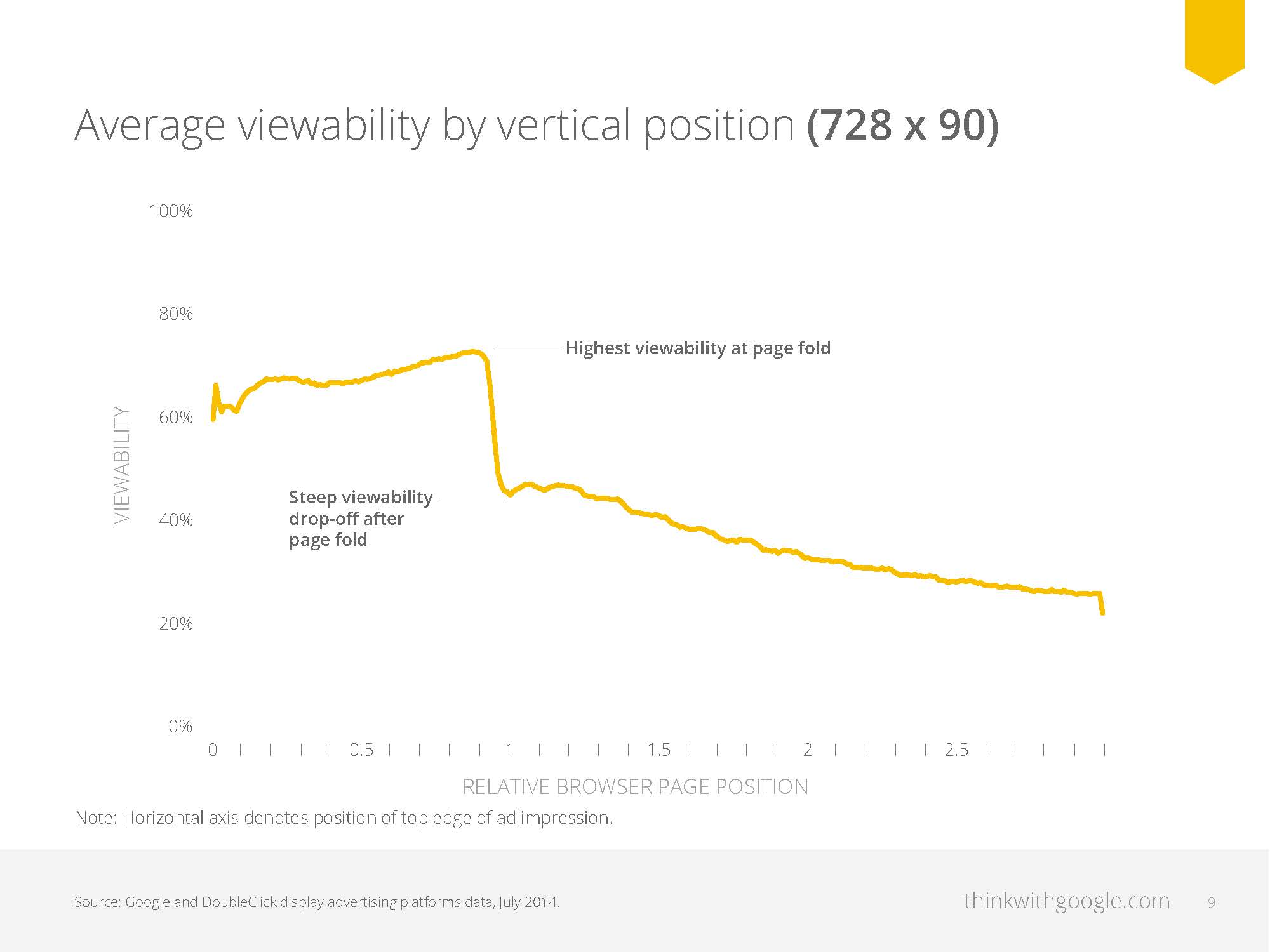
Helpfully, Google provides some clues in its report.  For instance, the highest viewability for ads is immediately above the “fold” – in other words, at the point where the viewer must begin to scroll down to see the rest of the page.

Surprisingly, viewability right above the fold is slightly higher than at the very top of the page.  But it’s massively less so just below that magic spot.  Google pressented five charts in its report to illustrate this drop-off phenomenon; the one reproduced below shows viewability of vertical position ads sized 728 x 90 pixels:

Average viewability by vertical position on online ads


Less surprising, perhaps, is the fact that vertical ads have higher viewability than horizontal or block ads, for the simple reason that they stay on the page longer:

Most viewable online display ad sizes


By publishing this data, Google purports to want to help their advertisers understand high- and low-value inventory better so they can target their campaigns more appropriately and effectively.

Google is also encouraging publishers to strive for delivering viewability rates in excess of 50% by offering ad inventory that will perform more effectively in its respective positions.

My only question is … why has it taken Google so long to set these standards and to publicize them in the first instance?

Sure, Google’s only the middleman between publishers and their viewers.  But it’s a pivotally important one.