Air, Water, Food … Internet

Fundamental importance of the InternetIs the Internet today as important to people as the very air they breathe? That’s what the results of a survey of ~2,800 college students and young professionals seem to be telling us.

Market research firm InsightExpress fielded the survey for Cisco Systems, a consumer electronics, networking, voice and communications technology/services company.

The research effort collected responses from the USA and 13 other countries in the developed world plus emerging powerhouse economies (Australia, Canada, the U.K., France, Germany, Italy, Spain, Russia, India, China, Japan, Brazil and Mexico).

What did the survey discover? More than half of the respondents said they couldn’t live without the Internet – it’s that vital to their lives.

In fact, for many the Internet is more important than dating, partying, and wheels.

Intriguing findings from the survey include:

 ~55% of college students and ~62% of young professionals believe that the Internet is such an integral part of their lives, they could not live without it.

 If forced to make a choice between access to the Internet and access to a car, ~64% of the respondents would choose having the Internet connection.

 “Virtual” relationships are gaining on face-to-face interaction. More than one quarter of the college respondents reported that staying updated on Facebook is more important to them than partying, dating, listening to music, or visiting with friends.

 Smartphones are on the cusp of eclipsing desktop computers as the most prevalent means of connecting with this segment of society … which then makes it not much of a stretch to learn that ~60% of these same young professionals feel that “having an office” is unnecessary for being competitive.

And here’s another thing: These respondents are used to constant interruptions. ~80% report being interrupted by instant messaging and social media updates at least once per hour … and over 30% reported having five or more such interruptions hourly.

To me, this sounds more like disruption than interruption.

Marie Hattar, Cisco Systems’ marketing vice president, concludes that the survey findings “should make businesses re-examine how they need to evolve in order to attract talent and shape their business models.”

She also noted that “CIOs need to plan and scale their networks now to address the security and mobility demands that the next generation workforce will put on their infrastructure … in conjunction with a proper assessment of corporate policies.”

As the survey makes clear, at the rate things are evolving, the office environment will look and feel nothing like it did just a few short years ago. And it may be the biggest single transformation in the business world we’ve yet seen.

Personalized e-mail campaigns? Nothing personal … but it’s not that important.

e-mail personalizationIt’s been a nagging question about direct marketing for years now: To what degree does personalizing a mass marketing program improve audience engagement and action?

Back in the old days, personalization was difficult to pull off, because the limitations of printing meant that the way people’s names were inserted into letters looked awkward and even jarring – different typeface, different ink concentration, etc.

Instead of creating a positive impact that suggested a personal relationship with the recipient, the effect was often just the opposite: the ill-fitting interpolations screaming “mass mailer.”

Today, with so many marketers targeting consumers electronically versus via postal mail, personalization has become a common technique used for the same purpose: to draw the reader’s attention by making the e-communiqué “unique” to him or her. Plus, it’s much easier to accomplish.

But how is this working out in the digital age? The latest e-mail marketing metrics report from email marketing and newsletter services provider MailerMailer, LLC, issued in July 2011, uses data compiled from more than 977 million opt-in e-mail newsletters in a sampling of over 1,600 customers. It found that adding the recipient’s first or last name to the subject line of an e-mail often generates negative, not positive results.

On the other hand, personalization within the message portion of the e-mail makes it a tad more likely to lead the recipient to interact with the message.

Here are the open rates MailerMailer found based on the degree of personalization:

 Subject line personalized: 4.1% open rate
 Both subject line and message personalized: 4.6% open rate
 Message personalized: 12.6% open rate
 No personalization at all: 11.4% open rate

[MailerMailer claims that personalized subject lines perform less favorably because this has been such a common tactic used by spammers in recent years. I claims the method has been so overused, recipients now associate all such e-mails as spam.]

And what about clickthrough rates — the more important metric? MailerMailer’s findings track neatly with the open rate trends, as follows:

 Subject line personalized: 0.8% clickthrough rate
 Both subject line and message personalized: 1.1% clickthrough rate
 Message personalized: 3.0% clickthrough rate
 No personalization at all: 3.0% clickthrough rate

So another thing the MailerMailer report is telling us is that the effort to personalize e-mails may not be worth it in the end. It’s true that a slightly higher open rate may occur with personalized message content … but the clickthrough rate, which is the more important metric, doesn’t budge at all with personalization versus without it.

So it would seem that personalizing e-mails isn’t something that’s going to “make or break” your direct marketing campaign’s success rate. Better to focus on the other classic success factors: the message, the offer, and the target recipients list. You know … just like always.

PR Firms at Loggerheads with Bloggerheads

PR mistakes with bloggersTime was, we could get a chuckle out of television commercials where unsuspecting consumers were surprised to find out that the restaurant coffee was really Folgers®, or the day spa’s skin moisturizer treatment for their hands was actually Palmolive® dish detergent.

There was something rather endearing about those consumer reactions – and they were uniformly positive ones as well.

But to show how far removed we are from those halcyon days, consider this recent attempt to pull a fast one on unsuspecting dinner guests at a “faux” restaurant in Midtown Manhattan: Cooked up by the Ketchum public relations unit of Omnicom Group for its client, ConAgra Foods, New York-based food bloggers and “mommy” bloggers were invited to dine at “Sotto Terra,” an underground restaurant supposedly run by Chef George Duran of TLC’s Ultimate Cake Off cable program.

But Sotto Terra, far from being the “intimate Italian restaurant” of the invitation, was nothing more than an elaborate set-up – hidden cameras and all – to get bloggers to sample ConAgra’s newest offerings in the Marie Callender’s line of frozen entrees and desserts … and presumably to extol the virtues of the cuisine.

In fact, no such restaurant even exists. Rather, it was all a staged scene in a Greenwich Village brownstone. The invitation promised a “delicious four-course meal” accompanied by Chef Duran’s “one-of-a-kind sangria” … along with a talk by famed food industry expert Phil Lempert on new taste trends in food.

The invitation also promised a “special surprise” for those who attended the dinner on one of five evenings.

The special surprise, of course, was revealing the actual provenance of the food items being served. “The twist at the end was not dissimilar to what brands like Pizza Hut and Domino’s have done in the recent past, with success,” noted Stephanie Moritz, a public relations flack at ConAgra.

The plan was to use the video footage captured at the dinners for promotional clips on ConAgra’s website and on YouTube … as well as for the bloggers who attended to generate cyber-buzz about being pleasantly surprised at the revelation.

But this is 2011, not 1981 or 1991. And bloggers are also quite different from the average consumer. Ketchum and ConAgra apparently forgot about the “90-9-1 rule” of online content: 1% create content … 9% comment on that content … and 90% simply lurk.

Not only are bloggers part of the 1%, they take their role seriously and certainly don’t appreciate being fooled. So instead of the food taking center stage, the event itself became the topic of (uniformly negative) conversation on the blogs. A few examples:

 “We discussed with the group the sad state of chemical-filled foods. And yet, you still fed me the exact thing I said I did not want to eat.” (Lon Binder, FoodMayhem Blog)

 “[I] pointed out that the reason I ate organic, fresh and good food was because my calories are very precious to me, so I want to use them wisely. Yet they were serving us a frozen meal, loaded with sodium. I’m NOT their target consumer, and they were totally off by thinking I would buy or promote their highly processed frozen goods after tricking me to taste it.” (Cindy Zhou, Chubby Chinese Girl Blog)

 “Our entire meal was a SHAM! We were unwitting participants in a bait-and-switch for Marie Callender’s new frozen three-cheese lasagna and there were cameras watching our reactions.” (Suzanne Chan, Mom Confessionals Blog)

I loved reading the PR personnel’s “spin” of the events the way they transpired: “Once we sensed it was not meeting attendees’ expectations, that’s where we stopped, we listened and we adjusted,” Stephanie Moritz remarked.

… By which she means the remaining dinner evenings were canceled.

Looking back is 20/20 hindsight, of course. But it does seem like most PR professionals could have seen this negative reaction coming from a mile away. PR agencies exist to provide not only publicity for their clients, but also counsel. Sure, the event sounds like a fun lark with a bit of a twist – and I can just picture the breathlessly animated PR brainstorming session at Ketchum that produced this idea.

But is duping bloggers and making them out to be fools the correct tactic? … Especially considering that their megaphone, augmented by the viral nature of social media, is much more effective and far-reaching than ConAgra’s corporate website ever could hope to be.

When the Public Relations Society of America was contacted by the New York Times for comment, Deborah Silverman, chairperson of the PRSA’s Board of Ethics and Professional Standards, responded by stating that the Ketchum/ConAgra PR stunt was “unfortunate” and “not quite where they should be in terms of honesty.”

Ya think?

What’s the Very Latest with Consumers and How They’re Using QR Codes?

Scanning a QR code with a smartphoneI’ve written before about QR (quick response) codes and how they’re viewed as a marketer’s dream.

What can be better than the ability for consumers to point-and-click their smartphones for instant access to product details, a coupon or other information … without them having to type in a web address?

But it’s been observed that U.S. consumers are a bit more reticent to use them compared to their Japanese counterparts (where QR codes got their start).

And a July 2011 survey of ~500 adult social media users conducted by research firm Lab42 (Chicago, IL) found that nearly 60% of the respondents were not familiar with QR codes. Furthermore, only ~13% of the respondents were able to use a QR code when prompted to do so in the research, suggesting that many of those saying they were familiar with QR codes may never have actually used them — or maybe only experimented with them once or twice.

But now that some time has elapsed since QR codes have made their debut in America, we have access to field research to help us understand how U.S. consumers are actually interacting with them.

The data comes in the form of a new MobiLens study by comScore, which has found that ~14 million mobile users in the U.S. scanned a QR code on their “smart” mobile device at least once during June 2011.

That figure represents ~6% of the total mobile audience over the age of 13. Not a big percentage, but considering that smartphones still represent only a minority of all mobile phones in circulation (just shy of 40%), it shows that use of QR codes is happening to some degree.

And what are the demographic characteristics of QR code users? According to comScore, they’re more likely to be male (~61% of the code scanning audience) … they definitely skew younger (~53% are between the ages of 18 and 34) … and they’re more likely to be upper-income folks (~36% have household incomes of $100,000+).

What are the most popular sources of scanned QR codes? The study shows that this skews more toward “traditional” media: magazines and newspapers:

 Printed magazines or newspapers: ~49% of the QR code audience
 Product packaging: ~35%
 Websites on a PC: ~27%
 Posters, flyers or kiosks: ~24%
 Business cards or sales brochures: ~13%
 Storefronts: ~13%
 Television: ~12%

I got a chuckle out of the fact that QR codes published on websites receive so many scans … it would seem to me that if someone is already sitting at a desktop or laptop computer, what’s the point of scanning a QR code into a smartphone? But I’m sure people have their reasons.

And where are people situated when they’re scanning a QR code? To hear many marketers tell it, they’re most excited about placing QR codes on billboards or in other public paces. But comScore has found out that most people are scanning QR codes not while “out and about” … but when sitting at home:

 Scanning QR codes at home: ~58% of the QR code audience
 … At a retail store: ~39%
 … At the grocery store: ~25%
 … At work: ~20%
 … Outside, or when using public transit: ~13%
 … In a restaurant: ~8%

If you’re interested in reviewing additional findings from the comScore MobiLens study, you can find them here. Because of the “newness and novelty” of QR codes in the American market, not doubt comScore will be returning to this research topic regularly to chart how consumer behaviors continue to evolve over time.

Dumb and Dumber: Internet Explorer Users, the Media and the AptiQuant Hoax

The AptiQuant "Dumb IE Users" Research has more than one news organization with egg on its face.
AptiQuant's "Not-so-smart IE users" research brief leaves more than one news organization with egg on its face.
You may have read the news reports a few weeks ago of a study conducted by a Canadian research company that “concluded” that Internet Explorer users have lower IQs than users of other browsers like Firebox and Safari.

The “news release” was peppered with authentic-looking charts and graphs that supposedly provided backup for the conclusions, which purportedly came from online IQ testing of ~100,000 individuals found randomly through searches and Internet advertising.

Not surprisingly, the news that IE users are somehow “dumber” than the “bright bulbs” who use the supposedly more “hip” Chrome, Opera, Safari and Firefox browsers hit the newswires like a brick.

I saw reports on the research all over the place – from the BBC and Huffington Post to Yahoo, the New York Times, Forbes and MediaPost.

… And then, a week or so after the story burst on the scene, it began to fall apart.

One intrepid BBC reporter dug into the story deeper, and discovered in the process that AptiQuant, the Vancouver-based organization billed as a “psychometric consulting company” that supposedly conducted the survey, is an entity with no traceable presence back beyond just a few weeks prior to the deployment of its research findings.

Not only that, the AptiQuant website had been set up only a few days prior … and the site’s professional-looking photos lifted wholesale from a legitimate Paris-based consulting firm.

Curious, I trolled around online to find the original research brief released by AptiQuant. It seems to me that anyone reading the study’s conclusions would smell a rat.

True, the statistical data appear impressive enough. But no research organization worth its salt is going to make comments such as the following a part of its research conclusions, and I quote:

The study showed a substantial relationship between an individual’s cognitive ability and their choice of web browser. From the test results, it is a clear indication that individuals on the lower side of the IQ scale tend to resist a change/upgrade of their browsers. This hypothesis can be extended to any software in general ….

It is common knowledge that Internet Explorer Versions 6.0 to 8.0 are highly incompatible with modern web standards. In order to make websites work properly on these browsers, web developers have to spend a lot of unnecessary effort. This results in an extra financial strain on web projects, and has over the last decade cost millions of man-hours to IT companies. Now that we have a statistical pattern on the continuous usage of incompatible browsers, better steps can be taken to eradicate this nuisance.Nuisance? I mean, really!

A few days later, the perpetrators of the phony research report came forward and admitted as much. AptiQuant’s purported CEO, a person using the moniker “Leonard Howard,” laid the cards on the table:

“The main purpose behind this hoax was to create awareness about the incompatibilities of IE6 and how it is pulling back innovation. So, if you are still using IE6, please update to a newer browser. We got this idea when adding some features to our comparison shopping site … we found out that IE6 was highly incompatible with web standards. IE 7.0 and 8.0, though better than 6.0, are still incompatible with not only the standards, but with each other, too.”

It was also noted that “telltale signs that should have uncovered the hoax in less than five minutes” included the following red flags:

• The AptiQuant domain was registered only on July 14, 2011

• The IQ test that was referenced in the report (Wechsler Adult Intelligence Scale IV test) is copyrighted and cannot be administered online

• The company address listed on the report does not exist

• Much of the content on the website was ripped from other sites – including the photo images

• The website was developed using the WordPress platform, which would be highly unusual for any credible consulting firmBeyond the fact that “Mr. Howard & Co.” must have had way too much spare time on their hands … I think it’s interesting – and sobering – to witness how many reputable news organizations took this report and ran with it without so much as a minute of fact-checking – or even picking up the phone to get an additional quote from an AptiQuant company spokesperson.

… Especially since the topic and the conclusions drawn – namely, that some people are dumber than others – were bound to be controversial.

In the “old days,” a story like this would be lucky to be published in single outlet, if at all. But in today’s “brave new world” of online news, it took mere hours for the news to bound about the Internet and show up on dozens of legitimate news sites … thereby enabling the story to take on a “legitimate” life of its own.

I wonder what’ll be next. Because it’s sure to happen again.

Getting a Read on Viewer Engagement with Online Advertising

Online advertising effectiveness -- findings from Casale Media (2011)One of the great aspects of online advertising is that every jot and tittle of users’ experiences can be tracked and analyzed.

Much of the findings confirm what we might already suspect in terms of the ways people interact with online advertising … but having confirmation and quantification helps in planning and carrying out advertising program tactics.

Take new research conducted by Casale Media, a Canadian-based online advertising network which specializes in promoting brands via banner, rectangle, tower, hover and pop-up ads. The company analyzed nearly 2 billion ad impressions generated during the first quarter of 2011.

Based on this research, Casale has come to three key conclusions:

 Online display ads appearing “above the fold” – in other words, in the area that’s visible before the user starts scrolling the page – are nearly seven times more effective in generating clickthroughs compared to ads appearing below the fold.

 Viewers are three times more likely to “act” on an ad if it is the first or second one they encounter during their web session.

 The more times someone sees a particular ad, the more likely he or she will be to click through and take action. Casale finds that ads served five times to a user are 12 to 14 times more effective than ads shown less frequently.

The Casale conclusions support the findings of other studies utilizing eye-tracking data, where it’s been found that site visitors spend the vast majority of their time looking at information positioned within the web page’s initially viewable zone.

As for the finding that ads served to users later in their browsing session are much less likely to get attention and be acted upon … industry practitioners refer to this as “banner blindness.” It’s a phenomenon that has an antecedent in the print magazine world, where “far forward” positions were often the place everyone wanted to be.

And as for greater ad frequency generating more viewer actions, this also mirrors the offline advertising world, where multiple ad exposures are needed to achieve a degree of familiarity and to “register” with users.

Awareness and familiarity are the first steps in generating action. Of course, too much frequency can be counterproductive – but again, the tracking capabilities of online advertising enable marketers to experiment with different exposure levels to determine the optimum frequency that’ll generate the best level of engagement.

ICANN’s Brand-Named Internet Domain Scheme Encounters Strong Resistance

The ANA and others are trying to stop ICANN from implementing its new brand-named Internet domain plan.In late June, I blogged about the proposed new initiative by the Internet Corporation for Assigned Names and Numbers (ICANN) to broaden top-level domain names to include the use of company- or brand-name suffixes.

The idea is that famous brands could begin using their well-known monikers to further distinguish their activities on the Internet. ICANN’s spokespeople are on record claiming that the new guidelines will “usher in a new Internet age.”

Well … not so fast. The more people have been looking into this scheme, the less they like it. One of the biggest issues is the “pay to play” aspect. Unlike the days when people could purchase a domain name for just a few dollars … then squat on it until someone was willing to pay hundreds of thousands to use it, the cost to secure a new domain suffix like .pepsi or .hyundai will start at ~$185,000 … and go up from there.

That’s not chump change. But here’s the thing: For securing a famous brand name as a top-level domain name, it still represents a dandy opportunity for someone with funding (or a group of investors) to nab the “best brands” early on … then hold out to resell then name for a smart sum far greater than what they paid.

Which puts the onus back on the large companies who will feel compelled to pay the $185,000+ right off the bat – even if they have no intention of using the top-level domain name now or ever.

So it’s a very nice revenue stream to ICANN, ponied up by major international companies who don’t want the risk of having their names “hijacked” by someone bent on extortion – or worse, nefarious brand doings.

The concern is so great that the Association of National Advertisers, an organization made up of large national/international brand marketers, has issued an official communication to ICANN, warning that its scheme could have “potentially disastrous consequences” for marketers if the plan is implemented as proposed.

The letter also states that the ICANN scheme is likely to cause “irreparable harm and damage” to marketers, even as it “contravenes the legal rights of brand owners” and “jeopardizes the safety of consumers.”

Bob Liodice, president of ANA, has gone further in criticism of the ICANN proposal. “The decision to go forward with the program also violates sound public policy and contravenes ICANN’s Code of Conduct and its undertaking with the United States Department of Commerce,” he emphasizes.

Liodice contends that if the ICANN plan moves forward, it would create an ugly free-for-all environment in which many brand marketers would need to divert legal, financial and technical resources to applying for, managing and protecting their top-level domains … or risk the consequences.

“They are essentially being forced to buy their own brands from ICANN at an initial price of $185,000,” Liodice points out.

The sharp criticism of the plan ensures that these issues aren’t anywhere close to being resolved – and it probably puts ICANN’s anticipated January program launch date in question.

Stay tuned … ’cause it’s going to be a wild ride over the next few months!

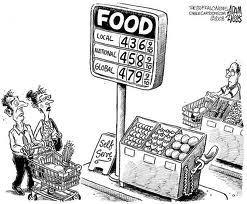
Move over, energy costs … Here come higher food prices.

Higher food prices like higher energy pricesIf it seems as if food prices have been increasing at a faster clip in recent months, you’re not dreaming.

Despite an overall inflation rate that seems low (although the federal government’s controversial exclusion of certain key components like gasoline makes its stats suspicious at best), we now have solid evidence that worldwide food cost increases are happening across the board.

Here’s a list of some of the most dramatic cost increases for key foodstuffs recorded since May 2010:

 Coconut oil: +134%
 Corn/maize: +111%
 Wheat: +75%
 Coffee: +70%
 Sugar: +55%
 Soybeans: +45%
 Palm oil: +42%
 Orange juice: +35%
 Beef and pork: +20%

Considering that this represents a time period of just a little over a year, these increases are some the largest recorded in decades.

What caused it to happen? Poor weather and bad harvests are two of the reasons. But high demand from developing countries – particularly China – is another important factor.

“This is a pretty sustainable increase … A number of factors have been building over time in terms of the commodity increase: world economic growth, rising crude oil prices, increased Chinese import demand have all conspired,” is how Bill Lapp, president of commodity analytical company Advanced Economic Solutions, puts it.

Unfortunately, the problem promises to persist, since many of the items above are ingredients that go into other prepared food items. Initially, packaged food makers that had locked in purchases for some items over certain time periods were able to delay delay passing on cost increases because of those hedges. But the bulk of those contracts have run their course by now.

So, even if commodity prices don’t go any higher, we’re likely to see the ripple effects in pass-along price increases all throughout the “food chain” in the months to come.

This isn’t news anyone wants to hear, considering how fragile (non-existent?) the economic recovery is here in the U.S. and in many other countries as well.

The sober truth is, high food costs coupled with increased energy prices have a chokehold on the world economy that is more consequential than many would care to admit.

Fasten your seatbelts, folks. We may be in for yet another wild ride on the economic roller-coaster …

Home Ownership as an Investment Comes Under Fire

Home ownership isn't quite the financial investment many think it is.
Home ownership as a foolproof way to financial well-being? Think again.
Here’s an interesting statistic: Market observers including Deloitte and Oxford Economics estimate that there are ~10.5 million households in the United States that have a net worth of $1 million or more. (The number is calculated including the primary home.)

I for one was a bit surprised by the number, figuring it might be higher.

But here’s another interesting number – and one that explains a lot: There were ~12.7 million such “millionaire households” in America back in 2006.

The difference? Housing property values, of course. They’ve declined by ~15% since 2006 … which makes it little surprise that the number of millionaire households in the country has dropped by a similar percentage.

Over past several years we’ve witnessed millions of homeowners become upside down in their home mortgages. For this reason alone, it would be nice if more people’s net worth wasn’t so tied up in houses.

It’s as if we’re all farmers, the ultimate “land poor” demographic group.

Many people have an aversion to other types of investment, pointing to a stock market that has seen little net upward movement over the past decade. Others simply prefer a solid asset like owning property – or maybe gold.

But if the past few years have taught us anything, it’s that home ownership isn’t always the road to financial well-being.

In fact, real estate specialist and Wall Street Journal editor David Crook wrote an article recently (“Why Your Home Isn’t the Investment You Think It Is“) which spells out a pretty convincing argument that home ownership doesn’t work as the best investment vehicle.

And that’s not just by looking over the past few years … but over the past several decades.

It’s a thought-provoking article that’s well worth a read.

What do consumers think of America’s corporations?

Corporate Trust ... Corporate ReputationWith the budget negotiations in full swing – and high dudgeon – on Capital Hill, naturally the public’s critical eye is trained on our political figures. And Congress is most assuredly taking a beating in the political polls, with approval ratings plunging astonishly below the 20% figure.

[Of course, is that really so surprising? After all, Congress is pretty evenly matched between the two parties … so partisans see much to criticize on both sides.]

The focus of attention on Washington has taken the spotlight off of corporate America – at least in terms of media attention. But that doesn’t mean that “John Q. Public” is giving companies much of a break.

I’ve blogged before about corporate reputations — most recently commenting on a field survey conducted early this year by Harris Interactive that measured the appeal of 60 of the “most visible” American corporate brands. That survey showed an uptick in positive opinions about those firms when compared to prior-year results.

But a May 2011 survey by GfK Custom Research North America shows otherwise. The findings from GfK’s online field survey of ~1,000 U.S. consumers include this doozy: Two-thirds of respondents believe that it’s harder today for American companies to be trusted than it was three years ago.

Furthermore, ~55% say it will be harder for companies to gain their trust in the years to come.

What’s bothering people about U.S. corporations? In order of significance, here are the key concerns:

 The perception that CEOs and other senior executives of corporations are overpaid.

 Corruption in senior management circles.

 Companies make up lost earnings at the expense of their customers.

 More products than ever are being manufactured overseas.

Interestingly, there’s less concern about declining product or service quality as a reason for lower levels of trust. And as has been found in other studies, the public’s view of technology companies is somewhat higher than its trust for companies in other industry segments.

But back to the rather grim overall findings … fewer than one in five survey respondents anticipate that corporate corruption will become better over time – a result that’s substantially lower than what was found in similar field research conducted by GfK a few years ago.

This survey underscores the fact that corporate America has a long way to go to change the sharply negative impressions consumers have of the world of business. Clearly, the financial crisis of 2008 continues to extend its long shadow more than two years later.

And it looms over everyone – public and private sector alike.

This helps explain the generally sour mood people are in these days.