Personality and Productivity in the Workplace: When Grumpy is Good

NoWhen it comes to which characteristics people consider the most important for being successful in the working world, we hear same traits cited so often, it becomes like a litany.

A recent survey of ~500 business managers in the communications and technology fields, conducted by digital education company Hyper Island, confirms it yet again.

When the survey respondents were asked to identify which traits were most important, here were their top answers:

  • A winning personality (e.g., creative, open-minded, positive):  ~78% identified as among the most desirable traits.
  •  Cultural alignment (making decisions that reflect the values shared with their organization):  ~53% identified as among the most desirable traits.
  •  The skill-sets of the worker:  Only ~39% identified this as the most important trait.

Regarding skill-sets, it seems that despite the inexorable increase in technical expertise and acumen required of workers in nearly every business discipline, many people continue to believe that personality, attitude and a team mentality trump capabilities and expertise.

In other words, it’s the notion that it’s easier to educate someone with a positive attitude than it is to work with someone who really knows his or her stuff, but has a bad attitude, is a wet dishrag, or whatever.

unhelpful employeeWell, hold that thought.  Because now we have new research from analysts at the University of Pennsylvania and the University of Illinois which is giving us another angle to consider.

In their studies, these researchers have found that workers with “net-negative” personality traits appear to be more efficient in their jobs than those who possess “net-positive” personalities.

What’s going on?

To come to this conclusion, the university researchers had their study participants meticulously document all of their activities over a prescribed period of time, along with completing a survey that measured attitudes about their jobs, their workplace and their colleagues.

As it turns out, it’s not that one group puts in more time than the other at the office.  It’s that workers with “sunnier” dispositions are more open to performing tasks that may be outside of their comfort zone.

They’re more inclined to “have a go” at different activities, because they’re naturally more curious … and more willing to step in and support the larger work team.

… Especially if their boss requests it.

By contrast, grumpier employees are less open to novelty … more suspicious of taking on other tasks … and more likely to put up subtle (or not-so-subtle) psychological barriers when it comes to being approachable about taking on those tasks.

By their behavior and body language, they may often be successful in dissuading their superiors from even asking them to take on new and different job tasks.

And if they’re asked, they’re less likely to acquiesce.

As a result, these employees tend to spend more time on a fewer variety of tasks – the ones they already know.  Which, in turn, makes them more likely to further hone their skills in those areas.

I don’t think these new findings challenge the underlying idea that employees with a positive attitude are a strong asset to companies.

But perhaps a smidgeon more credit may be due to the employees who are on the other end of the scale.  When you find them sitting alone in the break room, or avoiding gathering around the water cooler, they may be investing more amount of time in their work tasks — and developing a higher level of skill as a result.

I guess every cloud has a silver lining …

Amazon’s (Somewhat) Surprising Shopping Stats

Shoppin on AmazonOver the years, Amazon has branched out greatly from its original focus on books and other media to offer all sorts of other merchandise.

In fact, these days people can buy pretty much anything on Amazon — assuming it’s legal.

Even so, I was somewhat surprised to read the tea leaves on some new findings released by Chicago-based Consumer Intelligence Research Partners.  This research firm surveyed ~1,100 Amazon customers, asking them about their most recent purchases on Amazon.

Categorizing the responses by type of merchandise, CIRP found that books are no longer the most popular products sold on Amazon.

Instead, pride of place now goes to top-ranked electronics products, with ~33% of the survey respondents reporting that those types of products were their most recent purchase on the site.

Books still maintain their high ranking; the category comes in second at ~20% of respondents.  (Incidentally, approximately one-third of those book purchases are e-books.)

Amazon’s Fresh service, which delivers groceries within 24 hours of ordering, has been operating in select West Coast cities for some time now — and it appears that the company has latched onto a winning formula.

In fact, the grocery category ranked third in the survey.

This surprised me:  Call me old school, but I still prefer to select my fresh meats and produce on my own, instead of relying on some anonymous “picker” to do it for me.

What were the bottom three merchandise categories found in the CIRP survey?  Sports-related purchases were low  … and music purchases were lower still (about half of them being music downloads, by the way).

Dead last is the automotive category.  No real surprise here, I don’t think.

Personally, I don’t know anyone who would feel comfortable purchasing a car online.  And since the vast majority of consumers don’t work on their cars either, it seems natural that most of them will continue to rely on their repair shops to procure the replacement parts and consumables they need for servicing their vehicles.

If you have particular merchandise you like to buy through Amazon — or if there is something really unusual that you’ve purchased from the site, please share your experiences with other readers here.

Software and security flaws: Even mighty Google isn’t immune.

Here’s a bit of news that doesn’t make one feel very reassured about cyber-security.

Gmail email accounts compromisedIt turns out that a major flaw has existed in the security of Google’s Gmail service for an extended period of time.

And that flaw could have been exploited to extract millions of Gmail addresses – potentially every single one of them, in fact.

What’s even more unnerving is that this flaw wasn’t uncovered by Google’s own engineers, but instead by security researchers in Israel who were kind enough to bring it to the company’s attention.

Thankfully, it was the “good guys” rather than the “bad” who made the discovery.

Evidently, the flaw resided in the sharing feature of Gmail that allows each user to delegate access to his or her Gmail account.

By “tweaking” the web address, the security researchers were able to reveal a random user’s e-mail address.

Once this procedure was proved out, scaling the hack was relatively easy.  By automating character changes using a software tool called DirBuster, the researchers were able to harvest approximately 37,000 Gmail address inside of two hours.

Oren Hafif, one of the security researchers involved in the exercise, blogged recently about the potential scope of the flaw:

“I brute-forced a token in a Gmail URL to extract all of the e-mail addresses hosted on Google.  I could have done this potentially endlessly.  I have every reason to believe every Gmail address could have been mined.” 

While the hack would not have exposed passwords explcitly, it could have left email accounts open to password-guessing attacks — not to mention unwanted spam mail or phishing.

Potentially, the breach could have affected not only personal users, but also businesses that use Google to host their email platforms.

Helpfully, the Israeli security researchers decided to inform Google of their discovery, preferring to be part of the solution rather than let the company twist in the wind.

So … are you ready for the kicker?

Reportedly, it took Google one full month to fix the software bug after being informed about it.

For a core service like email that is so central to the entire Google experience, one wonders why it took one of the world’s largest and most powerful companies weeks rather than just days to fix the problem.

If you’re looking for a redeeming or staisfying finale to this story … there really isn’t one.

Why?  Because in its infinite generosity, Google decided to reward Mr. Hafif for bringing the software flaw to its attention, in the form of a cash award.

One that really, really expressed thanks and appreciation for what he did.

Reportedly, the award amounted to US$500.

Frequent flyer programs: No longer going the distance.

What took so long?

frequent flyer programsDelta and United Airlines have announced what they hope will be an industry-pacesetting change in the way frequent flyer programs are administered by the world’s biggest airlines.

The two air passenger carriers are shifting away from awarding points based on flight distance, and instead will award points based on the actual airfare paid by the traveler.

The change in procedures will become effective in 2015 (in January for Delta and in March for United).

In retrospect, one wonders why it took so long for the big airlines to make this move.

After all, the very nature of loyalty programs is to reward a company’s best and most profitable customers.

Business travelers who book a flight a few days ahead – not to mention people who prefer to travel first class – are far more valuable to an airline than someone who books the “Cheapy Charlie” web-only fare months in advance.

Besides, prominent low-cost air carriers like JetBlue, Southwest and Virgin have been using revenue-based methods of calculating their frequent-flier points for a good while now.

As for which types of travelers will come out winners vs. losers in the frequent flyer program changes, it’s exactly who you’d expect:

  • Big Winners:  Business passengers traveling internationally and on refundable-fare domestic flights + first-class passengers.
  • Big Losers:  Leisure fliers in coach class + business flyers who travel on cheap fares.
  • In-Betweeners:  Business passengers who travel using a mix of business and economy fares.

The recent announcements by Delta and United leave only American Airlines as the last big U.S.-based global carrier that still maintains the traditional distance-based calculation for earning miles.

I wonder how much longer they’ll hold out?

Only a matter of months, I’m guessing.

What are your opinions about the changing policies?  Are there particular frequent flyer programs you love?  … Or love to hate?  Feel free to share your thoughts with other readers.

The hybrid car sizzle is fast becoming the hybrid car fizzle.

Well, that sure didn’t last long.

Hybrid autos:  Already riding off into the sunset?
Hybrid autos: Already riding off into the sunset?

News reports this week are stating that the market share of hybrid vehicles is now on the decline.

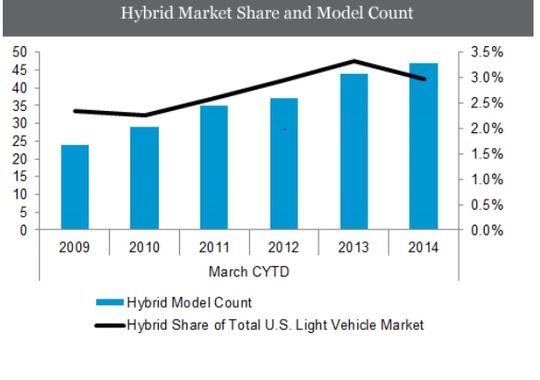
That is correct:  As of 1st Quarter 2014, hybrids only make up around 3% of the total car and light truck market in America.

Rather than an increase, that represents a pretty significant drop from nearly a 3.5% share of market just one year ago.

Here are the trend stats in graphic detail, courtesy of automotive statistics and intelligence firm IHS/Polk:

Hybrid Vehicle Stat ChartActually, the number of new hybrid car models being offered is still on the increase — now there are 47 different choices compared to around 25 in 2009, with Toyota’s five Prius models collected representing ~40% of the total hybrid market.  (The Prius share is down from ~55% in 2011, by the way.)

New model offerings or not … it’s pretty clear that the public’s interest in hybrid vehicles isn’t going up commensurately.  And the litany of reasons is all-too-familiar:

  • High car sticker price
  • Costly and complex batteries
  • Improved gas mileage and energy efficiency of conventional vehicles

Looking at the year-over-year trends, I think it’s doubtful that hybrid vehicles will ever achieve the high hopes the EPA and other federal officials have had for their adoption.

How embarrassing for them.

Instead, it seems more likely that the market will gravitate from the internal combustion engine straight to all-electric vehicles.  None of this “automotive hermaphrodite” stuff in between.

The more interesting question is this:  When will that shift occur?

To that one … not many people seem to have a definitive answer.

Patent Trolls: Is a Day of Reckoning Finally at Hand?

When the banks get involved … watch out.

patent holding companiesIn recent weeks, I’ve begun reading more news items about legislation being passed to limit the damage so-called “patent trolls” can do to unsuspecting businesses.

These are the bottom-feeding firms which exist only to collect royalty payments and fines from companies due to supposed infringement on patents the firms have purchased.

Many of the victims of these schemes are smaller businesses with fewer than $10 million in annual revenues.

The reasons they’re targeted are pretty obvious:  smaller companies are less able to defend themselves against such charges, and it’s often easier and less expensive to settle out of court — and avoid all the hassles that accompany litigation as well.

But the cumulative impact is pretty enormous.  Patent risk specialist RPX Corporation estimates that it’s nearly $13 billion in legal fees, settlements or judgments.

The University of California’s Hastings College of the Law has also been studying the numbers.  It finds that patent infringement claims against the portfolio companies of venture-capital firms cost an average of $100,000 each to settle.

Predictably, only a smidgeon of the monies collected by these patent-holding companies actually makes it back to the inventors.  The rest goes right in the deep pockets of the people trolling the business world for easy money.

And then …

come down hardThen some patent trolls made the mistake of sending demand notifications to banking firms, related to things like the software used in ATMs.

Oops.  Bad move.

Once the banking institutions got sensitized to the issue,  a lot of legislators did, too.  Funny how that works.

The results are now beginning to show.  In recent months, more states have enacted legislation curbing the ability of patent trolls to make “bad faith” assertions of patent claims.

What is a questionable patent claim?  It’s a claim that isn’t based on any clear evidence of infringement — but instead on vague accusations.

(In other words, these questionable claims represent the vast majority of the notifications delivered to the unsuspecting victims.)

States jumping on the “put the trolls on trial” bandwagon range from New York, Vermont to Oklahoma and Minnesota.  Twelve so far, and the tally will surely increase in the coming months.

One of the interesting twists is the fact that most of new legislation also allows targeted companies to strike back in state courts with their own litigation … against the patent-holding companies themselves.

I guess turnabout is fair play.

Another twist …

Here’s an interesting case where financial institutions – an industry not particularly loved in many quarters – is helping to rout a particularly pernicious and avaricious bunch of businesspeople.

This sort of activity, based not only on any sense of commercial fair play but instead on playing mercantile “gotcha” games, is reprehensible and gives “the business of business” a bad name.

Too, it has to have had a chilling effect on the activities of smaller businesses in particular – especially those who rely on established technologies to create and commercialize new products.

Constantly looking over one’s shoulder to make sure no one is coming after you for something as innocuous as using an e-mail tool on a FAX machine is hardly the kind of environment that fosters innovation.

So let the cheering begin … and no stopping until these trolls are banished back under the bridge.

Companies Continue to Increase their Investment in Social Media

InvestmentSocial media may have its share of nettlesome issues … but that doesn’t mean companies aren’t spending more effort and energy on these platforms.

To illustrate, a new online survey of ~1,060 business owners, senior management personnel and social strategists that was conducted in April 2014 by Social Media Marketing University finds that a clear majority of companies are investing more time and/or dollar resources on social media as compared to a year ago.

And three-fourths feel that this investment is worth it.

Here are some of the SMMU survey’s key findings:

  • ~74% of companies are devoting more time to social media.
  • ~54% are spending more dollars on social media.
  • Nearly 70% are managing four or more social profiles.

The most significant expenditures for social media programs fall into these four categories:

  • Compensation of in-house staff: ~37% of all social media program expenditures
  • Social media advertising: ~18% of program expenditures
  • Compensation of external staff: ~10% of expenditures
  • Content development: ~7% of expenditures

According to the SMMU survey, smaller businesses – those with fewer than 50 employees – face the biggest challenge in terms of the increased time and cost commitments to social media.

As SMMU Principal John Souza puts it:

“Because many small businesses don’t have the skill-set or the staff to properly manage social media, they are outsourcing their social, or spending an excessive amount of time on tasks as they learn social by trial-and-error.”

Not surprisingly, having some focused training on the “how-to” of social media can make a pretty big difference in the effectiveness of the people charged with planning and carrying out a company’s social media program.

The question is how many businesses actually feel the need for such training, seeing as how some of the recent press about social platforms hasn’t been all that positive.

The answer, based on my own personal interaction with numerous small and medium-sized firms is … not very many of them.

Ipsos Reid Poll: Female Execs Gauge Their Advances

women managers and executivesAn interesting Ipsos Reid poll of female executives conducted late last year sheds light on what the perceived career holdbacks are for women in the workforce these days.

The results of the online survey, which queried ~500 American women working in managerial or executive roles, suggest that women continue to face obstacles in advancing their careers to upper-level management and executive positions … although the disparities are less today – and hopefully continuing the trend toward parity.

An example of one perception which continues to show a big divide between women and men is this:  While ~37% the survey respondents feel that physical appearance and personal image are factors in career progression for men, nearly all (~90%) believe that they are for women.

On the other hand, the perceived differences are less stark when it comes to opportunities for career progression based on the gender of a female employee’s immediate superior.  When asked how gender affects the chances for women to obtain a managerial position, here’s how the respondents answered:

If the superior is a woman …

  • 26% better chance for advancement
  • 30% worse chance for advancement
  • 44% no difference

If the superior is a man …

  • 26% better chance for advancement
  • 25% worse chance for advancement
  • 49% no difference

… Which translates into trust levels that aren’t so very different at all:

  • ~22% would trust a man more for help with career advancement
  • ~18% would trust a woman more for help with career advancement
  • ~60% express no difference in trust levels

Positive Work Attributes

The Ipsos/Reid survey also found that nearly two-thirds of the respondents consider women to be better leaders than men, primarily for these five reasons:

  • Women are better communicators
  • They are more organized
  • They are more empathetic
  • They have a better understanding of the needs of their employees
  • They are more open to changing their approach

For the record, two attributes that respondents do not attribute to women over men are:

  • Women have better instincts than men
  • They are more invested in an organization’s success compared to men.

With a confident self-image and backed by positive work habits, what do these respondents see as the biggest continuing challenges to their career growth?  Here’s what the Ipsos Reid survey found:

  • The requirement for women to work harder and put in longer hours to prove themselves: ~77%
  • Managing work and family balance: ~61%
  • External factors (economic climate/job loss): ~56%
  • Being welcomed into an established senior management team:  ~48%
  • Dealing with outdated perceptions of women in managerial and executive roles: ~48%
  • Lack of female mentors: ~47%

Moreover, ~78% of respondents discern a “noticeable” different in salaries between men and women.

Asked what a company might “fear” about promoting women to senior managerial and executive posts, the respondents cited several probable factors:  the fear that an executive might want to start and maintain a family … and the fear of too many absences from work due to family obligations.

Bottom line, the Ipsos Reid survey reveals some continuing obstacles for women in the executive-level work force.  But there’s positive news, too.  Additional survey findings can be found here.

If you have additional observations or perspectives on this topic, please share them with other readers here.

LinkedIn: The “Other” Social Network Makes its Move

linkedinWe may be reading quite a few news reports these days about Facebook and Twitter facing a plateau in usage … but LinkedIn’s fortunes continue to be on the upswing (financial losses notwithstanding).

In late April, the social network reported that it now has more than 300 million active members throughout the world, which is up more than 35% since the beginning of the year.

Too, the gender gap in membership is narrowing, albeit more slowly:  Today, ~44% of LinkedIn members are women, up from ~39% in 2009.

Even more impressive for a network that has the lofty goal of “creating economic opportunity for every one of the 3.3 billion people in the global workforce,” is the fact that two-thirds of LinkedIn’s active members are located outside the United States.

This is underscored by the top three countries represented  in LinkedIn’s membership, which are the U.S. (#1), India (#2) and Brazil (#3).

worldwide membersLinkedIn’s latest international push is into China, where it seeks to add more than 140 million Chinese professionals to its membership rolls.

Mobile Movement

The increased use of “smart” mobile units has affected the ways users interact with LinkedIn as well; mobile traffic is expected to overtake desktop access later this year.

[In fact, that’s already happened in markets like the United Kingdom, Singapore and Sweden.]

Here are a few “factoids” that illustrate how significant mobile has become for LinkedIn operating as the world’s mobile employment bazaar:

  • Average number of LinkedIn profiles viewed daily via mobile devices:  ~15 million
  • Average number of job position openings viewed daily via mobile:  ~1.5 million
  • Average number of job applications submitted daily via mobile:  ~44,000

Despite these healthy usage figures, a continuing challenge for LinkedIn is the degree to which it has been able to “monetize” its membership.  Among U.S. members, the average revenue-per-user is hovering around $11.30.

That’s much better than the ~$3.75 average revenue-per-user amount for members overseas.  But it’s still well below the revenue-per-member figures being charted by Facebook, which helps explain LinkedIn’s continuing revenue and profit challenges.

Still, when you consider that LinkedIn is becoming the de facto “Help Wanted” public square for the professional world, it’s hard to criticize its business model as the “go-to resource” for human resources professionals involved in personnel recruitment.

And now that the platform has a an active membership north of 300 million people, it’s hard seeing how that dynamic is going to change going forward; LinkedIn really is in the catbird seat when it comes to recruitment.

Speaking personally, I’m glad LinkedIn is resisting going the route of Facebook and Twitter in their evolving “all advertising, all the time” revenue models.  If LinkedIn can continue to derive a large chunk of its revenue stream from recruitment solutions instead of relying on display advertising or sponsored posts that are too often distracting or irritating, so much the better for us.

Less is less? What’s happening with customer loyalty programs.

CustomersWhen it comes to customer loyalty programs, here’s a sobering statistic: Only about 15% of consumers redeem loyalty rewards.

This finding comes from a report by Forrester Research, based on results from an in-depth survey it conducted last fall of 50 member companies of Loyalty360, a major loyalty marketing association.

What Forrester found is that fewer than half of the surveyed companies’ customers are enrolled in their loyalty programs. And of those customers, only about 35% of them are actually redeeming their loyalty awards.

Hence the 15% “effective” participation rate.

At first blush, the paltry participation makes one wonder what all the fuss is about when it comes to loyalty marketing.  But more than half of the companies surveyed by Forrester reported that they view their loyalty program as a strategic priority, not merely a marketing afterthought..

Clearly, there seems to be a bit of a “disconnect” between those lofty aims and the not-so-airborne reality. The question is how companies can encourage greater participation in their loyalty programs, thereby using them to improve consumer brand loyalty in addition to retaining customers over time.

Forrester offered several recommendations in its report:

1. Use advances in analytics to act on customer insights, rather than just relying on the purchase transactional history of loyalty program members. 

2. Balance the “reward mix” with personalized offers that present rewards program customers with unique experiences that are different from simply offering “more of the same.” (In many cases, offering discounts on more of the same merchandise a customer has already purchased won’t qualify as anything particularly special.) 

3. Break out from the traditional e-mail/web portal/call center communication vehicles to embrace more social media channels featuring two-way interaction. (Surprisingly, only about half of Forrester’s survey respondents reported that social media is an important part of their loyalty programs’ methods of communication.)

Speaking personally, I’m not particularly surprised at the relatively low engagement levels reported in this study. Many companies and brands have reached out to me over the years with offers to join loyalty programs, using various incentives – often purchase discounts or sign-on points as an incentive for joining.

apathyFor me, it’s a matter of “time” and “mindshare” as to which of these programs qualify for my participation. If a brand isn’t that important to me in terms of how I live my daily life, it – and its loyalty program – isn’t ever going to be big on my radar screen.

I suspect there are quite a few other consumers like me. But if you have different take, leave a comment and share your perspective with other readers.