It’s no secret that the newspaper industry has been struggling with finding a lucrative business model to augment or replace the traditional print medium supported by subscriptions and advertising.
The problem is, their efforts are thwarted by market realities at every intersection, setting up the potential for head-on crashes everywhere.
The researchers pinpointed 2007 as the year in which most large newspapers’ online versions had been available for about a decade, meaning that they had become “mature” products. The evaluation looked at the total local online readership of the Top 50 American newspapers, and found that nearly all of them have been stagnant in terms of growth over the past decade.
Even worse, since 2011 more than half of the papers have actually lost online readership.
The issue isn’t that people aren’t going online to consume news; the precipitous drop in print newspaper subscriptions proves otherwise. The problem is that many consumers are going to news aggregator sites – places like Yahoo News, CNN.com and other non-newspaper websites – rather than to sites operated by the newspapers.
That leaves online newspapers attracting disappointing advertising revenues that can’t begin to make up for the loss of those dollars on the print side. To wit, the University of Texas study reported that total newspaper industry digital ad revenues increased only about 15% between 2010 and 2014, going from ~$3 billion to ~$3.5 billion. That’s pretty paltry.
The problem goes beyond ad revenue concerns too. In a market survey conducted in 2012, two-thirds of newspaper subscribers stated that preferred the print version of their daily newspaper over the web version.
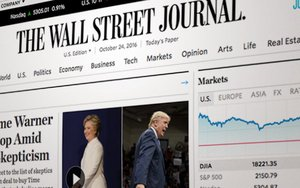
I find that finding totally believable. I am a print subscriber to The Wall Street Journal whereas I read other newspaper fare online. My daily time spent with the print WSJ ranges from 30 minutes to an hour, and I peruse every section of the paper “linearly.” It’s an immersive experience.
With online newspaper sites, I hunt for one or two topics, check out the headlines and maybe a story or two, and that’s it. It’s more a “hit and run” operation, and I’m out of there in five minutes or less.
The notion of carefully picking my way through all of the menu items on an online newspaper’s navbar? Forget it.
And with such a tentative relationship with online newspapers, do I want to pay for that online access? Nope.
Magnify that to the entire market, and the web traffic stats show the same thing, which is why online advertising revenues are so underwhelming.
Once again, the optimistic goals of newspaper marketers are running up against cold, hard reality. The fact is, people don’t “read” online in the traditional sense, and they’re quick to jump from place to place, in keeping with the “ADD” most all of us have developed in our online behaviors.
There just isn’t a good way that newspapers can take their product and migrate it to the web without losing readers, losing ad revenue – and indeed, losing the differentiation they’ve built for quality long-form journalism. And so the conundrum continues …
What about your print vs. online newspaper reading habits? Are your experiences different from mine? Please leave a comment for the benefit of other readers.
When it comes to attitudes about personal finances, millennials appear to have more in common with their Depression-era grandparents or great-grandparents than with anyone else.
Headlining the TDA results is this interesting finding: More than three-quarters of the millennials surveyed would place an extra $1,000 in a savings account rather than invest it in the stock market.
Concurrent with that conservative financial worldview, two-thirds of the respondents in the TDA survey consider themselves to be “savers.” Even more have established personal budgets for themselves and their families.
Helping to explain the similarities in characteristics between millennials and the Depression-era generation, Matthew Sadowsky, director of retirement and annuities at TD Ameritrade, put it this way:
“The Silent Generation and Millennials [both] came of age during a major financial crisis, which increases the propensity to save and financial conservativism. Further adding to Millennials’ financial anxiety is the economy, student debt, and escalating peer influence from social media.”
Social media could partially explain one finding in the Ameritrade field research – the notion that the vast majority of the survey respondents don’t feel financially secure now.
Being active on social media is much more likely to cause Millennials to compare themselves to others: Nearly two-thirds of Millennials admitted that fact (64%), whereas with Baby Boomers the percentage is less than half of that (29%).
Despite Millennials’ awareness of their financial limitations, it doesn’t seem to translate into seeking out the counsel of professional financial advisors. Instead, they’re more likely to rely on parents (38%) and/or friends (28%).
As for their financial goals, most Millennials have bought into the idea that home ownership is a good thing – and something most of them aspire to achieving by the age of 30.
They also appear to have pretty realistic attitudes about retirement, too, as about half are concerned about running out of money during retirement, and hence are open to retiring at an older age in order to maintain a decent lifestyle in retirement.
Does this mean that Millennials will be better-prepared to handle the challenges of living and growing old in our society? The TD Ameritrade survey suggests so. Still, life has a way of playing tricks on people, so the question remains as to whether this generation will actually do any better than the preceding ones.
The holiday season isn’t yet upon us, and already there are a plethora of prognostications being made as to how holiday sales will stack up compared to prior years.
These predictions come courtesy of numerous forecasters including the National Retail Foundation, Deloitte, Kantar Media, eMarketer, the International Council of Shopping Centers, Market Track and others.
So what’s in store? On balance, forecasters predict that holiday sales in the United States will post an increase of approximately 3.5%. That’s higher than the 10-year rolling average of 2.5% but down a tick from last year’s 3.7% increase.
Still, at more than $655 billion in total sales, holiday spending continues to be the biggest single driver of the U.S. consumer market.
Hardly surprising, e-commerce sales are expected to continue their double-digit growth over last year’s holiday season, with various predictions ranging from 14% to 17% growth in this sector. Not only are consumers attracted by the convenience of online shopping, many of them believe they can find products at the cheapest price via online sources rather than taking a trip to the shopping mall.
Another factor that drives at least some people to shop on their online devices is their aversion to the crush of holiday shopping at the stores. A McKinsey study has found that nearly one-third of U.S. consumers basically hate Black Friday (the day after Thanksgiving), and make it a point to stay as far away from it as possible.
But there’s one drawback for businesses about online holiday shopper dynamics, however: Those consumers tend to be less brand loyal than is typical. RJ Metrics calculates that the typical e-commerce business acquires nearly 25% of its new customers during just the months of November and December. Tempering that healthy statistic is the lifetime value of those consumers, which RJ Metric has determined is about 13% lower than the lifetime value of customers acquired at other times of the year.
You might be wondering what amount of money the typical U.S. consumer will spend on his or her holiday shopping this year. Wait for it: The 2015 per capita amount is expected to be $935.
That figure may seem quite rich … but it’s actually a little bit lower than 2015’s average spend-per-person, which at $953 happens to have been the all-time high ever recorded.
Does the new $935 forecast signify a reversal of a trend … or is it just a pause in an otherwise ever-increasing amount of money that consumers are willing to plunk down as part of their celebration of the holiday season?
Check back in about a year and we should have an answer.
Regular readers of the Nones Notes blog will know that my brother, Nelson Nones, sometimes contributes his thoughts and perspectives for the benefit of other readers. As someone who has lived and worked outside the United States for the past two decades, Nelson’s perspectives on domestic and international events and megatrends are always insightful — and often different from prevailing local opinions.
That has certainly been the case during 2016. In a year of four major election surprises, my brother correctly predicted the results at the ballot box in every single case. Below is a guest post written by Nelson in which he explains how he arrived at predictions that were so much at odds with the prevailing views and conventional wisdom.
Oh, and by the way … I was one of the “confidantes” Nelson refers to in his post, so I can personally vouch for the fact that his “fearless predictions” were made before the events happened — even if they were delivered to a skeptical (and at times incredulous!) audience.
_______________________________________
A TALE OF FOUR PREDICTIONS
By Nelson M. Nones, CPIM
Bangkok, Thailand — 13th November 2016
Rodrigo Duterte and Donald Trump
A handful of my confidantes across the world can vouch that I correctly predicted four momentous events during the past fifteen months: that Donald Trump would be the US Republican nominee, United Kingdom (UK) citizens would vote to leave the European Union (EU), Rodrigo Duterte would be elected President of the Philippines and Trump would win the US Presidency.
To my knowledge, no one else correctly predicted all four events.
Skeptics might dismiss my predictions as reckless, and credit my successes to dumb luck, but my confidantes can also attest that these predictions were the products of diligent analyses which I freely shared alongside the predictions themselves. What did I do to gain insights into the future that most others did not see?
Independent, Globally-Connected Thinking
Although I’m American, I have lived and worked in Thailand since 2004, and elsewhere in Asia and Europe for 16 years of the past two decades. During that time I’ve had the good fortune to visit or reside in over 40 countries on five continents, and form long-lasting professional relationships with knowledgeable people all over the world.
Not only has this experience given me a truly global perspective, it also filters out most of the distractions that partisans everywhere deliberately craft to alter what people think. Happily, for instance, I almost never encounter the barrage of negative attack advertising which fills every US election cycle. Avoiding so much propaganda, instead of continually having to confront and fend it off, has given me freedom and time to nurture and hold a much more independent and finely balanced point of view than I could ever have acquired by sitting in a single locale.
By now, the repudiation of globalization and free trade, and the rise of nationalist, populist fervor are universally recognized as key reasons why these four events unfolded as they did. Most people have come to realize or accept this only in hindsight, but my global perspective made the eventual gathering of these forces obvious years ago.
In 1999, while living in London, I published the article “Deflation’s Impact on Business Information System Requirements” in which I anticipated that deflation would force manufacturers to reduce their variable labor costs and warned, “These actions will have adverse and increasing social effects. Worker demands for improved economic security may lead to renewal of isolationist policies in some locales, which would effectively reverse the economic liberalization and globalization trends of recent years. Business models designed to optimize performance in the previous climate of unrestricted free trade will be adjusted to account for the artificial incentives and penalties created by new government regulations.” My inspiration was a special section of The Economist, “Could it happen again?” published on February 18th, 1999 which declared, “It is conceivable that the world may be in for a new period of global deflation (meaning falling consumer prices) for the first time since the 1930s” and concluded, “The world economy is, in short, precariously balanced on the edge of a deflationary precipice … history has shown that once deflation takes hold, it can be far more damaging than inflation.”
At that time, global inflation had fallen to 3.6% per year, from a peak of 14.8% in 1980. By 2014, global inflation had fallen further to 1.7%, and the best-fitting linear trend over the previous 44 years suggested to me that prices could stop rising altogether by 2018 globally, after which a period of negative inflation (“deflation”) might ensue, with prices falling perhaps by 0.4% in 2020. From this I concluded that the rise of isolationism, and the concomitant demise of globalization, economic liberalization and free trade, were near at hand.
First Hand Observation
It is one thing to sit in a chair, reading and writing about such things, and quite another to see the evidence up close and in person.
Nigel Farage
I spent four months of 2013 working in the UK, which gave me plenty of opportunity to watch local television news. One person who seemed to make headlines every day was the controversial politician Nigel Farage, then a Member of the European Parliament and Leader of the UK Independence Party (UKIP) who would spearhead the campaign to leave the EU nearly three years later. Earlier in 2013, he had led UKIP, a Eurosceptic and right-wing populist party, to its best performance ever in a UK election. Key planks in its platform at that time sound eerily familiar now and included deporting migrants, legalizing handguns, destroying wind farms (which many climate change deniers like to condemn as wasteful and unattractive), privatizing the National Health Service (NHS) and improving relations with Vladimir Putin. Just like Trump would do in 2016, UKIP ran strongest among less-educated voters in predominantly white, blue-collar areas, while faring much worse in areas dominated by college graduates, immigrants and minorities.
The following year I had the opportunity to travel by train from Paris to London. It was the first time I’d passed through the Channel Tunnel, that most emblematic symbol of free trade and European economic integration. But as the train approached the tunnel’s French portal, I was struck by the tight security and double fencing meant to prevent migrants from climbing or jumping onto trains bound for the UK. These were impressively similar to the border fencing and controls separating El Paso, TX from Ciudad Juárez, Mexico which my family and I visited in early January, 2015.
Later, I spent July and August 2015 in the Pacific Northwest. Trump was all over the news, both before and after his infamous Republican primary debate on August 6th. I instantly noticed the many similarities between Trump’s rhetoric and what I’d heard from Nigel Farage two years before. Just like Farage, Trump appeared to be running a campaign requiring no television advertising whatsoever. By provoking so much controversy, he seemed to receive thirty minutes’ free television interview time for every thirty seconds any other candidate got.
Based on these observations, on August 19th, 2015, I wrote a confidante, “Last week, at lunch, I made a prediction to our project team in Washington state: Trump will win the Republican nomination, and he will probably win the Presidency too (or at least come very close to winning it).” I added, “Right now, he is looking like a steamroller, and all the other candidates (Hillary [Clinton] included), are looking like ants who can’t run fast enough to get out of the way.”
Fast-forward to October, 2016, when I next visited the U.S. and drove all the way from New York to Minnesota through Pennsylvania, Ohio, Indiana, Illinois and Wisconsin. These states, with the exception of New York and Illinois, form the majority of the “blue wall” which Trump successfully breached on Election Day, losing only Minnesota by a tiny margin. I noticed, particularly outside the big cities of New York, Cleveland, Chicago, Saint Paul and Minneapolis, that Trump’s lawn signs and bumper stickers seemed to outnumber Clinton’s by something like four to one. I even spotted a few homemade Trump signs or marquees, but not a single one for Clinton.
My arrival in the U.S. coincided with the Washington Post release of the video containing Trump’s lewd comments about women. Yet while I was driving across America, even as new accusers came forward with fresh allegations of sexual assault and Trump’s prospects, according to media pronouncements, sagged precipitously toward new lows, the lopsided proportion of Trump lawn signs and bumper stickers appeared to stay firmly planted in place.
Hypothesis Framing
As early as August, 2015, long before the Republican primaries got underway, I began to formulate a hypothesis to explain why Trump could possibly win the nomination as well as the US Presidency. At the time, Trump led the Republican polls and there was talk that he would hit a 25 or 30 percent “ceiling” of support which, if true, would put the Republican nomination out of his reach.
I decided to test this notion using Lee Drutman’s analysis of an American National Election Studies (ANES) 2012 Time Series data set (Lee Drutman, “What Donald Trump gets about the electorate,” Vox, August 18th, 2015). Drutman’s thesis was that Trump, as well as Bernie Sanders, were playing to a sizeable number of voters representing up to 40 percent of the total electorate. In very broad terms, according to Drutman, the electorate breaks down like this:
40 percent are “Populists” – of which 55 percent are strongly Republican, lean Republican or are independent; attracted to Trump and Sanders.
33 percent are “Liberals” – of which 80 percent are strongly Democratic, lean Democratic or are independent, thus forming the core of Clinton’s support (and presumably would vote for Sanders as well).
21 percent are “Moderates” – evenly divided between Democratic, independent and Republican, thus more likely than not to vote for Clinton on the Democratic side or a mainstream Republican like Jeb Bush on the Republican side.
4 percent are “Business Republicans” – attracted to mainstream Republicans.
2 percent are “Political Conservatives” – attracted to other Republicans in the field.
Considering this, I reckoned that Trump, being the only populist candidate in the Republican field, could potentially attract all the Republican as well as independent “Populists” and thereby conceivably garner up to 58 percent of the Republican primary vote, far exceeding any 25 or 30 percent “ceiling” and more than enough to win nomination.
Thereafter, assuming Clinton won the Democratic nomination, I reasoned that in the general election Trump, as the only “Populist” standing for the Presidency and also the Republican nominee, could potentially attract all the “Populists,” Republican “Moderates,” “Business Republicans” and “Political Conservatives,” thereby taking about an eighth of Clinton’s natural support away from her and giving him up to 52 percent of the popular vote.
My reasoning was simplistic, but good enough to frame my working hypothesis: Trump wins the nomination, and the US Presidency, by running as a populist under the Republican brand.
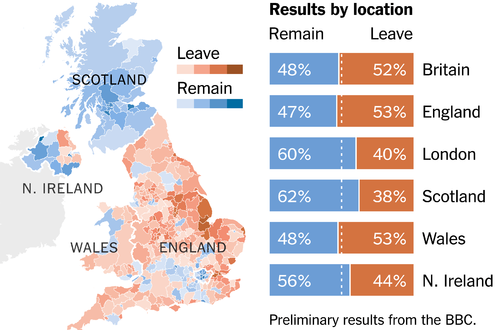
Later on, right before the Brexit referendum, another of my confidantes, who is British, mentioned rumors that published polls were understating the true extent of support for leaving the EU because likely voters, who actually intended to vote for leaving, were reluctant to admit this fact to the pollsters. Indeed, the final compilation of polls released by The Economist on the eve of the referendum revealed 45 percent each for leaving and remaining, and 10 percent undecided, yet 52 percent actually voted to leave. This meant that seven out of every ten supposedly undecided voters ultimately chose to leave. It’s not improbable that many of them truly intended to do so all along. But if this were true, polling data alone could not be relied upon to predict the outcome.
This insight led me to frame a supplementary hypothesis just before the US general election. In consequence of Trump’s many campaign missteps and personal indiscretions, a “closet” vote exists comprising likely voters who fully intend to vote for Trump in the privacy of a ballot booth, but are too ashamed to admit it to a pollster (or anyone else, for that matter).
Data Gathering
As much as I prefer gathering and analyzing my own data, instead of relying on secondary sources, this option was out of the question. I would have to rely on whatever public polls were available.
Fortunately even in Thailand, using high-speed Internet it is possible to instantly retrieve and compile data from thousands of public polls. But not all public polls are alike. Some have better track records than others. Some rely on questionable methodologies or don’t disclose their methodologies at all. While some are issued by reputable and supposedly impartial polling organizations, others come from partisan outfits. Last, and most importantly, some are less timely than others. A poll’s usefulness for predicting the winner decays rapidly with the passage of time.
Nonetheless, when doing empirical analyses, data of any kind or quality is always better than no data at all, so I employ a simple set of rules to separate the wheat from the chaff.
First, in countries such as the UK and Philippines, I analyze only national polls because national elections are decided by popular vote across the whole country. But for US data, considering how the Republican nomination process and the US Electoral College are designed to work, I completely disregard national US polls, and analyze only polls taken at the state and territorial levels. Unless no other polling data is available, I also disregard any poll taken over a period exceeding one week, or which is not documented to have been designed and taken according to standard opinion polling practices, or for which the polling dates, sample size, margin of error and confidence level are not disclosed.
Second, because polls are merely snapshots of an electorate at specific moments in time, for any given election I only use the most recent poll, after combining all the polls taken on the same day by weighting their frequencies according to sample size. To determine when a poll was taken, I use the last date it was conducted in the field and not the date it was released.
The US general election, and other national elections, are held on the same day so I prefer to wait until a few days before each election before gathering any data. However the US Republican nominating process is a sequence of 56 separate statewide or territorial elections, caucuses or conventions held over a period lasting just over four months. It is therefore necessary to refresh the analysis nearly every week, as late as possible before the next scheduled events, using previously-bound delegate counts together with the latest polling data.
Model Building
To turn poll results into election predictions, you need models. A model is simply an algorithm for converting the frequency distribution of the latest poll into a projection which takes all working hypotheses and applicable decision rules into consideration.
Modeling a national election decided by popular vote is quite straightforward. The poll’s reported frequency distribution is adjusted, if required, according to the working hypotheses. The candidate or proposition preferred by the greatest adjusted number (or percentage) of respondents is deemed the winner.
For example, the final compilation of polls available on the eve of the Brexit referendum reported that the percentage of respondents who preferred to leave the EU was exactly the same as the percentage of respondents who preferred to remain. A smaller percentage of respondents was undecided. According to the working hypothesis, the number of respondents who claim to be undecided but actually prefer to leave exceeds the number of respondents who claim to be undecided but actually prefer to remain. Because any possible adjustment conforming to the working hypothesis would break the tie in favor of respondents who preferred to leave, I predicted that the UK would choose to leave the EU.
Modeling Republican primary contests is much more complicated. Each state or territory sends its prescribed number of delegates to the national nominating convention. Most of those delegates are bound to vote for a specific candidate, at least during the initial balloting round, but the rules for binding those delegates vary widely based on proportional, winner-takes-all and other voting systems.
32 of the 56 states and territories bind their delegates proportionally according to each candidate’s share of the vote in a primary election, convention or local caucuses. Candidates may also need to exceed a minimum threshold before earning any delegates. The outcome is decided exclusively at the state or territorial level in some of these states and territories, while in the others outcomes are decided separately for each congressional district and, for some, at the state level also to bind their at-large delegates.
To illustrate, New York has 95 delegates comprising three delegates from each of its 27 congressional districts, plus 14 at-large delegates. It holds an April primary election to bind the delegates from each of its congressional districts proportionally, and uses the statewide popular vote to proportionally bind the at-large delegates. At both the congressional district and state levels, candidates must receive at least 20 percent of the popular vote and, at both levels also, a candidate who receives more than 50 percent of the popular vote wins all delegates. Finally, if at least two candidates receive 20 percent or more of the vote, the candidate with the most votes receives two delegates and the candidate with the second most votes receives one.
18 other states and territories use the winner-takes-all system which binds all delegates to the single candidate who received the largest number of popular votes in a primary election or local caucuses. Just as for states and territories using the proportional voting system, outcomes are decided either at the state or territorial level, by congressional district or at both levels.
California, for instance, has 172 delegates comprising three delegates from each of its 52 congressional districts, plus 13 at-large delegates. It holds a June primary election to bind the delegates from each of its congressional districts on a winner-takes-all basis, and uses the statewide popular vote to bind the at-large delegates, again on a winner-takes-all basis. Florida, on the other hand, holds a March primary election to bind all of its 99 delegates on statewide winner-takes-all basis.
West Virginia Republicans, uniquely, hold a primary election in which its 34 delegates are elected directly. Only the delegates’ names appear on the ballot.
Lastly, 5 states and territories don’t bind their delegates at all, nor do they hold primary elections. Instead they select their delegates at local caucuses or state nominating conventions.
Given the voting system differences and wide disparities between the rules, my basic approach is to model each state or territory separately. This allows me to take as many local variations into account as possible. Inevitably, though, compromises must be struck to deal with missing data and other uncertainties.
Although polling data is available for most states and territories, very little is available for individual congressional districts. In 2016, data were published only for congressional districts in New York and California. Accordingly, I modeled New York and California at both the state and congressional district levels, but elsewhere only at the state or territorial level which effectively employs statewide or territorial poll results as proxies for congressional districts.
Finally, for West Virginia as well as other states and territories whose delegates are unbound, I could only use statewide or territorial poll results as proxies to predict the outcomes of their primary elections, conventions or local caucuses.
To arrive at predictions for the Republican nomination, I saw no need to apply any supplemental working hypotheses. Instead, I used the unadjusted frequency distributions reported for the polls most recently taken in each state or territory, and then applied the relevant state or territorial model to project the number of delegates bound to each candidate in each state or territory. I summed these projections by candidate, and then added the actual number of delegates already bound to each candidate, to arrive at the national projection. The candidate projected to enter the national convention with at least 1,237 bound delegates (half the total of national convention delegates plus one) was deemed the eventual winner.
Incidentally, if no candidate was projected to enter the convention with at least 1,237 bound delegates, I made no attempt to model or project the eventual winner. In other words, I didn’t try to predict who would win the nomination on the second or subsequent rounds of balloting.
As mentioned earlier, I refreshed these projections nearly every week during the Republican primary season to reflect the actual outcomes of previous primary elections, conventions and local caucuses, and to incorporate the most recent polling data available.
Turning finally to modeling the US general election, under the Electoral College system each state, along with the District of Columbia, has a prescribed number of electors. All but two states use a winner-takes-all system which binds those electors to the single candidate who received the greatest number of popular votes. The exceptions are Maine and Nebraska, where each congressional district has one elector who is bound to the candidate receiving the greatest number of popular votes in that district. The remaining two electors from each of those states are bound to the candidate receiving the largest number of votes statewide, on a winner-takes-all basis. However, due again to the lack of polling data for individual congressional district in these states, I modeled Maine and Nebraska only at the state level, thus effectively employing statewide poll results as proxies for congressional districts.
To predict the outcome of the US general election, I applied alternate versions of the supplemental working hypothesis described earlier to the unadjusted frequency distributions reported for the polls most recently taken in each state.
The first alternate relied strictly on the actual outcome of the Brexit referendum. There, seven out of every ten presumably undecided voters ultimately chose to leave. So, I adjusted each state’s frequency distribution by allocating 70 percent of the undecided percentage to Trump, and the remainder to Clinton.
The second alternate moderates the actual Brexit referendum outcome as suggested by one of my confidantes. It assumes that half the undecided voters do not vote, and 70 percent of those who do vote for Trump. I adjusted each state’s frequency distribution by allocating 35 percent of the undecided percentage to Trump (that is, half the number of presumably undecided Brexit referendum voters who ultimately chose to leave), and 15 percent (remainder of those who presumably voted) to Clinton.
I then applied the statewide winner-takes-all model to project the number of electors bound to each candidate from each state. I summed these projections by candidate to arrive at the national projection. The candidate projected to win at least 270 bound electors (half the total of Electoral College votes plus one) was deemed the winner.
Rigorous Application of Data to the Models
All the races I predicted were hotly contested. Above and beyond civilized advertising, policy briefings, campaign rallies, speeches and debates, partisans of every stripe blasted falsehoods, negative attacks, dirty tricks, leaks, and endless spin through every available mass media and social media channel in their attempts to reinforce or change what voters were thinking.
Underlying this noise were the inevitable disruptions arising from transformational change. Although Switzerland’s Parliament voted, in March 2016, to retract its application to join the EU, and both Greenland and Algeria chose to leave the EU’s predecessors long ago, until the Brexit referendum no EU member state had ever exercised its right to withdraw under the current Treaty on European Union (TEU) Article 50. The withdrawal of the UK, which is the EU’s second-largest economy, is a transformational change for Europe which, according to many commentators, is likely to create serious repercussions and might be an existential threat to the EU itself.
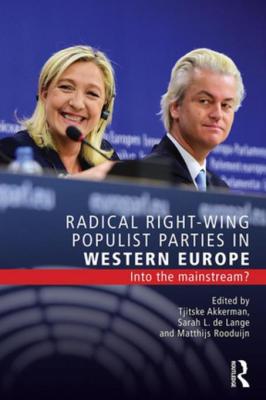
The rise of populism, and “renewal of isolationist policies in some locales, which would effectively reverse the economic liberalization and globalization trends of recent years” as I warned back in 1999, are symptoms of even broader transformational change that in the worst case harkens back to the dark days preceding World War II. Donald Trump, Nigel Farage and Rodrigo Duterte are by no means the only populists ascending to the worldwide political stage today. Others include Norbert Hofer (Austria), Marine Le Pen (France), André Poggenburg (Germany), Pawel Kukiz (Poland), Marian Kotleba (Slovakia), Recep Tayyip Erdoğan (Turkey) and Nicolás Maduro as well as his predecessor Hugo Chávez (Venezuela). Narendra Modi became India’s Prime Minister on a populist platform, although he recently stated that he is avoiding a “populist course.” In Thailand, the populist politician Thaksin Shinawatra rose to power democratically, and so did his sister, Yingluck, after Thaksin was deposed in a 2006 military coup. And Italy’s conservative populist Silvio Berlusconi first took power in 1994, though he is no longer Prime Minister.
Increasingly, these developments are rendering conventional political wisdom obsolete. The old-school ways, which rely upon centrist voters to nominate and elect mainstream candidates who lean either left or right, are becoming increasingly irrelevant. The advice of pols who cut their political teeth before the mid-nineties can no longer be counted upon to reliably predict the future.
Which is to say, to predict elections correctly in this day and age, it’s vital to filter out as much partisan noise and conventional wisdom as possible, and trust both the data and the models to speak for themselves. For me, time and time again, this meant resisting the temptation to fiddle with my projections based on what television, the Internet and even my confidantes were saying.
As mentioned earlier, during the Republican primary season I refreshed my projections nearly every week to reflect the actual outcomes as they occurred, remove candidates as they dropped out of the race, and incorporate the most recent polling data available. I began my first analysis on March 3rd, 2016, just after the “Super Tuesday” primaries, and it projected Trump would come up 87 delegates short. After that, every one of my subsequent analyses indicated Trump would win, except the one I published on March 25th, 2016, just after the Utah caucuses and the Arizona primary, when I projected he would fall 9 delegates short. My final analysis, on April 29th, 2016, projected Trump would enter the convention with 86 more delegates than he needed. The following Tuesday, Trump performed significantly better than my final projection, sweeping all of Indiana’s 57 delegates, and his main opponent Ted Cruz dropped out. It was game over.
The Philippine Presidential election was scheduled to take place the next week, on Monday, May 9th, 2016. I didn’t pay much attention until I spotted news reports labeling Duterte the “Trump of the East.”
Duterte had led every one of the 19 polls taken after March 25th, 2016, except three. Grace Poe, an independent businessperson, consistently placed second but never within the statistical margin of error. Curiously, another candidate, Mar Roxas, was tied with Poe in the first and led the second two of the three polls putting Duterte second or third. The last of those polls, which showed Roxas surging to a five-point lead, was also the final poll to be conducted before the election. Its immediate predecessor, conducted two days earlier by a highly-regarded polling organization, had shown Duterte leading Poe by 11 and Roxas by 13 points.
Shifts of that magnitude over such a short period of time always look suspicious to me. I started digging. It didn’t take long to discover that the organization which released the three polls showing Duterte second or third had never published any other polls, and the first of those three polls had been conducted merely three weeks before the election. I also learned that Roxas and his Liberal party were favored by outgoing Philippines President, Benigno Aquino III, himself a Liberal.
This was all the evidence I needed to disregard the final Philippines poll, and substitute its immediate predecessor. Seeing no need to apply any supplemental working hypotheses, I projected Duterte to win by 11 points. He actually won by 15.6 points over Roxas, and 17.6 points over Poe.
Next up was the Brexit referendum scheduled for June 23rd, 2016. I hadn’t initially planned to predict the outcome, but a lengthy conversation with my British confidante motivated me to give it a try. Using the working hypotheses, data and models I’ve already described, it took almost no time to predict that UK voters would choose to leave the EU. I shared my prediction with two confidantes in Singapore and sat back to watch the result, which ended up looking like this:
I began to analyze the US general election only on Sunday, November 6th, 2016. To save time, I quickly narrowed the scope of my analysis to 18 battleground states. These were Arizona, Colorado, Florida, Georgia, Iowa, Maine, Michigan, Minnesota, Missouri, Nevada, New Hampshire, New Mexico, North Carolina, Ohio, Pennsylvania, Utah, Virginia and Wisconsin. Victory appeared all but assured for Trump or Clinton in the remaining 32 states, as well as the District of Columbia, so I allocated their electoral votes as all key media outlets were unanimously projecting.
The latest available polls covering 13 of the 18 battleground states were conducted on November 6th, 2016, so most of the data was very recent. Altogether, I relied upon 31 polls from 16 different polling organizations. Notably, the oldest poll was conducted on October 25th, 2016, covering Minnesota. It showed Clinton with a 10 point lead. As it turned out, Clinton won Minnesota by only 1.4 points.
The latest polls, before any adjustments, pointed to a Clinton victory with 277 electoral votes versus 261 for Trump.
After adjusting the poll frequencies according to both the first and second alternate supplemental working hypotheses, the Electoral College model projected Trump the winner. So, I published my final prediction that Trump would win the US Presidency with 276 electoral votes versus 262 for Clinton.
U.S. Presidential Election Prediction by Nelson Nones
As at this writing, Michigan’s unofficial results show that Trump finished ahead of Clinton by just 13,107 votes in Michigan (0.3 points) but major news organizations, including the Associated Press (AP), have not yet called the race. If Trump’s current lead holds in Michigan, he will receive 306 electoral votes and Clinton will receive 232. Otherwise Trump will receive 290 electoral votes and Clinton will receive 248.
It’s perhaps premature to judge my forecast accuracy because Michigan still hasn’t been called. But if Michigan holds for Trump, my performance looks like this:
On a geographic basis, I have correctly predicted 50 of 55 (91 percent). The total includes 50 states, plus the District of Columbia, plus the four congressional districts in Maine and Nebraska.
On an electoral vote basis using either of the supplemental working hypotheses, I have correctly predicted 478 of 538 (89 percent).
In terms of the actual outcome, my prediction was 100 percent accurate.
I’ve also compared the latest polls as well as my projected winning margins against the actuals reported so far. The average statistical margin of error among the 31 polls within the scope of my final US general election analysis was 3.3 percent. So far, their average actual error is 4.2 percent with a 2 percent standard deviation, and the actual polling error exceeded the statistical margin of error in half the states I analyzed. Meanwhile, for either of the supplemental working hypotheses, the average actual error for my projected winning margins is 3.0 percent with a 0.5 percent standard deviation.
These performance measures tell me that none of my working hypotheses are likely to be disproven by the actual outcomes. Indeed, had I not framed them, and relied solely upon the latest available polls instead, I doubt that I would have correctly predicted any of these events except the Philippines Presidential election.
Conclusion
My method boiled down to framing hypotheses, adjusting the latest available polls according to my working hypotheses, if any, and running the adjusted data through deterministic models of voting systems and rules to project the winners. Along the way, especially during the Republican primary season, I discovered and corrected numerous errors of my own making. I am indebted to my confidantes for their information and critiques, and also for pointing out important details such as specific delegate allocation rules I’d overlooked. As such, my endeavors were error-prone at times and remained a constant work in process throughout.
In truth, along the way I judged my approach to be quite primitive. I didn’t (and couldn’t, from halfway round the world) consider the myriad soft factors or nuances that other prominent forecasters, with seemingly vast resources at their disposal, appeared to be incorporating into probabilistic models which seem far more elegant than mine.
But in the end, it’s the degree of objectivity combined with diligent work that really counts. And I can truthfully say that I did my best to leave my personal preferences outside the door, trust my cumulative experience and first-hand observations, incorporate my previous research, maintain a balanced point of view, and ultimately let the data points themselves guide me to my conclusions.
It’s a common complaint of people in business: E-mail is this great big blob that consumes way too much of their day.
And now we know just how much. According to a recent report published by Adobe — “E-Mail Survey 2016,” — white collar adults around the world are spending ~17% more time on e-mail activities today compared to last year. And on the business side, the growth is even bigger.
According to the findings of this research, which included surveys of ~1,000 American and ~3,000 European white collar workers, the time spent on work e-mails on a typical day is ~4 hours, while personal e-mail communications account for an additional ~3.3 hours.
This combined total of nearly 7.5 hours means that nearly one third of the typical day is spent working with e-mail communication.
Those findings suggest that other than sleeping, people spend more time on e-mail than on any other type of activity. How frightening is that?
[Findings among Europeans are much different, either, as this infographic illustrates.]
Contributing to the “always on” atmosphere, is the fact that smartphones have definitely become the “go-to” device for e-mail activities. Nearly 85% of the survey respondents reported that they check e-mail regularly on their smartphone, compared to around 70% who check their desktop or laptop regularly for e-mail.
In the workplace, the two devices are used approximately equally for e-mail activities, but on the personal side, smartphones have it all over other desktops and laptops. Nearly two-thirds report that they use their smartphones regularly for e-mail, compared to fewer than 30% who use other devices.
The other attribute that e-mail affects is the speed at which e-mails engage their recipients. The nature of e-mail is that it is “intrusive” and engenders a sense of time-sensitivity. For work e-mails that require a response, here’s how quickly those responses happen:
Within a few minutes: ~14%
Within 1 hour: ~29%
1 to 2 hours: ~24%
Within half a day: ~16%
Within 1 day: ~10%
1 to 2 days: ~5%
Longer than 2 days: ~2%
This means that two-thirds of work-related e-mails elicit a response from the recipient in two hours or sooner. But believe it or not, that’s not good enough; nearly three-fourths of the respondents expect to receive a response to their e-mail within that time period.
What this research proves is that although many people like to complain about e-mail communications taking over their lives, it’s actually become an integral part of daily life, to the degree that those same people are now conditioned to expect e-mail engagement in real-time.
In short, “always on” e-mail is now the norm. And if you don’t like that very much, there’s basically nothing you can do about it.
For more information on the results of the Adobe research, click here.
Only one presidential candidate was a winner on election night. But there was more than one loser.
Sure, minor-party candidates lost. But I’d posit that social media itself was a loser as well.
It isn’t an exaggeration to contend that the 18-month long presidential campaign has had a corrosive effect on the social media landscape.
You could even say that the social media landscape became downright “anti-social,” thanks to the 2016 campaign.
For those who might have posted politically-oriented social media posts, they’ve risked receiving strident arguments, flamethrower responses and alienated friends.
Along those lines, a recent Pew Research study found that significant percentages of people have blocked individuals or adjusted their privacy settings on social media to minimize their exposure to all the vitriol.
It’s a far cry from social media’s promise in the “good old days” – not so long ago actually — when these platforms enabled people to stay in touch with friends and make acquaintances across the country and the world that they would never have been able to forge in the days before social platforms.
The easy ability to share information and interests only added to the appeal of social media, as people expanded their horizons along with their network of friends.
Companies and brands got in on the action, too. They found social media a welcoming place – particularly in the case of consumer brands where companies could ride the wave of social interaction and promote all sorts of products, services and worthwhile causes.
Advertising and promotion on social media naturally followed, with many companies allocating as much as 20% or more of their annual marketing budgets to those endeavors.
Until quite recently, that happy scenario seemed to be holding, with brands launching interesting, fun, quirky or cause-oriented shareable content in the hopes that they would “go viral” and pay dividends far in excess of the resource outlay.
What a difference 18 months makes. Suddenly, brands are spending only about half as much on social media marketing as they attempt to stay above the fray. That also means staying far away from venturing into current topical discussions, lest their prickly digital audiences become instantly polarized.
Unfortunately, for brands who wish to avoid controversy arising from even the most seemingly innocuous of postings, social media is no longer a welcoming meadow of lush green grass and bright flowers. It’s closer to a war-torn field peppered with land mines just waiting to explode. Hence the hasty retreat.
Unfortunately, just like trying to unscramble an egg, it’s very hard to see social media ever going back to what it used to be.
And for that state of affairs, there’s plenty of blame to go around.
If you’re like many people, you may have begun to notice some telling changes in the “atmospherics” you encounter in your visits to the doctor’s office.
Perhaps the signs are just subtle, but things seem to be a little more stressed in the office – and a little less comforting for patients.
With the big changes happening in how healthcare services are delivered and how care providers are compensated, perhaps those changes are to be expected.
But a new survey of more than 500 physicians by InCrowd, a Boston-based market intelligence company focusing on the healthcare, pharmaceutical and life sciences fields, points to some unwelcome “collateral damage” that has to be concerning to everyone.
According to the InCrowd research results, three-fourths of the physicians surveyed do not feel that their healthcare facility or practice is doing enough to address the issue of physician burnout.
For the purposes of the research, burnout was defined as “decreased enthusiasm for work, depersonalization, emotional exhaustion, and a low sense of personal accomplishment.”
If three-quarters of the physicians think that too little attention is being paid to burnout issues, that may be one explanation for the changes in the “dynamics” many patients sense when they pay a visit to their doctor.
This doesn’t mean that the majority of physicians feel that they themselves have experienced burnout. But in two particular physician categories – emergency care and primary care – nearly 60% of the physicians surveyed reported that they had personally experienced burnout.
And most of the remaining respondents know other physicians who have experienced the same.
While burnout may be a more extreme condition, for many physicians the average day presents any number of challenges and frustrations. Nearly four in ten respondents reported that they “feel frustrated” by their work at least a few times weekly — or even every day.
The two biggest contributors to this frustration? Time pressures, and working with electronic medical records.
Perhaps the most startling finding from the InCrowd survey is that ~58% of the physician respondents say that they’re either unsure or wouldn’t recommend a career in medicine to a family member or child.
To me, that finding says volumes. When a profession goes from being the object of aspiration to something to be avoided … we really do have a problem.
What’s been your experience at your doctor’s office on recent visits? Do you sense a degree of tension or stress that’s more than before? Please share your thoughts with other readers.
Remember back in 2012 when Twitter introduced its Vine video sharing service?
Back then, observers were positively breathless in their accolades for the service, with some positing that Vine represented some sort of tipping point in the world of instant communications.
A little more than four years later … and as of November 1, Vine has just been shuttered. How is it that such a vaunted social media platform went from de rigeur to rigor mortis in such a short time?
There are several key reasons why.
Time and place: The year 2012 was a perfect time to launch Vine, as it coincided with when many companies and brands were shifting their focus towards video communications. At the time, short-form video was a novelty, making it a kind of dog whistle in the market. But Instagram, newly acquired by Facebook, swooped in and made a big splash, too, while Snapchat attracted younger audiences. What was Vine’s response to these competitor moves? If there was much of any, no one seems to have noticed.
Competing … with yourself: Strange as it may seem, Twitter itself ended up competing with Vine in 2015, launching its own branded video playback capabilities. When something like that happens, what’s the purpose of the older brand that’s doing the same thing? Twitter’s simultaneous foray into live-streaming was a further blow to a brand that simply couldn’t compete with these newer video services introduced by Vine’s very own parent company.
Commercial viability? — What commercial viability? In all its time on the scene, Vine never figured out a way to sell advertising on its network. It had a good germ of an idea in sponsored content, but never seemed to capitalize on the opportunities that presented, either.
Knowing your audience: From the outset, Vine attracted a fairly unique and crowd of users, such as people involved in the hip-hop music scene. It was vastly different from the typical user base in social media – and yet Vine never did all that much to support these users. As a result, there was little brand affinity to keep them close when the next “bright, shiny object” came their way.
In the social media space, the rise and fall of platforms can happen with amazing speed. Unlike some other platforms, Vine was a big hit from the get-go … but perhaps that turned out to be a double-edged sword. Vine never did figure out a way to “mature” with its audiences – which eventually left it behind.
In the end, Vine went out not with a bang, but with a whimper.
In theory, people love to have choices. But in practice, does having many choices always matter?
In the world of TV viewing, the answer seems to be … not so much.
New findings from Nielsen’s Total Audience Report finds that the average number of channels received by American viewers of TV is just over 200. But on average, people view fewer than 20 different TV channels during the course of a month.
That means that people are typically watching just 10% of the channels available to them.
[For purposes of the Nielsen report, “TV viewing” is defined as watching TV live or via DVR/time-shifted viewing.]
Trends shifting over time.
In a related report published by Marketing Charts, traditional TV viewing has declined in nearly every age group over the past five years.
Here’s how those stats break down:
Ages 12-17: Weekly TV viewing is down ~36% over the past five years
Ages 18-24: Down ~38%
Ages 25-34: Down ~26%
Ages 35-49: Down ~12%
Ages 50-64: Down ~2%
Ages 65+: Up ~5%
Clearly, younger generations are finding outlets for their leisure time other than traditional TV viewing. What’s more, time-shifted viewing remains only a small fraction of all TV viewing — no better than 90/10 split in favor of live TV in any of the six age categories tested.
So we have a combination of tradition asserting itself – people continuing to watch relatively few TV channels – along with some changing behaviors that promise to continue to upend the traditional TV industry.
More findings from the new Nielsen and Marketing Charts reports can be accessed here and here.
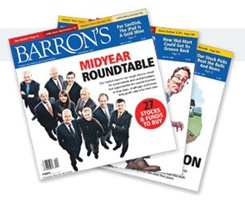
This past week, the business media world was buzzing about the inadvertent release of information concerning pending layoffs at Barron’s magazine, thanks to editor-in-chief Ed Finn mistakenly hitting “reply all” on a message intended for just one person.
But the more interesting news is what’s happening right now with two of America’s most important national print publishing properties: Barron’s and The Wall Street Journal.
Up until now, it was thought that a select handful of America’s largest and most pervasive publications with national reach and reputation would be the ones least susceptible to problems befalling the industry regarding declining advertising revenues and changing news consumption habits.
At or near the top of the list of those rarefied properties were these two publications for sure.
But now we know a different reality — or at least a more complicated one. WSJ editor-in-chief Gerard Baker announced last week that the publication is seeking a “substantial number” of employee buyouts to limit the extent of involuntary layoffs that will need to happen otherwise.
The WSJ buyout offer been extended to all news employees worldwide – managerial and non-managerial – and includes a lucrative voluntary severance benefit that’s 1.5 times larger than the company’s standard buyout package.
WSJ employees will need to make up their minds quickly, as the buyout offer is good only until the end of October.
As for Barron’s, its situation became public only after the Ed Finn memo was received in the New York City newsroom of The Wall Street Journal in error. The Finn memo, which had been intended for Dow Jones Media Group publisher Almar Latour, speculates on how The Wall Street Journal’s announcement might affect an upcoming round of layoffs at Barron’s.
That bit was “new news” to pretty much everyone.
Aside from the “drama” of news scoops happening because of unintentional actions, the bigger question is this: What do these layoffs and buyouts portend? Is it the end of the adjustments – or just the beginning?
Clues to that answer come in Gerard Baker’s memo, where he reveals that The Wall Street Journal has “begun an extensive review of operations as part of a broader transformation program.”
Let’s see what kind of “silver bullet” business strategy they end up devising – and whether it will have its intended effect.

 It’s no secret that the newspaper industry has been struggling with finding a lucrative business model to augment or replace the traditional print medium supported by subscriptions and advertising.








 Nones Notes