Cross-Currents in the Minimum Wage Debate

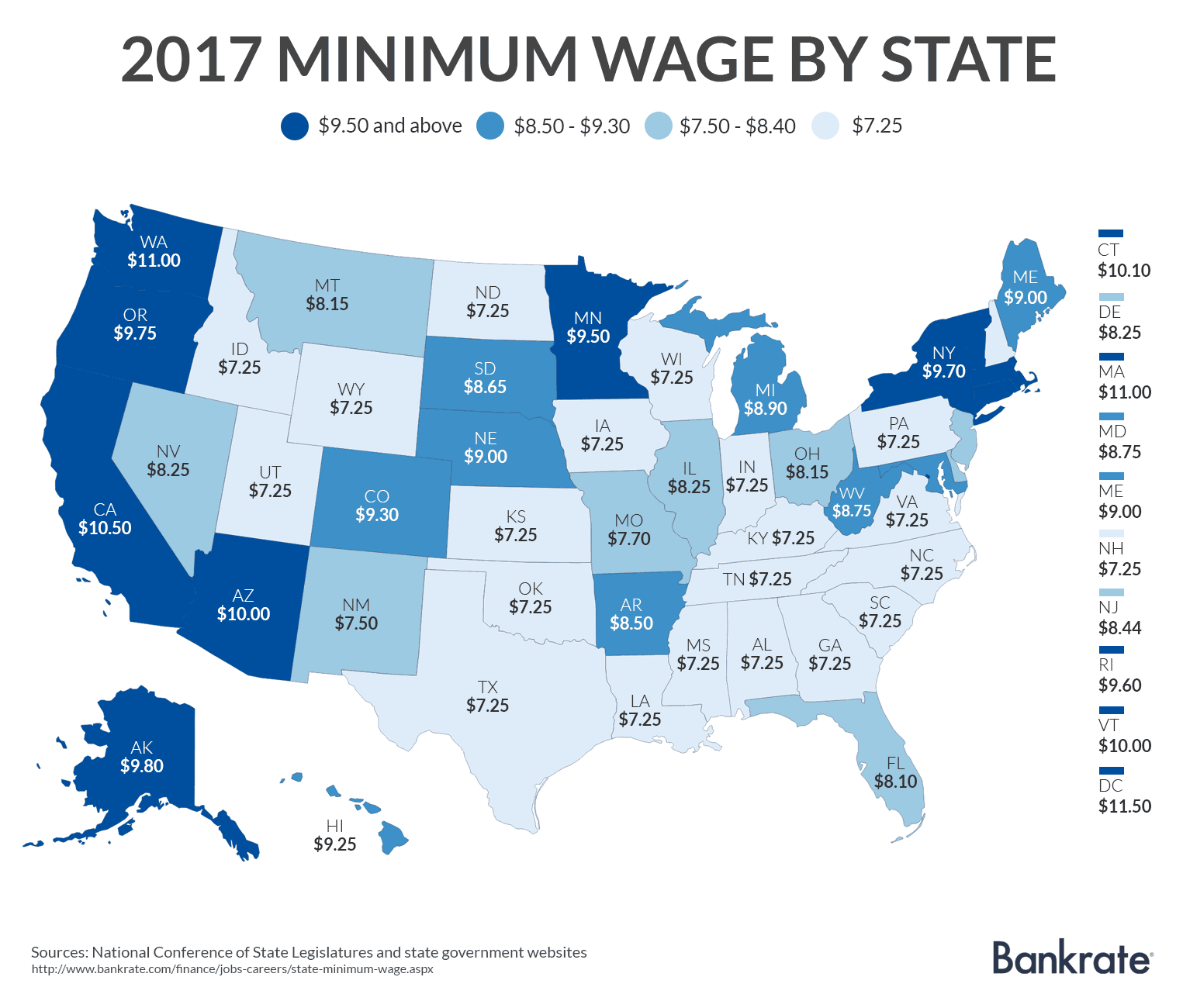
usmap-minimum-wages-2017This past November, there were increased minimum wage measures on the ballet in four states – Arizona, Colorado, Maine and Washington. They were approved by voters in every instance.

But are views about the minimum wage actually that universally positive?

A survey of ~1,500 U.S. consumers conducted by Cincinnati-based customer loyalty research firm Colloquy around the same time as the election reveals some contradictory data.

Currently, the federal minimum wage rate is set a $7.25 per hour. The Colloquy research asked respondents for their views in a world where the minimum wage would $15 per hour — a figure which is at the upper limit of where a number of cities and counties are now pegging their local minimum wage rates.

The survey asked consumers if they’d expect to receive better customer service and have a better overall customer experience if the minimum wage were raised to $15 per hour.

Nearly 60% of the respondents felt that they’d be justified in expecting to receive better service and a better overall experience if the minimum wage were raised to that level.  On the other hand, nearly 70% believed that they wouldn’t actually receive better service.

The results show pretty clearly that consumers don’t see a direct connection between workers receiving a substantially increased minimum wage and improvements in the quality of service those workers would provide to their consumers.

Men feel even less this way than women: More than 70% of men said they wouldn’t expect to receive better service, versus around 65% of women.

Younger consumers in the 25-34 age group, who could well be among the workers more likely to benefit from an increased minimum wage, are just as likely to expect little or no improvement in service quality. Nearly 70% responded as such to the Colloquy survey.

One concern some respondents had was the possibility that a dramatic rise in the minimum wage to $15 per hour could lead retailers to add more automation, resulting in an even less satisfying overall experience. (For men, it was ~44% who feel that way, while for women it was ~33%.)

Along those lines, we’re seeing that for some stores, labor-saving alternatives such as installing self-service checkout lanes have negative ramifications to such a degree that any labor savings are more than offset by incidences of merchandise “leaving the store” without having been paid for properly.

Significant numbers of consumers aren’t particularly thrilled with the “forced march” to self-serve checkout lines at some retail outlets, either.

Perhaps the most surprising finding of all in the Colloquy research was that only a minority of the survey respondents were actually in support of raising the minimum wage to $15 per hour. In stark contrast to the state ballot measures which were supported by clear majorities of voters, the survey found that just ~38% of the respondents were in favor.

The discrepancy is likely due to several factors. Most significantly, the November ballot measures were not stipulating such a dramatic monetary increase, but rather minimum wage rates that would increase to only $12 or $13 – and only by the year 2020 rather than immediately.

That, coupled with concerns about automation and little expectation of improved service quality, and it means that this issue isn’t quite as “black-and-white” as some might presume.


A Generational Shift within the American Workforce

bmI’ve blogged before about the cultural differences between older and younger Americans in the workforce. Some observers consider the differences to be of historic significance compared to previous eras, due to the confluence of various “macro” forces driving change at an extraordinary pace.

And somewhere along the way when few were looking, the millennial generation has now become the largest cohort in the American workforce.

And it isn’t even a close call: As of this year, millennials make up nearly 45% of all American workers, whereas baby boomer generation now comprises just over a quarter of the workforce.

According to a new report by management training and consulting firm RainmakerThinking titled The Great Generational Shift, there are actually seven groups of people currently in the workplace at this moment in time:

  • Pre-Baby Boomers (born before 1946): ~1% of the American workforce
  • Baby Boomers first wave (born 1946-1954): ~11%
  • Baby Boomers second wave (born 1955-1964): ~16%
  • GenXers (born 1965-1977): ~27%
  • Millennials first wave (born 1978-1989): ~27%
  • Millennials second wave (born 1990-2000): ~17%
  • Post-Millennials (born after 2000): ~1%

roowPersonally, I don’t know anyone born before 1946 who is still in the workforce, but there are undoubtedly a few of them — one out of every 100, to be precise.

But the older members of the Baby Boomer generation are fast cycling out of the workforce as well, with more than 10,000 of them turning 70 years old every day.

By the year 2020, the “first wave” Boomers are expected to be only around 6% of the workforce.  Meanwhile, Millennials are on track to represent more than 50% of the workforce by 2020.

Now, that makes some of us feel old!

The Great Generational Shift report can be downloaded here.

All those narratives about Amazon? They’re not exactly accurate.

abI doubt I know a single person under the age of 75 who hasn’t purchased at least one item of merchandise from Amazon over the years. And I know quite a few people whose only shopping experience for the holidays is a date with the Amazon website.

Still, some of the breathless stories and statistics that are put forward about Amazon and its business model seem almost too impressive to be true.

I’m not just talking about news reports of drone deliveries (a whole lot of “hat” and far less “cattle” there) or the idea that fully-robotic warehouses are just around the corner – although these stories do make for attention-grabbing headlines.  (Despite the continued need for human involvement, the way that robots are being used inside Amazon warehouses is still quite impressive.)

Moreover, a study published recently by BloomReach based on a survey of ~2,200 U.S. online consumers finds that Amazon is involved in most online shopping excursions, with nine out of ten online shoppers reporting that they check Amazon’s site even if they end up finding the product they want via another e-commerce resource.

More than half of the BloomReach survey respondents reports that they check on the Amazon site first — which is a new high for the company.

But are all of the reports about Amazon as credible?

Doug Garnett
Doug Garnett

Recently Doug Garnett, CEO of advertising agency Atomic Direct, penned a piece that was published in the December 2016 edition of Response Magazine. In it, he threw a dose of cold-water reality on some of the narratives surrounding Amazon and its business accomplishments.

Here are several of them that seem to contradict some of the commonly held perceptions:

“Amazon is a $100 billion retailer.”

Garnett notes that once subtracting Amazon’s non-retail revenue for 2015 (the last year for which financial data is available), the worldwide figure is more like half of that.

In the United States, Amazon’s retail sales are closer to $25 billion, which means it makes up approximately 6% of total retail sales.

That’s still very significant, but it isn’t the dominating presence as it might seem from all of the press hype.

“Amazon is profitable now.”

Yes, it is – and that’s after many years when the company wasn’t. However, approximately three-fourths of Amazon’s profits are due to selling cloud-based services, and the vast majority of the remaining profit dollars come from content delivery such as e-books plus music and video downloads.  So traditional retail hard-goods still aren’t generating profits for Amazon.

It turns out, just as retailers like Wal-Mart, Target and K-Mart have discovered, that replicating a retail store online is almost always a money-losing proposition.

To underscore this point, Garnett references this example of a merchandising campaign in 2016 as typical:

“When one unit was sold on Amazon, eight were sold at the retailer’s website and 80 were sold in the brick-and-mortar stores. The profit is in the store. 

For mass-market products, brick-and-mortar still dominates. Amazon is a nice incremental revenue stream, [but] not a valid alternative when you’re playing in the big game.”

It also means that companies that are looking to Amazon as a way to push their products into the marketplace should probably think twice.

At the very least, they should keep their expectations realistically modest.

ATMs look to the future … except that the future’s already been around for a while.

The new SelfServ 80 ATM from NCR
The new SelfServ 80 ATM from NCR.

Last week, the Yahoo newsfeed republished a trade article from BGR News titled “This Futuristic ATM Means You’ll Never Have to Go into a Bank Again.”

It was a rather breathless piece reporting that NCR (once called National Cash Register) will be introducing a new ATM dubbed the SelfServ 80 to a number of major banks as well as several community banking organizations.

In addition to dispensing cash, the SelfServ 80 machines have large touchscreens and video conferencing capabilities that will enable banking customers to do “virtually anything” they’d normally go into the bank to transact, according to the news article.

This includes applying for loans or credit cards – or any other communications that would typically occur with a bank officer.

It sounds quite intriguing – and major step forward for ATMs, which haven’t changed that much since they were unveiled decades ago.

It’s easy to forget that ATMs were among the very first devices to “automate” activities previous carried out by humans, because they’ve seemed rather “old hat” for a while.  They haven’t quite kept up with the times …

… Or maybe they have?

Reading this news piece my brother Nelson Nones, who has lived and worked outside the United States for more than 20 years, was amused.  Here’s what he wrote to me:

Those new machines from NCR may seem “futuristic” in the United States, but they are nothing new in the Far East. In Thailand, for instance, you can go to just about any bank branch and you’ll see three types of machines lined up in a row: 

ATMs (Automatic Teller Machines)

thai-banking-screenUnlike in the United States, these ATMs aren’t only for withdrawing cash and depositing checks. With your debit card you can also use these machines to transfer funds to other bank accounts within Thailand, and you can also pay bills, too – either on-the-spot or in advance.  Other functions are also available as well.  [See the image to the right.] 

Most consumer-facing businesses which send out monthly statements to customers put a barcode on the bottom of the statement. The ATMs have barcode scanners and so, when paying a bill, you just scan the barcode at the ATM.  All transactions take effect instantaneously. 

These services are available at any ATM – not just the ones at bank branches. As an example, every single one of Thailand’s approximately 9,400 7-Eleven stores has full-service ATMs for all the country’s banks. 

CDMs (Cash Deposit Machines) 

These machines allow you to deposit cash straight into your bank account – with or without a debit card. The machines come with money counters; just put your bank notes in the slot (local currency only) and the machine will count them for you. 

PUMs (Passbook Update Machines 

Passbook accounts might be a thing of the past in the United States, but they are still widely used in Thailand. Want to update your passbook?  Just go to any PUM and insert your book.  The machine will read it and then print all the transactions needed to bring it fully up to date. 

Of all the places I’ve ever visited, Thailand has the most automated banking machinery I’ve ever seen.

Imagine that: United States banking and commerce trying to keep up with … Thailand!

tatm
My brother providef this photo of an automated banking kiosk located in the lobby of a hospital in Bangkok, Thailand. (My sister-in-law is also in the picture, looking elegant and happy.)

What about you? If you’ve encountered similarly sophisticated financial services automation in other countries that makes the U.S. system seem hopelessly outmoded, please share your experiences as well.

More business management tools than ever … yet many small businesses stick with spreadsheets and other “outdated” processes.

csbr

It seems like there’s never been more information – and technologically based solutions — available concerning marketing, sales and other business operations support than there is today.

Just go online, type in a few keywords, and watch how many hundreds – in some cases thousands – of web links pop up. And there’s a lot that’s really quite beneficial and instructive.

But even with such a smorgasbord of information – much of it available free of charge – it can actually be overwhelming for owners and managers of small businesses.

Maybe it’s “analysis paralysis.”  Or perhaps something more fundamental.

Typically, small business owners wear many hats inside their companies — a jack of all trades and master of maybe just one or two.

The same dynamics are at work in the field of customer information management as well. Last year, the Harris Poll surveyed a group of small business owners on their practices in this realm, and the results were published this past December by SalesForce Research in its 2016 Connected Small Business Report.

The results showed that small business owners continue to rely on outdated processes such as spreadsheets (or even paper-based systems) to store and track their customer information.

As for more modern (digital) tools like CRM and analytics, it isn’t happening much at all.

For starters, more than 80% of the companies surveyed by Harris reported that they do not have any dedicated IT staff – so it comes as no surprise that nearly three-fourths of company owners are the ones responsible for making their companies’ technology buying decisions.

Here’s what the survey found:

  • Small business owner typically makes technology buying decisions: ~72% of respondents
  • A co-owner or business partner: ~28%
  • Chief technology officer, chief information officer or head of IT: ~4%
  • An outside vendor: ~3%
  • Chief financial officer: ~2%

Note: Tally above exceeds 100% due to multiple mentions.

Where is the technology spend going? Hardware expenses are the most significant, with financial software second in importance:

  • Hardware: ~46% of respondents cite as the majority of their annual technology spend
  • Financial software (e.g., accounting/bookkeeping and bill payment): ~33%
  • Productivity software (e.g., Microsoft Office): ~26%
  • Internet hosting/ISP services: ~22%
  • POS/POP software: ~20%
  • Telecommunications/VoIP: ~15%

E-mail and spreadsheet tools continue to dominate in terms of customer information management, and quite a few of the companies surveyed are still working with paper-based systems:

  • E-mail tools (Outlook, Apple, Gmail contact, etc.): ~44%
  • Spreadsheets (Excel, etc.): ~41%
  • Written customer ledger: ~34%
  • Basic database (e.g., Access, Quickbase): ~29%
  • CRM system or app (housed within the business): ~20%
  • Other paper-based practices: ~15%
  • CRM system or app (cloud-based): ~12%

And when it comes to customer service, small businesses rely on three major practices:

  • Direct phone contacts with customers: ~51%
  • Direct e-mail communication with customers: ~47%
  • Social media interaction: ~32%

So on balance, it looks as though most small business aren’t really tapping into many of the “new tools” that could help them manage their businesses and their sales, marketing and customer retention programs better.

It may be a similar dynamic to what we see with small investors. Today there’s more investment information available than ever before – and it’s right at people’s fingertips, too.  Even so, often the result is … to do nothing.  Whatever the choices are, so many investors make no changes at all to their investment portfolio.

And just like there are financial planners to assist the timid investor, there are plenty of business consultants ready and willing to guide small business owners in ramping up their operations.

But that’s another entire discussion, of course.

To access a copy of the 2016 Connected Small Business Report, click here.

Microchips migrate to people … and the legislators struggle to catch up.

mcrExpanding beyond their use in applications like IoT household appliances and pet location tracking, sensors and chips are now being embedded in people, too.

Last fall, The Wall Street Journal reported that as many as 50,000 microchips designed for people have been sold globally.  Each microchip kit includes a tag and an injection tool, and is priced at around $100.

More Australians have had chip implants than in any other country, but significant numbers of other people in European nations like Sweden and the Benelux countries have also stepped up to the plate for implants.

According to what I hear, the chip embedding process is easy and painless, as the devices are very small – not much bigger in size than a grain of rice.

But not everyone is thrilled about this latest “turn of technology.” And as a result – and hardly surprising – politicians are starting to become involved.

In a move aimed at trying to put the microchip genie back into the bottle, lawmakers in the state of Nevada have introduced legislation that would make it a felony to require a person to be implanted with microchips such as an RFID (radio frequency identification) or NFC (near field communication) devices.

The legislation doesn’t seek to outlaw the practice – but rather to make it illegal to mandate any such activities targeting any single individual.

Under certain circumstances, I can see how micro-chipping a person could not only be beneficial, it could be a life-saver. Consider situations where people are potentially in danger of kidnapping, or susceptible to violence from spousal threats.

No major opposition to the Nevada bill has been logged – so far. Still, I can’t help but think that this is yet another lame legislative attempt to restrain the inexorable march of technology — one that will come up woefully short.

Water finds its own level – and that’s never more true than in the realm of technological advancements.

But what are your own thoughts pro or con?  Please share your views with other readers here.

Getting a handle on survey response rates.

It turns out, there are some predictive factors.

sgOne of the nice things about the proliferation on online surveys in recent years is that, over time, we’ve come to understand survey response dynamics much better.

Of course, predicting response rates with flawless precision is impossible due to the individual attributes of each individual survey, the sample composition and so forth.  But thanks to a 2015 compilation of “bottom-line” information by content marketing specialist Andrea Fryrear, the following points are good ones for marketing personnel undertaking market survey work.

Surveys aimed at “internal audiences” outperform external ones.

Targeting an internal audience such as a company’s own employee base is likely going to generate higher response rates (in the neighborhood of 35% to 40%, give or take). For surveys of an external audience, it’s more like 10% or perhaps even lower.

The reason is simple: Surveys aimed at internal audiences are likely very-well targeted, whereas with an external audience, often it’s difficult to reach only the right type of respondents.  At least some of them will turn out to be poor targets.

Additional motivating factors.

Other factors that can influence survey response rates include:

  • Customer loyalty – People who feel a connection with the brand conducting a survey tend to be more likely to participate.
  • Brand recognition – Surveys that focus on well-known brands will typically outperform ones from an unknown source or dealing with unfamiliar brands.
  • Perceived benefit – The “WIIFM” factor.  For example, response rates can soar even higher if the respondent population is motivated by serious incentives.  I recall getting more than a 60% response rate on a mail survey and an external sample because the monetary incentive was a $2 bill.
  • Demographics – The reality is that certain segments of the population are more likely to respond to surveys than others.  Think everything from age and gender to ethnicity and geographic location.
  • Survey distribution – Certain audiences are used to interacting on social media … others online … still others offline.  Chances are, you already know which type of research targets those are within your target markets, and it should influence your choice of survey delivery.

Survey length can make or break your response and completion rates.

To achieve the highest response rates, ideally surveys should take five minutes or less to complete. Ten minutes or less is probably OK, too.  But anything longer than that will likely have deleterious effect on your response rate.

How many questions does this mean? On average, respondents can complete five closed-ended questions in a minutes’ time … but only two open-ended ones.

Survey reminders? Yes.

Particularly with online surveys, it’s a good idea to send reminder notices to those who haven’t completed surveys as you get closer to the cut-off date. Sending two or three reminders is a good rule of thumb … and try sending them at different times of the day or different days of the week to that you can reach as many different prospective respondents as possible.

Learning from the experience of the thousands of surveys administered every month should make it easier for marketers to ensure their next survey will generate successful results instead of flame out.  There’s really no reason for failure considering the wealth of “experiential information” that’s out there.

Putting the best face forward at Twitter.

tdWhen business results look disappointing, one can certainly sympathize with the efforts of company management to explain it away in the most innocuous of terms.

This may be what’s behind Twitter CEO Jack Dorsey’s description of his company’s 2016 performance as “transformative” – whatever that means.

Falling short of industry analysts’ forecasts yet again, Twitter experienced a revenue increase of only about 1% year-over-year during 2016.

Monthly active users didn’t look much better either, with the total number barely budging.

While I have no actual proof, one explanation of tepid active user growth may be that Twitter became the de facto “place for politics” in the 2016 U.S. Presidential election — which didn’t actually end in November and continues apace even today.

Simply put, for many people, politics isn’t their cup of tea — certainly not on a 24/7/365 diet, ad nauseum.

Quite telling, too, was the fact that advertising revenue showed an absolute decline during the 4th Quarter, dropping below $640 million for the period.

Even more disturbing for investors, the company’s explanation about the steps Twitter is taking to address its performance shortfalls smacks of vacuousness, to wit this statement from CEO Dorsey:

“While revenue growth continues to lag audience growth, we are applying the same focused approach that drove audience growth to our revenue product portfolio, focusing on our strengths and the real-time nature of our service.”

“This will take time, but we’re moving fast to show results,” Dorsey continued, rather unconvincingly.

One bright spot in the otherwise disappointing company results is that revenues from international operations – about 39% of total overall revenues – climbed ~12% during the year, as compared to a ~5% revenue drop domestically.

Overall however, industry watchers are predicting more in the way of bad rather than good news in 2017. Principal analyst Debra Aho Williamson at digital media market research firm eMarketer put it this way:

“Twitter is losing traction fast. It is starting to shed once-promising products such as Vine, and [to] sell off parts of its business such as its Fabric app development platform.  At the same time, some surveys indicate that Twitter is becoming less integral to advertisers’ spending plans.  That doesn’t bode well for future ad revenue growth.”

With a prognosis like that, can the next big drop in Twitter’s share price be far behind?

What do you think?

America’s shopping malls struggle to avoid becoming dinosaurs.

dm

America’s department store chains – and anchor stores at countless shopping malls across the country – are reporting another rounds of disappointing sales and profit figures following the 2016 holiday season.

It underscores what we’ve been seeing all over the country – dead or dying malls.

In fact, retail industry analyst Jan Rogers Kniffen predicts that about one-third of malls in the United States will shut their doors in the coming years.

That’s about 400 of the ~1,100 enclosed malls.

Equally startling, of the ~700 that remain, all but around 250 are expected to continue to struggle.

The problem is multi-faceted. At an estimated 48 sq. ft. of retail space for every man, woman and child in America, that’s a footprint that gotten too big.

“On an apples-to-apples basis, we have twice as much per-capita retail space than any other place in the world,” Kniffen says, adding that the United States is “the most over-stored” country anywhere.

The oversupply of retail space is challenged by changing customer tastes, too. Online shopping is a huge problem for malls, as is the rising popularity of off-price stores in lieu of the department stores like Macy’s and Penneys that have served as important anchors for mall properties all over the country.

Now we hear reports that Macy’s is planning to close numerous store locations during 2017, joining Sears and Penneys which have been doing the same thing over the past several years.

How will malls survive in the future? Recently, the McKinsey & Co. consulting firm issued a report that highlighted five ways malls can remain relevant to consumers today and in the future:

Mall of America (Bloomington, MN): Expansion Rendering

Entertainment – Even in the age of “interactive everything,” consumers – particularly younger ones – continue to seek out gathering places and “experiences.”  It’s one reason why some shopping malls have had to deal with large numbers of young people flooding their spaces – not always with pleasant results.  Malls seeking out tenants that provide entertainment hubs — such as theme parks and gaming parlors, edutainment, and even virtual-reality content and immersive experiences — will be able to draw customers from a wider geographic area who crave social interaction.

Food and drink – “Food is the new fashion,” some people like to say.  Successful malls are getting in on that action, incorporating popular dining options along with unique ones as a way of becoming destination locations.

Retail – Still a core aspect of malls, but with new twists, such as creating retail centers that are also learning zones that bring together consumers, retailers and entertainment.  McKinsey uses the example of a sporting goods store that also includes a fitness studio, or offline showrooms for online retail players.  More reconfigurable spaces that can be used for pop-up stores, special product launches and seasonal offerings are also options with potential.

Transportation – Getting to and from mall properties with ease is growing in importance, and where some creative thinking might go a way towards making some malls more attractive than others.

Technology – The more that malls can create a “seamless chain” between online and on-site shopping, the better their chances are for staying relevant in the new retail environment.  McKinsey posits a number of initiatives, such as creating “virtu-real” formats that provide consumers with a more interactive retail experience through the use of touchscreen navigation portals, virtual fitting rooms, allowing smartphones for e-checkouts, and click-and-collect services to help blend the offline and online shopping experience.

In sum, for shopping malls it means fundamentally rethinking their role — and then adapting their strengths to those of the virtual/interactive world.

If we check back in another five years or so, we should have a pretty good idea which tactics have been successful – and which mall properties, too.

Hopefully, the shopping mall closest to your home won’t look like the one at the top of this article.

Internet-connected TVs now dominate the market.

ictvRecently I blogged about how many Americans are now living in cellphone-only households.

Bottom-line:  It’s a major percentage.

A parallel development is the extent of Internet-connected TVs that are now in place in U.S. households. According to a recent survey of ~2,000 U.S. adult broadband users by The Diffusion Group, Internet-connected TV penetration has now risen to 74%.

This chart shows the penetration trends over the past four years:

  • 2013 Internet-connected TV penetration: ~50%
  • 2014: ~61%
  • 2015: ~70%
  • 2016: ~74%

What these figures show is that almost three fourths of U.S. households now have an Internet-connectable television, which is up about 50% since 2013.

With more consumers wanting to set up their own in-home networks, TV manufacturers saw this trend developing and began flooding the retail market with “smart” televisions. As a result, most any consumer looking to purchase a TV set these days is likely to end up with one that is Internet-connectable, whether they feel they need it or not.

This is a back door into the world of consumer IoT; both the TV and the smartphone are the prime facilitators for the adoption of the Internet of Things in the home.

But like with many other technological waves, actual adoption rates can lag. For many people, watching TV on Internet-connected equipment is still only “potential” viewing rather than actual viewing.  Just as some consumers who own the latest smartphone models never use them to watch videos, homes that replace a TV set with the latest Internet-connectable model don’t necessarily use the added built-in functionality — at least initially.

Still, one suspects that with this technology now at people’s fingertips, it won’t be much longer before we start seeing actual usage catch up with the potential that’s there.