When it comes to cyber-security, high-visibility data breaches get all the press, which is understandable.
But small businesses are also victims of cyber-attacks. And sometimes those events can be financially devastating.
Now a newly published survey quantifies the extent to which small businesses are at risk. The National Small Business Association polled nearly 850 U.S. small business owners (most with annual revenues between $500,000 and $25 million) in August 2013). The NSBA survey found that nearly 45% of the respondents’ businesses had been the victim of cyber attacks such as malware, spyware or banking Trojans.
The average cost of these cyber attacks was reportedly nearly $9,000 – with some dollar amounts going much higher.
Separately, another study shows that a record number of cyber attacks targeted small businesses in 2012. Verizon’s Data Breach Investigations Report examined 855 data breaches and found that over 70% of them involved victim companies with fewer than 100 employees.
Verizon’s 2013 report is showing a continuing increase in cyber attacks on small business, meaning that 2012 was no fluke.
What’s going on here?
According to the Verizon study’s conclusions as well as comments from security experts like Vikas Bhatia, small and medium-sized businesses could be doing a better job of “offensive defense.”
Among the mistakes commonly observed in small businesses are these:
Lack of conducting regular backups of business data
Neglecting to store backed up data offsite
Failing to test data restore functions on a periodic basis
Neglecting to keep antivirus software up to date, including software patches and updates
Practicing sloppy password protection behaviors (using plain-language passwords … using identical passwords across multiple accounts, etc.)
Not understanding cloud-based data storage and what outsourced providers’ liabilities are (and are not) for protecting data
There’s no question that cyber-security continues to be a big challenge – and probably a growing one – for many companies.
But it’s also pretty evident that many businesses could be doing more to protect themselves from the heartburn (and financial fallout) along the way.
With the interminable discussion and disagreement about the (so-called) Affordable Care Act we’ve been having lately, it’s easy to lose sight of some of the other important developments in health care and related behavioral trends.
The survey, conducted among nearly 1,100 Americans age 18 or older by healthcare communications consulting firms Makovsky Health and Kelton Global, shows that U.S. adults visit a physician three times per year, on average. That’s not much different from what previous research shows.
At the same time, however, American consumers now spend an average of over 50 hours per year researching health information on the Internet. And they’re accessing such information all over the place – from health-oriented websites to social media.
WebMD continues to have pride of place among healthcare online resources:
WebMD: ~53% of adults access during the year
Wikipedia: ~22%
Health magazine websites: ~19%
Advocacy group websites: ~16%
YouTube videos: ~10%
Facebook: ~10%
Blogs: ~10%
Pharmaceutical company websites: ~9%
Because health subject matters can be rather complicated or detailed, one would suspect that most people might do their research using a PC rather than devices with less screen-viewing or printing capabilities. And this research bears that out:
~83% use PCs the most to find health information online
~11% use tablets the most
~6% use smartphones the most
[However, tablet usage has grown from just 4% in the 2012 survey, while PCs have declined by a similar margin.]
The influence of consumers’ own doctors remains as strong as ever. When asked what would motivate consumers to visit a pharmaceutical company’s website for information, the survey respondents cited physicians over any other motivational influence:
Physicians: ~42% of respondents would be motivated by this source
News articles: ~33% would be motivated
TV advertising: ~25%
Drug discount card: ~14%
Magazine advertising: ~13%
Web/online advertising: ~11%
Newspaper advertising: ~9%
Radio advertising: ~9%
… All of which leads one to wonder if most of the dollars being spent by pharma companies on radio, TV, magazine and web advertising are simply wasted.
Really, this type of pharmaceutical advertising would appear to be “spray and pray” … on steroids.
Here’s a final piece of information from the Makovsky/Kelton survey that was quite revealing — perhaps even startling: With all of the talk about the Affordable Care Act, as of the time of this survey a few months back, one-third of respondents reported that they had never spent any time researching the reforms and how they might affect them.
… And another third indicated that they had spent less than one hour total researching the topic.
“Big data” is definitely one of the more commonly heard business buzz terms these days.
But beyond the general impression that “big data” represents the ability to collect and analyze lots and lots of information in some efficient manner, most people have a difficult time explaining with any specificity what the term really means.
Moreover, for some people “big data” isn’t very far removed from “big brother” – and for that reason, there’s some real ambivalence about the concept. Consider these recent “man on the street” comments about big data found online:
“Big data: Now they can crawl all the way up your *ss.”
“The scary thing about big data is knowing [that] Big Brother can know every single thing you do – and realizing your life is too unimportant for Big Brother to even bother.”
“Big data is what you get after you take a big laxative.”
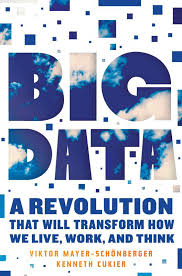
The book explores the potential for creating, mining and analyzing massive information sets while also pointing out the potential pitfalls and dangers, which the authors characterize as the “dark side of big data.”
The book also exposes the limitations of “sampling” as we’ve come understand it and work with it over the past decades.
Authors Viktor Mayer-Schonberger (l) and Kenneth Cukier (r).
Cukier and Mayer note that sampling works is fine for basic questions, but is far less reliable or useful for more “granular” evaluation of behavioral intent. That’s where “big data” comes into play big-time.
The authors are quick to note that advancements in data collection tend to come along, shake things up, and then quickly become routine.
Mayer calls this “datafication,” and describes how it works in practice:
“At first, we think it is impossible to render something in data form. Then somebody comes up with a nifty and cost-efficient idea to do so, and we are amazed by the applications that this will enable – and then we come to accept it as the ‘new normal.’ A few years ago, this happened with geo-location, and before it was with web browsing data gleaned through ‘cookies.’ It is a sign of the continuing progress of datafication.”
Causality is another aspect that may be changing how we go about treating the data we collect.
According to Cukier and Mayer, making the most of big data means “shedding some of the obsession for causality in exchange for simple correlations: not knowing why but only what.”
So then, we may have less instances when we come up with a hypothesis and then test it … but rather just use the data to determine what is important and act on whatever information is revealed in the process.
One example of this practice that’s cited in the book is how Wal-Mart determined that Kellogg’s® Pop-Tarts® should be positioned at the front of the store in selected regions of the country during hurricane season to stimulate product sales.
It wasn’t something anyone had thought about in advance and then decided to verify; it was something the retailer discovered by mining product purchase data and simply “connecting the dots.”
Author Mayer explains further:
“There is a value in having conveniently placed Pop-Tarts, and it isn’t just that Wal-Mart is making more money. It is also that shoppers find faster what they are likely looking for. Sometimes ‘big data’ gets badly mischaracterized as just a tool to create more targeted advertising … but UPS uses ‘big data’ to save millions of gallons of fuel – and thus improve both its bottom line and the environment.”
One area of concern covered by the authors is the potential for using “big data predictions” to single out people based on their propensity to commit certain behaviors, rather than after-the-fact. In other words, to treat all sorts of conditions or possibilities in the same manner we treat sex offender lists today.
Author Kenneth Cukier believes that the implications of a practice like this – focusing on the use of data as much as the collection of the data – is “sadly missing from the debate.”
This book fills a yawning gap in the business literature. And for that, we should give Dr. Mayer-Schönberger and Mr. Cukier fair dues. If any readers have become acquainted with the book and would care to weigh in with observations, please share your thoughts here.
Back in February 2010, Americans over the age of 18 spent a total of ~451 billion minutes’ time on the Internet, according to comScore’s Media Metrix research.
By comparison, in February 2013, the total time spent online had nearly doubled to ~890 minutes.
The vast majority of the increase is attributable to tablet computers and smartphones rather than PCs:
PC minutes rose from ~388 billion to ~467 billion (+24%).
Smartphone minutes grew from ~63 billion to a whopping ~208 billion (+230%).
Tablet minutes grew from zero to 115 billion (tablets didn’t exist in 2010).
In fact, taken together, smartphones and tablets now account for nearly 60% of the time online spent by people age 18 to 24. On the other hand, smartphones account for a relatively small 25% of time spent online by Americans age 50 or older.
This age divide is also clearly evident in comScore’s estimated breakdown of platform adoption:
All American Adults
PC only: ~30%
“Screen jumpers” (PC + mobile): ~63%
Mobile platforms only: ~7%
Young Adults (age 18-24)
PC only: ~22%
Screen jumpers: ~65%
Mobile only: ~13%
Older Adults (age 50+)
PC only: ~48%
Screen jumpers: ~51%
Mobile only: ~1%
The comScore analysis also provides some interesting stats pertaining to online share of minutes by the type of content being accessed.
Most online time spent on PCs:
Business/Finance (~68%)
TV (~68%)
News/Information (~62%)
Sports (~62%)
Retail (~49%)
Health (~54%)
Most online time spent on smartphones:
Radio (~77%)
Social Media (~58%)
Weather (~55%)
Games (~48%)
Tablets don’t lead in any single category, but score particularly well in these two:
A few weeks ago, I was driving to work on the main two-lane state highway here in our semi-rural corner of Maryland. It was the Friday before Labor Day weekend, so traffic was lighter than usual. It was also a clear day, with no wet roads or fog.
In other words, a perfect day for driving.
All of a sudden, an oncoming car drifted into our lane. In fact, it appeared as if it was purposefully targeting the vehicle about four or five car lengths in front of me.
In the inevitable collision that occurred (thankfully not completely head-on but sickening enough at 55 mph), there were injuries and ambulances … a closed road for 90 minutes … statements to the police required of myself and others … and two wrecks to be towed.
The cause of this accident had to be a case of distracted driving – perhaps reaching for a smartphone, checking a text message or some other action that took eyes off the road just long enough to cause a serious accident.
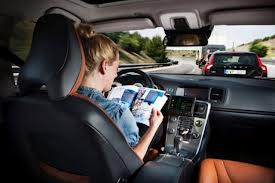
It got me to thinking about recent news reports touting “self-driving” cars of the future.
Certainly in a case like this accident, self-driving features like nudging the vehicle back into the correct lane could have easily prevented this accident from ever occurring.
Self-driving vehicles seem like a very nice idea in theory, and in practice they’re not very far off — at least if the news reports are to be believed.
Nissan, Volvo, Daimler-Benz and other leading car companies are predicting that commercial models will be a common sight on the road by about 2020 … and by about 2035, a majority of cars operating will have this technology.
But in order to get there from where we are now, we’re going to have to deal with numerous challenges. Here are a few that seem particularly nettlesome:
Will operators of self-driving cars require a different kind of vehicle training?
How will highways accommodate vehicles with and without drivers?
Will self-driving cars perform equally well in different road environments – ordinary roads in addition to super-highways?
Insurers will need to figure out who is at fault if a self-driving car crashes – the car or the driver?
How will automotive manufacturers ensure that cars’ onboard computers can’t be hacked?
And here’s another technology challenge: What sort of back-end servers will be required to process the huge amounts of vehicular data … as well as secure ways for cars to communicate in real-time with the cloud and other vehicles? (Daimler has reported that its self-driving test vehicle produces 300 gigabytes of data every hour from its stereo camera alone.)
And lest you become really anxious, don’t think very hard about the kind of data that’s being captured, chronicled and saved on each and every self-driving car’s trip – including “where it’s been when” and “how fast it got there.”
I also wonder about the transition period when there will be a mix of self-driving cars and traditional vehicles sharing the road.
If self-driving cars “react” to other vehicles so easily, won’t it be really tempting for driver-operated vehicles to make end-runs around self-driving cars or otherwise cut them off, knowing that those cars are programmed to move out of the way to prevent a collision?
Roy Goudy, a senior engineer at Nissan, has commented that since “autonomous” cars can react more quickly to potential hazards than can cars driven by people, it will be difficult to have both on the road at the same time.
“What are the rules in that environment, and what do we do to enforce those rules?” Goudy asks.
I think the future of driving is a very intriguing subject. Self-driving vehicles could mean far fewer traffic-related injuries and deaths … and it could bring more mobility and independence to disabled people and the elderly.
I hear grumbling from industry colleagues pretty often about how the current U.S. presidential administration seems to be reflexively “against” business.
I don’t agree that the administration is opposed to the idea of private-sector business. I think the vast majority of administration officials (if not all) believe that a vibrant private business economy is important to the viability of a society.
It doesn’t take an economic genius to figure out that if there aren’t jobs, there isn’t going to be prosperity. Certainly, no one thinks new jobs are going to become available if businesses are doing badly.
The alternative to private industry is state-run economies à la Cuba, North Korea and the old Soviet Union. How’d those experiments turn out?
So, no — I don’t believe the current administration has it “in” for business.
Maybe the problem is that administration officials don’t understand what it’s like to be in business – the day-to-day challenges of managing a company that can deliver quality, competitively priced goods and services that people need, want, and will pay money for.
And also … to manage a business in a way that attracts and keeps quality employees who are motivated, and who feel valued and fulfilled in their daily work.
In today’s global economy, successfully threading the needle on all of these factors is easier said than done!
But I came across a graphic recently that may point to a different explanation. The chart I saw is based on research by financial markets specialist and investment analyst Michael Cembalest that was published Forbes magazine.
It lists the percentage of past American presidents’ cabinet members who had worked in the private business sector prior to their appointment to the cabinet. (Cabinet members whose experience in the private sector was limited to legal counsel were not counted.)
From high to low, here are the percentages Cembalest came up with:
Dwight Eisenhower: 58%
Ronald Reagan: 56%
George W. Bush: 53%
Richard Nixon: 53%
George Herbert Walker Bush: 52%
Woodrow Wilson: 51%
Franklin Delano Roosevelt: 50%
Harry Truman: 50%
Warren Harding: 48%
Calvin Coolidge: 47%
Lyndon Johnson: 46%
Gerald Ford: 43%
Herbert Hoover: 40%
Robert Taft: 39%
Bill Clinton: 37%
Theodore Roosevelt: 37%
Jimmy Carter: 32%
John F. Kennedy: 29%
Barack Obama: 21%
One can argue the specifics of the research – such as whether those providing only legal services could be counted as people with private business management experience or not. But the overall message is pretty clear about the current administration’s paucity of first-hand private-sector business experience.
It’s difficult to really understand something unless you’ve had some degree of personal experience with it. So why should it be so surprising that businesses feel that the administration is so blind to their challenges?
Let me add one more point that remains vivid in my memory, even though it happened a few years ago.
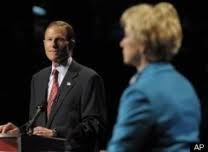
Clueless in Connecticut? Business executive Linda McMahon schools Attorney General Richard Blumenthal on how jobs are really created (2010 U.S. senate campaign).
In the 2010 U.S. senate race in the state of Connecticut, the state’s attorney general Richard Blumenthal was running against business executive Linda McMahon. During a televised debate, Ms. McMahon asked her opponent how jobs are created.
Here’s a verbatim transcript of that interaction:
McMAHON: Mr. Blumenthal, how do you create a job?
BLUMENTHAL: A job is created and it can be in a variety of ways, by a variety of people but principally by people and businesses in response to demand for products and services. And the main point about jobs in Connecticut is we can and we should create more of them by creative policies and that’s the kind of approach that I want to bring to Washington. I have stood up for jobs when they’ve been at stake. I know about how government can help preserve jobs and I want programs that provide more capital for small businesses, better tax policies that will promote creation of jobs, stronger intervention by government to make sure that we use the made-in-America policies and buy-America policies to keep jobs here rather than buying products that are manufactured overseas …
McMAHON: Government, government, government! Government does not create jobs. It’s very simple how you create jobs: An entrepreneur takes a risk. He or she believes that he creates a good or service that is sold for more than it costs to make it. And if an entrepreneur thinks he can do that, he creates a job.
Regardless of your personal politics or what you think about the two individuals who were running for the Connecticut senate seat in 2010, to me this exchange was really telling.
Richard Blumenthal has spent his entire career as an attorney in the public sector or as an elected official. Is it any wonder his thoughts on job creation sound like the meanderings of an Econ 101 student, three weeks into the course?
But unfortunately, there are thousands more just like Blumenthal: People in elected and appointed offices all across the United States – people in positions of power who are basically clueless about business.
There’s no question that Spotify has been an up-and-comer in the music streaming business. Speaking anecdotally, over time more and more of my friends and family members have been signing up for the service.
And now, Spotify is pushing forward with an even more aggressive growth strategy … and it’s not aiming low at all.
In fact, the company is seeking backers at an eye-popping valuation level of $5.3 billion.
And to top it off, the company’s co-founders (Daniel Ek and Martin Lorentzon) intend to raise the funds not through equity investment, but through loans.
It seems neither person wishes to give up any more of the company to investors than has already happened.
What makes the $5.3 billion valuation so startling is not just the amount – big though it is. It’s because that the last business valuation of Spotify, done less than 12 months ago, pegged the company’s value at just $3 billion.
That time around, a number of institutional investors stepped up to the plate (including Coca Cola, Fidelity and Goldman Sachs). But don’t look for more institutional investment in this round of funding.
In the case of Spotify, being second or third in the music streaming market segment has turned out to be a good thing. Pandora and others were the pioneers, laboring in the vineyards for many long years before proving out the business model.
Then along comes Spotify and cleans up in a market space that people now understand fully.
At the moment, Spotify has around 6 million paying users in 28 countries — along with several times that number of people who use Spotify’s free, ad-funded services. Spotify streams music across desktops and mobile devices along with other music gear.
The company reports that it pays approximately 70% of total revenues back to music rights-holders. It’s not profitable yet … but how many years was Pandora bleeding red ink? The better part of a decade, certainly.
There continues to be some low-level grumbling about how Spotify handles payouts to the “bigger name” performers in the music industry.
According to some reports, Spotify pays only about $0.005 per stream. That means only big stars (the likes of Beyoncé and others) can make any meaningful money from the service.
But for anyone who thinks that $5 billion+ is a tad rich when it comes to the valuation of a business property like Spotify … remember that Skype was sold to Microsoft for $8.5 billion in 2011, after having been valued at just $2.75 billion two short years before.
So maybe the whole thing isn’t so far-fetched after all.
When social media burst on the scene, it was considered by many marketers as a way to level the playing field when it comes to brand-building.
All of a sudden, the “little guy” had just as big a platform from which to trumpet key messages – especially if those messages were clever, intriguing or super-timely.
But something has happened over the past year or so.
As user participation in Twitter, Facebook, Pinterest, LinkedIn and other social platforms has grown and matured, these platforms are now requiring far more “pay to play” from those who post messages to them.
Whereas before, a simple Facebook post would be served to an entire “friend” or “like” or list, now it’s far fewer than 20% who will see the post.
That is, unless the poster (whether it be a company or a person) is willing to put up some upfront cash.
Can a post or a tweet still make an impact? Certainly.
Consider the case of Hasan Syed. He’s a Chicago-based business owner who took to Twitter last week to complain about the alleged shoddy treatment he and his father were subjected to by British Airways after the father’s luggage was lost during an international flight.
Had Mr. Syed uploaded a simple tweet, it would have had next-to-no impact.
But as a business owner – and a successful one with sufficient discretionary income – Mr. Syed was able to pay ~$1,000 for a “promoted tweet” that he directed at the UK and NYC markets.
The tweet said:
@British_Airways is the worst airline ever. Lost my luggage & can’t even track it down. Absolutely pathetic #britishairways
Instead of only Mr. Syed’s ~1,200 Twitter followers being the only to see the tweet, the promoted (paid) tweet reached nearly 80,000 people in the targeted geographic area – and in the process, garnered almost 15,000 “engagements” (retweets or favorites).
Needless to say, that got British Airways’ attention – and it got Mr. Syed’s father’s luggage back as well.
But the larger point is that social media is starting to behave more like other media with every passing day.
Just as traditional media benefits the “heavy hitters” with the biggest pockets the most … social media does now, as well.
This isn’t to say that the wonders of interactive communications don’t provide opportunities for smaller companies to make a splash in the market. Thanks to social platforms, it is possible to make more “marketing noise” on a broader basis and with a lower dollar investment than back in the pre-social days.
It’s just that you can’t accomplish it on a shoestring budget anymore. Those days are definitely gone.
Can it be possible that widespread public revulsion at the level of federal government conference and travel expenditures has actually had a positive impact?
It seems so, if new financial reporting is to be believed.
According to recent reports filed by the General Services Administration, federal travel card spending has declined ~17% so far in FY 2013 compared with the same period last year.
That’s for the GSA’s SmartPay charge card program which covers more than 2.5 million cardholders. And it’s the second year in a row that we’ve seen a drop in expenditures:
FY 2011: $9.6 billion
FY 2012: $8.9 billion
FY 2013 (YTD): $6.0 billion
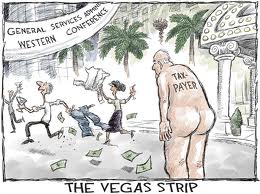
According to GSA officials, the decline in travel-related spending has happened because of “aggressive steps” taken to cut conference spending in the wake of embarrassing revelations that a single GSA conference in Las Vegas in 2010 had cost American taxpayers nearly $825,000.
The fact that this meeting included paying clowns and mindreaders to lead group discussions added an absurd twist on the entire affair.
In May 2012, the Office of Management and Budget issued a memo directing federal agencies to reduce their travel-related spending by 30% compared to 2010 levels – and to maintain those levels through FY 2016.
Another directive required agencies to report spending on any conference that exceeds $100,000.
Looking out over the government agency landscape, it appears that most agencies have made some pretty big strides towards meeting the new standards.
Comparative travel expense figures released by the GSA for FY 2013 through July against FY 2012 over the same period show these declines:
General Services Administration: -62%
Veterans Administration: -31%
Treasury: -30%
Energy: -25%
Commerce: -23%
Labor: -23%
Environmental Protection Administration: -21%
Housing & Urban Development: -21%
Defense: -19%
Justice: -19%
Transportation: -18%
State: -16%
Interior: -12%
A few agencies did show increased travel expenditures. Most significantly, the Small Business Administration doubled its expenses due to Hurricane Sandy and other natural disasters that required additional travel associated with putting manpower on location to provide financial assistance to homeowners, renters and businesses.
But taken as a whole, these expenditure drops are unprecedented.
I wonder how many people would have predicted it – even though most people I know figure that there’s plenty of “fat” to cut within these agencies without hurting the programs.
It’s just that … we so rarely hear of reports like this in government.
And of course, there’s plenty of grousing to go around about the new realities. One Department of Defense official who requested anonymity was quoted as saying, “When someone craps their pants, we all have to wear diapers. This is hardly the way to run the DOD efficiently.”
And then there’s this: Lest you think that we’ve put a lid on excess travel-related expenditures for good, the GSA has just announced that it will be unfreezing per diem rates for FY 2014.
That is correct: The GSA is now increasing the lodging, meal and incidental allowances that federal employees are reimbursed for expenses incurred while on official travel. It’s going up to $129 in most markets within the 48 contiguous states.
Directors Vincent Vittorio and Nathan McGill have produced a film that’s both realistic and optimistic – two words that aren’t often used in conjunction with one another when the topic is manufacturing.
The directors don’t shy away from the facts: U.S. manufacturing jobs shrinking from ~$17 million to just ~$12 million in the past 20 years due to technology, global competitiveness and outsourcing.
But there are signs of recovery. At least the anectodal evidence for it is strong.
In August, Wal-Mart organized a manufacturers’ summit which was attended by ~1,500 people including U.S. and foreign-based companies, Department of Commerce and Federal Reserve officials, and eight state governors.
At this meeting, Wal-Mart affirmed its commitment to buy $50 billion in additional American-made products over the next 10 years. GE, Element and other companies also announced plans to boost domestic manufacturing activities.
These developments aren’t merely patriotic or altruistic — although there may be some of that factoring into the decision.
In fact, with Chinese labor costs rising 15% to 20% each year, that country’s labor cost advantage is narrowing compared to the United Sates.
Harold Sirkin of Boston Consulting Group points out that factoring in raw materials and other costs, China maintains only a ~3% lead on product costs. Add in transportation costs from Asia, and the “Made in America” alternative takes on new validity.
“We are at an inflection point,” Sirkin has stated, noting that the United States is now competitive with China.
GE’s chief executive officer Jeff Immelt echoes these sentiments, contending that on a relative basis, America has never been more competitive thanks to technology and improved productivity.
“High transportation costs mean you want to be closer. It’s not just pure labor arbitrage,” Immelt notes.
As for productivity, the mere three hours it takes to assemble a GE refrigerator in America makes its total cost lower than a similar Chinese or Mexican-made models destined for the American market, according to Immelt.
I like what I’m hearing about the coming resurgence in American manufacturing … but I think we’ve heard this prediction before.
The film directors discovered this inconvenient issue when traveling the United States and visiting manufacturing plants from large cities to small towns: There’s a sizable gap between what manufacturers need in human capital, and the ability of the labor force to meet those requirements – whether it be older workers, or young workers right out of school.
“American Made Movie” documentary film directors Vittorio and McGill.
“We need to provide the apprenticeship training necessary for a new generation of American workers to grow as fast as our technology is changing,” the documentary movie directors contend.
That may be happening at some technical colleges and a few community colleges across America. But it’s not happening nearly enough if, like me, you hear constant complaints from manufacturing execs about the disconnect between the lack of (even basic) job skills and (increasingly sophisticated) job requirements on the manufacturing line.
Maybe it’s time to look harder at appropriating pieces of the German/Austrian apprenticeship model, wherein talented students are plucked from high school and placed with manufacturing firms for on-the-job training in lieu of college.
In such environments, a structured program of learning and training provides the roadmap for successful transition and integration into the job force.
An apprenticeship may not seem as “classy” an accomplishment as a college diploma. But a college diploma doesn’t mean nearly as much these days.
What once was a sure-fire ticket to a career has given way to an environment in which half of all new college graduates are unemployed, underemployed, or working jobs for which their degree is irrelevant or unnecessary.
To that half of the young labor force, the near-100% placement/success rate for apprenticeships must seem awfully attractive now.
What are your thoughts about a coming manufacturing renaissance in America? Please share your comments here.

 When it comes to cyber-security, high-visibility data breaches get all the press, which is understandable.











 Nones Notes