Twitter is looking more and more like the old, hidebound player in social platforms.

tWe’ve been hearing for a while now that Twitter’s go-go-days might be in the rear-view mirror.

But even so, the latest growth forecast for the company still seems pretty shocking for a “new media” participant.

In its most recent forecast of Twitter usage in the United States, eMarketer has lowered its projections of Twitter growth in usage to essentially “treading water” status.

More specifically, digital data research company eMarketer forecasts that by the end of the year, ~52 million U.S. consumers will be accessing their Twitter accounts at least once per month.

That will represent just a 2% increase for the year.

Long-term growth prospects for Twitter don’t look any better. At one point, eMarketer was forecasting growth estimates of nearly 14 million new Twitter users by 2020.  But today, that forecast has been downgraded significantly to only about 3.5 million new users.

In the world of social media platforms, such paltry growth expectations mean that Twitter’s share of domestic social network users will continue to decline. (It’s at around 28% now, which is already a bit of a drop from last year.)

What’s making Twitter seem like such a “passé player” in the go-go world of social media? Oscar Orozco, an analyst at eMarketer, sums up its challenges succinctly:

“Twitter continues to struggle with growing its user base because new users often find the product unwieldy and difficult to navigate, which makes it challenging to find long-term value in being an active user. Also, [Twitter’s] new product initiatives have had little impact in attracting new users.”

Who’s eating into Twitter’s market presence? How about Snapchat and Instagram, for starters.  A host of other messaging apps are also hurting Twitter’s growth prospects.

It hasn’t helped that Twitter has been struggling mightily to monetize its service offering. While it has made valiant efforts to do so, Facebook and LinkedIn have done a more effective job of leveraging their massive user data into attracting advertising dollars.

Facebook is a cash machine … LinkedIn does a respectable job … while Twitter seems almost hopeless by comparison.

After flying high for so long – even to the degree that many companies still speak about social media as one mashup term “Facebook-Twitter-LinkedIn,” Twitter’s decline is all the more surprising.  Poignant, even.

Digital display advertising: (Still) looking like the weakest online promo tactic.

untitledI’ve blogged before about the lack of engagement with online banner advertising, and as time goes on … the picture doesn’t change much at all.

When you break it down, online banner advertising is a bust on several levels:


  • As of the most recent stats, clickthrough rates on online banner advertising are running about 0.08%. That translates to fewer than one click for every 1,000 times the ad is served.


  • Based on current pricing for online banner ads, that one click might be costing anywhere from $5 to $10 (and it might have even been an accidental click).


Despite these “inconvenient truths,” nearly two-thirds of digital ad spending continues to go to online banner advertising based on a “cost per impression” pricing model. Why?

One answer is that it’s an easy way to advertise a product or service. Simply supply ad creative to the publisher and let it be served online.

Another may be that advertisers consider banner advertising to be a basic component of any promotional campaign: prepare a mix of direct marketing, some search engine marketing, some print advertising and some digital display advertising, and you’re off to the races.

A third reason — related to the one above and I suspect one big reason why so much digital display advertising persists in the B-to-B realm in particular — is that publishers who offer a suite of promo tactics as part of a specially priced integrated program always throw in digital display advertising as part of the mix. It becomes the default option for advertisers as they approve bundled programs and the discount rates that come along with them.

Here’s a suggestion for advertisers going forward: Push back a bit and ask publishers to come up with alternative program options that don’t include digital display advertising.  The revised program might not look as promising at first blush, but then remember the stats above and you may well see the attributes of the alternative program in a more positive light.

Tech meets traditional: Digital marketing drives more phone calls by far.

CCIn a classic case of marrying tech with traditional marketing, digital channels are driving more calls to businesses than ever before.

What’s more, digital channels are now responsible for nine out of ten phone calls made to companies as a result of promotional efforts using the ten most popular marketing channels.

These findings come from the 2016 Call Intelligence Index published by Invoca, a phone call tracking and analytics firm that evaluates phone call activity across 40 industry segments.

Invoca’s 2016 evaluation covers more than 58 million phone calls generated from ten marketing channels — six of them digital and four of them “traditional offline” channels.

According to Invoca’s analysis, the biggest single source of phone queries is mobile search — representing nearly half of all phone call volume. But the next five channels that follow in line are all digital as well, as can be seen in this list:

  • INMobile search: Drives 48% of phone calls to businesses from marketing channels
  • Desktop search: 17%
  • Desktop display advertising: 11%
  • Content / review websites: 9%
  • Mobile display advertising: 3%
  • E-mail marketing: 3%
  • Total digital channels: 91%


  • Radio advertising: 3%
  • TV advertising/infomercials: 2%
  • Newspaper advertising: 2%
  • Directory advertising: 2%
  • Total non-digital channels: 9%

Comparing the 2016 results against a similar analysis conducted by Invoca in 2014, digital marketing channels have continued to rise in prominence — from representing 84% of the total phone call activity to 91% today.

The Invoca research also finds that phone calls are supplementing digital interactions, which is the result of consumers shifting between various different digital channels as they go about their research — often employing several different ones during the same mission task.

One of the biggest jumps in digital channel usage is in the automotive segment, where it’s clear that a big shift is underway from offline to digital channels — particularly mobile. The automotive industry experienced nearly a 120% increase in digital sources driving phone calls in the current Invoca research compared to the previous one.

So there’s no question that digital now “rules” when it comes to marketing channels. But far from causing the demise of a traditional channel like a phone call — as some people predicted not so long ago — digital channels have simply changed where the consumer might be just prior to heading for the (smart)phone.

Journalism’s Slow Fade

jjLate last month, the 2016 Lecture Series at the Panetta Institute for Public Policy in Carmel, CA hosted a panel discussion focusing on the topic “Changing Society, Technology and Media.”

The panelists included Ted Koppel, former anchor of ABC News’ Nightline, Howard Kurtz, host of FAX News’ Media Buzz, and Judy Woodruff, co-anchor and managing editor of the PBS NewsHour show.

During the discussion, Ted Koppel expressed his dismay over the decline of journalism as a professional discipline, noting that the rise of social media and blogging have created an environment where news and information are no longer “vetted” by professional news-gatherers.

One can agree or disagree with Koppel about whether the “democratization” of media represents regression rather than progress, but one thing that cannot be denied is that the rise of “mobile media” has sparked a decline in the overall number of professional media jobs.

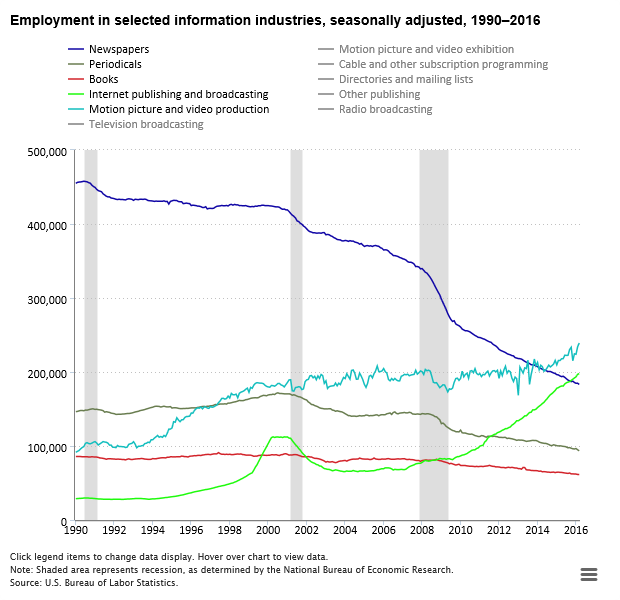
Data from the Bureau of Labor Statistics can quantify the trend pretty convincingly. As summarized in a report published in the American Consumers Newsletter, until the introduction of smartphones in 2007, the effect of the Internet on jobs in traditional media, newspapers, magazines and book had been, on balance, rather slight.

To wit, between 1993 and 2007, U.S. employment changes in the following segments looked like this:

  • Book Industry: Net increase of ~700 jobs
  • Magazines: Net decline of ~300 jobs
  • Newspapers: Net decline of ~79,000 jobs

True, the newspaper industry had been hard hit, but other segments not nearly so much, and indeed there had been net increases charted also in radio, film and TV.

But with the advent of the smartphone, Internet and media access underwent a transformation into something personal and portable. Look how that has impacted on jobs in the same media categories when comparing 2007 to 2016 employment:

  • Book Industry: Net loss of ~20,700 jobs
  • Magazines: Net loss of ~48,400 jobs
  • Newspapers: Net loss of ~168,200 jobs

Of course, new types of media jobs have sprung up during this period, particularly in Internet publishing and broadcasting. But those haven’t begun to make up for the losses noted in the segments above.

According to BLS statistics, Internet media employment grew by ~125,300 between 2007 and 2016 — but that’s less than half the losses charted elsewhere.

All told, factoring in the impact of TV, radio and film, there has been a net loss of nearly 160,000 U.S. media jobs since 2007.

employment-trends-in-newspaper-publishing-and-other-media-1990-2016

You’d be hard-pressed to find any other industry in the United States that has sustained such steep net losses over the past decade or so.

Much to the chagrin of old-school journalists, newspaper readership has plummeted in recent years — and with it newspaper advertising revenues (both classified and display).

The change in behavior is across the board, but it’s particularly age-based. These usage figures tell it all:

  • In 2007, ~33% of Americans age 18 to 34 read a daily newspaper … today it’s just 16%.
  • Even among Americans age 45 to 64, more than 50% read a daily newspaper in 2007 … today’s it’s around one third.
  • And among seniors age 65 and up, whereas two-thirds read a daily paper in 2007, today it’s just 50%.

With trends like that, the bigger question is how traditional media have been able to hang in there as long as they have. Because if it were simply dollars and cents being considered, the job losses would have been even steeper.

Perhaps we should take people like Jeff Bezos — who purchased the Washington Post newspaper not so long ago — at their word:  Maybe they do wish to see traditional journalism maintain its relevance even as the world around it is changing rapidly.

Online ad blocking grows ever-more popular.

abThe ad blocking phenomenon on the Internet shows no signs of abating.

Underscoring this, marketing research and forecasting firm eMarketer has just published its most recent ad blocking stats and forecasts for the United States. It projects that ad blocking adoption will continue to rise by a double digit rate in 2016 to reach nearly 70 million users.

If those projections turn out to be accurate, it will mean that ad blocking will now be used by more than 26% of all Internet users in the United States, up from ~20% just a year earlier.

And for 2017? Those forecasts are looking a whole lot like this year, too; eMarketer forecasts that ad blocker adoption will grow to more than 86 million users by the end of 2017.

[For the record, eMarketer defines a user as an Internet user of any age who accesses the ‘net at least once per month via a desktop or laptop computer, tablet, smartphone or other mobile device that has an ad blocker enabled.]

eab

According to the eMarketer analysis, the incidence of ad blocking is substantially more common on desktops and laptops; ~63 million people will use an ad blocker on these types of devices this year compared to ~21 million who will do so on a smartphone.

One reason for this is that ad blockers typically don’t work on apps, which is where mobile users spend much of their time. Moreover, some of the most irritating aspects of desktop/laptops advertising, such as ads with video and sound, are the kinds of advertising less likely to be served on mobile devices.

eMarketer expects many more people to begin installing ad blockers on their smartphones, however — to the tune of an increase of over 60% this year.

These projections must be alarming to publishers and advertisers. Paul Verna, a senior analyst at eMarketer, notes this:

“They’re seeing immediate revenue losses and [they] would be remiss to downplay what amounts to a large-scale rejection of their main monetization model.”

Separately, an analysis by Juniper Research sees more than $27 billion in advertising revenues lost over the next five years as a result of ad blockers.

Of course, that’s a far cry from the estimated ~$160 billion that digital advertising represents today.  But significant nonetheless.

As if on cue, The New York Times has just announced that it will introduce an ad-free subscription option. Reportedly, the publication will begin to offer subscriptions that cost more than a regular digital subscription, along with giving subscribers the option of opting out of seeing advertising if they wish to do so.

At present, NYT subscribers who use ad blockers are technically violating the publisher’s Terms of Use agreement — although I seriously doubt many people have had their knuckles rapped for doing so.

For now, all the Times does is kindly request that users “white-list” the NYT site so that the ads will appear even though an ad blocker has been installed.  According to news reports, about 40% of the people notified have actually done so.

Presumably, the new subscription option is targeted at people who really do wish to avoid seeing online advertising — and are willing to pay a premium for the benefit.

One wonders how much of a dollar premium subscribers will be asked to shell out for the privilege of keeping their screens from being inundated with advertising. (At present, annual NYT digital subscriptions range from ~$140 to ~$200.)  Will users balk at the higher rates?

Clearly, we’re in the middle of this movie … and it’ll be some time before we see how things shake out in the online media advertising game.  What are your thoughts about spending more for an ad-free subscription … and do you even have any online pay subscriptions at all?  (Many of my friends and business colleagues don’t.)

The Gawker saga: Are there any good guys in this drama?

gmSome people I’ve spoken to about blog collective Gawker Media’s recent legal and corporate tribulations have expressed concerns about the chilling effect well-funded lawsuits may be having on a free and unfettered press.  But it’s hard to find any angels in the ongoing saga of Gawker Media and its many detractors.

The latest news is that Gawker is filing for Chapter 11 bankruptcy protection even as it entertains an acquisition bid from publishing firm Ziff Davis.

Reportedly, Ziff Davis is offering $90 million to purchase Gawker Media.  This compares to the $140 million judgment against Gawker handed down by the courts in March in the Hulk Hogan defamation lawsuit.

hhLooking at the sordid details, it’s hard to find sympathy for any of the major players.  In the choice words of journalist and writer Bob Garfield:

“[Gawker Media is a] snide, predatory gossip site that built a reputation cutting hypocritical big shots down to size, but soon ran out of big shots and turned its sneering animus on any anonymous medium-shot unfortunate enough to fall into its sights … Gawker.com is in the schadenfreude business.”

Professional wrestler and television personality Hulk Hogan (aka Terry Gene Bollea) isn’t a paradigm of virtue, either – what with his history of obnoxious statements and what we’ll call euphemistically “other activities” that fall pretty low on the class-meter.

ptTech industry billionaire Peter Thiel, who provided the financial backing for Hulk Hogan’s successful lawsuit, was once a victim of Gawker himself – being “outed” as gay by the media site.  But Thiel’s über-libertarian pronouncements appear churlish on the one hand, while his legal takedown of Gawker seems to be at cross-purposes with the “anything goes” free speech premises of libertarianism.

Nick Denton, Gawker founder and CEO, has remained defiant even in the wake of the latest turn of events:  “Even with his billions, Thiel will not silence our writers.  Our sites will thrive – under new ownership,” Denton has been quoted, adding that court appeals will continue.

Clearly, this drama isn’t ending anytime soon. But with no sympathetic characters in this drama — and that’s about the most positive thing one can say about it — who’s ready to take a shower right about now?

Ad blocking goes big-time.

Adblock-PlusA new milestone of sorts has been reached in the ad blocking realm. Adblock Plus, the leading ad blocking tool, has just announced that it’s just passed the 100 million marker in active installations.

An earlier milestone – 500 million downloads – was reached at the beginning of this year. That means the active user base has now doubled in less than half a year.

If these figures are accurate – and there’s little reason to think that they aren’t – it’s a pretty big deal. No longer is ad blocking an exotic functionality that’s the exclusive preserve of techies or other geeky subgroups.  It’s gone majorly mainstream.

What’s driving the ad blocking business is the ubiquity of online advertising. For many viewers, it’s nothing short of intolerable:  obtrusive, irritating, and sometimes creepy (hello, retargeting).

So once a well-functioning and reputable tool like Adblock came along, it was only a matter of time before it would take on “snowball-rolling-down-a-mountainside” proportions.

AdBlock Plus promises “annoyance-free web surfing.”  But as with most any innovation, there are one or two hitches. For Adblock Plus, it’s something called “Acceptable Ads.”

untitled“What’s that?” you might ask. It’s a white-list program that allows certain advertisers through Adblock’s screen.  The company receives a cut of publishers’ revenues through that program.

Fundamentally, it’s how Adblock Plus makes money. But it’s also how advertisers can do an end-run around the very service Adblock provides.

AdBlock goes to great pains to “explain” its rationale and why the Acceptable Ads program makes sense for everyone.

But it isn’t difficult to see where this might end up.  Larger advertisers will see fit to exempt themselves from ad blocking by paying for the privilege of their ads being served.

Which gets us right back to where we were with advertising in the first place, doesn’t it? Pay to play.

What’s old is new again, I guess. And meanwhile, the online ads just keep coming …

In the Facebook-faceprint tussle, score one for the little guys.

Is that Maria Callas? Check with Facebook -- they'll know.
Is that Maria Callas? Check with Facebook — they’ll know.

I blogged last year about privacy concerns surrounding Facebook’s “face geometry” database activities, which have led to lawsuits in Illinois under the premise that those activities run afoul of that state’s laws regarding the use of biometric data.

The Illinois legislation, enacted in 2008, requires companies to obtain written authorization from subjects prior to collecting any sort of face geometry or related biometric data.

The lawsuit, which was filed in early 2015, centers on Facebook’s automatic photo-tagging feature which has been active since around 2010. The “faceprints” feature – Facebook’s term for face geometry – recognizes faces based on the social network’s vast archive of users and their content, and suggests their names when they appear in photos uploaded by their friends.

The lawsuit was filed by three plaintiffs in a potential class-action effort, and it’s been mired in legal wrangling ever since.

From the outset, many had predicted that Facebook would emerge victorious.  Eric Goldman, a law professor at Santa Clara University, noted in 2015 that the Illinois law is “a niche statute, enacted to solve a particular problem.  Seven years later, it’s being applied to a very different set of circumstances.”

But this past week, a federal judge sided not with Facebook, but with the plaintiffs by refusing to grant a request for dismissal.

In his ruling issued on May 5th, U.S. District Court Judge James Donato rejected Facebook’s contention that the Illinois Biometric Privacy Information Act does not apply to faceprints that are derived from photos, but only when it’s based on a source other than photos, such as in-person scans.

The Judge roundly rejected this contention as inconsistent with the purpose of the Illinois law. Donato wrote:

“The statute is an informed consent privacy law addressing the collection, retention and use of personal biometric identifiers and information at a time when biometric technology is just beginning to be broadly deployed. Trying to cabin this purpose within a specific in-person data collection technique has no support in the words and structure of the statute, and is antithetical to its broad purpose of protecting privacy in the face of emerging biometric technology.”

This isn’t the first time that the Illinois law has withstood a legal challenge. Another federal court judge, Charles Norgle, sided against Shutterfly recently on the same issues.

And Google is now in the crosshairs; it’s facing a class-action lawsuit filed early this year for its face geometry activities involving Google Photos.

Clearly, this fight has a long way to go before the issues are resolved.

If you have strong opinions pro or con about social networks’ use of face geometry, please share your views with other readers in the comment section below.

Bing Plays the Bouncer Role in a Big Way

untitledMicrosoft Bing has just released stats chronicling its efforts to do its part to keep the Internet a safe space. Its 2015 statistics are nothing short of breathtaking.

Bing did its part by rejecting a total of 250 million ad impressions … banning ~150,000 advertisements … and blocking around 50,000 websites outright.

It didn’t stop there. Bing also reports that it blocked more than 3 million pages and 30 million ads due to spam and misleading content.

What were some of the reasons behind the blocking? Here are a few clues as to where Bing’s efforts were strongest (although I don’t doubt that there are some others that Bing is keeping closer to its vest so as not to raise any alarms):

  • Healthcare/pharma phishing attacks: ~2,000 advertisers and ~800,000 ads blocked in 2015
  • Selling of counterfeit goods: 7,000 advertisers and 700,000+ ads blocked
  • Tech support scams: ~25,000 websites and ~15 million ads blocked
  • Trademark infringement factors: ~50 million ad placements rejected

Bing doesn’t say exactly how it identifies such a ginormous amount of fraudulent or otherwise nefarious advertising, except to report that the company has improved its handling of many aspects based on clues ranging from toll-free numbers analysis to dead links analysis.

According to Neha Garg, a program manager of ad quality at Bing:

“There have even been times our machine learning algorithms have flagged accounts that look innocent at first glance … but on close examination we find malicious intent. The back-end machinery runs 24/7 and used hundreds of attributes to look for patterns which help spot suspicious ads among billions of genuine ones.”

We’re thankful to Bing and Google for all that they do to control the incidence of advertising that carries malicious malware that could potentially cause many other problems above and beyond the mere “irritation factor.”

Of course, there’s always room for improvement, isn’t there?

Momentous milestone? U.S. advertising dips below 1% of GDP for the first time in living memory.

sdThe advertising industry has often been characterized as “boring.”  This 2014 analytical article from Bloomberg encapsulates the argument pretty succinctly.

Still, the “lay of the land” in the late 2000s and early 2010s represents a bit of a changeup from the previous decades of predictability.

During the period beginning the late 2000s when the “advertising recession” hit in an even bigger way than the overall U.S. economic recession, I’ve heard various industry insiders posit that there was more than merely a retrenchment happening due to overall economic conditions.

Beyond that, it was suggested that a migration was happening away from traditional advertising methods to more measurable ones.

Now we have more than just hunches to go on — and the results appear to be aligning with those suspicions.

The new evidence comes in the form of statistics released this week and reported on by MediaPost.

According to an analysis of ad spending trends published by Sanford Bernstein Research and Magna Global, for the first time in modern history U.S. advertising industry revenues have dropped below 1% of total U.S. Gross Domestic Product.

During the period 1999 to 2010, total advertising averaged 1.25% of GDP, but since then the percentage has stagnated or fallen. The 2014 total advertising estimate of $165 billion is 0.95% of GDP.  (The Bernstein/Magna research covers U.S. advertising revenues up through the year 2014.)

tbThe decline in advertising’s share of GDP is primarily due to the diminishing importance of two key traditional media categories: broadcast TV and cable TV.

Broadcast TV advertising’s annual revenue growth averaged around 3% per year between 1990 and 2010.  Since 2011, it’s been flat.

Cable TV has done somewhat better – but even there what had been around 12% growth per year has slowed to just a ~3% annual increase.

With such big baseline numbers for broadcast and cable TV, the behavior of these two broadcast categories have been key drivers of the advertising sector’s overall performance.

But we mustn’t forget another category that’s been performing pretty miserably of late: newspaper advertising.  It’s experienced a ~10% decline on a compound annual basis from 2010 to 2014.

That decline is even steeper than earlier projections had suggested.

Todd Juenger, a vice president and senior analyst at Sanford Bernstein, made a key takeaway observation about the newly published figures, noting:

“Our original piece theorized [that] advertising would recover to prior levels. Instead, it has remained deflated, suggesting the perhaps the Internet really has enabled marketers to eliminate waste.”

He’s right, of course.