The key to environmentally friendly products’ desirability? Deemphasize the green.

Selling green productsIt turns out that one key to the success of marketing so-called “green” products is actually to deemphasize the environmental messaging — at least when targeting consumers in the United States.

According to a number of surveys conducted by branding and marketing communications firm Landor, American consumers value possessing “green” attributes the least valuable of a series of brand attributes studied.

This despite years of social engineers and marketers of environmentally friendly brands attempting to “educate” consumers on environmental consciousness and the importance of sustainability.

At this point, it’s probably better for products to promote themselves based on other attributes besides “green” attributes … or at least to stop leading with that argument.

Instead, what are the values that resonate the most with American consumers?  According to Ted Page, a principal at content marketing firm Captains of Industry, there are three in particular — none of them having much to do with environmental issues — at least on the face of it:

  • Freedom
  • Independence
  • Saving money

But for green products, it’s possible to tie everything up in a nice bow by being able to lay claim all three of these attributes as brand attributes while not compromising the environment, either.

Nest Learning ThermostatAn example of this message strategy in action is the Nest Learning Thermostat, which promises saving energy in the context of achieving increased home efficiency, automated temperature management and lower energy bills.  The “green positioning” is nice — but it’s the other product attributes that really hit pay-dirt.

Tesla logoAnother example is Tesla electric automobiles.  Tesla is promoting the performance of its high-torque electric engine as superior to other sports cars manufactured by BMW, Lexus and Audi.

The fact that Tesla’s high-performance engine happens to be emissions-free is just icing on the cake.

Thanks in part to this messaging platform, sales of the Tesla Model S auto now outstrip those of the Mercedes S-Class, Lexus LS, BMW 7-Series, Porsche Panorama and the Audi AB.

One has to wonder if this would had happened had Tesla chose to lead with “green” messaging instead.

It would be nice to think so, but … probably not.

The hybrid car sizzle is fast becoming the hybrid car fizzle.

Well, that sure didn’t last long.

Hybrid autos:  Already riding off into the sunset?
Hybrid autos: Already riding off into the sunset?

News reports this week are stating that the market share of hybrid vehicles is now on the decline.

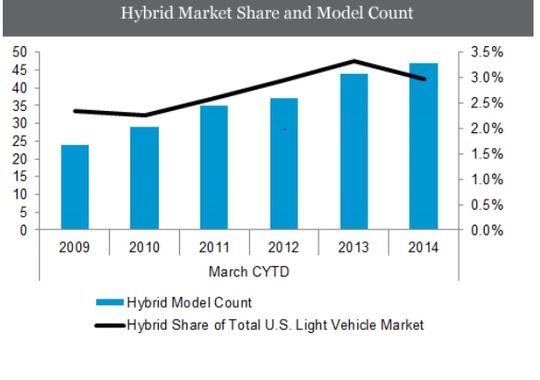
That is correct:  As of 1st Quarter 2014, hybrids only make up around 3% of the total car and light truck market in America.

Rather than an increase, that represents a pretty significant drop from nearly a 3.5% share of market just one year ago.

Here are the trend stats in graphic detail, courtesy of automotive statistics and intelligence firm IHS/Polk:

Hybrid Vehicle Stat ChartActually, the number of new hybrid car models being offered is still on the increase — now there are 47 different choices compared to around 25 in 2009, with Toyota’s five Prius models collected representing ~40% of the total hybrid market.  (The Prius share is down from ~55% in 2011, by the way.)

New model offerings or not … it’s pretty clear that the public’s interest in hybrid vehicles isn’t going up commensurately.  And the litany of reasons is all-too-familiar:

  • High car sticker price
  • Costly and complex batteries
  • Improved gas mileage and energy efficiency of conventional vehicles

Looking at the year-over-year trends, I think it’s doubtful that hybrid vehicles will ever achieve the high hopes the EPA and other federal officials have had for their adoption.

How embarrassing for them.

Instead, it seems more likely that the market will gravitate from the internal combustion engine straight to all-electric vehicles.  None of this “automotive hermaphrodite” stuff in between.

The more interesting question is this:  When will that shift occur?

To that one … not many people seem to have a definitive answer.

The VW Van Rides into History

T1 Type 2 VW Van
“T1 Type 2” VW van, manufactured by Volkswagen from 1950 to 1967.

Last week, a front-page article in The Wall Street Journal profiled the continuing attraction of ca. 1970s vans, decked out with all sorts of custom accessories and wild paint jobs.

It turns out, the vans are still so popular with a certain (aging?) segment of the American population, annual van rallies around the country attract thousands of participants.

But the article reminds us that, after more than 60 years of production and 10 million made, the very last VW vans came off the assembly line at the end of last year. That’s when Volkswagen’s Transporter van plant in metro São Paulo, Brazil shut down production.

Reportedly, production stopped because of new air bag and anti-lock braking system requirements for 2014 that were impossible to incorporate into the VW van’s design.

Brazil was the last place on earth where the iconic VW “bus” was being manufactured.  A plant in Mexico stopped producing the classic version of the van in 1995. European production had already been halted as far back as 1979 because the VW no longer met the minimum vehicle safety requirements on that continent.

But the true glory days of the VW van stretch back even further … to when the vehicle was synonymous with laid-back “hippie” lifestyles in the 1960s and early 1970s in the United States.

VW Type 2 Van
“T2 Type 2” VW van, manufactured by Volkswagen from 1968 to 1979.

Known by all sorts of nicknames (the Shaggin’ Wagon and Sin Bin are two of my favorites), the van served as “rolling homes” for many people.

It so reflected the popular culture of the day, the vehicle was featured on pop music album covers for the Beach Boys, Bob Dylan and others.

Bob Dylan album coverDamon Ristau, who directed a documentary film about the VW bus, said this about its mystique:

“It has a magic and charm lacking in other vehicles. It’s about the open road, about bringing smiles to peoples’ faces when they see an old WV van rolling along.”

For many Americans, the vision of a VW van transporting young, bronzed dudes and their surfboards to the California beaches is an iconic image. But the VW van’s brand identity is not at all like that in other parts of the world.

In places like Africa and Latin America, the vans were pressed into more mundane service — serving as mini-school buses, transporting troops, hauling merchandise or construction materials – even moving the mail.

In Brazil, the VW van is known as the “Kombi,” which is short-hand for the German term “Kombinations-fahrzeug” – or “combination transport vehicle.”

Over the years, the van developed a reputation for being breakdown-prone. But the flipside of this problem was that the VW’s simple engine design made it easy to repair.  So it was very popular with its owners — in a sort of ironic twist.

As one Brazilian van owner was quoted saying recently, “Driving a Kombi with your face up against the windshield is a thrilling experience … There is no other van that is so easy and inexpensive to maintain. Anyone with a minimum amount of knowledge about engines and a few tools can fix a Kombi.”

So it seems that no matter whether the VW van has been used for business or for pleasure, it has engendered similar feelings of attachment and affection.

The last VW van may have rolled off the assembly line and into history. But I suspect that many of the vehicles will be with us for decades to come – just like the 1950s American “fin” cars that continue to ply the streets of Havana five or six decades on.

Indeed, as long as there are people with a sense of wanderlust and the lure of the open road to beckon them, the VW bus will remain part of the cultural and emotional landscape in America.

A surprising development? America is now the world’s largest oil supplier.

number-1For those of us who came of age during the oil embargo of 1973 and the subsequent decades of high-priced, restricted-supply petroleum coupled with a contorted foreign policy continuously buffeted by those economic realities … the recent news that the United States is poised to become the world’s top oil supplier in 2013 comes as a bit of a surprise.

But it’s right there in black-and-white, in data published by PIRA Energy Group, a New York-based energy markets consulting firm:

  • This year, the United States is projected to produce an average of ~12 million barrels per day of liquid oil products (crude oil, natural gas liquids and biofuels together).
  • That’s ~300,000 barrels per day higher than Saudi Arabia … and ~1.6 million more than Russia.
  • The other countries that make up the “Big Ten” oil producers – China, Canada, the United Arab Emirates, Iran, Iraq, Kuwait and Mexico – don’t even come close to the “Big Three.”

Where’s Venezuela on the list?  Nowhere to be found.

Take that, Carlos Chávez and Nicolás Maduro!

The United States is forecast to pump approximately 7.5 million barrels per day of crude and concentrate in 2013.  That’s actually 3 million barrels less than Saudi Arabia and Russia.

But the shortfall is more than made up by the ~2.5 million in natural gas liquids and ~1 million of biofuels America is also producing every day.

The rise in U.S. production is practically unprecedented.  Only once before has a country raised its production faster (Saudi Arabia in 1970-74).

The reason for the rise in American production?  Two words:  “shale oil.”

USA Shale Gas Exploration ZonesU.S. shale oil and condensate production now stands at ~2.5 million barrels per day.  That’s slightly over one-third of total U.S. crude production.

And shale natural gas liquid production, at ~1.2 million barrels per day, is nearly half of total NGL production.

America’s shale oil boom could turn out to be of far greater import than all of the renewable or “alternative energy” schemes put together – despite the political attention and funding these more “sexy” technologies have had lavished on them by federal and state governments and research foundations.

Abetted by the explorationof shale oil formations via horizontal drilling and fracking, the impact of shale oil reserves isn’t a flash in the pan, either.  According to PIRA Energy, America’s position as the largest oil supplier in the world looks to be secure for many years.

Production growth rates may level off eventually, but PIRA forecasts that the United States will continue to increase its lead over Saudi Arabia and Russia until 2020 at least.

… And retain its production lead over all other countries until at least 2030.

What a relief all of this is.  Speaking for myself, I’m loving the fact that America is no longer so beholden to offshore energy resources controlled by people who “might” be our friends one day … and who “might” not be the next.

It’s like financial debt:  Having too much debt is really bad.  Having no debt at all is really nice.

Energy independence — or something close to it — is really nice, too.

Manufacturing in America: It is poised for a comeback?

American Made Movie (Documentary)On Labor Day weekend, the documentary film American Made Movie opened in theatres in key cities across the country.  And for a change, this film doesn’t chronicle the decline of American manufacturing, but instead its potential for rebirth.

Directors Vincent Vittorio and Nathan McGill have produced a film that’s both realistic and optimistic – two words that aren’t often used in conjunction with one another when the topic is manufacturing.

The directors don’t shy away from the facts:  U.S. manufacturing jobs shrinking from ~$17 million to just ~$12 million in the past 20 years due to technology, global competitiveness and outsourcing.

But there are signs of recovery.  At least the anectodal evidence for it is strong.

In August, Wal-Mart organized a manufacturers’ summit which was attended by ~1,500 people including U.S. and foreign-based companies, Department of Commerce and Federal Reserve officials, and eight state governors.

At this meeting, Wal-Mart affirmed its commitment to buy $50 billion in additional American-made products over the next 10 years.  GE, Element and other companies also announced plans to boost domestic manufacturing activities.

These developments aren’t merely patriotic or altruistic — although there may be some of that factoring into the decision.

In fact, with Chinese labor costs rising 15% to 20% each year, that country’s labor cost advantage is narrowing compared to the United Sates.

Harold Sirkin of Boston Consulting Group points out that factoring in raw materials and other costs, China maintains only a ~3% lead on product costs.  Add in transportation costs from Asia, and the “Made in America” alternative takes on new validity.

“We are at an inflection point,” Sirkin has stated, noting that the United States is now competitive with China.

GE’s chief executive officer Jeff Immelt echoes these sentiments, contending that on a relative basis, America has never been more competitive thanks to technology and improved productivity.

“High transportation costs mean you want to be closer.  It’s not just pure labor arbitrage,” Immelt notes.

As for productivity, the mere three hours it takes to assemble a GE refrigerator in America makes its total cost lower than a similar Chinese or Mexican-made models destined for the American market, according to Immelt.

I like what I’m hearing about the coming resurgence in American manufacturing … but I think we’ve heard this prediction before. 

The film directors discovered this inconvenient issue when traveling the United States and visiting manufacturing plants from large cities to small towns:  There’s a sizable gap between what manufacturers need in human capital, and the ability of the labor force to meet those requirements – whether it be older workers, or young workers right out of school.

Vincent Vittorio and Nathaniel McGill, movie directors
“American Made Movie” documentary film directors Vittorio and McGill.

“We need to provide the apprenticeship training necessary for a new generation of American workers to grow as fast as our technology is changing,” the documentary movie directors contend.

That may be happening at some technical colleges and a few community colleges across America.  But it’s not happening nearly enough if, like me, you hear constant complaints from manufacturing execs about the disconnect between the lack of (even basic) job skills and (increasingly sophisticated) job requirements on the manufacturing line.

Maybe it’s time to look harder at appropriating pieces of the German/Austrian apprenticeship model, wherein talented students are plucked from high school and placed with manufacturing firms for on-the-job training in lieu of college.

In such environments, a structured program of learning and training provides the roadmap for successful transition and integration into the job force.

An apprenticeship may not seem as “classy” an accomplishment as a college diploma.  But a college diploma doesn’t mean nearly as much these days.

What once was a sure-fire ticket to a career has given way to an environment in which half of all new college graduates are unemployed, underemployed, or working jobs for which their degree is irrelevant or unnecessary.

To that half of the young labor force, the near-100% placement/success rate for apprenticeships must seem awfully attractive now.

What are your thoughts about a coming manufacturing renaissance in America?  Please share your comments here.