Higher education choices in America: A distinction without (much of) a difference?

The cost differential is huge. But what about the education itself?

13According to the College Board, the average annual cost of college, including tuition and books, varies widely depending on the type of institution:

  • Private colleges and universities: ~$31,200
  • Public colleges and universities (out-of-state residents): ~$23,000
  • Public colleges and universities (in-state residents): ~$9,100
  • Community colleges: ~$3,300

In fact, the difference between the highest and lowest cost averages comes out to a factor of ten.

Averages are more difficult to calculate for online college institutions, where the annual cost ranges widely from as low as $5,000 all the way up to $25,000 or so, according to The Guide to Online Schools.

With such a disparity in college education costs, one might think that public perceptions of the value of the degrees granted by them would likewise show differences based on the type of institution.

But a recently completed national opinion study tells us otherwise. A telephone research survey conducted in June 2015 by the Gallup organization queried ~1,500 Americans age 18 or over about their attitudes toward college education.

Among the most interesting findings is the perception of community colleges: Two-thirds of the respondents rate the quality of education that community colleges offer as “excellent” or “good.”

For four-year colleges, the percentage figure for excellent/good quality was only slightly higher: ~70%.

Considering the vast difference in the financial outlay required to attend a four-year school, community college education is looking mighty attractive, indeed.

Tempering this finding are the Gallup survey’s respondents who possessed advanced degrees themselves.  They’re more likely to rate four-year institutions higher than community colleges on quality (a nine percentage point difference).

And of course, community colleges do face challenges such as their track record on lower graduation rates, plus the sometimes challenging process and procedures in successfully transitioning students from two-year to four-year schools.

Still, the perception of near-parity in education quality is striking — and it’s not very different from the findings Gallup has observed since beginning to survey the American public on this topic two years ago.

I don’t doubt that some families will be sharpening their pencils and doing new cost/benefit calculations based on the results of this Gallup survey.

But where a perceived difference in quality continues to persist is in online education. Survey respondents were about half as likely to rate the quality of Internet-based college programs as “excellent” or “good.”

While respondents don’t fault online programs for lacking a broad curriculum, or even for the value provided for the cost of enrolling, online education is seen as lacking strength in three key areas:

  • Reliable testing and grading
  • The quality of instruction
  • The value of the degree to prospective employers

But there’s another way to look at it.  Internet-based higher education is slipping through the door and becoming “mainstream” not just because of the online programs such as those offered by Capella University and the University of Phoenix, but because of the burgeoning online coursework being offered by traditionally brick-and-mortar institutions.

With that growing practice, I predict it’s only a matter of time before the perception of online higher learning will match the higher ratings that are already being given to community colleges, public and private institutions.

Let’s see how things look in another five years.
State of the States: CNBC’s take on the best ones for business.

In CNBC’s recently published scorecard, don’t look to the Northeast or California to find the states that are best ones for business.

CNBC State Rankings for Business
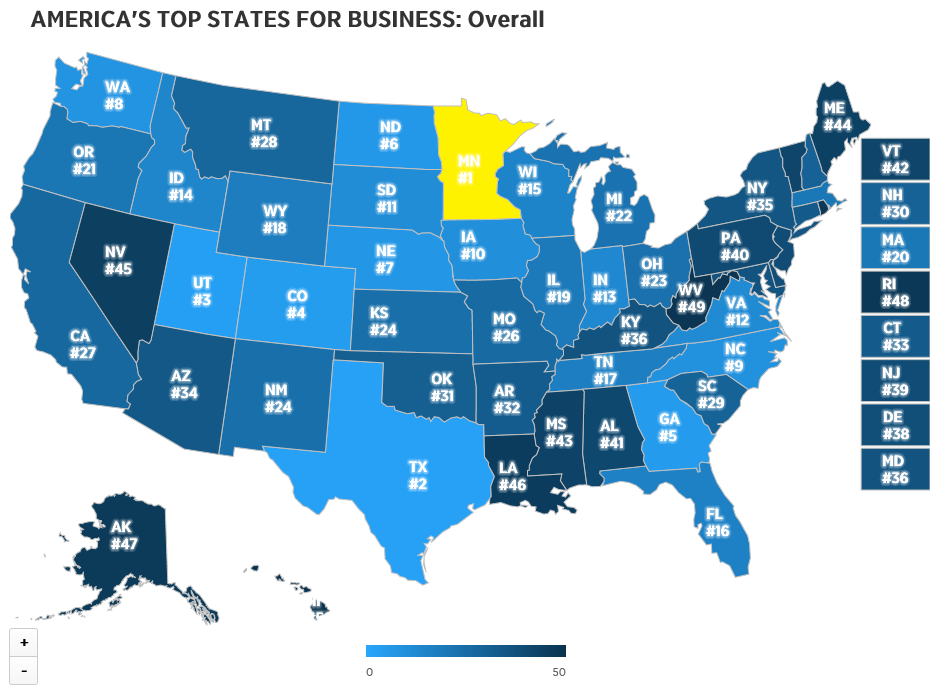
L’Etoile du nord: Just as in its state motto “Star of the North,” Minnesota is the stellar performer in CNBC’s 2015 state ranking of business competitiveness. (Click on the map for a larger view.)

State and city rankings are a source of fascination for many people. Of course, there are many ways to fashion them to place nearly any state or city you like at the top of the heap.  Some of the lists use criteria that are so convoluted, it stretches credulity.

Since when is Baltimore the best city in America for single men?  Since it was ranked #1 in this evaluation, evidently.  Many of us who know the city’s innards really well would disagree heartily, of course.

But I think the CNBC 2015 scorecard on state business climates, published earlier this month, is based on a more solid set of criteria.

CNBC created it by scoring all 50 states on approximately 60 separate measures of competitiveness – a list that was developed with input from an array of business and policy experts, official government sources, and CNBC’s own Global CFO Council, and that uses government-generated data.

CNBC then grouped these measures into ten broader categories, weighting the results based on how often each is used as “selling point” in state economic development marketing and promotional efforts. This was done in order to rank the states based on the criteria they themselves use to showcase their attractiveness to businesses considering expansion or relocation.

Here are the ten broad categories in the CNBC evaluation, and which states ranked first and last within them:

  • Access to capital: #1 North Carolina … #50 Wyoming
  • Business friendliness: #1 North Dakota … #50 California
  • Cost of doing business: #1 Indiana … #50 Hawaii
  • Cost of living: #1 Mississippi … #50 Hawaii
  • Economy: #1 Utah … #50 Mississippi
  • Education: #1 Massachusetts … #50 Nevada
  • Infrastructure: #1 Texas … #50 Rhode Island
  • Quality of life: #1 Hawaii … #50 Tennessee
  • Technology/innovation: #1 Washington … #50 West Virginia
  • Workforce: #1 North Dakota … #50 Maine

Do we see any surprises here?  To my mind, the high and low rankings look pretty well-aligned with the anecdotal information we hear all the time.

Perhaps we might consider several other states besides Nevada to be “bottoms” in education. And personally, I am pretty shocked to see Tennessee ranked last in quality of life. Having lived there during my college years at Vanderbilt University, I never considered the state to be substandard when it came to that attribute.

But It’s when CNBC amalgamates all of the rankings to come up with its overall state ranking that a few surprises emerge.

Such as … Minnesota notches first place overall. I’m sure some people are genuinely surprised to see that.

For the record, here is CNBC’s list of the Top 10 states for business in 2015:

  • #1 – Minnesota
  • #2 – Texas
  • #3 – Utah
  • #4 – Colorado
  • #5 – Georgia
  • #6 – North Dakota
  • #7 – Nebraska
  • #8 – Washington
  • #9 – North Carolina
  • #10 – Iowa

We see that four of the ten top states are in the Midwest … three are in the South … three are in the West … but none are in the Northeast.

CNBC study on business competitiveness
The center holds: According to CNBC, most of the most competitive states for business are in the Mid-Continent region.

By contrast, for the most part the Bottom 10 states are clustered in other areas of the country … including four Northeastern states plus Alaska and Hawaii, two states that clearly have unique locational circumstances:

Hawaii lacks business competitiveness
Not so sunny: Hawaii’s bad business climate.
  • #40 – Pennsylvania
  • #41 – Alabama
  • #42 – Vermont
  • #43 – Mississippi
  • #44 – Maine
  • #45 – Nevada
  • #46 – Louisiana
  • #47 – Alaska
  • #48 – Rhode Island
  • #49 – West Virginia
  • #50 – Hawaii

CNBC has issued a raft of charts and maps providing details behind how their ratings were formulated, and the results for each of the major categories. You can view the data here.

Speaking for yourselves, in what ways would you challenge the rankings? What strikes you here as different from your own personal experience in doing business in various states? Please share your perspectives with other readers.

Gallup’s Payroll-to-Population Rates Pinpoint the Go-Go Metro Areas

Commuters in New York City.

The Gallup polling organization’s P2P measurements (payroll-to-population employment rates) are an interesting metric and add an extra dimension of understanding as to what’s happening with employment across the United States.

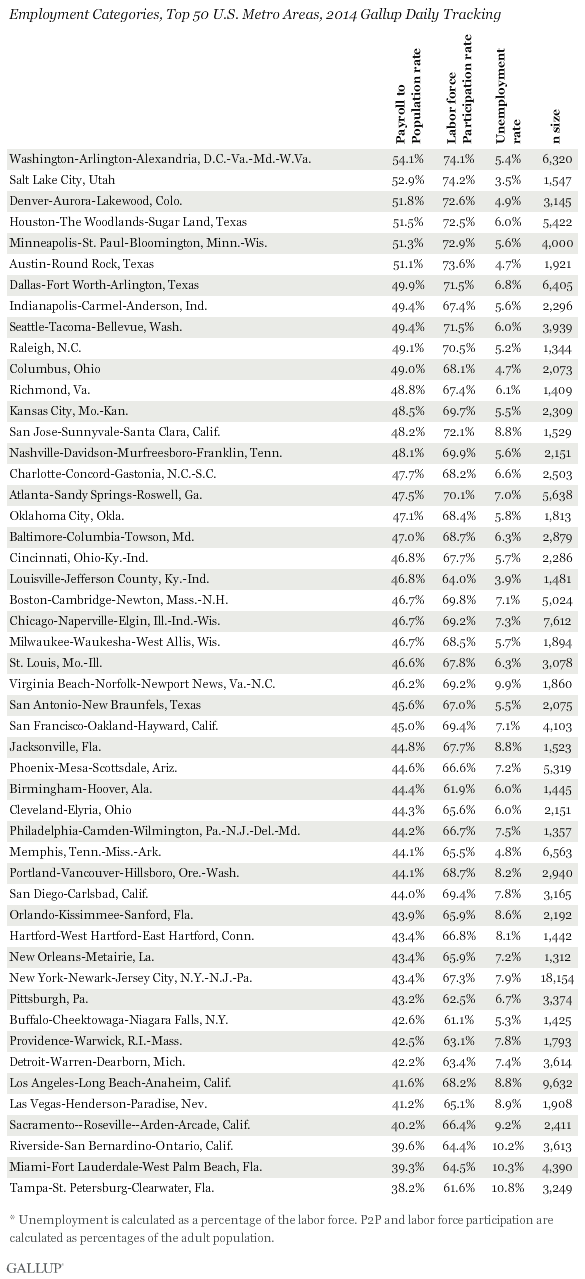
Gallup’s evaluation is limited to the top 50 most populous SMSAs (metropolitan statistical areas).  But because of the large number of phone interviews conducted within each metro area (ranging from ~1,300 to 18000+ depending on the population), the findings are statistically significant whether looking nationally or within a particular urban area.

The latest surveys, conducted by Gallup in 2014 among nearly 355,000 households, find that two metro areas with the highest P2P measures are Washington, DC and Salt Lake City, UT — urban centers that couldn’t be more dissimilar in other ways.

For DC, the P2P rate is 54.1.  The calculation is derived from the percentage of the adult population (age 18+) who are employed full-time for an employer for at least 30 hours per week.

For Salt Lake City, the P2P rate is just slightly lower, at 52.9.

Other top scoring metro areas include three markets in Texas (Austin, Dallas-Ft. Worth and Houston).

What about metro areas at the other end of the scale?  Those would be Miami (38.2 score) and Tampa (39.3).

Three other low-scoring MSAs are located in California:  Los Angeles, Riverside and Sacramento.

What do these stats mean in a broader sense?

For one thing, there’s a direct relationship between employment stats and P2P performance:  Metro areas with the highest unemployment rates correlate to those with low P2P scores.

For instance, Miami’s unemployment rate in 2014 was 10.3%.  It was 10.2% in Riverside, CA.

That’s a big contrast with Salt Lake City, which had an unemployment rate of just 3.5%.

I find one interesting deviation from the norm:  Buffalo, NY.  There, while the unemployment rate is one of the ten lowest in the country, its labor force participation rate is also very low — bottoms among all 50 metro areas, in fact.

Shown below are the figures for all of the 50 largest U.S. metro areas based on the interviews conducted by Gallup in 2014:

Gallup full results

More details on the research findings are available here.

Managing email communications: Winning the battle … losing the war?

many emailsHere’s a statistic that won’t come as a big surprise to many office workers … but it still looks pretty stark when you see it on the page:  According to research by McKinsey Global Institute, knowledge workers, including managers and professionals, spend nearly 30% of their work time managing e-mail communications.

This means that for a typical 50-hour work week, a total of 15 hours are sucked up in the e-mail vortex.

It’s nothing new, of course.  And for years, companies and individuals have been making efforts in big and small ways to manage their e-mail.

One method has been through the use of IM social collaboration platforms, but that solves only some of the problem.

Other methods include aggressive pruning of spam mail … sending unsubscribe notices … and tightening incoming mail filters.

e-mail inboxBeing more aggressive with e-mail unsubscribe requests can lighten the inbox, but other pruning efforts can sometimes be counterproductive, with “good” e-mails getting sent to junk e-mail folders, thereby requiring workers to scan those inboxes every day as well.

Another popular e-mail management technique can work at cross-purposes, too.  Research by Carnegie Mellon Institute has found that about a third of office workers file their e-mail messages into folders right after they’ve been read.

But according to Alex Moore, who heads up e-mail management service Baydin, Inc. creating files associated with different clients, projects or people turns out to have its own inefficiencies when searching for e-mail messages later.

It seems counterintuitive, but searching for older e-mail correspondence is often easier to do when using a single chronological file coupled with a search function, because it’s just one search instead of potentially many.

inbox managementSpeaking as someone who receives around 200 e-mail messages each business day, give or take, I find that the following strategies work best for me:

  • Unsubscribing – as best as possible (even with the shortcomings of attempting to do so)
  • Keeping my settings so that e-mail messages download every 20 minutes instead of right away
  • Aside from important client messages, “batch-processing” e-mails just four times each business day: early morning, late morning, mid-afternoon, and end-of-day

Adopting these practices makes it easier for me to concentrate on my other work tasks, keeping those Job 1 and relegating e-mail management to being “ornaments on the tree” rather than the tree itself.

If other readers use particular e-mail management techniques and tactics that are effective for them, let’s hear about them.  Please share your thoughts below.

Gallup’s CEO Calls the Official U.S. Unemployment Rate a “Big Lie”

American consumersI’ve blogged before about how the American public doesn’t seem to be responding to the news that the country has been out of its economic recession for a number of years now.

It’s not for lack of trying.  From the White House and other politicians to government agencies, financial industry practitioners and news media articles, there’s been a steady stream of speeches, announcements, news items and commentary lamenting the disconnect between the perception and the reality.

Plus … I’m reminded often by my business counterparts who work in Europe and Asia that the situation is much better in America than in many other countries.  I consider it advice to “count our blessings,” as it were.

With this as backdrop, it’s easy to fall into the paradigm of thinking that the American public is simply being unrealistic in its expectations for economic recovery — and the recovery’s ability to reach into all strata of society.

But then … along comes a commentary by Jim Clifton, chairman and CEO of the Gallup polling organization.

Jim Clifton Gallup CEO
Jim Clifton

In addition to heading what is arguably America’s most famous polling company, Mr. Clifton is a keen observer of economics and public policy.  He is also the author of the book The Coming Jobs War (published in 2011).

The gist of Clifton’s commentary is that the official unemployment rate, as reported by the U.S. Department of Labor, is very misleading.

Moreover, it’s Clifton’s contention that the very way the Department of Labor calculates the unemployment rate goes straight to the heart of the disconnect between the experts and the “person on the street.”

Here’s what Clifton wrote in a column released earlier this month:

“If a family member or anyone is unemployed and has subsequently given up on finding a job — if you are so hopelessly out of work that you’ve stopped looking [for work] over the past four weeks — the Department of Labor doesn’t count you as unemployed. 

That’s right:  While you are as unemployed as one could possibly be, and tragically may never find work again, you are not counted in the [unemployment] figure we see relentlessly in the news — currently 5.6%.”  

official U.S. unemployment rate
The official U.S. unemployment rate as reported by the United States Department of Labor’s Bureau of Labor Statistics.

In Clifton’s estimation, right now as many as 30 million Americas are either out of work or severely unemployed.  That would equate to an unemployment rate far higher than the reputed 5.6% figure.

But it goes even beyond that.  Clifton points out another clue as to why the perception gulf between the “statisticians” and the “street” seems so wide — and he puts it in the form of two examples:

“Say you’re an out-of-work engineer or healthcare worker or construction worker or retail manager.  If you perform a minimum of one hour of work in a week and are paid at least $20 — maybe someone pays you to mow their lawn — you’re not officially counted as unemployed in the much-reported 5.6% [figure]  

Few Americans know this. 

Yet another figure of importance that doesn’t get much press:  those working part time but wanting full-time work.  If you have a degree in chemistry or math and are working 10 hours part time because it is all you can find — in other words, you are severely unemployed — the government doesn’t count you in the 5.6%.   

Few Americans know this.”

Clifton doesn’t mince words in his characterization of the official unemployment rate; he calls it a “Big Lie” — one which has consequences that go well-beyond simply the stats being arguably wrong.

Here’s how he puts it:

“… It’s a lie that has consequences because the Great American Dream is to have a good job — and in recent years, America has failed to deliver that dream more than it has in any other time in recent memory.   

A good job is an individual’s primary identity — their very self-worth, their dignity.  It establishes the relationship they have with their friends, community and country.  When we fail to deliver a good job that fits a citizen’s talents, training and experience, we are failing the American Dream.”

Statisticians and economic policy experts can and do disagree about what constitutes a “good job” in America.  The Gallup organization defines it as working 30 or more hours per week for an organization that provides a regular paycheck, with or without other benefits.

That’s actually a pretty low-bar for what defines a “good job.”  But however jobs are defined, the U.S. economy is currently delivering at a rate of just 44%, which equates to the number of full-time jobs as a percent of the adult population (age 18 and over).

It would seem that the 44% figure would need to be significantly higher to really solve the challenge of available jobs.

Clifton concludes his commentary by issuing this challenge:

“I hear all the time that ‘unemployment is greatly reduced, but the people aren’t feeling it.’  When the media, talking heads, the White House and Wall Street start reporting the truth — the percent of Americans in good jobs; jobs that are full time and real — then we will quit wondering why Americans aren’t ‘feeling’ something that doesn’t remotely reflect the reality in their lives. 

And we will quit wondering what hollowed out the middle class.”

I’ve devoted significant space in this blog post to quoting Jim Clifton’s words verbatim, so as not to change their tenor or dilute them in any way.

What do you think?  Is Clifton speaking truth to power?  Or is he painting an overly negative view of things?  I welcome your thoughts and comments.

America’s small businesses: Quite bullish on 2015 … but with no thanks to the government.

Small Business Economic OutlookRecent reports on economic activity appear to show a continuation of a rather wobbly recovery of the U.S. economy since coming out of the Great Recession.

It’s a repeating pattern of one quarter of strong growth followed by the next one with weaker indices — sometimes with the stats from earlier quarters revised downward.

Still, things are still better for the U.S. economy as compared to many others around the world.

America’s small businesses appear to feel similarly about the U.S. economy.  Their perspective may be even more positive, in fact.

Illustrating this perspective, a January 2015 survey of ~850 U.S. businesses (ones that employ ten or fewer full-time or part-time workers) finds small business owners having a pretty bullish outlook on the year ahead.

In a survey conducted by web hosting company Endurance International Group (formerly Bizland), two-thirds of the respondents reported positive prospects for their businesses for 2015:

  • General business outlook is very positive: ~26% of respondents
  • Generally positive outlook: ~45%
  • Neutral outlook: ~25%
  • Negative outlook: ~5%

These findings align quite neatly with how these business owners see 2015 as compared to 2014’s performance:

  • 2015 will be positive compared to 2014: ~66% of respondents
  • 2015 will be about the same: ~29%
  • 2015 will be negative compared to 2014: ~5%

But … these positive impressions happen with no thanks to the government.  When asked if they felt that the U.S. Congress is effective in addressing the issues that are important to small businesses, a whopping 87% gave thumbs-down.

Even the changes in Congressional leadership that came about as a result of the 2014 midterm elections have done little to improve the perceptions of these business owners, as ~69% do not believe that the new leadership in Congress will be any more effective in addressing small business issues in 2015.

And what are those issues that are so important to small businesses?

They’re the usual things:  business taxes first and foremost … followed by the ability to obtain financing.

The next tier of issues includes the ability to hire workers with the appropriate skills, along with the ongoing healthcare coverage challenges.

Any other issues are basically just an asterisk at the bottom of the page …

More details on the survey results can be found here.

E-mail response time expectations: “The faster the better.”

e-mail inbox managementEver since the advent of e-mail communications, there’s tended to be a feeling that correspondence sent via this mode of delivery is generally more “pressing” than correspondence delivered the old-fashioned way via postal mail.

After all, people don’t call postal mail “snail mail” for nothing.

At the same time, one would think that the proliferation of e-mail volumes and the today’s reality of groaning inboxes might be causing an adjustment of thinking.

Surely, most of the e-mail doesn’t need a quick response, does it?

If 80% or more of today’s e-mail is the equivalent of the junk mail that used to fill our inbox trays in the office in the “bad old days,” why wouldn’t we begin to think of e-mail in the same terms?

But a new survey of workers appears to throw cold water on that notion.

The survey of ~1,500 adults was conducted by MailTime, Inc., the developer of a smartphone e-mail app of the same name.  The survey found that a majority of respondents (~52%) expect a response to their work-related e-mail communiqués within 24 hours of hitting the send button.

Moreover, nearly 20% expect a response in 12 hours or less.

While the survey encompassed just users of MailTime’s app, the findings are likely not all that different for office workers as a whole.

Why is that?  I think it’s because, in recent years, the e-mail stream has become more “instant” rather than less.

Back in the early days of e-mail, I can recall that many of my work colleagues checked their e-mail inboxes three times during the day:  early in the morning, over the lunch hour, and as they were wrapping up their workday.

That’s all out the window now.  Most people have their e-mail alerts set for “instantaneous” or for every five or ten minutes.

With practices like that being so commonplace, it’s little wonder that people expect to hear a response in short order.

And if a response isn’t forthcoming, it’s only natural to think one of three things:

  • The e-mail never made it to the recipient’s inbox.
  • The recipient is on vacation, out sick, or otherwise indisposed.
  • The recipient is ignoring you.

I think there’s an additional dynamic at work, too.  In my years in business, I’ve seen e-mail evolve to becoming the “first line of contact” — even among colleagues who are situated in the same office.  Younger workers especially eschew personal interaction — and even phone contact — as modes of communication that are needlessly inefficient.

Of course, I can think of many instances where e-communications can actually contribute to inefficiencies, whereas a good, old-fashioned phone call would have cut to the chase so much more easily and quickly.

But even with that negative aspect, there’s no denying the value of having a record of communications, which e-mail automatically provides.

And here’s another thing:  MailTime estimates that around two-thirds of all e-mails are first opened on a smartphone or tablet device — so message deliverability is just as easy “on the go” as it is in the office.

It’s yet another reason why so many people expect that their communiqués will be opened and read quickly.

I agree that e-mails are easy and convenient to open and read on a mobile device.  But sometimes the response isn’t nearly so easy to generate without turning to a laptop or desktop computer.

So as a courtesy, I’ll acknowledge receipt of the message, but a “substantive” response may not be forthcoming until later.

… And then, when others don’t show a similar kind of courtesy, I think many of us notice!

Some larger companies with employees who are more geographically far-flung have actually adopted guidelines for e-mail etiquette, and they’ve applied them across every level of the company.

It seems like a good idea to get everyone’s expectations on the same page like that.

Incidentally, the preferred scenario for responding to personal e-mails isn’t really all that different from work-related expectations, even though personal communiqués aren’t usually as time-sensitive.  Respondents in the MailTime survey said that they expect to receive a response to a personal e-mail within 48 hours.  For nearly everyone, waiting a week is far too long.

Americans and the economy as 2015 begins: Caution continues.

As we’ve closed out the year 2014, more than a few people – from politicians to business leaders and business journalists – have sought to reassure us that the American economy is not only on the right track, it’s back in a big way.

Bronx CheerBut evidently, word hasn’t trickled down to “John Q. Public.”  Or if it has, it’s been greeted by a gigantic Bronx Cheer.

We have the latest evidence of this in management consulting firm McKinsey & Company’s most recent annual Consumer Sentiment Survey, which was conducted in September 2014 with results released last month.

The bottom-line on consumer sentiment is that despite the recent spate of decent economic news and higher employment figures, people are still reluctant to increase spending, and thriftiness remains the order of the day.

While people don’t think things are deteriorating … they don’t think they’re becoming much better, either.

So … treading water is about all.

It’s not too difficult to figure out why sentiment continues to be so skittish.  After all, median household income for Americans, adjusted for inflation, actually declined in recent years and hasn’t rebounded.

With people still feeling the earnings squeeze, it’s only natural that McKinsey’s findings show consumer sentiment still in the doldrums, with only ~23% feeling optimistic about America’s economy.

Consider these further findings from the research:

  • About 40% of respondents report that they are living “paycheck to paycheck”
  • Around 39% are at least somewhat worried about losing their job
  • Approximately 34% feel they have decreased ability to make ends meet financially

Not surprisingly, respondents with lower family incomes (under $75,000 per year) have higher concerns, and roughly 40% of those households report cutting back or delaying purchases as a result.

[Even among people living in households earning $150,000+ per year, one in five say that they’ve cut back or delayed purchases because of financial uncertainty.]

Activities we commonly associate with recessionary eras continue to be practiced by consumers.  According to McKinsey’s research, those practices include:

  • Looking for ways to save money (comparison shopping, coupon use, etc.): ~55 of respondents report doing so
  • Purchasing more products online to save money: ~48%
  • Cutting spending over the past year: ~40%
  • Doing more shopping at “dollar stores”: ~34%
  • No longer preferring/buying more expensive product brands over private-label substitutes: ~33%

Where things really look different “on the ground” than in the economists’ forecasts is what the public is saying about their future behaviors:  McKinsey logoMcKinsey believes that consumers and their attitudes have been permanently changed by the years of austerity.

The strongest indication of this?  Nearly 40% of the survey respondents say that they’ll likely never go back to their pre-recession approaches to buying and spending.

As McKinsey concludes in its report:  Cautious is the new normal … and it’s unlikely to change anytime soon.

More details on McKinsey’s survey findings can be viewed here.

Coming Up: A Labor Shortage?

The coming labor shortageIt may seem fanciful, but a new report published last week by The Conference Board concludes that the United States and other advanced economies will actually face significant labor shortages over the coming decade and a half.

This forecast has been made primarily based on the Baby Boomer workforce departing the labor market over this period.

The Baby Boomer phenomenon is what makes things different in now compared to the decades previously:  For the first time since World War II, working age populations will actually be declining in mature markets.

Conference Board logoAs Dr. Gad Levanon, director of macroeconomics at The Conference Board reported, “The global financial crisis and its aftermath – stubbornly high unemployment in many countries – have postponed the onset of this demographic transformation, but will not prevent it from taking hold.”

According to The Conference Board’s analysis, several countries have already begun to see this happen, as their natural rates of employment have now fallen below their pre-recession levels:  Japan, Germany, South Korea and Canada.

The same thing is expected to happen in the United States and the United Kingdom by 2015 … and in the Scandinavian countries, the Benelux countries plus Australia by 2016 or 2017.

Other mature economies like those of Spain, France, Portugal, Italy and Greece won’t experience this until the years further out – but The Conference Board predicts that it will happen there as well.

U.S. market sectors that are expected to experience the most severe labor shortages include healthcare occupations, STEM occupations (science, technology, engineering and mathematics), as well as skilled trades that don’t require a college degree but that do require specialist training.

Among the challenges The Conference Board envisions in these three major categories are the following:

  1. Skilled labor occupations like construction, transportation and utility plant operations are going to be adversely affected by many more retirements happening than new job seekers coming in to fill the void.
  2. STEM occupations won’t be as stressed as some might imagine, because higher productivity will alleviate the pressure on hiring more workers in IT and high-tech manufacturing segment. That being said, certain sub-segments such as information security, environmental and agricultural engineering, and applied mathematics are expected to face severe labor shortages.
  3. The numbers of new entrants in various healthcare occupations are constrained by high barriers to entry such as extensive education and experience requirements, along with accreditation requirements.

The Conference Board report has constructed a Labor Shortage Index covering 32 countries.  The index combines current labor-market tightness with future demographic trends to predict the likelihood of the different countries experiencing labor shortages.

The bottom line on the index:  with the exception of the Mediterranean countries, all of the labor markets in developed economies are expected to be squeezed pretty tightly starting within the next few years.

It’s been quite a while since we’ve been hearing about pending labor shortages … but that’s exactly what The Conference Board is predicting.  Here’s a link to more details about the report, which is appropriately titled From Not Enough Jobs to Not Enough Workers.

If you have thoughts or personal observations to share on the job markets on the domestic scene or internationally, please share them with other readers here.

Vacationing Americans and the “Work Martyr Complex”

American workers on vacationI’ve blogged before about the propensity for Americans to forego using all of their allotted vacation time in a given year.

But that was back in 2012, in the waning months of the “Great Recession,” so perhaps one reason for those dynamics was leaner workforces and the need for “all hands on deck.”

A few years have gone by since then, and … very little has changed in these dynamics.

That’s the conclusion in a report released this week by the U.S. Travel Association.  Titled “Overwhelmed America: Why Don’t We Use Our Paid Time Off?”, the study included a survey of ~1,300 American workers and senior business leaders, conducted by GfK.

What the survey found was that 40% of workers fail to take all of their allotted paid time-off.

When asked why this was the case, look at the reasons that were cited:

  • Taking time off will cause my work to pile up: ~40% cited
  • Nobody else can do my job while I’m on vacation: ~35%
  • I can’t afford to take time off:  ~33%
  • I don’t want to be seen as “replaceable”: ~22%

The study characterizes the atmospherics surrounding the phemonemon as a “work martyr complex.”

As U.S. Travel’s chief executive puts it, “busyness” is something Americans wear as a “badge of honor.”

But there may be a bit more to it than that.

The survey also found that two-thirds of the respondents feel that their employer sends mixed messages about taking vacation … says nothing at all about it … or actually discourages people from taking paid time off.

What appears to motivate workers to take their full allotted vacation time is the implementation of “use it or lose it” policies.  When such policies are in place, ~84% of workers take all of their allotted time.

By contrast, for companies that offer the ability for workers to roll over vacation time, bank it, or be paid for time not taken, only about half of their employees (~48%) use all of their time.

The big question is whether most companies truly buy into the notion that taking vacation time is important for overall employee health, well-being and relationships – because the survey found that only a distinct minority of companies (one in four) maintain a “use it or lose it” PTO policy.

Of course, the members of the U.S. Travel Association would certainly benefit if more Americans took paid time off and used it to travel to vacation destinations.   Still, Roger Dow’s contention that “it’s time to start a conversation and reclaim the benefits we work so hard to earn” makes sense to me.  The full report can be viewed here.

At our company, we’ve a “use it or lose it” PTO policy in place for years.  What’s your own situation?