When it comes to smartphone capabilities … buyers want the basics.

With the plethora of smartphone models that seem to be released with ever-increasing frequently these days, one might think that the innovative features being added to the new smartphone models would be in high demand.

After all, the demand for smartphones looks as though it’s unquenchable; quarterly shipments of smartphones numbered some 366 million devices during the 3rd quarter of 2019 alone, according to data compiled by business consulting firm Strategy Analytics.

But the reality appears to be quite different. Recently, technology market research firm Global Web Index studied the popularity of various smartphone features, looking at a large sample of more than 550,000 consumers in the USA and UK.

As it turns out, the most desired smartphone feature is long battery life. And in fact, the top four smartphone features in terms of consumer importance don’t look like anything particularly jazzy:

  • Battery life: ~77% consider it the most desired smartphone feature
  • Storage capability: ~65%
  • Camera picture quality: ~62%
  • Screen resolution: ~48%

At the other end of the scale are four features which aren’t animating the market in any great way:

  • 5G compatibility: ~27%
  • Biometric security features: ~27%
  • Digital wellness features: ~16%
  • Virtual reality capabilities: ~10%

There’s no question that the newest smartphone models can do a lot more than their earlier iterations. But users want them to do the basics — and to do them well. Other capabilities are simply ornaments on the tree.

For more findings from the Global Web Index study, click here.

Amazon is poised to become America’s single biggest retailer, outpacing Walmart.

It’s a measure of how much the American retail landscape has changed in the past decade that Amazon is poised to overtake Walmart as the largest U.S. retailed by 2022.

That prediction comes from a recently published report from market research firm Packaged Facts.

As of today, Packaged Facts estimates that Amazon makes up ~43% of all U.S. e-commerce sales, which is dramatically higher than its ~28% share just four years ago. Continuing its growth trajectory, by 2022 Amazon is expected to make up nearly half of all U.S. e-commerce sales.

That degree of concentration will make it bigger than Walmart — even considering the latter’s huge brick-and-mortar presence which Amazon lacks.

Of course, Walmart continues to possess additional advantages that Amazon cannot match, despite the latter’s acquisition of supermarket chain Whole Foods in 2017. Not only does Walmart have a huge physical footprint in retail, it also offers a wide range of in-store services which entice foot traffic — things like an onsite pharmacy, financial services, and photo processing.

Also working in Walmart’s favor is its dominance in so-called “click-and-collect” shopping orders. According to recent surveys, ~43% of respondents identified Walmart as the pickup location for their last click-and-collect order — three times the share percentage of runner-up Target.

Still, the emergence of Amazon atop the retail industry heap says volumes about the seismic shifts brought about by online retail. The channel hasn’t been around all that long in the grand scheme of things, but its impact has been nothing short of seismic.

How have your shopping habits changed during this time? Do they reflect what has happened in the larger market? Please share your thoughts with other readers here.

A Strong Job Market and the “Gig” Economy

The two don’t go together very well.

It wasn’t so long ago that the so-called “gig” economy was all the rage. In the early 2010s, with a sizable portion of companies being skittish to commit to hiring full-time workers due to fresh memories of the economic downturn, many workers found opportunities to make money through various different gig economy service firms — companies like Uber, Lift, Postmates and others.

What those jobs offered workers were flexible schedules, reasonably decent pay, and the ability to cobble together a livelihood based on holding several such positions (while still being able to hunt around for full-time employment).

For employers, it was the ability to build a workforce for which they didn’t have to cover things like office expenses and various employee benefits — not to mentioning paying for payroll taxes like the employer social security contribution.

In the past few years, the environment has changed dramatically. With national unemployment hovering around 3.5% — and lower still in many larger urban areas — “gig” companies have found it more difficult to find workers.

What’s more, those workers who are hired are churning through the companies more even more quickly than before — many staying with these jobs for just a few months.

Tis is driving up worker recruitment costs to their highest levels ever.

In a May 2019 interview with The Wall Street Journal, Micah Rowland, COO of Fountain, a company that helps gig companies acquire new workers by streamlining the hiring process, puts it this way:

“It [strikes] me that in some of these markets, they’re processing thousands of job applicants every month — and these are not large cities.”

In Rowland’s view, gig companies in some markets may be burning through the entire available labor market of people willing to work in roles of this kind.

It isn’t as though turnover rates aren’t high in other service sectors in the more “traditional” economy. In the fast-food industry, for example, turnover is running as much as 150% annually these days. But in the case of gig employment markets, it’s even higher — sometimes dramatically so.

With the tight labor market showing little sign of loosening anytime soon, it may be that we see some firms looking at “regularizing” employment for at least some of their workers. If it makes economic sense to hire some actual employees in order to curb recruitment costs, some will likely go that route .

There’s another factor at work as well. More of these gig economy workers are becoming more vocal about pushing back on pay and working conditions. Noteworthy examples have been recent protests by rideshare company workers in cities like Los Angeles and San Francisco.  Others have done the envelope math and have determined that once driver-owned vehicle costs of gasoline and depreciation are calculated against declining fares that have dropped below $1 per mile in some markets like Los Angeles and Minneapolis-St. Paul, workers’ effective wages are significantly less than even $10 per hour.

Picking up on these worker concerns, a number of activist groups are making gig economy companies like Lyft and Uber into a “cause célèbre” (not in a good way), but loud, polarizing detractors such as these tend to muddy the water rather than bring fresh new insights to the debate.

As well, one wonders if the activism is even needed; I suspect what we’re seeing now is a pendulum swing which happens so often in economics — where an equilibrium is re-established as things come back into balance after going a bit too far in one direction. In the case of the gig economy, the low unemployment rate in many regions of the country appears to be helping that along.

Drones Start Delivering

But will they really deliver the goods?

Drone deliveries just got real. We’ve been reading about them for a good while, along with the occasional news story about a prototype drone model making a product delivery to someone’s doorstep.

But drone deliveries have suddenly taken a major step into the commercial mainstream with the announcement that the first home deliveries of packages from Walgreens have started. They’re being handled by Wing, a subsidiary of Alphabet — the parent company of Google.

Wing itself received a special certification from the Federal Aviation Administration recently that allows it to make commercial air deliveries directly to homes in the United States. That’s a first.

In addition to the Walgreens account, Wing is also delivering OTC medication, gifts and other items on behalf of Sugar Magnolia, a Virginia-based retailer.

How do these deliveries work? Customers order products via a special app, and can opt in to receive their items via FedEx Express delivered by drone, which lowers the packages to a designated spot in a yard or driveway.

Wing, Walgreens and Sugar Magnolia aren’t the only people nosing around this method of delivery. Walmart has filed a patent application for a system for retrieving packages delivered by drone, and UPS is also getting into the mix.  The FAA has given approval to UPS’s new Flight Forward subsidiary that will allow it to fly an unlimited number of drones with an unlimited number of remote operations. And right on cue, the first Flight Forward agreement for drone delivery services has just been announced, with CVS pharmacies.

So it’s pretty clear that drones have finally broken through to the point where they can be serioiusly tested for consumer use and acceptance. Next, it will be interesting to gauge consumer reaction.  Will drone deliveries break out into the mainstream, or are they destined to remain more of a curiosity?  Here’s one early read from online business owner Mark Reasbeck:

“[It’s] nice that everybody … has nothing else to do but to order stuff from Walgreens and just sit there and wait for the delivery. What happens if you’re not home?  How much [cost] for that service?  They have to pay for a ‘shopper’ and then all the pilots watching the drone.  This is not needed on so many levels.”

What are your thoughts on this latest transport frontier? Is it a flash in the pan? … or poised for phenomenal success?

Why aren’t wages moving in lockstep with the improved employment picture?

If you’ve taken a look at September’s U.S. unemployment figure – 3.5% — you’re seeing the lowest level of unemployment in over 50 years. And for particular subgroups of the population, they’re enjoying their lowest employment percentages ever — at least since records have been kept.

It’s definitely something to cheer about. But at the same time, it’s become increasingly evident that wage growth isn’t happening in tandem with lower unemployment.  And that includes industrial wages as well.

In fact, September results show the first dip in wages – albeit slight – in the past two years.

What gives?

According to Zheng Liu and Sylvain Leduc, two economics researchers at the Federal Reserve Bank of San Francisco, the cause of stagnating wages in an otherwise robust economy can be laid at the doorstep of automation.

According to Liu and Leduc, as certain tasks move more toward automation, employees are losing bargaining power within their organizations. When people fear that they could lose their jobs to a robot or a machine, there’s a hesitation to ask for higher wages as that might hasten the eventuality.

The net result is a widening gap between productivity and pay.

But does this situation apply across all of industry? Perhaps not. Last year, manufacturing expert and Forbes magazine contributing writer Jim Vinoski noted that “huge swaths of industry remain decidedly low-tech and heavily manual.”

The reason? Complexity, volume and margins are often barriers to the implementation of automation in many applications.  Just because something can be automated doesn’t mean that there’s a compelling economic argument to do so – particularly if the production volumes aren’t in the league of “mass manufacturing.”

Jobs in engineering and R&D are even less likely to become automated. After all, probably the single most important attribute of employees in these positions is the ability to “think outside the box” – something artificial intelligence hasn’t come anywhere close to replicating (at least not yet).

What are your thoughts about automation and how it will affect employment and wage growth? Please share your perspectives with other readers.

The Demise of the Urban Commuter Tabloids

The end of the line: The final edition of Express at the McPherson Square Metro stop in Washington, DC.

I’ve blogged before about the major struggles of the so-called alt-weekly press in recent times as the Internet has upended both the business model and the editorial mission of such papers.

But what about urban commuter publications? These are the tabloid freebies that sprang over the decades up to serve the daily public transit population in large urban areas, offering quick-read news and entertainment during subway, train and bus commutes.

Unlike the alt-weeklies with their often-edgy or otherwise counterculture editorial slant, the commuter tabloids were generally more conventional in their content — focusing less on controversial POV topics and instead on “what’s happening” in headline news and on the dining, arts and entertainment front.

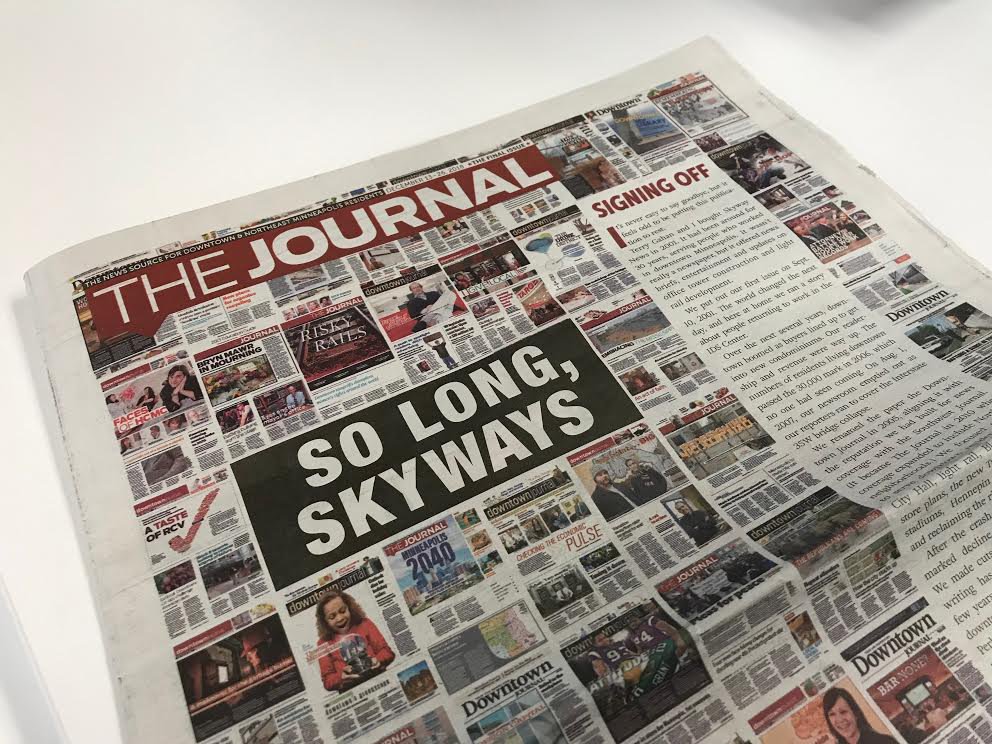
One such publication that I came to know quite well was Skyway News — named after the iconic skyway system in downtown Minneapolis — where professionals could grab a copy of the tabloid while dashing off to grab their public transport.  For me, reading Skyway News was a way to pass the time while taking my 35-minute bus commute (yes – it took that long to travel just three miles in the city during rush hour).

An amazing 48-year run: Skyway News / The Journal (Minneapolis, 1970-2018).

Alas, Skyway News, which debuted in 1970, eventually went the way of so many alt-weekly papers.  First it tried expanding its circulation (and editorial focus) to cover residential Northeast Minneapolis, changing its name to The Journal in the process … but finally shut down for good late last year.

Still, it was an amazing 48-year run for a paper that never had a circulation exceeding 30,000.

This week, we’re hearing news that one of the most successful of the urban commuter tabloid ventures has bitten the dust, too. In this case it’s Washington DC’s vaunted Express, a free commuter tabloid published by the Washington Post since 2003.

In his customary colorful way, Dan Caccavaro – the tabloid’s founding editor who remained in that position for the entire 16 years of the publication’s existence – explained to readers what was behind the paper’s demise:

The final edition of the Express tabloid paper (September 2019).

“When we launched in 2003, there was no such thing as an iPhone. It would be another year before Harvard students would start using a novel social network called Facebook to keep tabs on their classmates.  No one was tweeting anything – or Instagramming or Snapchatting.  And most of us still mocked our “CrackBerry”-addicted friends who just couldn’t wait until they got to work to check their email.   

How quaint.”

The headline of Caccavaro’s editorial says it all: “Hope you enjoy your stinkin’ phones.”

While circulation of the Express had been declining since its height of nearly 200,000 copies to around 130,000 today and while the paper’s finances had slipped into loss territory, the death knell came when the DC metro system introduced Wi-Fi service on its trains.  With that move, the ability for the Express to engage the attentions of DC’s metro commuters died.

Whereas at one time the Express and its quick-read news format was “an integral part of the morning commute for Washingtonians,” the ability for people to stay online during their commute effectively made the Express an irrelevance.

As Caccavaro explained in his final editorial salvo:

Express editor Dan Caccavaro then …

“It wasn’t unusual in [the] early days to see two-thirds of riders on a rush-hour train reading Express … The appetite for Express was so great, in fact, that we more than once considered printing an afternoon edition.  

This Monday morning as I rode the train to work, I was struck by a very different observation. Three people on my crowded Blue Line train were reading Express … one man had his nose in an old-fashioned book. Almost everyone else was staring at a phone.”

Express editor Dan Caccavaro now.

What’s particularly ironic is that the Express, with its lively, quick-read character and attractive, colorful layout, was the precursor to the kind of news and information that everyone expects to see continuously fed to them on their devices.  So as it acclimated a generation of readers to being quickly-informed, entertained and pleasantly distracted during their commutes, Express actually sowed the seeds for the wholesale shift to mobile screens to receive information in the same fashion.

With the closure of Express, there can’t be more than a handful of urban commuter tabloids left in existence in America.  I can’t think of single one.  But if you’re aware of any, please enlighten us – and let us know what might be the secret behind their continuing relevance.

For meetings and events, the coasts still dominate.

Those of us who have been in the marketing field over the past three or four decades have witnessed some pretty fundamental changes in the role that professional meetings and events play in business.

“Way back when,” national trade shows and professional meetings were one of the most effective ways to interact with industry colleagues.  In terms of people gathered together in one place, it was difficult to top trade shows for the convenience of staying in touch on a personal level.

Things are much different now, with advances in communications technology and all. Today, webinars and virtual meetings are on my calendar far more frequently than events where I need to hop a plane to get there.

In-person meetings and events won’t ever go away, of course. There’s really no substitute for real-time pressing the flesh, and it’s still how some of the best business relationships are built and maintained.

This truism is underscored in reporting by Carlson Wagonlit Travel Meetings & Events. The Minneapolis-based firm – part of the Carlson Companies group of hospitality-sector businesses – analyzes proprietary and industry booking data each year to determine which cities are North America’s top locations for meetings and events.

CWT’s 2020 forecast has just been published, and what it shows is that despite the vicissitudes of the business cycle or economic uncertainties, meeting and event activity continues to grow.

And once again, cities on the coasts are the most popular meeting destinations.

As one who lives on the East Coast and who doesn’t particularly relish the idea of flying all the way across the country to attend a 2- or 3-day event, I would have thought that in today’s time-pressed environment, mid-continent locations such as Chicago, New Orleans, Dallas and Houston would be growing in popularity at the expense of East Coast and West Coast destinations.

Moreover, the cost of holding meetings and events in many coastal cities like New York, Boston, DC, LA and San Francisco is measurably higher than many locations in the middle of the continent that are simply more affordable.  Surely that must count for something, too.

The Carlson “Top Ten” meeting destination ranking tells us otherwise, however:

#1. New York City

#2. San Francisco

#3. Chicago

#4. Atlanta

#5. Toronto

#6. San Diego

#7. Seattle

#8. Orlando

#9. Dallas-Ft. worth

#10. Las Vegas

Of the Top Ten meeting destination cities, only two could be classified as truly “mid-continent” locations (Chicago and Dallas). And while it’s technically true that Toronto, Atlanta and Las Vegas aren’t “coastal,” they’re far enough east (or west) to make them almost as inconvenient to get to for people traveling from the other side of the country.

Going beyond the factor of travel inconvenience, there’s another issue I’ve had with certain meeting locations.  It seem that some are chosen due to their attraction as a recreation destination as much as for their appropriateness for a business event.

For a trade show exhibitor, an event held in Orlando (Disneyworld) or in Las Vegas (The Strip) often has the sorry result of an exhibit hall so empty that you can roll a bowling ball down the aisle and have it pick up speed. (And it isn’t just on the final day of the show.)

It may be a minority view, but speaking personally, give me more meetings in plain-Jane Chicago, Kansas City or St. Louis than in sunny California or Nevada. My travel time is more precious than that.

Click here to access more information from the most recent Carlson Wagonlit trends report.

What’s the “long-game” in the U.S.-China trade conflict?

The efforts to craft a new trade agreement with the People’s Republic of China have run into some pretty major roadblocks in recent weeks and months.

Things came to another inflection point this week when President Trump announced that new tariffs would be imposed on more Chinese goods imported into the United States. As of September 1, pretty much all categories of Chinese imports will now be subject to tariffs.

If we look at the impact the protracted impasse has had on markets, the repercussions are plain to see. One result we’ve seen is that China has dipped from making up the largest portion of trade with the United States to being in third place now, behind Mexico and Canada:

But what’s the long-term prognosis for a trade deal with China? Recent world (and USA) statistics point to softening of the economy, which could have negative consequences across the board.

When it comes to perspectives on economic and business matters involving China and the Pacific Rim, I like to check in with my brother, Nelson Nones, who has lived and worked in the Far East for more than 20 years.  He has first-hand experience working in the Chinese market and is keenly aware of the issues of intellectual property protection, which is a major bone of contention between the United States and China and is one of the factors in the trade negotiations.  (Nelson runs a software company which has chosen to forego the Chinese market because of regulations requiring software firms that set up a joint ventures with Chinese companies to disclose their source code — something his firm will never do.)

I asked Nelson to share his thoughts about what he sees happening in the coming months.  Here are his observations:

Chinese President Xi has a lot on his plate right now. It isn’t just the U.S. trade war but also the Hong Kong disturbances, U.S. arms sales to Taiwan, the U.S. sending warships through the Taiwan Strait and the South China Sea, and China’s domestic banking sector weakness, to name just some. Trump has also put President Xi in a tight spot by demanding (or getting) Xi’s assurances that China will buy more U.S. agricultural products and will enact legislation protecting foreign intellectual property.  

In spite of his very substantial power, I predict that Xi will have a very tough time ramming Trump’s conditions down the throats of his countrymen. 

I should mention that the biggest issue here is intellectual property protection. The draft agreement that China “almost” signed had assurances that IP protection laws will be enacted, but Xi apparently nixed that draft whereupon the Chinese government stated that no government can promise, when negotiating a treaty with a foreign country, to change its domestic laws.

Technically, they’re right. For example, President Trump can’t commit to changing U.S. laws because only the Congress can do that under the constitutional separation of powers. Similarly, on paper, only China’s National People’s Congress (the national legislature) can change Chinese laws, and President Xi is not a member of the National People’s Congress. (Of course, this explanation conveniently overlooks the fact that both the Presidency and the National People’s Congress are subservient to the Communist Party of China, and that Xi is the General Secretary of the Communist Party, but still it’s technically correct.)

In view of all this, the natural Chinese instinct is to wait … and in this case, wait until the 2020 U.S. election and see what happens. If Trump is defeated for re-election, then perhaps many of Xi’s problems will disappear magically. On the other hand, if Trump stays in office maybe the pain that Trump’s China trade policy is inflicting on U.S. businesses and consumers will force Trump to lighten up a bit.  

In other words, President Xi has much to gain and relatively little to lose by playing the waiting game for a while. 

As for U.S. tariffs, those are causing Chinese businesses to adapt their supply chains by routing them through other East and Southeast Asian countries which are not subject to the tariffs. For instance, instead of sending products straight to the U.S., Chinese manufacturers are sending products to Vietnam or Thailand where a tiny bit of additional work is done – just enough to qualify for a “Made in Vietnam” or “Made in Thailand” label. (This adaptation partially explains Thailand’s large trade surplus which has made the Thai Baht one of the world’s best-performing currencies this year.)  

These maneuvers actually provide a safety valve for both Xi and Trump. For Xi, it cushions the reduction in demand for Chinese exports. At the same time it puts some additional pressure on Trump because this type of safety valve does not really exist for U.S. exporters trying to evade reciprocal Chinese tariffs.  But on the plus side for Trump, it tends to dampen the impact of higher tariffs pushing up U.S. producer and consumer prices.

If you ask me to bottom-line this, the trade problems look more like a protracted siege than an episode of brinksmanship.

How the siege is resolved depends on how strong Trump’s position will be after the 2020 election. If the Democrats continue with their leftward lurch, then Xi will eventually have to cave because Trump’s position will be strong (I’d say a 65% probability of re-election). But if the Democrats come to their senses and Trump continues shooting himself in the foot, then he’s in real danger of losing the election and Xi will come up the big winner (I’d give this a 35% probability as of today). 

So there you have it: the prognosis from someone who is “on the ground” in East Asia.  What are your thoughts?  Are you in broad agreement or do you see things differently?  Please share your observations with other readers here.

Evidently, America isn’t in IKEA’s manufacturing future …

Going, going, gone …

Over the past several years, the political mantra has been that jobs are now coming back to the United States – particularly manufacturing ones.

That may well be. But this past week we’ve learned that IKEA plans to close its last remaining U.S. production facility.  The iconic home furnishings company has announced that it will be closing its manufacturing plant in Danville, Virginia by the end of the year.

The Danville plant makes wood-based furniture and furnishings for IKEA’s retail store outlets in the United States and Canada.

The reason for the plant closure, as it turns out, is a bit ironic. According to IKEA, high raw materials costs in North America are triggering the move, because those costs are actually significantly lower in Europe than they are here.  Even accounting for other input costs like labor that are higher in Europe, shifting production to Europe will keep product prices lower for U.S. retailers, IKEA claims.

So much for the notion that imports from Europe are overpriced compared to domestically produced ones!

The Danville plant isn’t even that old, either. Far from being some multi-story inefficient dinosaur left over from a half-century ago, the manufacturing facility opened only in 2008, making it only about a decade old.  At its peak the plant employed around 400 people.

IKEA made staff cuts or around 20% earlier in the year, before following up with this latest announcement that will wipe out 300 more jobs in a community that can scarcely withstand such large economic shocks.

With the closure of Danville, IKEA will still have more than 40 production plants operating around the world. It employs around 20,000 workers in those plants (out of a total workforce of ~160,000, most of which are employed in the company’s vast retail and distribution business activities).

So, it doesn’t appear that IKEA will be exiting the manufacturing sector anytime soon.  It’s just that … those manufacturing activities no longer include the United States.

As a certain well-known U.S. political leader might say, “Sad!”

The wider implications of the “deliver it to my door” mentality.

There’s been quite a bit of attention paid to the impact of online retail on bricks-and-mortar sectors like shopping centers.  More than a few of them have started looking like Potemkin Villages. Some forecasts predict that the number of indoor shopping malls in America will contract by as much as one-third in the coming years.

On the other hand, the changing dynamics of e-tailing are having the opposite effect when it comes to shipping logistics … because not only are consumers shopping online in record numbers, they’re also taking advantage of delivery options that are bringing merchandise directly to them in 24 or 48 hours – even same-day deliveries in some cases.

What this means is that the efficiencies in procurement, inventory and distribution that drove many distribution centers to be built in outlying locations aren’t exactly working in today’s “deliver it to me and deliver it to me now” mindset.

[This is why we’re hearing about solutions such as drone deliveries – but that’s still a ways in the future and could eventually begin to cause congestion in a new realm – up in the air.]

In the meantime, more delivery vehicles than ever are competing with commuter traffic on already-congested highways during peak time periods. A shortage of qualified truckers is spurring development of driverless trucking, while the delivery system as a whole is running at full capacity (if not full efficiency).

Of particular concern is the so-called “last mile” delivery aspect in urban environments. It isn’t merely the issue of traffic congestion.  It’s also city planning codes (outdated), parking restrictions (made even more difficult thanks to the current fad in “progressive” cities of adding bike lanes while removing on-street stopping and parking), and load limitations (adding even more challenges and complexity).

But nature abhors a vacuum, and there are some interesting developments happening to address the challenges. The use of data analytics is growing exponentially, with route maps, GPS data, and real-time expected-versus-actual travel time updates allowing for transport rerouting to happen “in the moment.”

Other novel solutions, such as smart lockers that receive multiple shipments in a central location, plus the use of mobile warehouses within urban areas enabling less reliance on the big remote distribution centers, are emerging.

Burgeoning ride-sharing services like Uber and Lyft are contributing to more congestion in urban areas – just think how many more ride-sharing vehicles are on the road today compared to taxi cabs in the past. But in rural or remote areas the opposite issue is in play – difficult accessibility.  This is where drone deliveries are a welcome development — including during in the wake of natural disaster occurrences where traditional transportation methods might be impossible — or at the very least highly dangerous.

What are your thoughts about the friction between “convenience and congestion”?  Will technology help us smooth out the rough edges — or are we in for even more frustrations?  Please share your thoughts with other readers here.