Old Forester: A storied brand attempts a comeback.

Old Forrester bourbonA half century ago, Old Forester bourbon was the big brand name in the spirits business.  As the flagship brand of the Brown-Forman Corporation, it routinely sold in quantities approaching one million cases each year.

Back in the day, Old Forester was marketed as “America’s Guest Whiskey” – the one to bring out when company came to visit.  (I remember finding an ancient bottle of Old Forrester when cleaning out my late mother-in-law’s liquor cabinet.)

Forward to today.  Despite a recent rise in bourbon sales, Old Forester is a near-forgotten brand entry.  Shipments barely topped 100,000 cases last year, and nearly half of all sales came from just two states:  Alabama and Kentucky.

What the heck happened?

In broad terms, American tastes in distilled beverages shifted away from scotch and bourbon to vodka and gin.  Wine became more popular, too.

But those changes affected the entire market for bourbon, scotch and other whiskeys.  What made Old Forrester sink so low in a category that’s actually been on an upward trend since 2000?

Two words:  “Jack Daniels.”

BF logoIn 1956, Louisville-based Brown-Forman, the makers of Old Forrester, acquired the iconic Jack Daniels brand, and promptly started marketing it big-time.

Jack Daniels advertising has been pretty constant in the decades since.

Then in the mid-1990s, Brown-Forman introduced Woodford Reserve, which it marketed as premium bourbon — much as Old Forester had been a half-century before.

With all of the attention lavished on these two brands, Old Forester got squeezed out of the action.

But as it turns, out, there may be a second act for Old Forrester after all.  Starting in 2001, bourbon shipments have been on a pretty steady upward trend, with total shipments now topping 1 billion liters annually.

Mad-Men-Season-6Some have attributed the growth in bourbon consumption to the success of the Mad Men TV series, but I suspect there’s a lot more to it than just that.

Besides, even with Mad Men going off the air, market forecast firm Cowen & Company predicts American whiskey growth rates will clock in at nearly 10% per year until 2020 at least.

Because of those dynamics, it comes as little surprise that brands like Bulleit Bourbon have been so very aggressive in the market.

New entrants abound, too, as there are now more than 26 distillery licenses issued by the state of Kentucky (up from just ten in 2011).

Evidently, the key managers at Brown-Forman must have decided that they weren’t going to let the market pass them by, and so they’ve committed to a major initiative to resuscitate the Old Forester brand name.  Major commitments and goals include:

  • Building a new distillery in Louisville that will open next year
  • Expanding the geographic reach of brand sales
  • Undertaking a $20 million marketing effort including digital advertising, point-of-sale promotion and bar promotions
  • Increasing annual shipments to 500,000+ cases within five years

What are the chances that Old Forester can regain its lost luster and once again become one of America’s esteemed bourbon brands?

Brown-Forman's Campbell Brown, a fifth-generation family member, heads up the Old Forrester branding initiative.
Brown-Forman’s Campbell Brown, a fifth-generation family member, heads up the Old Forrester branding initiative.

There are no guarantees, of course.  But starting with a venerable brand name … and then appointing a seasoned industry veteran — and fifth generation Brown family member as well — to head the effort may give this initiative pretty decent odds of success.

We’ll check back in four or five years and see how it all turns out.

The Ad Fraud Gravy Train Keeps Chugging Along — No Matter What …

xbnAd fraud is quite a large issue for online advertisers – and it’s been on many companies’ radar screens for a long time.

But even with the higher visibility and greater scrutiny of online ad fraud, it seems to be a problem that only gets bigger.

The most recent example of the phenomenon came to light a few weeks ago, when ad fraud prevention consulting firm Pixalate announced that a newly discovered botnet has been draining literally billions of dollars from advertisers’ MarComm coffers.

The botnet is dubbed Xindi – the same name as the hostile aliens in the Star Trek sci-fi TV series.

Xindi is making money for its creators by serving actual ads – but to simulated audiences.  It has spread via familiar methods such as phishing.

Pixalate estimates that just shy of 78 billion fake ad impressions have been racked up so far.  Even at low cost-per-impression revenue figures, the high volume amounts to several billions of dollars of illicit revenues siphoned (and counting).

What makes the Xindi botnet particularly nettlesome is that it’s designed to go after computers and networks at high-end organizations, enabling it to “mimic” desirable web traffic (i.e. affluent consumers).

xbotAccording to Pixalate, already there could be as many as 8 million computers compromised in more than 5,000 networks, including a goodly number of Fortune 500 companies as well as university and governmental networks.

Such desirable locations and ad audiences translate into lucrative online ad pricing (CPMs of $200 or more).

In the event, advertisers are paying high prices … for nothing.

To counteract Xindi, Pixalate recommends that the Internet Advertising Bureau update its protocols to factor in the pace of ad requests, so that impression generated after a certain time period cannot be accepted as valid — and hence would be non-billable.

Whether this or other remedies will actually happen is up in the air at the moment (the IAB isn’t onboard with the recommendations).

Either way, what seems clear is that whatever the remedial actions that are taken, burgeoning ad fraud activity is bound to continue.

The question is, can it ever be contained, or will it just continue to grow and grow?  If you have any thoughts or ideas on the challenge, please share them with other readers.

As the U.S. Postal Service girds for processing 15 billion pieces of mail this holiday season …

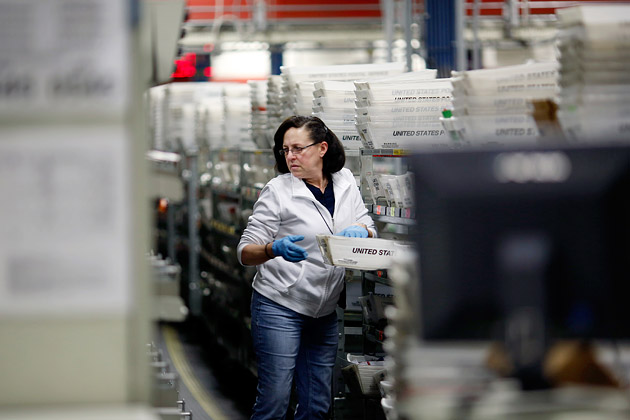
workerConsidering the many dire predictions about the perils of the out-of-date business model of the United States Postal Service, one might surmise that its very future is in doubt.

But then we read the following news about the upcoming holiday mail season:

  • 15 billion+ pieces of mail are expected to be processed by the USPS this holiday season.
  • That represents an increase of ~10.5% compared to last year.
  • Of the 15 billion items processed, more than 500 million will be packages.

There’s a new benefit being offered to USPS customers, too. Ahead of the holiday season, the USPS is now offering real-time delivery notification.  People who register will receive real-time e-mail alerts when delivery scans are made by postal workers.

That new function may well be why the new USPS slogan has been unveiled as “One more reason this is our season.”

Normally, all of the additional volume would be cause for celebration – tapping unused capacity while growing revenues during this busy time of year.

But here’s the rub: In order to handle the added volume, the USPS needs to hire ~30,000 temporary workers.

This could mean that substantially all of the added revenues are immediately sucked out of the USPS’s coffers in order to pay for the added labor resources.

“It’s always something …”

Marketing Technology: Is “Implosion” Where We’re Headed?

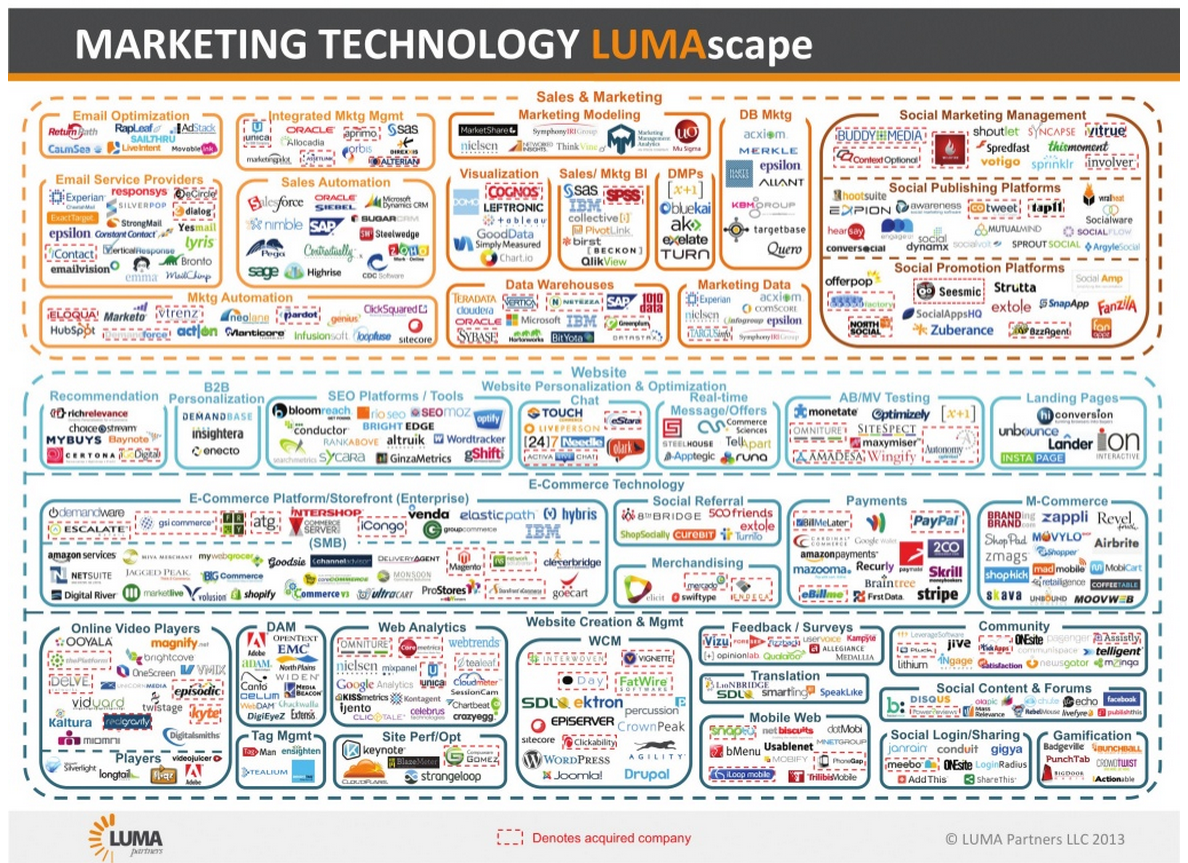
A chart of just some of the major marketing technology platforms -- and this is as of 2013!
A chart of just some of the major marketing technology platforms — and this was in 2013!

It seems that with each passing day, one or two new technology products are announced by MediaPost and other publishers in the marketing field.

The numbers tell the story. The marketing technology industry website chiefmartec.com lists nearly 1,900 marketing technology vendors in more than 40 categories.

That’s nearly double last year’s tally of around 950 vendors.

Software clearinghouse Capterra lists even more: a whopping 3,000+ marketing technology products across 30 categories.

These firms account for well over $20 billion in financing – the dollars that can be tracked, that is – including around 30 companies that are valued at $1 billion or more each.

That’s a lot of companies and vendors. Of course, there are many customers who are looking for tech-driven marketing solutions as well.  The question is whether things have gotten out of balance.

Business writer and marketing tech specialist Malcom Friedberg thinks so. He’s Chief Marketing Officer at CleverTap, and he also publishes columns on a variety of business topics.

In Friedberg’s view, the sheer number of marketing technology vendors and products means that the segment may now be on the brink of an implosion.

Friedman references a recent CMO Council document that reports that more than 80% of marketers are using as many as ten different marketing-related technologies or cloud solutions.

And as new technologies are added, the problem is finding educated staff – and enough hours in the day – to cover all of these products well. In many instances, users may be just scratching the surface of what these products can provide; the “multiple hat” dynamics of many marketing departments mean that very few people qualify as being “advanced” users.

The problems boil down to this: Even if a department has two or three marketing people devoted exclusively to tech-related responsibilities (at tall order in most companies) – this assumes that those people can work equally well on multiple different platforms.

The reality is quite different. It’s more like a big jumble – with consultants brought in to sort things out.  It may get the job done, but it isn’t pretty – and it’s hardly a recipe for “the best of best practices.”

Survey work by the CMO Council supports this hypothesis. The Council has found that fewer than on in ten of the marketers it surveyed reported that they possess a highly evolved digital marketing model that has a proven, clear path of evolution.

Malcolm Friedberg
Malcolm Friedberg

Friedman thinks he knows where things are heading. Not to more choices, but rather to less:

“In my opinion, we’ll start to see massive consolidation and uber-marketing systems. Think super-integrated marketing and advertising clouds … the preoccupation with ‘best-of-breed’ in every category will be replaced by a ‘tree-and-branch’ model, with one core technology and a few ‘good enough’ complementary ones.”

Friedman calls it “an expensive French meal” instead of “a Vegas buffet.” While there will always be new products promising incremental improvements, he predicts that by 2020, the common business model will be super-integrated marketing and advertising clouds as we see already with the likes of Marketo and Hubspot.

What do you think? Is Friedman onto something … or is the orgy of new marketing technology products going to continue unabated?  Please share your thoughts with other viewers here.

The “100% ad viewability” gambit: Gimmick or game-changer?

Say hello to the ad industry’s newest acronym: vCPM (viewable cost-per-thousand).

viewabilityA few weeks back, Google announced that it will be introducing 100% viewable ads in the coming months, bringing all online ad campaigns bought on a CPM basis into view across its Google Display Network.

The news comes as a relief to advertisers, who have long complained about the high percentage of ads that never have a chance to be viewed by “real people.”

The statistic that Google likes to reference is that approximately 55% of all display ads are never viewed due to a myriad of factors — such as appearing being below the fold, being scrolled out of view, or showing up in a background tab.

And the problem is only growing larger with the increased adoption of ad blocker software tools.

Google isn’t the only that’s one coming up with in-view advertising guarantees. Facebook recently announced that it will begin selling 100% viewable ads in its News Feed area.

But some are questioning how much of a better benefit 100% viewability will be in actuality. For one thing, ad rates for these program are sure to be higher than for conventional ad buying contracts.

For another, neither Facebook nor Google have stated how long an ad would need to remain in view before an advertiser gets charged. Whether it’s 1 second, 2 seconds or 5 seconds makes a huge difference in the real worth of that exposure to the consumer.

Then there’s the realm of mobile advertising. In a startling analysis conducted and reported on by The New York Times, a mix of advertising and editorial on the mobile home pages of the top 50 news sites was measured.  What the analysis found was that mobile airtime is being chewed up by advertising content far more than by the editorial content people are tuning in to view.

Boston.com mobile readers are a case in point. The analysis found that its readers spend an average of ~31 seconds waiting for ads to load versus ~8 seconds waiting for the editorial content to load.  That translates into a home page visitor paying $9.50 per month — just to view the ads.

ad blockerWhen there’s suddenly a cost implication in addition to the basic “irritation factor,” expect more smartphone and tablet users to avail themselves of ad blockers even more than they do today.

As if on cud, Apple is now allowing ad blockers on the iPhone, giving consumers the ability to conserve data, make websites load faster, and save on usage charges all in one fell swoop.

Sounds like a pretty sweet deal all-around.

Surprising statistic? One-third of American adults still aren’t on social media.

social mediaFor the many people who use social media on a daily basis, it may seem inconceivable that there are a substantial number of other Americans who aren’t on social media at all.

But that’s the case. The Pew Research Center has been tracking social media usage on an annual basis over the past decade or so, and it finds that about one-third of Americans still aren’t using any social networking sites.

To be sure, today’s ~65% participation rate is about ten times higher than the paltry ~7% participation rate Pew found the first time it surveyed Americans about their social media usage back in 2005.

According to Pew’s field research findings, here’s how the percentage of social media involvement has risen in selected years in the decade since. (The figures measure the percentage of Americans age 18 or over who use at least one social networking site.)

  • 2006: ~11% using at least one social networking site
  • 2008: ~25%
  • 2010: ~46%
  • 2012: ~55%
  • 2015: ~65%

In more recent years, the highest growth in social media participation rates has been among older Americans (over the age of 65), ~35% of whom are using social media today compared to just 11% five years ago.

That still pales in comparison to younger Americans (age 18-29), ~90% of whom use social media platforms.

While it’s a common perception that women are more avid users of social media than men, Pew’s research shows that the participation rate is actually not that far apart. Statistically it isn’t significant, in fact: a ~68% social media participation rate for women versus ~62% for men.

pew-research-centerSimilarly, there are more similarities than differences among the various racial and ethnic groups that Pew surveys — and the same dynamics are at work when it comes to differing education levels, too.

Regional differences in social media practice continue to persist, however, with rural residents less likely to use social media than suburban residents by a ten-point margin (58% versus 68%). City dwellers fall in between.

More details on Pew’s most recent field research on the topic of social media participation can be accessed here. See if you notice any surprising findings among them.

Where Outside Suppliers of Business Services Fall Down on the Job …

Quirk's Corporate Research ReportQuirk’s Marketing Research Review is a periodical I’ve enjoyed reading for three decades or more.  Unlike the articles that appear in other research-related publications that are more “scholarly” and theoretical,  I find the articles in Quirk’s to be chockfull of insights, while at the same time being “efficiently practical” and easy to digest.

Recently, the magazine published findings from its second annual Quirk’s Corporate Research Report, designed to give corporate researchers an in-depth look into their world.

As part of the research-gathering process for the report, Quirk’s conducted a field survey covering budgets, outsourcing, research techniques in use and under consideration, how research findings are reported inside organizations and, last but not least, the experiences researchers have had when working with outside vendors.

When asked by Quirk’s to state what are the main problem areas when research vendors have come up short on a project, these eight factors were cited by respondents most often:

  • The vendor over-promised and under-delivered: ~56% of respondents mentioned
  • The project was handled by low-level staff: ~51%
  • Vendor failed to take time to understand the client’s business: ~50%
  • Vendor had poor communications: ~39%
  • Vendor failed to take time to understand the project’s needs: ~36%
  • Data integrity issues: ~35%
  • Vendor missed deadlines: ~35%
  • Tools/methodologies that the vendor suggested weren’t right for the project: ~14%

Notice how the most pervasive issues have less to do with the inherent quality of the research product being delivered, and more to do with how the vendor interfaces with and communicates with the companies they support.

The above behaviors represent challenges associated with conducting research projects. But I contend that they apply equally well to providers of other types of business and corporate services, whether they’re ERP or IT projects, website development projects, CRM implementation, SEM/SEO programs, media campaigns, PR initiatives … even IPOs, capital campaigns and the like.

Which of these shortcomings do you find to be most prevalent in your dealings with outside service providers — and what have you done about them? Please share any insights you may have with other readers here.

The lifetime value of a blog post: It’s more than you probably think.

bgHere’s an interesting factoid: In 2014, more than 550 million blog posts were uploaded on WordPress alone.

Add in Tumblr, and there are another 250 million blogs.

Considering the sheer volume of blogging activity, it’s surprising how little intelligence on the “value” of a blog post has been available. But now a study has been published that sheds light on the question.

The evaluation, which was commissioned by branding agency IZEA and conducted by research firm The Halverson Group, has determined that the lifespan of a blog post is far greater than the accepted measurement of 30 days.

The lifespan is more than 20 times longer, it turns out.

Let’s break down the research findings a bit more. The IZEA/Halverson study determined that by Day 700 (about two years), the typical blog post will have received ~99% of its impressions.

That’s a pretty long annuity, and it provides strong ammo for marketers who advocate for blog posts as an important way to maximize the return on their marketing spend.

According to the study, the typical blog post goes through three distinct phases in its useful life:

  • Shout: The initial spike in impressions that happens within the first 7 to 10 days, typically resulting in half of the total impressions the post will ever receive.
  • Echo: The period ending at 30 days, by which time the typical blog post will have racked up ~70% of its total impressions.
  • Reverb: The third phase that stretches from approximately Day 30 all the way to Day 700. This long-tail phase will typically generate the final ~30% of impressions.

Of course, the performance of individual blog posts will depend on the subject matter, the timeliness of the information, and other factors. But as a general rule of thumb, the Halverson findings show the potential value of a blog post as far greater than many marketers may have surmised up until now.

The Halverson study also provides a good rule of thumb for the lifetime impression value of a blog post. It can be calculated by multiplying a blog post’s 30-day monthly pageview total by a factor of 1.4.

In other words, by Day 30, marketers can know with a good deal of confidence how the blog post will perform overall.

Using this formula, marketers will be able to demonstrate the “evergreen” effect of blogging as a marketing tactic.

Certainly, the residual benefits of a blog post look very strong — particularly in contrast to volume-based media such as display or search advertising, which stop performing the instant the campaign investment ends.

The bottom line: Companies should continue to blog away … and if they haven’t started or if they’ve allowed their blogging program to flag, it’s time to get things back in gear!

“Boomerang employees”: No longer such a rarity in the corporate world.

Time was, once a person left a company – for whatever reason – the likelihood that they’d ever come back to work there was pretty slim.

Perhaps to be re-engaged as a consultant or a contract worker … but as a return employee? Not likely at all.

That mindset appears to be changing.  Data accumulated from a recent survey by HR research and advisory firm Workplace Trends from ~1,800 human resources executives, managers of staff, and employees provide the following clues:

  • Half of the HR professionals responding to the survey claimed that their organization once had formal policies against rehiring former employees (even if the employee had departed in good standing).
  • Three-fourths of the HR respondents reported that they are more accepting of hiring boomerang employees today. More than half of the respondents who are people managers felt the same way.

The actual incidence of returning to work at a former company isn’t all that common.  Of the employees who took part in the survey, fewer than 15% of them fell into this category.

Still, 15% is way up from where it has been traditionally — and the current percentage is higher than I would have guessed.

What’s more, nearly 40% of employee respondents reported that they would consider going back to an employer where they had once worked.

There are distinct differences in employee attitudes based on age demographics: More than 45% of Millennials would consider returning to work for a former employer … but the percentage is just 29% for Baby Boomer respondents.

As for why boomerang employees are becoming more common, a number of factors are at play:

  • Intense competition for certain technically advanced employees who may be in short supply makes poaching more common … and also intensifies the need for companies to respond in kind. In fields were strong talent is hard to come by, often the pool of workers is too small to summarily omit former employees from consideration.
  • Familiarity with a company’s organization, culture and ways of doing business reduces “ramp-up” requirements and the amount of training needed, when compared to bringing on a brand-new employee.
  • The “devil you know” factor: Even if a former employee possesses a few characteristics that are less-than-ideal, at least these are known quantities, as compared to a brand-new employee who may or may not be all that she or he seems to be on paper.

chairGoing forward, I suspect that boomerang employees will become even more prevalent than they are today.

To do well at that, companies might wish to look into maintaining open lines of communication with select former employees. It seems like a good way to keep choice workers “in the loop” and potentially available — and interactive/social media makes it easier to keep those channels open.

As things stands now, the results of this survey suggest that such channels are, at best, ad hoc rather than being part of a formal “alumni” communications strategy.

Addressing this point, Dan Schawbel, head of WorkplaceTrends, had this to say:

“In previous research we’ve done, we’ve found that Millennials are switching jobs every two years because they are searching for the job – and organization – of best fit. But this new study indicates that this younger generation is more likely to boomerang back when they’ve experienced other company cultures and realized what they’ve missed.”

Schawbel’s prediction? “We’ll see the boomerang employee trend continue in the future as more employees adopt a ‘free agent’ mentality – and more organizations create a stronger alumni ecosystem.”

What about you? Are you a boomerang employee? Or do you know colleagues who have done this? What are the pluses and minuses? Please share your thoughts with other readers here.

China’s controversial product supplier pledge: An “on the ground” view from the Far East.

The business world is abuzz about the latest moves by China to regulate the behavior of U.S. and other foreign companies that choose to do business in that country.  What’s the real skinny?

contract

While much of the reporting and commentary has been decidedly scant on details, we can actually take a look at the official document that contains the various provisos the Chinese government is intending to impose on foreign companies.

Ostensibly, the declaration is aimed at “protecting user security.” Here are the six provisions that make up the declaration:

Information Technology Product Supplier Declaration of Commitment to Protect User Security

Our company agrees to strictly adhere to the two key principles of “not harming national security and not harming consumer rights” and hereby promises to:

#1.  Respect the user’s right to know. To clearly advise users of the scope, purpose, quantity, storage location, etc. of information collected about the user; and to use clear and easy-to-understand language in the user agreement regarding policies and details of protecting user security and privacy.

#2.  Respect the user’s right to control. To permit the user to determine the scope of information that is collected and products and systems that are controlled; to collect user information only after openly obtaining user permission, and to use collected user information to [sic] the authorized purposes only.

#3.  Respect the user’s right to choice. To allow the user to agree, reject or withdraw agreement for collection of user information; to permit the user to choose to install or uninstall non-essential components; to not restrict user selection of other products and services.

#4.  Guarantee product safety and trustworthiness. To use effective measures to ensure the security and trustworthiness of products during the design, development, production, delivery and maintenance processes; to provide timely notice and fixes upon discovery of security vulnerabilities; to not install any hidden functionalities or operations the user is unaware of [sic] within the product.

#5.  Guarantee the security of user information. To employ effective measures to guarantee that any user information that is collected or processed isn’t illegally altered, leaked, or used; to not transfer, store or process any sensitive user information collected within the China market outside China’s borders without express permission of the user or approval from relevant authorities.

#6.  Accept the supervision of all parts of society. To promise to accept supervision from all parts of society, to cooperate with third-party institutions for assessment and verification that products are secure and controllable and that user information is protected etc. to prove actual compliance with these commitments.

Often with China, there are “official” pronouncements … and then there’s what’s “really” going on behind the curtain.

So to find out the real skinny, I decided to ask my brother, Nelson Nones, who has lived and worked in East Asia for years.  Since Nelson’s business activities take him to China and all of the other key Asian economies on a regular basis, I figured that his perspectives would be well-grounded and worth hearing.  Here’s Nelson’s take:

Points 1 through 3 are fundamentally no different from the provisions of personal data protection laws already on the books in the 27 member states of the European Union, plus Australia, Hong Kong, Iceland, India, Japan, South Korea, Liechtenstein, Macau, Malaysia, New Zealand, Norway, Singapore, the Philippines, Taiwan and some U.S. states.  Nor do they materially differ from privacy policy best practices — so I would not see these as particularly onerous or unreasonable.

The key difference is that these points are not enshrined in law in Mainland China, so compliance is voluntary at the moment (as it was in Singapore until 2013) – presumably binding on only those companies that sign this declaration. 

News reports also indicate that China has asked only American technology companies to sign its Declaration of Commitment, implying that domestic Chinese companies aren’t necessarily held to the same standards — although if this is truly the case, it might actually put Chinese companies at a competitive disadvantage by enhancing the appeal of American technology products to discerning Chinese users.

Point 4 doesn’t generally fall within the scope of existing personal data protection laws, but in my view its provisions fall well within the QA and warranty commitments that any legitimate technology company should be prepared to make in today’s competitive environment.

Comparing Point 5 with legislation currently in force within the European Union, Australia, Hong Kong, Iceland, India, Japan, South Korea, Liechtenstein, Macau, Malaysia, New Zealand, Norway, Singapore, the Philippines, Taiwan and some U.S. states, this point lacks some really key definitions, including:  

  • Who exactly is a “data subject” who is entitled to personal (i.e. user) data protection?
  • Who exactly is the “data controller” who owns the user information that is being collected or processed?
  • Who might be the “data processor” who stores and/or processes user information on behalf of the “data controller”?

EU Data Protection DirectiveThe legislation and regulations I’ve reviewed in this realm provide very explicit (and varied) definitions of these entities. Unlike China’s Declaration of Commitment, for instance, the E.U. Data Protection Directive allows “data controllers” or “data processors” to transfer user data outside the E.U., as long as the country where the data is transferred protects the rights of “data subjects” as much as the E.U. 

It also defines which “data controllers” and “data processors” must comply with E.U. law, based on whether or not they store or process personal information with the E.U., or operate within the E.U. (regardless of where the data is actually stored or processed).

The requirement to keep sensitive user information within China’s borders, in the absence of permission from users or “relevant authorities” to transfer, store or process it elsewhere, could also be seen as an attempt by the Chinese government to enlist the help of American technology companies in circumventing the U.S. government’s ongoing Internet data-gathering programs.

If this attempt succeeds, it might further enhance the appeal of American technology products to discerning Chinese users. 

Point 6 is garnering the most headlines in the West because of the implied threat that cooperating with “third-party institutions for assessment and verification … to prove actual compliance with these commitments” could mean being forced to reveal source code or encryption algorithms.  

However, in classic Chinese style, none of that is actually spelled out. 

Green Dam Youth Escort ServiceA little history about this: Over the past decade, the Chinese government has put forward various proposals for controlling IT – and then abruptly withdrawing them in the face of domestic as well as global criticism. Here are two: 

As for implications, China’s Declaration of Commitment shouldn’t have significant impact on companies that aren’t in the consumer IT market.  At best, its first five points could potentially improve the competitiveness of American IT products in the  Chinese market.    

However, I would advise any tech companies that may be wondering what to do, to sit on their hands for a while. Law in China is always a “work in progress,” so the safest bet is to wait for that “progress” for as long as possible.

So there you have it – the view from someone who is smack in the middle of the business economy in East Asia. If you have your own perspectives to share on the topic, I’m sure other readers would be interested to hear them as well.