The key to environmentally friendly products’ desirability? Deemphasize the green.

Selling green productsIt turns out that one key to the success of marketing so-called “green” products is actually to deemphasize the environmental messaging — at least when targeting consumers in the United States.

According to a number of surveys conducted by branding and marketing communications firm Landor, American consumers value possessing “green” attributes the least valuable of a series of brand attributes studied.

This despite years of social engineers and marketers of environmentally friendly brands attempting to “educate” consumers on environmental consciousness and the importance of sustainability.

At this point, it’s probably better for products to promote themselves based on other attributes besides “green” attributes … or at least to stop leading with that argument.

Instead, what are the values that resonate the most with American consumers?  According to Ted Page, a principal at content marketing firm Captains of Industry, there are three in particular — none of them having much to do with environmental issues — at least on the face of it:

  • Freedom
  • Independence
  • Saving money

But for green products, it’s possible to tie everything up in a nice bow by being able to lay claim all three of these attributes as brand attributes while not compromising the environment, either.

Nest Learning ThermostatAn example of this message strategy in action is the Nest Learning Thermostat, which promises saving energy in the context of achieving increased home efficiency, automated temperature management and lower energy bills.  The “green positioning” is nice — but it’s the other product attributes that really hit pay-dirt.

Tesla logoAnother example is Tesla electric automobiles.  Tesla is promoting the performance of its high-torque electric engine as superior to other sports cars manufactured by BMW, Lexus and Audi.

The fact that Tesla’s high-performance engine happens to be emissions-free is just icing on the cake.

Thanks in part to this messaging platform, sales of the Tesla Model S auto now outstrip those of the Mercedes S-Class, Lexus LS, BMW 7-Series, Porsche Panorama and the Audi AB.

One has to wonder if this would had happened had Tesla chose to lead with “green” messaging instead.

It would be nice to think so, but … probably not.

Pinterest: Will it ever become a male hangout?

Pinterest logoHere’s a statistic about social media platform Pinterest that will probably surprise few people:  As of June 2014 statistics reported by digital analytics firm comScore, its user base is more than 70% female.

… Which means that Pinterest remains the most “gender imbalanced” of all the major social media platforms.

For the record, other social platforms have far more gender balance among their user bases – with at least 45% being male:

  • SnapChat:  52% male
  • Tumblr:  52%
  • Twitter:  48%
  • Facebook:  47%
  • Instagram:  45%
  • Pinterest:  28%

But here’s the thing:  Pinterest has been trying mightily hard to attract more male participants, but the proportional figures have yet to budge.

This points to a fundamental challenge.  It’s very difficult to change the image and atmospherics of a social platform once they’ve become so firmly entrenched.

And it’s not just a question of image.  The platform’s content says it all.

Jill Sherman, vice president of social and content strategy at marketing communications firm DigitasLBi, puts it this way:

“If you pull up Pinterest and go into any content section, you will see purses, dresses and women’s shoes — because women are the user base.  When 70% of the users are female, then 70% of the content is going to be female-oriented.” 

Pinterest for menHope springs eternal, however.  Pinterest is continuing its effort to attract more men.

Or at least … to make the site more “guy friendly” when a new member goes there signs up.  This means making sure to show items more stereotypically catering to men’s interests rather than things like women’s fashion items.

But how to get men to the stage of even signing up?  That challenge falls to Pinterest’s new “head of brand” – who just happens to be a man.

David Rubin
David Rubin

He’s David Rubin, erstwhile senior vice president of marketing at Unilever, where he worked on marketing the Axe brand of men’s body care products.

Mr. Rubin might wish to start his tenure by asking himself what would bring him to engage with Pinterest more … because according to news reports, Rubin had posted only 22 items on Pinterest prior to joining the company.

DigitasLBi’s Jill Sherman sees a challenge for Pinterest that is fundamentally basic.  “They haven’t cracked the motivation code:  How to attract men and keep them using the platform beyond saving things that pique their interest.”

I agree – and I’d go a step further.  Convincing people to visit Pinterest to find or view something of interest “feels” like a function a search engine such as Google Images is doing quite well already.  Who needs “yet another place” to tap into that functionality?  Especially if one is a male of the species?

In order for Pinterest to evolve beyond where it is today, perhaps it needs to look at what Facebook and others have been doing to create communities and interaction beyond just pretty pictures and videos.

It could be a tall order.

“Surprise & Delight” vs. “Tried & True” Branding

All the emphasis on having consumer-facing brands “surprise and delight” their customers isn’t what many people are looking for at all.

surprise surpriseIn the interactive age, what we hear often is that companies and brands need to go beyond simply offering a high-quality product.

Many companies and brands have the notion that they should strive to engender a kind of “personal” relationship with customers – so that consumers will develop the same kinds of feelings for brands as they have with their close friends.

How true is this?

One marketing company decided to find out.  Toronto-based virtual agent technology firm IntelliResponse surveyed ~1,000 online consumers in the United States earlier this year.

When asked what sort of relationship they would prefer to have with the companies whose products and services they purchase, here’s how the percentages broke for these respondents:

  • Prefer a “friendship” where they get personalized service:  ~24% 
  • Prefer a “transactional” relationship where they receive efficient service and that’s all:  ~59% 
  • Prefer both equally:  ~17% 

Evidently, “boringly consistently good” beats “surprisingly delightful” far more often – assuming the company is minding its Ps and Qs when it comes to product quality.

Here’s what else consumers are seeking:  They want to be able to get the same information and answers from a company’s desktop or mobile website … online portal … or social media sites as they do from speaking with company representatives over the phone.

The IntelliResponse survey found that two-thirds of the respondents will go to a company’s website first when seeking out information regarding a product or service – so the answers better be there or the brand risks consumer disappointment.

The takeaway is this:  No matter how much breathless reporting there is about this “surprising” social media campaign or that “delightful” interactive contest … the majority of consumers continue to view companies and brands the way they have for 100 years:  Companies are merely the vehicle by which they can acquire the goods they need.

Puzzle piecesRather than spending undue energy trying to make the interactive world “fun” or “sticky” for customers, companies should focus on the basic work of delivering products, information and answers that are easy to find, easy to understand, and easy to act on.

And related to that — make sure support systems (and support people) are in place so that customers can get any problems or issues solved with a minimum of time or hassle.

Do those things well, and companies will naturally please the vast majority of their current and future customers.

Everything else is just window-dressing.

Internet Properties: No Longer an American Monopoly

The amount of translated content is also showing big-time growth.

languageAccording to an analysis by venture capitalist and Internet industry specialist Mary Meeker, in 2013 nine of the ten top global Internet properties were U.S.-based.

For the record, they were as follows (in order of ranking):

  • Google
  • Microsoft
  • Facebook
  • Yahoo
  • Wikipedia
  • Amazon
  • Ask
  • Glam Media
  • Apple

Only China-based Tencent cracked the Top Ten from outside the United States — and it just barely made it in as #10 in the rankings.

And yet … the same Top 10 Internet properties had nearly 80% of their users located outside America.

With such a disparity between broad-based Internet usage and concentrated Internet ownership, the picture was bound to change.

And boy, has it changed quickly:  Barely a year later — as of March 2014 — the Top 10 listing now contains just six American-based companies.

Ask, Glam Media and Apple have all fallen off the list, replaced by three more China-based properties:  Alibaba, Baidu and Sohu.

Paralleling this trend is another one:  a sharp increase in the degree to which businesses are providing content in multiple languages.

For websites that offer some form of translated content, half of them are offering it in at least six languages.  That’s double the number of languages that were being offered a year earlier.

And for a quarter of these firms, translated content is available in 15 or more languages.

What are the most popular languages besides English?  Spanish, French, Italian and German are popular — not a great surprise there.  But other languages that are becoming more prevalent include Portuguese, Chinese, Japanese and Korean.

In fact, the average volume of translated content has ballooned nearly 90% within just the past year.

The growing accuracy of computer-based translation modules — including surprisingly good performance in “idiomatic” language — is certainly helping the process along.

Moreover, when a major site like Facebook reports that its user base in France grew from 1.4 million to 2.4 million within just three months of offering its French-language site, it’s just more proof that the world may be getting smaller … but native language still remains a key to maximizing business success.

It’s one more reminder that for any company which hopes to compete in a transnational world, offering content in other languages isn’t just an option, but a necessity in order to build and maintain a strategic advantage.

Genericide: The Biggest Threat to Trademarks

brandingWhen reading articles or promotional copy about certain brands, the extensive use of footnotes plus “®” designations dangling off of words like ornaments on a tree look clunky and can be a real distraction.

But there are important reasons for companies to police and protect their brand equity … because if you spend some time snooping around the English language, you’ll find any number of words that began life as trademarked terms but became “genericized” over time.

Trademark lawyers refer to this progression as “genericide.”  And there are a surprising number of high-profile examples they can cite.

Recently, business writer and editor Mary Beth Quirk compiled a list of once-trademarked brand terms that have become victims of genericide, and she published her findings in the Consumerist, an e-zine put out by Consumer Reports.

Among the trade names she highlights that have “gone generic” are these:

Aspirin — Originally registered by German firm Bayer, aspirin’s trademark was confiscated by the U.S. government in the wake of World War I. Considering the massive headache Germany would unleash on the world barely 20 years later, perhaps this aggressive move wasn’t the best course of action!

Dry Ice — Believe it or not, this was actually a trademarked term, dating from 1925.  To nearly everyone, it sounds so much better than “solid CO2.”  The clearly preferred “dry ice” descriptor everyone uses is probably why the company lost its trademark by 1932.

Escalator — Registered in 1900 by Otis Elevator, the company lost its trademark when the U.S. Patent & Trademark Office determined that Otis had used it as a descriptive term — even in its own patent applications.

Heroin — This was yet another Bayer trademark.  It seems strange that heroin started out life as an actual branded product … but there we are.  Presumably, these days Bayer is happy that its company is no longer associated with such a problematic substance.

Laundromat — This term started out as a General Electric trademark back in 1940, issued for the first wall-mounted washing machine.  GE failed to renew its registration after the 1950s.

Linoleum — Here’s an example of a brand name that had already entered the generic lexicon before the manufacturing firm even attempted to register it.  Coined in the mid-1860s, the company’s efforts to register the flooring name were to fail just a decade later.

Thermos — This trademark was established in the early 1900s as a more pleasing way to describe a “vacuum flask.”  After too much loosey-goosey use of the term, the USPTO pronounced it genericized in 1963.

Trampoline — It appears that this term, coined by inventors George Nissen and Larry Griswold in 1936, was never officially registered.  The real generic descriptor is “rebound tumbler,” but “trampoline” sounds so much more effective to me.  Everyone else seemed to think so, too, leading to its ineligibility for trademark status.

ZIP Code — An acronym for “Zone Improvement System,” the ZIP code began life in the mid-1970s as a service mark of the U.S. Postal Service, but the registration was never renewed.  I guess the USPTO chose not to notify its sister agency of the renewal — not their business to do so even among friends and colleagues, evidently.

The next bit of interesting information in Quirk’s article is her listing of brand names that remain trademarked to this day — even though some of them seem to epitomize the essence of generic terminology.

Quirk concurs in the view that these terms may be on life support as proprietary names, noting that they are “trademarks who need to watch their backs” because of how pervasive they are in everyday language usage.  Among the terms she cites are these:

  • Adrenalin® (owned by Park-Davis)
  • AstroTurf® (Monsanto)
  • Band-Aid® (Johnson & Johnson)
  • Bubble Wrap® (Sealed Air)
  • Crock-Pot® (Sunbeam)
  • Dumpster® (Dempster Brothers)
  • Fiberglas® (Owens Corning)
  • Frisbee® (Wham-O)
  • Hula Hoop® (Wham-O)
  • Jet Ski® (Kawasaki)
  • Kleenex® (Kimberly-Clark)
  • Lava Lamp® (Mathmos)
  • Mace® (Mace Security International)
  • Memory Stick® (Sony
  • Ping Pong® (Parker Brothers)
  • Plexiglas® (Rohm & Haas)
  • Popsicle® (Good Humor-Breyers)
  • Q-Tips® (Unilever)
  • Realtor® (National Association of Realtors)
  • Stetson® (John B. Stetson Company)
  • Styrofoam® (Dow Chemical)
  • Taser® (Taser Systems)
  • Teflon® (DuPont)

Thinking along these lines, do other trade names come to mind that could be in danger of losing their trademark status?  If you can think of any, please share your nominations with other readers here.

The most respected brands in 2014: Who’s up … who’s down.

Brand imageIn recent years, there’s been more press than ever about “brand respect.”  Building on this interest, brand strategy firm CoreBrand decided to use historical survey data to attempt to determine the sentiment behind the world’s best-known brands.

CoreBrand uses proprietary Corporate Branding Index data – 23 years’ worth – that it has been compiling through consumer surveys covering nearly 1,000 of most famous brands.

CoreBrand’s 2014 Brand Respect Study covers the 100 brands (limited to publicly traded companies) in the CBI that chart the highest levels of market familiarity among all of the brands tracked.

CoreBrand’s scoring mechanism is pretty straightforward:  Brands with the highest familiarity and favorability are defined as “most respected,” while brands that have high familiarity but low favorability levels are the “least respected.”

For the record, here are the most respected brands as determined from the 2014 CoreBrand research:

  • #1:  Coca-Cola – the most respected
  • #2:  PepsiCo
  • #3:  Hershey
  • #4:  Bayer
  • #5:  Johnson & Johnson
  • #6:  Harley-Davidson
  • #7:  IBM
  • #8:  Apple
  • #9:  Kellogg
  • #10:  General Electric

In comparing 2014’s results to the previous year, Coke and Pepsi remain at the top of the heap – although they traded places from one year to the next.  Moreover, both brands’ favorability scores declined slightly – perhaps due to the burgeoning “better for you” foods movement that seems to be souring some consumers on soft drinks and related beverages.

New on the “Top Ten” most-respected listing this year are IBM, Apple and GE.

At the other end of the scale, these ten brands came up as the ones that are the least respected – with Delta Airlines earning the Booby Prize as “the worst of the worst”:

  • #1:  Delta Airlines – the least respected
  • #2:  H&R Block
  • #3:  Big Lots
  • #4:  Denny’s
  • #5:  Best Buy
  • #6:  Rite Aid
  • #7:  J.C. Penney
  • #8:  Capital One Financial
  • #9:  Family Dollar Stores
  • #10:  Sprint Nextel

While it’s certainly no fun to be on the “least respected” list, two of the brands – Denny’s and Family Dollar — have actually seen their scores improve significantly this year compared to last.  So at least they’re headed in the right direction.

Two other brands – Philip Morris and Foot Locker – have gone off the list.  In the case of Foot Locker, it’s because its brand favorability ratings have improved significantly enough to lift them off the list.

For Philip Morris, the reason is far more mundane:  it’s simply because its familiarity level has deteriorated so much, the brand no longer even qualifies to be part of the annual CoreBrand Brand Respect evaluation.

And finally … we come to Delta Airlines.  It’s the air carrier everyone loves to hate — and it’s dead last in the brand respect rankings.

There’s some consolation for Delta, though:  The only two other U.S.-based air carriers that qualify for inclusion in the study based on their familiarity levels (United and American) also score on the low end, although they (just) miss being on the “least respected list.”

Evidently, the airlines in general could benefit from earning more brand respect.  Good luck with that.

Tough Nut: Shoehorning Social Media Practices into an Existing Corporate Culture

managing social mediaIn late May 2014, Business Insider published an article about the processes by which corporations and their brands plan and manage their social media efforts.

It elicited derision and snorts of laughter in response.

Why?  For starters, the story sported this irreverent headline:  “We Got a Look Inside the 45-day Planning Process that Goes Into Creating a Single Corporate Tweet.”

And inside the article, it was revealed that it took the four-person agency team that handles the social media program for the Président Cheese brand 45 days to take a single tweet from conception to published reality.

For the record, here is the tweet as it finally appeared on Twitter:

President Cheese tweet

On the one hand, it seems patently ridiculous that a single tweet should take so long to germinate, come to fruition and be published.  At that pace, the Président Cheese brand is going to be left in the dust.

[To add further insult, the social media accounts in question had only ~100 Twitter followers and ~220 Facebook likes at the time.]

But let’s look more closely.  The tweet is recommending serving camembert cheese at room temperature for better flavor, rather than straight out of the refrigerator.

It’s a mild enough suggestion … but it has potential negative implications concerning food safety — or at least the perception of such.

When one is a brand sold nationally, such considerations aren’t merely theoretical; a simple tweet can be turned into a cudgel to beat over the head of the brand in the case of a lawsuit over food sanitation.

Considered in those terms, it no longer seems quite so strange that it took the MarComm agency so many days to go from ideation through the review-and-approval process to get to publication.

And the four agency people involved?  They’re the team assigned to the brand’s social media account, and the full group’s involvement was a single meeting to discuss the upcoming month’s social media topics.

It turns out that “planned” topics represent about one-third of the Président Cheese activity on social media platforms; the rest of the postings are done on the fly, responding to customer chatter, answering questions or weighing in on other comments, and responding to food trend news or other developments that tie in with the world of food, hospitality and entertaining.

So, like so many other factors in the business world and in life, the 45-day tweet isn’t a black-and-white issue of failure; it’s shades of gray.

Now that we’ve seen both sides of the coin, I think it’s still legitimate to question the length of time and the amount of energy required to post a single tweet.

Several ways to correct this come to mind.  One is for brands to stay away from any topics that might expose them to the risk of public relations problems or potential legal repercussions.

But in a world where brands are competing against an endless crowd of other social posters … that seems like a pretty sure ticket to irrelevance and social media oblivion.

At the same time, any MarComm agency or in-house social media department needs to adhere to some practical standards of vetting so that some ill-conceived post doesn’t blow up in the company’s face.

The sweet spot — or at least the proper balance between interest, efficiency and prudence — would be creating a streamlined client approval process involving only one or two people (plus backups) who are sufficiently attuned to the brand’s market position and the best ways to advance it and protect it.

Oh, and the team assigned to the responsibility needs to be available 24/7 for vetting purposes (hence the need for backup personnel who are at-the-ready).

It may be a pesky responsibility, but in the “always-on” world of marketing today, it’s really the only way to go if one wishes to participate on the interactive playing field.

The alternative is a tweet that takes weeks to be published … and I doubt anyone is ever going to be satisfied with that.

Frequent flyer programs: No longer going the distance.

What took so long?

frequent flyer programsDelta and United Airlines have announced what they hope will be an industry-pacesetting change in the way frequent flyer programs are administered by the world’s biggest airlines.

The two air passenger carriers are shifting away from awarding points based on flight distance, and instead will award points based on the actual airfare paid by the traveler.

The change in procedures will become effective in 2015 (in January for Delta and in March for United).

In retrospect, one wonders why it took so long for the big airlines to make this move.

After all, the very nature of loyalty programs is to reward a company’s best and most profitable customers.

Business travelers who book a flight a few days ahead – not to mention people who prefer to travel first class – are far more valuable to an airline than someone who books the “Cheapy Charlie” web-only fare months in advance.

Besides, prominent low-cost air carriers like JetBlue, Southwest and Virgin have been using revenue-based methods of calculating their frequent-flier points for a good while now.

As for which types of travelers will come out winners vs. losers in the frequent flyer program changes, it’s exactly who you’d expect:

  • Big Winners:  Business passengers traveling internationally and on refundable-fare domestic flights + first-class passengers.
  • Big Losers:  Leisure fliers in coach class + business flyers who travel on cheap fares.
  • In-Betweeners:  Business passengers who travel using a mix of business and economy fares.

The recent announcements by Delta and United leave only American Airlines as the last big U.S.-based global carrier that still maintains the traditional distance-based calculation for earning miles.

I wonder how much longer they’ll hold out?

Only a matter of months, I’m guessing.

What are your opinions about the changing policies?  Are there particular frequent flyer programs you love?  … Or love to hate?  Feel free to share your thoughts with other readers.

The hybrid car sizzle is fast becoming the hybrid car fizzle.

Well, that sure didn’t last long.

Hybrid autos:  Already riding off into the sunset?
Hybrid autos: Already riding off into the sunset?

News reports this week are stating that the market share of hybrid vehicles is now on the decline.

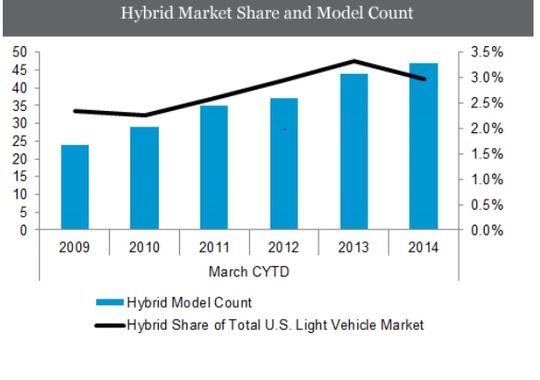
That is correct:  As of 1st Quarter 2014, hybrids only make up around 3% of the total car and light truck market in America.

Rather than an increase, that represents a pretty significant drop from nearly a 3.5% share of market just one year ago.

Here are the trend stats in graphic detail, courtesy of automotive statistics and intelligence firm IHS/Polk:

Hybrid Vehicle Stat ChartActually, the number of new hybrid car models being offered is still on the increase — now there are 47 different choices compared to around 25 in 2009, with Toyota’s five Prius models collected representing ~40% of the total hybrid market.  (The Prius share is down from ~55% in 2011, by the way.)

New model offerings or not … it’s pretty clear that the public’s interest in hybrid vehicles isn’t going up commensurately.  And the litany of reasons is all-too-familiar:

  • High car sticker price
  • Costly and complex batteries
  • Improved gas mileage and energy efficiency of conventional vehicles

Looking at the year-over-year trends, I think it’s doubtful that hybrid vehicles will ever achieve the high hopes the EPA and other federal officials have had for their adoption.

How embarrassing for them.

Instead, it seems more likely that the market will gravitate from the internal combustion engine straight to all-electric vehicles.  None of this “automotive hermaphrodite” stuff in between.

The more interesting question is this:  When will that shift occur?

To that one … not many people seem to have a definitive answer.

Companies Continue to Increase their Investment in Social Media

InvestmentSocial media may have its share of nettlesome issues … but that doesn’t mean companies aren’t spending more effort and energy on these platforms.

To illustrate, a new online survey of ~1,060 business owners, senior management personnel and social strategists that was conducted in April 2014 by Social Media Marketing University finds that a clear majority of companies are investing more time and/or dollar resources on social media as compared to a year ago.

And three-fourths feel that this investment is worth it.

Here are some of the SMMU survey’s key findings:

  • ~74% of companies are devoting more time to social media.
  • ~54% are spending more dollars on social media.
  • Nearly 70% are managing four or more social profiles.

The most significant expenditures for social media programs fall into these four categories:

  • Compensation of in-house staff: ~37% of all social media program expenditures
  • Social media advertising: ~18% of program expenditures
  • Compensation of external staff: ~10% of expenditures
  • Content development: ~7% of expenditures

According to the SMMU survey, smaller businesses – those with fewer than 50 employees – face the biggest challenge in terms of the increased time and cost commitments to social media.

As SMMU Principal John Souza puts it:

“Because many small businesses don’t have the skill-set or the staff to properly manage social media, they are outsourcing their social, or spending an excessive amount of time on tasks as they learn social by trial-and-error.”

Not surprisingly, having some focused training on the “how-to” of social media can make a pretty big difference in the effectiveness of the people charged with planning and carrying out a company’s social media program.

The question is how many businesses actually feel the need for such training, seeing as how some of the recent press about social platforms hasn’t been all that positive.

The answer, based on my own personal interaction with numerous small and medium-sized firms is … not very many of them.