Consumer buying behaviors: The power of choice … or not?

Toothpaste Aisle -- too many choicesIf you were to poll consumers, most would probably tell you that they love to be given many choices or options when it comes to merchandise and services.

And why not? Everyone recalls hearing about the “bad old days” of the Soviet Union and Communist China, when people had the choice of one type of bread or one color of clothing.

In the United States and other Western economies, we’ve long provided consumers a vast array of selection — sometimes with very little actual differentiation.  And those choices have proliferated all the more in recent years. 

[Take a walk up the toothpaste aisle at your local retail store and you’ll see “product choice, circa 2012″  in action – and on steroids.]

From the mundane to the important in goods and services, we have more choices today than ever before. But how well are we coping with having all of these options?

Not well at all, according to Barry Schwartz, the author of an important book on the topic. His book, The Paradox of Choice: Why More is Less, was published back in 2005 but is still quite timely today – perhaps even more when considering what’s happened in the ensuing years to things like the latest range of satellite television viewing package offerings from DirecTV.

Dr. Schwartz, who is a professor of social theory at Swarthmore College, posits that people are often overwhelmed by everyday decisions that have become increasingly complex due to the burgeoning number of available choices and options.

This over-abundance of choice happens not merely in the realm of toothpaste, but also in big decision areas such as selecting a healthcare provider, making investment decisions, deciding whether to move to a new city or state, or selecting a college or other educational program.

According to Dr. Schwartz, this is what often happens when confronted by so many choices:

 People question their decisions before they even make them

 The myriad of choices can set up unrealistically high expectations

 Depending on the importance of the decision to be made, too many choices can actually lead to decision-making paralysis

At what point the lines of “too few choices à la Havana” and “too many choices à la Atlanta” cross, differs depending on the situation: What might be a beautiful array of options for one person may induce an unacceptable degree of stress for another.

Dr. Schwartz lays out a number of suggestions for people who find that the bevy of choices produces too much stress, too much anxiety, or simply too much “busyness” in their lives. In turn, Harvard Business Review bloggers Anna Bird, Karen Freeman and Patrick Spenner help by coming at it from the other side.

This trio of business writers tells marketers, “If customers ask for more choice, don’t listen.” Their advice, as paraphrased by search marketing über-specialist Gord Hotchkiss, is this:

“The harder consumers find it to make purchase decisions, the more likely they are to overthink the decision and repeatedly change their minds or give up on the purchase altogether. In fact, regression analysis points to decision complexity and resulting cognitive overload as the single biggest barrier to purchase.

“Provide them with fewer choices, and make them as relevant and compelling as possible. Ease the burden of risk by providing information that reassures.”

Hotchkiss offers a few additional words of wisdom as well:

“Realize that one of the components of risk is the degree of bias in the information we’re given. If that information reeks of marketing hyperbole, it will be discounted immediately.”

So the bottom line for marketers could be this:  Simplifying product and service offerings may deliver just what consumers actually need (as opposed to what they say) … while also making employees’ lives in the product management department a whole lot easier.

TMI: The Seduction of Data

The Seduction of DataIt was the Roman philosopher Seneca who once remarked, “The abundance of books is a distraction.”

(He said it in Latin, of course.)

Fast-forward 2,000 years … and we’re dealing with the same phenomenon – on steroids.

Jonathan Spira, author of the book Overload: How Too Much Information is Hazardous to your Organization, calculates that “info-inundation” and the productivity inefficiencies that emanate from it costs the U.S. economy around $1 trillion per year.

But how can anyone combat the information explosion and not risk missing out on something important? After all, no one wants to be left behind when it comes to “knowing what needs to be known.”

But there are some small things you can do to help control your information environment. Spira and others suggest a few tips:

  • Skim and scan information first rather than digging deep from the get-go. More than 80% of it is likely dispensable.
  • Set aside some quality “thinking time” to properly digest what is truly important from what you just consumed.
  • Engage in more “real-time” interactions with colleagues rather than wasting energy over long e-communiqués and missed communications.

A related issue is whether “too much” information actually hinders good decision-making. That possibility was studied by psychologists at Princeton University and Stanford University more than a dozen years ago in research that seems even more pertinent and consequential today.

The researchers studied two groups of people. Each group was presented the same set-up: A person with a well-paying job and a solid credit history is applying for a bank loan. The issue facing the two groups is whether to reject the loan application because a background check has uncovered the fact that for the past three months the loan applicant has not paid on a debt to his charge card account.

Group A was informed that the amount of the card account charge was $5,000 … while Group B was told that the amount was either $5,000 or $25,000. Participants could decide to approve or reject the application immediately, or they could hold off making their decision until more information was available.

It was later revealed to Group B participants that the applicant’s debt was only $5,000 rather than $25,000. So eventually both sets of participants had the same information upon which to make their decision.

The experiment’s findings, published in a report titled On the Pursuit and Misuse of Useless Information, revealed the interesting final result: In what clearly should be a cut-and-dried decision to reject the loan application, more than 70% of Group 1 participants dutifully did just that. They rejected the loan application, properly protecting the bank from undue financial risk.

Group 2? Only about 20% rejected the application.

The Princeton/Stanford study concluded that even though both groups possessed the same exact information, Group 2 revealed an intriguing blind spot when it comes to the way many people make decisions: They’re passionately interested in filling information gaps.

But the compulsion to seek out the added information can actually lead people to delay making decisions for too long … or ultimately to make the wrong one.

Making the siren call of info-inundation all the more dangerous, the explosion of information that’s at our fingertips thanks to the Internet means there’s always “one more report” … ” one more evaluation” … “one more perspective” to seek out and consider.

It’s the seduction of data … where sometimes “more” can be “less.”

Newspaper Ad Revenues Plummet to a 60-year Inflation-adjusted Low

Newspaper advertising revenues decline to 1950 levels in inflation-adjusted dollars.Newspaper ad revenues have now collapsed to a level not seen since the 1950s in inflation-adjusted dollars. 

That’s the sobering conclusion from the Newspaper Association of America’s release of the most recent advertising revenue figures for the U.S. industry.

With these dismal statistics, the newspaper industry seems sure to contract even further, while getting precious little boost from their online advertising activities.

Clearly, when it comes to media, it’s “out with the old” and “in with the new” …

Election Campaign News Consumption: What a Difference a Dozen Years Makes

Trends in Campaign News Sources (Pew Surveys)One of the interesting aspects of the U.S. presidential elections that come along every four years is the opportunity to see how Americans are getting their political news. That’s because the Pew Research Center for People & the Press conducts a survey every presidential election year to find out those very behaviors.

The 2012 survey of ~1,500 voting-age Americans older was fielded earlier this year. It found that fewer people are following news about the campaign compared to four years ago.

That’s hardly surprising, given that the “heady and hopeful” campaign rhetoric of 2008 has given way to nothing more than a long, hard slog in 2012. 

What’s more interesting is to see how campaign news consumption behaviors have changed.

If we compare survey results this year against those of 2000 – a dozen years ago – it quantifies what many suspect has been happening: a big decline in traditional news sources like newspapers and network news in favor of the Internet.

In response to Pew’s question as to where consumers are regularly getting their campaign news, here are the comparisons between 2000 and 2012:

  • Cable TV news: Rose from 34% in 2000 to 36% in 2012
  • Internet: Jumped from 9% to 25%
  • Local TV news: Declined from 48% to 32%
  • Network news: Declined from 45% to 26%
  • Local newspaper: Dropped from 49% to just 20%

[Interestingly, the Internet as a source for campaign news has actually leveled off since 2008, when 24% reported it being a regular source for news. In the previous four-year cycle, that source had doubled in popularity.]

The most popular Internet sources for campaign news are the usual suspects:

  • CNN: ~24%
  • Yahoo: ~22%
  • Google: ~13%
  • Fox News: ~10%
  • MSN: ~9%
  • MSNBC (NBCNews): ~8%

But what about social media, the newest kid on the block when it comes to news sources? The Pew survey reveals that social media are being used by a pretty limited audience for presidential politics: ~20% report that they regularly or sometimes receive campaign information from Facebook, and only ~5% say the same about Twitter.

More details on the Pew survey – perhaps more than you ever wanted to know – can be found here.

Rude Awakening: Google to Cut Jobs

Google is cutting 4,000 jobs at MotorolaNow here’s some interesting news: Google is downsizing – the first time it’s ever done so.

More precisely, it’s cutting ~20% of the workforce of its Motorola subsidiary, which it acquired earlier this year. And most of those job cuts are happening in the United States.

While Google is known for being a money machine, the fate of its Motorola subsidiary has been far less stellar. In fact, Motorola hasn’t turned a profit in 14 of its last 16 quarters.

Motorola proves how dicey the world of hardware is compared to the search advertising realm where Google makes more than 90% of its revenues and profits.

The fact is, despite Motorola’s strong lineup of smartphone models like the Droid RAZR and RAZR HD, it’s just very difficult to turn a profit on the hardware side — especially in the entry-level mass market where Motorola has also attempted to compete.

But more to the point: Motorola’s subsidiary is one industry sector where Google isn’t in the driver’s seat. By contrast, it’s easy to be a veritable profit machine when you control 65%+ of the billions that make up the search marketing world.

Recently, it’s clear that Google has been sniffing around to add other products and services and not be so dependent on one silver-bullet business category.

The big question is … what does Motorola’s experience portend for future forays by Google into new segments where the company doesn’t command an overwhelming advantage?  Or, will it spend more of its capital on search-related acquisitions, like the just-announced absorption of Frommer’s travel-related media properties?

Welcome to the real-world competition, Google.

Tablet Computer Adoption: Fast and Furious

Tablets are growing faster than smartphone adoptionThe tablet computer hasn’t been around long at all.  But it’s making a huge splash in the digital arena … and giving not only laptops but also smartphones a run for their money in the bargain.

Consider these data points as reported on recently by Mark Donovan, a senior vice president at comScore, a leading Internet cyber-analytics firm:

  • Tablet adoption is happening significantly faster than what was experienced with smartphones.
  • The majority of iPad users don’t own an iPhone or some other type of smartphone.
  • Tablet “early adopters” are equally male and female – a departure from the norm which typically finds early adopters of new digital technology being primarily young men.
  • There is very high usage of tablets for shopping, watching video, and other media consumption. That’s also a departure from what was experienced with smartphones, where it took much longer for consumers to become comfortable shopping from their smartphone devices.
  • People use tablets and smartphones differently – and at different times. For example, smartphone usage peaks during the day whereas tablets are used more in the evening.

That tablets are making big gains on laptop computers is no surprise at all, considering their lighter weight, nearly effortless portability, brighter screens, and the ease of using them in environments not conducive to a keyboard-and-mouse (like in bed).

But of the trends noted above, I think the most intriguing one pertains to tablet computer usage versus smartphones – specifically, how tablets are becoming an alternative to smartphones rather than an adjunct.

Indeed, it seems as if some people aren’t making the transition from feature phones to smartphones that everyone expected; they’re opting for tablets instead. We may see the adoption rates for smartphonesbegin to flatten out as a result.

Indeed, Adobe Systems reported in May 2012 that tablet traffic is growing at a rate ten times faster than smartphone traffic.

But if you really think about it, maybe these latest developments aren’t so surprising: Many folks have long complained about the “miniaturization” of display screens that are a necessary evil of mobile phones. Now that the tablet has come along, there’s finally an effective solution to that dilemma – and the market has responded accordingly, blowing away even the most optimistic sales forecasts for tablets.

Tower of Babble: Four billion e-mail addresses and counting.

Billions of e-mail addressesDavid Baker, a global vice president at marketing technologies firm Acxiom and e-mail expert extraordinaire, wrote recently that when speaking with an employee at one of the major online database aggregators, he was informed that this company had a grand total of 4 billion e-mail addresses on file.

And of these, ~2 billion had names and addresses associated with them.

These numbers are dramatically higher than the worldwide estimate of e-mail addresses published by the Pingdom blog in its Internet 2011 in Numbers report.

Think about this for a moment. Considering that the total population of the United States is a little over 310 million, how many e-mail addresses per person are floating around out there?

Strip away the very young … plus teens and ‘tweens who don’t engage nearly so much in e-mail … and we’re left with the realization that among the core adult audience of Boomers and GenXers, there’s really no such thing as a single e-mail address that can be tied to one individual.

Even if we ourselves don’t maintain multiple e-mail accounts for different purposes, surely we know people who do. One person I know is juggling no fewer than 20 separate e-mail addresses; he claims to be keeping them all straight.

This notion of multiplicity is at cross-purposes with how marketers have traditionally viewed prospecting. We’ve been conditioned to think about an individual as being tied to one physical address and one e-mail address – in the same manner as a discrete mobile phone number or a unique social security number.

In theory, all of these are vehicles of monetization, with e-mail being particularly attractive because of the low cost associated with reaching prospects in that manner.

But in actuality, there’s a great deal of complexity:

  • Which e-mails are associated with opt-in permission?
  • Which e-mail addresses are primary (highly active) versus secondary (relatively inactive)?
  • Which e-mails are valid, but lying dormant?

Because e-mail addresses are “cheap/free,” they’re ephemeral. They aren’t “linear” in the same sense as the data on a residence, a business address or even a mobile phone number can deliver.

Mr. Baker concludes that, far from becoming easier, “the ability to engage a customer through e-mail across a portfolio of communications is becoming more costly and complex.”

With 4 billion e-mail addresses sloshing around in the digital space, there’s no doubt e-mail marketing will continue to be a major force in marketing. Even if half of them are cyber-zombies, digital Potemkin villages or what-have-you.

The challenge is in sorting it all out.

I think the e-mail specialists are going to be at this for a good long time to come.

Sometimes “permission slips” aren’t enough when it comes to e-mail deliverability.

Bounced-emails-undelivered-emailsIn case you’ve been wondering how much marketing e-mail actually reaches its intended targets, a recently released benchmark report from e-mail scoring and certification services provider Return Path has some answers. It finds that only about 75% of “permissioned” e-mails are actually making their way through.

That means one in every four e-mails are either hitting a spam or junk folder, or are being blocked by ISP-level filtering.

The report was based on analysis of data from Return Path’s Mailbox Monitor service, which tracks the delivery, filtering and blocking rates for more than 600,000 e-mail campaigns.

Interestingly, the delivery stats for business-to-business marketing e-mail aren’t much lower than for business-to-consumer e-mail. This was considered somewhat surprising because of company-level filtering systems like Postini, MessageLabs and Symantec that are installed at many large corporations. Presumably, they do a more thorough job of filtering e-correspondence.

The Return Path report also included a few cautionary notes for marketers:

 Many e-mailers believe that whatever gets deployed and doesn’t bounce must be reaching inboxes. But senders are notified only when the e-mail is a hard bounce – not if it has ended up in a spam or junk folder.

 Relying on rented e-mail files in the B-to-B world can be dangerous, as those files can be riddled with spam traps. Commercial entities are always on the search for new prospects and leads … but merging a good in-house list with a few of these bad boy rental lists can result in compromising the entire database.

 In the consumer sector, many marketers aren’t paying close enough attention to inbox placement rates. For example, data about Gmail shows that while many marketers are ostensibly achieving a 90%+ deliverability rate, fewer than one in five of those emails are actually being directed to the “priority” inboxes within Gmail as designated by the recipients. And you can bet that precious few of the other ~80% are getting any sort of attention at all from consumers.

More details about the Return Path report can be found here – well-worth checking out.

Amazon continues to push the envelope … while pushing books right off the table.

Amazon Kindle continues to push the envelope in book publishingIt’s hard to deny that the growth and success of Amazon has had a huge impact on the book industry. The liquidation of Borders Books is just the latest evidence of that.

But other market moves by Amazon demonstrate that the company has set its sights on far more than just owning the traditional retail book and recorded music segments. The introduction of the Kindle e-reader and release of subsequent newer, cheaper models proves that Amazon seeks to dominate the “information” space no matter what form it takes.

Two recent developments show how this is continuing to happen. First, the company announced that it is launching a new public-library feature that gives the Kindle the same library-borrowing abilities as competing e-reader devices like the Nook offer.

Public libraries have taken notice of the announcement, because Kindle so dominates the e-reader market. According to Forrester Research, an estimated 7.5 million Kindles are being used in America; that’s about two-thirds of all e-readers in the country.

Already, large public library systems such as those in Chicago and New York offer free digital-book lending. A trip to the library is not needed. Instead, patrons simply use their library card ID numbers to download books from the library’s website.

As with conventional “paper and glue” books (I love that new term!), there are “lending periods” for e-books usually ranging 2-3 weeks. Libraries purchase the e-books from publishers as they do bound books, and only one borrower can check out an e-title at a time.

How are Amazon’s latest e-lending developments affecting book publishers? For one thing, e-books never wear out, which means publishers (and authors) can’t benefit from reorders of popular titles due to book wear. Partially for this reason, several major publishers such as Simon & Schuster and Macmillan don’t sell their digital works to libraries … yet.

Adam Rothberg, senior vice president and director of corporate communications at Simon & Schuster, commented, “We value libraries for their work of encouraging literacy and the habit of reading, but we haven’t yet found a business model we’re comfortable with.”

Another publisher, HarperCollins, decided to set a checkout limit for each title of 26 times, after which a library would need to repurchase the book in order to continue lending it out.

Not surprisingly, that policy has been greeted with hoots and catcalls by the library industry.

Regardless of the selling policies under consideration, one wonders how much longer the major publishers can continue to hold out, as the entry of market-dominant Kindle should significantly raise consumer demand for library e-titles.

And in another move that is sure to shake up another segment of the book world – educational textbooks – Amazon announced several weeks ago that it has opened up a “textbook store” for the Kindle platform. That store is already offering thousands of textbook titles for rental, with many more in the offing.

Here’s how it works: Amazon will allow buyers to acquire textbooks at a deep-discount off of the standard print pricing. The charge will be based on the amount of time the student plans to hold the book – with a minimum rental period of 30 days (which can be extended, if desired).

And to further sweeten the pot, borrowers will be able to access any “notes” and “highlights” they’ve made to their texts even after they’ve “returned” the textbooks.

I’ve blogged before about the college textbook publishing segment — a niche some see as an unholy alliance between book publishers and college bookstores that more resembles a “racket” than a fair business model.

Charging ridiculously high textbook prices along with releasing suspiciously frequent “updated” new editions that change perhaps 2% or less of a book’s content have been all too common.

Moves by Amazon – along with similar programs introduced by smaller providers like Chegg, Inkling and Kno – may finally usher in an end to the indefensibly high prices of textbooks that have long been the bane of students (and their parents). And no one is mourning that.

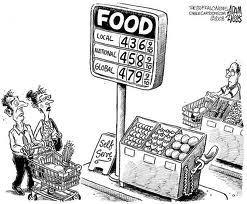
Move over, energy costs … Here come higher food prices.

Higher food prices like higher energy pricesIf it seems as if food prices have been increasing at a faster clip in recent months, you’re not dreaming.

Despite an overall inflation rate that seems low (although the federal government’s controversial exclusion of certain key components like gasoline makes its stats suspicious at best), we now have solid evidence that worldwide food cost increases are happening across the board.

Here’s a list of some of the most dramatic cost increases for key foodstuffs recorded since May 2010:

 Coconut oil: +134%
 Corn/maize: +111%
 Wheat: +75%
 Coffee: +70%
 Sugar: +55%
 Soybeans: +45%
 Palm oil: +42%
 Orange juice: +35%
 Beef and pork: +20%

Considering that this represents a time period of just a little over a year, these increases are some the largest recorded in decades.

What caused it to happen? Poor weather and bad harvests are two of the reasons. But high demand from developing countries – particularly China – is another important factor.

“This is a pretty sustainable increase … A number of factors have been building over time in terms of the commodity increase: world economic growth, rising crude oil prices, increased Chinese import demand have all conspired,” is how Bill Lapp, president of commodity analytical company Advanced Economic Solutions, puts it.

Unfortunately, the problem promises to persist, since many of the items above are ingredients that go into other prepared food items. Initially, packaged food makers that had locked in purchases for some items over certain time periods were able to delay delay passing on cost increases because of those hedges. But the bulk of those contracts have run their course by now.

So, even if commodity prices don’t go any higher, we’re likely to see the ripple effects in pass-along price increases all throughout the “food chain” in the months to come.

This isn’t news anyone wants to hear, considering how fragile (non-existent?) the economic recovery is here in the U.S. and in many other countries as well.

The sober truth is, high food costs coupled with increased energy prices have a chokehold on the world economy that is more consequential than many would care to admit.

Fasten your seatbelts, folks. We may be in for yet another wild ride on the economic roller-coaster …