Take Your Pick: One Super Bowl Ad Spot … or 14 Billion Facebook Ad Impressions

Super Bowl Ad Cost


This year a single 30-second ad spot during the Super Bowl TV broadcast will cost a cool $4 million.

And that’s just for the placement alone — not the dollars that go into producing the ad.

The high cost of advertising is directly related to Super Bowl viewership, of course, which is predicted to be north of 100 million people this year.

Still, $4 million is a really hefty sum, even for major brand advertisers.  Just how big is underscored in some comparative figures put together by Jack Marshall, a reporter at marketing e-zine Digiday.

Jack Marshall
Digiday’s Jack Marshall

In lieu of spending $4 million on a single ad spot, here’s how Marshall reported that the promotional money could be spent in alternative ways:

  • 14 billion Facebook Ad Impressions – According to digital marketing software firm Kenshoo, right-hand column “marketplace” ads on Facebook averaged 27 cents per thousand impressions during 2013.  This means that for $4 million, an advertiser could run a Facebook marketplace ad every second of every day for the next 469 years.
  • 3 billion Banner Ad Impressions – In 2013, average online display ad CPMs were running just shy of $1.30, looking globally.  Applying that figure to the U.S. market translates into 3 billion display ad impressions for your $4 million spend.
  • 160 million Sponsored Content Views – The typical charge is ~$25 to distribute sponsored content to 1,000 readers.  At that rate, $4 million would give you 160 million impressions (provided a publisher could actually deliver that many!).
  • 10.8 million Paid Search Clicks – With an overall average cost-per-click of 37 cents in 2013, $4 million would cover just shy of 11 million clicks.  That may be one-tenth the size of the Super Bowl viewing audience … but at least your audience would be actually searching for your product or service instead of heading to the kitchen for more corn chips and queso dip.

These are just some of the comparative figures outlined by Jack Marshall in his article.  You can read the others here.

Is AdTrap the answer to our prayers when it comes to blocking online advertising?

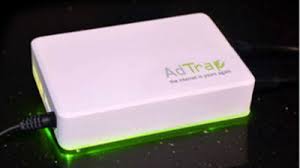
ad blocking deviceYou may have heard of AdTrap … or maybe you haven’t.

AdTrap is a newly developed device that intercepts online ads before they reach any devices that access a person’s Internet connection.

That basic action means that people are able to surf the web – including viewing videos – without the onslaught of online advertisements that seem to become more and more pervasive with every passing month.

The fundamental promise that the developers of AdTrap are making is a return to the “good ol’ days” of web surfing.

You know, back when most web pages you downloaded contained text and pictures – and virtually no advertising.

AdTrap’s motto is a simple and powerful one:  The Internet is yours again.”

Not surprisingly, there’s a good deal of excitement surrounding this new product.  In fact, interest has been so great that the invention attracted more than $200,000 in funding — raised in a 30-day Kickstarter campaign in early 2013.

Those funds are now being used to manufacture the first AdTrap units for shipment to “early adopter” consumers across the country.

How New an Idea Is This?

advertisingIn actuality, there have been a plethora of (often-free) software and browser plug-ins offered to consumers that can block online advertisements. 

But most of them have significant limitations because they’ve been designed to work only with specific browsers or on specific devices.

Free is good, of course.  But the developers of AdTrap are banking on the willingness of consumers to shell out $139 for their product – a rectangular box that looks a lot like a wireless router and that intercepts advertisements before they reach a laptop, tablet or mobile device.

The beauty of AdTrap is that it will work on every device connected to a person’s network.  Situated between the modem and router, it takes just a few minutes to set up.  

CNN technology correspondent Dan Simon reports that AdTrap does an effective job blocking advertising content.  But not perfectly; ads still appear on Hulu content, for example. 

But the developers of AdTrap report that they’re working on ways to block even more content going forward, including ads on Hulu.

Is this Bigger than Merely Blocking Ads?

Beyond the collective sigh of relief you’re likely hearing from those reading this blog post … what are the larger implications if AdTrap and similar devices are adopted by consumers on a large scale?

One not-so-positive implication may be that websites will no longer offer be able to offer content without charge, since so many publishers’ business models rely on advertising content to help pay most of the bills.

If advertising isn’t appearing thanks to AdTrap, people aren’t getting paid.

So let’s think about this for a minute:  It’s true that the Internet was blissfully free of wall-to-wall advertising 15 years ago compared to today. 

But cyberspace was also far less robust in terms of the quantity and quality of the informational and entertainment content available to us.

So yes … having a device to block 80% or more of the ads served to us is a very attractive proposition.  But if it means that some of our favorite sites move to pay-walls as a result, it might be that making a $139 investment in an AdTrap device isn’t such a “no-brainer” choice in the final analysis.

What do you think of this development — pro or con?  Please share your thoughts with other readers here.

Optify takes the pulse of B-to-B paid search programs.

Optify logoI’ve been highlighting the key findings of Optify’s annual benchmark report charting the state of B-to-B online marketing. You can read my earlier posts on major findings from Optify’s most recent benchmarking here and here.

In this post, I focus on the paid search activities of business-to-business firms.

Interestingly, Optify finds that pay-per-click programs have been undertaken by fewer firms in 2012 compared to the previous year.

And the decline isn’t tiny, either:  Some 13% fewer companies ran paid search programs in 2012 compared to 2011, based on the aggregate data Optify studied from 600+ small and medium-sized B-to-B websites.

However, those companies who did elect to run pay-per-click advertising programs in 2012 achieved decent results for their efforts.

The median company included in the Optify evaluation attracted nearly 550 visits per month via paid search, with a conversion rate just shy of 2%, or ~45 leads per month.

[For purposes of the Optify analysis, a lead is defined as the visitor taking an action such as filling out a query form.]

Leads from paid search programs represented an important segment of all leads, too – between 10% and 15% each month.

The above figures represent the median statistics compiled by Optify. It also published results for the lower 25th percentile of B-to-B firms in its study. Among these, the results aren’t nearly so robust: only around ~60 visits per month from paid search that translated into 6 leads.

Since the Optify report covers only statistics generated from visitor and lead tracking activity, it doesn’t attempt to explain the reasons behind the decrease in the proportion of B-to-B firms that are engaged in paid search programs.

But I think one plausible explanation is the steadily rising cost of clicks. They broke the $2 barrier a long time ago and see no signs of letting up. For some companies, those kinds of costs are a bridge too far.

I’ll address one final topic from the Optify report in a subsequent blog post: B-to-B social media activities. Stay tuned to see if your preconceptions about engagement levels with social media are confirmed – or not!

Move Over, Howard Stern: Now Google’s the “King of All Media”

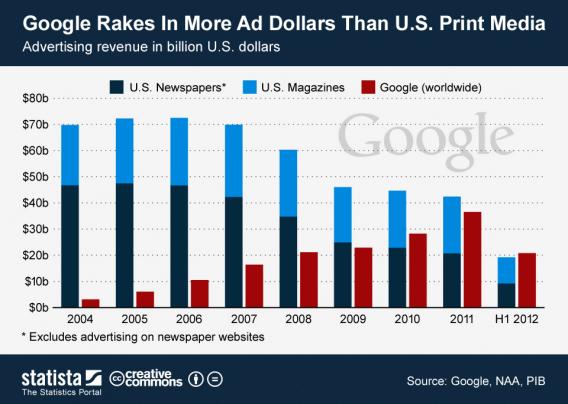
Google and Print Advertising Revenue Trends, 2004-2012It’s official. With nearly $21 billion in ad revenue generated during the first half of 2012, Google now attracts more advertising business than all U.S. print media combined.

That is correct:  German-based statistics portal Statista reports that Google garnered ~$20.8 billion in total ad revenues over the period, while all U.S. newspapers and magazines took in only about $19.2 billion.

Never mind that the comparison isn’t completely apples-to-apples … in that print revenues are for the United States only, while Google generates ad revenues worldwide. Still, it’s a dramatic milestone, and it says a lot about the fortunes (and future) of print versus online advertising.

Statista has helpfully published trend charts that show how quickly the ad picture has changed (see above). Only a few years ago, print advertising dominated the scene, but the trajectories of it and Google have been on opposite paths ever since.

It was inevitable that the lines would eventually cross, but how many could have foreseen it happening as early as 2012?

As if on cue, Advance Publications, a company that owns a number of venerable newspapers in New Orleans, Cleveland and elsewhere, has just announced that it is likely to cut the publication frequency of the Plain Dealer newspaper from its current seven days a week.

If Advance follows through on its intentions, it will join the New Orleans Times Picayune as a daily newspaper that’s no longer a daily.

The publisher’s letter to Plain Dealer readers described the newspaper’s future in lofty terms, noting that changes were coming as the paper seeks to “embrace dynamic shifts in the way information is consumed.”  And other such language.

It also noted that the pending changes are “not about cost-cutting.” But who believes that?

And in fact, the publisher’s letter states also that “if we maintain the status quo, we risk doing what everyone – our employees, advertisers and the community – wants to avoid: disappearing.”

If people don’t see a correlation between the Statista data and what the Plain Dealer has in store for its readers … they’re living on another planet. 

The ad-supported web: Will it fall under its own weight?

Banner advertisingFor the past (nearly) 20 years, the biggest thing that’s kept the Internet free for users is advertising – banner display advertising in particular.

Bloggers and other online publishers large and small rely on revenue from web banner ads to fund their activities. That’s because the vast majority of them don’t have pay walls … nor do they sell much in the way of products and services.

Because of this, the temptation is for publishers to serve up as many display ads as possible on each page.

It’s not unusual to see web pages that tile ten or more ads in the right-hand column. Usually the content of these ads has no relevance to readers, and the overall appearance isn’t conducive at all to reader engagement, either.

And that’s the problem.

Because of conditioning, people don’t even “see” these ads anymore. The advertising space has become one big blur – as easy to gloss over as if the ads weren’t even there to begin with.  (When’s the last time you clicked on a banner ad?)

Attempts to come up with other display advertising types – pop-ups and pop-unders, animations and other rich media, skycrapers and so forth – haven’t done much to change the picture. Indeed, they’re so ubiquitous – and so predictable – we don’t even consider the ads to be annoying anymore; they’re just part of the “décor.”

I’ve blogged before about how clickthrough rates on banner advertising are bouncing along in the basement, making them less and less valuable for advertisers to consider placing. And ads that are priced on a pay-per-click basis can’t be giving advertisers much in the way of revenue either, since relevance and engagement rates are so abysmally low.

The bottom line is that we now have a “lose-lose-lose” situation in online advertising:

  • Advertisers lose because of near-zero user engagement, thereby limiting their potential to drive business.
  • Publishers lose because ad revenues aren’t sufficient to bankroll their activities.
  • Readers lose because of lack of relevance and an incredible degree of page clutter.

So it seems that the ad-supported online publishing model is in a bit of a fix – and the question is how things can evolve to create a more satisfying result for all parties.

I’d be interested in hearing your thoughts on this issue:  What will online publishing look like in another five or ten years?  Anyone willing to hazard a guess?

Google Gone Wild: Has its AdWords pay-per-click program become too costly for businesses?

Google advertisingNo one should be surprised by the huge success of Google’s AdWords pay-per-click advertising program. Almost single-handedly, that service has vaulted the company into the top ranks of U.S. corporations.

And why not? As an advertising concept, pay-per-click has no peer. Capturing the attention of customers when they’re in the midst of searching for specific goods and services is the ultimate in effective targeting.

What’s more, Google’s pioneering advertising model, where advertisers set their own bid pricing and pay only when someone clicks on a link to their web landing pages, made the program affordable for everyone – from the biggest national brands down to the neighborhood store.

Google also offered all sorts of geographic and time-of-day filters to make it easier for businesses to target people at the right time and the right place … yet another boon to smaller businesses that otherwise couldn’t hope to compete against the big national players.

Many advertisers were able to participate in pay-per-click programs at a fraction of the cost of traditional display advertising, where advertisers pay significant fees up-front for “wait and wish for” customer engagement.

A few years back, it wasn’t unusual to be able to conduct a lucrative AdWords program bidding, with clickthrough pricing running well below $1 per click.

Because Google continues to possess the lion’s share of search activity (two-thirds or more of all search volume despite the best efforts of Bing/Yahoo and others to chip away at it), it was only natural for more and more advertisers to gravitate to Google’s AdWords program as the best venue for pay-per-click advertising.

But the temptation to get in the game has had the predictable result: pay-per-click bid rates have been climbing steadily.

Whereas before, an advertiser could expect to get good exposure on search results pages with a modest bid, it’s not possible to accomplish that anymore without bidding $5, $10, $15 or even more per click.

That’s beginning to drive some businesses away – particularly smaller ones without the deep pockets of the big firms.  For for many of them, it’s simply not sustainable to pay that much money just to get someone to visit their website.

AdGooroo, a search intelligence database firm that studies the pay-per-click market, reports that ~96% of pay-per-click advertisers spend less than $10,000 per month on such programs. That compares to millions of dollars spent by the largest companies.

Richard Stokes, AdGooroo’s founder, states this: “The only way for smaller advertisers to get an edge is to spend a lot of time improving the quality and relevance of their ads. The problem is that everyone else is doing that as well.”

So where does this leave us now? We’re beginning to get some hints that Google may have tapped out on advertiser demand. Some companies are dropping pay-per-click programs altogether, while others are scaling back while redirecting resources to other forms of promotion – traditional and social.

We have additional proof of this in the earnings report filed by Google just last week. The company reported that advertising sales continue to grow, but at a slowing rate.

And even more interestingly, average cost-per-click rates have declined by ~15%. That’s the first-ever decline since the AdWords program was launched.

Here’s another development:  heightened interest and focus on obtaining better natural search rankings by optimizing websites for content relevance.

Imagine that:  companies looking for ways to make their websites more relevant to viewers as well as search engine bots!

The heightened SEO emphasis has worked for many companies – at least up until now. Google may want to increase advertising revenues, but it also wants to ensure that its search functionality continues to deliver the most relevant and quality results so that users don’t begin to migrate to other search platforms.

But some advertisers may be wondering if the “Chinese wall” between advertising and natural search is as high or as airtight as it once was. They contend that their natural search rankings seem to perform better when they’re also actively engaged in pay-per-click advertising campaigns … and perform less well when they’re not.

Whether there’s any actual proof of this happening is mere conjecture. After all, the same company that runs AdWords is also running the search algorithms. So there’s really no way to prove this from the outside looking in.

The Free Lunch Ends on Facebook

Promoted posts on Facebook is the only way to get exposure anymore.
Promoted posts are the only way to ensure decent exposure on Facebook now.

It had to happen.  Suffering from a raft of unflattering news stories about its inability to monetize the Facebook business model and under withering criticism from investors whose post-IPO stock price has been battered, Facebook has been rolling out new policies aimed at redressing the situation.

The result?  No longer can companies or organizations utilize Facebook as a way to advance their brand “on the cheap.”

Under a program that began rolling out this summer and has snowballed in recent months, businesses must pay Facebook anywhere from a fiver to triple figures to “promote” each of their posts to the people who have “liked” their pages plus the friends of those users.

And woe to the company that doesn’t choose to play along or “pay along” … because the average percentage of fans who sees any given non-promoted post has plummeted to … just 16%, according to digital marketing intelligence firm comScore.

Facebook views this as a pretty significant play, because its research shows that Facebook friends rarely visit a brand’s Facebook page on a proactive basis. 

Instead, the vast degree of interaction with brands on Facebook comes from viewing newsfeed posts that appear on a user’s own Facebook wall.

What this means is that the effort that goes into creating a brand page on Facebook, along with a stream of compelling content, is pretty much wasted if abrand isn’t  willing to spend the bucks to “buy”exposure on other pages.

So the new situation in an ever-changing environment boils down to this:

  • Company or brand pages on Facebook are (still) free to create.  
  • To increase reach, companies undertake to juice the volume of “likes” and “fans” through coupons, sweepstakes, contests and other schemes that cost money.
  • And now, companies must spend more money to “promote” their updates on their fan’s own wall pages.  Otherwise, only a fraction of them will ever see them.

Something else seems clear as well:  The promotion dollars are becoming serious money

Even for a local or regional supplier of products or services that wishes to promote its brand to its fan base, a yearly budget of $5,000 to $10,000 is likely what’s required take to generate an meaningful degree of exposure.

Many small businesses were attracted to Facebook initially because of its free platform and potential reach to many people.  Some use Facebook as their de facto web presence and haven’t even bothered to build their own proprietary websites.

So the latest moves by Facebook come as a pretty big dash of cold water.  It’s particularly tough for smaller businesses, where a $10,000 or $20,000 advertising investment is a major budget item, not a blip on the marketing radar screen.

What’s the alternative?  Alas, pretty much all of the other important social platforms have wised up, it seems. 

For those businesses who may wish to scout around for other places in cyberspace where they can piggyback their marketing efforts on a free platform, they won’t find all that much out there anymore.  Everyone seems to be busily implementing “pay-to-play” schemes as well.

FourSquare now has “promoted updates” in which businesses pay to be listed higher in search results on its mobile app.  And LinkedIn has an entire suite of “pay-for” options for promoting companies and brands to target audiences.

It’s clearly a new world in the social sphere … but one that reverts back to the traditional advertising monetary model:  “How much money do you have to spend?”

Newspaper Ad Revenues Plummet to a 60-year Inflation-adjusted Low

Newspaper advertising revenues decline to 1950 levels in inflation-adjusted dollars.Newspaper ad revenues have now collapsed to a level not seen since the 1950s in inflation-adjusted dollars. 

That’s the sobering conclusion from the Newspaper Association of America’s release of the most recent advertising revenue figures for the U.S. industry.

With these dismal statistics, the newspaper industry seems sure to contract even further, while getting precious little boost from their online advertising activities.

Clearly, when it comes to media, it’s “out with the old” and “in with the new” …

Online display advertising’s clickthrough performance: Now it’s just embarrassing.

poor online display ad clickthrough ratesRecently, several executives at the Advertising Research Foundation, the online analytics firm Moat and media buying company Accordant Media created six completely blank online display ads – no copy and no images – in three standard sizes and two colors.

The idea was to test the veracity of information being collected on clickthroutgh rates in online advertising and the algorithms that drive automated ad buying and selling — ads being automatically served where they will generate the most clicks.

Once the ads had been created, the crack team had them served via a demand-side ad platform, using both run-of-exchanges as well as being trafficked to publishers that would accept unaudited copy.

The idea was to see what sort of clickthrough rate would be garnered by these “faux” ads.

It’s common knowledge that clickthrough rates for online display advertising are abysmally low. But what transpired in the ARF-led team’s “nothing-doing” ad campaign was startling, to say the least.

The average clickthrough rate on these ads, across 1 million+ impressions served, was 0.08%

That clickthrough rate rivaled the better results achieved by online branding campaigns … and isn’t very far off the average performance for a direct response effort!

The team noted that the modest cost of this research effort (less than $500) was a “pretty good deal for a diagnostic check-up on a $100 billion machine.”

And what are those results telling us? A couple things, I think:

  • If you believe these clickthroughs are legitimate, there’s not much difference between someone clicking on an ad by mistake and the degree of intentional interaction with actual online branding campaigns.
  • If you believe that these clickthroughs might be happening to generate click rates that someone can roll up into an ROI calculation … you might be correct, too.

But ARF’s Ted McConnell reported that a follow-up screen appearing once an ad was clicked asked why the person who clicked did so — out of curiousity or by mistake. 

Here’s what McConnell reported:  “We detected no click fraud in the data we counted.  Half the clickers told us they were curious; the other half admitted to a mistaken click.”

McConnell noted that the team went beyond the follow-up query in its investigation.  “To obtain further insights, we tracked hovers, interactions, mouse-downs, heat maps — everything.  (Heat maps detect click fraud because bots tend to click on the same spot every time.)”

So, what’s the major takeaway finding from this experiment? 

If it’s that online brand advertising campaigns are going to deliver abysmal engagement, you already knew that. 

But if you think achieving a clickthrough rate of 0.04% or 0.05% for an online brand advertising campaign is an indication of anything in particular, you’re probably off by miles, too.

Was this “nothing-doing” research worthwhile, seeing as how it didn’t test “real” ads? 

I think it was … because the findings are telling us that below some threshold level, what we’re really experiencing is just noise. That’s not exactly what the online display advertising advocates want to hear …

Revenge of the Nerds: Microsoft will make “Do Not Track” the Default Setting for IE 10.

Do Not TrackIs it just me, or has Microsoft seemed to be the quiet wallflower in recent months? Meanwhile, Facebook and Google have been getting all the attention – good and bad.

But now, here comes this announcement: Microsoft will make the “do not track” feature in the next version of its Internet Explorer browser the “default” option when it ships.

This move poses a threat to the efforts of online advertising giants – including arch-rival Google – to track browsing behaviors and serve up relevant advertising – you know, the high-priced kind.

Could it be that Microsoft is doing a Monty Python “I fart in your general direction” number on Google? And how does this move affect the evolving privacy standards in the online realm?

It should be remembered that the “do not track” feature doesn’t actually block tracking cookies. But it does send a message to every website visited, stating the preference not to track.

It’s a request, not a command, but more sites are now honoring the request. Including, importantly, Twitter … which announced in May that it would embrace the emerging privacy standard.

The Federal Trade Commission also backs the new privacy standard, even as the agency has become more hostile to the online advertising industry’s tracking practices. In fact, the FTC has been threatening to advocate for privacy legislation.

Indeed, online advertisers are now walking a fine line in all of this. Ostensibly, they’re supporting privacy policies … but the ones they’re advocating aren’t too onerous on their ability to collect behavioral data.

What’s most concerning to advertisers is the possibility that they may eventually need to change the way they build profiles of users in order to sell premium-priced targeted ads.  That’s a nightmare scenario they’re attempting to avoid at all costs.

In this environment, how much of a threat is Microsoft’s move? Potentially big, since it’s likely that ~25% or more of web users will upgrade to the IE 10 product over time – with all of them having the “do not track” feature “on” by default.

Microsoft claims that it’s making the change “to better protect user privacy.” That seems logical on its face – and in keeping with Microsoft’s recent moves to incorporate privacy technologies in its browser products.

But one has to wonder if it’s also one of those “nyah” moments directed squarely at Google.

Because as we all know, there’s absolutely no love lost between these two behemoths.