Harris Poll: What Americans say they want in news coverage.

When it comes to the news, Americans say they’re tired of so much attention on celebrity gossip and scandal stories … but are they really?

news mediaExperience has shown that healthy foods on the menu at fast food establishments test well in consumer attitudinal surveys — only to bomb big time when actually introduced.

It seems as though many people answer the way they think they’re “supposed” to respond, even though they’ll never actually opt for the apple slices in lieu of the order of fries.

I wonder if the same dynamics are at work in a recent Harris Poll, which queried ~2,500 Americans age 18 or over about their preferences for news topics.  The online survey was conducted in August 2014, with the results released this past week.

For starters, three-fourths of the respondents felt that celebrity gossip and scandal stories receive too much coverage.

Indeed, many believe that entertainment news in general receives too much attention in the news:

  • Celebrity gossip and scandal stories: ~76% claim too much attention is paid in the news
  • Entertainment news in general: ~49%
  • Professional spectator sports: ~44%
  • Politics and elections: ~33%

And which topics do people feel aren’t covered sufficiently in the news? It’s everything that’s “good for you”:

  • Education topics: ~47% believe too little attention is paid in the news
  • Local/national humanitarian issues: ~47%
  • Science topics: ~45%
  • Government corruption and scandals: ~44%
  • Corporate corruption and white collar crime: ~42%
  • Global humanitarian issues: ~33%
  • Health topics: ~30%

I suspect that the “actual reality” is different from how the survey participants responded. If news organizations weren’t seeing keen interest generated by their celebrity, entertainment and sports stories, they would stop producing them.  Simple as that.

Harris Poll logoYou can view more findings from the Harris survey, including data tabulations, here. Among the interesting findings is the degree of trust people have for various different news media:  network TV news, local TV news, local newspapers, national newspapers, online news sources.

Hint: trust levels are nearly where they should be …

What are your thoughts about news topics? Which ones are getting proper coverage versus too much?  Please share your observations with other readers here.

Craigslist: The $5 billion juggernaut that crippled an industry.

Craigslist logoIt’s common knowledge that the business model for newspapers started going awry in a major way with the decline in newspaper classified advertising.

Craigslist played a huge role in that development, as the online classifieds site went about methodically entering one urban market after another across the United States.

And now we have quantification of just how impactful Craigslist’s role was.  It comes in the form of a May 2013 study authored by Robert Seamans of New York University’s Stern School of Business and Feng Zhu of the University of Southern California.

Titled Responses to Entry in Multi-Sided Markets:  The Impact of Craigslist on Local Newspapers, the study explored the dynamics at play over the period 2000-2007, focusing on newspapers’ degree of reliance on classifieds at the time of Craigslist’s entry into their markets.

What the researchers found was that those newspapers that relied heavily on classified ads for revenue experienced more than a 20% decline in classified advertising rates following Craigslist’s entry into their markets.

But that isn’t all:  The outmigration of classified advertising to Craigslist was accompanied by other negative trend lines — an increase of subscription prices (up 3%+) and lowering circulation figures (down nearly 5%).

Even newspaper display advertising rates fell by approximately 3%.

Were these developments “cause” or “effect”?  The study’s authors posit that fewer classified ads may have diminished the incentive for people to purchase the newspapers.  Also, display advertising rates tend to track circulation figures, so once the “decline cycle” started, it was bound to continue.

The study concludes that by offering buyers and sellers a free classified ad alternative to paid listings in newspapers, Craigslist saved users approximately $5 billion over the seven-year period.

Those dollars came right out of the hides of the newspapers, of course … and changed the print newspaper industry for good.

But here’s the thing:  The experience of the newspaper industry has relevance beyond just them.  “The boundaries between media industries are blurred and advertisers are able to reach consumers through a variety of platforms such as TV, the Internet and mobile devices,” the authors write.

The unmistakable message to others in the media is this:  It could happen to you, too.

A full summary of the Seamans/Zhu report can be found here.

To Find Newspaper Readers in the United States … Head East

Newspaper stackThe news about newspaper readership rates has been uniformly bleak over the past decade or so.

In fact, readership rates for daily print newspaper have declined almost 20% since 2001, according to trend studies conducted by market research firm Scarborough.

Today, national daily print newspaper readership rates stand at around 37% of adults, down from ~50% just a dozen years ago.

Interestingly however, there are distinct differences in readership rates based on geography. 

Readership appears to be highest in the Northeast and Industrial Midwest regions, whereas it’s significantly lower than the national average across the Southeast, Texas and the Pacific Southwest.

Which metropolitan market takes top honors for readership? It’s Pittsburgh, where ~51% of the adult population reads daily print newspapers.

Other high readership rates are found in a cluster of markets within a 250-mile radius of Pittsburgh, it turns out:

  • Pittsburgh Metro Area: ~51% of adults read daily print newspapers
  • Albany/Schenectady/Troy Metro: ~49%
  • Hartford/New Haven Metro: ~49%
  • Cleveland Metro: ~48%
  • Buffalo/Niagara Fall Metro: ~47%
  • New York City Metro: ~47%
  • Toledo Metro: ~47%

Only one other metropolitan market charts daily newspaper readership as high: Honolulu, at ~47% adult readership.

Highest and Lowest Daily Newspaper Readership by Major Metropolitan Market
(Source: AdvertisingAge Magazine)

At the other end of the scale are various Sunbelt urban markets. Here are the five metropolitan areas that bring up the rear when it comes to the lowest daily newspaper readership rates:

  • Atlanta Metro Area: ~23% of adults read daily print newspapers
  • Houston/Galveston Metro: ~24%
  • San Antonio Metro: ~24%
  • Las Vegas Metro: ~26%
  • Bakersfield Metro: ~26%

What’s the cause of these geographic discrepancies?

It may be age demographics, which tend to skew younger in these Sunbelt markets.

Perhaps it’s the ethnic composition of the markets – although pretty much all of them on both lists have diverse populations.

So I turn the question over to the readers:  If you have any insights (or even simply suspicions) to share, I welcome your comments.

Move Over, Howard Stern: Now Google’s the “King of All Media”

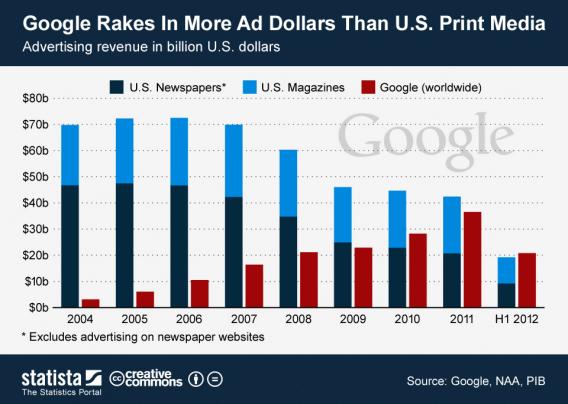
Google and Print Advertising Revenue Trends, 2004-2012It’s official. With nearly $21 billion in ad revenue generated during the first half of 2012, Google now attracts more advertising business than all U.S. print media combined.

That is correct:  German-based statistics portal Statista reports that Google garnered ~$20.8 billion in total ad revenues over the period, while all U.S. newspapers and magazines took in only about $19.2 billion.

Never mind that the comparison isn’t completely apples-to-apples … in that print revenues are for the United States only, while Google generates ad revenues worldwide. Still, it’s a dramatic milestone, and it says a lot about the fortunes (and future) of print versus online advertising.

Statista has helpfully published trend charts that show how quickly the ad picture has changed (see above). Only a few years ago, print advertising dominated the scene, but the trajectories of it and Google have been on opposite paths ever since.

It was inevitable that the lines would eventually cross, but how many could have foreseen it happening as early as 2012?

As if on cue, Advance Publications, a company that owns a number of venerable newspapers in New Orleans, Cleveland and elsewhere, has just announced that it is likely to cut the publication frequency of the Plain Dealer newspaper from its current seven days a week.

If Advance follows through on its intentions, it will join the New Orleans Times Picayune as a daily newspaper that’s no longer a daily.

The publisher’s letter to Plain Dealer readers described the newspaper’s future in lofty terms, noting that changes were coming as the paper seeks to “embrace dynamic shifts in the way information is consumed.”  And other such language.

It also noted that the pending changes are “not about cost-cutting.” But who believes that?

And in fact, the publisher’s letter states also that “if we maintain the status quo, we risk doing what everyone – our employees, advertisers and the community – wants to avoid: disappearing.”

If people don’t see a correlation between the Statista data and what the Plain Dealer has in store for its readers … they’re living on another planet. 

Newspaper Ad Revenues Plummet to a 60-year Inflation-adjusted Low

Newspaper advertising revenues decline to 1950 levels in inflation-adjusted dollars.Newspaper ad revenues have now collapsed to a level not seen since the 1950s in inflation-adjusted dollars. 

That’s the sobering conclusion from the Newspaper Association of America’s release of the most recent advertising revenue figures for the U.S. industry.

With these dismal statistics, the newspaper industry seems sure to contract even further, while getting precious little boost from their online advertising activities.

Clearly, when it comes to media, it’s “out with the old” and “in with the new” …

A Newspaper Startup in 2012 … Is this Madness?

European Daily, preview editionOver the past decade or more, seemingly all the business trends on the newspaper front have been negative. So to read that a new transnational newspaper is being planned for a Fall 2012 launch comes as a pretty big surprise.

Yes, you heard that right:  The European Daily plans to hit the streets in a few months’ time. In the meantime, the budding newspaper already has a website up and running.

The European Daily is the brainchild of three young entrepreneurs from Sweden and Germany. “We are a publication that partly targets a more senior audience who, to a great extent, still prefers print, as well as a traveling audience who wants to read their news on a flight or at their hotel,” says Johan Malmsten, one of the three founders.

Does this sort of thinking sound like a recipe for success in 2012?

At first blush, it seems like a pipe dream. Two huge roadblocks appear to be standing in the way of success. First, the market dynamics have been ugly for traditional newspapers … their traditional business model swept away by the Internet and changing ways that consumers access the news.

Add to this the mounting political and economic crisis in Europe, which could result in the European Union’s breakup, rather than any sort of renewed consolidation.  Is this the right time to be introducing a media property that’s “pan-European” in its character?

Mr. Malmsten discounts these threats. Instead he asserts, “Some people have praised us on our perfect timing, given the vivid current debate about Europe and the fact that a European news source and a common public sphere have never been as much in demand.”

“Europe is a daily reality for millions of Europeans, and that won’t change. We see giving these people a news source and a daily point of reference as our mission,” he adds.

Looking at the newspaper’s launch plans, it’s pretty clear the investors are fully committed to their mission. A staff of 30 is being constructed for the paper — about half of them focused on content.  The editorial team will be based in Amsterdam in Holland.

A “preview” edition of the European Daily was printed last year and ~40,000 copies were distributed in key urban centers like Paris, London, Berlin and Brussels. Reportedly, the reception was highly positive.

But I have doubts whether a completely new newspaper title can be launched successfully – especially one that’s based on a conventional print-centric product with a digital adjunct. It seems like we’ve seen this movie before:  This very formula has been tried and found wanting – even among established newspaper brands.

It will be interesting to look back in about two or three years and see if this endeavor adds up to much – or instead has gone by the wayside.

Anyone care to weigh in with odds on the front end?

The Continuing Slide in Newspaper Advertising

Continuing declines in newspaper advertising revenues
Industry practitioners were hoping to stem the decline in newspaper advertising revenues in 2011. Alas, it was not to be ...
The hoped-for uptick in newspaper advertising has yet to materialize. In fact, the Newspaper Association of America’s just released final statistics for 2011 advertising revenues show a significant continuing decline in ad revenues rather than a leveling off, as some industry practitioners had hoped.

Overall advertising revenue dropped ~7% during the year. The print portion was off by more than 9%, while digital advertising revenues weren’t able to offset those losses; they rose only a modest ~7%.

Translated into dollars, newspaper industry ad revenues were just shy of $24 billion. If you add in other sources of income from things like contract printing, the total revenues for 2011 were about $35 billion for the entire industry in the United States.

Compare that figure to Google’s revenues for 2011: ~$38 billion.

That is correct. One single company – one that wasn’t even in business 15 years ago – chalked up more revenues than all of America’s 2,000+ daily and weekly newspapers put together.

Looking past the decline in print ad revenues is the sluggish pace of digital ad revenue growth, which has come nowhere close to replacing print advertising revenues. For every $1 gained in digital advertising, $7 in print advertising is lost.

A recent Project for Excellence in Journalism study by the Pew Research Center concludes that slow culture change at newspapers is partially responsible for the problem, not simply changing news consumption habits among consumers of all ages. The analysis from Pew and others contends that the prognosis remains bleak for the newspaper companies, even as the U.S. slowly climbs out of the economic doldrums.

From the vantage point of a few more years to see how consumer behaviors have evolved, it now seems quite likely that we’re headed to a two tiered structure in the newspaper industry: Strongest at the top with a few papers with truly national circulation (The Wall Street Journal, The New York Times, Washington Post, USA Today) … and also somewhat strong at the bottom with hyper-local papers that deliver news to an audience that finds it difficult to access it from other sources. (High school sports stories are always a hit.)

Everything in between? Unfortunately for them, it’s going to continue to be a major struggle. And is there even a light at the end of the tunnel?

Pew Monitors Changing Views about the News Media

News media organizations losing luster with Americans
News organizations are losing their luster with Americans, according to the Pew Research Center.
The Pew Research Center for People and the Press has been surveying American adults since 1985 about their views of the news media.

A new comprehensive report, incorporating results up to and including field surveys conducted in 2011, finds that negative opinions about the performance of news media are higher than ever on nine of twelve key measures studied.

Here are some sobering stats from this year’s consumer pulse:

 ~66% of respondents believe that news stories are often inaccurate
 ~77% think that news organizations tend to favor one side over another politically
 ~80% believe that news organizations are influenced by powerful people and organizations

The findings on the accuracy of news reporting are particularly striking. As few as four years ago, ~39% of respondents felt that news organizations “mostly get the facts straight” while ~53% believed that the news stories were “often inaccurate.”

Today’s those numbers look more depressing: Only ~25% say that news organizations tend to get the facts straight, while ~66% contend that news stories are often inaccurate.

[Of course, when it comes to respondents’ own preferred news outlets, the figures don’t look nearly as dismal. In fact, nearly two thirds of the respondents believe their preferred news sources get the facts mostly correct.]

Who does the public see as the leading “news media” these days? Cable TV organizations clearly lead in the rankings, with network news now pushed down the list:

 ~43% named CNN as a “news organization”
 ~39% named Fox News
 ~18% named NBC News
 ~16% named ABC News
 ~12% named CBS News
 ~12% named MSNBC
 ~10% named local TV news

It’s been a long fall for CBS News in particular, which was once considered the ace news broadcast network in the United States.

In general terms, who do people trust most as a source of news? The answer may be surprising to some: Top-ranked are local news organizations:

 Local news organizations: ~69% of people have “a lot” or “some” trust
 National news organizations: ~59%
 State government: ~51%
 Presidential administration: ~50%
 Federal government agencies: ~44%
 Business corporations: ~41%
 U.S. Congress: ~37%
 Political candidates: ~29%

And as far as where people go for news, TV and the Internet continue to be the top two sources. But consider how those rankings have changed. Five years ago, TV was cited by 74% of survey respondents as one of the two top news sources … but that figure has now declined to ~66%.

As for the Internet, it’s grown from ~24% saying it’s a top-two source for news in 2007, to ~43% today.

Meanwhile, newspapers are staying on the decline … so that today, only ~31% of respondents place them among the two top sources of news. Newspapers continue to have their partisans among the over-65 age segment, but younger than this, it’s just a lost cause.

But there’s one bright spot for newspapers: They continue to be recognized as a leading source of local news. This helps explain why many small-town and local papers have been better able to navigate the choppy waters of newspaper publishing better than their big-city counterparts.

There are many more interesting findings outlined in the latest Pew news organization survey. For more details, click here.

Where are Newspapers Now?

Newspaper ad revenues continue in the doldrums.John Barlow of Barlow Research Associates, Inc. reminds me that it’s been awhile since I blogged about the dire straits of America’s newspaper industry. The twin whammies of a major economic recession along with the rapidly changing ways Americans are getting their news have hammered advertising revenues and profits, leading to organizational restructuring, bankruptcies, and more.

But with the recession bottoming out (hopefully?), there was hope that the decline in newspaper ad revenues might be arrested as well.

Well, the latest industry survey doesn’t provide much cause for celebration. A poll of ~2,700 small and mid-size businesses conducted this summer by Portland, OR-based market research firm ITZBelden and the American Press Institute finds that ~23% of these businesses plan to cut back on newspaper advertising this year.

The kicker is that these revenues are being spent, but they’re being put to use in other advertising media.

The ITZBelden survey found that a similar ~23% of companies plan to up their 2010 digital ad spending anywhere from 10% to 30%. This compares to only about 10% planning to increase their print advertising by similar proportions.

Moreover, the survey findings reveal that small and mid-size U.S. businesses have moved into digital marketing in a significant way. Not only do more than 80% of them maintain web sites, they’re active in other areas, including:

 ~45% maintain a Facebook or MySpace page
 ~23% are engaged in online couponing
 ~13% are involved with Craigslist
 ~10% are listed on Yelp! or similar user-review sites

One area which is still just a relative blip on the screen is mobile advertising, in that fewer than 4% of the respondents reported activities in that advertising category.

Where are these advertisers planning to put their promotional funds going forward? While newspapers should continue to represent around one quarter of the expenditures, various digital media expenditures will account for ~13% of the activity, making this more important than direct mail, TV and Yellow Pages advertising.

There was one bright spot for newspapers in the survey, however. Respondents expressed a mixture of confusion and bewilderment about the constantly evolving array of digital marketing communications options opening up … and they’re looking for support from media experts to guide their plans and activities.

And where do they see this expert advice coming from? Newspaper ad reps.

Perhaps the Yellow Book’s “Beyond Yellow” small business advertising campaign – you know, the one that touts not only the Yellow Pages advertising but also web development, online advertising, search marketing and mobile advertising – is onto something.

Newspapers crash … Online news soars.

The latest annual News Users report by Outsell, Inc. predicts additional declines in print newspaper circulation as consumers continue to gravitate to online news. It is the third annual report issued by this marketing and communications research firm, which is developed from findings gathered in consumer surveys.

Outsell projects that Sunday newspaper readers will drop to ~43 million by 2012. That would represent a decline of some 20 million readers from Sunday papers’ circulation heights in the 1990s.

But what’s even more noteworthy is the continuing evolution in online activities. Today, nearly 60% of consumers report that they go online for “news right now.” That’s up from 33% just a few years ago.

And where are people going for their online news? By a large margin, it’s to aggregator sites like Google News, Yahoo and Drudge Report rather than to newspaper sites. As an example, 44% of the people who go to Google News scan the headlines there, without clicking through or accessing the newspapers’ individual sites.

Other key findings from the Outsell survey:

One in five consumers now go to online news aggregators for their “first in the day” news, up from 10% three years ago. TV/cable still leads with 30%, but that margin has been shrinking dramatically.

Paid online content is not a picking up the slack for newspapers, with participation rates of no more than 10% of consumers.

Newspapers retain strengths in reporting local topics (e.g., local news, sports and entertainment), even as national topics have gone pretty much all-digital.

That being stated, if a valued local online news site were to put up a pay wall – or require a paid subscription to the print paper in order to gain free online access – three out of four respondents claimed they would go somewhere else to find the news free of charge. (That’s despite the fact that good alternative news sources at the local level are usually not so numerous.)

The Outsell study found that consumers continue to believe printed news is worth paying for … but they expect the news they get online to be free of charge.

The big problem: It looks like it’s too late for publishers to “transition” reader willingness to pay for print news over to now paying for that same content online.

Nope, that train’s already left the station.